ILLUSTRATES POLYNOMIAL EQUATIONS
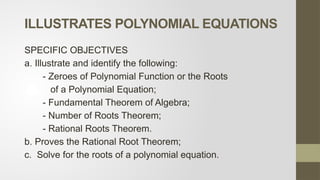
SPECIFIC OBJECTIVES
a. Illustrate and identify the following:
- Zeroes of Polynomial Function or the Roots
of a Polynomial Equation;
- Fundamental Theorem of Algebra;
- Number of Roots Theorem;
- Rational Roots Theorem.
b. Proves the Rational Root Theorem;
c. Solve for the roots of a polynomial equation.
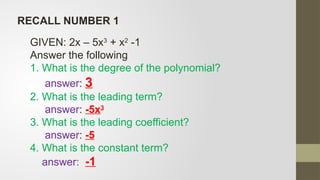
RECALL NUMBER 1
GIVEN: 2x – 5x3
+ x2
-1
Answer the following
1. What is the degree of the polynomial?
answer: 3
2. What is the leading term?
answer: -5x3
3. What is the leading coefficient?
answer: -5
4. What is the constant term?
answer: -1
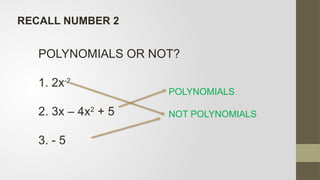
POLYNOMIALS OR NOT?
1. 2x-2
2. 3x – 4x2
+ 5
3. - 5
POLYNOMIALS
NOT POLYNOMIALS
RECALL NUMBER 2
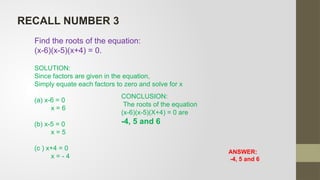
ANSWER:
-4, 5 and 6
Find the roots of the equation:
(x-6)(x-5)(x+4) = 0.
SOLUTION:
Since factors are given in the equation,
Simply equate each factors to zero and solve for x
(a) x-6 = 0
x = 6
(b) x-5 = 0
x = 5
(c ) x+4 = 0
x = - 4
CONCLUSION:
The roots of the equation
(x-6)(x-5)(X+4) = 0 are
-4, 5 and 6
RECALL NUMBER 3
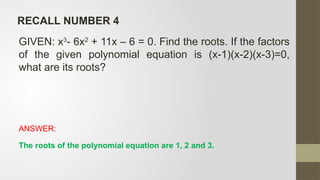
GIVEN: x3
- 6x2
+ 11x – 6 = 0. Find the roots. If the factors
of the given polynomial equation is (x-1)(x-2)(x-3)=0,
what are its roots?
ANSWER:
The roots of the polynomial equation are 1, 2 and 3.
RECALL NUMBER 4
ILLUSTRATING
POLYNOMIAL
EQUATION
THE ZEROES OF THE POLYNOMIAL FUNCTION
Introduction:
Finding the polynomial function zeroes is not quite so
straightforward when the polynomial is expanded and
of a degree greater than two. One method is to use
synthetic division, with which we can test
possible polynomial function zeros found with
the rational roots theorem. Once we find a zero we
can partially factor the polynomial and then find the
polynomial function zeros of a reduced polynomial.
According to Karl Friedrich Gauss of Germany(one of the great
mathematicians of all times.), in his “Fundamental Theorem
of Algebra” : every polynomial equation in one variable has at
least one root, real or imaginary. The theorem guarantees the
existence of the roots of any polynomial equation in one
variable. This theorem leads to the discoveries of other
theorems concerning roots of any polynomials. The difficulty of
finding the zeroes of a polynomial function or the roots of a
polynomial equation increases when the polynomial function is
not expressed in factored form. In this case, we can use the
guess-and-check method.
THE ZEROES OF THE POLYNOMIAL FUNCTION
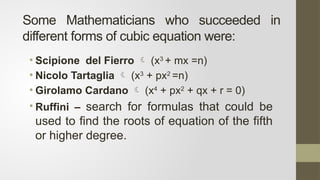
Some Mathematicians who succeeded in
different forms of cubic equation were:
• Scipione del Fierro  (x3
+ mx =n)
• Nicolo Tartaglia  (x3
+ px2
=n)
• Girolamo Cardano  (x4
+ px2
+ qx + r = 0)
• Ruffini – search for formulas that could be
used to find the roots of equation of the fifth
or higher degree.
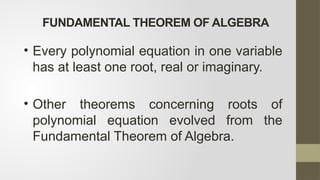
FUNDAMENTAL THEOREM OF ALGEBRA
• Every polynomial equation in one variable
has at least one root, real or imaginary.
• Other theorems concerning roots of
polynomial equation evolved from the
Fundamental Theorem of Algebra.
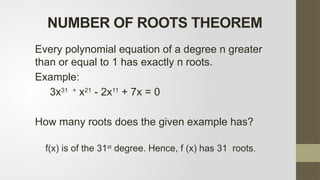
NUMBER OF ROOTS THEOREM
Every polynomial equation of a degree n greater
than or equal to 1 has exactly n roots.
Example:
3x31 +
x21
- 2x11
+ 7x = 0
How many roots does the given example has?
f(x) is of the 31st
degree. Hence, f (x) has 31 roots.
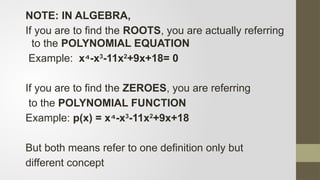
NOTE: IN ALGEBRA,
If you are to find the ROOTS, you are actually referring
to the POLYNOMIAL EQUATION
Example: x -x
⁴ 3
-11x2
+9x+18= 0
If you are to find the ZEROES, you are referring
to the POLYNOMIAL FUNCTION
Example: p(x) = x -x
⁴ 3
-11x2
+9x+18
But both means refer to one definition only but
different concept
SOLVE:
1. Determine the degree and the zeroes
of the polynomial function:
p(x) = (x + 3) ( x- 4)2
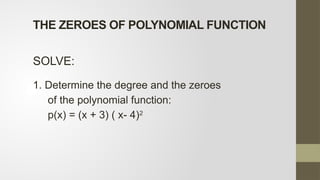
THE ZEROES OF POLYNOMIAL FUNCTION
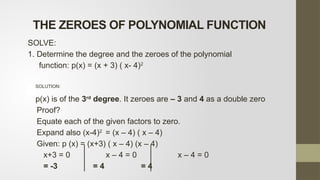
SOLVE:
1. Determine the degree and the zeroes of the polynomial
function: p(x) = (x + 3) ( x- 4)2
SOLUTION:
p(x) is of the 3rd
degree. It zeroes are – 3 and 4 as a double zero
Proof?
Equate each of the given factors to zero.
Expand also (x-4)2
= (x – 4) ( x – 4)
Given: p (x) = (x+3) ( x – 4) (x – 4)
x+3 = 0 x – 4 = 0 x – 4 = 0
= -3 = 4 = 4
THE ZEROES OF POLYNOMIAL FUNCTION
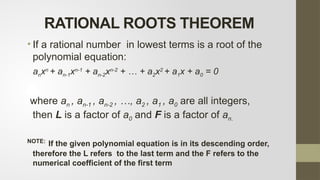
RATIONAL ROOTS THEOREM
• If a rational number in lowest terms is a root of the
polynomial equation:
anxn
+ an-1xn-1
+ an-2xn-2
+ … + a2x2
+ a1x + a0 = 0
where an , an-1 , an-2 , …, a2 , a1 , a0 are all integers,
then L is a factor of a0 and F is a factor of an.
NOTE:
If the given polynomial equation is in its descending order,
therefore the L refers to the last term and the F refers to the
numerical coefficient of the first term
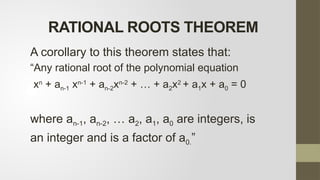
A corollary to this theorem states that:
“Any rational root of the polynomial equation
xn
+ an-1 xn-1
+ an-2xn-2
+ … + a2x2
+ a1x + a0 = 0
where an-1, an-2, … a2, a1, a0 are integers, is
an integer and is a factor of a0.”
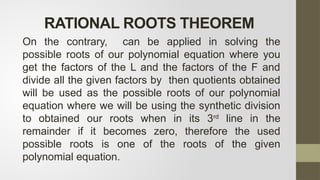
RATIONAL ROOTS THEOREM
On the contrary, can be applied in solving the
possible roots of our polynomial equation where you
get the factors of the L and the factors of the F and
divide all the given factors by then quotients obtained
will be used as the possible roots of our polynomial
equation where we will be using the synthetic division
to obtained our roots when in its 3rd
line in the
remainder if it becomes zero, therefore the used
possible roots is one of the roots of the given
polynomial equation.
RATIONAL ROOTS THEOREM
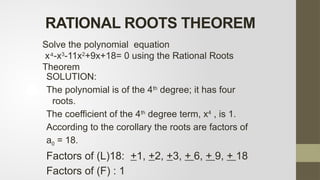
SOLUTION:
The polynomial is of the 4th
degree; it has four
roots.
The coefficient of the 4th
degree term, x4
, is 1.
According to the corollary the roots are factors of
a0 = 18.
Factors of (L)18: +1, +2, +3, + 6, + 9, + 18
Factors of (F) : 1
RATIONAL ROOTS THEOREM
Solve the polynomial equation
x -x
⁴ 3
-11x2
+9x+18= 0 using the Rational Roots
Theorem
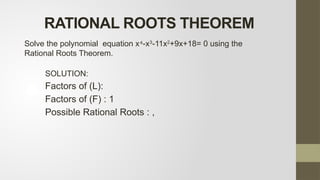
SOLUTION:
Factors of (L):
Factors of (F) : 1
Possible Rational Roots : ,
Solve the polynomial equation x -x
⁴ 3
-11x2
+9x+18= 0 using the
Rational Roots Theorem.
RATIONAL ROOTS THEOREM
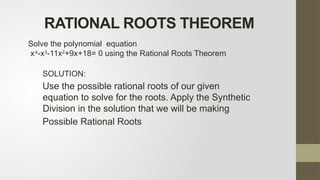
SOLUTION:
Use the possible rational roots of our given
equation to solve for the roots. Apply the Synthetic
Division in the solution that we will be making
Possible Rational Roots
Solve the polynomial equation
x -x
⁴ 3
-11x2
+9x+18= 0 using the Rational Roots Theorem
RATIONAL ROOTS THEOREM
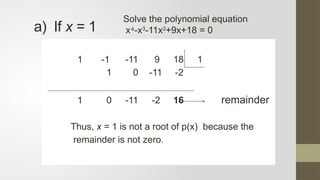
a) If x = 1
1 -1 -11 9 18 1
1 0 -11 -2
1 0 -11 -2 16 remainder
Thus, x = 1 is not a root of p(x) because the
remainder is not zero.
Solve the polynomial equation
x -x
⁴ 3
-11x2
+9x+18 = 0
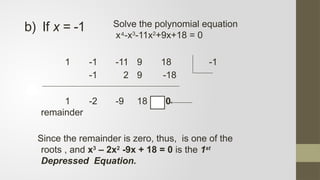
1 -1 -11 9 18 -1
-1 2 9 -18
1 -2 -9 18 0
remainder
Since the remainder is zero, thus, is one of the
roots , and x3
– 2x2
-9x + 18 = 0 is the 1st
Depressed Equation.
b) If x = -1 Solve the polynomial equation
x -x
⁴ 3
-11x2
+9x+18 = 0
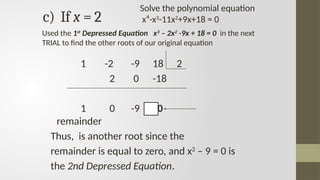
c) If x = 2
1 -2 -9 18 2
2 0 -18
1 0 -9 0
remainder
Thus, is another root since the
remainder is equal to zero, and x2
– 9 = 0 is
the 2nd Depressed Equation.
Used the 1st
Depressed Equation x3
– 2x2
-9x + 18 = 0 in the next
TRIAL to find the other roots of our original equation
Solve the polynomial equation
x⁴-x3
-11x2
+9x+18 = 0
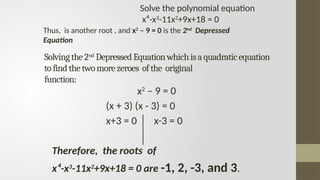
Solvingthe2nd
DepressedEquationwhichisaquadraticequation
tofindthetwomorezeroes ofthe original
function:
x2
– 9 = 0
(x + 3) (x - 3) = 0
x+3 = 0 x-3 = 0
Therefore, the roots of
x⁴-x3
-11x2
+9x+18 = 0 are -1, 2, -3, and 3.
Thus, is another root , and x2
– 9 = 0 is the 2nd
Depressed
Equation
Solve the polynomial equation
x⁴-x3
-11x2
+9x+18 = 0

11-Illustrating-Polynomial-Equations-1.pptx

  • 1.
    ILLUSTRATES POLYNOMIAL EQUATIONS SPECIFICOBJECTIVES a. Illustrate and identify the following: - Zeroes of Polynomial Function or the Roots of a Polynomial Equation; - Fundamental Theorem of Algebra; - Number of Roots Theorem; - Rational Roots Theorem. b. Proves the Rational Root Theorem; c. Solve for the roots of a polynomial equation.
  • 2.
    RECALL NUMBER 1 GIVEN:2x – 5x3 + x2 -1 Answer the following 1. What is the degree of the polynomial? answer: 3 2. What is the leading term? answer: -5x3 3. What is the leading coefficient? answer: -5 4. What is the constant term? answer: -1
  • 3.
    POLYNOMIALS OR NOT? 1.2x-2 2. 3x – 4x2 + 5 3. - 5 POLYNOMIALS NOT POLYNOMIALS RECALL NUMBER 2
  • 4.
    ANSWER: -4, 5 and6 Find the roots of the equation: (x-6)(x-5)(x+4) = 0. SOLUTION: Since factors are given in the equation, Simply equate each factors to zero and solve for x (a) x-6 = 0 x = 6 (b) x-5 = 0 x = 5 (c ) x+4 = 0 x = - 4 CONCLUSION: The roots of the equation (x-6)(x-5)(X+4) = 0 are -4, 5 and 6 RECALL NUMBER 3
  • 5.
    GIVEN: x3 - 6x2 +11x – 6 = 0. Find the roots. If the factors of the given polynomial equation is (x-1)(x-2)(x-3)=0, what are its roots? ANSWER: The roots of the polynomial equation are 1, 2 and 3. RECALL NUMBER 4
  • 6.
  • 7.
    THE ZEROES OFTHE POLYNOMIAL FUNCTION Introduction: Finding the polynomial function zeroes is not quite so straightforward when the polynomial is expanded and of a degree greater than two. One method is to use synthetic division, with which we can test possible polynomial function zeros found with the rational roots theorem. Once we find a zero we can partially factor the polynomial and then find the polynomial function zeros of a reduced polynomial.
  • 8.
    According to KarlFriedrich Gauss of Germany(one of the great mathematicians of all times.), in his “Fundamental Theorem of Algebra” : every polynomial equation in one variable has at least one root, real or imaginary. The theorem guarantees the existence of the roots of any polynomial equation in one variable. This theorem leads to the discoveries of other theorems concerning roots of any polynomials. The difficulty of finding the zeroes of a polynomial function or the roots of a polynomial equation increases when the polynomial function is not expressed in factored form. In this case, we can use the guess-and-check method. THE ZEROES OF THE POLYNOMIAL FUNCTION
  • 9.
    Some Mathematicians whosucceeded in different forms of cubic equation were: • Scipione del Fierro  (x3 + mx =n) • Nicolo Tartaglia  (x3 + px2 =n) • Girolamo Cardano  (x4 + px2 + qx + r = 0) • Ruffini – search for formulas that could be used to find the roots of equation of the fifth or higher degree.
  • 10.
    FUNDAMENTAL THEOREM OFALGEBRA • Every polynomial equation in one variable has at least one root, real or imaginary. • Other theorems concerning roots of polynomial equation evolved from the Fundamental Theorem of Algebra.
  • 11.
    NUMBER OF ROOTSTHEOREM Every polynomial equation of a degree n greater than or equal to 1 has exactly n roots. Example: 3x31 + x21 - 2x11 + 7x = 0 How many roots does the given example has? f(x) is of the 31st degree. Hence, f (x) has 31 roots.
  • 12.
    NOTE: IN ALGEBRA, Ifyou are to find the ROOTS, you are actually referring to the POLYNOMIAL EQUATION Example: x -x ⁴ 3 -11x2 +9x+18= 0 If you are to find the ZEROES, you are referring to the POLYNOMIAL FUNCTION Example: p(x) = x -x ⁴ 3 -11x2 +9x+18 But both means refer to one definition only but different concept
  • 13.
    SOLVE: 1. Determine thedegree and the zeroes of the polynomial function: p(x) = (x + 3) ( x- 4)2 THE ZEROES OF POLYNOMIAL FUNCTION
  • 14.
    SOLVE: 1. Determine thedegree and the zeroes of the polynomial function: p(x) = (x + 3) ( x- 4)2 SOLUTION: p(x) is of the 3rd degree. It zeroes are – 3 and 4 as a double zero Proof? Equate each of the given factors to zero. Expand also (x-4)2 = (x – 4) ( x – 4) Given: p (x) = (x+3) ( x – 4) (x – 4) x+3 = 0 x – 4 = 0 x – 4 = 0 = -3 = 4 = 4 THE ZEROES OF POLYNOMIAL FUNCTION
  • 15.
    RATIONAL ROOTS THEOREM •If a rational number in lowest terms is a root of the polynomial equation: anxn + an-1xn-1 + an-2xn-2 + … + a2x2 + a1x + a0 = 0 where an , an-1 , an-2 , …, a2 , a1 , a0 are all integers, then L is a factor of a0 and F is a factor of an. NOTE: If the given polynomial equation is in its descending order, therefore the L refers to the last term and the F refers to the numerical coefficient of the first term
  • 16.
    A corollary tothis theorem states that: “Any rational root of the polynomial equation xn + an-1 xn-1 + an-2xn-2 + … + a2x2 + a1x + a0 = 0 where an-1, an-2, … a2, a1, a0 are integers, is an integer and is a factor of a0.” RATIONAL ROOTS THEOREM
  • 17.
    On the contrary,can be applied in solving the possible roots of our polynomial equation where you get the factors of the L and the factors of the F and divide all the given factors by then quotients obtained will be used as the possible roots of our polynomial equation where we will be using the synthetic division to obtained our roots when in its 3rd line in the remainder if it becomes zero, therefore the used possible roots is one of the roots of the given polynomial equation. RATIONAL ROOTS THEOREM
  • 18.
    SOLUTION: The polynomial isof the 4th degree; it has four roots. The coefficient of the 4th degree term, x4 , is 1. According to the corollary the roots are factors of a0 = 18. Factors of (L)18: +1, +2, +3, + 6, + 9, + 18 Factors of (F) : 1 RATIONAL ROOTS THEOREM Solve the polynomial equation x -x ⁴ 3 -11x2 +9x+18= 0 using the Rational Roots Theorem
  • 19.
    SOLUTION: Factors of (L): Factorsof (F) : 1 Possible Rational Roots : , Solve the polynomial equation x -x ⁴ 3 -11x2 +9x+18= 0 using the Rational Roots Theorem. RATIONAL ROOTS THEOREM
  • 20.
    SOLUTION: Use the possiblerational roots of our given equation to solve for the roots. Apply the Synthetic Division in the solution that we will be making Possible Rational Roots Solve the polynomial equation x -x ⁴ 3 -11x2 +9x+18= 0 using the Rational Roots Theorem RATIONAL ROOTS THEOREM
  • 21.
    a) If x= 1 1 -1 -11 9 18 1 1 0 -11 -2 1 0 -11 -2 16 remainder Thus, x = 1 is not a root of p(x) because the remainder is not zero. Solve the polynomial equation x -x ⁴ 3 -11x2 +9x+18 = 0
  • 22.
    1 -1 -119 18 -1 -1 2 9 -18 1 -2 -9 18 0 remainder Since the remainder is zero, thus, is one of the roots , and x3 – 2x2 -9x + 18 = 0 is the 1st Depressed Equation. b) If x = -1 Solve the polynomial equation x -x ⁴ 3 -11x2 +9x+18 = 0
  • 23.
    c) If x= 2 1 -2 -9 18 2 2 0 -18 1 0 -9 0 remainder Thus, is another root since the remainder is equal to zero, and x2 – 9 = 0 is the 2nd Depressed Equation. Used the 1st Depressed Equation x3 – 2x2 -9x + 18 = 0 in the next TRIAL to find the other roots of our original equation Solve the polynomial equation x⁴-x3 -11x2 +9x+18 = 0
  • 24.
    Solvingthe2nd DepressedEquationwhichisaquadraticequation tofindthetwomorezeroes ofthe original function: x2 –9 = 0 (x + 3) (x - 3) = 0 x+3 = 0 x-3 = 0 Therefore, the roots of x⁴-x3 -11x2 +9x+18 = 0 are -1, 2, -3, and 3. Thus, is another root , and x2 – 9 = 0 is the 2nd Depressed Equation Solve the polynomial equation x⁴-x3 -11x2 +9x+18 = 0