
Disperse systems
Dr. Syed Atif Raza
Head of Pharmaceutics
Punjab University College of Pharmacy
University of the Punjab,
Disperse system
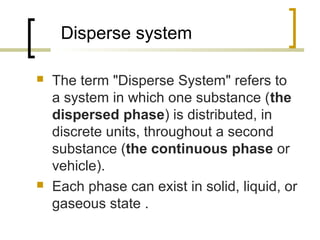
 The term "Disperse System" refers to
a system in which one substance (the
dispersed phase) is distributed, in
discrete units, throughout a second
substance (the continuous phase or
vehicle).
 Each phase can exist in solid, liquid, or
gaseous state .
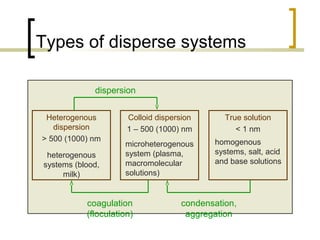
Types of disperse systems
True solution
< 1 nm
Heterogenous
dispersion
> 500 (1000) nm
Colloid dispersion
1 – 500 (1000) nm
dispersion
coagulation
(floculation)
condensation,
aggregation
heterogenous
systems (blood,
milk)
microheterogenous
system (plasma,
macromolecular
solutions)
homogenous
systems, salt, acid
and base solutions
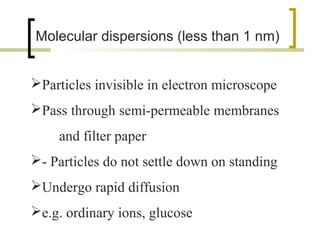
Particles invisible in electron microscope
Pass through semi-permeable membranes
and filter paper
- Particles do not settle down on standing
Undergo rapid diffusion
e.g. ordinary ions, glucose
Molecular dispersions (less than 1 nm)
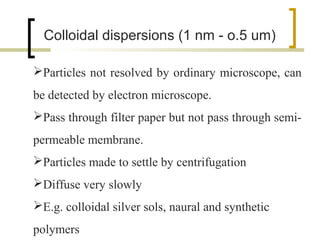
Particles not resolved by ordinary microscope, can
be detected by electron microscope.
Pass through filter paper but not pass through semi-
permeable membrane.
Particles made to settle by centrifugation
Diffuse very slowly
E.g. colloidal silver sols, naural and synthetic
polymers
Colloidal dispersions (1 nm - o.5 um)
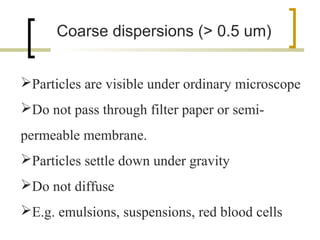
Particles are visible under ordinary microscope
Do not pass through filter paper or semi-
permeable membrane.
Particles settle down under gravity
Do not diffuse
E.g. emulsions, suspensions, red blood cells
Coarse dispersions (> 0.5 um)
Classification of disperse
systems
Medium/Phase Dispersed phase
Gas Liquid Solid
Gas None Liquid aerosol Solid aerosol
(All gases are mutually (fog, hair sprays) (smoke cloud, air
miscible) particles)
Liquid Foam Emulsion Sol
(whipped cream, (milk (blood
shaving cream) mayonnaise) pigmented ink)
Solid Solid foam Gel Solid sol
(aerogel, pumice (agar, gelatine (jewel, gemstone)
polystyrene foam) jelly, opal)
Continuousmedium
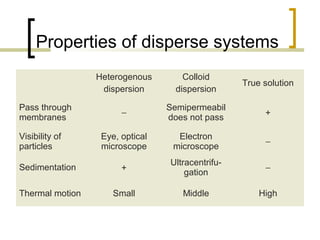
Properties of disperse systems
Heterogenous
dispersion
Colloid
dispersion
True solution
Pass through
membranes
−
Semipermeabil
does not pass
+
Visibility of
particles
Eye, optical
microscope
Electron
microscope
−
Sedimentation +
Ultracentrifu-
gation
−
Thermal motion Small Middle High
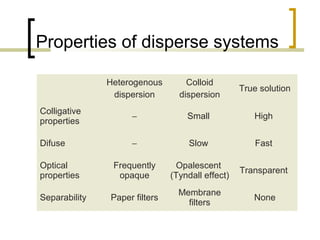
Properties of disperse systems
Heterogenous
dispersion
Colloid
dispersion
True solution
Colligative
properties
− Small High
Difuse − Slow Fast
Optical
properties
Frequently
opaque
Opalescent
(Tyndall effect)
Transparent
Separability Paper filters
Membrane
filters
None
Disperse system--------(Pharmaceutics)

Disperse system--------(Pharmaceutics)

  • 1.
    Disperse systems Dr. SyedAtif Raza Head of Pharmaceutics Punjab University College of Pharmacy University of the Punjab,
  • 2.
    Disperse system  Theterm "Disperse System" refers to a system in which one substance (the dispersed phase) is distributed, in discrete units, throughout a second substance (the continuous phase or vehicle).  Each phase can exist in solid, liquid, or gaseous state .
  • 3.
    Types of dispersesystems True solution < 1 nm Heterogenous dispersion > 500 (1000) nm Colloid dispersion 1 – 500 (1000) nm dispersion coagulation (floculation) condensation, aggregation heterogenous systems (blood, milk) microheterogenous system (plasma, macromolecular solutions) homogenous systems, salt, acid and base solutions
  • 4.
    Particles invisible inelectron microscope Pass through semi-permeable membranes and filter paper - Particles do not settle down on standing Undergo rapid diffusion e.g. ordinary ions, glucose Molecular dispersions (less than 1 nm)
  • 5.
    Particles not resolvedby ordinary microscope, can be detected by electron microscope. Pass through filter paper but not pass through semi- permeable membrane. Particles made to settle by centrifugation Diffuse very slowly E.g. colloidal silver sols, naural and synthetic polymers Colloidal dispersions (1 nm - o.5 um)
  • 6.
    Particles are visibleunder ordinary microscope Do not pass through filter paper or semi- permeable membrane. Particles settle down under gravity Do not diffuse E.g. emulsions, suspensions, red blood cells Coarse dispersions (> 0.5 um)
  • 7.
    Classification of disperse systems Medium/PhaseDispersed phase Gas Liquid Solid Gas None Liquid aerosol Solid aerosol (All gases are mutually (fog, hair sprays) (smoke cloud, air miscible) particles) Liquid Foam Emulsion Sol (whipped cream, (milk (blood shaving cream) mayonnaise) pigmented ink) Solid Solid foam Gel Solid sol (aerogel, pumice (agar, gelatine (jewel, gemstone) polystyrene foam) jelly, opal) Continuousmedium
  • 8.
    Properties of dispersesystems Heterogenous dispersion Colloid dispersion True solution Pass through membranes − Semipermeabil does not pass + Visibility of particles Eye, optical microscope Electron microscope − Sedimentation + Ultracentrifu- gation − Thermal motion Small Middle High
  • 9.
    Properties of dispersesystems Heterogenous dispersion Colloid dispersion True solution Colligative properties − Small High Difuse − Slow Fast Optical properties Frequently opaque Opalescent (Tyndall effect) Transparent Separability Paper filters Membrane filters None