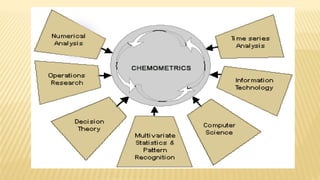
CHEMOMETRICS
 Presented By:
Shivang Bansal
0818CM141011
INDEX
1. Objective
2. What is Chemo metrics
3. History And Development of chemo metrics
4. Chemo metric Techniques
5. Chemo metric And overall Chemistry
6. Application of Chemo metrics
7. Careers in Chemo metrics
8. Conclusion
9. Reference
OBJECTIVES
 Give an overview of Chemometrics
 Show the relevance of Chemometrics to IC & AC
 Highlight applications of Chemometrics
WHAT IS CHEMOMETRICS?
“Chemometrics is the (multivariate) chemistry discipline that
uses mathematical and statistical methods, to design or select
optimal measurement procedures and experiments; and to
provide maximum chemical information by analyzing
chemical data,”- Bruce Kowalski
HISTORY AND DEVELOPMENT OF
CHEMOMETRICS
 The term ‘chemometrics’ was coined by Svante Wold in
a grant application 1971, and the International
Chemometrics Society was formed shortly thereafter by
Svante Wold and Bruce Kowalski, two pioneers in the
field.
 Wold was a professor of organic chemistry at Umeå
University, Sweden, and Kowalski was a professor of
analytical chemistry at University of Washington,
Seattle.
CHEMOMETRIC TECHNIQUES
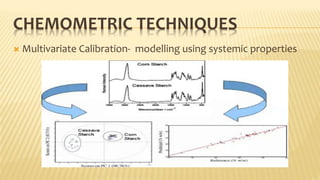
 Multivariate Calibration- modelling using systemic properties
CHEMOMETRIC TECHNIQUES
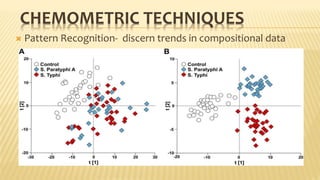
 Pattern Recognition- discern trends in compositional data
CHEMOMETRIC TECHNIQUES
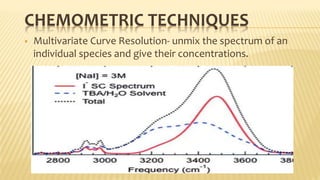
 Multivariate Curve Resolution- unmix the spectrum of an
individual species and give their concentrations.
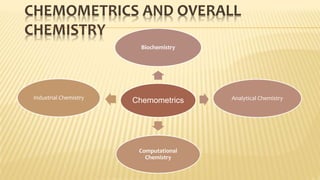
CHEMOMETRICS AND OVERALL
CHEMISTRY
Chemometrics
Biochemistry
Analytical Chemistry
Computational
Chemistry
Industrial Chemistry
APPLICATIONS OF CHEMOMETRICS
 Exploratory Analysis- detect outliers and pattern
trends.
 Regression Analysis - predict related properties
 Classification of Data- grouping of undefined
samples
CAREERS IN CHEMOMETRICS
 The scope of Chemometrics is by no
means limited to studies involving chemical
measurement.
 Several important studies have been
conducted in medical chemistry, biochemistry
and other areas of chemistry.
CONCLUSION
 Chemometrics is the science of extracting information from
chemical systems by data-driven means. Chemometrics is
inherently interdisciplinary, using methods frequently
employed in core data-analytic disciplines such as
multivariate statistics, applied mathematics, and computer
science, in order to address problems
in chemistry, biochemistry, medicine, biology and chemical
engineering. In this way, it mirrors other interdisciplinary
fields, such as psychometrics and econometrics.
REFERENCES
Kurt Varmuza (2012). Chemometrics in Practical Applications. InTech
Publishers, Janeza Trdine 9, 51000 Rijeka, Croatia.
Rasmus, et al (2010).Chemometrics in Metabolomics- A Reveiw in Human
Disease Diagnosis. Analytica Chimica Acta, Vol 659(1), Pages 23-33.
Geyden, et al (1986). Use of Chemometrics in Industrial Process
Diagnostics. Michromica Acta, Volume 89, Isuue 1-6 pages 369-377.
Gurden, et al (1998). The Introduction of Process Chemometrics into an
Industrial Pilot Plant. Chemometric and Intelligent Laboratory Systems
by Elsevier Journals.
Thank you

Chemometrics

  • 1.
  • 2.
    INDEX 1. Objective 2. Whatis Chemo metrics 3. History And Development of chemo metrics 4. Chemo metric Techniques 5. Chemo metric And overall Chemistry 6. Application of Chemo metrics 7. Careers in Chemo metrics 8. Conclusion 9. Reference
  • 3.
    OBJECTIVES  Give anoverview of Chemometrics  Show the relevance of Chemometrics to IC & AC  Highlight applications of Chemometrics
  • 4.
    WHAT IS CHEMOMETRICS? “Chemometricsis the (multivariate) chemistry discipline that uses mathematical and statistical methods, to design or select optimal measurement procedures and experiments; and to provide maximum chemical information by analyzing chemical data,”- Bruce Kowalski
  • 6.
    HISTORY AND DEVELOPMENTOF CHEMOMETRICS  The term ‘chemometrics’ was coined by Svante Wold in a grant application 1971, and the International Chemometrics Society was formed shortly thereafter by Svante Wold and Bruce Kowalski, two pioneers in the field.  Wold was a professor of organic chemistry at Umeå University, Sweden, and Kowalski was a professor of analytical chemistry at University of Washington, Seattle.
  • 7.
    CHEMOMETRIC TECHNIQUES  MultivariateCalibration- modelling using systemic properties
  • 8.
    CHEMOMETRIC TECHNIQUES  PatternRecognition- discern trends in compositional data
  • 9.
    CHEMOMETRIC TECHNIQUES  MultivariateCurve Resolution- unmix the spectrum of an individual species and give their concentrations.
  • 10.
    CHEMOMETRICS AND OVERALL CHEMISTRY Chemometrics Biochemistry AnalyticalChemistry Computational Chemistry Industrial Chemistry
  • 11.
    APPLICATIONS OF CHEMOMETRICS Exploratory Analysis- detect outliers and pattern trends.  Regression Analysis - predict related properties  Classification of Data- grouping of undefined samples
  • 13.
    CAREERS IN CHEMOMETRICS The scope of Chemometrics is by no means limited to studies involving chemical measurement.  Several important studies have been conducted in medical chemistry, biochemistry and other areas of chemistry.
  • 14.
    CONCLUSION  Chemometrics isthe science of extracting information from chemical systems by data-driven means. Chemometrics is inherently interdisciplinary, using methods frequently employed in core data-analytic disciplines such as multivariate statistics, applied mathematics, and computer science, in order to address problems in chemistry, biochemistry, medicine, biology and chemical engineering. In this way, it mirrors other interdisciplinary fields, such as psychometrics and econometrics.
  • 15.
    REFERENCES Kurt Varmuza (2012).Chemometrics in Practical Applications. InTech Publishers, Janeza Trdine 9, 51000 Rijeka, Croatia. Rasmus, et al (2010).Chemometrics in Metabolomics- A Reveiw in Human Disease Diagnosis. Analytica Chimica Acta, Vol 659(1), Pages 23-33. Geyden, et al (1986). Use of Chemometrics in Industrial Process Diagnostics. Michromica Acta, Volume 89, Isuue 1-6 pages 369-377. Gurden, et al (1998). The Introduction of Process Chemometrics into an Industrial Pilot Plant. Chemometric and Intelligent Laboratory Systems by Elsevier Journals.
  • 16.

Editor's Notes

  • #5 This definition was given during the formal presentation of Centre for Process Analytical Chemistry (CPAC), December 1997. It is regarded as the International definition of Chemometrics. He is one of the pioneers in the field, the other one being Svante Wold.
  • #8 MC- properties such as pressure, flow, temperatures and spectra. For example, in multi-wavelength spectral response to analyte concentration, one can use data from different samples and the concentration of the reference and the corresponding spectra of the sample. The Figure: Raman spectroscopy and multivariate calibration analysis of the amylose content in cassava and corn starches (Courtesy of Analytical and Bioanalytical Chemistry, research by Mariana ,et al)
  • #9 A PCA score of unsupervised pattern recognition analysis of filtered metabolite dataset from S. typhi and S. paratyphi showing distinct signatures of the two species with substancial overlap.
  • #10 Also called self-modelling mixture analysis, blind source/signal separation or spectral unmixing. From the figure, there's the total signal from (t-butyl alcohol) TBA/H20 solvent and I- spectra unmixed to yield the individual spectrum of the solvent and the I-. They used the hyphenated technique Raman- MCR to study the behavior of the species. Courtesy of RSC Publishing of Interactions between halide Ions and a Molecular Hydrophobic Interphase by Blake et al.
  • #11 Biochemistry- mostly in metabolomics; the systematic study of the unique chemical fingerprints that specific cellular processes leave behind. The large data obtained from metabolomics can be processed chemometrically to give insights to disease diagnosis, pattern recognition and underlying pathology. Analytical Chemistry- the data from analysis is processed to yield information and finally useful knowledge of the analytes. This has improved the analytical instrumentation methodologies, as well as enhance method development. Industrial Chemistry- employed to determine the reasons for variable performance in an industrial process(example, a multistage silver recovery unit was examined by statistical examination of the parameters and performance criteria (Leyden et al,1986), experimental design can help in the maximum utilization of the data from a pilot plant (gurden, et al 1998), and use of Intelligent Laboratory Systems in the manufacturing sector. Computational Chemistry-experimental design, calibration, signal processing, pattern recognition
  • #12 Exploratory Analysis- Principal Component Algorithms are designed to reduce large complex data sets into a series of optimized and interpretable data. Example of PCA-based methods are SIMCA (Soft Independent Modelling of Class Analogy) or Partial Least Squares Discriminant Analysis (PLS-DA). They detect outliers and presence of pattern trends. Regression Analysis- predict related properties that are easier to measure. The goal is to correlate the information in the set of known measurements to the desired property. The algorithms used for performing regression include Partial Least Squares (PLS) & Principal Component Regression (PCR). Classification of Data – to group undefined samples and predict the group of an unknown sample. Examples of classification model is K-nearest neighbor (K-NN). This helps in data standardization.
  • #13 A display of the complex use of PCA, PLS, SIMCA and PLS-DA by Sara and Keith from MacDiarmid Institute of Advanced Materials and Nanotechnology, Chemistry Department, University of Otago, Dunedin, New Zealand. They were investigating counterfeit and substandard medicines such as tadalafil (Cialis), sildenafil (Viagra) and vardenafil (Levitra)- mainly for erectile dysfunction and weight loss.