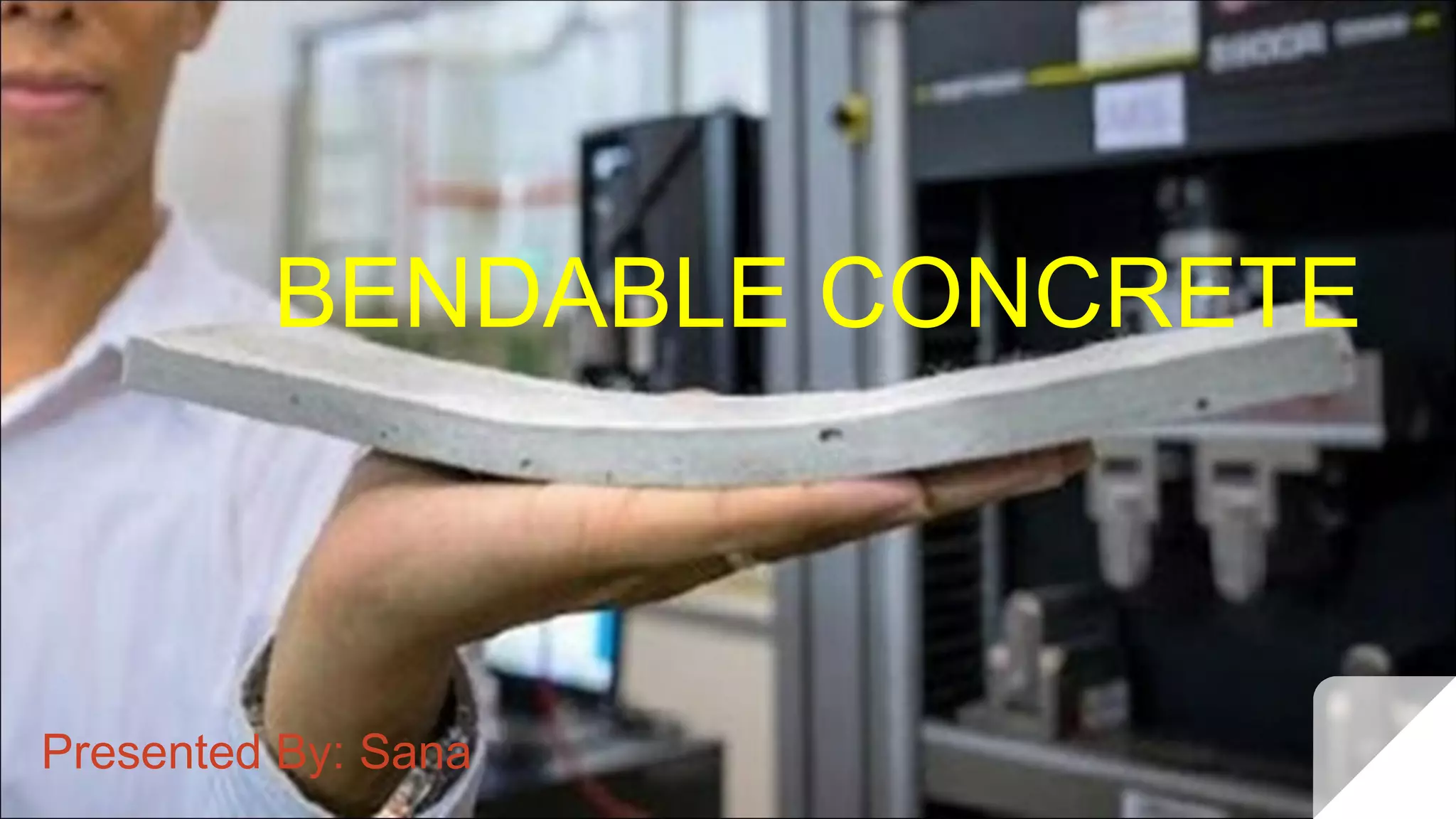
BENDABLE CONCRETE
Contents:
➔ Introduction
➔ ECC
➔ Composition of ECC
➔ Environment Friendliness
➔ Applications
➔ Advantages and Disadvantages
➔ Conclusion
➔ References
Introduction
The recently developed smart building material namely
Bendable concrete also known as Flexible concrete or
Engineered Cementitious Composite (ECC), was
developed by the Professor Victor Li at the University of
Michigan.
What is ECC ?
• It is a class of ultra-ductile fibre reinforced cementitious
composites characterised by high ductility and tight
crack width control.
Why ECC ?
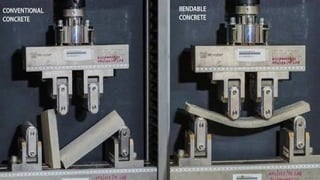
• Conventional concretes are almost unbendable and
have a strain capacity of only 0.1 % and are highly brittle
and rigid.
• An ECC has a strain capacity of more than 3 % and thus
acts more like a ductile metal rather than like a brittle
glass.
Composition of ECC
• Bendable concrete is composed of all the ingredients of a traditional
concrete minus coarse aggregates and is reinforced with polymer
fibres.
• It contains cement,sand, water, fibres, and admixtures.
• Polyvinyl Alcohol-fibres covered with a very thin (nanometer thick),
slick coating which prevents the fibre from rupturing.Thus ECC
deforms much more than a normal concrete but without fracturing.
Working Mechanism
• Whenever the load increases beyond its limiting value the strong
molecular bond formed between PVA fibres and concrete during
hydration prevents it from cracking.
• Different ingredients of ECC work together, to share the applied
load.
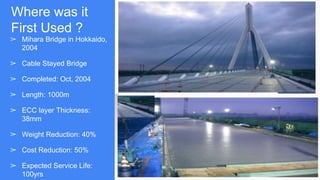
Where was it
First Used ?
➢ Mihara Bridge in Hokkaido,
2004
➢ Cable Stayed Bridge
➢ Completed: Oct, 2004
➢ Length: 1000m
➢ ECC layer Thickness:
38mm
➢ Weight Reduction: 40%
➢ Cost Reduction: 50%
➢ Expected Service Life:
100yrs
Environment Friendliness
• ECC is a green construction material.
• ECC is 37% less expensive, consumes 40% less energy, and
produces 39% less carbon dioxide than regular concrete.
• ECC incorporates high volumes of industrial wastes including fly
ash, sands and wastes from metal casting processes, wasted
cement kiln dust from cement production.
• Reduced emission of Greenhouse gases.
Applications
• In the construction of the jointless Bridges.
• In EarthQuake resistant structures.
• In flexible concrete roads and bridges there is no need of joints
such as expansion joint, contraction joint as the ECC itself has the
ability to change its shape.
• ECC overlays can be used over cracked concrete surfaces.
Advantages
• It is more Stronger, more durable, and lasts longer than conventional concrete.
• It is more resistant to cracking.
• It does not emit that amount of harmful gases as compared to conventional concrete.
• The flexible concrete is approx. 20-40% lighter.
• The use of steel reinforcement is reduced and can be eliminated.
• It reduces the cost of the project.
• It can be used as precast concrete.
Disadvantages
• It has a high initial cost as compared to conventional concrete.
• It requires skilled labour for its construction.
• It needs some special type of materials which can be difficult to find in
some areas.
• Its quality depend upon the material used and the condition under which it
is made.
Conclusion
 ECC is the upcoming advancement in technology which
will almost replace the Conventional concrete in
countries which are more prone to Natural disaster.
 But in India it is still a new material and requires proper
research for its use in India.
References
[1] V.C. Li, From Micromechanics to Structural Engineering-The design of
Cementitious Composites for Civil Engineering Applications, Structural
Engineering and Earthquake engineering, Japan Society of Civil Engineers.
[2] Cementitious composite bendable concrete, Construction Innovation Forum.
6494 Latcha Road, Walbridge, USA, (2007).
[3] V.C.Li, G.Fischer, Y.Kim, M.Lepech,S.Qian, M.Weimann, S.Wang, Durable
Link Slabs for Jointless Bridge Decks Based on Strain-Hardening Cementitious
Composites, CEE Department, University of Michigan,(2003)
“ Science is about knowing;
Engineering is about doing. ”
- Henry Petroski
Thank You.
Any Questions ??????

Bendable Concrete

  • 1.
  • 2.
    Contents: ➔ Introduction ➔ ECC ➔Composition of ECC ➔ Environment Friendliness ➔ Applications ➔ Advantages and Disadvantages ➔ Conclusion ➔ References
  • 3.
    Introduction The recently developedsmart building material namely Bendable concrete also known as Flexible concrete or Engineered Cementitious Composite (ECC), was developed by the Professor Victor Li at the University of Michigan.
  • 4.
    What is ECC? • It is a class of ultra-ductile fibre reinforced cementitious composites characterised by high ductility and tight crack width control.
  • 5.
    Why ECC ? •Conventional concretes are almost unbendable and have a strain capacity of only 0.1 % and are highly brittle and rigid. • An ECC has a strain capacity of more than 3 % and thus acts more like a ductile metal rather than like a brittle glass.
  • 6.
    Composition of ECC •Bendable concrete is composed of all the ingredients of a traditional concrete minus coarse aggregates and is reinforced with polymer fibres. • It contains cement,sand, water, fibres, and admixtures. • Polyvinyl Alcohol-fibres covered with a very thin (nanometer thick), slick coating which prevents the fibre from rupturing.Thus ECC deforms much more than a normal concrete but without fracturing.
  • 8.
    Working Mechanism • Wheneverthe load increases beyond its limiting value the strong molecular bond formed between PVA fibres and concrete during hydration prevents it from cracking. • Different ingredients of ECC work together, to share the applied load.
  • 9.
    Where was it FirstUsed ? ➢ Mihara Bridge in Hokkaido, 2004 ➢ Cable Stayed Bridge ➢ Completed: Oct, 2004 ➢ Length: 1000m ➢ ECC layer Thickness: 38mm ➢ Weight Reduction: 40% ➢ Cost Reduction: 50% ➢ Expected Service Life: 100yrs
  • 12.
    Environment Friendliness • ECCis a green construction material. • ECC is 37% less expensive, consumes 40% less energy, and produces 39% less carbon dioxide than regular concrete. • ECC incorporates high volumes of industrial wastes including fly ash, sands and wastes from metal casting processes, wasted cement kiln dust from cement production. • Reduced emission of Greenhouse gases.
  • 13.
    Applications • In theconstruction of the jointless Bridges. • In EarthQuake resistant structures. • In flexible concrete roads and bridges there is no need of joints such as expansion joint, contraction joint as the ECC itself has the ability to change its shape. • ECC overlays can be used over cracked concrete surfaces.
  • 14.
    Advantages • It ismore Stronger, more durable, and lasts longer than conventional concrete. • It is more resistant to cracking. • It does not emit that amount of harmful gases as compared to conventional concrete. • The flexible concrete is approx. 20-40% lighter. • The use of steel reinforcement is reduced and can be eliminated. • It reduces the cost of the project. • It can be used as precast concrete.
  • 15.
    Disadvantages • It hasa high initial cost as compared to conventional concrete. • It requires skilled labour for its construction. • It needs some special type of materials which can be difficult to find in some areas. • Its quality depend upon the material used and the condition under which it is made.
  • 16.
    Conclusion  ECC isthe upcoming advancement in technology which will almost replace the Conventional concrete in countries which are more prone to Natural disaster.  But in India it is still a new material and requires proper research for its use in India.
  • 17.
    References [1] V.C. Li,From Micromechanics to Structural Engineering-The design of Cementitious Composites for Civil Engineering Applications, Structural Engineering and Earthquake engineering, Japan Society of Civil Engineers. [2] Cementitious composite bendable concrete, Construction Innovation Forum. 6494 Latcha Road, Walbridge, USA, (2007). [3] V.C.Li, G.Fischer, Y.Kim, M.Lepech,S.Qian, M.Weimann, S.Wang, Durable Link Slabs for Jointless Bridge Decks Based on Strain-Hardening Cementitious Composites, CEE Department, University of Michigan,(2003)
  • 18.
    “ Science isabout knowing; Engineering is about doing. ” - Henry Petroski
  • 19.