PRESENTED BY : PRESENTED TO :
MADUPALLI.AKHIL DEPARTMENT OF
U14CE096 CIVIL ENGINEERING
DEPARTMENT OF
CIVIL ENGINEERING
CONTENTS
 What is Concrete ?
 Types of Concrete?
 What is Green Concrete ?
 Technique followed by Green Concrete
 Materials for Green Concrete
 Cementitious Materials-Fly Ash
 Suitability Of Green Concrete In Structures
 Advantages
 Applications of Green Concrete
 Scope in INDIA
 Conclusion
 References
CONCRETE :
Concrete is a mixture of coarse aggregate,
Cement , water and fine aggregate with mixed
Proportions which can be poured in to
formwork
And form a hard structure like a stone .
TYPES OF CONCRETE
 Reinforced cement concrete (R.C.C)
 Plain cement concrete
 Ready-mix concrete
 Light weight concrete
 Fiber reinforced concrete
 Green concrete
INTRODUCTION
 Green concrete is an revolutionary topic in
the history of concrete industry, this was first
invented in Denmark in year 1998.
 Green concrete is the type of concrete which
like the conventional concrete but a
production of such concrete requires
minimum amount of energy and causes less
harmful to environment
 Green concrete has nothing to do with colour
GREEN CONCRETE?
 Green concrete is an environmentally
friendly concrete
 Concrete that made with concrete waste and
uses less in energy in its production and
produced less carbon dioxide than normal
concrete is green concrete
 The main ingredient in concrete is cement and it
consists of lime stone
 During manufacturing of cement its ingredients
are heated to about 800c-10000c
 During this process carbon dioxide is released
 Approximately 1kg of concrete releases about
900gms of carbon dioxide into the atmosphere
 Therefore green concrete came in to existence
to reduce the emission of carbon dioxide
WHERE DOES THE CARBON DIOXIDE COME
FROM IN CONCRETE?
Cement :
Most of CO2 in concrete is from the cement
manufacturing process a typical cubic meter
of concrete contains about 10% cement by
weight .The reaction in this process of
cement
manufacture is:
CaCO3 = CaO+CO2
TECHNIQUE
It should follow 3R‘s Technique
 Reduce
 Reuse
 Recycle
 Reduce the green house gas emission
 Reduce the use of natural resources such as
lime stone, shale, clay and natural river sand
 Use of waste materials
objective:
The main objective is sustainable development
with out destruction of natural resources.
FEATURES OF GREEN CONCRETE
The concrete which fall in the category of green
Must have the following characteristics
 Optimizes use of available materials
 Better performance
 Enhanced cohesion workability / consistency
 Reduce shrinkage /creep
 Durability-better service life of concrete
 Reduce carbon footprint
 No increase in cost
 LEED India Certification
 Green concrete mix is designed with the
principle of “particle-packing optimization” to
meet requirements of plastic and hardened
properties
 Recycled Demolition Waste Aggregate
 Recycled Concrete Aggregate
 Blast furnace Slag (BFS)
 Manufactured Sand
 Glass Aggregate
 Fly ash
CEMENTITIOUS MATERIALS
FLY ASH
Fly ash is a by product during the operation of
coal fired plants. The finely divided particles from the
exhaust gases are collected in the electro static
precipitators. These particles are called Fly Ash.
Utilization of Fly Ash as a part
replacement of cement or
mineral admixture in concrete
saves on cement and hence the
emission of Carbon dioxide.
ADVANTAGES OF FLYASH
 Use of good quality fly ash in concrete has
shown remarkable improvement in durability
of concrete, especially in aggressive
environment.
 Higher Ultimate Strength
 Increased durability
 Improved Workability
 Reduced bleeding
 Reduced shrinkage
 Increased resistance to alkali-silica reactivity
SUITABILITY OF GREEN CONCRETE IN
STRUCTURES
Several factors which enhances the suitability of
Green Concrete in structures include:
1. Reduce the dead weight of a structure
2. Good thermal and fire resistance sound insulation
than the traditional granite rock
3. Reduce of concrete industry's carbon dioxide
emission by 30%
4. Increased concrete industry’s use of waste
products by 20%
5. Green Concrete requires less maintenance and
repairs
ADVANTAGE‘S
 Reduction in creep and shrinkage
 It uses the local and recycled materials in
concrete
 The heat of hydration of green concrete is
significantly lower than the traditional
concrete
 Compressive strength and flexural behavior
is fairly equal to that of conventional concrete
 Since these are optimized mix designs it is
easier to handling
ADVANTAGE‘S
 Concrete gives good strength to the
structure
 It is good fire resistant
 It helps in reducing the consumption of
cement overall
 Use of fly ash the concrete also increase its
workability and durability
 Optimized mix design ,easier handling ,better
consistency and easier finishing
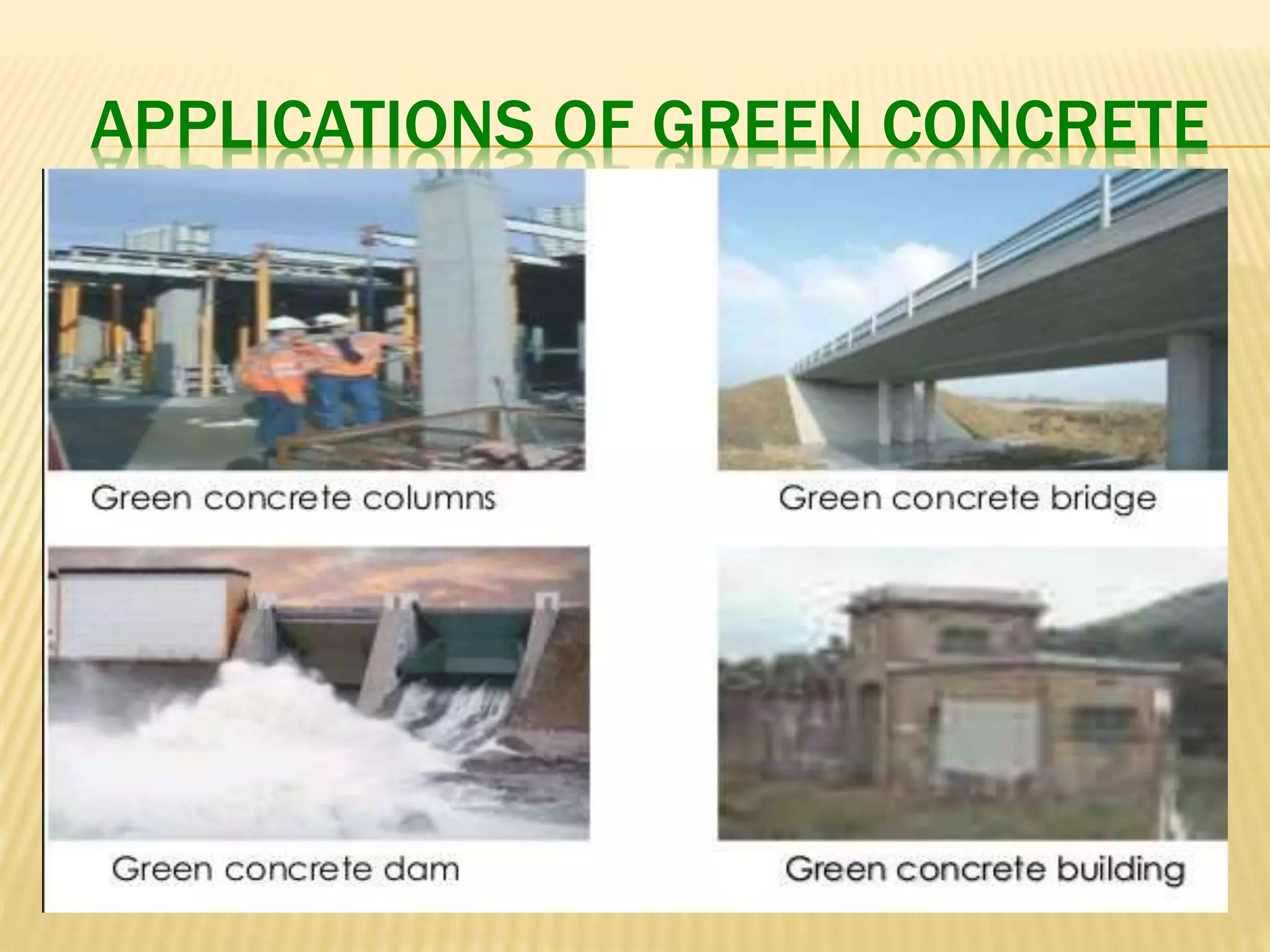
APPLICATIONS OF GREEN CONCRETE
SCOPE IN INDIA
Green concrete is a revolutionary topic in the
History of concrete industry.
As Green Concrete is made with concrete
waste it
does take more time to come in India because
of
Industries having problem to dispose wastes
and
It also reduces environmental impact with
reduction in co2 emission .
Use of Green Concrete can help us reduce
Various non –biodegradable products can also
be used and thus avoiding the issues of their
disposal.
CONCLUSION
• Although there are some defects of green
technology, everything done should have
both positive and negative impacts.
• Global warming and energy crisis cannot be
solved with one or two years
• It really requires our determination and
continue effort in improving the situation
• Green technology will definitely be the
solution that gets the potential in helping us
to solve those problems and improve our
environment.
REFERENCES
 Indian concrete journal volume 77-january-
2003-no-1 green concrete technology by
R.M.SWAMY on page -878
 Websites:-
 http://www.greenconcrete.dk/
 http://www.diamondbidewarehouse.com/gree
n concrete.html
Green concrete power point presentation

Green concrete power point presentation

  • 1.
    PRESENTED BY :PRESENTED TO : MADUPALLI.AKHIL DEPARTMENT OF U14CE096 CIVIL ENGINEERING DEPARTMENT OF CIVIL ENGINEERING
  • 2.
    CONTENTS  What isConcrete ?  Types of Concrete?  What is Green Concrete ?  Technique followed by Green Concrete  Materials for Green Concrete  Cementitious Materials-Fly Ash  Suitability Of Green Concrete In Structures  Advantages  Applications of Green Concrete  Scope in INDIA  Conclusion  References
  • 3.
    CONCRETE : Concrete isa mixture of coarse aggregate, Cement , water and fine aggregate with mixed Proportions which can be poured in to formwork And form a hard structure like a stone .
  • 4.
    TYPES OF CONCRETE Reinforced cement concrete (R.C.C)  Plain cement concrete  Ready-mix concrete  Light weight concrete  Fiber reinforced concrete  Green concrete
  • 6.
    INTRODUCTION  Green concreteis an revolutionary topic in the history of concrete industry, this was first invented in Denmark in year 1998.  Green concrete is the type of concrete which like the conventional concrete but a production of such concrete requires minimum amount of energy and causes less harmful to environment  Green concrete has nothing to do with colour
  • 7.
    GREEN CONCRETE?  Greenconcrete is an environmentally friendly concrete  Concrete that made with concrete waste and uses less in energy in its production and produced less carbon dioxide than normal concrete is green concrete
  • 8.
     The mainingredient in concrete is cement and it consists of lime stone  During manufacturing of cement its ingredients are heated to about 800c-10000c  During this process carbon dioxide is released  Approximately 1kg of concrete releases about 900gms of carbon dioxide into the atmosphere  Therefore green concrete came in to existence to reduce the emission of carbon dioxide
  • 9.
    WHERE DOES THECARBON DIOXIDE COME FROM IN CONCRETE? Cement : Most of CO2 in concrete is from the cement manufacturing process a typical cubic meter of concrete contains about 10% cement by weight .The reaction in this process of cement manufacture is: CaCO3 = CaO+CO2
  • 10.
    TECHNIQUE It should follow3R‘s Technique  Reduce  Reuse  Recycle  Reduce the green house gas emission  Reduce the use of natural resources such as lime stone, shale, clay and natural river sand  Use of waste materials objective: The main objective is sustainable development with out destruction of natural resources.
  • 11.
    FEATURES OF GREENCONCRETE The concrete which fall in the category of green Must have the following characteristics  Optimizes use of available materials  Better performance  Enhanced cohesion workability / consistency  Reduce shrinkage /creep  Durability-better service life of concrete  Reduce carbon footprint  No increase in cost  LEED India Certification
  • 12.
     Green concretemix is designed with the principle of “particle-packing optimization” to meet requirements of plastic and hardened properties  Recycled Demolition Waste Aggregate  Recycled Concrete Aggregate  Blast furnace Slag (BFS)  Manufactured Sand  Glass Aggregate  Fly ash
  • 15.
    CEMENTITIOUS MATERIALS FLY ASH Flyash is a by product during the operation of coal fired plants. The finely divided particles from the exhaust gases are collected in the electro static precipitators. These particles are called Fly Ash. Utilization of Fly Ash as a part replacement of cement or mineral admixture in concrete saves on cement and hence the emission of Carbon dioxide.
  • 16.
    ADVANTAGES OF FLYASH Use of good quality fly ash in concrete has shown remarkable improvement in durability of concrete, especially in aggressive environment.  Higher Ultimate Strength  Increased durability  Improved Workability  Reduced bleeding  Reduced shrinkage  Increased resistance to alkali-silica reactivity
  • 17.
    SUITABILITY OF GREENCONCRETE IN STRUCTURES Several factors which enhances the suitability of Green Concrete in structures include: 1. Reduce the dead weight of a structure 2. Good thermal and fire resistance sound insulation than the traditional granite rock 3. Reduce of concrete industry's carbon dioxide emission by 30% 4. Increased concrete industry’s use of waste products by 20% 5. Green Concrete requires less maintenance and repairs
  • 18.
    ADVANTAGE‘S  Reduction increep and shrinkage  It uses the local and recycled materials in concrete  The heat of hydration of green concrete is significantly lower than the traditional concrete  Compressive strength and flexural behavior is fairly equal to that of conventional concrete  Since these are optimized mix designs it is easier to handling
  • 19.
    ADVANTAGE‘S  Concrete givesgood strength to the structure  It is good fire resistant  It helps in reducing the consumption of cement overall  Use of fly ash the concrete also increase its workability and durability  Optimized mix design ,easier handling ,better consistency and easier finishing
  • 20.
  • 21.
    SCOPE IN INDIA Greenconcrete is a revolutionary topic in the History of concrete industry. As Green Concrete is made with concrete waste it does take more time to come in India because of Industries having problem to dispose wastes and It also reduces environmental impact with reduction in co2 emission . Use of Green Concrete can help us reduce
  • 22.
    Various non –biodegradableproducts can also be used and thus avoiding the issues of their disposal.
  • 23.
    CONCLUSION • Although thereare some defects of green technology, everything done should have both positive and negative impacts. • Global warming and energy crisis cannot be solved with one or two years • It really requires our determination and continue effort in improving the situation • Green technology will definitely be the solution that gets the potential in helping us to solve those problems and improve our environment.
  • 24.
    REFERENCES  Indian concretejournal volume 77-january- 2003-no-1 green concrete technology by R.M.SWAMY on page -878  Websites:-  http://www.greenconcrete.dk/  http://www.diamondbidewarehouse.com/gree n concrete.html