

11/30/2019 1
Group Members
Supervisor
University Of Engineering and Technology Peshawar Jalozai Campus
Abu Bakar Malik (abm.abubakar2672@gmail.com)
Alim Ur Rahman (alimurrahman76@gmail.com)
Mujahid Hussain (mhussain00126@gmail.com)
Dr. Sajjad Wali Khan
11/30/2019 2
Contents.
• Project Tittle.
• Introduction.
• Problem Statement.
• Aims and Objectives.
• Methodology.
• Practical Applications.
• Benefits.
• Schedule.
• References.
11/30/2019 3
Shear Behaviour of RC Beam Externally
Strengthened with Engineered
Cementitious Composite (ECC) Layer.
Project Tittle
11/30/2019 4
Introduction
• A significant part of the infrastructure is in need of strengthening and rehabilitation.
• This highlights the need to find innovative solutions that offer real advantages over traditional
methods, particularly in terms of performance, simplicity of application, speed of execution,
and ease of handling. [1]
 Focus is specifically on structural performance in response to shear loading
11/30/2019 5
Intro…
 Shear Failure : Shear failure can be defined as a failure that takes place due to
insufficiency of shear resistance available between the materials.
➢ Different techniques are used to upgrade/retrofit the structure
Retrofitting : Retrofitting is the process of addition of new features to older buildings, bridges
etc. Retrofitting reduces the vulnerability of damage of an existing structure during a near future
seismic activity. Retrofitting helps to increase the strength, resistivity and overall lifespan of the
structure.[2]
11/30/2019 6
Intro…
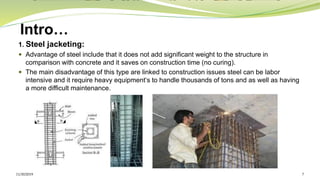
1. Steel jacketing:
 Advantage of steel include that it does not add significant weight to the structure in
comparison with concrete and it saves on construction time (no curing).
 The main disadvantage of this type are linked to construction issues steel can be labor
intensive and it require heavy equipment‘s to handle thousands of tons and as well as having
a more difficult maintenance.
11/30/2019 7
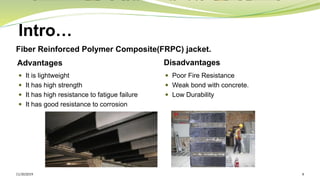
Fiber Reinforced Polymer Composite(FRPC) jacket.
Advantages
 It is lightweight
 It has high strength
 It has high resistance to fatigue failure
 It has good resistance to corrosion
Disadvantages
 Poor Fire Resistance
 Weak bond with concrete.
 Low Durability
11/30/2019 8
Intro…
Intro…
ECC:
Engineered Cementitious composite (ECC) is a class of ultra-ductile fibre invented in early 1990’s by
Dr. Victor Li (University of Michigon) with a design based on micro-mechanics.[3]
ECC has many properties such as
 ultra-high tensile strength.
 strain hardening behavior.
 Strain capacity increase by 3 to 7%.
 Reduce corrosion
 excellent impact resistance.
11/30/2019 9
Intro…
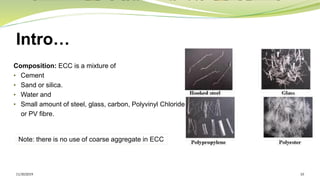
Composition: ECC is a mixture of
• Cement
• Sand or silica.
• Water and
• Small amount of steel, glass, carbon, Polyvinyl Chloride
or PV fibre.
Note: there is no use of coarse aggregate in ECC
11/30/2019 10
Intro…
 When RC beam are vulnerable to shear failure they are needed to be strengthened by using
ECC layer externally.
 Other works has been done related to this project.
(Kim, S.-W. et all ) [4]
 The experimental results show that the use of an ECC layer leads to a substantial increase
in the shear strength and ductility of the RC beams after the peak load.
(Yuan, F. et all) [5]
 ECC beams showed better seismic performance in terms of load carrying capacity.
11/30/2019 11
Problem Statement
 Concrete structures gets deteriorated with time and hence its service life decreases. this
deterioration is caused by environmental impacts because Concrete is porous.
 Structural elements like beam fail due to Shear and flexure, shear failure is sudden and
catastrophic.
 A trial of other materials like ECC can be used to enhance these properties and to improve
the shear behaviour of RC beam.
11/30/2019 12
Aims & Objectives
 To enhance shear capacity of RC beams
 To develop guidelines for construction industry using ECC verified through experimental work.
11/30/2019 13
Methodology
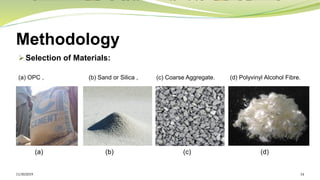
➢ Selection of Materials:
(a) OPC , (b) Sand or Silica , (c) Coarse Aggregate. (d) Polyvinyl Alcohol Fibre.
(a) (b) (c) (d)
11/30/2019 14
Cont…
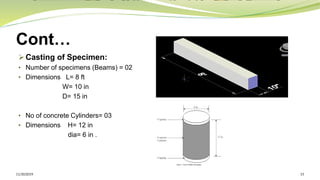
➢ Casting of Specimen:
• Number of specimens (Beams) = 02
• Dimensions L= 8 ft
W= 10 in
D= 15 in
• No of concrete Cylinders= 03
• Dimensions H= 12 in
dia= 6 in .
11/30/2019 15
Cont…
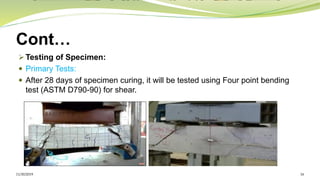
➢ Testing of Specimen:
 Primary Tests:
 After 28 days of specimen curing, it will be tested using Four point bending
test (ASTM D790-90) for shear.
11/30/2019 16
Cont…
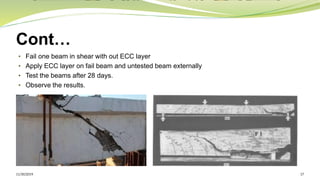
• Fail one beam in shear with out ECC layer
• Apply ECC layer on fail beam and untested beam externally
• Test the beams after 28 days.
• Observe the results.
11/30/2019 17
Cont…
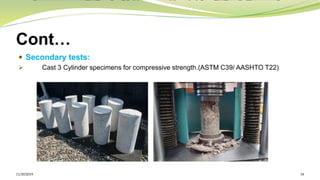
 Secondary tests:
➢ Cast 3 Cylinder specimens for compressive strength.(ASTM C39/ AASHTO T22)
11/30/2019 18
Cont…
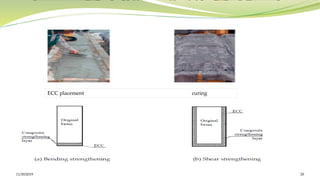
➢Method of Applying ECC layer.[6]
• The procedure consists of the following steps:
• Chisel both sides and bottom of each beam, then clean and wet the sides and
bottom to a standard condition.
• An interface agent will be apply to the sides and bottom of the beams.
• Apply ECC onto the sides and bottom of the beams to the design thickness.
• Cover the beam with a polyethylene sheet to prevent the loss of moisture and cure
for 28 days at room temperature.
11/30/2019 19
11/30/2019 20
ECC placement curing
Practical Applications
 ECC is not limited to structural RC beam only.
 ECC can be use in different situation for the stability of structure such as;
➢ Dams
➢ Bridges
➢ Building ( column , slab , beam )
11/30/2019 21
Cont…
 The Mitaka Dam near Hiroshima was repaired using ECC in 2003.
 The surface of the dam was severely damaged, showing evidence of cracks, spalling, and
some water leakage.
 A 20 mm-thick layer of ECC was applied by spraying over the 600 m2 surface.[7]
11/30/2019 22
Cont…
 The 1 km long Mihara Bridge in Hokkaido, Japan was opened to traffic in 2005. The steel-
reinforced road bed contains nearly 800 m3 of ECC material.
 The tensile ductility and tight crack control behaviour of ECC led to a 40% reduction in
material used during construction.[8]
11/30/2019 23
Cont…
 The 95 m (312 ft.) Glorio high-rise apartment building in Tokyo contains a total of 54 ECC
beams (two per story) intended to mitigate earthquake damage. The properties of ECC give it
superior properties in seismic resistance applications when compared to ordinary Portland
cement [9]
11/30/2019 24
Benefit
• Strength and Durability.
• Seismic Resistance.
• Economical in Mega Project
11/30/2019 25
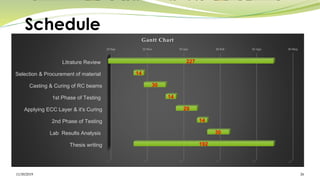
Schedule
11/30/2019 26
23-Sep 12-Nov 01-Jan 20-Feb 10-Apr 30-May
Litrature Review
Selection & Procurement of material
Casting & Curing of RC beams
1st Phase of Testing
Applying ECC Layer & it's Curing
2nd Phase of Testing
Lab Results Analysis
Thesis writing
227
14
30
14
29
14
30
192
Gantt Chart
References.
1. Li, O. Chaalla.; Member, ASCE “Shear strengthening of rc beams by externally bonded Side
CFRP strips”
2. Retrofitting: Urban Design Solutions for Redesigning Suburbs‖ by Richard Florida.
3. Li, V.C. From Micromechanics to Structural Engineering—The Design of Cementitious
Composites for Civil Engineering Applications.
4. Kim, S.-W.; Park, W.-S.; Jang, Y.-I.; Feo, L.; Yun, H.-D. Crack damage mitigation and shear
behavior of shear-dominant reinforced concrete beams repaired with strain-hardening
cement-based composite. Compos.
5. Yuan, F.; Pan, J.; Dong, L.; Leung, C. Mechanical behaviors of steel reinforced ECC or
ECC/concrete composite beams under reversed cyclic loading.
11/30/2019 27
Cont…
6. Li Guan Wang, “Shear Behaviors of RC Beams Externally Strengthened with Engineered
Cementitious Composite Layers”
7. ECC Technology Network - Mitaka Dam accessed 11/11/09.
8. Technology Network –Mihara Bridge” Accessed 10/28/09
9. Bendable concrete minimizes cracking and fracture problems, MRS Bulletin (2006)
11/30/2019 28
11/30/2019 29

Engineered Cementitious Composite

  • 1.
  • 2.
    Group Members Supervisor University OfEngineering and Technology Peshawar Jalozai Campus Abu Bakar Malik (abm.abubakar2672@gmail.com) Alim Ur Rahman (alimurrahman76@gmail.com) Mujahid Hussain (mhussain00126@gmail.com) Dr. Sajjad Wali Khan 11/30/2019 2
  • 3.
    Contents. • Project Tittle. •Introduction. • Problem Statement. • Aims and Objectives. • Methodology. • Practical Applications. • Benefits. • Schedule. • References. 11/30/2019 3
  • 4.
    Shear Behaviour ofRC Beam Externally Strengthened with Engineered Cementitious Composite (ECC) Layer. Project Tittle 11/30/2019 4
  • 5.
    Introduction • A significantpart of the infrastructure is in need of strengthening and rehabilitation. • This highlights the need to find innovative solutions that offer real advantages over traditional methods, particularly in terms of performance, simplicity of application, speed of execution, and ease of handling. [1]  Focus is specifically on structural performance in response to shear loading 11/30/2019 5
  • 6.
    Intro…  Shear Failure: Shear failure can be defined as a failure that takes place due to insufficiency of shear resistance available between the materials. ➢ Different techniques are used to upgrade/retrofit the structure Retrofitting : Retrofitting is the process of addition of new features to older buildings, bridges etc. Retrofitting reduces the vulnerability of damage of an existing structure during a near future seismic activity. Retrofitting helps to increase the strength, resistivity and overall lifespan of the structure.[2] 11/30/2019 6
  • 7.
    Intro… 1. Steel jacketing: Advantage of steel include that it does not add significant weight to the structure in comparison with concrete and it saves on construction time (no curing).  The main disadvantage of this type are linked to construction issues steel can be labor intensive and it require heavy equipment‘s to handle thousands of tons and as well as having a more difficult maintenance. 11/30/2019 7
  • 8.
    Fiber Reinforced PolymerComposite(FRPC) jacket. Advantages  It is lightweight  It has high strength  It has high resistance to fatigue failure  It has good resistance to corrosion Disadvantages  Poor Fire Resistance  Weak bond with concrete.  Low Durability 11/30/2019 8 Intro…
  • 9.
    Intro… ECC: Engineered Cementitious composite(ECC) is a class of ultra-ductile fibre invented in early 1990’s by Dr. Victor Li (University of Michigon) with a design based on micro-mechanics.[3] ECC has many properties such as  ultra-high tensile strength.  strain hardening behavior.  Strain capacity increase by 3 to 7%.  Reduce corrosion  excellent impact resistance. 11/30/2019 9
  • 10.
    Intro… Composition: ECC isa mixture of • Cement • Sand or silica. • Water and • Small amount of steel, glass, carbon, Polyvinyl Chloride or PV fibre. Note: there is no use of coarse aggregate in ECC 11/30/2019 10
  • 11.
    Intro…  When RCbeam are vulnerable to shear failure they are needed to be strengthened by using ECC layer externally.  Other works has been done related to this project. (Kim, S.-W. et all ) [4]  The experimental results show that the use of an ECC layer leads to a substantial increase in the shear strength and ductility of the RC beams after the peak load. (Yuan, F. et all) [5]  ECC beams showed better seismic performance in terms of load carrying capacity. 11/30/2019 11
  • 12.
    Problem Statement  Concretestructures gets deteriorated with time and hence its service life decreases. this deterioration is caused by environmental impacts because Concrete is porous.  Structural elements like beam fail due to Shear and flexure, shear failure is sudden and catastrophic.  A trial of other materials like ECC can be used to enhance these properties and to improve the shear behaviour of RC beam. 11/30/2019 12
  • 13.
    Aims & Objectives To enhance shear capacity of RC beams  To develop guidelines for construction industry using ECC verified through experimental work. 11/30/2019 13
  • 14.
    Methodology ➢ Selection ofMaterials: (a) OPC , (b) Sand or Silica , (c) Coarse Aggregate. (d) Polyvinyl Alcohol Fibre. (a) (b) (c) (d) 11/30/2019 14
  • 15.
    Cont… ➢ Casting ofSpecimen: • Number of specimens (Beams) = 02 • Dimensions L= 8 ft W= 10 in D= 15 in • No of concrete Cylinders= 03 • Dimensions H= 12 in dia= 6 in . 11/30/2019 15
  • 16.
    Cont… ➢ Testing ofSpecimen:  Primary Tests:  After 28 days of specimen curing, it will be tested using Four point bending test (ASTM D790-90) for shear. 11/30/2019 16
  • 17.
    Cont… • Fail onebeam in shear with out ECC layer • Apply ECC layer on fail beam and untested beam externally • Test the beams after 28 days. • Observe the results. 11/30/2019 17
  • 18.
    Cont…  Secondary tests: ➢Cast 3 Cylinder specimens for compressive strength.(ASTM C39/ AASHTO T22) 11/30/2019 18
  • 19.
    Cont… ➢Method of ApplyingECC layer.[6] • The procedure consists of the following steps: • Chisel both sides and bottom of each beam, then clean and wet the sides and bottom to a standard condition. • An interface agent will be apply to the sides and bottom of the beams. • Apply ECC onto the sides and bottom of the beams to the design thickness. • Cover the beam with a polyethylene sheet to prevent the loss of moisture and cure for 28 days at room temperature. 11/30/2019 19
  • 20.
  • 21.
    Practical Applications  ECCis not limited to structural RC beam only.  ECC can be use in different situation for the stability of structure such as; ➢ Dams ➢ Bridges ➢ Building ( column , slab , beam ) 11/30/2019 21
  • 22.
    Cont…  The MitakaDam near Hiroshima was repaired using ECC in 2003.  The surface of the dam was severely damaged, showing evidence of cracks, spalling, and some water leakage.  A 20 mm-thick layer of ECC was applied by spraying over the 600 m2 surface.[7] 11/30/2019 22
  • 23.
    Cont…  The 1km long Mihara Bridge in Hokkaido, Japan was opened to traffic in 2005. The steel- reinforced road bed contains nearly 800 m3 of ECC material.  The tensile ductility and tight crack control behaviour of ECC led to a 40% reduction in material used during construction.[8] 11/30/2019 23
  • 24.
    Cont…  The 95m (312 ft.) Glorio high-rise apartment building in Tokyo contains a total of 54 ECC beams (two per story) intended to mitigate earthquake damage. The properties of ECC give it superior properties in seismic resistance applications when compared to ordinary Portland cement [9] 11/30/2019 24
  • 25.
    Benefit • Strength andDurability. • Seismic Resistance. • Economical in Mega Project 11/30/2019 25
  • 26.
    Schedule 11/30/2019 26 23-Sep 12-Nov01-Jan 20-Feb 10-Apr 30-May Litrature Review Selection & Procurement of material Casting & Curing of RC beams 1st Phase of Testing Applying ECC Layer & it's Curing 2nd Phase of Testing Lab Results Analysis Thesis writing 227 14 30 14 29 14 30 192 Gantt Chart
  • 27.
    References. 1. Li, O.Chaalla.; Member, ASCE “Shear strengthening of rc beams by externally bonded Side CFRP strips” 2. Retrofitting: Urban Design Solutions for Redesigning Suburbs‖ by Richard Florida. 3. Li, V.C. From Micromechanics to Structural Engineering—The Design of Cementitious Composites for Civil Engineering Applications. 4. Kim, S.-W.; Park, W.-S.; Jang, Y.-I.; Feo, L.; Yun, H.-D. Crack damage mitigation and shear behavior of shear-dominant reinforced concrete beams repaired with strain-hardening cement-based composite. Compos. 5. Yuan, F.; Pan, J.; Dong, L.; Leung, C. Mechanical behaviors of steel reinforced ECC or ECC/concrete composite beams under reversed cyclic loading. 11/30/2019 27
  • 28.
    Cont… 6. Li GuanWang, “Shear Behaviors of RC Beams Externally Strengthened with Engineered Cementitious Composite Layers” 7. ECC Technology Network - Mitaka Dam accessed 11/11/09. 8. Technology Network –Mihara Bridge” Accessed 10/28/09 9. Bendable concrete minimizes cracking and fracture problems, MRS Bulletin (2006) 11/30/2019 28
  • 29.