ALTERNATE
CONSTRUCTION
MATERIAL
SYNOPSIS
CONTENTS
INTRODUCTION
1.FLY ASH AS A REPLACEMENT FOR CEMENT IN
CONCRETE
2.RECENT DEVELOPMENT IN CEMENT BONDED
BUILDING PRODUCTS
3.HIGH PERFORMANCE CONCRETE
4.POLYMER AS WATER PROOFING MATERIALS
5.SUMMARY
6.REFERANCES
SYNOPSIS
 Man is trying since pre-historic period to have a comfortable shelter
and he seems to be continue the same.Day by day he is improving
but still not satisfied.He aspires for best shelter at least cost.This is
mainly because of the increase in cost of construction materials and
poor construction technique.With this increase in cost,people are
not able to afford shelter because of economy.
 In this regard,certain alternate construction materials and
techniques have been adopted such that the overall cost of
materials reduces with increase in durability aspects.The materials
used should cater to all the requirements without any compromise.
 Studies have been made in this respect and on the use of various
alternate materials in the field of construction and same is
presented in this report.
CONTENTS
 INTRODUCTION
1. FLY ASH AS REPLACEMENT FOR CEMENT IN CONCRETE
Fly ash as utilization practices, Fly ash can be used in many ways, Uses of
fly ash, Fly ash as puzzling in concrete, Advantages of using fly ash in
concrete, Limitations of fly ash in concrete.
2. RECENT DEVELOPMENT IN CEMENT BONDED BUILDING PRODUCTS
Introduction, Uses, Lignocelluloses materials for development of CBC,
Manufacturing technology, Cement bonded fiber composites, Cement
bonded particle composite, Properties of CBC, Durability aspects,
Conclusions.
3. HIGH PERFORMANCE CONCRETE Introduction,Defination, High
performance concrete:A composite material, Making high-performance
concrete, Concrete shrinkage, Durability of HPC, Properties of specially
formulated HPC(polycrete).
4.POLYMER AS WATER PROOFING MATERIAL
Introduction, conventional water proofing systems, properties, polymeric
modified membranes with reinforcement, Surfacing, Thermoset and
thermoplastic membranes, Applications, Conclusions.
INTRODUCTION
 Housing has been continues to be of prime concern to human beings. This
problem has become more acute in the developing countries as their rate of
growth of population is far in excess of rate of new dwellings being
added.Shelter has been, is and will always remain an important basic need
of human beings next only to food.Hence it should be designed and
constructed as a permanent structure and it should be capable of being
used for longer periods with low maintenance and replacement often
become a problem because of the non availability of technical personnel or
technology.
 In this regard the modern trend should aim at achieving the desired
character at the minimum cost.Construction industry is the largest industry
in our country contributing to more than 40% of total industrial activities.It
has been found that the cost of construction of buildings for an ordinary
person is becoming unaffordable.However many investigations are going on
with varied degree of success, as a building cost mainly depends on the raw
materials like stone, aggregate, sand, cement, steel and bricks.
 Here the reports on methods to reduce the cost of construction materials
and techniques, which forms the major part of the constructional cost, have
been studied and a brief report is presented.
FLY ASH AS REPLACEMENT FOR
CEMENT IN CONCRETE
 Fly ash is a material collected from the flue gases of coal
burning using electrostatic or mechanical precipitators.
 By-product of combustion of pulverized coal in chemical
plant.
 Finer than Portland cement.
 Consists of small glassy ranging from less than 1 micron
to 100 microns.
 Components are silica (SiO2), alumina (Al2O3) and
oxides of calcium and iron (CIO, Fe2o3).
 Used in many other applications in civil engineering
construction and other special materials.
Utilization of coal combustion by
products as to disposal
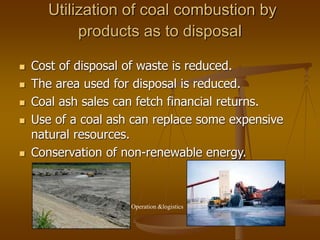
 Cost of disposal of waste is reduced.
 The area used for disposal is reduced.
 Coal ash sales can fetch financial returns.
 Use of a coal ash can replace some expensive
natural resources.
 Conservation of non-renewable energy.
Operation &logistics
FLY ASH CAN BE USED IN MANY
WAYS
USES:-
 Raw materials for cement production.
 An ingredient in blended cement.
 Partial replacement for cement in
concrete.
 Partial replacement of fine aggregates.
Fly ash as puzzling in concrete:-
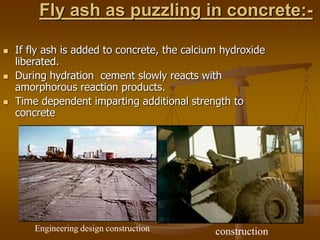
 If fly ash is added to concrete, the calcium hydroxide
liberated.
 During hydration cement slowly reacts with
amorphorous reaction products.
 Time dependent imparting additional strength to
concrete
Engineering design construction construction
With partial replacement of cement by fly
ash in concrete, the heat of hydration is
reduced.Further the heat is released over
a long period of time, because of reduced
amount of cement and longer pozzolanic
reactions.The temperatures in mass
concrete in particular, remain lower
because heat is dissipated as it develops.
ADVANTAGES OF FLY ASH IN
CONCRETE
 Economical.
 The workability and pump ability increased without
increasing in water cement ratio.
 Heat of hydration can be reduced.
 Long term strength of concrete increased.
 Permeability of concrete reduced and the durability be
increased.
 Better surface finish.
 Resistance to sulphur attack increased.
 Corrosion of reinforcement prevented.
LIMITATIONS:-
 Fly ash use in concrete results in a delay
strength gain.
 The resistance to scaling due to salts
reduces, especially
RECENT DEVELOPMENTS IN CEMENT
BONDED BUILDING PRODUCTS
INTRODUCTION:-
 Cement bonded products are an important class of
building materials.
 These products are made up of hydrated cement paste
that binds aggregates-particles or fibres to make precast
building components.
 The cementetious products made with aggregates is
called cement concrete.The cementetious products made
with particles and fibres are called cement
bonded composites(CPC).
USES:-
For making precast products like:
 External cladding.
 Protective elements for fire proofing.
 Sound insulation.
 Specialization flooring .
 Partition and roofing tiles .
 Masonry blocks and others .
LIGNOCELLULOSE MATERIALS
FOR DEVELOPMENT OF CBC:-
The lignocellulose materials are:-
 Wood :-Used in various form like particles chips, wool and fibers.
 Natural fibers:-Obtained from plants, such as leaf, stem,
fruitsurface and wood.
 Agro wastes:-Uses are as fodder, fuel and for making bio
fertilizers. To make CBC from rice straw, baggase, wheat straw, oil
palms .
 Other wastes: - Huge quantity of wood waste available from the
demolition of old structures such as buildings, railways, telephones.
MANUFACTURING
TECHNOLOGY
 The manufacturing technology for fibre-
reinforced composites is based upon the process
used for making paper from the pulp, whilst for
fiber-reinforced composites is based upon the
process is similar to that used for producing the
resin bonded particle
board/fibreboards.Presently, the cement-bonded
composites are manufactured in several
countries.
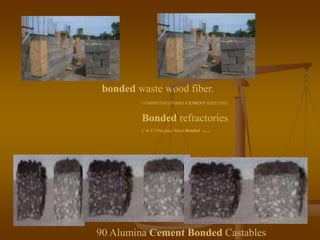
bonded waste wood fiber.
90 Alumina Cement Bonded Castables
...
COMPRESSED FIBRE CEMENT SHEETING.
C & E Fiberglass Stitch Bonded ...
Bonded refractories
CEMENT BONDED FIBRE
COMPOSITES
 CBC are refined wood fibres and a cement matrix that may or may
not contains sand.
 The plant fibres are short and stiff, but they have better strength
and durability in cement matrix.
 In addition,wood contains lignin and hemicellulose, which are to
known to have an adverse effect on the cement hydration and
durability of concrete.Therefore to reduce lignin and hemicellulose,
and to obtain wood in the forms of fibres, wood chips are subjected
to a process called pulping.
 Recently the natural fibres are also used for pulping to improve the
strength and durability.
 There are 3 types of pulping:-
 Mechanical
 Chemical
 Semi-chemical.
CEMENT BONDED PARTICLE
COMPOSITES
Made by using wood, lignocellolusic
materials like, oil palm, shells in
aggregate form.
 The CBC classified into :-
 Wood wool cement composite.
 Wood chip cement composite.
 Wood particle cement composite.
 Structural wood concrete.
PROPERTIES OF CBC:-
 The CBC composites are denser and stronger than the cement bonded
particle composite .
 Density- 1100 and 1800Kg/m3 .
 The bending strength up to 30Mpa .
 Roofing tiles and cladding elements are made from these composites .
DURABILITY ASPECTS:-
Attempts have been made to reduce the alkalinity of cement by using
pozzolona such as silica flumes, rice husk-ash .
CONCLUSIONS:-
 Toughness, water resistance, fire resistance, durability, machinability,
lightweight and cost effectiveness make CBC an attractive material .
 The use of several kinds of waste materials like construction demolition
wastes agro forestry waste and inorganic industrial waste in making CBC
would be very beneficial from an environmental point of view .
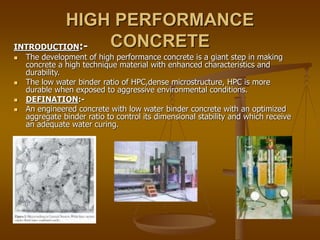
HIGH PERFORMANCE
CONCRETE
INTRODUCTION:-
 The development of high performance concrete is a giant step in making
concrete a high technique material with enhanced characteristics and
durability.
 The low water binder ratio of HPC,dense microstructure, HPC is more
durable when exposed to aggressive environmental conditions.
 DEFINATION:-
 An engineered concrete with low water binder concrete with an optimized
aggregate binder ratio to control its dimensional stability and which receive
an adequate water curing.
HIGH PERFORMANCE CONCRETE:
A COMPOSITE MATERIAL:-
 Concrete can be characterized solely by its compressive
strength because that can be directly linked to the
cement paste, water cement ratio,The transition zone
around a course aggregates particles constitute the
weakest links in concrete.
 Aggregate component have mechanical properties of the
ordinary concrete. If strength of the hydrated cement
increases in HPC, the transition zone between the
coarse aggregates and the hydrated cement paste
disappears. Since there is proper stress transfer under
these conditions, HPC behaves like a true composite
material.
MAKING HIGH PERFORMANCE CONCRETE :-
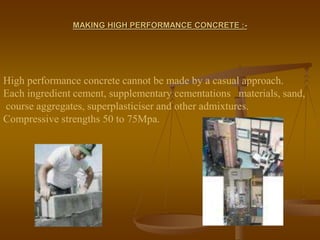
High performance concrete cannot be made by a casual approach.
Each ingredient cement, supplementary cementations materials, sand,
course aggregates, superplasticiser and other admixtures.
Compressive strengths 50 to 75Mpa.
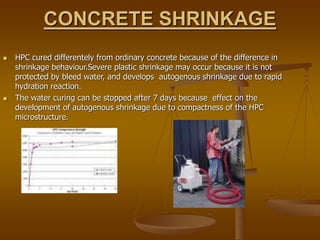
 HPC cured differentely from ordinary concrete because of the difference in
shrinkage behaviour.Severe plastic shrinkage may occur because it is not
protected by bleed water, and develops autogenous shrinkage due to rapid
hydration reaction.
 The water curing can be stopped after 7 days because effect on the
development of autogenous shrinkage due to compactness of the HPC
microstructure.
CONCRETE SHRINKAGE
DURABILITY OF HPC:-
 Based on years of experience with ordinary concrete, we can safely
assume that high performance concrete is more durable than
ordinary concrete.
PROPERTIES OF SPECIALLY FORMULATED HPC(POLYCRETE):-
 PROPERTY
VALUE
 Compressive strength 75-
70N/mm2
 Flextural strength
15N/mm2
 Tensile strength
12N/mm2
 Youngs modulus
32N/mm2
POLYMER AS WATER
PROOFING MATERIAL
INTRODUCTION:-
Progress has been made in polymer technology with the development of
synthetic plastic and synthetic rubber water proofing system.Two polymers
polypropolene and styrene
CONVENTIONAL WATERFOOFING SYSTEM:-
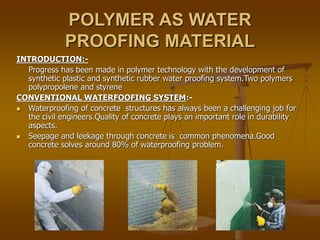
 Waterproofing of concrete structures has always been a challenging job for
the civil engineers.Quality of concrete plays an important role in durability
aspects.
 Seepage and leekage through concrete is common phenomena.Good
concrete solves around 80% of waterproofing problem.
PROPERTIES:-
 Excellent resistance to moisture.
 Resistance to weathering.
 Good cohesive and excellent adhesive characteristics.
 Thermoplastic in nature.
 Asphalt and coal tar excellent waterproofing properties because of its
versatile nature.
POLYMERIC MEMBRANES:-
 Polymeric membranes represents a transformation to the superior,factory
made component that reduces field work, Where quality control is most
difficult.The slightly higher material cost is generally offset by its cost
effectiveness in the long run.
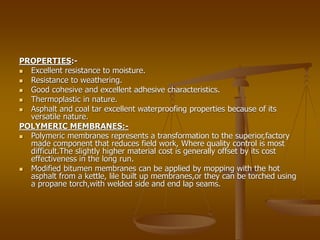
 Modified bitumen membranes can be applied by mopping with the hot
asphalt from a kettle, lile built up membranes,or they can be torched using
a propane torch,with welded side and end lap seams.
POLYMER MODIFIED MEMBRANES WITH REINFORCEMENT
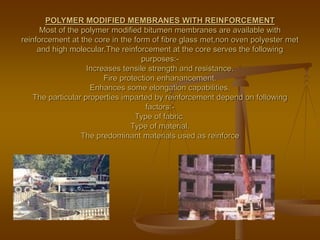
Most of the polymer modified bitumen membranes are available with
reinforcement at the core in the form of fibre glass met,non oven polyester met
and high molecular.The reinforcement at the core serves the following
purposes:-
Increases tensile strength and resistance.
Fire protection enhanancement.
Enhances some elongation capabilities.
The particular properties imparted by reinforcement depend on following
factors:-
Type of fabric.
Type of material.
The predominant materials used as reinforce
SURFACING:-
 Surfacing for modified bitumen membranes provides a heat resistance viz.
solar reflectances,ultraviolet resistance and fire resistance.
 Three basic types of surfacings are:-
 Mineral granules.
 Metallic granules.
 Field applied protective coatings.
THERMOSET AND THERMOPLASTIC MEMBRANES:-
 Thermoset membranes are those whose principal polymers are chemically
cross linked. This chemical cross-linkage is commonly reffered to as
vulcanization.
 The categories of thermoset roof membranes are :-
 Neoprene.
 Chlorosulphonate polyethylene.
 Epichlorohydride.
 Ethylene propylene diene monomer.
 The sub-catagories of thermoplastic membranes are:-
 Polyvinyl chloride.
 Co-polymer alloy.
 Ethylene interpolymer.
APPLICATION:-
 The advent of polymer modified bitumen membranes have one
more noticeable change and that was in the system of laying.
 Torch- on and self adhesive application of these products being less
labour intensive has led to a more faster execution.
CONCLUSIONS:-
 In the last 20 years,use of polymer modified roofing system has
grown substantially.Accoriding to a recent market analysis,80% of
the waterproofing in the developed countries are being executed
with polymeric materail.
 In India these materials have been accepted as one of the durable
solution for waterfroofing.
SUMMARY
Going through the literature while preparing the
above report,we conclude that it is really
possible to reduce the construction cost of
buildings by using the above mentioned
alternative materials and technologies and there
by achieving economy,durability,with proper care
and supervision.Structures built using these
methods and technologies will be sound and
asthetically appealing.

alternate concrete material use in construction

  • 1.
    ALTERNATE CONSTRUCTION MATERIAL SYNOPSIS CONTENTS INTRODUCTION 1.FLY ASH ASA REPLACEMENT FOR CEMENT IN CONCRETE 2.RECENT DEVELOPMENT IN CEMENT BONDED BUILDING PRODUCTS 3.HIGH PERFORMANCE CONCRETE 4.POLYMER AS WATER PROOFING MATERIALS 5.SUMMARY 6.REFERANCES
  • 2.
    SYNOPSIS  Man istrying since pre-historic period to have a comfortable shelter and he seems to be continue the same.Day by day he is improving but still not satisfied.He aspires for best shelter at least cost.This is mainly because of the increase in cost of construction materials and poor construction technique.With this increase in cost,people are not able to afford shelter because of economy.  In this regard,certain alternate construction materials and techniques have been adopted such that the overall cost of materials reduces with increase in durability aspects.The materials used should cater to all the requirements without any compromise.  Studies have been made in this respect and on the use of various alternate materials in the field of construction and same is presented in this report.
  • 3.
    CONTENTS  INTRODUCTION 1. FLYASH AS REPLACEMENT FOR CEMENT IN CONCRETE Fly ash as utilization practices, Fly ash can be used in many ways, Uses of fly ash, Fly ash as puzzling in concrete, Advantages of using fly ash in concrete, Limitations of fly ash in concrete. 2. RECENT DEVELOPMENT IN CEMENT BONDED BUILDING PRODUCTS Introduction, Uses, Lignocelluloses materials for development of CBC, Manufacturing technology, Cement bonded fiber composites, Cement bonded particle composite, Properties of CBC, Durability aspects, Conclusions. 3. HIGH PERFORMANCE CONCRETE Introduction,Defination, High performance concrete:A composite material, Making high-performance concrete, Concrete shrinkage, Durability of HPC, Properties of specially formulated HPC(polycrete). 4.POLYMER AS WATER PROOFING MATERIAL Introduction, conventional water proofing systems, properties, polymeric modified membranes with reinforcement, Surfacing, Thermoset and thermoplastic membranes, Applications, Conclusions.
  • 4.
    INTRODUCTION  Housing hasbeen continues to be of prime concern to human beings. This problem has become more acute in the developing countries as their rate of growth of population is far in excess of rate of new dwellings being added.Shelter has been, is and will always remain an important basic need of human beings next only to food.Hence it should be designed and constructed as a permanent structure and it should be capable of being used for longer periods with low maintenance and replacement often become a problem because of the non availability of technical personnel or technology.  In this regard the modern trend should aim at achieving the desired character at the minimum cost.Construction industry is the largest industry in our country contributing to more than 40% of total industrial activities.It has been found that the cost of construction of buildings for an ordinary person is becoming unaffordable.However many investigations are going on with varied degree of success, as a building cost mainly depends on the raw materials like stone, aggregate, sand, cement, steel and bricks.  Here the reports on methods to reduce the cost of construction materials and techniques, which forms the major part of the constructional cost, have been studied and a brief report is presented.
  • 5.
    FLY ASH ASREPLACEMENT FOR CEMENT IN CONCRETE  Fly ash is a material collected from the flue gases of coal burning using electrostatic or mechanical precipitators.  By-product of combustion of pulverized coal in chemical plant.  Finer than Portland cement.  Consists of small glassy ranging from less than 1 micron to 100 microns.  Components are silica (SiO2), alumina (Al2O3) and oxides of calcium and iron (CIO, Fe2o3).  Used in many other applications in civil engineering construction and other special materials.
  • 6.
    Utilization of coalcombustion by products as to disposal  Cost of disposal of waste is reduced.  The area used for disposal is reduced.  Coal ash sales can fetch financial returns.  Use of a coal ash can replace some expensive natural resources.  Conservation of non-renewable energy. Operation &logistics
  • 7.
    FLY ASH CANBE USED IN MANY WAYS USES:-  Raw materials for cement production.  An ingredient in blended cement.  Partial replacement for cement in concrete.  Partial replacement of fine aggregates.
  • 8.
    Fly ash aspuzzling in concrete:-  If fly ash is added to concrete, the calcium hydroxide liberated.  During hydration cement slowly reacts with amorphorous reaction products.  Time dependent imparting additional strength to concrete Engineering design construction construction
  • 9.
    With partial replacementof cement by fly ash in concrete, the heat of hydration is reduced.Further the heat is released over a long period of time, because of reduced amount of cement and longer pozzolanic reactions.The temperatures in mass concrete in particular, remain lower because heat is dissipated as it develops.
  • 10.
    ADVANTAGES OF FLYASH IN CONCRETE  Economical.  The workability and pump ability increased without increasing in water cement ratio.  Heat of hydration can be reduced.  Long term strength of concrete increased.  Permeability of concrete reduced and the durability be increased.  Better surface finish.  Resistance to sulphur attack increased.  Corrosion of reinforcement prevented.
  • 11.
    LIMITATIONS:-  Fly ashuse in concrete results in a delay strength gain.  The resistance to scaling due to salts reduces, especially
  • 12.
    RECENT DEVELOPMENTS INCEMENT BONDED BUILDING PRODUCTS INTRODUCTION:-  Cement bonded products are an important class of building materials.  These products are made up of hydrated cement paste that binds aggregates-particles or fibres to make precast building components.  The cementetious products made with aggregates is called cement concrete.The cementetious products made with particles and fibres are called cement bonded composites(CPC).
  • 13.
    USES:- For making precastproducts like:  External cladding.  Protective elements for fire proofing.  Sound insulation.  Specialization flooring .  Partition and roofing tiles .  Masonry blocks and others .
  • 14.
    LIGNOCELLULOSE MATERIALS FOR DEVELOPMENTOF CBC:- The lignocellulose materials are:-  Wood :-Used in various form like particles chips, wool and fibers.  Natural fibers:-Obtained from plants, such as leaf, stem, fruitsurface and wood.  Agro wastes:-Uses are as fodder, fuel and for making bio fertilizers. To make CBC from rice straw, baggase, wheat straw, oil palms .  Other wastes: - Huge quantity of wood waste available from the demolition of old structures such as buildings, railways, telephones.
  • 15.
    MANUFACTURING TECHNOLOGY  The manufacturingtechnology for fibre- reinforced composites is based upon the process used for making paper from the pulp, whilst for fiber-reinforced composites is based upon the process is similar to that used for producing the resin bonded particle board/fibreboards.Presently, the cement-bonded composites are manufactured in several countries.
  • 16.
    bonded waste woodfiber. 90 Alumina Cement Bonded Castables ... COMPRESSED FIBRE CEMENT SHEETING. C & E Fiberglass Stitch Bonded ... Bonded refractories
  • 17.
    CEMENT BONDED FIBRE COMPOSITES CBC are refined wood fibres and a cement matrix that may or may not contains sand.  The plant fibres are short and stiff, but they have better strength and durability in cement matrix.  In addition,wood contains lignin and hemicellulose, which are to known to have an adverse effect on the cement hydration and durability of concrete.Therefore to reduce lignin and hemicellulose, and to obtain wood in the forms of fibres, wood chips are subjected to a process called pulping.  Recently the natural fibres are also used for pulping to improve the strength and durability.  There are 3 types of pulping:-  Mechanical  Chemical  Semi-chemical.
  • 18.
    CEMENT BONDED PARTICLE COMPOSITES Madeby using wood, lignocellolusic materials like, oil palm, shells in aggregate form.  The CBC classified into :-  Wood wool cement composite.  Wood chip cement composite.  Wood particle cement composite.  Structural wood concrete.
  • 19.
    PROPERTIES OF CBC:- The CBC composites are denser and stronger than the cement bonded particle composite .  Density- 1100 and 1800Kg/m3 .  The bending strength up to 30Mpa .  Roofing tiles and cladding elements are made from these composites . DURABILITY ASPECTS:- Attempts have been made to reduce the alkalinity of cement by using pozzolona such as silica flumes, rice husk-ash . CONCLUSIONS:-  Toughness, water resistance, fire resistance, durability, machinability, lightweight and cost effectiveness make CBC an attractive material .  The use of several kinds of waste materials like construction demolition wastes agro forestry waste and inorganic industrial waste in making CBC would be very beneficial from an environmental point of view .
  • 20.
    HIGH PERFORMANCE CONCRETE INTRODUCTION:-  Thedevelopment of high performance concrete is a giant step in making concrete a high technique material with enhanced characteristics and durability.  The low water binder ratio of HPC,dense microstructure, HPC is more durable when exposed to aggressive environmental conditions.  DEFINATION:-  An engineered concrete with low water binder concrete with an optimized aggregate binder ratio to control its dimensional stability and which receive an adequate water curing.
  • 21.
    HIGH PERFORMANCE CONCRETE: ACOMPOSITE MATERIAL:-  Concrete can be characterized solely by its compressive strength because that can be directly linked to the cement paste, water cement ratio,The transition zone around a course aggregates particles constitute the weakest links in concrete.  Aggregate component have mechanical properties of the ordinary concrete. If strength of the hydrated cement increases in HPC, the transition zone between the coarse aggregates and the hydrated cement paste disappears. Since there is proper stress transfer under these conditions, HPC behaves like a true composite material.
  • 22.
    MAKING HIGH PERFORMANCECONCRETE :- High performance concrete cannot be made by a casual approach. Each ingredient cement, supplementary cementations materials, sand, course aggregates, superplasticiser and other admixtures. Compressive strengths 50 to 75Mpa.
  • 23.
     HPC cureddifferentely from ordinary concrete because of the difference in shrinkage behaviour.Severe plastic shrinkage may occur because it is not protected by bleed water, and develops autogenous shrinkage due to rapid hydration reaction.  The water curing can be stopped after 7 days because effect on the development of autogenous shrinkage due to compactness of the HPC microstructure. CONCRETE SHRINKAGE
  • 24.
    DURABILITY OF HPC:- Based on years of experience with ordinary concrete, we can safely assume that high performance concrete is more durable than ordinary concrete. PROPERTIES OF SPECIALLY FORMULATED HPC(POLYCRETE):-  PROPERTY VALUE  Compressive strength 75- 70N/mm2  Flextural strength 15N/mm2  Tensile strength 12N/mm2  Youngs modulus 32N/mm2
  • 25.
    POLYMER AS WATER PROOFINGMATERIAL INTRODUCTION:- Progress has been made in polymer technology with the development of synthetic plastic and synthetic rubber water proofing system.Two polymers polypropolene and styrene CONVENTIONAL WATERFOOFING SYSTEM:-  Waterproofing of concrete structures has always been a challenging job for the civil engineers.Quality of concrete plays an important role in durability aspects.  Seepage and leekage through concrete is common phenomena.Good concrete solves around 80% of waterproofing problem.
  • 26.
    PROPERTIES:-  Excellent resistanceto moisture.  Resistance to weathering.  Good cohesive and excellent adhesive characteristics.  Thermoplastic in nature.  Asphalt and coal tar excellent waterproofing properties because of its versatile nature. POLYMERIC MEMBRANES:-  Polymeric membranes represents a transformation to the superior,factory made component that reduces field work, Where quality control is most difficult.The slightly higher material cost is generally offset by its cost effectiveness in the long run.  Modified bitumen membranes can be applied by mopping with the hot asphalt from a kettle, lile built up membranes,or they can be torched using a propane torch,with welded side and end lap seams.
  • 27.
    POLYMER MODIFIED MEMBRANESWITH REINFORCEMENT Most of the polymer modified bitumen membranes are available with reinforcement at the core in the form of fibre glass met,non oven polyester met and high molecular.The reinforcement at the core serves the following purposes:- Increases tensile strength and resistance. Fire protection enhanancement. Enhances some elongation capabilities. The particular properties imparted by reinforcement depend on following factors:- Type of fabric. Type of material. The predominant materials used as reinforce
  • 29.
    SURFACING:-  Surfacing formodified bitumen membranes provides a heat resistance viz. solar reflectances,ultraviolet resistance and fire resistance.  Three basic types of surfacings are:-  Mineral granules.  Metallic granules.  Field applied protective coatings. THERMOSET AND THERMOPLASTIC MEMBRANES:-  Thermoset membranes are those whose principal polymers are chemically cross linked. This chemical cross-linkage is commonly reffered to as vulcanization.  The categories of thermoset roof membranes are :-  Neoprene.  Chlorosulphonate polyethylene.  Epichlorohydride.  Ethylene propylene diene monomer.  The sub-catagories of thermoplastic membranes are:-  Polyvinyl chloride.  Co-polymer alloy.  Ethylene interpolymer.
  • 30.
    APPLICATION:-  The adventof polymer modified bitumen membranes have one more noticeable change and that was in the system of laying.  Torch- on and self adhesive application of these products being less labour intensive has led to a more faster execution. CONCLUSIONS:-  In the last 20 years,use of polymer modified roofing system has grown substantially.Accoriding to a recent market analysis,80% of the waterproofing in the developed countries are being executed with polymeric materail.  In India these materials have been accepted as one of the durable solution for waterfroofing.
  • 31.
    SUMMARY Going through theliterature while preparing the above report,we conclude that it is really possible to reduce the construction cost of buildings by using the above mentioned alternative materials and technologies and there by achieving economy,durability,with proper care and supervision.Structures built using these methods and technologies will be sound and asthetically appealing.