PRESENTATION
ON
BENDABLE CONCRETE
PRESENTED BY :
SOMAYA GANGOTIYA
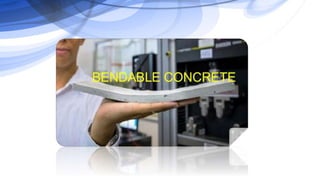
BENDABLE CONCRETE
CONTENTS:
Introduction
ECC
Ingredients of ECC
Environment Friendliness
Uses of ECC in Field
Advantages and Disadvantages
References
Introduction
• The recently developed smart building material namely Bendable
concrete also known as Flexible concrete or Engineered
Cementitious Composite (ECC), was developed by the Professor
Victor Li at the University of Michigan.
What is ECC ?
• It is a class of ultra-ductile fibre reinforced cementitious
composites characterised by high ductility and tight crack
width control.
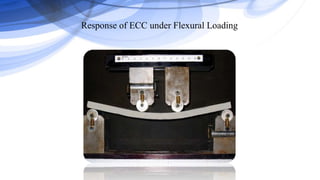
Response of ECC under Flexural Loading
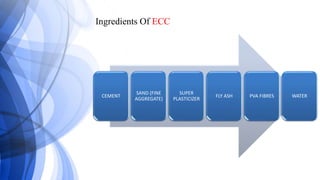
Ingredients Of ECC
CEMENT
SAND (FINE
AGGREGATE)
SUPER
PLASTICIZER
FLY ASH PVA FIBRES WATER
* CEMENT
Ordinary Portland Cement (OPC) – 53 grade is normally used.
* SAND
The fine aggregates passing through 4.75 mm sieve with a specific
gravity of 2.68 is normally used.
* SUPER PLASTICIZER
Super plasticizer used is Melamine Formaldehyde Sulphonate.
* FLY ASH
Fly ash used is pozzocrete dirk 60.
* PVA FIBRES
Polyvinyl Alcohol fibres covered with a very thin (nanometer thick),
slick coating is used.
* WATER
Water fit for drinking is generally considered fit for making concrete.
Environment Friendliness
ECC is a green construction material.
ECC is 37% less expensive, consumes 40% less energy, and produces 39% less carbon
dioxide than regular concrete.
ECC incorporates high volume of industrial wastes including fly ash, sands and wastes
from metal casting processes, wasted cement kiln dust from cement production.
Reduced emission of Greenhouse gases.
Uses of ECC in Field
The Mitaka Dam
near Hiroshima was
repaired using ECC
in 2003.
Also in 2003, an
earth retaining wall
in Gifu, Japan, was
repaired using ECC.
The 95 m (312ft.)
Glorio Roppongi
high-rise apartment
building in Tokyo
contains a total of
54 ECC coupling
beams (two per
story) intended to
mitigate earthquake
damage.
A 225 mm thick ECC
bridge deck on
interstate 94 in
Michigan was
completed in 2005.
And Many More…
Advantages
• It is more stronger, more durable, and lasts longer than
conventional concrete.
• It is more resistant to cracking.
• It is approx. 20-40% lighter.
• The use of steel reinforcement is reduced and can be eliminated.
• It reduces the cost of the project.
• It can be used as precast concrete
Disadvantages
• It has high initial cost as compared to conventional concrete.
• It requires skilled labour for construction.
• It needs some special type of materials which can be difficult to
find in some areas.
• Its quality depend upon the material used and the condition under
which it is made .
References
• V.C. Li, From Micromechanics to Structural Engineering – The
design of Cementitious Composites for Civil Engineering
Applications, Structural Engineering and Earthquake Engineering
, Japan Society of Civil Engineers.
• Cementitious composite bendable concrete, Construction
Innovation Forum, 6494 Latcha Road, Walbridge, USA, (2007).

Bendable concrete

  • 1.
  • 2.
  • 4.
    CONTENTS: Introduction ECC Ingredients of ECC EnvironmentFriendliness Uses of ECC in Field Advantages and Disadvantages References
  • 5.
    Introduction • The recentlydeveloped smart building material namely Bendable concrete also known as Flexible concrete or Engineered Cementitious Composite (ECC), was developed by the Professor Victor Li at the University of Michigan.
  • 6.
    What is ECC? • It is a class of ultra-ductile fibre reinforced cementitious composites characterised by high ductility and tight crack width control.
  • 7.
    Response of ECCunder Flexural Loading
  • 8.
    Ingredients Of ECC CEMENT SAND(FINE AGGREGATE) SUPER PLASTICIZER FLY ASH PVA FIBRES WATER
  • 9.
    * CEMENT Ordinary PortlandCement (OPC) – 53 grade is normally used. * SAND The fine aggregates passing through 4.75 mm sieve with a specific gravity of 2.68 is normally used. * SUPER PLASTICIZER Super plasticizer used is Melamine Formaldehyde Sulphonate.
  • 10.
    * FLY ASH Flyash used is pozzocrete dirk 60. * PVA FIBRES Polyvinyl Alcohol fibres covered with a very thin (nanometer thick), slick coating is used. * WATER Water fit for drinking is generally considered fit for making concrete.
  • 11.
    Environment Friendliness ECC isa green construction material. ECC is 37% less expensive, consumes 40% less energy, and produces 39% less carbon dioxide than regular concrete. ECC incorporates high volume of industrial wastes including fly ash, sands and wastes from metal casting processes, wasted cement kiln dust from cement production. Reduced emission of Greenhouse gases.
  • 12.
    Uses of ECCin Field The Mitaka Dam near Hiroshima was repaired using ECC in 2003. Also in 2003, an earth retaining wall in Gifu, Japan, was repaired using ECC. The 95 m (312ft.) Glorio Roppongi high-rise apartment building in Tokyo contains a total of 54 ECC coupling beams (two per story) intended to mitigate earthquake damage. A 225 mm thick ECC bridge deck on interstate 94 in Michigan was completed in 2005. And Many More…
  • 13.
    Advantages • It ismore stronger, more durable, and lasts longer than conventional concrete. • It is more resistant to cracking. • It is approx. 20-40% lighter. • The use of steel reinforcement is reduced and can be eliminated. • It reduces the cost of the project. • It can be used as precast concrete
  • 14.
    Disadvantages • It hashigh initial cost as compared to conventional concrete. • It requires skilled labour for construction. • It needs some special type of materials which can be difficult to find in some areas. • Its quality depend upon the material used and the condition under which it is made .
  • 15.
    References • V.C. Li,From Micromechanics to Structural Engineering – The design of Cementitious Composites for Civil Engineering Applications, Structural Engineering and Earthquake Engineering , Japan Society of Civil Engineers. • Cementitious composite bendable concrete, Construction Innovation Forum, 6494 Latcha Road, Walbridge, USA, (2007).