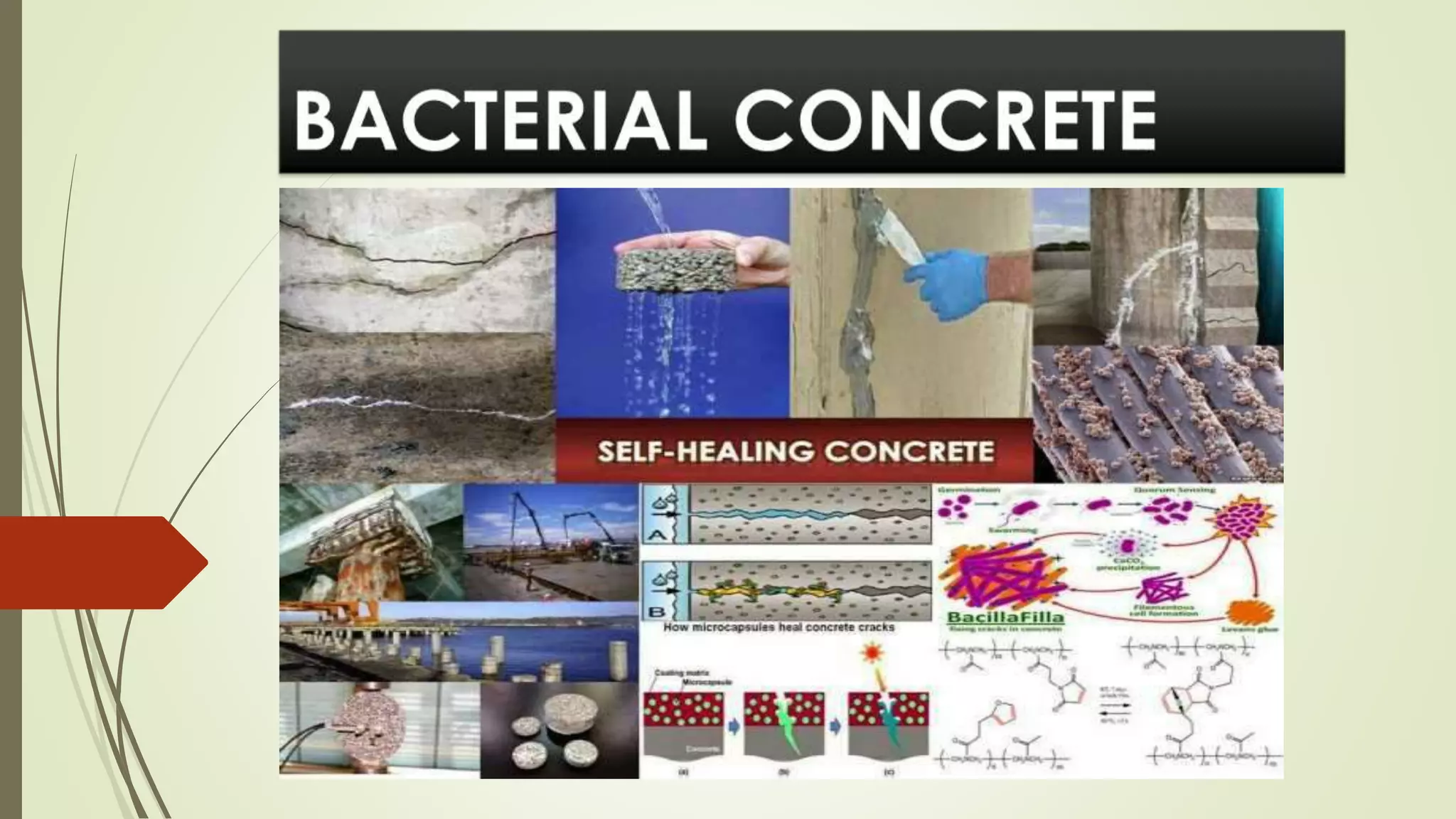
INTRODUCTION-:
- Cracking in concrete is a main concern throughout the
World because it cause loss of strength of structure with
Time.
- Maintaince of cracked structures require lot of care
and money.
- A environmental friendly solution is preferred i.e.
biological concrete over other alternatives like
epoxy resins which is non degradable.
- Spore forming alkali philic bacteria genus Bacillus, supplied
with a calcium-based nutrient are incorporated in to the
concrete suspended in mixing water.
- This bacteria based self healing agent is believed to remain
hibernated within the concrete for up to 200 years 2. When cracks
appear in a concrete structure and water starts to seep in through,
the spores of the bacteria starts microbial activities on contact with
the water and oxygen.
- In the process of precipitating calcite crystals through
nitrogen cycle the soluble nutrients are is converted to
insoluble CaCO3. The CaCO3 solidifies on the cracked
surface, thereby sealing it up.
Working process-:
Cracks less than .2mm can be auto fill by
concrete.
But if cracks are more than .2mm then
concrete itself fail to heal itself thus
opening passage to chemicals and other
cooroding materials.
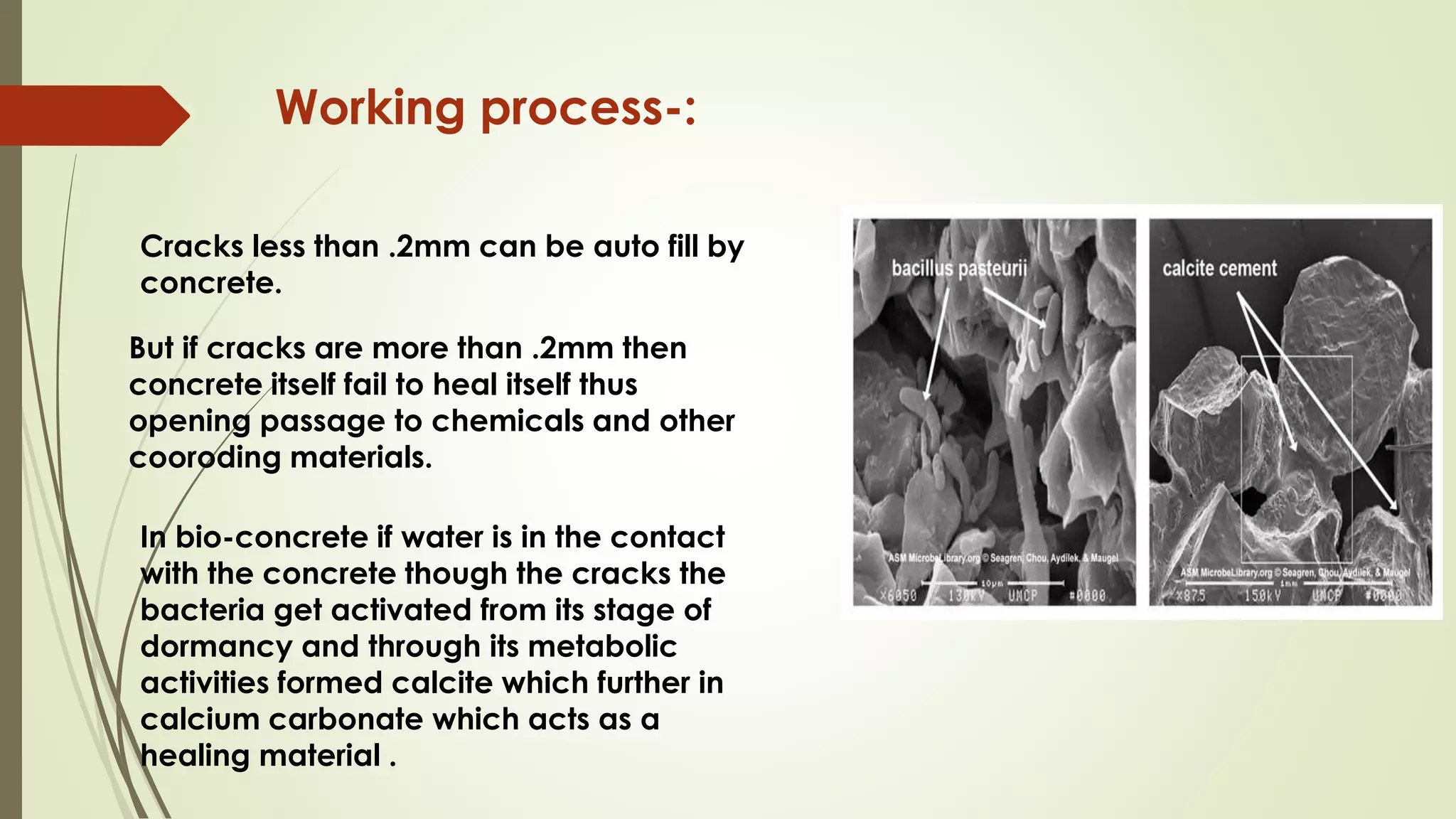
In bio-concrete if water is in the contact
with the concrete though the cracks the
bacteria get activated from its stage of
dormancy and through its metabolic
activities formed calcite which further in
calcium carbonate which acts as a
healing material .
- When the cracks is fill completely by the bacteria it again
went to the stage of dormancy again.
- Again if in future if cracks get widen and the foreign particles
tends to enter through the cracks the bacteria get activated
and thus heel the cracks. Thus acting as a long lasting healing
agent.
The following reactions carried out during the process-:
Due to the autogenous property of concrete reaction of
environmental carbon dioxide with calcium hydroxide present in
concrete
CO 2 + Ca(OH) 2 → CaCO 3 + H 2O
The bacterial action of self healing is prefer due to the active
metabolic conversion of calcium nutrients by the bacteria
present in concrete:
Ca(C 3H5O2)2 + 7O 2 → CaCO 3 + 5CO 2 + 5H 2O
This process does not only produce calcium carbonate
directly due to microbial metabolic process but also
indirectly due to autogeneous healing.
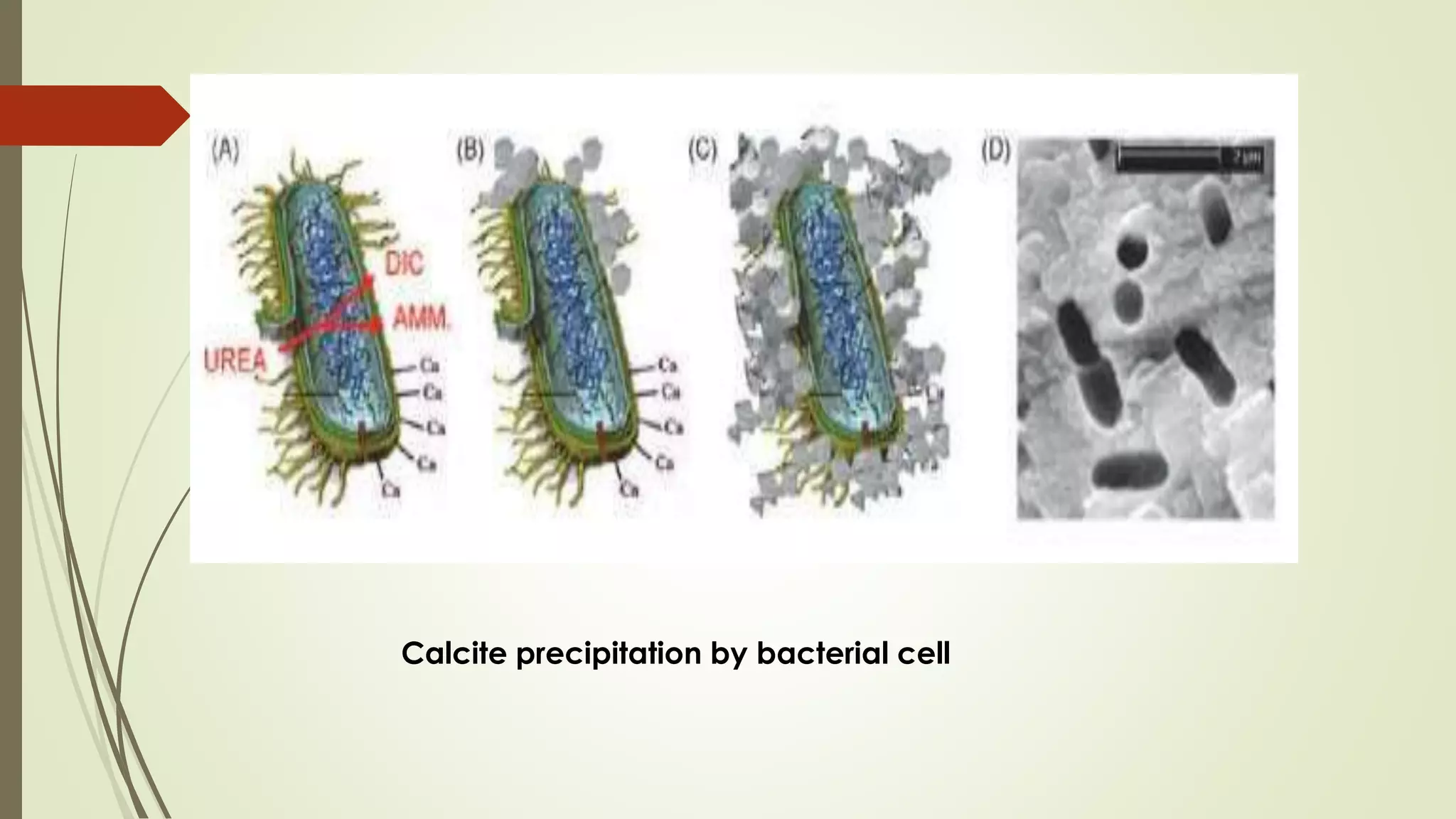
Ureolytic bacteria such as Bacillus subtilis JC3 can able to
precipitate CaCO 3 in the high alkaline environment by converting
urea into ammonium and carbonate.
1 mol. of urea is hydrolysed intracellularly to 1 mol of ammonia and 1 mol
of carbonate (Eq.1), which spontaneously hydrolyzes to form additional 1
mol of ammonia and carbonic acid (Eq.2) as follows: (with bacteria)
CO (NH2)2 + H2O →NH2COOH + NH3
NH2COOH + H2O →NH3 + H2CO3
These products equilibrate in water to form bicarbonate, 1 mol. of
ammonium and hydroxide ions which give rise to pH increase
H2CO3 2 H+ + 2CO32-
NH3 + H2O NH4- + OH-
Ca2 + CO32- CaCO3 (KSP = 3.8 × 10⁻⁹)
(KSP is the Solubility of product )
Calcite precipitation by bacterial cell
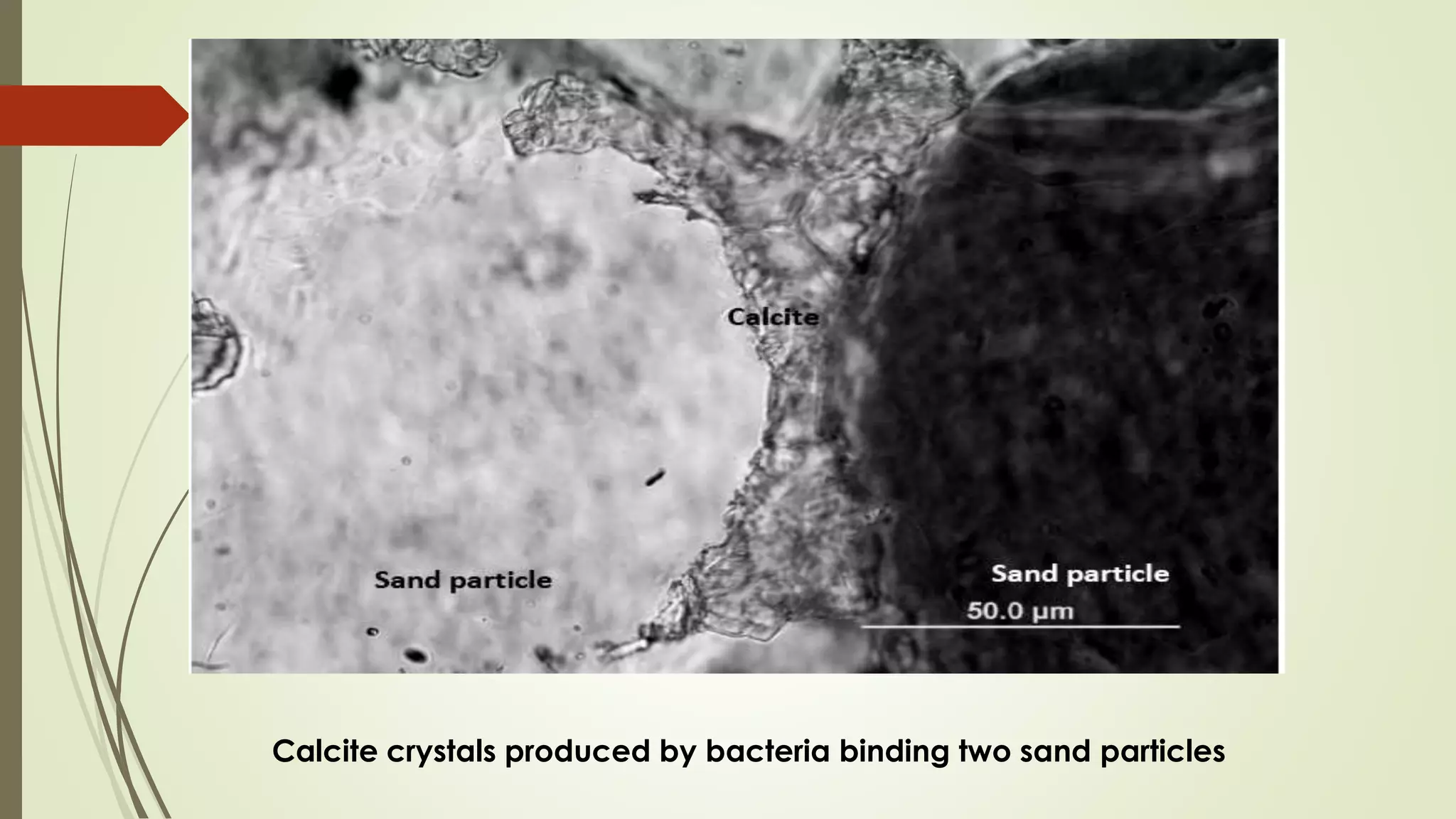
Calcite crystals produced by bacteria binding two sand particles
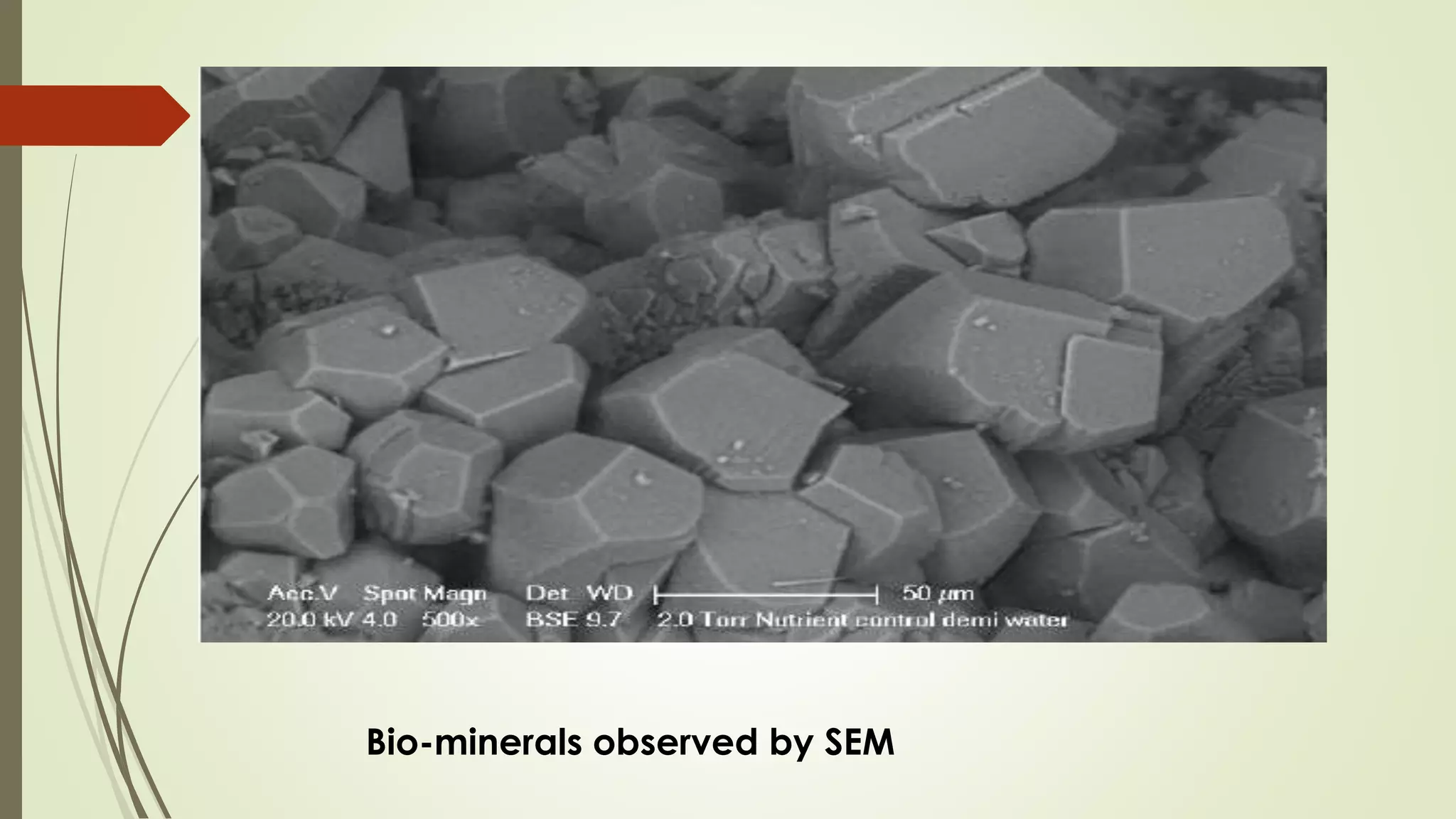
Bio-minerals observed by SEM
Viability of bacteria in concrete
-Only specific alkaliphilic bacteria can
survive in such hostile environment of
concrete.
-It is necessary to immobilize the bacterial
cells and to protect them from the high pH
in concrete 9.
- They should be able to perform long-term
effective crack sealing, preferably during the
total constructions life time.
-Both bacteria and a bio-cement precursor
compound should be integrated in the
material matrix.
Polyurethane (PU) has been widely for immobilization of nutrients
and bacterial cells even silica gel was used to protect the bacteria
against the high pH in concrete.
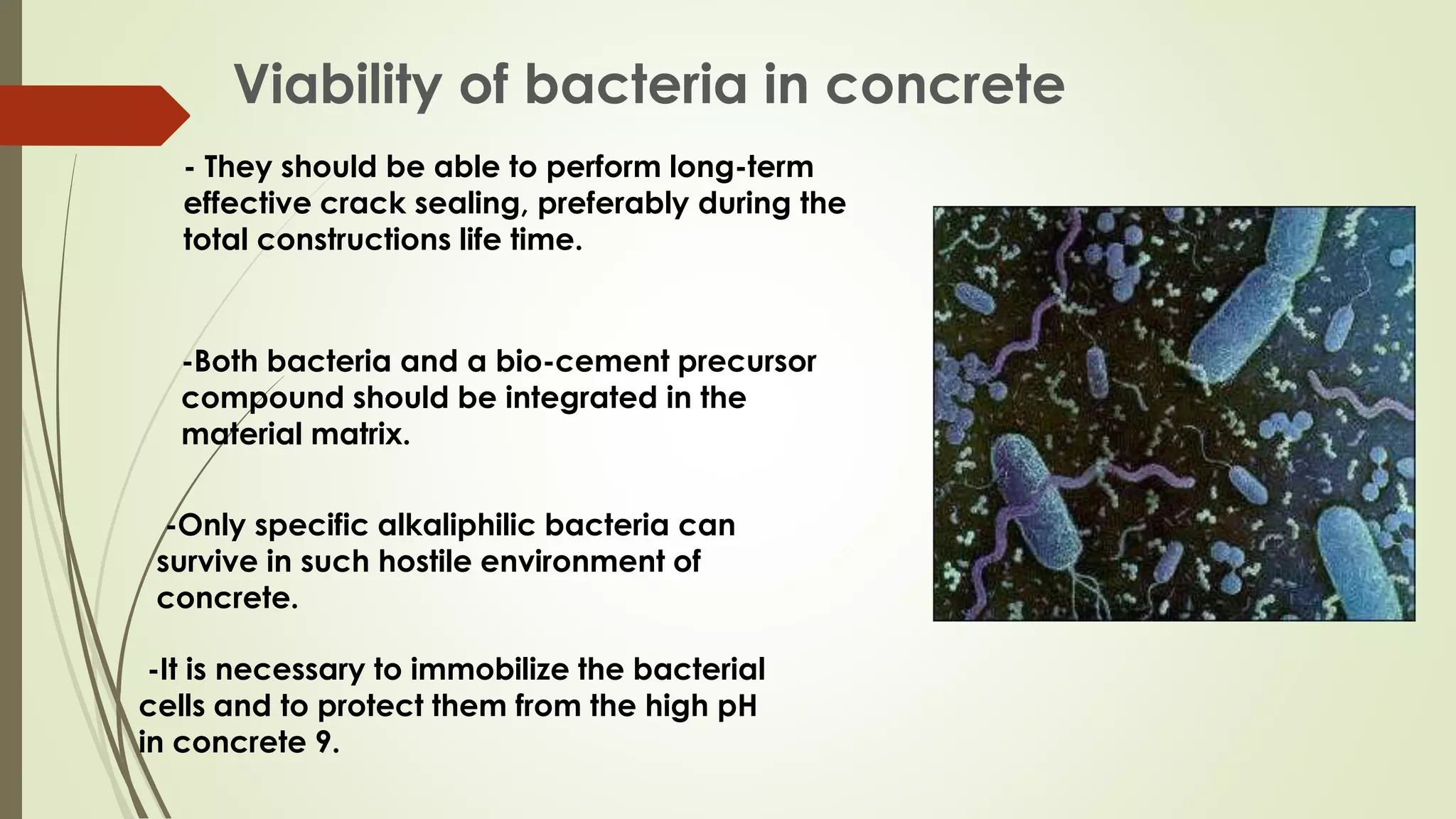
ESEM photomicrograph (5000x magnification) of alkali-resistant spore
forming bacterium (Bacillus strain B2-E2-1). Visible are active vegetative
bacteria (rods) and spores (spheres), showing that spore diameter sizes are in
the order of one micrometer.
Testing on Bacterial concrete
Strength Studies
28 days age
Compressive Strength (MPa)
Split Tensile Strength (MPa)
Flexural Strength (MPa)
Controlled Concrete Bio Concrete
M20 M40 M20 M40
28.8 52.01 32.74 61.04
3.26 4.51 3.73 5.13
4.68 6.11 6.11 7.73
RESULTS -:
Correlation curve between UPSV and compressive strength of Bacterial and
controlled concrete specimens of M20 Grade
Correlation curve between UPSV and compressive strength of Bacterial
and controlled concrete specimens of M40 Grade
ADVANTAGES AND DISADVANTAGES OF BACTERIAL
CONCRETE:
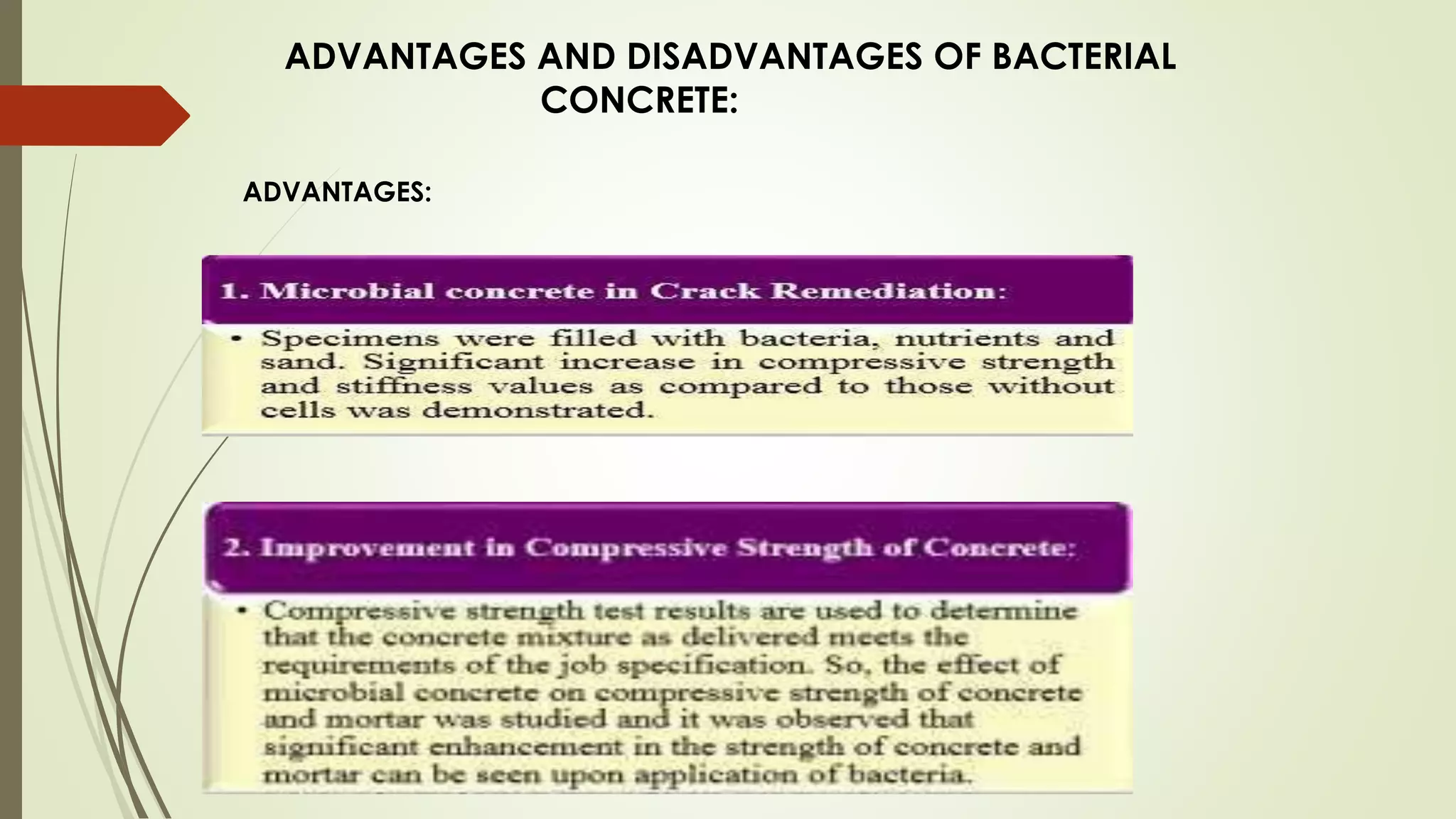
ADVANTAGES:
DIS-ADVANTAGES:
APPLICATION OF BACTERIA IN
CONSTRUCTION AREA
From enhancement in durability of cementitius materials to
improvement in sand properties, from repair of limestone monuments,
sealing of concrete cracks to highly durable bricks, microbial concrete
has been successful in one and all.
This new technology can provide ways for low cost and durable roads.
High strength buildings with more bearing capacity.
Long lasting river bank.
Erosion prevention of loose sands
Low cost durable housing.
Green Roofing
-Roof covered with vegetation cover over a water proofing
materials.
-A layer of mosses are allowed to grow due to the nutrient
media provided by biological concrete.
Practised generally for several purposes-:
-Absorbing rainwater thus keeping house cool and also
surronding.
-Creating habited for wildlife.
- Reduces pollution and providing hygienic environment.
Conclusion
-Microbial concrete technology has proved to be better than many
conventional technologies because of its eco- friendly nature, self-
healing abilities and increase in durability of various building materials.
-Work of various researchers has improved our understanding on
the possibilities and limitations of biotechnological applications on
building materials.
-Enhancement of compressive strength, reduction in permeability,
water absorption, reinforced corrosion have been seen in various
cementitious and stone materials.
-Cementation by this method is very easy and convenient for usage.
This will soon provide the basis for high quality structures that will be
cost effective and environmentally safe but, more work is required to
improve the feasibility of this technology from both an economical
and practical viewpoints.
Bacterial concrete

Bacterial concrete

  • 3.
    INTRODUCTION-: - Cracking inconcrete is a main concern throughout the World because it cause loss of strength of structure with Time. - Maintaince of cracked structures require lot of care and money. - A environmental friendly solution is preferred i.e. biological concrete over other alternatives like epoxy resins which is non degradable.
  • 4.
    - Spore formingalkali philic bacteria genus Bacillus, supplied with a calcium-based nutrient are incorporated in to the concrete suspended in mixing water. - This bacteria based self healing agent is believed to remain hibernated within the concrete for up to 200 years 2. When cracks appear in a concrete structure and water starts to seep in through, the spores of the bacteria starts microbial activities on contact with the water and oxygen. - In the process of precipitating calcite crystals through nitrogen cycle the soluble nutrients are is converted to insoluble CaCO3. The CaCO3 solidifies on the cracked surface, thereby sealing it up.
  • 8.
    Working process-: Cracks lessthan .2mm can be auto fill by concrete. But if cracks are more than .2mm then concrete itself fail to heal itself thus opening passage to chemicals and other cooroding materials. In bio-concrete if water is in the contact with the concrete though the cracks the bacteria get activated from its stage of dormancy and through its metabolic activities formed calcite which further in calcium carbonate which acts as a healing material .
  • 9.
    - When thecracks is fill completely by the bacteria it again went to the stage of dormancy again. - Again if in future if cracks get widen and the foreign particles tends to enter through the cracks the bacteria get activated and thus heel the cracks. Thus acting as a long lasting healing agent. The following reactions carried out during the process-: Due to the autogenous property of concrete reaction of environmental carbon dioxide with calcium hydroxide present in concrete CO 2 + Ca(OH) 2 → CaCO 3 + H 2O
  • 10.
    The bacterial actionof self healing is prefer due to the active metabolic conversion of calcium nutrients by the bacteria present in concrete: Ca(C 3H5O2)2 + 7O 2 → CaCO 3 + 5CO 2 + 5H 2O This process does not only produce calcium carbonate directly due to microbial metabolic process but also indirectly due to autogeneous healing. Ureolytic bacteria such as Bacillus subtilis JC3 can able to precipitate CaCO 3 in the high alkaline environment by converting urea into ammonium and carbonate.
  • 11.
    1 mol. ofurea is hydrolysed intracellularly to 1 mol of ammonia and 1 mol of carbonate (Eq.1), which spontaneously hydrolyzes to form additional 1 mol of ammonia and carbonic acid (Eq.2) as follows: (with bacteria) CO (NH2)2 + H2O →NH2COOH + NH3 NH2COOH + H2O →NH3 + H2CO3 These products equilibrate in water to form bicarbonate, 1 mol. of ammonium and hydroxide ions which give rise to pH increase H2CO3 2 H+ + 2CO32- NH3 + H2O NH4- + OH- Ca2 + CO32- CaCO3 (KSP = 3.8 × 10⁻⁹) (KSP is the Solubility of product )
  • 12.
  • 13.
    Calcite crystals producedby bacteria binding two sand particles
  • 14.
  • 20.
    Viability of bacteriain concrete -Only specific alkaliphilic bacteria can survive in such hostile environment of concrete. -It is necessary to immobilize the bacterial cells and to protect them from the high pH in concrete 9. - They should be able to perform long-term effective crack sealing, preferably during the total constructions life time. -Both bacteria and a bio-cement precursor compound should be integrated in the material matrix.
  • 21.
    Polyurethane (PU) hasbeen widely for immobilization of nutrients and bacterial cells even silica gel was used to protect the bacteria against the high pH in concrete. ESEM photomicrograph (5000x magnification) of alkali-resistant spore forming bacterium (Bacillus strain B2-E2-1). Visible are active vegetative bacteria (rods) and spores (spheres), showing that spore diameter sizes are in the order of one micrometer.
  • 22.
  • 23.
    Strength Studies 28 daysage Compressive Strength (MPa) Split Tensile Strength (MPa) Flexural Strength (MPa) Controlled Concrete Bio Concrete M20 M40 M20 M40 28.8 52.01 32.74 61.04 3.26 4.51 3.73 5.13 4.68 6.11 6.11 7.73 RESULTS -:
  • 24.
    Correlation curve betweenUPSV and compressive strength of Bacterial and controlled concrete specimens of M20 Grade
  • 25.
    Correlation curve betweenUPSV and compressive strength of Bacterial and controlled concrete specimens of M40 Grade
  • 26.
    ADVANTAGES AND DISADVANTAGESOF BACTERIAL CONCRETE: ADVANTAGES:
  • 29.
  • 31.
    APPLICATION OF BACTERIAIN CONSTRUCTION AREA From enhancement in durability of cementitius materials to improvement in sand properties, from repair of limestone monuments, sealing of concrete cracks to highly durable bricks, microbial concrete has been successful in one and all. This new technology can provide ways for low cost and durable roads. High strength buildings with more bearing capacity. Long lasting river bank. Erosion prevention of loose sands Low cost durable housing.
  • 33.
    Green Roofing -Roof coveredwith vegetation cover over a water proofing materials. -A layer of mosses are allowed to grow due to the nutrient media provided by biological concrete. Practised generally for several purposes-: -Absorbing rainwater thus keeping house cool and also surronding. -Creating habited for wildlife. - Reduces pollution and providing hygienic environment.
  • 35.
    Conclusion -Microbial concrete technologyhas proved to be better than many conventional technologies because of its eco- friendly nature, self- healing abilities and increase in durability of various building materials. -Work of various researchers has improved our understanding on the possibilities and limitations of biotechnological applications on building materials. -Enhancement of compressive strength, reduction in permeability, water absorption, reinforced corrosion have been seen in various cementitious and stone materials.
  • 36.
    -Cementation by thismethod is very easy and convenient for usage. This will soon provide the basis for high quality structures that will be cost effective and environmentally safe but, more work is required to improve the feasibility of this technology from both an economical and practical viewpoints.