BENDABLE
CONCRETE
June 24–26, 2008
Ann Arbor, Michigan
LEARN HOW THIS REVOLUTIONARY
MATERIAL MEETS STRUCTURAL
AND DURABILITY CHALLENGES
Mixed and applied using traditional methods,
this advanced synthetic fiber-reinforced engineered
material offers unique properties when compared
to traditional concrete:
Able to bend like a metal
Stronger, more durable, and lasts longer
Non-brittle (containing only two percent by
volume of short fibers)
500 times more resistant to cracking
Up to 40 percent lighter
Reduces or eliminates steel reinforcement
Reduces project cost
Faster precast or on-site construction
Minimizes maintenance cost
Reduces environmental impacts
Register Online Today: InterPro.engin.umich.edu
UNDERSTANDING AND USING
BENDABLE CONCRETE
presented by
A New Short Course Presented by the Inventor
of an Improved, More Environmentally Friendly
Engineered Cementitious Composite (ECC)
One of the “10 Tech Concepts
You Need to Know for 2007”
Popular Mechanics
One of the “Top 5 Concrete and
Masonry Products of 2006”
Architectural Record
Recently featured in
Concrete Engineering International
©2008TheRegentsoftheUniversityofMichigan41708
University of Michigan College of Engineering
Interdisciplinary Professional Programs
2401 Plymouth Road, Suite A
Ann Arbor, MI 48105-2193
(734) 647-7200 | (734) 998-6127 (fax)
The Regents of the University of Michigan
Julia Donovan Darlow, Ann Arbor
Laurence B. Deitch, Bingham Farms
Olivia P. Maynard, Goodrich
Rebecca McGowan, Ann Arbor
Andrea Fischer Newman, Ann Arbor
Andrew C. Richner, Grosse Pointe Park
S. Martin Taylor, Grosse Pointe Farms
Katherine E. White, Ann Arbor
Mary Sue Coleman (ex officio)
ABOUT INTERPRO
Michigan Interdisciplinary and Professional
Engineering (InterPro) develops and delivers
programs and services that enable engineers,
managers, and technical professionals to be
more effective, productive, and competitive.
InterPro extends and enhances the programs,
capabilities, and relationships of the faculty and
affiliates of the College of Engineering by offering
graduate degree programs, distance learning,
non-credit public short courses, professional
certification programs, and conferences.
Graduate degree programs currently
offered include:
Automotive Engineering
Energy Systems Engineering
Engineering Sustainable Systems
Financial Engineering
Global Automotive and Manufacturing
Engineering
Integrated Microsystems
Manufacturing Engineering
Pharmaceutical Engineering
indicates programs with an online delivery option.
Graduate Certificates of Advanced Studies
in Engineering (CASE) are also available in
some of the programs.
Professional development short courses and
certification programs include:
Six Sigma for product development,
manufacturing, and services
Lean for manufacturing, healthcare
and pharmaceuticals, logistics, office
and product development
Visit our website at InterPro.engin.umich.edu
for information on this and other Michigan
Engineering programs:
Lean Manufacturing
Lean Office & Business Processes
Certificate Program
Lean Product & Process Development
Certificate Program
Lean Healthcare
Lean Logistics & Supply Chain Certificate
Program
Lean Pharma
To learn more about InterPro programs, visit,
InterPro.engin.umich.edu, send an email to
MEonline@umich.edu or call (734) 647-7200.
The University of Michigan, as an equal opportunity/affirmative action
employer, complies with all applicable federal and state laws regarding
nondiscrimination and affirmative action, including Title IX of the Education
Amendments of 1972 and Section 504 of the Rehabilitation Act of 1973.
The University of Michigan is committed to a policy of nondiscrimination
and equal opportunity for all persons regardless of race, sex*, color, religion,
creed, national origin or ancestry, age, marital status, sexual orientation,
disability, or Vietnam-era veteran status in employment, educational
programs and activities, and admissions. Inquiries or complaints may be
addressed to the Senior Director for Institutional Equity and Title IX/Section
504 Coordinator, Office of Institutional Equity, 2072 Administrative Services
Building, Ann Arbor, Michigan 48109-1432, (734) 763-0235, TTY (734)
647-1388. For other University of Michigan information call (734) 764-1817.
*Includes gender identity and gender expression
ABOUT THE PROGRAM
Reducing the brittle nature of concrete has opened
a new world of possibilities to enhance the safety,
durability, and sustainability of the next generation
of civil infrastructure. In this new ECC material
which was under development at U-M for 10
years, specially coated microscopic polymer fibers
slide past each other instead of snapping under
stress, giving it incredible ductility previously only
seen in ductile metals.The fresh properties of ECC
have been tuned for ease in field casting using
familiar construction equipment.
Cost savings can be realized through more
efficient design as well as reductions in
material volume, labor cost, steel reinforcement,
and less frequent repairs.When long-term cost
and environmental impacts are accounted for, the
advantages offered by ECC over conventional
concrete become compelling.The material is
currently emerging in the repair, manufactured
product, pre-cast, and ready-mix markets as well
as in the bridge, pavement, agriculture, hous-
ing, and business industries where a lightweight,
strong, and durable building material is needed.
WHO SHOULD ATTEND
This program is intended for engineers and
industry professionals who can benefit by
learning about what can be accomplished
with less brittle concrete. Business develop-
ment consultants and entrepreneurs may find
applications for new market opportunities.
Markets open to the incorporation of ECCs
include transportation, building, water, and
energy supply infrastructure as well as the
housing, architectural, and manufactured
concrete product industries. It may be of
particular interest to those with experience
in the following fields:
Civil engineering
design
Architecture
Construction
Transportation
Concrete repair
consulting
Concrete product
manufacturing
Housing
Agriculture
DIRECTORS
PROGRAM DIRECTORS
VICTOR LI, Ph.D., is the E. Benjamin Wylie collegiate chair professor of Civil and
Environmental Engineering at the University of Michigan. He is the Director of the
Advanced Civil Engineering Materials Research Laboratory where ECC (bendable
concrete) was invented. Professor Li is a frequent keynote speaker in major national
and international conferences and often serves as the invited speaker at society
meetings of concrete professionals.Together with Drs. G. Fischer and M. Lepech,
he founded Li, Fischer, Lepech & Associates, a materials consulting firm specializing
in the application of ECC in commercial applications.
MICHAEL D. LEPECH, Ph.D.,Assistant Professor of Civil and Environmental
Engineering at Stanford University, has been working with Engineered Cementitious
Composites since 2001. His research specializations include the durability of ECC
materials and structures, the use of ECC in large-scale infrastructure applications,
and improving the environmental sustainability of built environments using ECC
materials. In 2005, he spearheaded the first large-scale demonstration of ECC in the
United States working with the Michigan Department of Transportation. He also
serves as a principal of Li, Fischer, Lepech & Associates.
PROGRAM COMPONENTS
DAY 1: BENDABLE CONCRETE
MATERIALS
Session 1: ECC Materials
Development
Constituent materials
Materials design methodology
Unique properties of ECC
Session 2: ECC Processing
Fresh self-consolidating material
properties
Large scale mixing using
commercial concrete batching
plants and trucks
Specialty processing techniques
(spraying, extrusion, precasting)
Laboratory demonstration mixing
DAY 2: BENDABLE CONCRETE
APPLICATIONS
Session 3: Structural Design
with ECC
Experimental structural studies
Shear behavior
Seismic resistance
Project case study—bridge
infrastructure
Construction specifications,
material quality assurance,
and quality control (QA/QC)
Impacts of design code
requirements
Session 4: Durability of ECC
Overcoming repeated concrete repairs
through advanced concrete materials
Durability of ECC in laboratory studies
ECC field performance in the
U.S. and Japan
A Green Solution
Based on a study by the U-M School of Natural Resources
and Environment’s Center for Sustainable Systems, using
this composite to replace conventional concrete in some
infrastructure applications can reduce life cycle costs by an
estimated 37%, energy consumption by 40%, and carbon
dioxide emissions by 39% (a major cause of global warming).
CONTINUING EDUCATION UNITS (CEUs)
Upon successful completion of this course
participants will receive two Continuing
Education Units.
HOW TO REGISTER*
Visit our website at InterPro.engin.umich.edu
or send an email to MEonline@umich.edu or
call (734) 647-7200.
*Program fees at the time of brochure printing. Check our current
program fee schedule at InterPro.engin.umich.edu. Fees are
subject to change.
$1,950* COVERS THE ENTIRE
PROGRAM Fee includes tuition, instructional
materials, continental breakfast, lunch, and
breaks each day. Fee is payable in advance.*
Upon registration, you will receive an email
confirmation including directions to the
program site and recommended lodging.
WANT TO SEND A TEAM FROM YOUR
ORGANIZATION? Contact us for discounted
prices for teams of five or more.
DAY 3 (HALF DAY): BENDABLE
CONCRETE ECONOMICS
Session 5: Economic and
Life Cycle Considerations
Initial material and construction
costs
Life cycle costing and
assessment methods for
durable ECC materials
Worldwide implementation
highlights
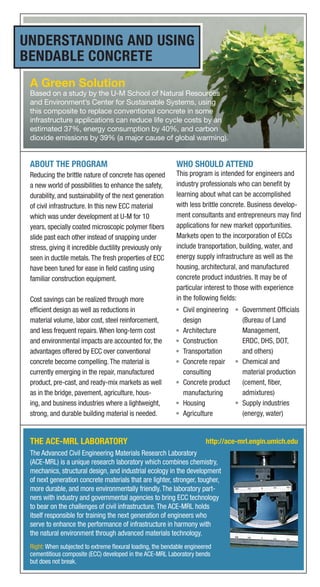
Right:When subjected to extreme flexural loading, the bendable engineered
cementitious composite (ECC) developed in the ACE-MRL Laboratory bends
but does not break.
The Advanced Civil Engineering Materials Research Laboratory
(ACE-MRL) is a unique research laboratory which combines chemistry,
mechanics, structural design, and industrial ecology in the development
of next generation concrete materials that are lighter, stronger, tougher,
more durable, and more environmentally friendly.The laboratory part-
ners with industry and governmental agencies to bring ECC technology
to bear on the challenges of civil infrastructure.The ACE-MRL holds
itself responsible for training the next generation of engineers who
serve to enhance the performance of infrastructure in harmony with
the natural environment through advanced materials technology.
THE ACE-MRL LABORATORY http://ace-mrl.engin.umich.edu
Government Officials
(Bureau of Land
Management,
ERDC, DHS, DOT,
and others)
Chemical and
material production
(cement, fiber,
admixtures)
Supply industries
(energy, water)
UNDERSTANDING AND USING
BENDABLE CONCRETE
ABOUT THE PROGRAM
Reducing the brittle nature of concrete has opened
a new world of possibilities to enhance the safety,
durability, and sustainability of the next generation
of civil infrastructure. In this new ECC material
which was under development at U-M for 10
years, specially coated microscopic polymer fibers
slide past each other instead of snapping under
stress, giving it incredible ductility previously only
seen in ductile metals.The fresh properties of ECC
have been tuned for ease in field casting using
familiar construction equipment.
Cost savings can be realized through more
efficient design as well as reductions in
material volume, labor cost, steel reinforcement,
and less frequent repairs.When long-term cost
and environmental impacts are accounted for, the
advantages offered by ECC over conventional
concrete become compelling.The material is
currently emerging in the repair, manufactured
product, pre-cast, and ready-mix markets as well
as in the bridge, pavement, agriculture, hous-
ing, and business industries where a lightweight,
strong, and durable building material is needed.
WHO SHOULD ATTEND
This program is intended for engineers and
industry professionals who can benefit by
learning about what can be accomplished
with less brittle concrete. Business develop-
ment consultants and entrepreneurs may find
applications for new market opportunities.
Markets open to the incorporation of ECCs
include transportation, building, water, and
energy supply infrastructure as well as the
housing, architectural, and manufactured
concrete product industries. It may be of
particular interest to those with experience
in the following fields:
Civil engineering
design
Architecture
Construction
Transportation
Concrete repair
consulting
Concrete product
manufacturing
Housing
Agriculture
DIRECTORS
PROGRAM DIRECTORS
VICTOR LI, Ph.D., is the E. Benjamin Wylie collegiate chair professor of Civil and
Environmental Engineering at the University of Michigan. He is the Director of the
Advanced Civil Engineering Materials Research Laboratory where ECC (bendable
concrete) was invented. Professor Li is a frequent keynote speaker in major national
and international conferences and often serves as the invited speaker at society
meetings of concrete professionals.Together with Drs. G. Fischer and M. Lepech,
he founded Li, Fischer, Lepech & Associates, a materials consulting firm specializing
in the application of ECC in commercial applications.
MICHAEL D. LEPECH, Ph.D.,Assistant Professor of Civil and Environmental
Engineering at Stanford University, has been working with Engineered Cementitious
Composites since 2001. His research specializations include the durability of ECC
materials and structures, the use of ECC in large-scale infrastructure applications,
and improving the environmental sustainability of built environments using ECC
materials. In 2005, he spearheaded the first large-scale demonstration of ECC in the
United States working with the Michigan Department of Transportation. He also
serves as a principal of Li, Fischer, Lepech & Associates.
PROGRAM COMPONENTS
DAY 1: BENDABLE CONCRETE
MATERIALS
Session 1: ECC Materials
Development
Constituent materials
Materials design methodology
Unique properties of ECC
Session 2: ECC Processing
Fresh self-consolidating material
properties
Large scale mixing using
commercial concrete batching
plants and trucks
Specialty processing techniques
(spraying, extrusion, precasting)
Laboratory demonstration mixing
DAY 2: BENDABLE CONCRETE
APPLICATIONS
Session 3: Structural Design
with ECC
Experimental structural studies
Shear behavior
Seismic resistance
Project case study—bridge
infrastructure
Construction specifications,
material quality assurance,
and quality control (QA/QC)
Impacts of design code
requirements
Session 4: Durability of ECC
Overcoming repeated concrete repairs
through advanced concrete materials
Durability of ECC in laboratory studies
ECC field performance in the
U.S. and Japan
A Green Solution
Based on a study by the U-M School of Natural Resources
and Environment’s Center for Sustainable Systems, using
this composite to replace conventional concrete in some
infrastructure applications can reduce life cycle costs by an
estimated 37%, energy consumption by 40%, and carbon
dioxide emissions by 39% (a major cause of global warming).
CONTINUING EDUCATION UNITS (CEUs)
Upon successful completion of this course
participants will receive two Continuing
Education Units.
HOW TO REGISTER*
Visit our website at InterPro.engin.umich.edu
or send an email to MEonline@umich.edu or
call (734) 647-7200.
*Program fees at the time of brochure printing. Check our current
program fee schedule at InterPro.engin.umich.edu. Fees are
subject to change.
$1,950* COVERS THE ENTIRE
PROGRAM Fee includes tuition, instructional
materials, continental breakfast, lunch, and
breaks each day. Fee is payable in advance.*
Upon registration, you will receive an email
confirmation including directions to the
program site and recommended lodging.
WANT TO SEND A TEAM FROM YOUR
ORGANIZATION? Contact us for discounted
prices for teams of five or more.
DAY 3 (HALF DAY): BENDABLE
CONCRETE ECONOMICS
Session 5: Economic and
Life Cycle Considerations
Initial material and construction
costs
Life cycle costing and
assessment methods for
durable ECC materials
Worldwide implementation
highlights
Right:When subjected to extreme flexural loading, the bendable engineered
cementitious composite (ECC) developed in the ACE-MRL Laboratory bends
but does not break.
The Advanced Civil Engineering Materials Research Laboratory
(ACE-MRL) is a unique research laboratory which combines chemistry,
mechanics, structural design, and industrial ecology in the development
of next generation concrete materials that are lighter, stronger, tougher,
more durable, and more environmentally friendly.The laboratory part-
ners with industry and governmental agencies to bring ECC technology
to bear on the challenges of civil infrastructure.The ACE-MRL holds
itself responsible for training the next generation of engineers who
serve to enhance the performance of infrastructure in harmony with
the natural environment through advanced materials technology.
THE ACE-MRL LABORATORY http://ace-mrl.engin.umich.edu
Government Officials
(Bureau of Land
Management,
ERDC, DHS, DOT,
and others)
Chemical and
material production
(cement, fiber,
admixtures)
Supply industries
(energy, water)
UNDERSTANDING AND USING
BENDABLE CONCRETE
BENDABLE
CONCRETE
June 24–26, 2008
Ann Arbor, Michigan
LEARN HOW THIS REVOLUTIONARY
MATERIAL MEETS STRUCTURAL
AND DURABILITY CHALLENGES
Mixed and applied using traditional methods,
this advanced synthetic fiber-reinforced engineered
material offers unique properties when compared
to traditional concrete:
Able to bend like a metal
Stronger, more durable, and lasts longer
Non-brittle (containing only two percent by
volume of short fibers)
500 times more resistant to cracking
Up to 40 percent lighter
Reduces or eliminates steel reinforcement
Reduces project cost
Faster precast or on-site construction
Minimizes maintenance cost
Reduces environmental impacts
Register Online Today: InterPro.engin.umich.edu
UNDERSTANDING AND USING
BENDABLE CONCRETE
presented by
A New Short Course Presented by the Inventor
of an Improved, More Environmentally Friendly
Engineered Cementitious Composite (ECC)
One of the “10 Tech Concepts
You Need to Know for 2007”
Popular Mechanics
One of the “Top 5 Concrete and
Masonry Products of 2006”
Architectural Record
Recently featured in
Concrete Engineering International
©2008TheRegentsoftheUniversityofMichigan41708
University of Michigan College of Engineering
Interdisciplinary Professional Programs
2401 Plymouth Road, Suite A
Ann Arbor, MI 48105-2193
(734) 647-7200 | (734) 998-6127 (fax)
The Regents of the University of Michigan
Julia Donovan Darlow, Ann Arbor
Laurence B. Deitch, Bingham Farms
Olivia P. Maynard, Goodrich
Rebecca McGowan, Ann Arbor
Andrea Fischer Newman, Ann Arbor
Andrew C. Richner, Grosse Pointe Park
S. Martin Taylor, Grosse Pointe Farms
Katherine E. White, Ann Arbor
Mary Sue Coleman (ex officio)
ABOUT INTERPRO
Michigan Interdisciplinary and Professional
Engineering (InterPro) develops and delivers
programs and services that enable engineers,
managers, and technical professionals to be
more effective, productive, and competitive.
InterPro extends and enhances the programs,
capabilities, and relationships of the faculty and
affiliates of the College of Engineering by offering
graduate degree programs, distance learning,
non-credit public short courses, professional
certification programs, and conferences.
Graduate degree programs currently
offered include:
Automotive Engineering
Energy Systems Engineering
Engineering Sustainable Systems
Financial Engineering
Global Automotive and Manufacturing
Engineering
Integrated Microsystems
Manufacturing Engineering
Pharmaceutical Engineering
indicates programs with an online delivery option.
Graduate Certificates of Advanced Studies
in Engineering (CASE) are also available in
some of the programs.
Professional development short courses and
certification programs include:
Six Sigma for product development,
manufacturing, and services
Lean for manufacturing, healthcare
and pharmaceuticals, logistics, office
and product development
Visit our website at InterPro.engin.umich.edu
for information on this and other Michigan
Engineering programs:
Lean Manufacturing
Lean Office & Business Processes
Certificate Program
Lean Product & Process Development
Certificate Program
Lean Healthcare
Lean Logistics & Supply Chain Certificate
Program
Lean Pharma
To learn more about InterPro programs, visit,
InterPro.engin.umich.edu, send an email to
MEonline@umich.edu or call (734) 647-7200.
The University of Michigan, as an equal opportunity/affirmative action
employer, complies with all applicable federal and state laws regarding
nondiscrimination and affirmative action, including Title IX of the Education
Amendments of 1972 and Section 504 of the Rehabilitation Act of 1973.
The University of Michigan is committed to a policy of nondiscrimination
and equal opportunity for all persons regardless of race, sex*, color, religion,
creed, national origin or ancestry, age, marital status, sexual orientation,
disability, or Vietnam-era veteran status in employment, educational
programs and activities, and admissions. Inquiries or complaints may be
addressed to the Senior Director for Institutional Equity and Title IX/Section
504 Coordinator, Office of Institutional Equity, 2072 Administrative Services
Building, Ann Arbor, Michigan 48109-1432, (734) 763-0235, TTY (734)
647-1388. For other University of Michigan information call (734) 764-1817.
*Includes gender identity and gender expression

Bendable concrete web_41708

  • 1.
    BENDABLE CONCRETE June 24–26, 2008 AnnArbor, Michigan LEARN HOW THIS REVOLUTIONARY MATERIAL MEETS STRUCTURAL AND DURABILITY CHALLENGES Mixed and applied using traditional methods, this advanced synthetic fiber-reinforced engineered material offers unique properties when compared to traditional concrete: Able to bend like a metal Stronger, more durable, and lasts longer Non-brittle (containing only two percent by volume of short fibers) 500 times more resistant to cracking Up to 40 percent lighter Reduces or eliminates steel reinforcement Reduces project cost Faster precast or on-site construction Minimizes maintenance cost Reduces environmental impacts Register Online Today: InterPro.engin.umich.edu UNDERSTANDING AND USING BENDABLE CONCRETE presented by A New Short Course Presented by the Inventor of an Improved, More Environmentally Friendly Engineered Cementitious Composite (ECC) One of the “10 Tech Concepts You Need to Know for 2007” Popular Mechanics One of the “Top 5 Concrete and Masonry Products of 2006” Architectural Record Recently featured in Concrete Engineering International ©2008TheRegentsoftheUniversityofMichigan41708 University of Michigan College of Engineering Interdisciplinary Professional Programs 2401 Plymouth Road, Suite A Ann Arbor, MI 48105-2193 (734) 647-7200 | (734) 998-6127 (fax) The Regents of the University of Michigan Julia Donovan Darlow, Ann Arbor Laurence B. Deitch, Bingham Farms Olivia P. Maynard, Goodrich Rebecca McGowan, Ann Arbor Andrea Fischer Newman, Ann Arbor Andrew C. Richner, Grosse Pointe Park S. Martin Taylor, Grosse Pointe Farms Katherine E. White, Ann Arbor Mary Sue Coleman (ex officio) ABOUT INTERPRO Michigan Interdisciplinary and Professional Engineering (InterPro) develops and delivers programs and services that enable engineers, managers, and technical professionals to be more effective, productive, and competitive. InterPro extends and enhances the programs, capabilities, and relationships of the faculty and affiliates of the College of Engineering by offering graduate degree programs, distance learning, non-credit public short courses, professional certification programs, and conferences. Graduate degree programs currently offered include: Automotive Engineering Energy Systems Engineering Engineering Sustainable Systems Financial Engineering Global Automotive and Manufacturing Engineering Integrated Microsystems Manufacturing Engineering Pharmaceutical Engineering indicates programs with an online delivery option. Graduate Certificates of Advanced Studies in Engineering (CASE) are also available in some of the programs. Professional development short courses and certification programs include: Six Sigma for product development, manufacturing, and services Lean for manufacturing, healthcare and pharmaceuticals, logistics, office and product development Visit our website at InterPro.engin.umich.edu for information on this and other Michigan Engineering programs: Lean Manufacturing Lean Office & Business Processes Certificate Program Lean Product & Process Development Certificate Program Lean Healthcare Lean Logistics & Supply Chain Certificate Program Lean Pharma To learn more about InterPro programs, visit, InterPro.engin.umich.edu, send an email to MEonline@umich.edu or call (734) 647-7200. The University of Michigan, as an equal opportunity/affirmative action employer, complies with all applicable federal and state laws regarding nondiscrimination and affirmative action, including Title IX of the Education Amendments of 1972 and Section 504 of the Rehabilitation Act of 1973. The University of Michigan is committed to a policy of nondiscrimination and equal opportunity for all persons regardless of race, sex*, color, religion, creed, national origin or ancestry, age, marital status, sexual orientation, disability, or Vietnam-era veteran status in employment, educational programs and activities, and admissions. Inquiries or complaints may be addressed to the Senior Director for Institutional Equity and Title IX/Section 504 Coordinator, Office of Institutional Equity, 2072 Administrative Services Building, Ann Arbor, Michigan 48109-1432, (734) 763-0235, TTY (734) 647-1388. For other University of Michigan information call (734) 764-1817. *Includes gender identity and gender expression
  • 2.
    ABOUT THE PROGRAM Reducingthe brittle nature of concrete has opened a new world of possibilities to enhance the safety, durability, and sustainability of the next generation of civil infrastructure. In this new ECC material which was under development at U-M for 10 years, specially coated microscopic polymer fibers slide past each other instead of snapping under stress, giving it incredible ductility previously only seen in ductile metals.The fresh properties of ECC have been tuned for ease in field casting using familiar construction equipment. Cost savings can be realized through more efficient design as well as reductions in material volume, labor cost, steel reinforcement, and less frequent repairs.When long-term cost and environmental impacts are accounted for, the advantages offered by ECC over conventional concrete become compelling.The material is currently emerging in the repair, manufactured product, pre-cast, and ready-mix markets as well as in the bridge, pavement, agriculture, hous- ing, and business industries where a lightweight, strong, and durable building material is needed. WHO SHOULD ATTEND This program is intended for engineers and industry professionals who can benefit by learning about what can be accomplished with less brittle concrete. Business develop- ment consultants and entrepreneurs may find applications for new market opportunities. Markets open to the incorporation of ECCs include transportation, building, water, and energy supply infrastructure as well as the housing, architectural, and manufactured concrete product industries. It may be of particular interest to those with experience in the following fields: Civil engineering design Architecture Construction Transportation Concrete repair consulting Concrete product manufacturing Housing Agriculture DIRECTORS PROGRAM DIRECTORS VICTOR LI, Ph.D., is the E. Benjamin Wylie collegiate chair professor of Civil and Environmental Engineering at the University of Michigan. He is the Director of the Advanced Civil Engineering Materials Research Laboratory where ECC (bendable concrete) was invented. Professor Li is a frequent keynote speaker in major national and international conferences and often serves as the invited speaker at society meetings of concrete professionals.Together with Drs. G. Fischer and M. Lepech, he founded Li, Fischer, Lepech & Associates, a materials consulting firm specializing in the application of ECC in commercial applications. MICHAEL D. LEPECH, Ph.D.,Assistant Professor of Civil and Environmental Engineering at Stanford University, has been working with Engineered Cementitious Composites since 2001. His research specializations include the durability of ECC materials and structures, the use of ECC in large-scale infrastructure applications, and improving the environmental sustainability of built environments using ECC materials. In 2005, he spearheaded the first large-scale demonstration of ECC in the United States working with the Michigan Department of Transportation. He also serves as a principal of Li, Fischer, Lepech & Associates. PROGRAM COMPONENTS DAY 1: BENDABLE CONCRETE MATERIALS Session 1: ECC Materials Development Constituent materials Materials design methodology Unique properties of ECC Session 2: ECC Processing Fresh self-consolidating material properties Large scale mixing using commercial concrete batching plants and trucks Specialty processing techniques (spraying, extrusion, precasting) Laboratory demonstration mixing DAY 2: BENDABLE CONCRETE APPLICATIONS Session 3: Structural Design with ECC Experimental structural studies Shear behavior Seismic resistance Project case study—bridge infrastructure Construction specifications, material quality assurance, and quality control (QA/QC) Impacts of design code requirements Session 4: Durability of ECC Overcoming repeated concrete repairs through advanced concrete materials Durability of ECC in laboratory studies ECC field performance in the U.S. and Japan A Green Solution Based on a study by the U-M School of Natural Resources and Environment’s Center for Sustainable Systems, using this composite to replace conventional concrete in some infrastructure applications can reduce life cycle costs by an estimated 37%, energy consumption by 40%, and carbon dioxide emissions by 39% (a major cause of global warming). CONTINUING EDUCATION UNITS (CEUs) Upon successful completion of this course participants will receive two Continuing Education Units. HOW TO REGISTER* Visit our website at InterPro.engin.umich.edu or send an email to MEonline@umich.edu or call (734) 647-7200. *Program fees at the time of brochure printing. Check our current program fee schedule at InterPro.engin.umich.edu. Fees are subject to change. $1,950* COVERS THE ENTIRE PROGRAM Fee includes tuition, instructional materials, continental breakfast, lunch, and breaks each day. Fee is payable in advance.* Upon registration, you will receive an email confirmation including directions to the program site and recommended lodging. WANT TO SEND A TEAM FROM YOUR ORGANIZATION? Contact us for discounted prices for teams of five or more. DAY 3 (HALF DAY): BENDABLE CONCRETE ECONOMICS Session 5: Economic and Life Cycle Considerations Initial material and construction costs Life cycle costing and assessment methods for durable ECC materials Worldwide implementation highlights Right:When subjected to extreme flexural loading, the bendable engineered cementitious composite (ECC) developed in the ACE-MRL Laboratory bends but does not break. The Advanced Civil Engineering Materials Research Laboratory (ACE-MRL) is a unique research laboratory which combines chemistry, mechanics, structural design, and industrial ecology in the development of next generation concrete materials that are lighter, stronger, tougher, more durable, and more environmentally friendly.The laboratory part- ners with industry and governmental agencies to bring ECC technology to bear on the challenges of civil infrastructure.The ACE-MRL holds itself responsible for training the next generation of engineers who serve to enhance the performance of infrastructure in harmony with the natural environment through advanced materials technology. THE ACE-MRL LABORATORY http://ace-mrl.engin.umich.edu Government Officials (Bureau of Land Management, ERDC, DHS, DOT, and others) Chemical and material production (cement, fiber, admixtures) Supply industries (energy, water) UNDERSTANDING AND USING BENDABLE CONCRETE
  • 3.
    ABOUT THE PROGRAM Reducingthe brittle nature of concrete has opened a new world of possibilities to enhance the safety, durability, and sustainability of the next generation of civil infrastructure. In this new ECC material which was under development at U-M for 10 years, specially coated microscopic polymer fibers slide past each other instead of snapping under stress, giving it incredible ductility previously only seen in ductile metals.The fresh properties of ECC have been tuned for ease in field casting using familiar construction equipment. Cost savings can be realized through more efficient design as well as reductions in material volume, labor cost, steel reinforcement, and less frequent repairs.When long-term cost and environmental impacts are accounted for, the advantages offered by ECC over conventional concrete become compelling.The material is currently emerging in the repair, manufactured product, pre-cast, and ready-mix markets as well as in the bridge, pavement, agriculture, hous- ing, and business industries where a lightweight, strong, and durable building material is needed. WHO SHOULD ATTEND This program is intended for engineers and industry professionals who can benefit by learning about what can be accomplished with less brittle concrete. Business develop- ment consultants and entrepreneurs may find applications for new market opportunities. Markets open to the incorporation of ECCs include transportation, building, water, and energy supply infrastructure as well as the housing, architectural, and manufactured concrete product industries. It may be of particular interest to those with experience in the following fields: Civil engineering design Architecture Construction Transportation Concrete repair consulting Concrete product manufacturing Housing Agriculture DIRECTORS PROGRAM DIRECTORS VICTOR LI, Ph.D., is the E. Benjamin Wylie collegiate chair professor of Civil and Environmental Engineering at the University of Michigan. He is the Director of the Advanced Civil Engineering Materials Research Laboratory where ECC (bendable concrete) was invented. Professor Li is a frequent keynote speaker in major national and international conferences and often serves as the invited speaker at society meetings of concrete professionals.Together with Drs. G. Fischer and M. Lepech, he founded Li, Fischer, Lepech & Associates, a materials consulting firm specializing in the application of ECC in commercial applications. MICHAEL D. LEPECH, Ph.D.,Assistant Professor of Civil and Environmental Engineering at Stanford University, has been working with Engineered Cementitious Composites since 2001. His research specializations include the durability of ECC materials and structures, the use of ECC in large-scale infrastructure applications, and improving the environmental sustainability of built environments using ECC materials. In 2005, he spearheaded the first large-scale demonstration of ECC in the United States working with the Michigan Department of Transportation. He also serves as a principal of Li, Fischer, Lepech & Associates. PROGRAM COMPONENTS DAY 1: BENDABLE CONCRETE MATERIALS Session 1: ECC Materials Development Constituent materials Materials design methodology Unique properties of ECC Session 2: ECC Processing Fresh self-consolidating material properties Large scale mixing using commercial concrete batching plants and trucks Specialty processing techniques (spraying, extrusion, precasting) Laboratory demonstration mixing DAY 2: BENDABLE CONCRETE APPLICATIONS Session 3: Structural Design with ECC Experimental structural studies Shear behavior Seismic resistance Project case study—bridge infrastructure Construction specifications, material quality assurance, and quality control (QA/QC) Impacts of design code requirements Session 4: Durability of ECC Overcoming repeated concrete repairs through advanced concrete materials Durability of ECC in laboratory studies ECC field performance in the U.S. and Japan A Green Solution Based on a study by the U-M School of Natural Resources and Environment’s Center for Sustainable Systems, using this composite to replace conventional concrete in some infrastructure applications can reduce life cycle costs by an estimated 37%, energy consumption by 40%, and carbon dioxide emissions by 39% (a major cause of global warming). CONTINUING EDUCATION UNITS (CEUs) Upon successful completion of this course participants will receive two Continuing Education Units. HOW TO REGISTER* Visit our website at InterPro.engin.umich.edu or send an email to MEonline@umich.edu or call (734) 647-7200. *Program fees at the time of brochure printing. Check our current program fee schedule at InterPro.engin.umich.edu. Fees are subject to change. $1,950* COVERS THE ENTIRE PROGRAM Fee includes tuition, instructional materials, continental breakfast, lunch, and breaks each day. Fee is payable in advance.* Upon registration, you will receive an email confirmation including directions to the program site and recommended lodging. WANT TO SEND A TEAM FROM YOUR ORGANIZATION? Contact us for discounted prices for teams of five or more. DAY 3 (HALF DAY): BENDABLE CONCRETE ECONOMICS Session 5: Economic and Life Cycle Considerations Initial material and construction costs Life cycle costing and assessment methods for durable ECC materials Worldwide implementation highlights Right:When subjected to extreme flexural loading, the bendable engineered cementitious composite (ECC) developed in the ACE-MRL Laboratory bends but does not break. The Advanced Civil Engineering Materials Research Laboratory (ACE-MRL) is a unique research laboratory which combines chemistry, mechanics, structural design, and industrial ecology in the development of next generation concrete materials that are lighter, stronger, tougher, more durable, and more environmentally friendly.The laboratory part- ners with industry and governmental agencies to bring ECC technology to bear on the challenges of civil infrastructure.The ACE-MRL holds itself responsible for training the next generation of engineers who serve to enhance the performance of infrastructure in harmony with the natural environment through advanced materials technology. THE ACE-MRL LABORATORY http://ace-mrl.engin.umich.edu Government Officials (Bureau of Land Management, ERDC, DHS, DOT, and others) Chemical and material production (cement, fiber, admixtures) Supply industries (energy, water) UNDERSTANDING AND USING BENDABLE CONCRETE
  • 4.
    BENDABLE CONCRETE June 24–26, 2008 AnnArbor, Michigan LEARN HOW THIS REVOLUTIONARY MATERIAL MEETS STRUCTURAL AND DURABILITY CHALLENGES Mixed and applied using traditional methods, this advanced synthetic fiber-reinforced engineered material offers unique properties when compared to traditional concrete: Able to bend like a metal Stronger, more durable, and lasts longer Non-brittle (containing only two percent by volume of short fibers) 500 times more resistant to cracking Up to 40 percent lighter Reduces or eliminates steel reinforcement Reduces project cost Faster precast or on-site construction Minimizes maintenance cost Reduces environmental impacts Register Online Today: InterPro.engin.umich.edu UNDERSTANDING AND USING BENDABLE CONCRETE presented by A New Short Course Presented by the Inventor of an Improved, More Environmentally Friendly Engineered Cementitious Composite (ECC) One of the “10 Tech Concepts You Need to Know for 2007” Popular Mechanics One of the “Top 5 Concrete and Masonry Products of 2006” Architectural Record Recently featured in Concrete Engineering International ©2008TheRegentsoftheUniversityofMichigan41708 University of Michigan College of Engineering Interdisciplinary Professional Programs 2401 Plymouth Road, Suite A Ann Arbor, MI 48105-2193 (734) 647-7200 | (734) 998-6127 (fax) The Regents of the University of Michigan Julia Donovan Darlow, Ann Arbor Laurence B. Deitch, Bingham Farms Olivia P. Maynard, Goodrich Rebecca McGowan, Ann Arbor Andrea Fischer Newman, Ann Arbor Andrew C. Richner, Grosse Pointe Park S. Martin Taylor, Grosse Pointe Farms Katherine E. White, Ann Arbor Mary Sue Coleman (ex officio) ABOUT INTERPRO Michigan Interdisciplinary and Professional Engineering (InterPro) develops and delivers programs and services that enable engineers, managers, and technical professionals to be more effective, productive, and competitive. InterPro extends and enhances the programs, capabilities, and relationships of the faculty and affiliates of the College of Engineering by offering graduate degree programs, distance learning, non-credit public short courses, professional certification programs, and conferences. Graduate degree programs currently offered include: Automotive Engineering Energy Systems Engineering Engineering Sustainable Systems Financial Engineering Global Automotive and Manufacturing Engineering Integrated Microsystems Manufacturing Engineering Pharmaceutical Engineering indicates programs with an online delivery option. Graduate Certificates of Advanced Studies in Engineering (CASE) are also available in some of the programs. Professional development short courses and certification programs include: Six Sigma for product development, manufacturing, and services Lean for manufacturing, healthcare and pharmaceuticals, logistics, office and product development Visit our website at InterPro.engin.umich.edu for information on this and other Michigan Engineering programs: Lean Manufacturing Lean Office & Business Processes Certificate Program Lean Product & Process Development Certificate Program Lean Healthcare Lean Logistics & Supply Chain Certificate Program Lean Pharma To learn more about InterPro programs, visit, InterPro.engin.umich.edu, send an email to MEonline@umich.edu or call (734) 647-7200. The University of Michigan, as an equal opportunity/affirmative action employer, complies with all applicable federal and state laws regarding nondiscrimination and affirmative action, including Title IX of the Education Amendments of 1972 and Section 504 of the Rehabilitation Act of 1973. The University of Michigan is committed to a policy of nondiscrimination and equal opportunity for all persons regardless of race, sex*, color, religion, creed, national origin or ancestry, age, marital status, sexual orientation, disability, or Vietnam-era veteran status in employment, educational programs and activities, and admissions. Inquiries or complaints may be addressed to the Senior Director for Institutional Equity and Title IX/Section 504 Coordinator, Office of Institutional Equity, 2072 Administrative Services Building, Ann Arbor, Michigan 48109-1432, (734) 763-0235, TTY (734) 647-1388. For other University of Michigan information call (734) 764-1817. *Includes gender identity and gender expression