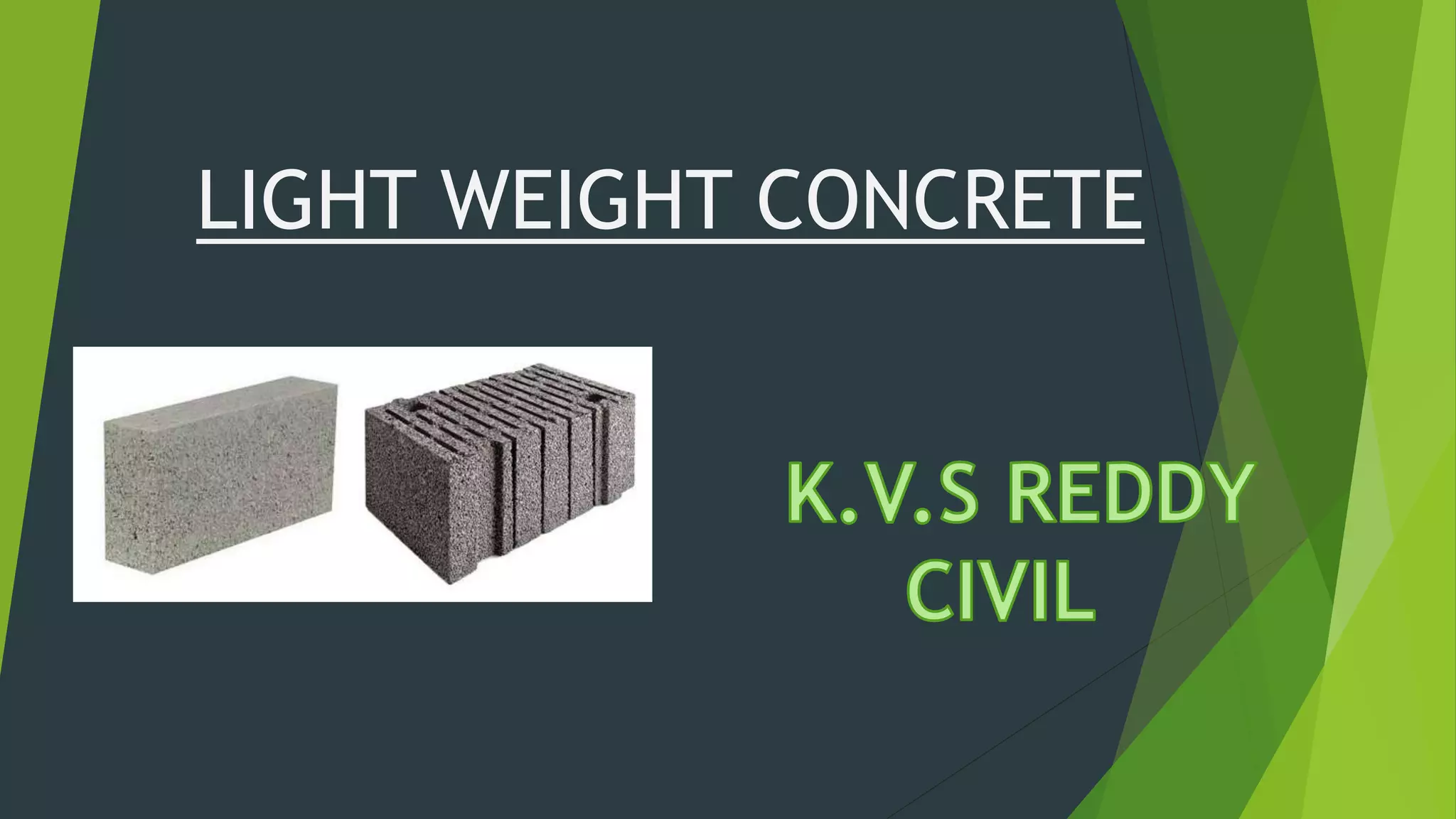
LIGHT WEIGHT CONCRETE
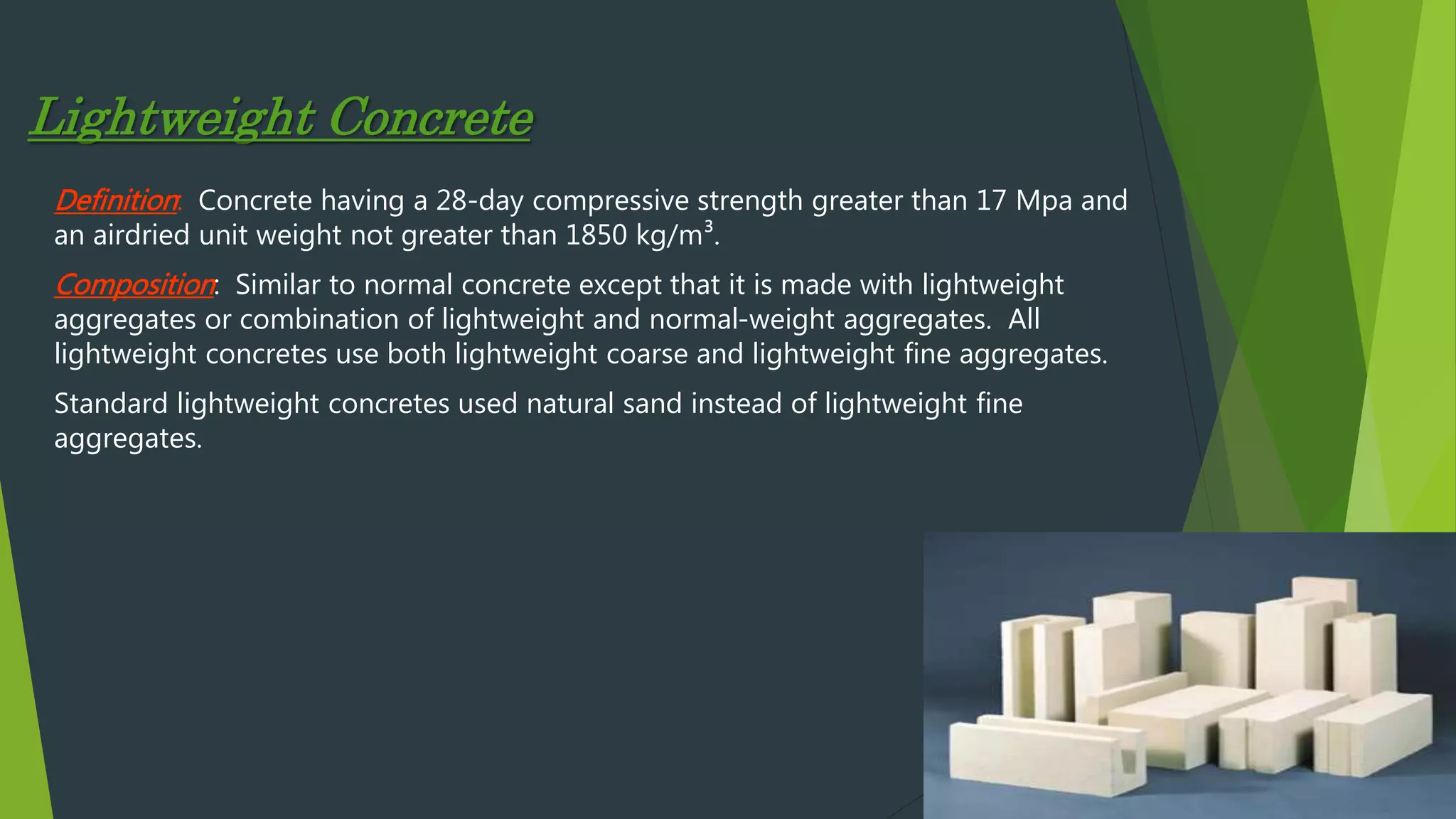
Definition: Concrete having a 28-day compressive strength greater than 17 Mpa and
an airdried unit weight not greater than 1850 kg/m³.
Composition: Similar to normal concrete except that it is made with lightweight
aggregates or combination of lightweight and normal-weight aggregates. All
lightweight concretes use both lightweight coarse and lightweight fine aggregates.
Standard lightweight concretes used natural sand instead of lightweight fine
aggregates.
Lightweight Concrete
Introduction:
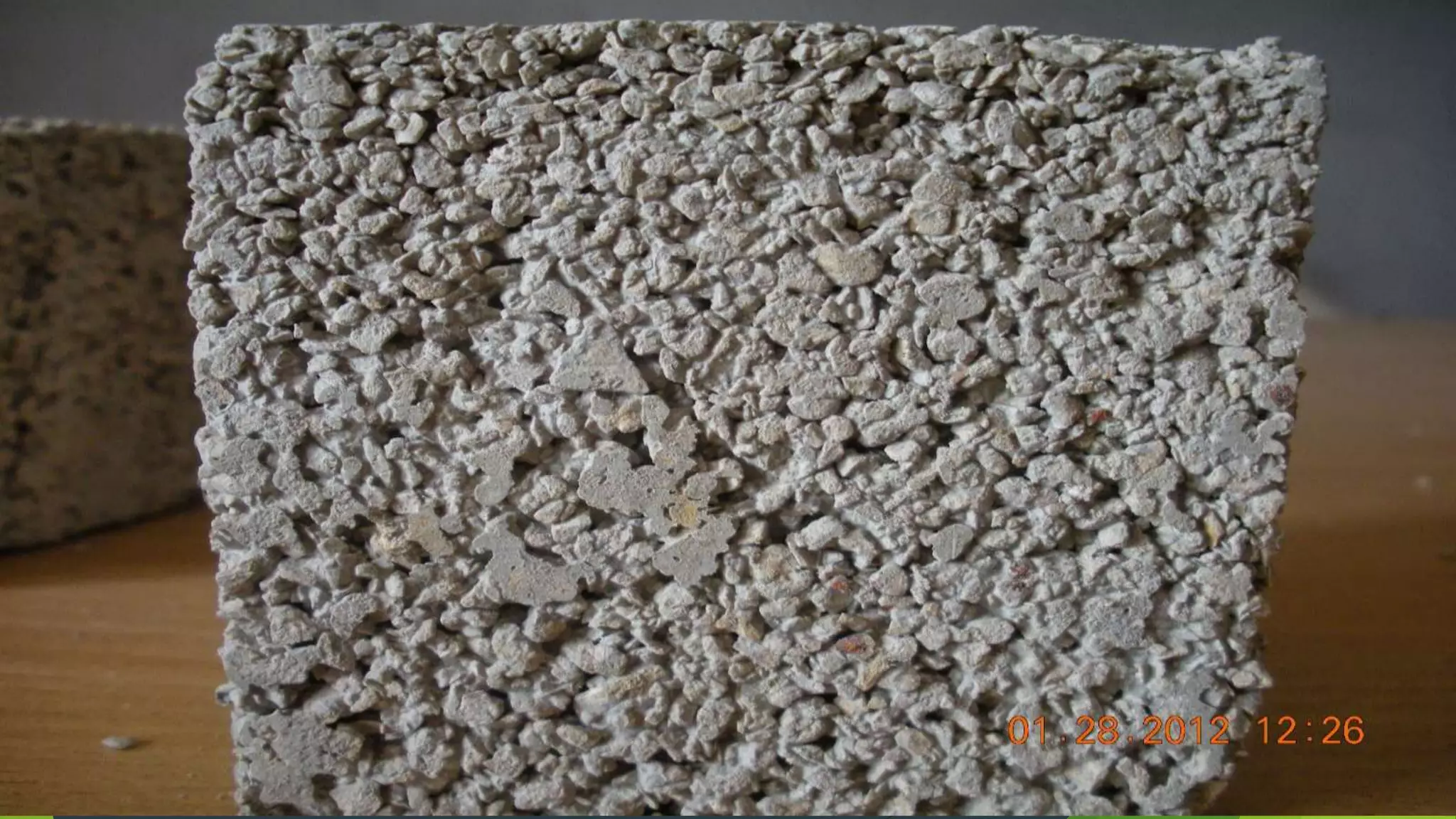
 Light weight concrete is a special concrete which weighs lighter than
conventional concrete.
 Density of this concrete is considerably low (300 kg/m3 to 1850 kg/m3) when
compared to normal concrete (2200kg/m3 to 2600kg/m3).
 Basically there is only one method for making concrete light i.e by
INCLUSION of air in concrete. This is achieved in actual practice by there
different ways
i)By replacing the usual aggregate by cellular porous or LWA
ii)By introducing gas or bubbles in mortar-aerated concrete
iii)By omitting sand fraction from the aggregate-no fines concrete
 Light weight aggregate concrete - UK, France & USA
 Aerated concrete - Scandinavian countries
 No – fines concrete is less popular
LWC can also be classified on the purpose for which
it is used such as:
1. Structural light weight concrete
2. Non-load bearing concrete
3. Insulating concrete
Light weight aggregate concrete:
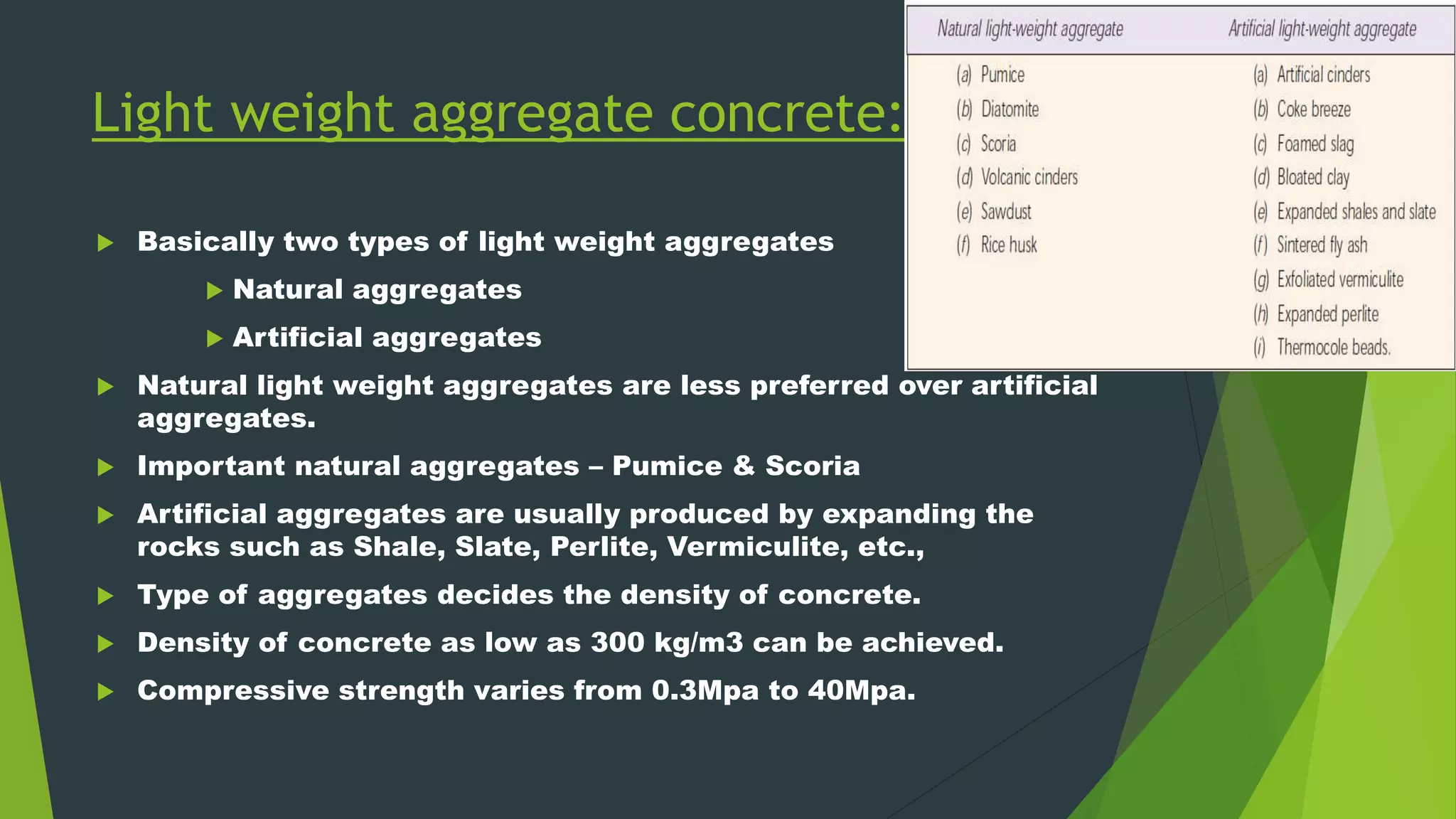
 Basically two types of light weight aggregates
 Natural aggregates
 Artificial aggregates
 Natural light weight aggregates are less preferred over artificial
aggregates.
 Important natural aggregates – Pumice & Scoria
 Artificial aggregates are usually produced by expanding the
rocks such as Shale, Slate, Perlite, Vermiculite, etc.,
 Type of aggregates decides the density of concrete.
 Density of concrete as low as 300 kg/m3 can be achieved.
 Compressive strength varies from 0.3Mpa to 40Mpa.
7
 Foamed Slag – was the first LWA suitable for reinforced concrete.
(that was produced in large quantity in (UK)
 Sintered Pulverised – fuel ash aggregate – is being used in the UK for a variety
of structural purposes and is being marketed under the trade name Lytag.
 Expanded Clays and Shales – capable of achieving sufficiently high strength
for prestressed concrete
 Pumice – is used for reinforced concrete roof slab, mainly for industrial roofs
• Brick bats
• Cinder, Clinker and
breeze
• Foamed slag
• Bloated clay
• Pulverised fuel ash
• Expanded perlite
• Very often light weight Concrete is made by the use of
light weight aggregates
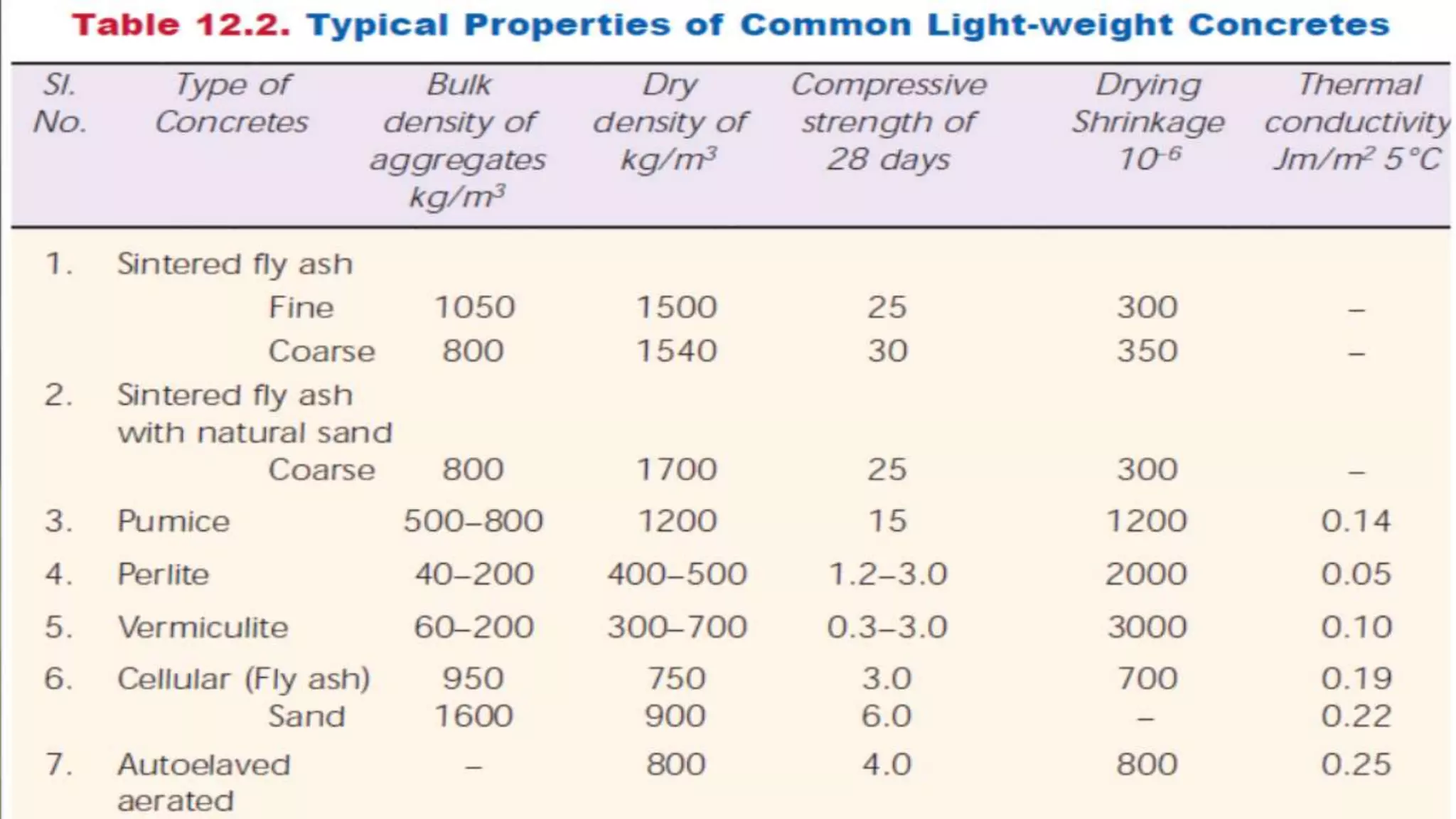
usually different LWC have different densities based on
the density concrete differs In various properties like bulk
density, dry density compressive strength ,shrinkage and
thermal conductivity
• Most of the light weight aggrregates have rapid absorption
quality. This is one of the difficulties in normal mix design
procedure to light weight concrete
• But it is possible to water-proof the LWA by coating it with
bitumen.
• The coating of aggregate by bitumen may reduce the bond
strength between aggregate and paste,it result in degree
in compressive strength of concrete
o The structural LWC is going to be one of the important
materials of construction.
A concrete which is light in weight and sufficiently strong
to be used in conjunction with steel reinforcement will be
a material which is more economical than the conventional
concrete
Structural LWA concrete is a concrete having 28 day
compressive strength more than 17Mpa
and 28 day air dried unit weight not exceeding 1850kg/m3
For practical reasons it is common practice to use normal
sand as fine aggregate and light weight coarse aggregate
of maximum size 19mm such light weight concrete is
termed as standard light weight concrete
Structural Light Weight Concrete
• In case of high slump and over vibration the mortar goes down
and aggregate tends to float
LWC exhibits higher moisture movement than the normal weight
concrete
The higher magnitude of drying shrinkage couple with lower
tensile strength makes the LWA concrete to undergo shrinkage
cracks
But the higher extensibility and lower modulus of elasticity help
to reduce the tensile cracks
Since LWC contains large percent of air it is naturally a better
material with respect to
a)sound absorption
b)sound proofing
c)thermal insulation
WORKABILITY
Mix design of LWC:
 Difficult to decide water–cement ratio, due to variable water
absorption by aggregates.
 The lack of accurate value of absorption, specific gravity and free
moisture content in aggregate make it difficult to apply water-
cement ratio accurately for mix-proportion
 Generally done by trial mixing.
 The density of concrete made with saturated aggregate is higher
and the durability of such concrete, especially its resistance to
frost is lower.
 Concrete with saturated aggregates will have higher density,
which is bad in freezing & thawing action.
 In rare cases, aggregates are coated with bitumen to overcome
the water absorption problem.
• Mixing procedure for light weight concrete may
vary with different types of aggregates
The general practice for structural light weight
concrete is to mix the aggregate and about 2/3 of
the mixing water for period up to one minute prior
to the addition of cement and the balancing mixing
water.
MIXING PROCEDURE:
Advantages:
 Reduces the dead load of the building.
 Easy to handle and hence reduces the cost of transportation and
handling.
 Improves the workability.
 Relatively low thermal conductivity
 Comparatively more durable. But less resistant to abrasion.
 Has applications in pre-stressed concrete, high rise buildings & shell
roofs.
 Good resistance to freezing & thawing action when compared to
conventional concrete.
 Helps in disposal of industrial wastes like fly ash, clinker, slag etc.
light weight aggregate.ppt

light weight aggregate.ppt

  • 1.
  • 3.
    Definition: Concrete havinga 28-day compressive strength greater than 17 Mpa and an airdried unit weight not greater than 1850 kg/m³. Composition: Similar to normal concrete except that it is made with lightweight aggregates or combination of lightweight and normal-weight aggregates. All lightweight concretes use both lightweight coarse and lightweight fine aggregates. Standard lightweight concretes used natural sand instead of lightweight fine aggregates. Lightweight Concrete
  • 4.
    Introduction:  Light weightconcrete is a special concrete which weighs lighter than conventional concrete.  Density of this concrete is considerably low (300 kg/m3 to 1850 kg/m3) when compared to normal concrete (2200kg/m3 to 2600kg/m3).  Basically there is only one method for making concrete light i.e by INCLUSION of air in concrete. This is achieved in actual practice by there different ways i)By replacing the usual aggregate by cellular porous or LWA ii)By introducing gas or bubbles in mortar-aerated concrete iii)By omitting sand fraction from the aggregate-no fines concrete  Light weight aggregate concrete - UK, France & USA  Aerated concrete - Scandinavian countries  No – fines concrete is less popular
  • 5.
    LWC can alsobe classified on the purpose for which it is used such as: 1. Structural light weight concrete 2. Non-load bearing concrete 3. Insulating concrete
  • 6.
    Light weight aggregateconcrete:  Basically two types of light weight aggregates  Natural aggregates  Artificial aggregates  Natural light weight aggregates are less preferred over artificial aggregates.  Important natural aggregates – Pumice & Scoria  Artificial aggregates are usually produced by expanding the rocks such as Shale, Slate, Perlite, Vermiculite, etc.,  Type of aggregates decides the density of concrete.  Density of concrete as low as 300 kg/m3 can be achieved.  Compressive strength varies from 0.3Mpa to 40Mpa.
  • 7.
    7  Foamed Slag– was the first LWA suitable for reinforced concrete. (that was produced in large quantity in (UK)  Sintered Pulverised – fuel ash aggregate – is being used in the UK for a variety of structural purposes and is being marketed under the trade name Lytag.  Expanded Clays and Shales – capable of achieving sufficiently high strength for prestressed concrete  Pumice – is used for reinforced concrete roof slab, mainly for industrial roofs
  • 8.
    • Brick bats •Cinder, Clinker and breeze • Foamed slag • Bloated clay • Pulverised fuel ash • Expanded perlite
  • 9.
    • Very oftenlight weight Concrete is made by the use of light weight aggregates usually different LWC have different densities based on the density concrete differs In various properties like bulk density, dry density compressive strength ,shrinkage and thermal conductivity • Most of the light weight aggrregates have rapid absorption quality. This is one of the difficulties in normal mix design procedure to light weight concrete • But it is possible to water-proof the LWA by coating it with bitumen. • The coating of aggregate by bitumen may reduce the bond strength between aggregate and paste,it result in degree in compressive strength of concrete
  • 11.
    o The structuralLWC is going to be one of the important materials of construction. A concrete which is light in weight and sufficiently strong to be used in conjunction with steel reinforcement will be a material which is more economical than the conventional concrete Structural LWA concrete is a concrete having 28 day compressive strength more than 17Mpa and 28 day air dried unit weight not exceeding 1850kg/m3 For practical reasons it is common practice to use normal sand as fine aggregate and light weight coarse aggregate of maximum size 19mm such light weight concrete is termed as standard light weight concrete Structural Light Weight Concrete
  • 12.
    • In caseof high slump and over vibration the mortar goes down and aggregate tends to float LWC exhibits higher moisture movement than the normal weight concrete The higher magnitude of drying shrinkage couple with lower tensile strength makes the LWA concrete to undergo shrinkage cracks But the higher extensibility and lower modulus of elasticity help to reduce the tensile cracks Since LWC contains large percent of air it is naturally a better material with respect to a)sound absorption b)sound proofing c)thermal insulation WORKABILITY
  • 13.
    Mix design ofLWC:  Difficult to decide water–cement ratio, due to variable water absorption by aggregates.  The lack of accurate value of absorption, specific gravity and free moisture content in aggregate make it difficult to apply water- cement ratio accurately for mix-proportion  Generally done by trial mixing.  The density of concrete made with saturated aggregate is higher and the durability of such concrete, especially its resistance to frost is lower.  Concrete with saturated aggregates will have higher density, which is bad in freezing & thawing action.  In rare cases, aggregates are coated with bitumen to overcome the water absorption problem.
  • 14.
    • Mixing procedurefor light weight concrete may vary with different types of aggregates The general practice for structural light weight concrete is to mix the aggregate and about 2/3 of the mixing water for period up to one minute prior to the addition of cement and the balancing mixing water. MIXING PROCEDURE:
  • 15.
    Advantages:  Reduces thedead load of the building.  Easy to handle and hence reduces the cost of transportation and handling.  Improves the workability.  Relatively low thermal conductivity  Comparatively more durable. But less resistant to abrasion.  Has applications in pre-stressed concrete, high rise buildings & shell roofs.  Good resistance to freezing & thawing action when compared to conventional concrete.  Helps in disposal of industrial wastes like fly ash, clinker, slag etc.