Shankersinh Vaghela Bapu
Institute Of Technology.
IDEA
International Data
Encryption Algorithm
History…
 IDEA is a symmetric block cipher algorithm.
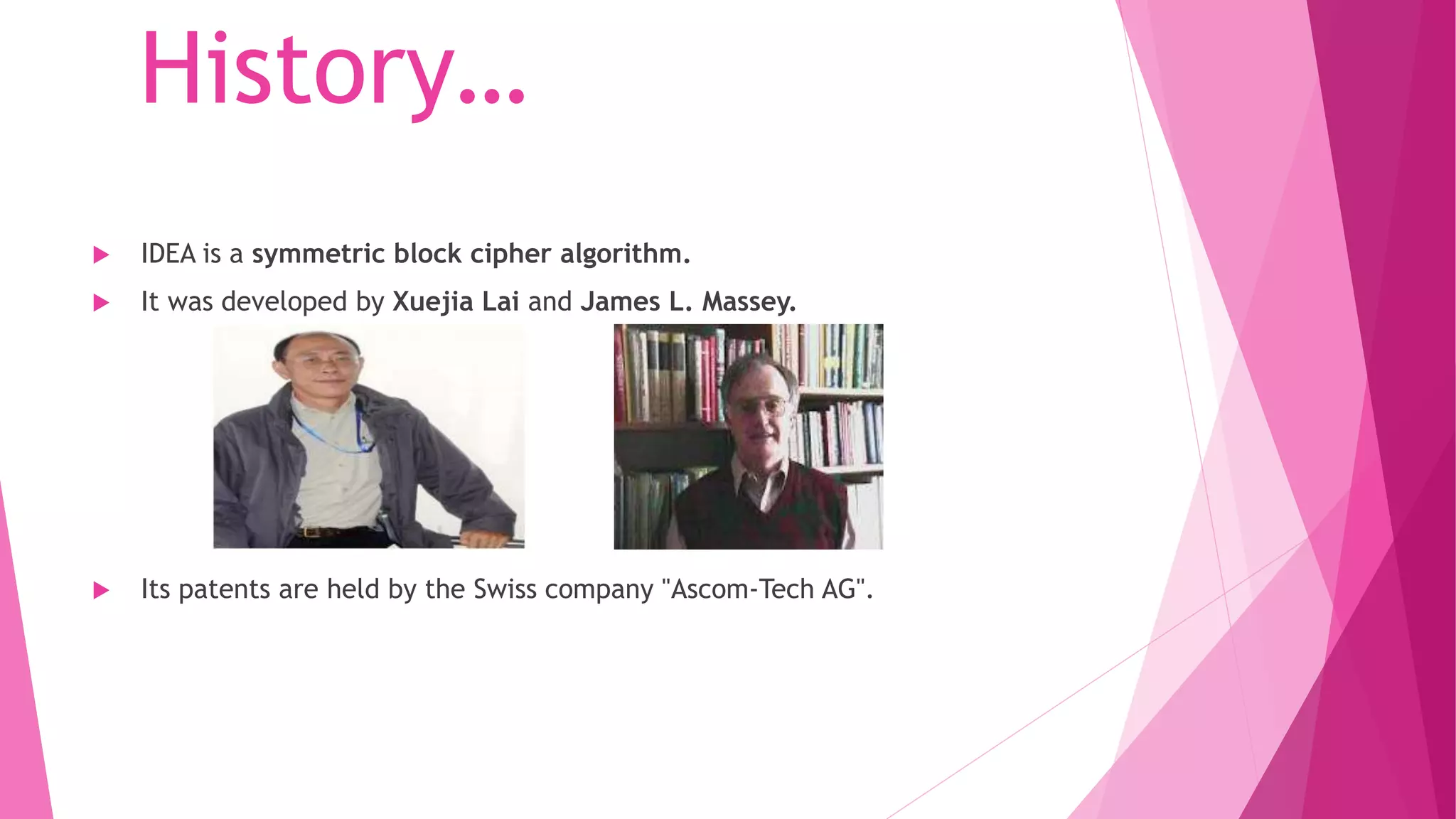
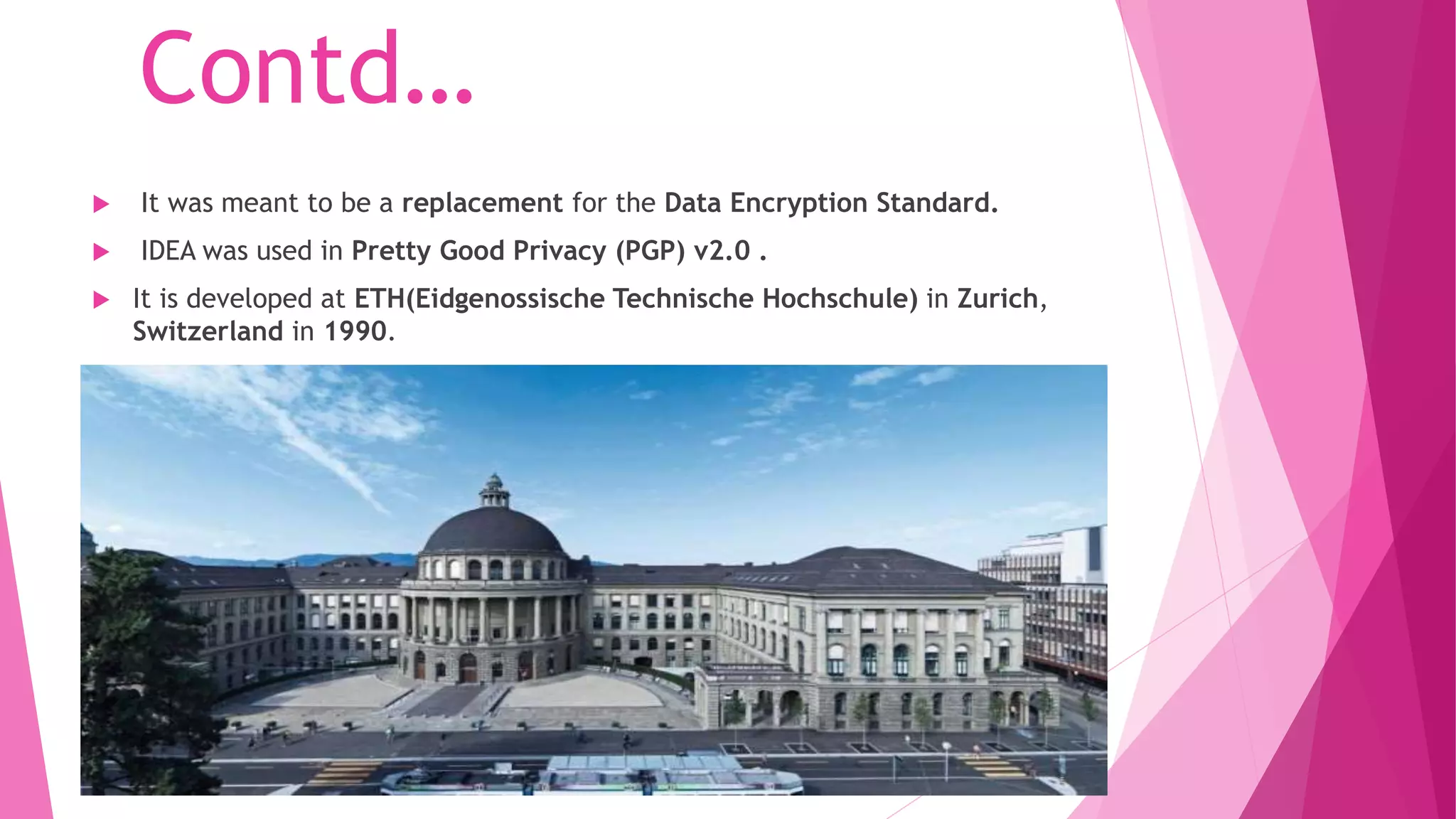
 It was developed by Xuejia Lai and James L. Massey.
 Its patents are held by the Swiss company "Ascom-Tech AG".
Contd…
 It was meant to be a replacement for the Data Encryption Standard.
 IDEA was used in Pretty Good Privacy (PGP) v2.0 .
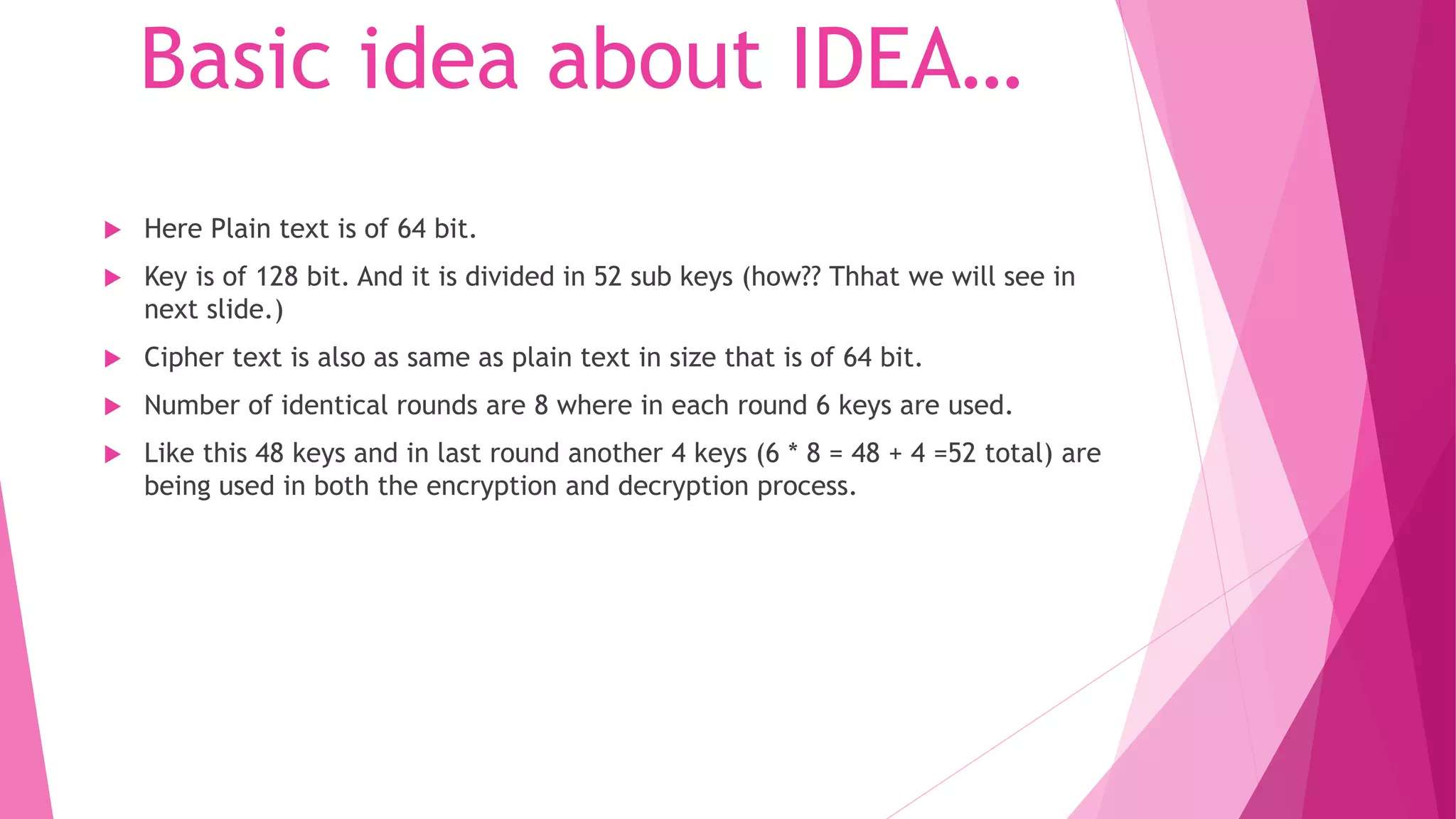
 It is developed at ETH(Eidgenossische Technische Hochschule) in Zurich,
Switzerland in 1990.
Basic idea about IDEA…
 Here Plain text is of 64 bit.
 Key is of 128 bit. And it is divided in 52 sub keys (how?? Thhat we will see in
next slide.)
 Cipher text is also as same as plain text in size that is of 64 bit.
 Number of identical rounds are 8 where in each round 6 keys are used.
 Like this 48 keys and in last round another 4 keys (6 * 8 = 48 + 4 =52 total) are
being used in both the encryption and decryption process.
Design issue
 The design philosophy behind the algorithm is one of “ mixing operation from
different algebraic groups”
 Lets take a look which different operations are used.
 1) XOR
 2) Addition
 3) Multiplication
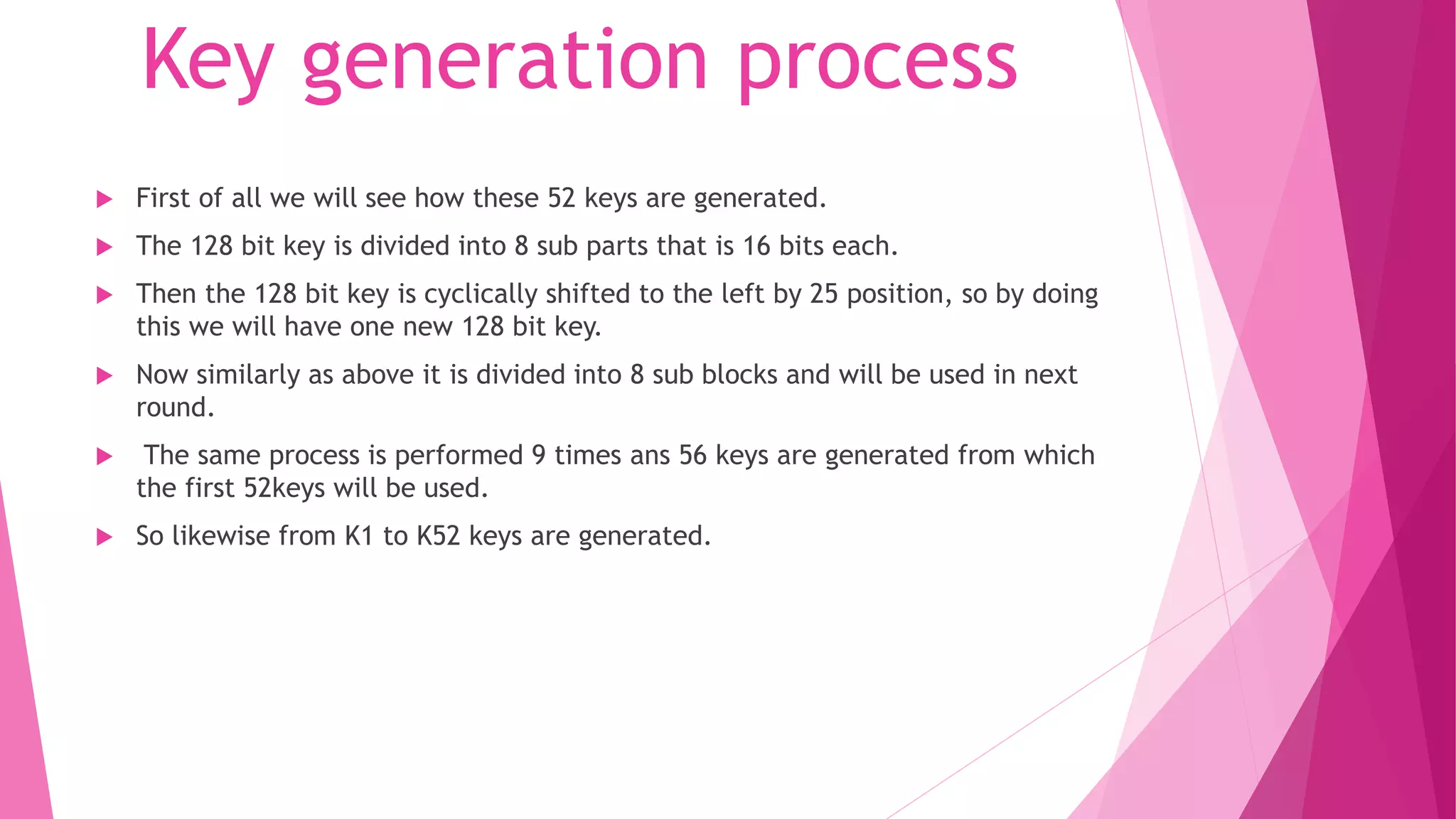
Key generation process
 First of all we will see how these 52 keys are generated.
 The 128 bit key is divided into 8 sub parts that is 16 bits each.
 Then the 128 bit key is cyclically shifted to the left by 25 position, so by doing
this we will have one new 128 bit key.
 Now similarly as above it is divided into 8 sub blocks and will be used in next
round.
 The same process is performed 9 times ans 56 keys are generated from which
the first 52keys will be used.
 So likewise from K1 to K52 keys are generated.
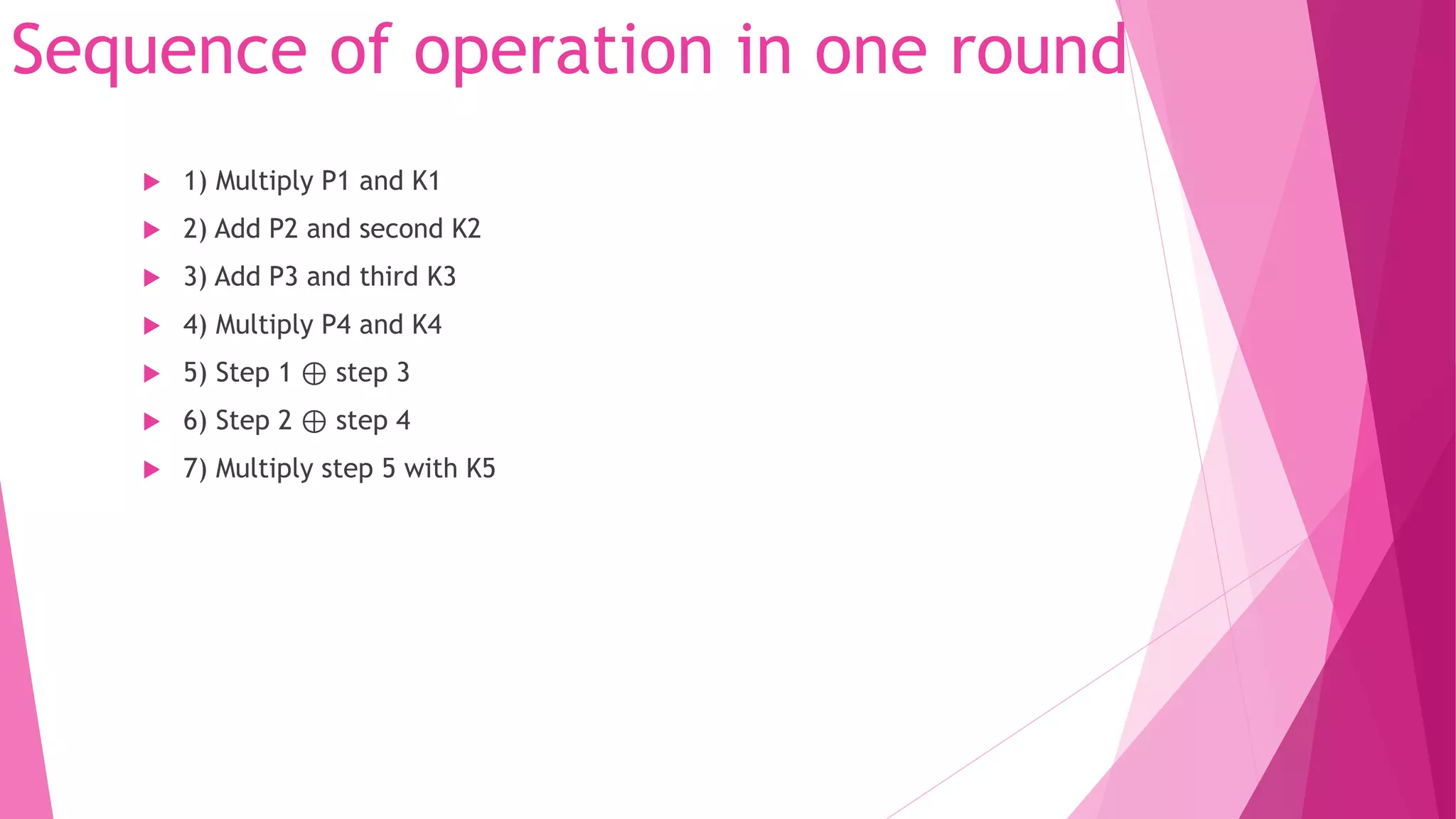
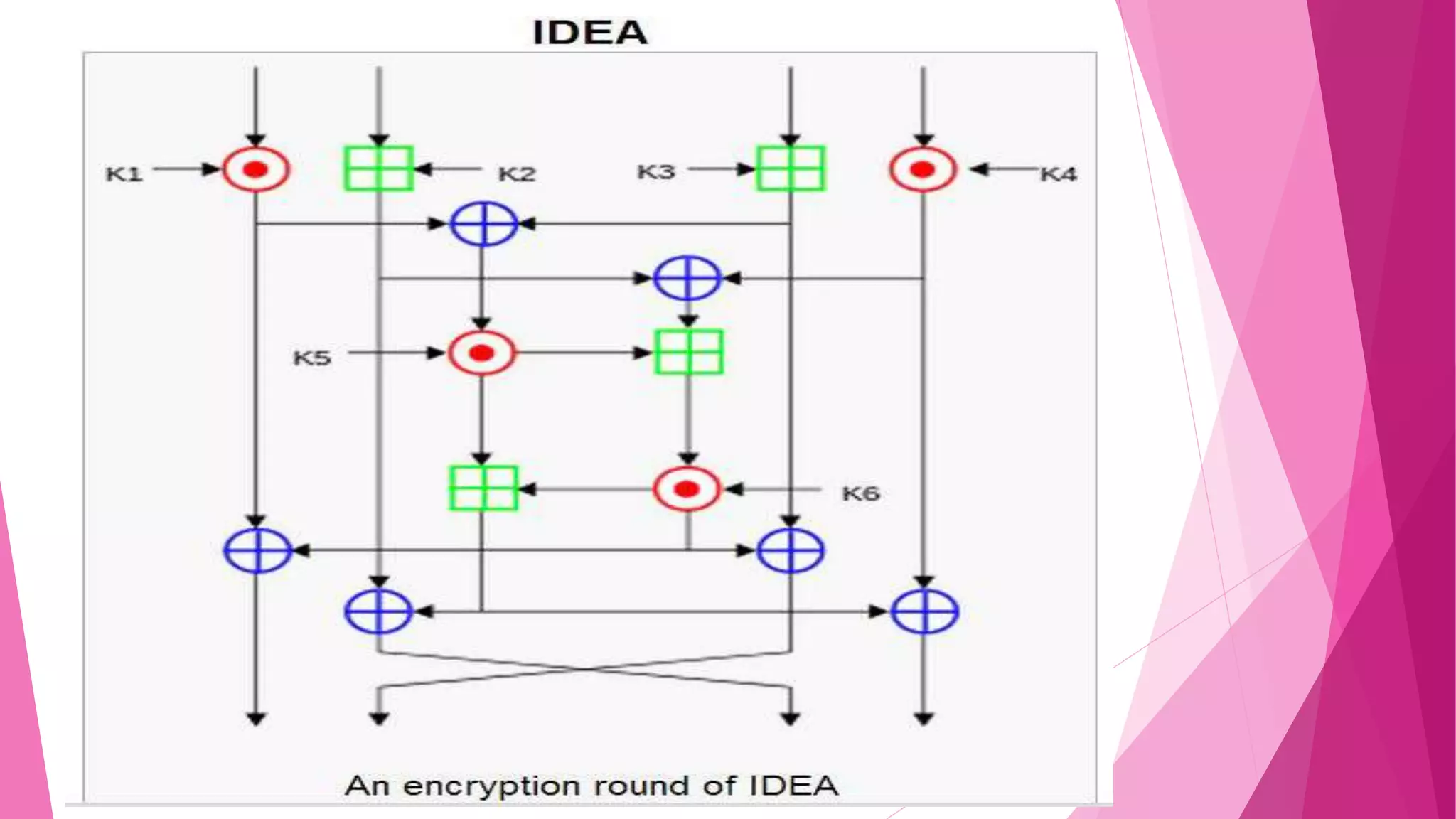
Sequence of operation in one round
 1) Multiply P1 and K1
 2) Add P2 and second K2
 3) Add P3 and third K3
 4) Multiply P4 and K4
 5) Step 1 ⊕ step 3
 6) Step 2 ⊕ step 4
 7) Multiply step 5 with K5
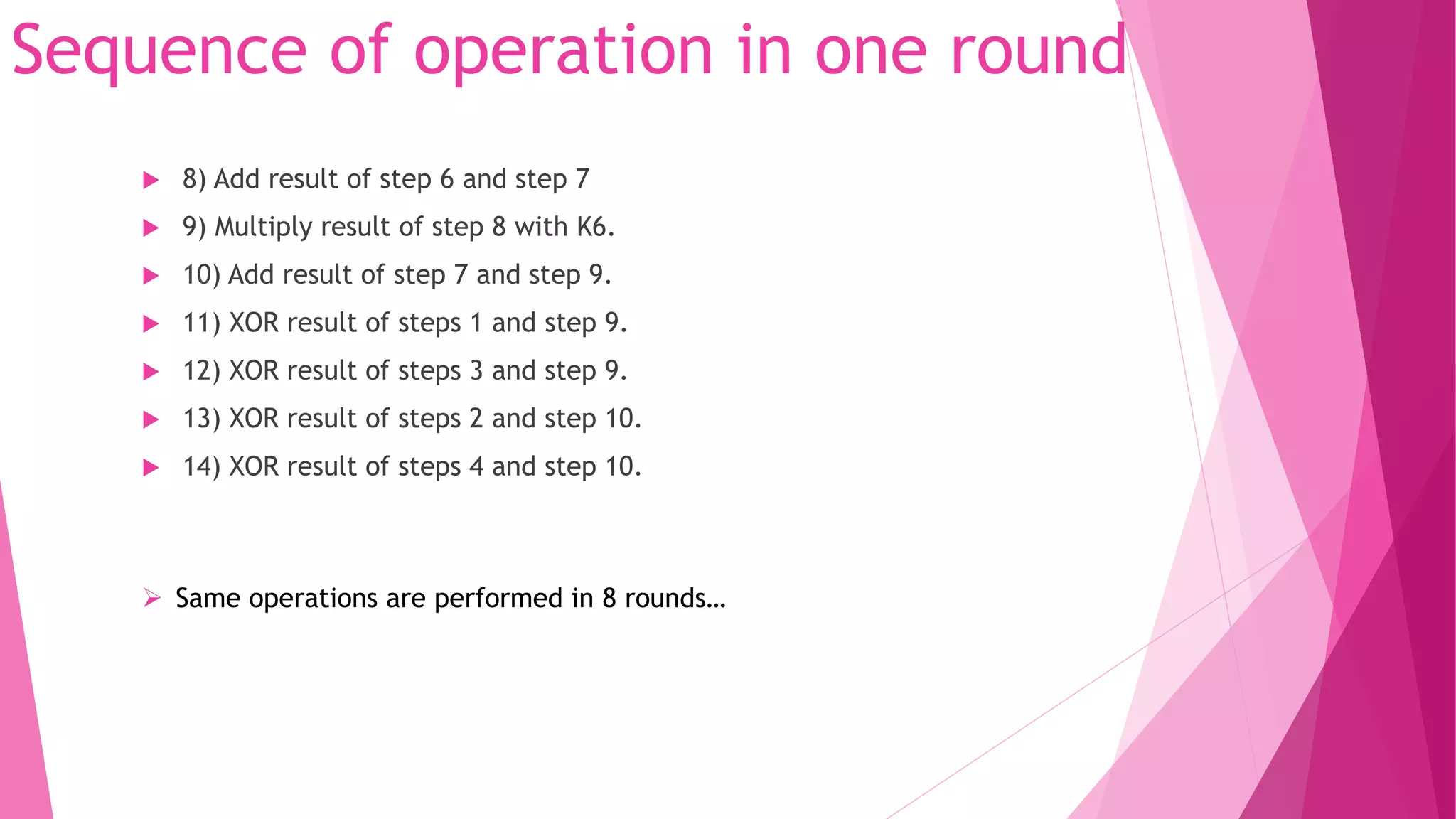
 8) Add result of step 6 and step 7
 9) Multiply result of step 8 with K6.
 10) Add result of step 7 and step 9.
 11) XOR result of steps 1 and step 9.
 12) XOR result of steps 3 and step 9.
 13) XOR result of steps 2 and step 10.
 14) XOR result of steps 4 and step 10.
Sequence of operation in one round
 Same operations are performed in 8 rounds…
 1) Multiply P1 with K49.
 2) Add P2 and K50.
 3) Add P3 and K51.
 4) Multiply P4 and K52.
Sequence of operation in last round
Encyption
 First of all 64 bit plain text is divided into 4 16-bit parts and they are taken as
an input in first round.
 At the end of the first encryption round four 16-bit values are produced which
are used as input to the second encryption round
 The process is repeated in each of the subsequent 8 encryption rounds
 Note that in 9th round we have to use only 4 key( K49, K50, K51,K52) and have
to perform different operation as guided in previous slide.
Decryption
 The computational process used for decryption of the ciphertext is essentially
the same as that used for encryption
 The only difference is that each of the 52 16-bit key sub-blocks used for
decryption is the inverse of the key sub-block used during encryption
 Do remember that the sub blocks must be used in reverse order than of the
encryption round.
Applications of IDEA
 Today, there are hundreds of IDEA-based security solutions available in
many market areas, ranging from Financial Services, and Broadcasting
to Government
 The IDEA algorithm can easily be combined in any encryption software.
Data encryption can be used to protect data transmission and storage.
 Typical fields are:
 Audio and video data for cable TV, video conferencing, distance
learning
 Sensitive financial and commercial data
 Email via public networks
 Smart cards
Heartly thank you for
your time and
attention…
Hey all mature people please
attention here:
Don’t forget to go for vote on
the day after tomorrow that is
on 30th april… 
presented by:
Akshay ( 110750107020 )
Akash ( 110750107005 )
Saurabh ( 110750107021 )
Guided by:
Anand sir.
Guided by:
Anand sir.

Idea(international data encryption algorithm)

  • 1.
  • 2.
  • 3.
    History…  IDEA isa symmetric block cipher algorithm.  It was developed by Xuejia Lai and James L. Massey.  Its patents are held by the Swiss company "Ascom-Tech AG".
  • 4.
    Contd…  It wasmeant to be a replacement for the Data Encryption Standard.  IDEA was used in Pretty Good Privacy (PGP) v2.0 .  It is developed at ETH(Eidgenossische Technische Hochschule) in Zurich, Switzerland in 1990.
  • 5.
    Basic idea aboutIDEA…  Here Plain text is of 64 bit.  Key is of 128 bit. And it is divided in 52 sub keys (how?? Thhat we will see in next slide.)  Cipher text is also as same as plain text in size that is of 64 bit.  Number of identical rounds are 8 where in each round 6 keys are used.  Like this 48 keys and in last round another 4 keys (6 * 8 = 48 + 4 =52 total) are being used in both the encryption and decryption process.
  • 6.
    Design issue  Thedesign philosophy behind the algorithm is one of “ mixing operation from different algebraic groups”  Lets take a look which different operations are used.  1) XOR  2) Addition  3) Multiplication
  • 7.
    Key generation process First of all we will see how these 52 keys are generated.  The 128 bit key is divided into 8 sub parts that is 16 bits each.  Then the 128 bit key is cyclically shifted to the left by 25 position, so by doing this we will have one new 128 bit key.  Now similarly as above it is divided into 8 sub blocks and will be used in next round.  The same process is performed 9 times ans 56 keys are generated from which the first 52keys will be used.  So likewise from K1 to K52 keys are generated.
  • 8.
    Sequence of operationin one round  1) Multiply P1 and K1  2) Add P2 and second K2  3) Add P3 and third K3  4) Multiply P4 and K4  5) Step 1 ⊕ step 3  6) Step 2 ⊕ step 4  7) Multiply step 5 with K5
  • 10.
     8) Addresult of step 6 and step 7  9) Multiply result of step 8 with K6.  10) Add result of step 7 and step 9.  11) XOR result of steps 1 and step 9.  12) XOR result of steps 3 and step 9.  13) XOR result of steps 2 and step 10.  14) XOR result of steps 4 and step 10. Sequence of operation in one round  Same operations are performed in 8 rounds…
  • 11.
     1) MultiplyP1 with K49.  2) Add P2 and K50.  3) Add P3 and K51.  4) Multiply P4 and K52. Sequence of operation in last round
  • 12.
    Encyption  First ofall 64 bit plain text is divided into 4 16-bit parts and they are taken as an input in first round.  At the end of the first encryption round four 16-bit values are produced which are used as input to the second encryption round  The process is repeated in each of the subsequent 8 encryption rounds  Note that in 9th round we have to use only 4 key( K49, K50, K51,K52) and have to perform different operation as guided in previous slide.
  • 13.
    Decryption  The computationalprocess used for decryption of the ciphertext is essentially the same as that used for encryption  The only difference is that each of the 52 16-bit key sub-blocks used for decryption is the inverse of the key sub-block used during encryption  Do remember that the sub blocks must be used in reverse order than of the encryption round.
  • 14.
    Applications of IDEA Today, there are hundreds of IDEA-based security solutions available in many market areas, ranging from Financial Services, and Broadcasting to Government  The IDEA algorithm can easily be combined in any encryption software. Data encryption can be used to protect data transmission and storage.  Typical fields are:  Audio and video data for cable TV, video conferencing, distance learning  Sensitive financial and commercial data  Email via public networks  Smart cards
  • 15.
    Heartly thank youfor your time and attention… Hey all mature people please attention here: Don’t forget to go for vote on the day after tomorrow that is on 30th april…  presented by: Akshay ( 110750107020 ) Akash ( 110750107005 ) Saurabh ( 110750107021 ) Guided by: Anand sir. Guided by: Anand sir.