IDEA Cipher Block
Presented by:
Boudour Ouissem-Eddine Amir
Bellache Nour El Islam
Responsible :
Dr. Chikouche
International Data Encryption Algorithm
What is IDEA ?
• IPES Improved proposed encrypting standard 1990.
• IDEA = International Data Encryption Algorithm
• Block Cipher
• Designed in 1991 by:
James Massey (cryptographer, Germany)
Xuejia Lai (cryptographer, China)
• Best Block Cipher available until
AES
Algorithm - Overview
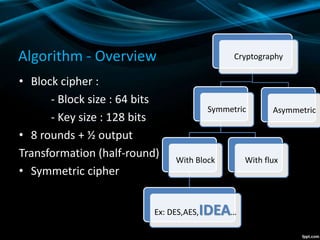
• Block cipher :
- Block size : 64 bits
- Key size : 128 bits
• 8 rounds + ½ output
Transformation (half-round)
• Symmetric cipher
Cryptography
Symmetric
With Block
Ex: DES,AES,IDEA…
With flux
Asymmetric
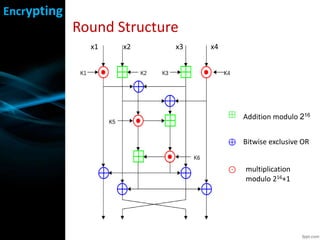
Round Structure
⊕
Addition modulo 216⊞
Bitwise exclusive OR
⊙ multiplication
modulo 216+1
x1 x2 x3 x4
Encrypting
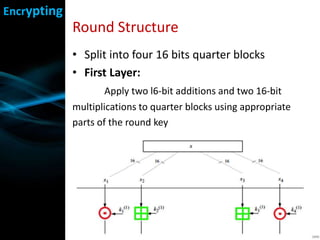
Round Structure
• Split into four 16 bits quarter blocks
• First Layer:
Apply two l6-bit additions and two 16-bit
multiplications to quarter blocks using appropriate
parts of the round key
Encrypting
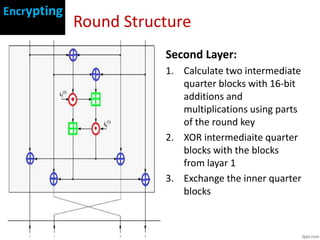
Round Structure
Second Layer:
1. Calculate two intermediate
quarter blocks with 16-bit
additions and
multiplications using parts
of the round key
2. XOR intermediaite quarter
blocks with the blocks
from layar 1
3. Exchange the inner quarter
blocks
Encrypting
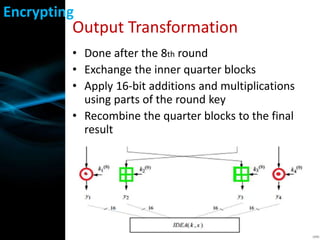
Output Transformation
• Done after the 8th round
• Exchange the inner quarter blocks
• Apply 16-bit additions and multiplications
using parts of the round key
• Recombine the quarter blocks to the final
result
Encrypting
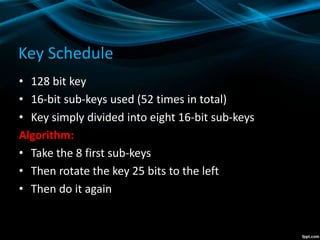
Key Schedule
• 128 bit key
• 16-bit sub-keys used (52 times in total)
• Key simply divided into eight 16-bit sub-keys
Algorithm:
• Take the 8 first sub-keys
• Then rotate the key 25 bits to the left
• Then do it again
Decryption
• Basically same as the encryption algorithm !
• Except the sub-keys
-> Schedule for decryption key is using
combinations of multiplicative inverse, additive
inverse, and original sub-keys
Security
• Considered as really secure
• Best attack can break IDEA reduced To 6 rounds (full
IDEA = 8.5 rounds)
• But could be redesigned because of The very simple
key schedule
• “Weak key" problem with too many 0-bits
Running time measurements & analysis
• Most frequently-executed methods:
- IDEA.encrypt
- IDEA. multiplication
- IDEA.addition
• Twice the speed as DES
References
• Wikipedia article
https://fr.wikipedia.org/wiki/International_Data_Encryption_A
lgorithm
• Team OSIX FINAL PRESENTATION .pdf
• "Handbook of Applied Cryptography" (by Alfred J. Menezes)
http://cacr.uwaterloo.ca/hac/
• Secret-key Cryptography institute of computer technology
Vienna university of technology 2005 manfred lindner
Thanks!

Idea

  • 1.
    IDEA Cipher Block Presentedby: Boudour Ouissem-Eddine Amir Bellache Nour El Islam Responsible : Dr. Chikouche International Data Encryption Algorithm
  • 2.
    What is IDEA? • IPES Improved proposed encrypting standard 1990. • IDEA = International Data Encryption Algorithm • Block Cipher • Designed in 1991 by: James Massey (cryptographer, Germany) Xuejia Lai (cryptographer, China) • Best Block Cipher available until AES
  • 3.
    Algorithm - Overview •Block cipher : - Block size : 64 bits - Key size : 128 bits • 8 rounds + ½ output Transformation (half-round) • Symmetric cipher Cryptography Symmetric With Block Ex: DES,AES,IDEA… With flux Asymmetric
  • 4.
    Round Structure ⊕ Addition modulo216⊞ Bitwise exclusive OR ⊙ multiplication modulo 216+1 x1 x2 x3 x4 Encrypting
  • 5.
    Round Structure • Splitinto four 16 bits quarter blocks • First Layer: Apply two l6-bit additions and two 16-bit multiplications to quarter blocks using appropriate parts of the round key Encrypting
  • 6.
    Round Structure Second Layer: 1.Calculate two intermediate quarter blocks with 16-bit additions and multiplications using parts of the round key 2. XOR intermediaite quarter blocks with the blocks from layar 1 3. Exchange the inner quarter blocks Encrypting
  • 7.
    Output Transformation • Doneafter the 8th round • Exchange the inner quarter blocks • Apply 16-bit additions and multiplications using parts of the round key • Recombine the quarter blocks to the final result Encrypting
  • 8.
    Key Schedule • 128bit key • 16-bit sub-keys used (52 times in total) • Key simply divided into eight 16-bit sub-keys Algorithm: • Take the 8 first sub-keys • Then rotate the key 25 bits to the left • Then do it again
  • 9.
    Decryption • Basically sameas the encryption algorithm ! • Except the sub-keys -> Schedule for decryption key is using combinations of multiplicative inverse, additive inverse, and original sub-keys
  • 10.
    Security • Considered asreally secure • Best attack can break IDEA reduced To 6 rounds (full IDEA = 8.5 rounds) • But could be redesigned because of The very simple key schedule • “Weak key" problem with too many 0-bits
  • 11.
    Running time measurements& analysis • Most frequently-executed methods: - IDEA.encrypt - IDEA. multiplication - IDEA.addition • Twice the speed as DES
  • 12.
    References • Wikipedia article https://fr.wikipedia.org/wiki/International_Data_Encryption_A lgorithm •Team OSIX FINAL PRESENTATION .pdf • "Handbook of Applied Cryptography" (by Alfred J. Menezes) http://cacr.uwaterloo.ca/hac/ • Secret-key Cryptography institute of computer technology Vienna university of technology 2005 manfred lindner
  • 13.