BINARY CODES
Contents:
 Definition
 Classification
 Examples
Kongunadu College of Engineering & Technology Binary Codes
1
BINARY CODES
• When numbers, alphabets or words are
represented by a specific group of symbols i.e.,
they are encoded
• The group of symbols used to encode them are
called codes. The digital data is represented,
stored and transmitted as groups of binary
digits (bits)
• Group of bits--- binary code---- numeric and
alphanumeric code
Kongunadu College of Engineering & Technology Binary Codes
2
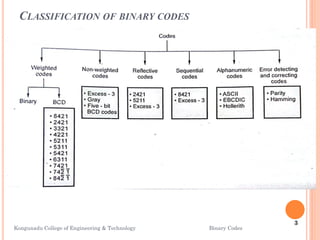
CLASSIFICATION OF BINARY CODES
Kongunadu College of Engineering & Technology Binary Codes
3
 Weighted codes:
 In weighted codes, each digit position of the number represents a
specific weight
 Examples: 93(1001)(0011)  8421 code
93(1100)(0011) 5421 code
 Non-weighted codes
 Non-weighted codes are not assigned with any weight to each digit
position, i.e., each digit position within the number is not assigned
fixed value
 Excess-3 and gray codes are the non-weighted codes
Kongunadu College of Engineering & Technology Binary Codes
4
 Reflective codes:
 A code is said to be reflective when the code for 9 is the complement
for 0, the code for 8 is complement for 1, 7 for 2,6 for 3 and 5 for 4.
 Like 2421,codes 5211 and excess-3 are also reflective.
 The 8421 code is not reflective
Kongunadu College of Engineering & Technology Binary Codes
5
 Sequential codes
 In sequential codes each succeeding code is one binary number
greater than its preceding code.
 This greatly aids mathematical manipulation of data
 The 8421 and excess-3 are sequential, whereas the 2421 and 5211
codes are not sequential
 Alphanumeric codes
 The codes which consists of both numbers and alphabetic characters
are called alphanumeric codes.
Kongunadu College of Engineering & Technology Binary Codes
6
CONTD..
 Most of these codes, however, also represent symbols and various
instructions necessary for conveying intelligible information
 The most commonly used alphanumeric codes are: ASCII, EBCDIC and
Hollerith code
 Error detecting and correcting codes
 When the digital information in the binary form is transmitted from one
circuit or system to another circuit or system an error may occur.
 This means the signal corresponding to 0 may change to 1 or vice-versa
due to presence of noise
Kongunadu College of Engineering & Technology Binary Codes
7
CONTD..
To maintain data integrity between transmitter
and receiver, extra bit or more than one bit are
added in the data.
These extra bits allow the detection and
sometimes the correction of error in the data.
The data along with the extra bit /bits form the
code
Codes which allow only error detection are called
error detecting codes and codes which allow error
detection and correction are called error detecting
and correcting codes
Kongunadu College of Engineering & Technology Binary Codes
8
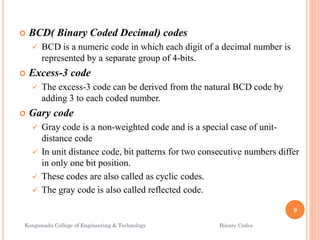
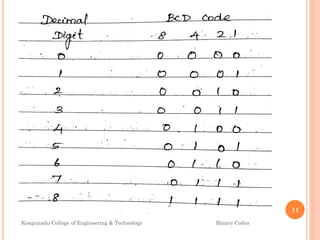
 BCD( Binary Coded Decimal) codes
 BCD is a numeric code in which each digit of a decimal number is
represented by a separate group of 4-bits.
 Excess-3 code
 The excess-3 code can be derived from the natural BCD code by
adding 3 to each coded number.
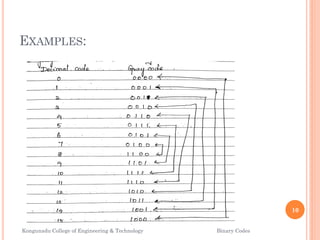
 Gary code
 Gray code is a non-weighted code and is a special case of unit-
distance code
 In unit distance code, bit patterns for two consecutive numbers differ
in only one bit position.
 These codes are also called as cyclic codes.
 The gray code is also called reflected code.
Kongunadu College of Engineering & Technology Binary Codes
9
EXAMPLES:
10
Kongunadu College of Engineering & Technology Binary Codes
11
Kongunadu College of Engineering & Technology Binary Codes
12
Kongunadu College of Engineering & Technology Binary Codes
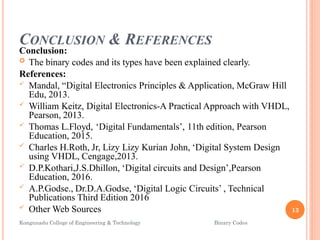
CONCLUSION & REFERENCES
Conclusion:
 The binary codes and its types have been explained clearly.
References:
 Mandal, “Digital Electronics Principles & Application, McGraw Hill
Edu, 2013.
 William Keitz, Digital Electronics-A Practical Approach with VHDL,
Pearson, 2013.
 Thomas L.Floyd, ‘Digital Fundamentals’, 11th edition, Pearson
Education, 2015.
 Charles H.Roth, Jr, Lizy Lizy Kurian John, ‘Digital System Design
using VHDL, Cengage,2013.
 D.P.Kothari,J.S.Dhillon, ‘Digital circuits and Design’,Pearson
Education, 2016.
 A.P.Godse., Dr.D.A.Godse, ‘Digital Logic Circuits’ , Technical
Publications Third Edition 2016
 Other Web Sources
Kongunadu College of Engineering & Technology Binary Codes
13

Binary codes

  • 1.
    BINARY CODES Contents:  Definition Classification  Examples Kongunadu College of Engineering & Technology Binary Codes 1
  • 2.
    BINARY CODES • Whennumbers, alphabets or words are represented by a specific group of symbols i.e., they are encoded • The group of symbols used to encode them are called codes. The digital data is represented, stored and transmitted as groups of binary digits (bits) • Group of bits--- binary code---- numeric and alphanumeric code Kongunadu College of Engineering & Technology Binary Codes 2
  • 3.
    CLASSIFICATION OF BINARYCODES Kongunadu College of Engineering & Technology Binary Codes 3
  • 4.
     Weighted codes: In weighted codes, each digit position of the number represents a specific weight  Examples: 93(1001)(0011)  8421 code 93(1100)(0011) 5421 code  Non-weighted codes  Non-weighted codes are not assigned with any weight to each digit position, i.e., each digit position within the number is not assigned fixed value  Excess-3 and gray codes are the non-weighted codes Kongunadu College of Engineering & Technology Binary Codes 4
  • 5.
     Reflective codes: A code is said to be reflective when the code for 9 is the complement for 0, the code for 8 is complement for 1, 7 for 2,6 for 3 and 5 for 4.  Like 2421,codes 5211 and excess-3 are also reflective.  The 8421 code is not reflective Kongunadu College of Engineering & Technology Binary Codes 5
  • 6.
     Sequential codes In sequential codes each succeeding code is one binary number greater than its preceding code.  This greatly aids mathematical manipulation of data  The 8421 and excess-3 are sequential, whereas the 2421 and 5211 codes are not sequential  Alphanumeric codes  The codes which consists of both numbers and alphabetic characters are called alphanumeric codes. Kongunadu College of Engineering & Technology Binary Codes 6
  • 7.
    CONTD..  Most ofthese codes, however, also represent symbols and various instructions necessary for conveying intelligible information  The most commonly used alphanumeric codes are: ASCII, EBCDIC and Hollerith code  Error detecting and correcting codes  When the digital information in the binary form is transmitted from one circuit or system to another circuit or system an error may occur.  This means the signal corresponding to 0 may change to 1 or vice-versa due to presence of noise Kongunadu College of Engineering & Technology Binary Codes 7
  • 8.
    CONTD.. To maintain dataintegrity between transmitter and receiver, extra bit or more than one bit are added in the data. These extra bits allow the detection and sometimes the correction of error in the data. The data along with the extra bit /bits form the code Codes which allow only error detection are called error detecting codes and codes which allow error detection and correction are called error detecting and correcting codes Kongunadu College of Engineering & Technology Binary Codes 8
  • 9.
     BCD( BinaryCoded Decimal) codes  BCD is a numeric code in which each digit of a decimal number is represented by a separate group of 4-bits.  Excess-3 code  The excess-3 code can be derived from the natural BCD code by adding 3 to each coded number.  Gary code  Gray code is a non-weighted code and is a special case of unit- distance code  In unit distance code, bit patterns for two consecutive numbers differ in only one bit position.  These codes are also called as cyclic codes.  The gray code is also called reflected code. Kongunadu College of Engineering & Technology Binary Codes 9
  • 10.
    EXAMPLES: 10 Kongunadu College ofEngineering & Technology Binary Codes
  • 11.
    11 Kongunadu College ofEngineering & Technology Binary Codes
  • 12.
    12 Kongunadu College ofEngineering & Technology Binary Codes
  • 13.
    CONCLUSION & REFERENCES Conclusion: The binary codes and its types have been explained clearly. References:  Mandal, “Digital Electronics Principles & Application, McGraw Hill Edu, 2013.  William Keitz, Digital Electronics-A Practical Approach with VHDL, Pearson, 2013.  Thomas L.Floyd, ‘Digital Fundamentals’, 11th edition, Pearson Education, 2015.  Charles H.Roth, Jr, Lizy Lizy Kurian John, ‘Digital System Design using VHDL, Cengage,2013.  D.P.Kothari,J.S.Dhillon, ‘Digital circuits and Design’,Pearson Education, 2016.  A.P.Godse., Dr.D.A.Godse, ‘Digital Logic Circuits’ , Technical Publications Third Edition 2016  Other Web Sources Kongunadu College of Engineering & Technology Binary Codes 13