OXIDATION
Presented to:
Dr. Rakhi Mishra
Associate Professor
NIET(PHARMACY INSTITUTE),
Greater Noida
Presented by:
Ranjeet kumar yadav
m. Pharm. 1st year
(pharmaceutical chemistry)
CONTENT
• Introduction
• Oxidizing agent
• Types of oxidation reaction
• Reactions involving elimination of hydrogen from
substrate
• Reaction involving addition of oxygen to substrate
• Multiple choice type question
INTRODUCTION
• Oxidation is any chemical reaction that involves the
moving of electrons. Specifically, it means the
substance that gives away electrons is oxidized.
Normally, this is a reaction between oxygen and a
substance such as iron.
• Oxidation is nothing but a process in which either;.
• Addition of oxygen.
• Removal of hydrogen.
• Loss of an electron.
• Increase in oxidation number takes place.
OXIDIZINGAGENT
• an oxidizing agent (oxidant, oxidizer) is a substance
that can oxidize other substances-in other words to
accept their electrons. Common oxidizing agents are
oxygen, hydrogen peroxide and the halogens.
DIFFERENT OXIDIZING AGENTS
• CrO3 pyridine is called sarett
reagent.
Sarett
reagent
• CrO3,H2SO4,H2O is called
john’s reagent.
John’s
agent
• CrO3 pyridine is used first and
product is treated with CH2Cl2
Collin’s
reagent
DIFFERENT OXIDIZING AGENTS
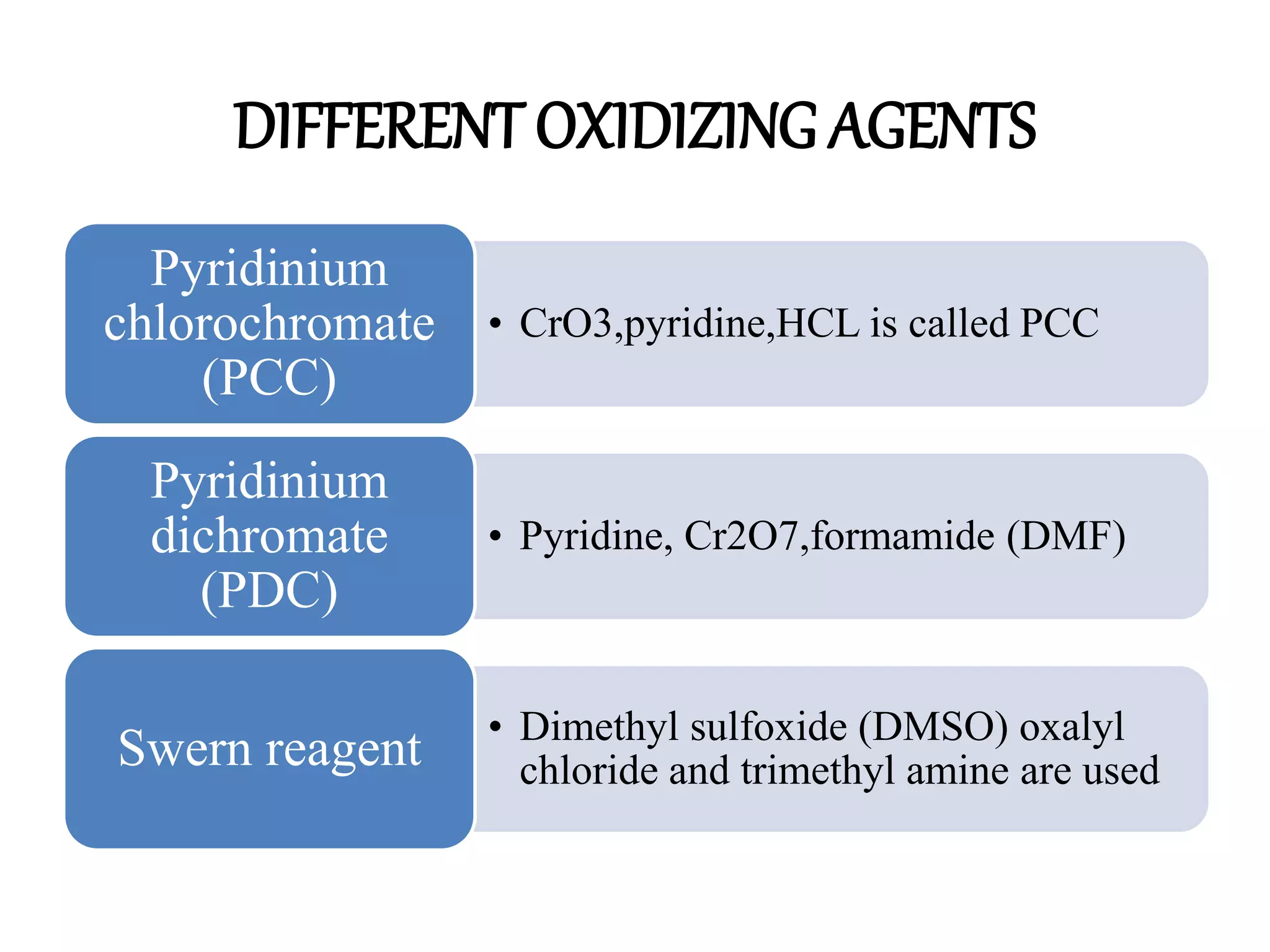
• CrO3,pyridine,HCL is called PCC
Pyridinium
chlorochromate
(PCC)
• Pyridine, Cr2O7,formamide (DMF)
Pyridinium
dichromate
(PDC)
• Dimethyl sulfoxide (DMSO) oxalyl
chloride and trimethyl amine are used
Swern reagent
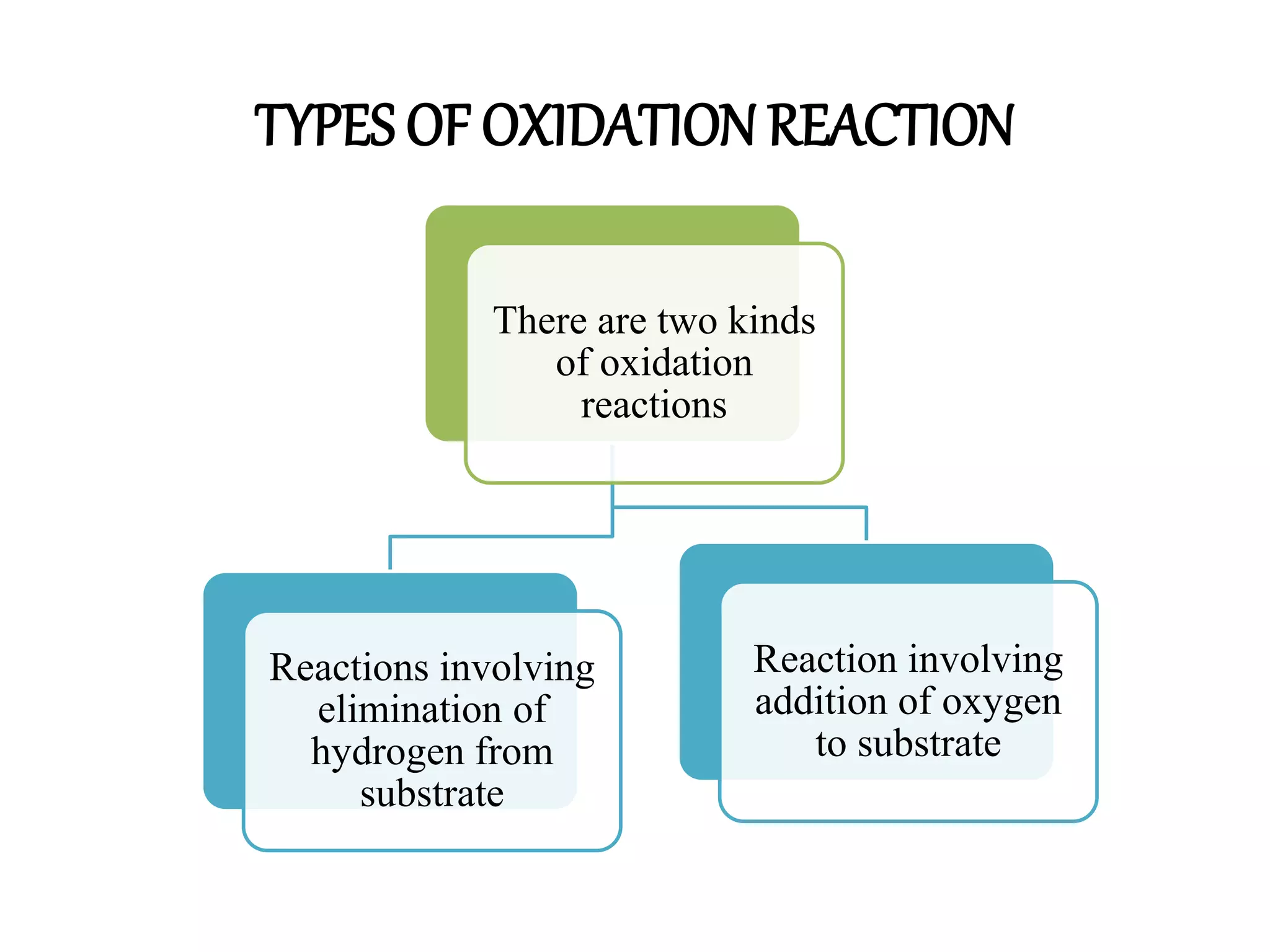
TYPES OF OXIDATION REACTION
There are two kinds
of oxidation
reactions
Reactions involving
elimination of
hydrogen from
substrate
Reaction involving
addition of oxygen
to substrate
Reactions involving
elimination of hydrogen from
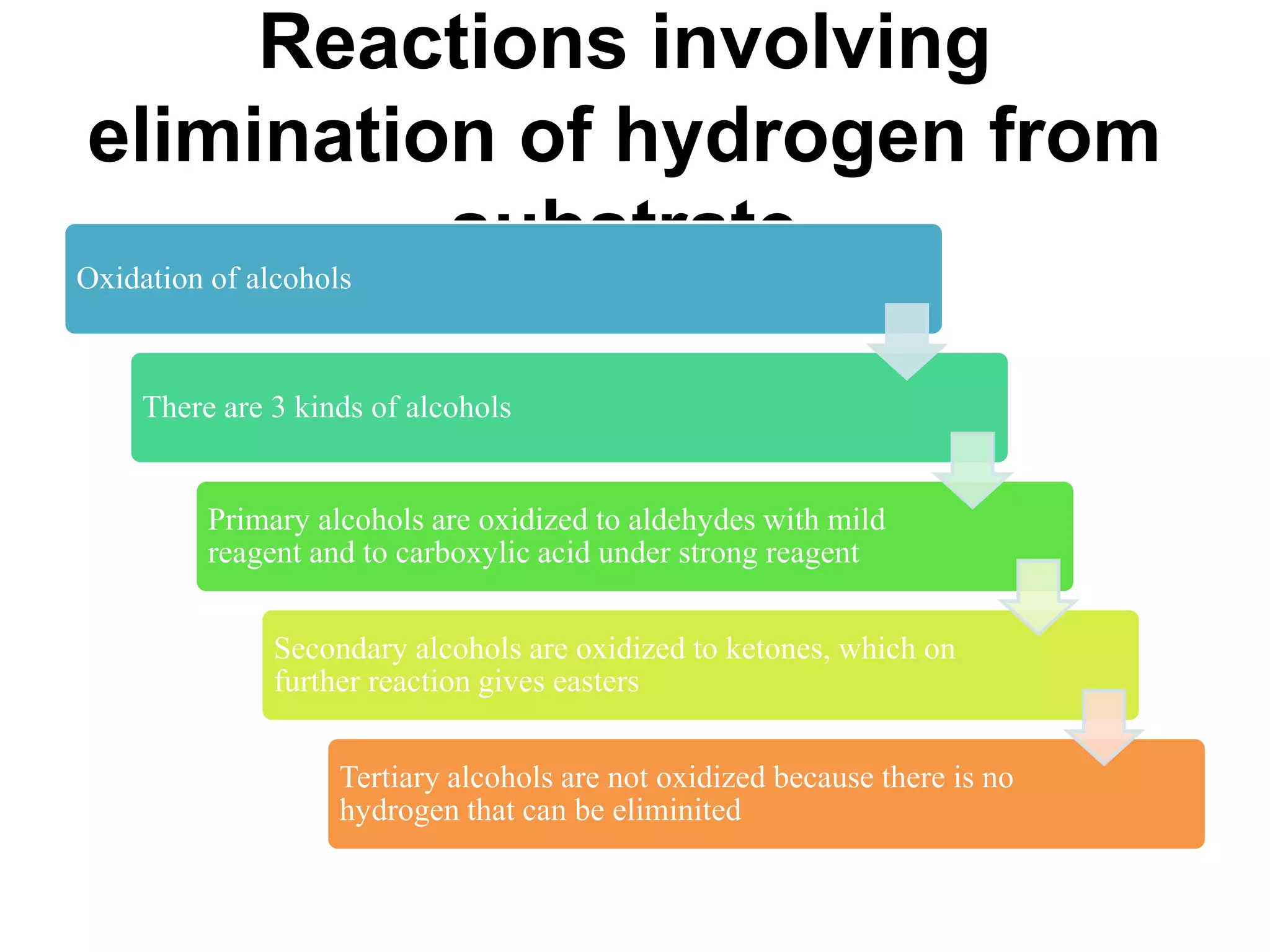
substrate
Oxidation of alcohols
There are 3 kinds of alcohols
Primary alcohols are oxidized to aldehydes with mild
reagent and to carboxylic acid under strong reagent
Secondary alcohols are oxidized to ketones, which on
further reaction gives easters
Tertiary alcohols are not oxidized because there is no
hydrogen that can be eliminited
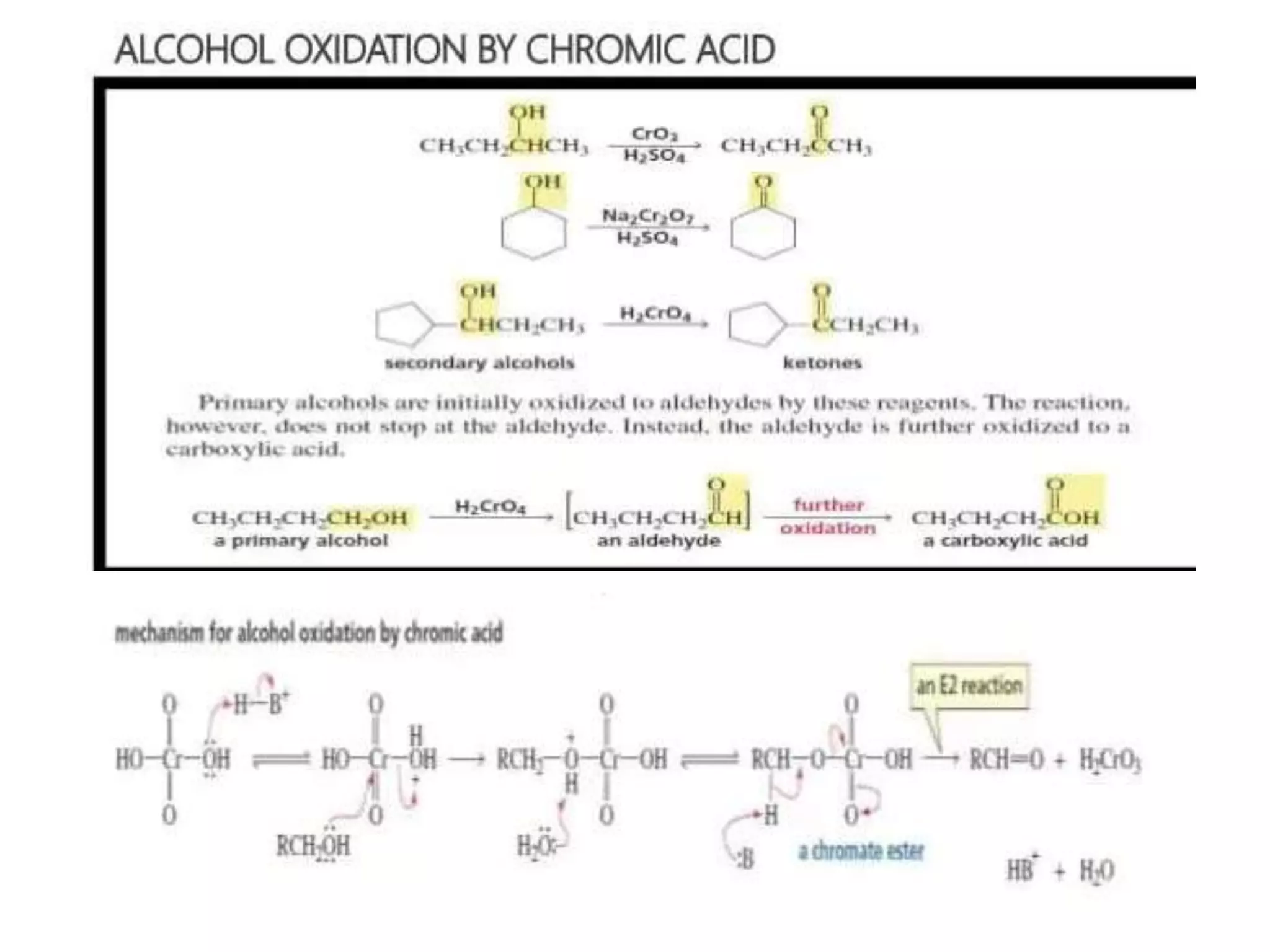
OXIDATION OF ALCOHOLS BY CHROMIC ACID
• Chromic acid is formed when chromium trioxide or
sodium dichromate is dissolved in aqueous acids.
These reactions. easily recognized as oxidation
because the number of C-H bonds decreases, and
number of C-O bonds increases.
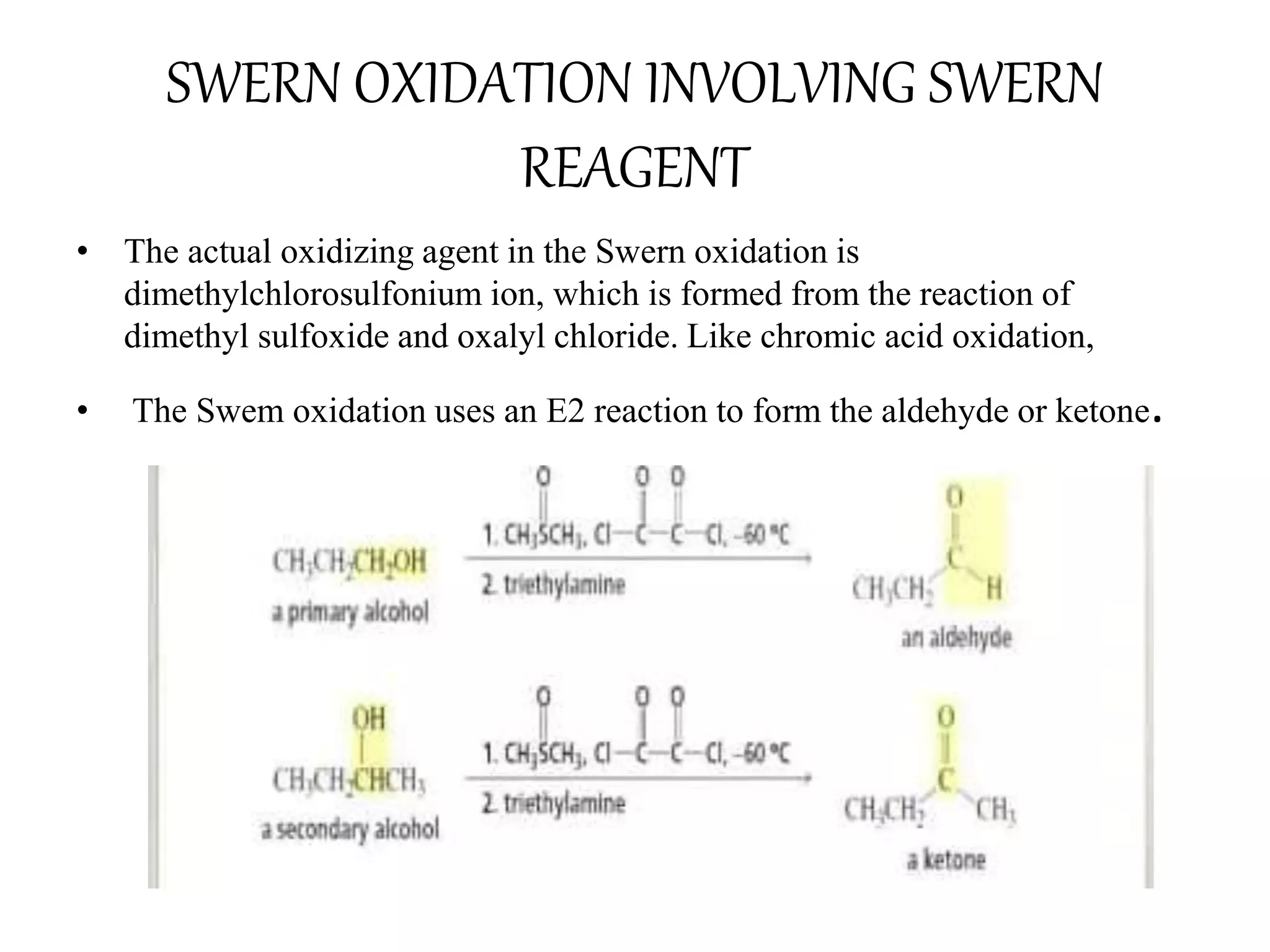
SWERN OXIDATION INVOLVING SWERN
REAGENT
• The actual oxidizing agent in the Swern oxidation is
dimethylchlorosulfonium ion, which is formed from the reaction of
dimethyl sulfoxide and oxalyl chloride. Like chromic acid oxidation,
• The Swem oxidation uses an E2 reaction to form the aldehyde or ketone.
Reaction involving addition of oxygen to substrate
• This involving the following oxidation
reactions.
1. • Oxidation of aldehydes and ketones
2. • Oxidation of alkenes
3. • Etard reaction
4. • Oppeneur oxidation
5. • Sharpless epoxidation
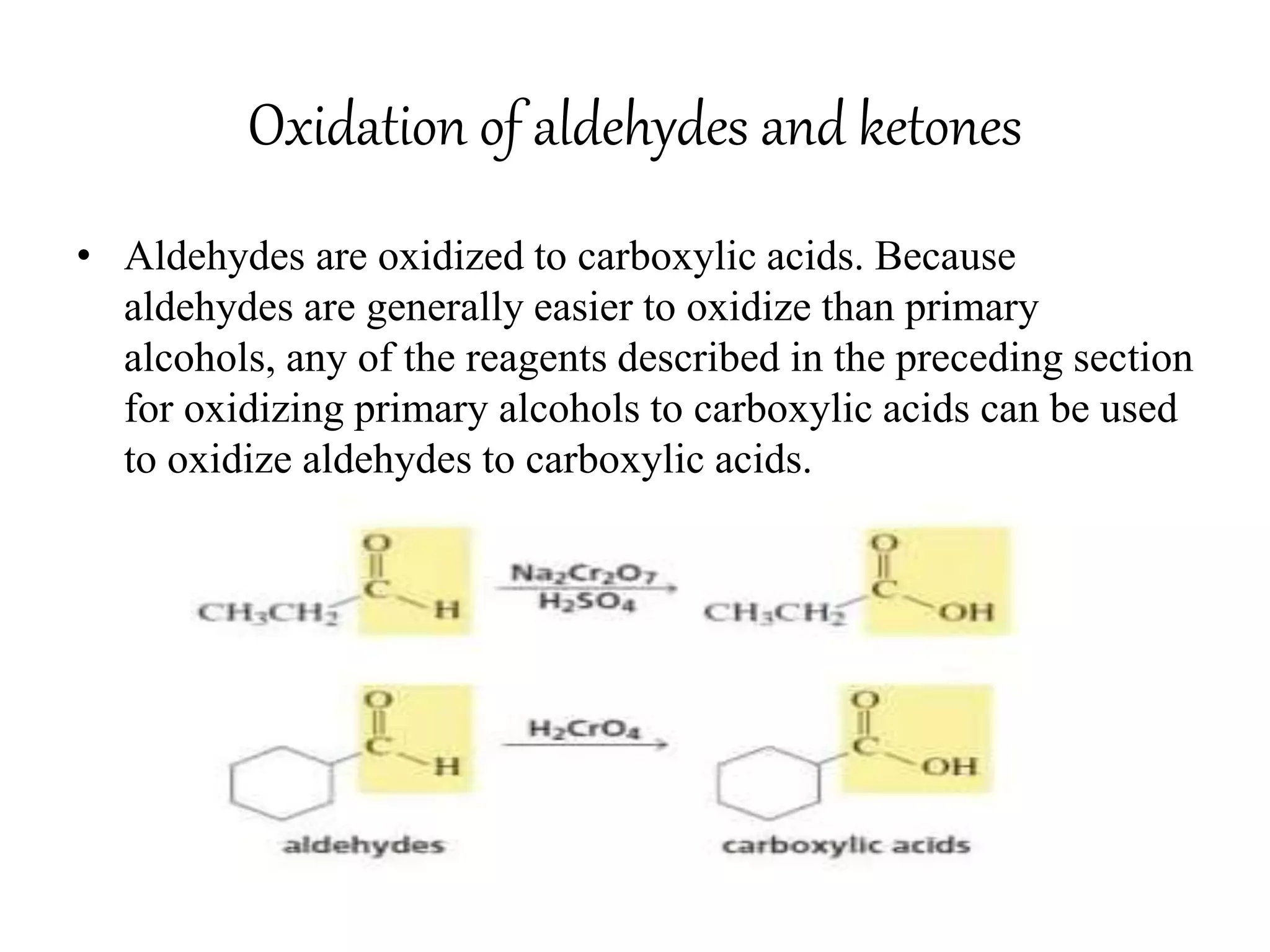
Oxidation of aldehydes and ketones
• Aldehydes are oxidized to carboxylic acids. Because
aldehydes are generally easier to oxidize than primary
alcohols, any of the reagents described in the preceding section
for oxidizing primary alcohols to carboxylic acids can be used
to oxidize aldehydes to carboxylic acids.
OXIDATION OF ALKENES
• PERMANGANATE CLEAVAGE OF ALKENES
ETARD REACTION
• The Etard reaction is a chemical reaction that involves the direct oxidation
of an aromatic or heterocyclic bound methyl group to an aldehyde using
chromyl chloride. For example, toluene can be oxidized to benzaldehyde
SHARPLESS EPOXIDATION
• The Sharpless epoxidation reaction is an enantioselective
chemical reaction to prepare 2,3-epoxyalcohols from primary
and secondary allylic alcohols. The stereochemistry of the
resulting epoxide is determined by the enantiomer of the chiral
tartrate diester employed in the reaction.
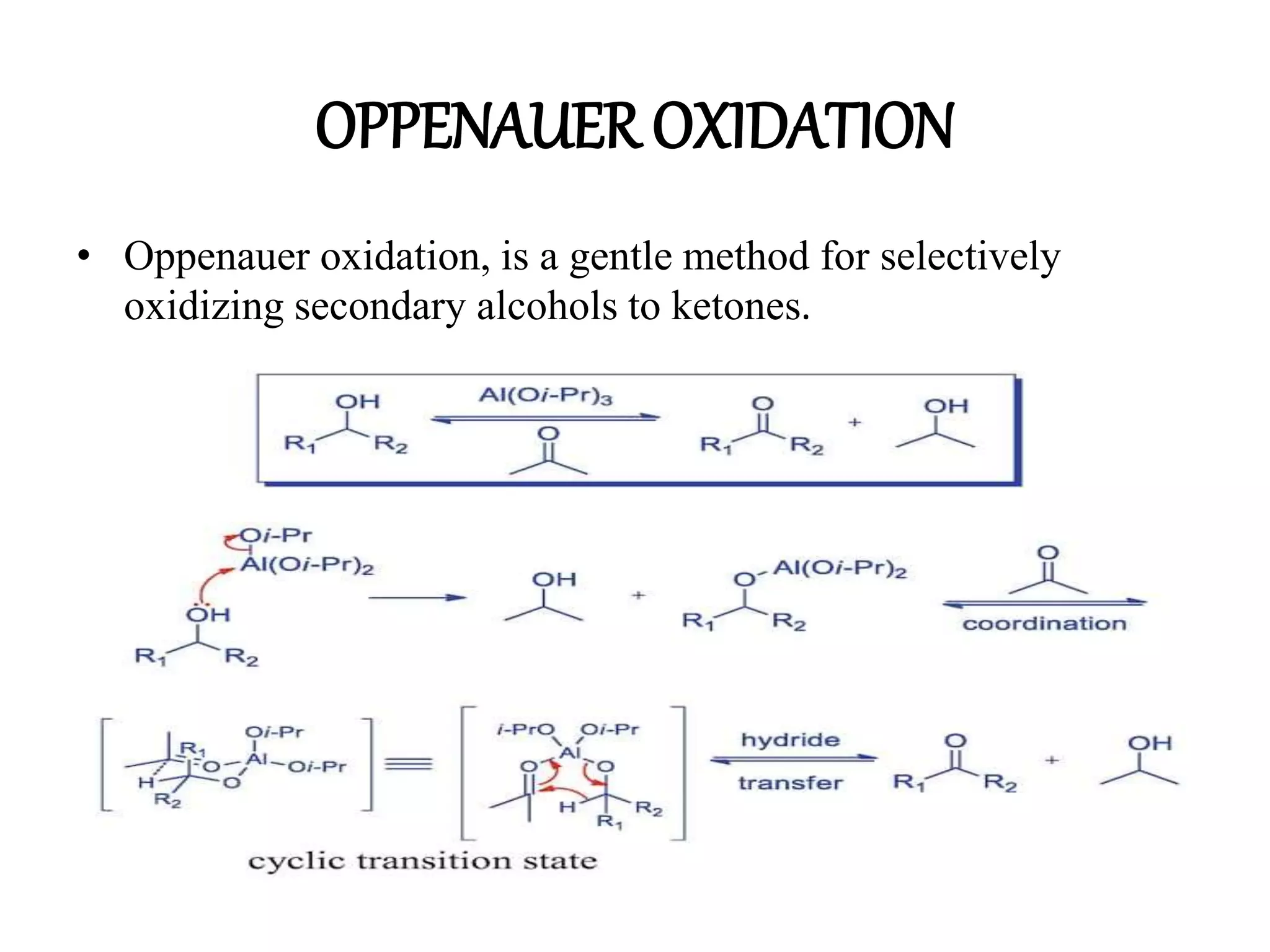
OPPENAUER OXIDATION
• Oppenauer oxidation, is a gentle method for selectively
oxidizing secondary alcohols to ketones.
MULTIPLE CHOICE QUESTIONS
1. Which among the following is the strongest oxidizing agent?
a) H2O2
b) O3
c) K2Cr2O7
d) KMnO4
Ans. (b
2. The total of the oxidation number in an element is
a) charge
b) Volatility
c) Reduction
d) oxidation
Ans. (a
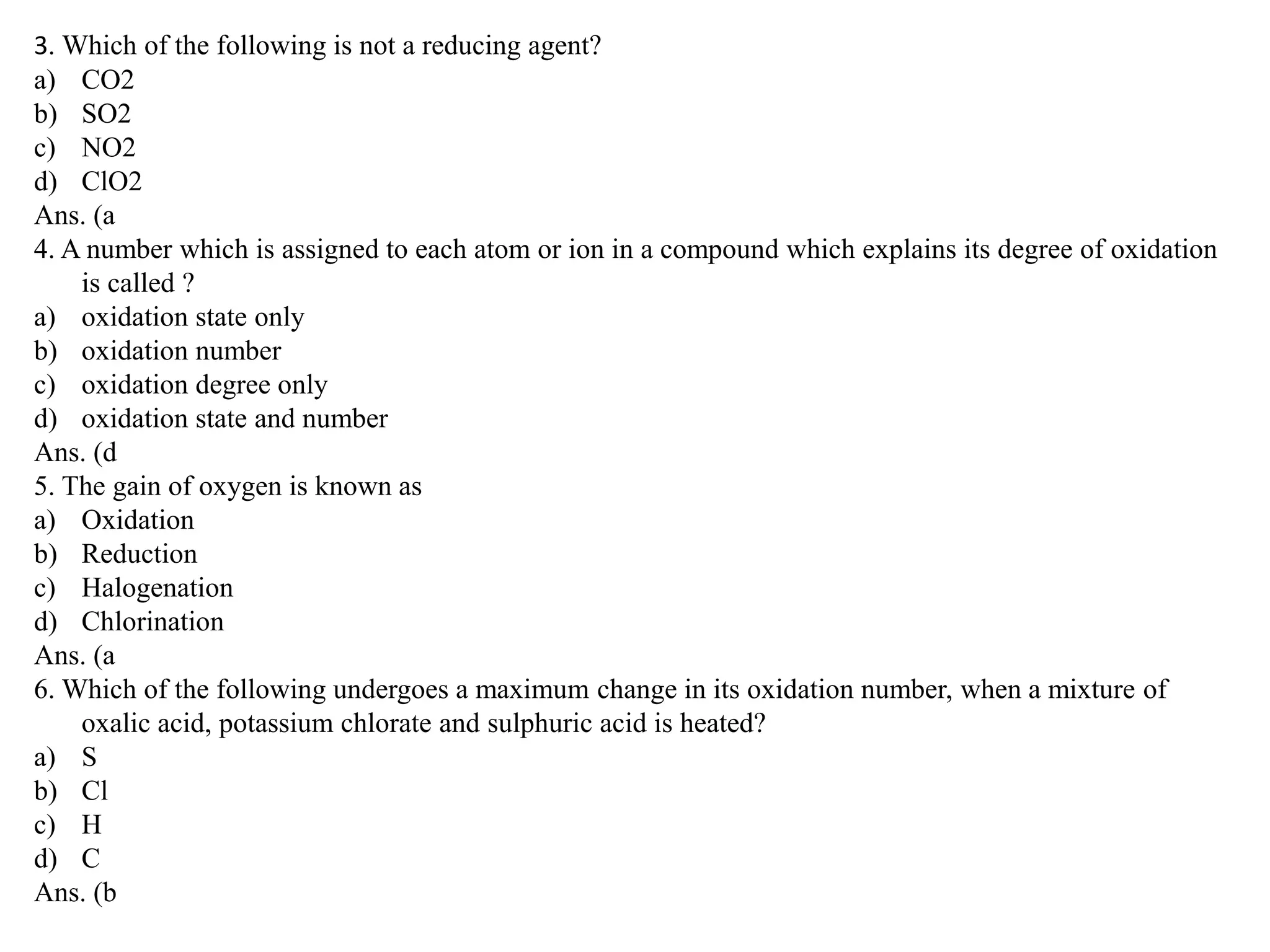
3. Which of the following is not a reducing agent?
a) CO2
b) SO2
c) NO2
d) ClO2
Ans. (a
4. A number which is assigned to each atom or ion in a compound which explains its degree of oxidation
is called ?
a) oxidation state only
b) oxidation number
c) oxidation degree only
d) oxidation state and number
Ans. (d
5. The gain of oxygen is known as
a) Oxidation
b) Reduction
c) Halogenation
d) Chlorination
Ans. (a
6. Which of the following undergoes a maximum change in its oxidation number, when a mixture of
oxalic acid, potassium chlorate and sulphuric acid is heated?
a) S
b) Cl
c) H
d) C
Ans. (b
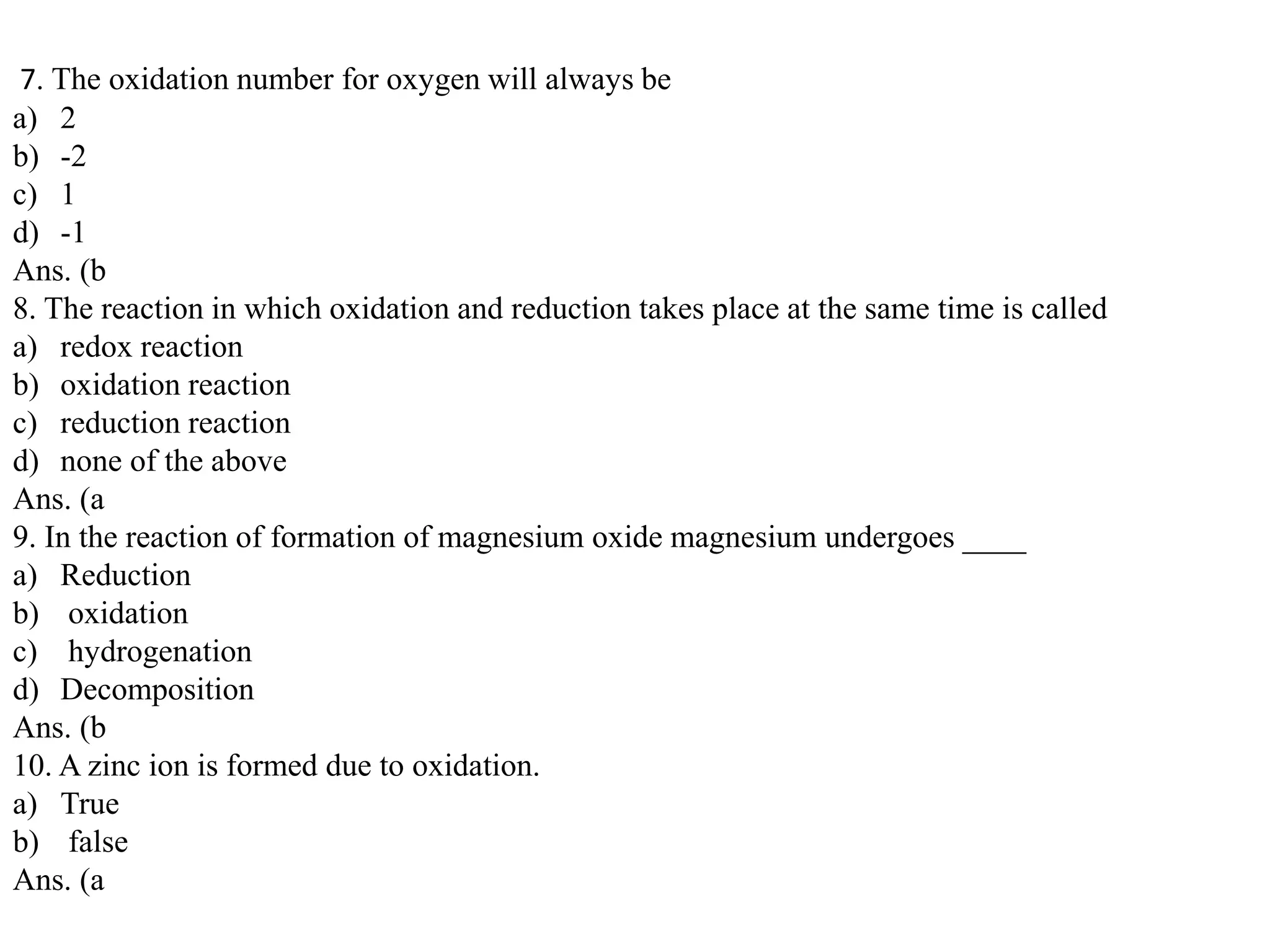
7. The oxidation number for oxygen will always be
a) 2
b) -2
c) 1
d) -1
Ans. (b
8. The reaction in which oxidation and reduction takes place at the same time is called
a) redox reaction
b) oxidation reaction
c) reduction reaction
d) none of the above
Ans. (a
9. In the reaction of formation of magnesium oxide magnesium undergoes ____
a) Reduction
b) oxidation
c) hydrogenation
d) Decomposition
Ans. (b
10. A zinc ion is formed due to oxidation.
a) True
b) false
Ans. (a
11. Oxidation is the same as ____
a) addition of hydrogen
b) removal of oxygen
c) addition of oxygen
d) removal of Nitrogen
Ans. (c
12. Formation of zinc sulphide is an example of _____
a) Reduction
b) oxidation
c) removal of oxygen
d) addition of hydrogen
Ans. (b
13. SnCl2 + 2FeCl2 → SnCl4 + 2FeCl2 is an example of ______ reaction.
a) only oxidation
b) only reduction
c) redox
d) neither oxidation nor reduction
Ans. (c
14. SnCl2 + 2FeCl2 → SnCl4 + 2FeCl2. Which of the following element undergoes oxidation in the
reaction given?
a) Iron
b) tin
c) Chlorine
d) ferrous
Ans. (b
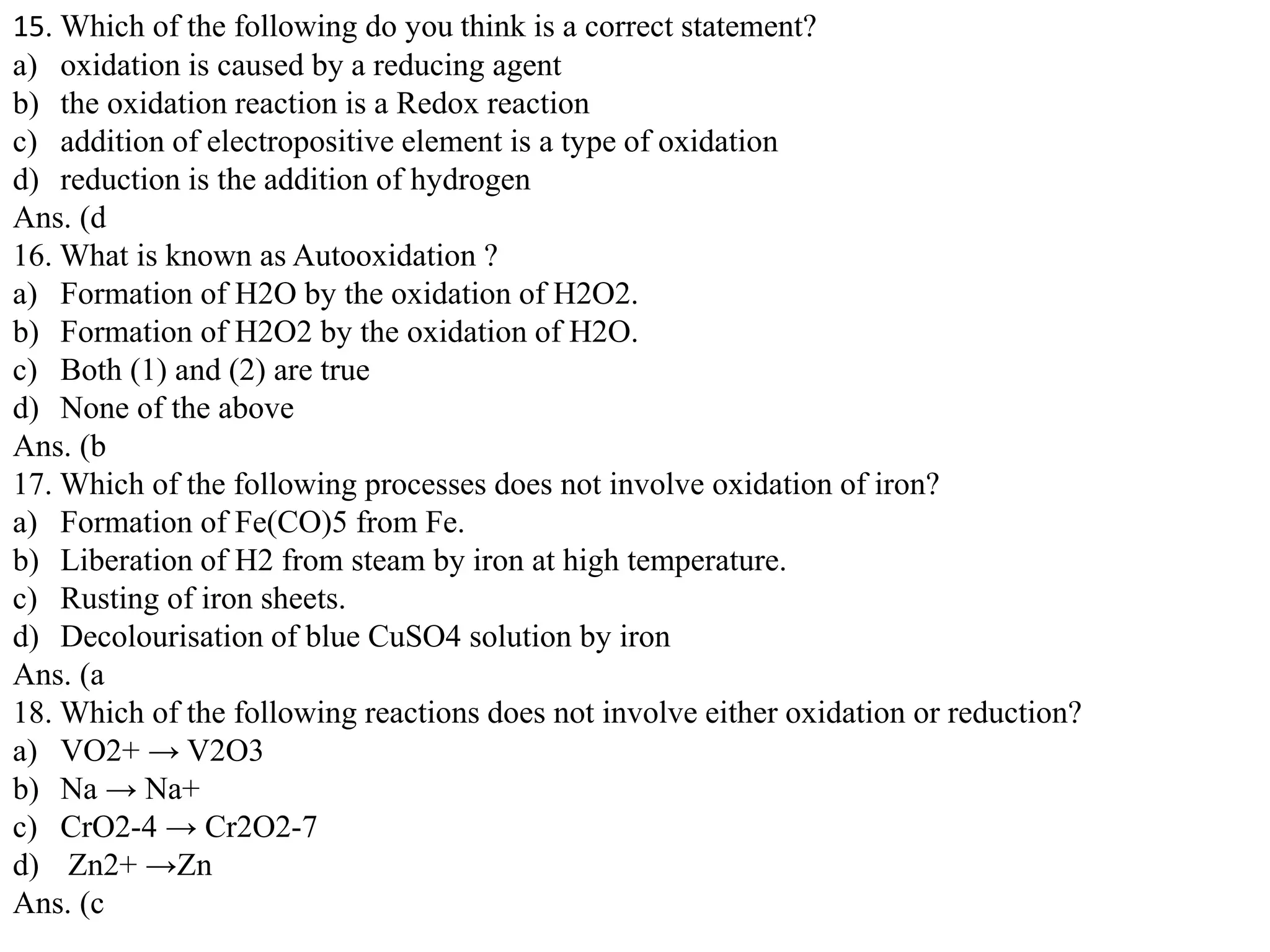
15. Which of the following do you think is a correct statement?
a) oxidation is caused by a reducing agent
b) the oxidation reaction is a Redox reaction
c) addition of electropositive element is a type of oxidation
d) reduction is the addition of hydrogen
Ans. (d
16. What is known as Autooxidation ?
a) Formation of H2O by the oxidation of H2O2.
b) Formation of H2O2 by the oxidation of H2O.
c) Both (1) and (2) are true
d) None of the above
Ans. (b
17. Which of the following processes does not involve oxidation of iron?
a) Formation of Fe(CO)5 from Fe.
b) Liberation of H2 from steam by iron at high temperature.
c) Rusting of iron sheets.
d) Decolourisation of blue CuSO4 solution by iron
Ans. (a
18. Which of the following reactions does not involve either oxidation or reduction?
a) VO2+ → V2O3
b) Na → Na+
c) CrO2-4 → Cr2O2-7
d) Zn2+ →Zn
Ans. (c
19. The colourless solution of silver nitrate slowly turns blue on adding copper chips to it
because of
a) Dissolution of Copper
b) Oxidation of Ag+ → Ag
c) Reduction of Cu2+ ions
d) Oxidation of Cu atom
Ans. (d
20. In the following reaction
4P+3KOH+3H2O 3KH2PO2+PH3
a) Phosphorus is both oxidized and reduced
b) Only phosphorus is reduced
c) Phosphorus is not oxidized
d) None of these
Ans. (a
Oxidation ppt

Oxidation ppt

  • 1.
    OXIDATION Presented to: Dr. RakhiMishra Associate Professor NIET(PHARMACY INSTITUTE), Greater Noida Presented by: Ranjeet kumar yadav m. Pharm. 1st year (pharmaceutical chemistry)
  • 2.
    CONTENT • Introduction • Oxidizingagent • Types of oxidation reaction • Reactions involving elimination of hydrogen from substrate • Reaction involving addition of oxygen to substrate • Multiple choice type question
  • 3.
    INTRODUCTION • Oxidation isany chemical reaction that involves the moving of electrons. Specifically, it means the substance that gives away electrons is oxidized. Normally, this is a reaction between oxygen and a substance such as iron. • Oxidation is nothing but a process in which either;. • Addition of oxygen. • Removal of hydrogen. • Loss of an electron. • Increase in oxidation number takes place.
  • 5.
    OXIDIZINGAGENT • an oxidizingagent (oxidant, oxidizer) is a substance that can oxidize other substances-in other words to accept their electrons. Common oxidizing agents are oxygen, hydrogen peroxide and the halogens.
  • 6.
    DIFFERENT OXIDIZING AGENTS •CrO3 pyridine is called sarett reagent. Sarett reagent • CrO3,H2SO4,H2O is called john’s reagent. John’s agent • CrO3 pyridine is used first and product is treated with CH2Cl2 Collin’s reagent
  • 7.
    DIFFERENT OXIDIZING AGENTS •CrO3,pyridine,HCL is called PCC Pyridinium chlorochromate (PCC) • Pyridine, Cr2O7,formamide (DMF) Pyridinium dichromate (PDC) • Dimethyl sulfoxide (DMSO) oxalyl chloride and trimethyl amine are used Swern reagent
  • 8.
    TYPES OF OXIDATIONREACTION There are two kinds of oxidation reactions Reactions involving elimination of hydrogen from substrate Reaction involving addition of oxygen to substrate
  • 9.
    Reactions involving elimination ofhydrogen from substrate Oxidation of alcohols There are 3 kinds of alcohols Primary alcohols are oxidized to aldehydes with mild reagent and to carboxylic acid under strong reagent Secondary alcohols are oxidized to ketones, which on further reaction gives easters Tertiary alcohols are not oxidized because there is no hydrogen that can be eliminited
  • 10.
    OXIDATION OF ALCOHOLSBY CHROMIC ACID • Chromic acid is formed when chromium trioxide or sodium dichromate is dissolved in aqueous acids. These reactions. easily recognized as oxidation because the number of C-H bonds decreases, and number of C-O bonds increases.
  • 12.
    SWERN OXIDATION INVOLVINGSWERN REAGENT • The actual oxidizing agent in the Swern oxidation is dimethylchlorosulfonium ion, which is formed from the reaction of dimethyl sulfoxide and oxalyl chloride. Like chromic acid oxidation, • The Swem oxidation uses an E2 reaction to form the aldehyde or ketone.
  • 14.
    Reaction involving additionof oxygen to substrate • This involving the following oxidation reactions. 1. • Oxidation of aldehydes and ketones 2. • Oxidation of alkenes 3. • Etard reaction 4. • Oppeneur oxidation 5. • Sharpless epoxidation
  • 15.
    Oxidation of aldehydesand ketones • Aldehydes are oxidized to carboxylic acids. Because aldehydes are generally easier to oxidize than primary alcohols, any of the reagents described in the preceding section for oxidizing primary alcohols to carboxylic acids can be used to oxidize aldehydes to carboxylic acids.
  • 18.
    OXIDATION OF ALKENES •PERMANGANATE CLEAVAGE OF ALKENES
  • 19.
    ETARD REACTION • TheEtard reaction is a chemical reaction that involves the direct oxidation of an aromatic or heterocyclic bound methyl group to an aldehyde using chromyl chloride. For example, toluene can be oxidized to benzaldehyde
  • 20.
    SHARPLESS EPOXIDATION • TheSharpless epoxidation reaction is an enantioselective chemical reaction to prepare 2,3-epoxyalcohols from primary and secondary allylic alcohols. The stereochemistry of the resulting epoxide is determined by the enantiomer of the chiral tartrate diester employed in the reaction.
  • 21.
    OPPENAUER OXIDATION • Oppenaueroxidation, is a gentle method for selectively oxidizing secondary alcohols to ketones.
  • 22.
    MULTIPLE CHOICE QUESTIONS 1.Which among the following is the strongest oxidizing agent? a) H2O2 b) O3 c) K2Cr2O7 d) KMnO4 Ans. (b 2. The total of the oxidation number in an element is a) charge b) Volatility c) Reduction d) oxidation Ans. (a
  • 23.
    3. Which ofthe following is not a reducing agent? a) CO2 b) SO2 c) NO2 d) ClO2 Ans. (a 4. A number which is assigned to each atom or ion in a compound which explains its degree of oxidation is called ? a) oxidation state only b) oxidation number c) oxidation degree only d) oxidation state and number Ans. (d 5. The gain of oxygen is known as a) Oxidation b) Reduction c) Halogenation d) Chlorination Ans. (a 6. Which of the following undergoes a maximum change in its oxidation number, when a mixture of oxalic acid, potassium chlorate and sulphuric acid is heated? a) S b) Cl c) H d) C Ans. (b
  • 24.
    7. The oxidationnumber for oxygen will always be a) 2 b) -2 c) 1 d) -1 Ans. (b 8. The reaction in which oxidation and reduction takes place at the same time is called a) redox reaction b) oxidation reaction c) reduction reaction d) none of the above Ans. (a 9. In the reaction of formation of magnesium oxide magnesium undergoes ____ a) Reduction b) oxidation c) hydrogenation d) Decomposition Ans. (b 10. A zinc ion is formed due to oxidation. a) True b) false Ans. (a
  • 25.
    11. Oxidation isthe same as ____ a) addition of hydrogen b) removal of oxygen c) addition of oxygen d) removal of Nitrogen Ans. (c 12. Formation of zinc sulphide is an example of _____ a) Reduction b) oxidation c) removal of oxygen d) addition of hydrogen Ans. (b 13. SnCl2 + 2FeCl2 → SnCl4 + 2FeCl2 is an example of ______ reaction. a) only oxidation b) only reduction c) redox d) neither oxidation nor reduction Ans. (c 14. SnCl2 + 2FeCl2 → SnCl4 + 2FeCl2. Which of the following element undergoes oxidation in the reaction given? a) Iron b) tin c) Chlorine d) ferrous Ans. (b
  • 26.
    15. Which ofthe following do you think is a correct statement? a) oxidation is caused by a reducing agent b) the oxidation reaction is a Redox reaction c) addition of electropositive element is a type of oxidation d) reduction is the addition of hydrogen Ans. (d 16. What is known as Autooxidation ? a) Formation of H2O by the oxidation of H2O2. b) Formation of H2O2 by the oxidation of H2O. c) Both (1) and (2) are true d) None of the above Ans. (b 17. Which of the following processes does not involve oxidation of iron? a) Formation of Fe(CO)5 from Fe. b) Liberation of H2 from steam by iron at high temperature. c) Rusting of iron sheets. d) Decolourisation of blue CuSO4 solution by iron Ans. (a 18. Which of the following reactions does not involve either oxidation or reduction? a) VO2+ → V2O3 b) Na → Na+ c) CrO2-4 → Cr2O2-7 d) Zn2+ →Zn Ans. (c
  • 27.
    19. The colourlesssolution of silver nitrate slowly turns blue on adding copper chips to it because of a) Dissolution of Copper b) Oxidation of Ag+ → Ag c) Reduction of Cu2+ ions d) Oxidation of Cu atom Ans. (d 20. In the following reaction 4P+3KOH+3H2O 3KH2PO2+PH3 a) Phosphorus is both oxidized and reduced b) Only phosphorus is reduced c) Phosphorus is not oxidized d) None of these Ans. (a