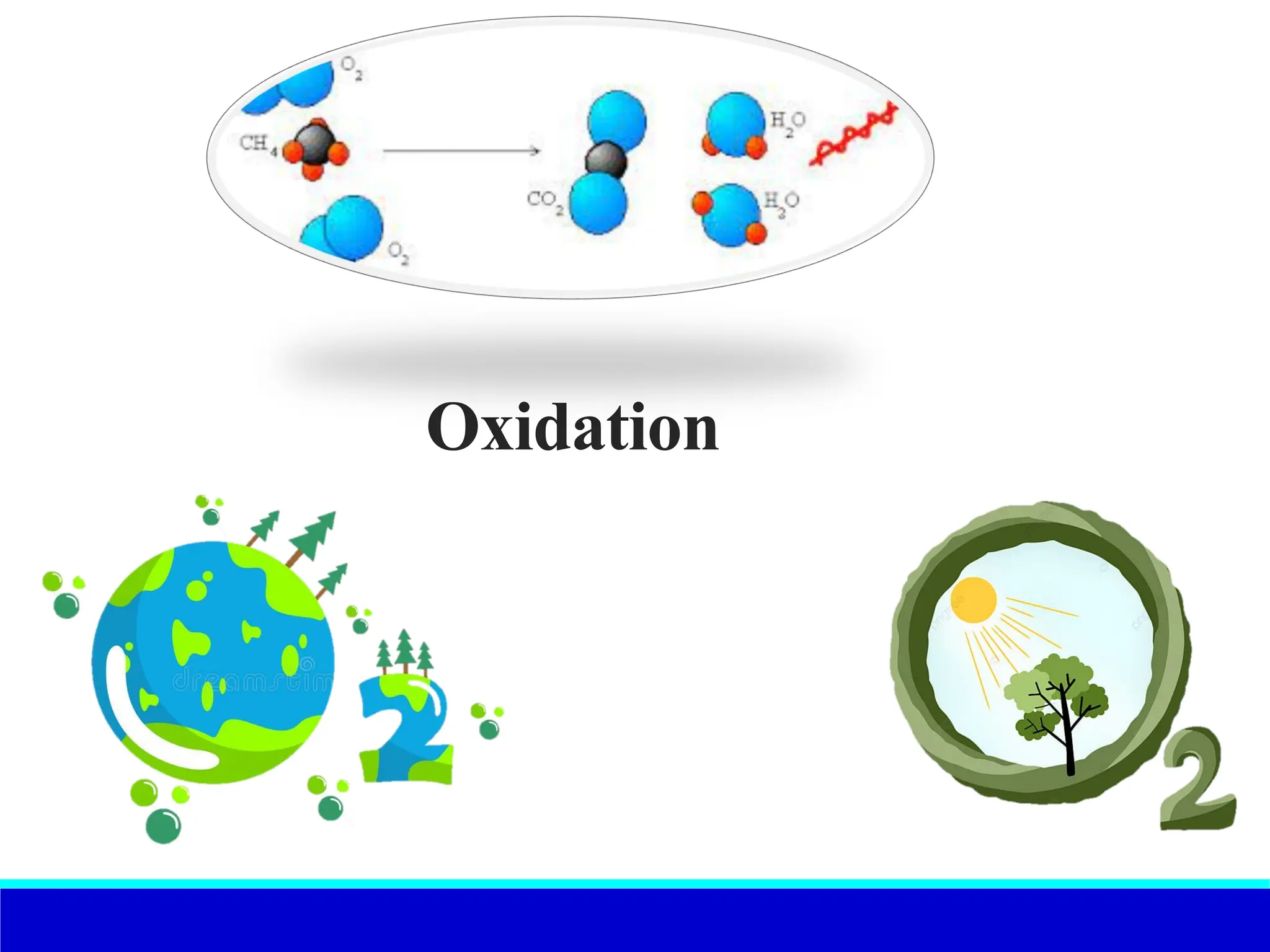
Oxidation
Learning objectives
After completion of this section, you will be able to:
Definitions of oxidation
Application of oxidation
Types of oxidation reaction
Oxidizing agents
Kinetics and thermochemistry
2
Definition
IUPAC gives several different definitions of oxidation:
◦ loss of electrons,
◦ increase in oxidation state,
◦ loss of hydrogen, or
◦ gain of oxygen
3
https://pubs.acs.org/doi/10.1021/ed100777q
Application of oxidation
Oxidation is involved in photosynthesis
During photosynthesis, plants use light energy, water, and carbon
dioxide to create oxygen and chemical energy. Electron transfer
occurs after the light is absorbed and this is when water molecules
are oxidized to oxygen and carbon dioxide molecules are reduced
to glucose. Without redox reactions, plants would not be able to
produce oxygen or store the energy of sunlight in chloroplasts.
Respiration is an oxidation reaction
Respiration is the reverse of photosynthesis, during which glucose
molecules are oxidized and oxygen molecules are reduced. Without
the redox reactions occurring during respiration, our bodies would
not be able to metabolize, generate energy, or discard waste
products. Hence, cellular respiration is a vital process in living
organisms.
4
https://theimportantsite.com/why-oxidation-is-important/
Application of oxidation
Combustion of substances is an oxidation reaction
The combustion or burning of any substance is an oxidation
reaction. Typically, combustion reactions include oxygen that is
reduced and the substance that is oxidized. For instance, various
fuels are burnt to generate energy in numerous everyday and
industrial activities. For example, if you own a car, oxidation occurs
every time you drive. Besides, burning wood or coal for household
purposes is also an example of combustion incorporating an
oxidation reaction. Do you use natural gas or LPG for cooking? This
is also a combustion reaction.
5
https://theimportantsite.com/why-oxidation-is-important/
Application of oxidation
Corrosion is an oxidation reaction
You have probably seen corroded metals, right? But did you know
that certain materials deteriorate as a result of oxidation?
Generally speaking, corrosion occurs when the atoms on the metal
surface are oxidized. This happens because metals tend to easily
lose electrons when exposed to a gas (e.g., air) containing oxygen.
During the redox reaction, metals return to their natural oxidation
states and oxygen is reduced, forming a metal oxide.
6
https://theimportantsite.com/why-oxidation-is-important/
Application of oxidation
Oxidation is used for the treatment of agricultural and industrial
wastewaters
There is no doubt that wastewater treatment and water
purification protect humans and the overall ecosystem. Therefore,
removing toxic chemicals from wastewater is key to avoiding severe
health risks. There are several effective processes to treat
wastewater and chemical water treatment is just one of them.
Advanced oxidation processes (AOPs) involve the use of oxidizing
agents (chlorine, ozone, calcium/sodium hypochlorite, etc.) that kill
bacteria and remove organic or inorganic materials through
reactions with hydroxyl radicals.
7
https://theimportantsite.com/why-oxidation-is-important/
Application of oxidation
Oxidation is key in organic synthesis
Oxidation reactions are of huge importance in organic synthesis.
The main reason for this is that oxidation is a fundamental
technique for creating new functional groups. For instance, primary
alcohols can be oxidized to aldehydes and carboxylic acids, while
the oxidation of secondary alcohols produces ketones.
8
https://theimportantsite.com/why-oxidation-is-important/
Types of oxidative reactions
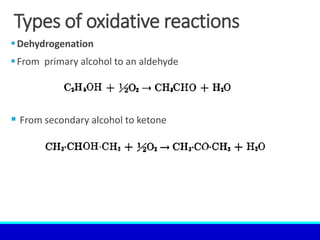
Dehydrogenation
From primary alcohol to an aldehyde
 From secondary alcohol to ketone
Types of oxidative reactions
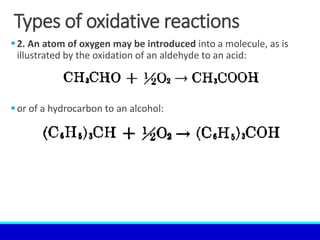
2. An atom of oxygen may be introduced into a molecule, as is
illustrated by the oxidation of an aldehyde to an acid:
or of a hydrocarbon to an alcohol:
Types of oxidative reactions
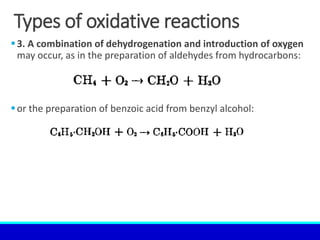
3. A combination of dehydrogenation and introduction of oxygen
may occur, as in the preparation of aldehydes from hydrocarbons:
or the preparation of benzoic acid from benzyl alcohol:
Types of oxidative reactions
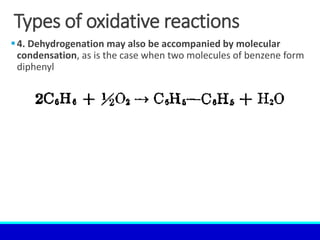
4. Dehydrogenation may also be accompanied by molecular
condensation, as is the case when two molecules of benzene form
diphenyl
Types of oxidative reactions
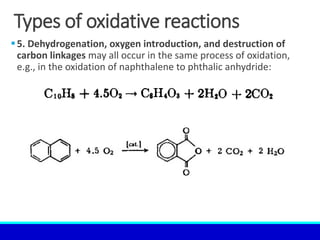
5. Dehydrogenation, oxygen introduction, and destruction of
carbon linkages may all occur in the same process of oxidation,
e.g., in the oxidation of naphthalene to phthalic anhydride:
Types of oxidative reactions
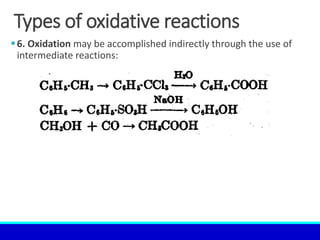
6. Oxidation may be accomplished indirectly through the use of
intermediate reactions:
Types of oxidative reactions
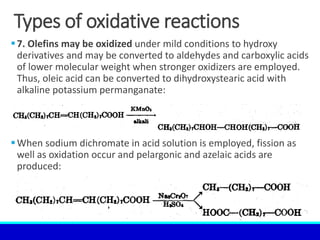
7. Olefins may be oxidized under mild conditions to hydroxy
derivatives and may be converted to aldehydes and carboxylic acids
of lower molecular weight when stronger oxidizers are employed.
Thus, oleic acid can be converted to dihydroxystearic acid with
alkaline potassium permanganate:
When sodium dichromate in acid solution is employed, fission as
well as oxidation occur and pelargonic and azelaic acids are
produced:
Types of oxidative reactions
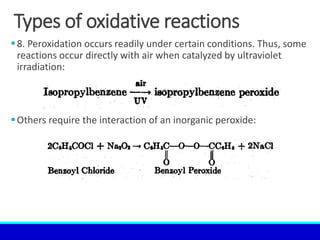
8. Peroxidation occurs readily under certain conditions. Thus, some
reactions occur directly with air when catalyzed by ultraviolet
irradiation:
Others require the interaction of an inorganic peroxide:
Types of oxidative reactions
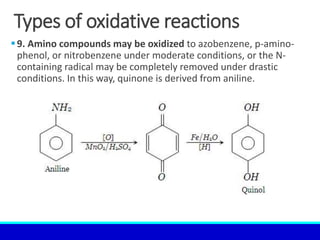
9. Amino compounds may be oxidized to azobenzene, p-amino-
phenol, or nitrobenzene under moderate conditions, or the N-
containing radical may be completely removed under drastic
conditions. In this way, quinone is derived from aniline.
Types of oxidative reactions
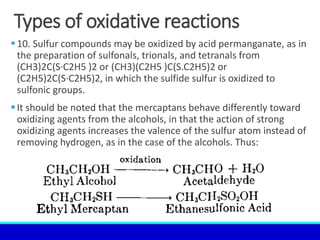
10. Sulfur compounds may be oxidized by acid permanganate, as in
the preparation of sulfonals, trionals, and tetranals from
(CH3)2C(S·C2H5 )2 or (CH3)(C2H5 )C(S.C2H5)2 or
(C2H5)2C(S·C2H5)2, in which the sulfide sulfur is oxidized to
sulfonic groups.
It should be noted that the mercaptans behave differently toward
oxidizing agents from the alcohols, in that the action of strong
oxidizing agents increases the valence of the sulfur atom instead of
removing hydrogen, as in the case of the alcohols. Thus:
Types of oxidative reactions
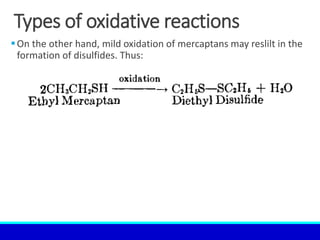
On the other hand, mild oxidation of mercaptans may reslilt in the
formation of disulfides. Thus:
Oxidizing agents
The principal problem involved in oxidation reaction is the
induction of the desired reaction coupled with a satisfactory
control of the extent of reaction.
Since this is so, a study of the processes employing oxidation
would best be founded on an inspection of the materials and
methods used to solve these problems.
In the case of liquid-phase oxidations, it is possible to use either
gaseous oxygen or compounds having oxidizing power. To illustrate
the methods that are used, the processes will first be examined
from the standpoint of the oxidizing agent, and the character of the
action of each agent will be pointed out later by the use of
exemplary reactions.
20
Oxidizing agents
Permanganates
The solid salts of permanganic acid are powerful oxidizing agents.
Calcium permanganate induces such rapid oxidation of ethanol that
inflammation may result.
Aqueous solutions of the permanganates also possess powerful
oxidizing properties.
One of the commonest and most useful of the agents employed in
organic oxidations is potassium permanganate.
The potassium salt is available in the form of stable crystals,
whereas the sodium salt is deliquescent; consequently, the former
is almost invariably used.
It functions as an oxidizing agent of different strengths in alkaline,
neutral, and acid solutions.
21
Oxidizing agents
Dichromates
The usual form of oxidation with dichromates is in the presence of
sulfuric acid and with the sodium or potassium salt.
Although the dichromates exert an oxidizing tendency in the
absence of acid, the oxidation reaction can be made to occur much
more quickly in the presence of acid, and acid solutions are almost
invariably used.
22
Oxidizing agents
Hypochlorous Acid and Salts
The lithium, sodium, and calcium salts of hypochlorous acid are
known in the solid state.
Although they decompose easily when wet, they are stable if
thoroughly dry.
Bleaching powder, formed by reacting chlorine with dry calcium
hydroxide, is related to the hypochlorites and depends upon the
presence of the hypochlorite radical for its characteristic action.
Chlorinated solutions of zinc and aluminum hydroxides are more
active oxidizing agents than are comparably treated solutions of
the alkalies or alkaline earths because of greater hydrolysis and
consequent more rapid decomposition of hypochlorous acid. But
the sodium salt has the advantage of ease of preparation and
handling.
23
Oxidizing agents
Sodium Chlorite and Chlorine Dioxide
Sodium chlorite, NaCIO2, is marketed as an 80 per cent dry powder
for use in bleaching. When reacted with chlorine, sodium chlorite
releases chlorine dioxide, CIO2, a gas at normal temperatures and
soluble in water.
Chlorine dioxide is a powerful oxidizing and bleaching agent; but
because of its instability, it cannot be produced and stored.
The aqueous solutions are decomposed by light to perchloric and
chloric acids, oxygen, and water.
24
Oxidizing agents
Chlorates
Chlorie acid, HCIO3, is a powerful oxidizing agent. It may be
obtained in aqueous solutions at concentrations up to about 40 per
cent and is stable at temperatures up to 40°C.
Such a solution will ignite paper immersed in it.
Peroxides
The principal peroxides used as oxidizing agents are those of lead,
manganese, and hydrogen.
25
Oxidizing agents
Nitric Acid and Nitrogen Tetroxide
The principal disadvantage of nitric acid as a partial oxidizing agent
,rises from the tendency to act as a nitrating agent. Even when
dilute solutions are used, the products of oxidation may contain
nitro derivatives.
The method of Krafft uses the concentrated acid (sp gr, 1.5) and is
particularly effective in the partial oxidation of substances that arc
already nitrated.
Copper Salts
Copper is capable of existing in two states of oxidation and of
passing readily from one to the other of these states by oxidation
or reduction.
26
Oxidizing agents
Alkali Fusion
Fusion with alkali in the presence of air (oxygen) often acomplishes
oxidations impossible to obtain otherwise.
Fuming Sulfuric Acid (Oleum)
Fuming sulfuric acid, H2S0 4 + SO3, in the Dresence of mercury
salts is a powerful oxidizing agent.
Ozone
The use of ozone for the oxidation of oleic acid to azelaic plus
pelargonic acids has reached commercial practicability in a
multimillion-dollar plant.
27
Kinetics and thermochemistry
Thermodynamics
In oxidations reactions, especially based on elemental oxygen, the
important thermo chemical aspect is the heat evolved.
Equilibrium is favorable and problems are largely the removal of
heat at the desired reaction temperature level and the limitation of
the oxidation to the desired product by avoidance of complete
combustion.
Catalysts are generally used in an effort to obtain the oxidation
reaction at as low a temperature as possible and to direct the
reaction to the desired products.
28
Kinetics
Oxidation reactions, are accompanied by the formation of water,
carbon oxides, or both, or by the introduction of elemental oxygen
in the organic molecule, or by the stepdown of an oxidizing
compound from an unstable state of high oxidation to a more
stable state of lower oxidation.
These reactions are exothermic and accompanied by a free-energy
decrease. Equilibrium, therefore, is favorable, and in practically all
cases no means need be provided to force the completion of the
reaction. Indeed, in the majority of cases, steps must be taken to
limit the extent of the reaction and prevent complete loss of
product through continued oxidation.
However favorable equilibrium may
29
30

Oxidation process, Unit processes of Chemical engineering

  • 1.
  • 2.
    Learning objectives After completionof this section, you will be able to: Definitions of oxidation Application of oxidation Types of oxidation reaction Oxidizing agents Kinetics and thermochemistry 2
  • 3.
    Definition IUPAC gives severaldifferent definitions of oxidation: ◦ loss of electrons, ◦ increase in oxidation state, ◦ loss of hydrogen, or ◦ gain of oxygen 3 https://pubs.acs.org/doi/10.1021/ed100777q
  • 4.
    Application of oxidation Oxidationis involved in photosynthesis During photosynthesis, plants use light energy, water, and carbon dioxide to create oxygen and chemical energy. Electron transfer occurs after the light is absorbed and this is when water molecules are oxidized to oxygen and carbon dioxide molecules are reduced to glucose. Without redox reactions, plants would not be able to produce oxygen or store the energy of sunlight in chloroplasts. Respiration is an oxidation reaction Respiration is the reverse of photosynthesis, during which glucose molecules are oxidized and oxygen molecules are reduced. Without the redox reactions occurring during respiration, our bodies would not be able to metabolize, generate energy, or discard waste products. Hence, cellular respiration is a vital process in living organisms. 4 https://theimportantsite.com/why-oxidation-is-important/
  • 5.
    Application of oxidation Combustionof substances is an oxidation reaction The combustion or burning of any substance is an oxidation reaction. Typically, combustion reactions include oxygen that is reduced and the substance that is oxidized. For instance, various fuels are burnt to generate energy in numerous everyday and industrial activities. For example, if you own a car, oxidation occurs every time you drive. Besides, burning wood or coal for household purposes is also an example of combustion incorporating an oxidation reaction. Do you use natural gas or LPG for cooking? This is also a combustion reaction. 5 https://theimportantsite.com/why-oxidation-is-important/
  • 6.
    Application of oxidation Corrosionis an oxidation reaction You have probably seen corroded metals, right? But did you know that certain materials deteriorate as a result of oxidation? Generally speaking, corrosion occurs when the atoms on the metal surface are oxidized. This happens because metals tend to easily lose electrons when exposed to a gas (e.g., air) containing oxygen. During the redox reaction, metals return to their natural oxidation states and oxygen is reduced, forming a metal oxide. 6 https://theimportantsite.com/why-oxidation-is-important/
  • 7.
    Application of oxidation Oxidationis used for the treatment of agricultural and industrial wastewaters There is no doubt that wastewater treatment and water purification protect humans and the overall ecosystem. Therefore, removing toxic chemicals from wastewater is key to avoiding severe health risks. There are several effective processes to treat wastewater and chemical water treatment is just one of them. Advanced oxidation processes (AOPs) involve the use of oxidizing agents (chlorine, ozone, calcium/sodium hypochlorite, etc.) that kill bacteria and remove organic or inorganic materials through reactions with hydroxyl radicals. 7 https://theimportantsite.com/why-oxidation-is-important/
  • 8.
    Application of oxidation Oxidationis key in organic synthesis Oxidation reactions are of huge importance in organic synthesis. The main reason for this is that oxidation is a fundamental technique for creating new functional groups. For instance, primary alcohols can be oxidized to aldehydes and carboxylic acids, while the oxidation of secondary alcohols produces ketones. 8 https://theimportantsite.com/why-oxidation-is-important/
  • 9.
    Types of oxidativereactions Dehydrogenation From primary alcohol to an aldehyde  From secondary alcohol to ketone
  • 10.
    Types of oxidativereactions 2. An atom of oxygen may be introduced into a molecule, as is illustrated by the oxidation of an aldehyde to an acid: or of a hydrocarbon to an alcohol:
  • 11.
    Types of oxidativereactions 3. A combination of dehydrogenation and introduction of oxygen may occur, as in the preparation of aldehydes from hydrocarbons: or the preparation of benzoic acid from benzyl alcohol:
  • 12.
    Types of oxidativereactions 4. Dehydrogenation may also be accompanied by molecular condensation, as is the case when two molecules of benzene form diphenyl
  • 13.
    Types of oxidativereactions 5. Dehydrogenation, oxygen introduction, and destruction of carbon linkages may all occur in the same process of oxidation, e.g., in the oxidation of naphthalene to phthalic anhydride:
  • 14.
    Types of oxidativereactions 6. Oxidation may be accomplished indirectly through the use of intermediate reactions:
  • 15.
    Types of oxidativereactions 7. Olefins may be oxidized under mild conditions to hydroxy derivatives and may be converted to aldehydes and carboxylic acids of lower molecular weight when stronger oxidizers are employed. Thus, oleic acid can be converted to dihydroxystearic acid with alkaline potassium permanganate: When sodium dichromate in acid solution is employed, fission as well as oxidation occur and pelargonic and azelaic acids are produced:
  • 16.
    Types of oxidativereactions 8. Peroxidation occurs readily under certain conditions. Thus, some reactions occur directly with air when catalyzed by ultraviolet irradiation: Others require the interaction of an inorganic peroxide:
  • 17.
    Types of oxidativereactions 9. Amino compounds may be oxidized to azobenzene, p-amino- phenol, or nitrobenzene under moderate conditions, or the N- containing radical may be completely removed under drastic conditions. In this way, quinone is derived from aniline.
  • 18.
    Types of oxidativereactions 10. Sulfur compounds may be oxidized by acid permanganate, as in the preparation of sulfonals, trionals, and tetranals from (CH3)2C(S·C2H5 )2 or (CH3)(C2H5 )C(S.C2H5)2 or (C2H5)2C(S·C2H5)2, in which the sulfide sulfur is oxidized to sulfonic groups. It should be noted that the mercaptans behave differently toward oxidizing agents from the alcohols, in that the action of strong oxidizing agents increases the valence of the sulfur atom instead of removing hydrogen, as in the case of the alcohols. Thus:
  • 19.
    Types of oxidativereactions On the other hand, mild oxidation of mercaptans may reslilt in the formation of disulfides. Thus:
  • 20.
    Oxidizing agents The principalproblem involved in oxidation reaction is the induction of the desired reaction coupled with a satisfactory control of the extent of reaction. Since this is so, a study of the processes employing oxidation would best be founded on an inspection of the materials and methods used to solve these problems. In the case of liquid-phase oxidations, it is possible to use either gaseous oxygen or compounds having oxidizing power. To illustrate the methods that are used, the processes will first be examined from the standpoint of the oxidizing agent, and the character of the action of each agent will be pointed out later by the use of exemplary reactions. 20
  • 21.
    Oxidizing agents Permanganates The solidsalts of permanganic acid are powerful oxidizing agents. Calcium permanganate induces such rapid oxidation of ethanol that inflammation may result. Aqueous solutions of the permanganates also possess powerful oxidizing properties. One of the commonest and most useful of the agents employed in organic oxidations is potassium permanganate. The potassium salt is available in the form of stable crystals, whereas the sodium salt is deliquescent; consequently, the former is almost invariably used. It functions as an oxidizing agent of different strengths in alkaline, neutral, and acid solutions. 21
  • 22.
    Oxidizing agents Dichromates The usualform of oxidation with dichromates is in the presence of sulfuric acid and with the sodium or potassium salt. Although the dichromates exert an oxidizing tendency in the absence of acid, the oxidation reaction can be made to occur much more quickly in the presence of acid, and acid solutions are almost invariably used. 22
  • 23.
    Oxidizing agents Hypochlorous Acidand Salts The lithium, sodium, and calcium salts of hypochlorous acid are known in the solid state. Although they decompose easily when wet, they are stable if thoroughly dry. Bleaching powder, formed by reacting chlorine with dry calcium hydroxide, is related to the hypochlorites and depends upon the presence of the hypochlorite radical for its characteristic action. Chlorinated solutions of zinc and aluminum hydroxides are more active oxidizing agents than are comparably treated solutions of the alkalies or alkaline earths because of greater hydrolysis and consequent more rapid decomposition of hypochlorous acid. But the sodium salt has the advantage of ease of preparation and handling. 23
  • 24.
    Oxidizing agents Sodium Chloriteand Chlorine Dioxide Sodium chlorite, NaCIO2, is marketed as an 80 per cent dry powder for use in bleaching. When reacted with chlorine, sodium chlorite releases chlorine dioxide, CIO2, a gas at normal temperatures and soluble in water. Chlorine dioxide is a powerful oxidizing and bleaching agent; but because of its instability, it cannot be produced and stored. The aqueous solutions are decomposed by light to perchloric and chloric acids, oxygen, and water. 24
  • 25.
    Oxidizing agents Chlorates Chlorie acid,HCIO3, is a powerful oxidizing agent. It may be obtained in aqueous solutions at concentrations up to about 40 per cent and is stable at temperatures up to 40°C. Such a solution will ignite paper immersed in it. Peroxides The principal peroxides used as oxidizing agents are those of lead, manganese, and hydrogen. 25
  • 26.
    Oxidizing agents Nitric Acidand Nitrogen Tetroxide The principal disadvantage of nitric acid as a partial oxidizing agent ,rises from the tendency to act as a nitrating agent. Even when dilute solutions are used, the products of oxidation may contain nitro derivatives. The method of Krafft uses the concentrated acid (sp gr, 1.5) and is particularly effective in the partial oxidation of substances that arc already nitrated. Copper Salts Copper is capable of existing in two states of oxidation and of passing readily from one to the other of these states by oxidation or reduction. 26
  • 27.
    Oxidizing agents Alkali Fusion Fusionwith alkali in the presence of air (oxygen) often acomplishes oxidations impossible to obtain otherwise. Fuming Sulfuric Acid (Oleum) Fuming sulfuric acid, H2S0 4 + SO3, in the Dresence of mercury salts is a powerful oxidizing agent. Ozone The use of ozone for the oxidation of oleic acid to azelaic plus pelargonic acids has reached commercial practicability in a multimillion-dollar plant. 27
  • 28.
    Kinetics and thermochemistry Thermodynamics Inoxidations reactions, especially based on elemental oxygen, the important thermo chemical aspect is the heat evolved. Equilibrium is favorable and problems are largely the removal of heat at the desired reaction temperature level and the limitation of the oxidation to the desired product by avoidance of complete combustion. Catalysts are generally used in an effort to obtain the oxidation reaction at as low a temperature as possible and to direct the reaction to the desired products. 28
  • 29.
    Kinetics Oxidation reactions, areaccompanied by the formation of water, carbon oxides, or both, or by the introduction of elemental oxygen in the organic molecule, or by the stepdown of an oxidizing compound from an unstable state of high oxidation to a more stable state of lower oxidation. These reactions are exothermic and accompanied by a free-energy decrease. Equilibrium, therefore, is favorable, and in practically all cases no means need be provided to force the completion of the reaction. Indeed, in the majority of cases, steps must be taken to limit the extent of the reaction and prevent complete loss of product through continued oxidation. However favorable equilibrium may 29
  • 30.