Early detection of lethal arrythmias
& interpretation of ECG changes
Dr Prudhvi Krishna
ELECTRICITY OF HEART
Contraction of any muscle is associated with
electrical charges called depolarization.
These changes can be detected by electrodes
attached to the surface of the body.
Although the heart has 4 chambers, from the
electrical point it is having only 2.
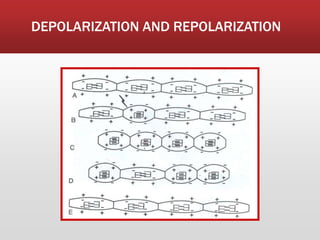
DEPOLARIZATION AND REPOLARIZATION
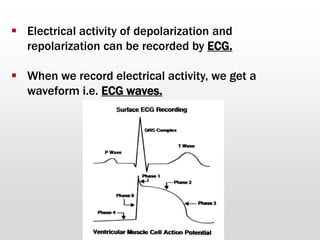
 Electrical activity of depolarization and
repolarization can be recorded by ECG.
 When we record electrical activity, we get a
waveform i.e. ECG waves.
5
Electrical Events of the Cardiac Cycle
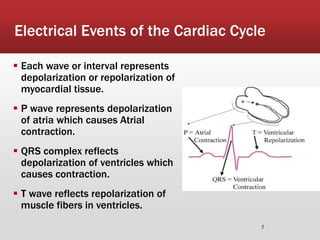
 Each wave or interval represents
depolarization or repolarization of
myocardial tissue.
 P wave represents depolarization
of atria which causes Atrial
contraction.
 QRS complex reflects
depolarization of ventricles which
causes contraction.
 T wave reflects repolarization of
muscle fibers in ventricles.
Basic ECG Components
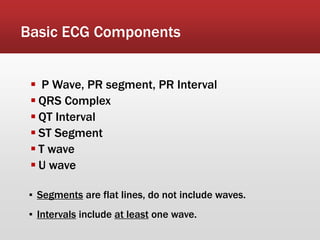
▪ Segments are flat lines, do not include waves.
▪ Intervals include at least one wave.
 P Wave, PR segment, PR Interval
 QRS Complex
 QT Interval
 ST Segment
 T wave
 U wave
P Wave
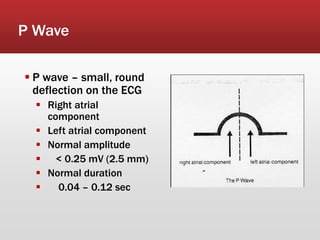
 P wave – small, round
deflection on the ECG
 Right atrial
component
 Left atrial component
 Normal amplitude
 < 0.25 mV (2.5 mm)
 Normal duration
 0.04 – 0.12 sec
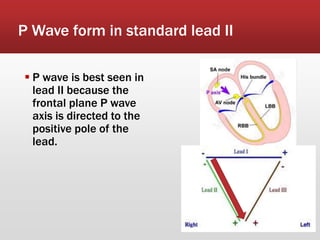
P Wave form in standard lead II
 P wave is best seen in
lead II because the
frontal plane P wave
axis is directed to the
positive pole of the
lead.
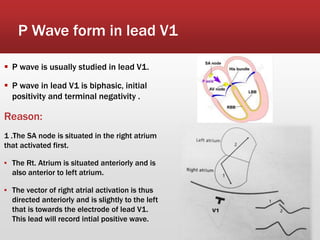
P Wave form in lead V1
 P wave is usually studied in lead V1.
 P wave in lead V1 is biphasic, initial
positivity and terminal negativity .
Reason:
1 .The SA node is situated in the right atrium
that activated first.
▪ The Rt. Atrium is situated anteriorly and is
also anterior to left atrium.
▪ The vector of right atrial activation is thus
directed anteriorly and is slightly to the left
that is towards the electrode of lead V1.
This lead will record intial positive wave.
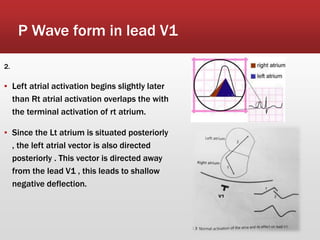
P Wave form in lead V1
2.
▪ Left atrial activation begins slightly later
than Rt atrial activation overlaps the with
the terminal activation of rt atrium.
▪ Since the Lt atrium is situated posteriorly
, the left atrial vector is also directed
posteriorly . This vector is directed away
from the lead V1 , this leads to shallow
negative deflection.
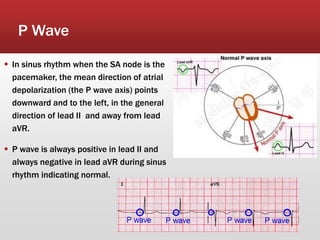
P Wave
 In sinus rhythm when the SA node is the
pacemaker, the mean direction of atrial
depolarization (the P wave axis) points
downward and to the left, in the general
direction of lead II and away from lead
aVR.
 P wave is always positive in lead II and
always negative in lead aVR during sinus
rhythm indicating normal.
12
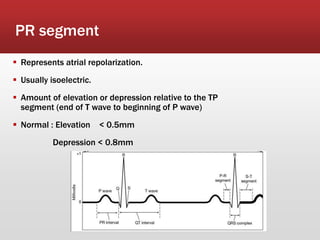
PR segment
 Represents atrial repolarization.
 Usually isoelectric.
 Amount of elevation or depression relative to the TP
segment (end of T wave to beginning of P wave)
 Normal : Elevation < 0.5mm
Depression < 0.8mm
13
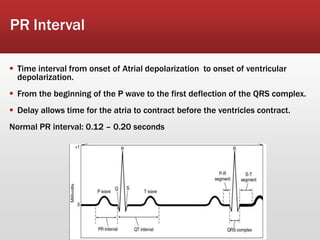
PR Interval
 Time interval from onset of Atrial depolarization to onset of ventricular
depolarization.
 From the beginning of the P wave to the first deflection of the QRS complex.
 Delay allows time for the atria to contract before the ventricles contract.
Normal PR interval: 0.12 – 0.20 seconds
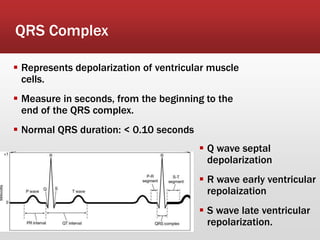
QRS Complex
 Represents depolarization of ventricular muscle
cells.
 Measure in seconds, from the beginning to the
end of the QRS complex.
 Normal QRS duration: < 0.10 seconds
 Q wave septal
depolarization
 R wave early ventricular
repolaization
 S wave late ventricular
repolarization.
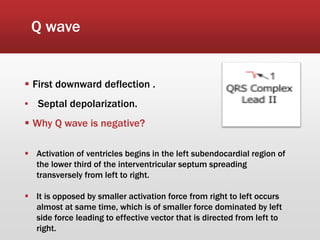
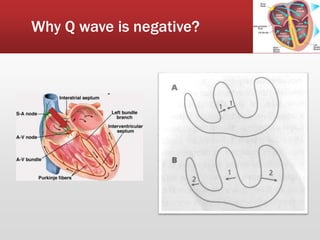
Q wave
 First downward deflection .
▪ Septal depolarization.
 Why Q wave is negative?
 Activation of ventricles begins in the left subendocardial region of
the lower third of the interventricular septum spreading
transversely from left to right.
 It is opposed by smaller activation force from right to left occurs
almost at same time, which is of smaller force dominated by left
side force leading to effective vector that is directed from left to
right.
Why Q wave is negative?
2
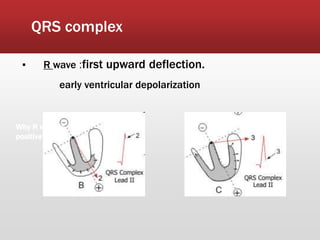
QRS complex
▪ R wave :first upward deflection.
early ventricular depolarization
Why R wave is
positive?
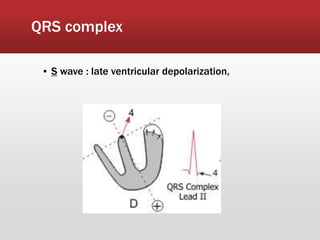
QRS complex
▪ S wave : late ventricular depolarization,
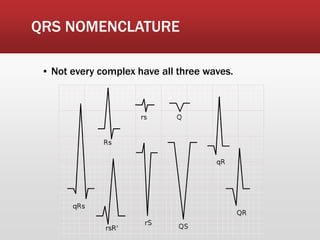
QRS NOMENCLATURE
▪ Not every complex have all three waves.
QRS COMPLEX
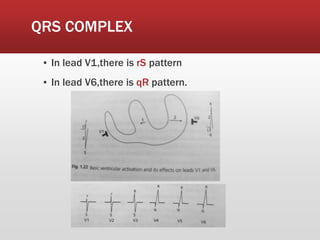
▪ In lead V1,there is rS pattern
▪ In lead V6,there is qR pattern.
QT Interval
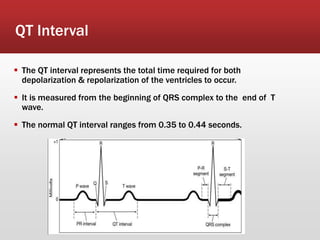
 The QT interval represents the total time required for both
depolarization & repolarization of the ventricles to occur.
 It is measured from the beginning of QRS complex to the end of T
wave.
 The normal QT interval ranges from 0.35 to 0.44 seconds.
ST Segment
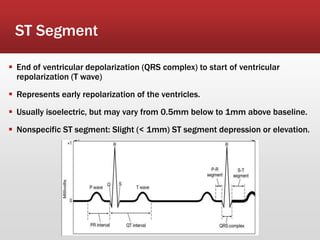
 End of ventricular depolarization (QRS complex) to start of ventricular
repolarization (T wave)
 Represents early repolarization of the ventricles.
 Usually isoelectric, but may vary from 0.5mm below to 1mm above baseline.
 Nonspecific ST segment: Slight (< 1mm) ST segment depression or elevation.
J point
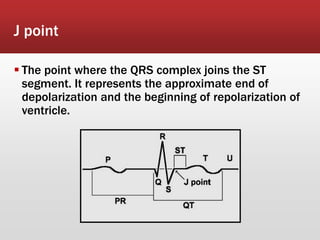
 The point where the QRS complex joins the ST
segment. It represents the approximate end of
depolarization and the beginning of repolarization of
ventricle.
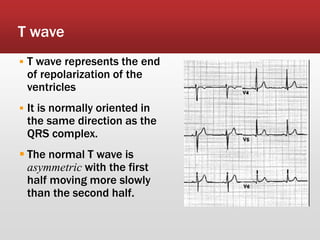
T wave
 T wave represents the end
of repolarization of the
ventricles
 It is normally oriented in
the same direction as the
QRS complex.
 The normal T wave is
asymmetric with the first
half moving more slowly
than the second half.
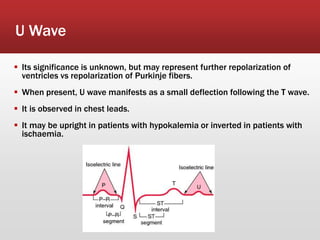
U Wave
 Its significance is unknown, but may represent further repolarization of
ventricles vs repolarization of Purkinje fibers.
 When present, U wave manifests as a small deflection following the T wave.
 It is observed in chest leads.
 It may be upright in patients with hypokalemia or inverted in patients with
ischaemia.
Sinus Rhythms
▪ Originate in the SA node
▪ Normal sinus rhythm (NSR)
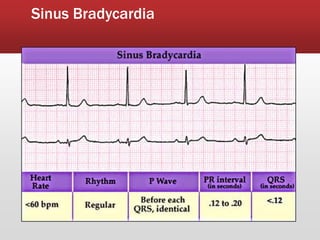
▪ Sinus bradycardia (SB)
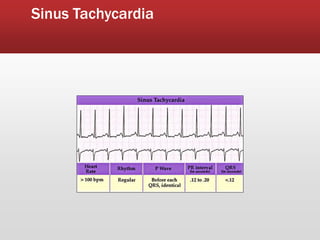
▪ Sinus tachycardia (ST)
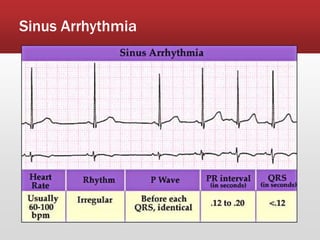
▪ Sinus arrhythmia
▪ Inherent rate of 60 – 100
▪ Base all other rhythms on deviations from
sinus rhythm
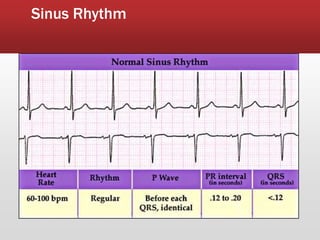
Sinus Rhythm
Sinus Bradycardia
Sinus Tachycardia
Sinus Arrhythmia
Atrial Rhythms
▪ Originate in the atria
▪ Atrial fibrillation (A Fib)
▪ Atrial flutter
▪ Wandering pacemaker
▪ Multifocal atrial tachycardia (MAT)
▪ Supraventricular tachycardia (SVT)
▪ PAC’s
▪ Wolff–Parkinson–White syndrome (WPW)
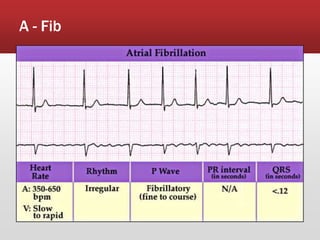
A - Fib
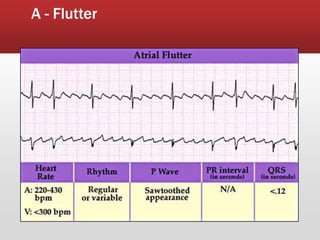
A - Flutter
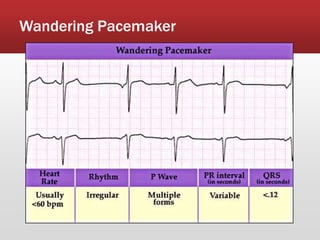
Wandering Pacemaker
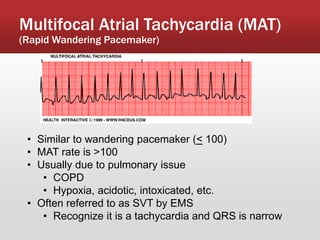
Multifocal Atrial Tachycardia (MAT)
(Rapid Wandering Pacemaker)
• Similar to wandering pacemaker (< 100)
• MAT rate is >100
• Usually due to pulmonary issue
• COPD
• Hypoxia, acidotic, intoxicated, etc.
• Often referred to as SVT by EMS
• Recognize it is a tachycardia and QRS is narrow
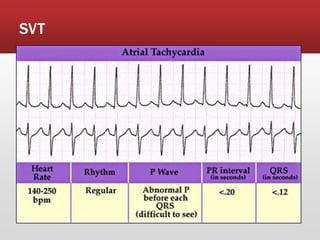
SVT
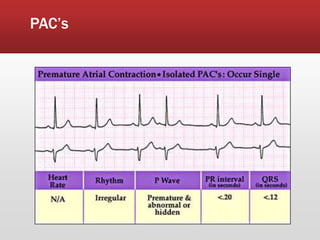
PAC’s
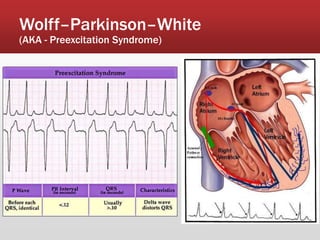
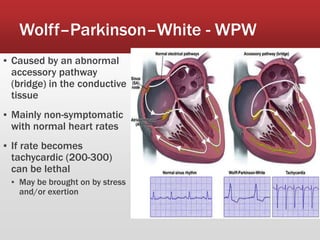
Wolff–Parkinson–White - WPW
▪ Caused by an abnormal
accessory pathway
(bridge) in the conductive
tissue
▪ Mainly non-symptomatic
with normal heart rates
▪ If rate becomes
tachycardic (200-300)
can be lethal
▪ May be brought on by stress
and/or exertion
Wolff–Parkinson–White
(AKA - Preexcitation Syndrome)
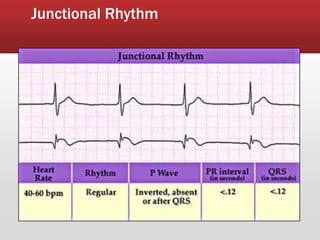
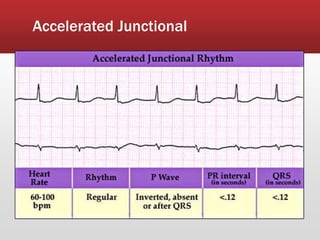
AV/Junctional Rhythms
▪ Originate in the AV node
▪ Junctional rhythm rate 40-60
▪ Accelerated junctional rhythm rate 60-
100
▪ Junctional tachycardia rate over 100
▪ PJC’s
▪ Inherent rate of 40 - 60
Junctional Rhythm
Accelerated Junctional
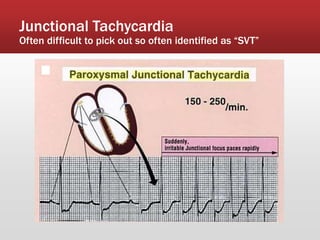
Junctional Tachycardia
Often difficult to pick out so often identified as “SVT”
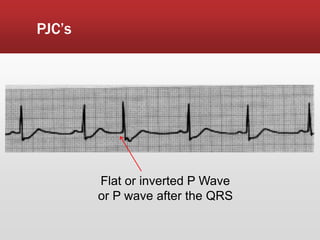
PJC’s
Flat or inverted P Wave
or P wave after the QRS
Ventricular Rhythms
▪ Originate in the ventricles / purkinje fibers
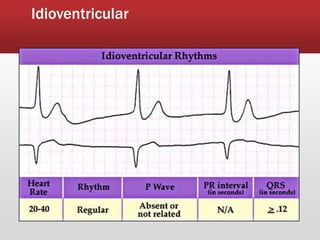
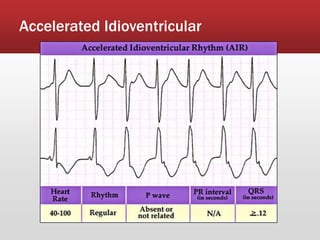
▪ Ventricular escape rhythm (idioventricular) rate
20-40
▪ Accelerated idioventricular rate 42 - 100
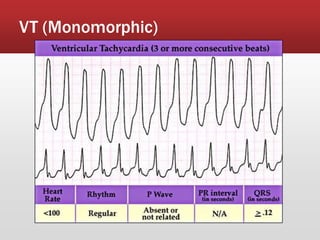
▪ Ventricular tachycardia (VT) rate over 102
▪ Monomorphic – regular, similar shaped wide QRS
complexes
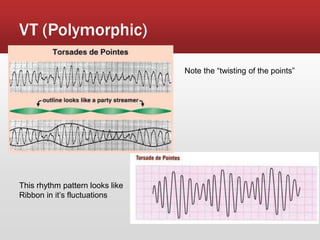
▪ Polymorphic (i.e. Torsades de Pointes) – life
threatening if sustained for more than a few seconds
due to poor cardiac output from the tahchycardia)
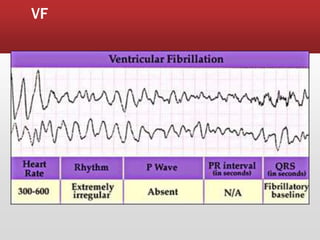
▪ Ventricular fibrillation (VF)
▪ Fine & coarse
▪ PVC’s
Idioventricular
Accelerated Idioventricular
VT (Monomorphic)
VT (Polymorphic)
Note the “twisting of the points”
This rhythm pattern looks like
Ribbon in it’s fluctuations
VF
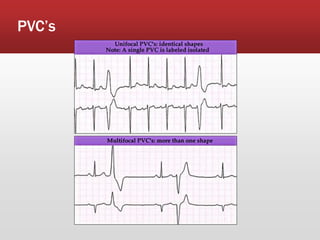
PVC’s
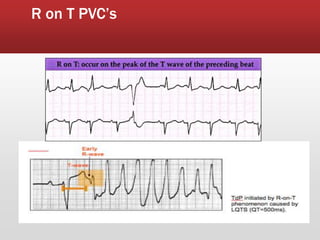
R on T PVC’s
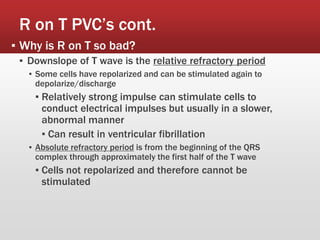
R on T PVC’s cont.
▪ Why is R on T so bad?
▪ Downslope of T wave is the relative refractory period
▪ Some cells have repolarized and can be stimulated again to
depolarize/discharge
▪ Relatively strong impulse can stimulate cells to
conduct electrical impulses but usually in a slower,
abnormal manner
▪ Can result in ventricular fibrillation
▪ Absolute refractory period is from the beginning of the QRS
complex through approximately the first half of the T wave
▪ Cells not repolarized and therefore cannot be
stimulated
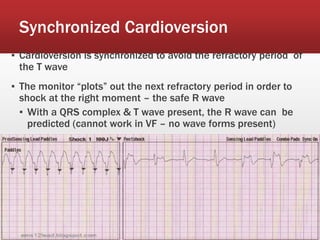
Synchronized Cardioversion
▪ Cardioversion is synchronized to avoid the refractory period of
the T wave
▪ The monitor “plots” out the next refractory period in order to
shock at the right moment – the safe R wave
▪ With a QRS complex & T wave present, the R wave can be
predicted (cannot work in VF – no wave forms present)
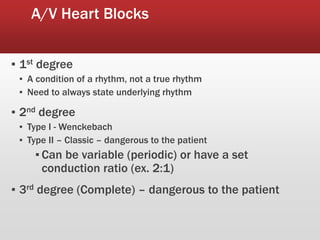
A/V Heart Blocks
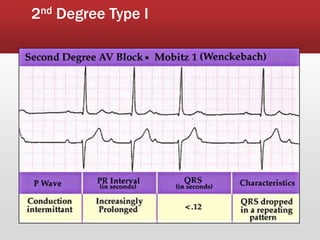
▪ 1st degree
▪ A condition of a rhythm, not a true rhythm
▪ Need to always state underlying rhythm
▪ 2nd degree
▪ Type I - Wenckebach
▪ Type II – Classic – dangerous to the patient
▪ Can be variable (periodic) or have a set
conduction ratio (ex. 2:1)
▪ 3rd degree (Complete) – dangerous to the patient
Atrioventricular (AV) Blocks
▪ Delay or interruption in impulse conduction in
AV node, bundle of His, or His/Purkinje system
▪ Classified according to degree of block and
site of block
▪ PR interval is key in determining type of AV block
▪ Width of QRS determines site of block
AV Blocks cont.
▪ Clinical significance dependent on:
Degree or severity of the block
Rate of the escape pacemaker site
▪ Ventricular pacemaker site will be a slower
heart rate than a junctional site
Patient’s response to that ventricular rate
▪ Evaluate level of consciousness /
responsiveness & blood pressure
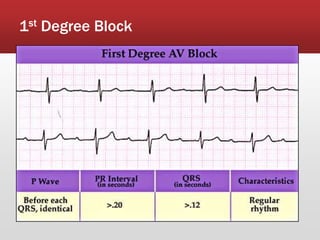
1st Degree Block
2nd Degree Type I
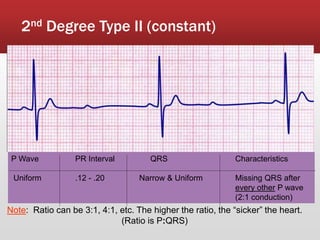
2nd Degree Type II (constant)
P Wave PR Interval QRS Characteristics
Uniform .12 - .20 Narrow & Uniform Missing QRS after
every other P wave
(2:1 conduction)
Note: Ratio can be 3:1, 4:1, etc. The higher the ratio, the “sicker” the heart.
(Ratio is P:QRS)
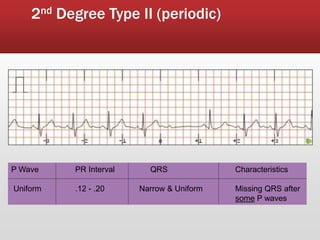
2nd Degree Type II (periodic)
P Wave PR Interval QRS Characteristics
Uniform .12 - .20 Narrow & Uniform Missing QRS after
some P waves
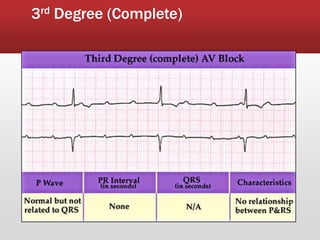
3rd Degree (Complete)
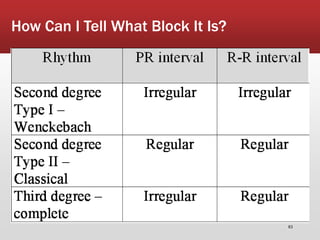
How Can I Tell What Block It Is?
63
Helpful Tips for AV Blocks
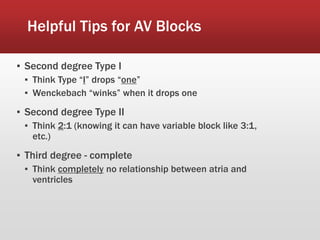
▪ Second degree Type I
▪ Think Type “I” drops “one”
▪ Wenckebach “winks” when it drops one
▪ Second degree Type II
▪ Think 2:1 (knowing it can have variable block like 3:1,
etc.)
▪ Third degree - complete
▪ Think completely no relationship between atria and
ventricles
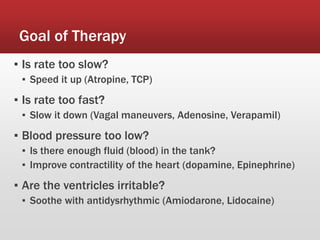
Goal of Therapy
▪ Is rate too slow?
▪ Speed it up (Atropine, TCP)
▪ Is rate too fast?
▪ Slow it down (Vagal maneuvers, Adenosine, Verapamil)
▪ Blood pressure too low?
▪ Is there enough fluid (blood) in the tank?
▪ Improve contractility of the heart (dopamine, Epinephrine)
▪ Are the ventricles irritable?
▪ Soothe with antidysrhythmic (Amiodarone, Lidocaine)
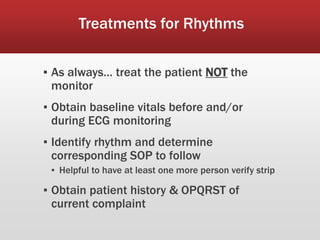
Treatments for Rhythms
▪ As always… treat the patient NOT the
monitor
▪ Obtain baseline vitals before and/or
during ECG monitoring
▪ Identify rhythm and determine
corresponding SOP to follow
▪ Helpful to have at least one more person verify strip
▪ Obtain patient history & OPQRST of
current complaint
Transcutaneous Pacing
▪ No response to doses of atropine
▪ Unstable patient with a wide QRS
▪ Set pacing at a rate of 80 beats per minute in
the demand mode
▪ Start output (mA) at lowest setting possible (0)
and increase until capture noted
▪ Spike followed by QRS complex
▪ Consider medications to help with the chest
discomfort
Tachycardias
▪ Can be generally well tolerated rhythms
OR
▪ Can become lethal usually related to the heart rate
and influence on cardiac output
▪ Ask 2 questions:
▪ Is the patient stable or unstable?
▪ If unstable, needs cardioversion
▪ If stable, determine if the QRS is narrow or wide
▪ QRS width drives decisions for therapy in stable
patient
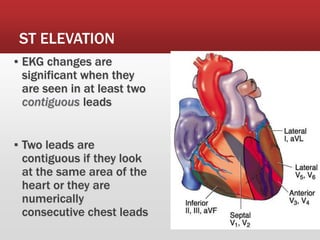
ST ELEVATION
▪ EKG changes are
significant when they
are seen in at least two
contiguous leads
▪ Two leads are
contiguous if they look
at the same area of the
heart or they are
numerically
consecutive chest leads
ST Elevation Evaluation
▪ Locate the J-point
▪ Identify/estimate where the isoelectric line is
noted to be
▪ Check the standardized 2mm mark at the far left or
beginning of each row of the EKG strip
▪ Compare the level of the ST segment 0.4 seconds
after the J point to the isoelectric line
▪ Elevation (or depression) is significant if more than
1 mm (one small box) is seen in 2 or more leads
facing the same anatomical area of the heart (ie:
contiguous leads)
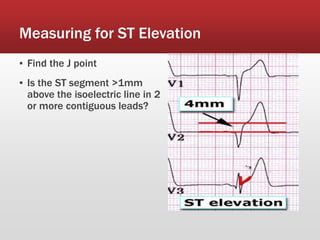
Measuring for ST Elevation
▪ Find the J point
▪ Is the ST segment >1mm
above the isoelectric line in 2
or more contiguous leads?
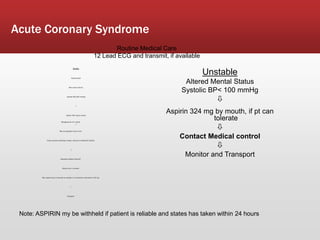
Acute Coronary Syndrome
Stable
Patient Alert
Skin warm and dry
Systolic BP>100 mmHg

Aspirin 324 mg by mouth

Nitroglycerine 0.4 mg SL
May be repeated every 5 min
If pain persists following 2 doses, advance to Morphine Sulfate

Morphine Sulfate 2mg IVP
Slowly over 2 minutes
May repeat every 2 minutes as needed, to a maximum total dose of 10 mg

Transport
Unstable
Altered Mental Status
Systolic BP< 100 mmHg

Aspirin 324 mg by mouth, if pt can
tolerate

Contact Medical control

Monitor and Transport
Note: ASPIRIN my be withheld if patient is reliable and states has taken within 24 hours
Routine Medical Care
12 Lead ECG and transmit, if available
Patient Presenting with Coronary Chest Pain
– AMI Until Proven Otherwise
▪ Oxygen
▪ May limit ischemic injury
▪ New trends/guidelines coming out in 2011 SOP’s
▪ Aspirin - 324 mg chewed (PO)
▪ Blocks platelet aggregation (clumping) to keep clot
from getting bigger
▪ Chewing breaks medication down faster & allows for
quicker absorption
▪ Hold if patient allergic or for a reliable patient that
states they have taken aspirin within last 24 hours
Acute Coronary Syndrome
Medications cont.
▪Nitroglycerin - 0.4 mg SL every 5
minutes
▪ Dilates coronary vessels to relieve vasospams
▪ Increases collateral blood flow
▪ Dilates veins to reduce preload to reduce workload of
heart
▪ Watch for hypotension
▪ If inferior wall MI (II, III, aVF), contact Medical Control prior to
administration
▪ If pain persists after 2 doses, move to Morphine
▪ Check for recent male enhancement drug use (ie:
viagra, cialis, levitra)
▪ Side effect could be lethal hypotension
Acute Coronary Syndrome
Medications cont.
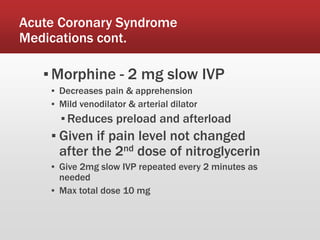
▪Morphine - 2 mg slow IVP
▪ Decreases pain & apprehension
▪ Mild venodilator & arterial dilator
▪ Reduces preload and afterload
▪ Given if pain level not changed
after the 2nd dose of nitroglycerin
▪ Give 2mg slow IVP repeated every 2 minutes as
needed
▪ Max total dose 10 mg
Thank you

ECG BASICS AND ARRTHYMIAS

  • 1.
    Early detection oflethal arrythmias & interpretation of ECG changes Dr Prudhvi Krishna
  • 2.
    ELECTRICITY OF HEART Contractionof any muscle is associated with electrical charges called depolarization. These changes can be detected by electrodes attached to the surface of the body. Although the heart has 4 chambers, from the electrical point it is having only 2.
  • 3.
  • 4.
     Electrical activityof depolarization and repolarization can be recorded by ECG.  When we record electrical activity, we get a waveform i.e. ECG waves.
  • 5.
    5 Electrical Events ofthe Cardiac Cycle  Each wave or interval represents depolarization or repolarization of myocardial tissue.  P wave represents depolarization of atria which causes Atrial contraction.  QRS complex reflects depolarization of ventricles which causes contraction.  T wave reflects repolarization of muscle fibers in ventricles.
  • 6.
    Basic ECG Components ▪Segments are flat lines, do not include waves. ▪ Intervals include at least one wave.  P Wave, PR segment, PR Interval  QRS Complex  QT Interval  ST Segment  T wave  U wave
  • 7.
    P Wave  Pwave – small, round deflection on the ECG  Right atrial component  Left atrial component  Normal amplitude  < 0.25 mV (2.5 mm)  Normal duration  0.04 – 0.12 sec
  • 8.
    P Wave formin standard lead II  P wave is best seen in lead II because the frontal plane P wave axis is directed to the positive pole of the lead.
  • 9.
    P Wave formin lead V1  P wave is usually studied in lead V1.  P wave in lead V1 is biphasic, initial positivity and terminal negativity . Reason: 1 .The SA node is situated in the right atrium that activated first. ▪ The Rt. Atrium is situated anteriorly and is also anterior to left atrium. ▪ The vector of right atrial activation is thus directed anteriorly and is slightly to the left that is towards the electrode of lead V1. This lead will record intial positive wave.
  • 10.
    P Wave formin lead V1 2. ▪ Left atrial activation begins slightly later than Rt atrial activation overlaps the with the terminal activation of rt atrium. ▪ Since the Lt atrium is situated posteriorly , the left atrial vector is also directed posteriorly . This vector is directed away from the lead V1 , this leads to shallow negative deflection.
  • 11.
    P Wave  Insinus rhythm when the SA node is the pacemaker, the mean direction of atrial depolarization (the P wave axis) points downward and to the left, in the general direction of lead II and away from lead aVR.  P wave is always positive in lead II and always negative in lead aVR during sinus rhythm indicating normal.
  • 12.
    12 PR segment  Representsatrial repolarization.  Usually isoelectric.  Amount of elevation or depression relative to the TP segment (end of T wave to beginning of P wave)  Normal : Elevation < 0.5mm Depression < 0.8mm
  • 13.
    13 PR Interval  Timeinterval from onset of Atrial depolarization to onset of ventricular depolarization.  From the beginning of the P wave to the first deflection of the QRS complex.  Delay allows time for the atria to contract before the ventricles contract. Normal PR interval: 0.12 – 0.20 seconds
  • 14.
    QRS Complex  Representsdepolarization of ventricular muscle cells.  Measure in seconds, from the beginning to the end of the QRS complex.  Normal QRS duration: < 0.10 seconds  Q wave septal depolarization  R wave early ventricular repolaization  S wave late ventricular repolarization.
  • 15.
    Q wave  Firstdownward deflection . ▪ Septal depolarization.  Why Q wave is negative?  Activation of ventricles begins in the left subendocardial region of the lower third of the interventricular septum spreading transversely from left to right.  It is opposed by smaller activation force from right to left occurs almost at same time, which is of smaller force dominated by left side force leading to effective vector that is directed from left to right.
  • 16.
    Why Q waveis negative? 2
  • 17.
    QRS complex ▪ Rwave :first upward deflection. early ventricular depolarization Why R wave is positive?
  • 18.
    QRS complex ▪ Swave : late ventricular depolarization,
  • 19.
    QRS NOMENCLATURE ▪ Notevery complex have all three waves.
  • 20.
    QRS COMPLEX ▪ Inlead V1,there is rS pattern ▪ In lead V6,there is qR pattern.
  • 21.
    QT Interval  TheQT interval represents the total time required for both depolarization & repolarization of the ventricles to occur.  It is measured from the beginning of QRS complex to the end of T wave.  The normal QT interval ranges from 0.35 to 0.44 seconds.
  • 22.
    ST Segment  Endof ventricular depolarization (QRS complex) to start of ventricular repolarization (T wave)  Represents early repolarization of the ventricles.  Usually isoelectric, but may vary from 0.5mm below to 1mm above baseline.  Nonspecific ST segment: Slight (< 1mm) ST segment depression or elevation.
  • 23.
    J point  Thepoint where the QRS complex joins the ST segment. It represents the approximate end of depolarization and the beginning of repolarization of ventricle.
  • 24.
    T wave  Twave represents the end of repolarization of the ventricles  It is normally oriented in the same direction as the QRS complex.  The normal T wave is asymmetric with the first half moving more slowly than the second half.
  • 25.
    U Wave  Itssignificance is unknown, but may represent further repolarization of ventricles vs repolarization of Purkinje fibers.  When present, U wave manifests as a small deflection following the T wave.  It is observed in chest leads.  It may be upright in patients with hypokalemia or inverted in patients with ischaemia.
  • 26.
    Sinus Rhythms ▪ Originatein the SA node ▪ Normal sinus rhythm (NSR) ▪ Sinus bradycardia (SB) ▪ Sinus tachycardia (ST) ▪ Sinus arrhythmia ▪ Inherent rate of 60 – 100 ▪ Base all other rhythms on deviations from sinus rhythm
  • 27.
  • 28.
  • 29.
  • 30.
  • 31.
    Atrial Rhythms ▪ Originatein the atria ▪ Atrial fibrillation (A Fib) ▪ Atrial flutter ▪ Wandering pacemaker ▪ Multifocal atrial tachycardia (MAT) ▪ Supraventricular tachycardia (SVT) ▪ PAC’s ▪ Wolff–Parkinson–White syndrome (WPW)
  • 32.
  • 33.
  • 34.
  • 35.
    Multifocal Atrial Tachycardia(MAT) (Rapid Wandering Pacemaker) • Similar to wandering pacemaker (< 100) • MAT rate is >100 • Usually due to pulmonary issue • COPD • Hypoxia, acidotic, intoxicated, etc. • Often referred to as SVT by EMS • Recognize it is a tachycardia and QRS is narrow
  • 36.
  • 37.
  • 38.
    Wolff–Parkinson–White - WPW ▪Caused by an abnormal accessory pathway (bridge) in the conductive tissue ▪ Mainly non-symptomatic with normal heart rates ▪ If rate becomes tachycardic (200-300) can be lethal ▪ May be brought on by stress and/or exertion
  • 39.
  • 40.
    AV/Junctional Rhythms ▪ Originatein the AV node ▪ Junctional rhythm rate 40-60 ▪ Accelerated junctional rhythm rate 60- 100 ▪ Junctional tachycardia rate over 100 ▪ PJC’s ▪ Inherent rate of 40 - 60
  • 41.
  • 42.
  • 43.
    Junctional Tachycardia Often difficultto pick out so often identified as “SVT”
  • 44.
    PJC’s Flat or invertedP Wave or P wave after the QRS
  • 45.
    Ventricular Rhythms ▪ Originatein the ventricles / purkinje fibers ▪ Ventricular escape rhythm (idioventricular) rate 20-40 ▪ Accelerated idioventricular rate 42 - 100 ▪ Ventricular tachycardia (VT) rate over 102 ▪ Monomorphic – regular, similar shaped wide QRS complexes ▪ Polymorphic (i.e. Torsades de Pointes) – life threatening if sustained for more than a few seconds due to poor cardiac output from the tahchycardia) ▪ Ventricular fibrillation (VF) ▪ Fine & coarse ▪ PVC’s
  • 46.
  • 47.
  • 48.
  • 49.
    VT (Polymorphic) Note the“twisting of the points” This rhythm pattern looks like Ribbon in it’s fluctuations
  • 50.
  • 51.
  • 52.
    R on TPVC’s
  • 53.
    R on TPVC’s cont. ▪ Why is R on T so bad? ▪ Downslope of T wave is the relative refractory period ▪ Some cells have repolarized and can be stimulated again to depolarize/discharge ▪ Relatively strong impulse can stimulate cells to conduct electrical impulses but usually in a slower, abnormal manner ▪ Can result in ventricular fibrillation ▪ Absolute refractory period is from the beginning of the QRS complex through approximately the first half of the T wave ▪ Cells not repolarized and therefore cannot be stimulated
  • 54.
    Synchronized Cardioversion ▪ Cardioversionis synchronized to avoid the refractory period of the T wave ▪ The monitor “plots” out the next refractory period in order to shock at the right moment – the safe R wave ▪ With a QRS complex & T wave present, the R wave can be predicted (cannot work in VF – no wave forms present)
  • 55.
    A/V Heart Blocks ▪1st degree ▪ A condition of a rhythm, not a true rhythm ▪ Need to always state underlying rhythm ▪ 2nd degree ▪ Type I - Wenckebach ▪ Type II – Classic – dangerous to the patient ▪ Can be variable (periodic) or have a set conduction ratio (ex. 2:1) ▪ 3rd degree (Complete) – dangerous to the patient
  • 56.
    Atrioventricular (AV) Blocks ▪Delay or interruption in impulse conduction in AV node, bundle of His, or His/Purkinje system ▪ Classified according to degree of block and site of block ▪ PR interval is key in determining type of AV block ▪ Width of QRS determines site of block
  • 57.
    AV Blocks cont. ▪Clinical significance dependent on: Degree or severity of the block Rate of the escape pacemaker site ▪ Ventricular pacemaker site will be a slower heart rate than a junctional site Patient’s response to that ventricular rate ▪ Evaluate level of consciousness / responsiveness & blood pressure
  • 58.
  • 59.
  • 60.
    2nd Degree TypeII (constant) P Wave PR Interval QRS Characteristics Uniform .12 - .20 Narrow & Uniform Missing QRS after every other P wave (2:1 conduction) Note: Ratio can be 3:1, 4:1, etc. The higher the ratio, the “sicker” the heart. (Ratio is P:QRS)
  • 61.
    2nd Degree TypeII (periodic) P Wave PR Interval QRS Characteristics Uniform .12 - .20 Narrow & Uniform Missing QRS after some P waves
  • 62.
  • 63.
    How Can ITell What Block It Is? 63
  • 64.
    Helpful Tips forAV Blocks ▪ Second degree Type I ▪ Think Type “I” drops “one” ▪ Wenckebach “winks” when it drops one ▪ Second degree Type II ▪ Think 2:1 (knowing it can have variable block like 3:1, etc.) ▪ Third degree - complete ▪ Think completely no relationship between atria and ventricles
  • 65.
    Goal of Therapy ▪Is rate too slow? ▪ Speed it up (Atropine, TCP) ▪ Is rate too fast? ▪ Slow it down (Vagal maneuvers, Adenosine, Verapamil) ▪ Blood pressure too low? ▪ Is there enough fluid (blood) in the tank? ▪ Improve contractility of the heart (dopamine, Epinephrine) ▪ Are the ventricles irritable? ▪ Soothe with antidysrhythmic (Amiodarone, Lidocaine)
  • 66.
    Treatments for Rhythms ▪As always… treat the patient NOT the monitor ▪ Obtain baseline vitals before and/or during ECG monitoring ▪ Identify rhythm and determine corresponding SOP to follow ▪ Helpful to have at least one more person verify strip ▪ Obtain patient history & OPQRST of current complaint
  • 67.
    Transcutaneous Pacing ▪ Noresponse to doses of atropine ▪ Unstable patient with a wide QRS ▪ Set pacing at a rate of 80 beats per minute in the demand mode ▪ Start output (mA) at lowest setting possible (0) and increase until capture noted ▪ Spike followed by QRS complex ▪ Consider medications to help with the chest discomfort
  • 68.
    Tachycardias ▪ Can begenerally well tolerated rhythms OR ▪ Can become lethal usually related to the heart rate and influence on cardiac output ▪ Ask 2 questions: ▪ Is the patient stable or unstable? ▪ If unstable, needs cardioversion ▪ If stable, determine if the QRS is narrow or wide ▪ QRS width drives decisions for therapy in stable patient
  • 69.
    ST ELEVATION ▪ EKGchanges are significant when they are seen in at least two contiguous leads ▪ Two leads are contiguous if they look at the same area of the heart or they are numerically consecutive chest leads
  • 70.
    ST Elevation Evaluation ▪Locate the J-point ▪ Identify/estimate where the isoelectric line is noted to be ▪ Check the standardized 2mm mark at the far left or beginning of each row of the EKG strip ▪ Compare the level of the ST segment 0.4 seconds after the J point to the isoelectric line ▪ Elevation (or depression) is significant if more than 1 mm (one small box) is seen in 2 or more leads facing the same anatomical area of the heart (ie: contiguous leads)
  • 71.
    Measuring for STElevation ▪ Find the J point ▪ Is the ST segment >1mm above the isoelectric line in 2 or more contiguous leads?
  • 72.
    Acute Coronary Syndrome Stable PatientAlert Skin warm and dry Systolic BP>100 mmHg  Aspirin 324 mg by mouth  Nitroglycerine 0.4 mg SL May be repeated every 5 min If pain persists following 2 doses, advance to Morphine Sulfate  Morphine Sulfate 2mg IVP Slowly over 2 minutes May repeat every 2 minutes as needed, to a maximum total dose of 10 mg  Transport Unstable Altered Mental Status Systolic BP< 100 mmHg  Aspirin 324 mg by mouth, if pt can tolerate  Contact Medical control  Monitor and Transport Note: ASPIRIN my be withheld if patient is reliable and states has taken within 24 hours Routine Medical Care 12 Lead ECG and transmit, if available
  • 73.
    Patient Presenting withCoronary Chest Pain – AMI Until Proven Otherwise ▪ Oxygen ▪ May limit ischemic injury ▪ New trends/guidelines coming out in 2011 SOP’s ▪ Aspirin - 324 mg chewed (PO) ▪ Blocks platelet aggregation (clumping) to keep clot from getting bigger ▪ Chewing breaks medication down faster & allows for quicker absorption ▪ Hold if patient allergic or for a reliable patient that states they have taken aspirin within last 24 hours
  • 74.
    Acute Coronary Syndrome Medicationscont. ▪Nitroglycerin - 0.4 mg SL every 5 minutes ▪ Dilates coronary vessels to relieve vasospams ▪ Increases collateral blood flow ▪ Dilates veins to reduce preload to reduce workload of heart ▪ Watch for hypotension ▪ If inferior wall MI (II, III, aVF), contact Medical Control prior to administration ▪ If pain persists after 2 doses, move to Morphine ▪ Check for recent male enhancement drug use (ie: viagra, cialis, levitra) ▪ Side effect could be lethal hypotension
  • 75.
    Acute Coronary Syndrome Medicationscont. ▪Morphine - 2 mg slow IVP ▪ Decreases pain & apprehension ▪ Mild venodilator & arterial dilator ▪ Reduces preload and afterload ▪ Given if pain level not changed after the 2nd dose of nitroglycerin ▪ Give 2mg slow IVP repeated every 2 minutes as needed ▪ Max total dose 10 mg
  • 76.