 A product’s life cycle is its progress from when it is created to when it is discontinued.
 The product life cycle helps business owners manage sales, determine prices, predict
profitability, and compete with other businesses.
 Product life cycle management, or PLM, is the process of observing a product throughout
its life cycle. Track each product’s activities and successes to keep profits high and avoid
steep losses.
 There are four stages in the cycle
 Development
 Growth
 Maturity
 Decline
PRODUCT LIFE CYCLE
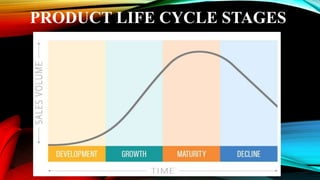
PRODUCT LIFE CYCLE STAGES
1.DEVELOPMENT
The initial stage of a product’s life cycle, development, is when the product is first
introduced to the market.
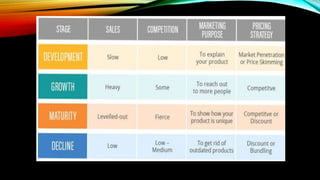
Typically, sales are slow during this stage because consumers are unfamiliar with the
new product.
Sales are especially slow when the product is unique because consumers might not
have an instant demand for it. But, there is generally low competition.
Sales are especially slow when the product is unique because consumers might not
have an instant demand for it. But, there is generally low competition.
You can promote the product on a budget through outlets like social media channels
and your business website.
You will need to explain the product in your marketing materials.
2.GROWTH
• There is high demand for the product and a lot of sales.
• Though this is a really great stage for the product, there are some drawbacks.
• When you sell a product in its growth stage, your competition might begin to duplicate
it.
• Competitors might release the same product you sell at a lower price, or they might
work on making the product better.
• You might need to work on getting your customers to choose your product over the
competition.
• This could require more marketing and lowering your prices. You might try to market
to new customers.
3.MATURITY
• In the maturity stage, there isn’t as much sales growth.
• When the product is mature, most of your target customers already have the product,
so there is not as much demand.
• Your sales volume will not be climbing like during the growth stage.
• Some businesses continue making additions to their products during this stage.
• Typically, the maturity stage has the most competition. Once products are developed,
they are more unique from competitor to competitor.
• Many businesses work on marketing their product and emphasizing its uniqueness
as well as any discounts.
4.DECLINE
• The final stage in a product’s life cycle is decline.
• There is less demand for the product, and businesses must decide if they want to
discontinue the product or keep producing and selling it.
• Some businesses that don’t pull the product add features to make it stand out more and
give it fresh life.
• There are a few different reasons for the decline of a product:
Competitors’ products are getting more attention than yours
Consumers are no longer interested in the product
You aren’t profiting off the product anymore
• During a product’s decline, many businesses choose to lower its price. In fact, there are
a few different pricing strategies you can try in this stage.
PREPARING FOR THE PRODUCT
LIFE CYCLE
• There is no definite way you can prepare for the product life cycle.
• You can’t predict the exact amount of time the product will be in each
stage.
• But, understanding the product life cycle will help you know how to
handle pricing strategies, competition, and marketing.
Product life cycle.ppt

Product life cycle.ppt

  • 1.
     A product’slife cycle is its progress from when it is created to when it is discontinued.  The product life cycle helps business owners manage sales, determine prices, predict profitability, and compete with other businesses.  Product life cycle management, or PLM, is the process of observing a product throughout its life cycle. Track each product’s activities and successes to keep profits high and avoid steep losses.  There are four stages in the cycle  Development  Growth  Maturity  Decline PRODUCT LIFE CYCLE
  • 2.
  • 3.
    1.DEVELOPMENT The initial stageof a product’s life cycle, development, is when the product is first introduced to the market. Typically, sales are slow during this stage because consumers are unfamiliar with the new product. Sales are especially slow when the product is unique because consumers might not have an instant demand for it. But, there is generally low competition. Sales are especially slow when the product is unique because consumers might not have an instant demand for it. But, there is generally low competition. You can promote the product on a budget through outlets like social media channels and your business website. You will need to explain the product in your marketing materials.
  • 4.
    2.GROWTH • There ishigh demand for the product and a lot of sales. • Though this is a really great stage for the product, there are some drawbacks. • When you sell a product in its growth stage, your competition might begin to duplicate it. • Competitors might release the same product you sell at a lower price, or they might work on making the product better. • You might need to work on getting your customers to choose your product over the competition. • This could require more marketing and lowering your prices. You might try to market to new customers.
  • 5.
    3.MATURITY • In thematurity stage, there isn’t as much sales growth. • When the product is mature, most of your target customers already have the product, so there is not as much demand. • Your sales volume will not be climbing like during the growth stage. • Some businesses continue making additions to their products during this stage. • Typically, the maturity stage has the most competition. Once products are developed, they are more unique from competitor to competitor. • Many businesses work on marketing their product and emphasizing its uniqueness as well as any discounts.
  • 6.
    4.DECLINE • The finalstage in a product’s life cycle is decline. • There is less demand for the product, and businesses must decide if they want to discontinue the product or keep producing and selling it. • Some businesses that don’t pull the product add features to make it stand out more and give it fresh life. • There are a few different reasons for the decline of a product: Competitors’ products are getting more attention than yours Consumers are no longer interested in the product You aren’t profiting off the product anymore • During a product’s decline, many businesses choose to lower its price. In fact, there are a few different pricing strategies you can try in this stage.
  • 7.
    PREPARING FOR THEPRODUCT LIFE CYCLE • There is no definite way you can prepare for the product life cycle. • You can’t predict the exact amount of time the product will be in each stage. • But, understanding the product life cycle will help you know how to handle pricing strategies, competition, and marketing.