FMRI
Further Readings 
• FMRIBC, University of oxford Ed: FMRI: Int. 
• Functional MRI: An Introduction to Methods, Peter Jezzard et all. 1-3 CHL. 
• FMRI: Basic and Clinical Applications, Stephen Ulmer et all. 
• MRI From A to Z: A Definate Guide for Medical Professionals, Gary Liney 
• Youtube has nice illustrative videos 
• http://www.fmrib.ox.ac.uk/education/fmri/introduction-to-fmri/
Introduction 
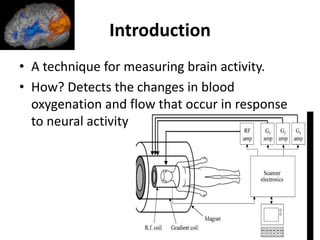
• A technique for measuring brain activity. 
• How? Detects the changes in blood 
oxygenation and flow that occur in response 
to neural activity
Advantages & Disadvantages 
• Pros: 
1. Can see activation in addition to high res brain 
structures 
2. Scanners can be fitted to present stimuli 
3. Higher spatial and temporal resolution than PET 
• Cons: 
1. Cannot trace neurotransmission like PET 
2. Blood flow is, again, only an indirect correlate of 
brain activity
MRI 
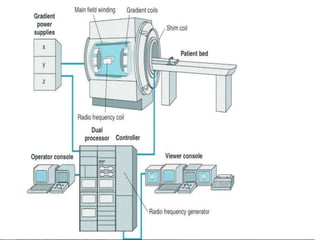
• MRI houses a very powerful electro-magnet. 
• Field strength of 3 teslas (T) 
• The magnetic field influence atomic nuclei 
• The stronger the field the greater the degree of alignment. 
• When pointing in the same direction, the tiny magnetic signals 
from individual nuclei add up coherently resulting in a signal that is 
large enough to measure. 
• In FMRI it is the magnetic signal from hydrogen nuclei in water 
(H2O) that is detected 
• The key to MRI is that the signal from hydrogen nuclei varies in 
strength depending on the surroundings. This provides a means of 
discriminating between grey matter, white matter and cerebral 
spinal fluid in structural images of the brain.
Measuring FMRI 
• Haemoglobin has oxygen, and increase neuronal 
activity increases demand for oxygen rendering in local 
increase of blood flow near the area of activity. 
• Haemoglobin is diamagnetic when oxygenated but 
paramagnetic when deoxygenated. 
• Difference in magnetic properties leads to differences 
in MR signal of blood depending on the degree of 
oxygenation. 
• Since blood oxygenation varies according to the levels 
of neural activity these differences can be used to 
detect brain activity [blood oxygenation level 
dependent (BOLD) imaging]
One point to note is the direction of oxygenation change with increased 
activity. You might expect blood oxygenation to decrease with activation, 
but the reality is a little more complex. 
There is a momentary decrease in blood oxygenation immediately after 
neural activity increases, known as the “initial dip” in the haemodynamic 
response. This is followed by a period where the blood flow increases, not 
just to a level where oxygen demand is met, but overcompensating for the 
increased demand. This means the blood oxygenation actually increases 
following neural activation. The blood flow peaks after around 6 seconds 
and then falls back to baseline, often accompanied by a “post-stimulus 
undershoot”.
FMRI
FMRI

FMRI

  • 1.
  • 2.
    Further Readings •FMRIBC, University of oxford Ed: FMRI: Int. • Functional MRI: An Introduction to Methods, Peter Jezzard et all. 1-3 CHL. • FMRI: Basic and Clinical Applications, Stephen Ulmer et all. • MRI From A to Z: A Definate Guide for Medical Professionals, Gary Liney • Youtube has nice illustrative videos • http://www.fmrib.ox.ac.uk/education/fmri/introduction-to-fmri/
  • 3.
    Introduction • Atechnique for measuring brain activity. • How? Detects the changes in blood oxygenation and flow that occur in response to neural activity
  • 4.
    Advantages & Disadvantages • Pros: 1. Can see activation in addition to high res brain structures 2. Scanners can be fitted to present stimuli 3. Higher spatial and temporal resolution than PET • Cons: 1. Cannot trace neurotransmission like PET 2. Blood flow is, again, only an indirect correlate of brain activity
  • 5.
    MRI • MRIhouses a very powerful electro-magnet. • Field strength of 3 teslas (T) • The magnetic field influence atomic nuclei • The stronger the field the greater the degree of alignment. • When pointing in the same direction, the tiny magnetic signals from individual nuclei add up coherently resulting in a signal that is large enough to measure. • In FMRI it is the magnetic signal from hydrogen nuclei in water (H2O) that is detected • The key to MRI is that the signal from hydrogen nuclei varies in strength depending on the surroundings. This provides a means of discriminating between grey matter, white matter and cerebral spinal fluid in structural images of the brain.
  • 7.
    Measuring FMRI •Haemoglobin has oxygen, and increase neuronal activity increases demand for oxygen rendering in local increase of blood flow near the area of activity. • Haemoglobin is diamagnetic when oxygenated but paramagnetic when deoxygenated. • Difference in magnetic properties leads to differences in MR signal of blood depending on the degree of oxygenation. • Since blood oxygenation varies according to the levels of neural activity these differences can be used to detect brain activity [blood oxygenation level dependent (BOLD) imaging]
  • 8.
    One point tonote is the direction of oxygenation change with increased activity. You might expect blood oxygenation to decrease with activation, but the reality is a little more complex. There is a momentary decrease in blood oxygenation immediately after neural activity increases, known as the “initial dip” in the haemodynamic response. This is followed by a period where the blood flow increases, not just to a level where oxygen demand is met, but overcompensating for the increased demand. This means the blood oxygenation actually increases following neural activation. The blood flow peaks after around 6 seconds and then falls back to baseline, often accompanied by a “post-stimulus undershoot”.

Editor's Notes

  • #4 – when a brain area is more active it consumes more oxygen and to meet this increased demand blood flow increases to the active area. FMRI can be used to produce activation maps showing which parts of the brain are involved in a particular mental process.