CIN & Cervical Screening
Plan 
• Part 1: Incidence, pathogenesis, and 
prevention 
• Part 2: Cervical Screening 
• Part 3: Grading, treatment, and Follow up
Part 1: Incidence, pathogenesis, 
and prevention
Introduction 
• Premalignant condition of uterine cervix 
• Ectocervix is covered by squamous epitheiam 
• Endocervix including cervical canal covered by 
glandular epithelium 
– CIN refers to squamous abnormality 
• Adenocarcinoma in situ, and adenocarcinoma 
• CIN can be low grade or high grade. 
– Women with low grade CIN have minimal 
potential for developing cervical malignancy
Incidence 
• 4 % in US for CIN 1, 5% for CIN2, 3 
• High grade lesion are typically diagnosed in 
women 25-35 years old 
• Invasive cancer is commonly after age of 40 
– Typically 8-13 years afer a diagnosis of a high 
grade lesion
Premalignant disease of the cervix 
HPV 
infection 
CIN I 
CIN II 
CIN III 
Cervical 
cancer 
Normal cervix
Pathogenesis 
• Role of human papillomavirus (HPV) 
– Major etiologic agent 
– Strong association 
– Necessary for development of neoplasia 
– Not sufficient alone to cause such disorders cause 
many HPV infected women do not develop it 
– HPV subtype, and persistence of virus 
• Enviromental (eg, cigarette smoking) 
• Immunlogic influences
HPV Subtype 
• Over 100 subtype 
– 40 types specific for anogenital epithelium 
– Distribution varies by geographic region 
– Infection with more than one subtype is common 
– Acquisition of one subtype and clearance of 
another are independent events 
• Subtype determines manifestation of infection 
and oncogenic potential of virus
Oncogenic HPV
Low Risk & High Risk Subtypes 
• Low risk – e.g., HPV 6 and 11 
– do not integrate into host genome 
– Only cause CIN 1 (10%) 
– benign condylomatous genital warts (90%) 
• High risk – e.g., HPV 16 and 18 
– Associated with CIN 2, 3, persistence, and invasive 
cancer, can also cause low grade 
– Low grade (25%), high grade (50-60%)Cancer(70%)
Persistence 
• HPV is transient and occur in young women 
– Persistency is a key factor for development of high 
grade 
– Unknown why it persists 
– The likelihood of persistence 
• Older age - > 55 years of age (50%) 
• Duration of infection – long infection = long clearance 
• High oncogenic HPV subtype – the longer it persists
Sexual transmission 
• HPV transmitted sexually 
• Endemic amongst sexually experienced 
individuals 
• At least 75-85% of sexually active women will 
have acquired genital HPV by age 50
Cervical Transformation Zone 
• Transformation Zone vs SCJ 
– SCJ – where the squamous epithelium meets the 
cervical of ectocervix meets columnar epithelium of 
endocervix. 
– Transformation zone is dynamic entity of metaplasia 
throughout a women’s life, which is the area of 
glandular epithelium has been replaced by squamous 
epithelium 
– Transformation zone comprises SCJ + larger area 
• Primary site of carcinogenic HPV-related CIN& CN 
– Cuboidal cells at Squamouscolumnar Junction
Molecular Mechanism 
• Epitheliotropic, once epithelium is infected, the virus 
can either persist in cytoplasm or integrate into the 
host genome 
– Remains episomal nonintegrated state 
• Low-grade cervical lesion 
– Becomes integrate into human genome 
• High grade lesion and cancer may develop 
• Integration into host cell – disruptions of viral 
regulatory oncoproteins, where E6 binds to p53, and 
E7 binds to Retinoblastoma, and suppress their 
function, the latter activates IL5&IL6 which are 
important in progression of CN 2,3 to over malignancy..
Co-factor in Pathogenesis 
• Immunosupression – cervical cancer is one of 
AIDS related malignancy in women 
• Cigarette smoking – with HPV have synergistic 
effects on development of CIN and CN 
– Breakdown products of nicotine cotinine and NNK are 
concentrated in cervical mucus and cause cellular 
abnormalities 
• HSV and Chlamydia – surrogate marker for 
exposure of HPV rather than a causal factor 
• OCP – long term use, as a surrogate marker
Prevention 
• Primary – HPV vaccination 
• Secondary – for cervical cancer rather than 
CIN, through appropriate treatment and 
prevent progression to malignant disease
Part 2 
Cervical Screening
Cervical screening 
• Prevention of cervical cancer 
• Early detection by: 
– Pap smear 
– HPV test
Pap Smear 
• George Papanicolaou (1883-1962) 
• The Pap test aims to identify abnormal cells 
sampled from the transformation zone, the 
junction of the ecto- and endocervix, where 
cervical dysplasia and cancers arise.
Guidelines 
• ACOG 
• Start at 21 years 
• 21-29: Pap smear every 3 years 
• 30-65: Pap smear every 3 years OR HPV co-test 
every 5 years 
• Stop at 65 years 
• Annual screening not recommended
How to prepare? 
• Before the pap test, patient should avoid: 
– Having intercourse 
– Using tampon 
– Douching 
• Preferably not during menstruation
Speculum 
• Insert lubricated speculum
Methods Of Interpretation 
• For conventional Pap smears, cervical samples 
obtained by brush and spatula are plated on a 
microscope slide and preserved with fixative. 
• Thin layer (or liquid-based) cytology, an 
alternative to conventional cytologic sampling, 
has been widely implemented in the US. 
– Testing involves transferring samples from the brush 
and spatula into a liquid fixative solution; the cytology 
lab subsequently traps the loose cells onto a filter 
from which they are plated in a monolayer onto a 
glass slide
Spatula 
• Insert spatula and rotate 
• Smear on a slide
Cytobrush 
• Insert brush and rotate 
• Smear on slide
Fixation 
• Alcohol
Liquid Media
Bethesda 
• Specimen type (conventional, liquid-based, etc) 
• Specimen adequacy 
– Satisfactory for evaluation (note presence/absence of 
endocervical/transformation zone component) 
– Unsatisfactory for evaluation (specify reason) 
• Specimen rejected/not processed (specify reason) 
• Specimen processed and examined, but unsatisfactory 
for evaluation of epithelial abnormality because of 
(specify reason)
Bethesda 
• General Categorization (Optional) 
– Negative for intraepithelial lesion or malignancy 
– Epithelial cell abnormality 
– Other 
• Interpretation/result 
– Negative for intraepithelial lesion or malignancy 
• Organisms (e.g. trichomonasvaginalis) 
• Reactive cellular changes associated with inflammation, 
radiation, intrauterine contraceptive device 
• Atrophy
Bethesda 
• Epithelial cell abnormalities 
– Squamous 
• Atypical squamous cells 
– ASC-US (undetermined significance) 
– ASC-H (cannot exclude HSIL) 
• Low grade squamous intraepithelial lesion (LSIL) - mild 
dysplasia/CIN I 
• High grade squamous intraepithelial lesion (HSIL) – 
moderate and severe dysplasia/CIN II/III 
• Squamous cell carcinoma
Bethesda 
• Epithelial cell abnormalities 
– Glandular 
• Atypical 
– Endocervical 
– Endometrial 
– NOS 
• Atypical favor neoplastic 
– Endocervical 
– NOS 
• Endocervical adenocarcinoma in situ (AIS) 
• Adenocarcinoma
Part 3 
Classification and Treatment
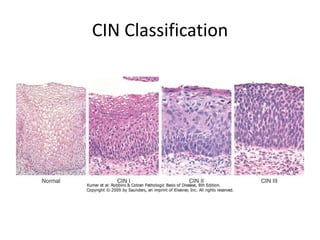
CIN Classification 
• Low-grade squamous intraepithelial lesion 
(LSIL) 
– CIN I (Mild dysplasia) 50%, 30%, 20%, 1-5% 
• High-grade squamous intraepithelial lesion 
(HSIL 
– CIN II (Moderate dysplasia) 
– CIN III (Severe dysplasia) 33%, 60-74%
CIN Classification
Diagnosis: 
• Pap tests 
• Colposcopy 
• Endocervical curettage 
• Cone biopsy or loop electrosurgical excision 
procedure (LEEP) which are performed to rule 
out invasive cancer
Adequacy of Colposcopy 
• Must evaluate the entirety of the lesion 
• Must evaluate the entirety of the SCJ 
Failure of either criteria is an inadequate 
colposcopy and leads to changes
TREATMENT 
• Mainstays of treatment of high-grade cervical 
intraepithelial neoplasia (CIN) are excision or 
ablation 
• Excisional treatments are: 
– referred to as cone biopsies or cervical conization 
• Ablative treatments 
– use an energy source (eg, cryotherapy, laser) to 
destroy the transformation zone
Laser 
TREATMENT
What to choose 
• Factors affect: 
– Efficacy: the efficacy rate for both ablation and excision is 
approximately 90 to 95 percent 
– Diagnostic specimen: no specimen is removed in ablative. For 
this reason, an excisional procedure is required for diagnostic 
purposes in the following situations: 
• High risk of invasive disease 
• Glandular disease is present 
• Diagnostic uncertainty 
– Future obstetric risks — Excision has been associated with an 
increased risk of adverse obstetric outcomes 
– Morbidity — Excisional methods are typically thought to be 
associated with greater morbidity than ablative therapy. 
However, the meta-analysis of randomized trials found no 
significant difference in adverse effects
What to choose? 
• For women with CIN 2,3 and an adequate 
colposcopy, either an excisional treatment or 
an ablative treatment is appropriate. 
• For women with an inadequate colposcopy, 
recurrent CIN 2,3, an excisional procedure is 
preferred
What to choose? 
• For young women with CIN 2,3 and an 
adequate colposcopy, either observation or 
treatment is acceptable. If treatment is 
performed, either excision or ablation may be 
used.
What to choose? 
• Women with CIN 1 — Most women with CIN 1 
are managed with follow-up testing, and 
treatment is only indicated if CIN 1 persists for 
longer than two years.
Hysterectomy for: 
1. CIN 2,3 with a positive conization margin 
2. who have completed childbearing 
3. who would benefit from a definitive 
procedure 
4. women who are not willing or able to comply 
with long-term follow-up
Outcome: 
• The rate of recurrent or persistent CIN is 5 to 17 percent 
despite therapy with any of the excisional or ablative 
techniques 
• Higher rates of persistent disease are associated with: 
– Large lesion size (eg, greater than two thirds of the surface of the 
cervix) 
– Endocervical gland involvement 
– Positive margin status 
– Continuing human papillomavirus (HPV) DNA positivity (especially 
with HPV 16) six months or more post-treatment 
• The prognosis after treatment of CIN differs based upon the 
presence of CIN at the margin of a conization specime
FOLLOW-UP AFTER TREATMENT: 
• After treatment with excision or ablation, women with 
CIN 2,3 should be followed with: 
– Human papillomavirus (HPV)/cervical cytology co-testing in 
12 and 24 months. 
• If both co-tests are negative, co-testing should be repeated in 
three years. 
• If there is abnormal cytology or a positive HPV test during follow-up, 
colposcopy with endocervical sampling should be performed. 
• If CIN 2,3 is identified at the margins of an excisional 
procedure or post-procedure endocervical curettage 
(ECC), cytology and ECC at four to six months is 
preferred.
CIN and Cervical Screening

CIN and Cervical Screening

  • 1.
    CIN & CervicalScreening
  • 2.
    Plan • Part1: Incidence, pathogenesis, and prevention • Part 2: Cervical Screening • Part 3: Grading, treatment, and Follow up
  • 3.
    Part 1: Incidence,pathogenesis, and prevention
  • 4.
    Introduction • Premalignantcondition of uterine cervix • Ectocervix is covered by squamous epitheiam • Endocervix including cervical canal covered by glandular epithelium – CIN refers to squamous abnormality • Adenocarcinoma in situ, and adenocarcinoma • CIN can be low grade or high grade. – Women with low grade CIN have minimal potential for developing cervical malignancy
  • 5.
    Incidence • 4% in US for CIN 1, 5% for CIN2, 3 • High grade lesion are typically diagnosed in women 25-35 years old • Invasive cancer is commonly after age of 40 – Typically 8-13 years afer a diagnosis of a high grade lesion
  • 6.
    Premalignant disease ofthe cervix HPV infection CIN I CIN II CIN III Cervical cancer Normal cervix
  • 7.
    Pathogenesis • Roleof human papillomavirus (HPV) – Major etiologic agent – Strong association – Necessary for development of neoplasia – Not sufficient alone to cause such disorders cause many HPV infected women do not develop it – HPV subtype, and persistence of virus • Enviromental (eg, cigarette smoking) • Immunlogic influences
  • 8.
    HPV Subtype •Over 100 subtype – 40 types specific for anogenital epithelium – Distribution varies by geographic region – Infection with more than one subtype is common – Acquisition of one subtype and clearance of another are independent events • Subtype determines manifestation of infection and oncogenic potential of virus
  • 9.
  • 10.
    Low Risk &High Risk Subtypes • Low risk – e.g., HPV 6 and 11 – do not integrate into host genome – Only cause CIN 1 (10%) – benign condylomatous genital warts (90%) • High risk – e.g., HPV 16 and 18 – Associated with CIN 2, 3, persistence, and invasive cancer, can also cause low grade – Low grade (25%), high grade (50-60%)Cancer(70%)
  • 11.
    Persistence • HPVis transient and occur in young women – Persistency is a key factor for development of high grade – Unknown why it persists – The likelihood of persistence • Older age - > 55 years of age (50%) • Duration of infection – long infection = long clearance • High oncogenic HPV subtype – the longer it persists
  • 12.
    Sexual transmission •HPV transmitted sexually • Endemic amongst sexually experienced individuals • At least 75-85% of sexually active women will have acquired genital HPV by age 50
  • 13.
    Cervical Transformation Zone • Transformation Zone vs SCJ – SCJ – where the squamous epithelium meets the cervical of ectocervix meets columnar epithelium of endocervix. – Transformation zone is dynamic entity of metaplasia throughout a women’s life, which is the area of glandular epithelium has been replaced by squamous epithelium – Transformation zone comprises SCJ + larger area • Primary site of carcinogenic HPV-related CIN& CN – Cuboidal cells at Squamouscolumnar Junction
  • 15.
    Molecular Mechanism •Epitheliotropic, once epithelium is infected, the virus can either persist in cytoplasm or integrate into the host genome – Remains episomal nonintegrated state • Low-grade cervical lesion – Becomes integrate into human genome • High grade lesion and cancer may develop • Integration into host cell – disruptions of viral regulatory oncoproteins, where E6 binds to p53, and E7 binds to Retinoblastoma, and suppress their function, the latter activates IL5&IL6 which are important in progression of CN 2,3 to over malignancy..
  • 16.
    Co-factor in Pathogenesis • Immunosupression – cervical cancer is one of AIDS related malignancy in women • Cigarette smoking – with HPV have synergistic effects on development of CIN and CN – Breakdown products of nicotine cotinine and NNK are concentrated in cervical mucus and cause cellular abnormalities • HSV and Chlamydia – surrogate marker for exposure of HPV rather than a causal factor • OCP – long term use, as a surrogate marker
  • 17.
    Prevention • Primary– HPV vaccination • Secondary – for cervical cancer rather than CIN, through appropriate treatment and prevent progression to malignant disease
  • 18.
    Part 2 CervicalScreening
  • 19.
    Cervical screening •Prevention of cervical cancer • Early detection by: – Pap smear – HPV test
  • 20.
    Pap Smear •George Papanicolaou (1883-1962) • The Pap test aims to identify abnormal cells sampled from the transformation zone, the junction of the ecto- and endocervix, where cervical dysplasia and cancers arise.
  • 21.
    Guidelines • ACOG • Start at 21 years • 21-29: Pap smear every 3 years • 30-65: Pap smear every 3 years OR HPV co-test every 5 years • Stop at 65 years • Annual screening not recommended
  • 22.
    How to prepare? • Before the pap test, patient should avoid: – Having intercourse – Using tampon – Douching • Preferably not during menstruation
  • 23.
    Speculum • Insertlubricated speculum
  • 24.
    Methods Of Interpretation • For conventional Pap smears, cervical samples obtained by brush and spatula are plated on a microscope slide and preserved with fixative. • Thin layer (or liquid-based) cytology, an alternative to conventional cytologic sampling, has been widely implemented in the US. – Testing involves transferring samples from the brush and spatula into a liquid fixative solution; the cytology lab subsequently traps the loose cells onto a filter from which they are plated in a monolayer onto a glass slide
  • 25.
    Spatula • Insertspatula and rotate • Smear on a slide
  • 26.
    Cytobrush • Insertbrush and rotate • Smear on slide
  • 27.
  • 29.
  • 31.
    Bethesda • Specimentype (conventional, liquid-based, etc) • Specimen adequacy – Satisfactory for evaluation (note presence/absence of endocervical/transformation zone component) – Unsatisfactory for evaluation (specify reason) • Specimen rejected/not processed (specify reason) • Specimen processed and examined, but unsatisfactory for evaluation of epithelial abnormality because of (specify reason)
  • 32.
    Bethesda • GeneralCategorization (Optional) – Negative for intraepithelial lesion or malignancy – Epithelial cell abnormality – Other • Interpretation/result – Negative for intraepithelial lesion or malignancy • Organisms (e.g. trichomonasvaginalis) • Reactive cellular changes associated with inflammation, radiation, intrauterine contraceptive device • Atrophy
  • 33.
    Bethesda • Epithelialcell abnormalities – Squamous • Atypical squamous cells – ASC-US (undetermined significance) – ASC-H (cannot exclude HSIL) • Low grade squamous intraepithelial lesion (LSIL) - mild dysplasia/CIN I • High grade squamous intraepithelial lesion (HSIL) – moderate and severe dysplasia/CIN II/III • Squamous cell carcinoma
  • 34.
    Bethesda • Epithelialcell abnormalities – Glandular • Atypical – Endocervical – Endometrial – NOS • Atypical favor neoplastic – Endocervical – NOS • Endocervical adenocarcinoma in situ (AIS) • Adenocarcinoma
  • 36.
    Part 3 Classificationand Treatment
  • 37.
    CIN Classification •Low-grade squamous intraepithelial lesion (LSIL) – CIN I (Mild dysplasia) 50%, 30%, 20%, 1-5% • High-grade squamous intraepithelial lesion (HSIL – CIN II (Moderate dysplasia) – CIN III (Severe dysplasia) 33%, 60-74%
  • 38.
  • 39.
    Diagnosis: • Paptests • Colposcopy • Endocervical curettage • Cone biopsy or loop electrosurgical excision procedure (LEEP) which are performed to rule out invasive cancer
  • 41.
    Adequacy of Colposcopy • Must evaluate the entirety of the lesion • Must evaluate the entirety of the SCJ Failure of either criteria is an inadequate colposcopy and leads to changes
  • 42.
    TREATMENT • Mainstaysof treatment of high-grade cervical intraepithelial neoplasia (CIN) are excision or ablation • Excisional treatments are: – referred to as cone biopsies or cervical conization • Ablative treatments – use an energy source (eg, cryotherapy, laser) to destroy the transformation zone
  • 43.
  • 44.
    What to choose • Factors affect: – Efficacy: the efficacy rate for both ablation and excision is approximately 90 to 95 percent – Diagnostic specimen: no specimen is removed in ablative. For this reason, an excisional procedure is required for diagnostic purposes in the following situations: • High risk of invasive disease • Glandular disease is present • Diagnostic uncertainty – Future obstetric risks — Excision has been associated with an increased risk of adverse obstetric outcomes – Morbidity — Excisional methods are typically thought to be associated with greater morbidity than ablative therapy. However, the meta-analysis of randomized trials found no significant difference in adverse effects
  • 45.
    What to choose? • For women with CIN 2,3 and an adequate colposcopy, either an excisional treatment or an ablative treatment is appropriate. • For women with an inadequate colposcopy, recurrent CIN 2,3, an excisional procedure is preferred
  • 46.
    What to choose? • For young women with CIN 2,3 and an adequate colposcopy, either observation or treatment is acceptable. If treatment is performed, either excision or ablation may be used.
  • 47.
    What to choose? • Women with CIN 1 — Most women with CIN 1 are managed with follow-up testing, and treatment is only indicated if CIN 1 persists for longer than two years.
  • 48.
    Hysterectomy for: 1.CIN 2,3 with a positive conization margin 2. who have completed childbearing 3. who would benefit from a definitive procedure 4. women who are not willing or able to comply with long-term follow-up
  • 49.
    Outcome: • Therate of recurrent or persistent CIN is 5 to 17 percent despite therapy with any of the excisional or ablative techniques • Higher rates of persistent disease are associated with: – Large lesion size (eg, greater than two thirds of the surface of the cervix) – Endocervical gland involvement – Positive margin status – Continuing human papillomavirus (HPV) DNA positivity (especially with HPV 16) six months or more post-treatment • The prognosis after treatment of CIN differs based upon the presence of CIN at the margin of a conization specime
  • 50.
    FOLLOW-UP AFTER TREATMENT: • After treatment with excision or ablation, women with CIN 2,3 should be followed with: – Human papillomavirus (HPV)/cervical cytology co-testing in 12 and 24 months. • If both co-tests are negative, co-testing should be repeated in three years. • If there is abnormal cytology or a positive HPV test during follow-up, colposcopy with endocervical sampling should be performed. • If CIN 2,3 is identified at the margins of an excisional procedure or post-procedure endocervical curettage (ECC), cytology and ECC at four to six months is preferred.

Editor's Notes

  • #38 Only one third = CIN I Half to two thirds = CIN II Complete = CIN III
  • #39 Cytopathic effect of HPV causes koilocytosis which (nuclear hyperchromesia, angulation, perineuclear vaculation)
  • #42 Squamo-columnar junction
  • #44 Large lesions can be destroyed with low failure rates of (5-10%) Lost favor in most centers
  • #45 second trimester pregnancy loss, preterm premature rupture of membranes, preterm delivery Glandular disease is present  endocervical  not adequate colposcopy