Neurological Paraneoplastic
Syndrome
Introduction
• Heterogeneous group of disorders caused by mechanisms other than
metastases, metabolic, and nutritional deficits, infections
coagulopathy or side effects of cancer treatment
• May affect any part of nervous system
• Cerebral cortex  NMJ  Muscle
• Damaging one area (purkinje cell, presynaptic cholinergic synapses)
• Multiple areas ( encephalomyelitis)
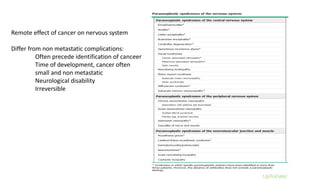
Remote effect of cancer on nervous system
Differ from non metastatic complications:
Often precede identification of canceer
Time of development, cancer often
small and non metastatic
Neurological disability
Irreversible
Pathogenesis
• Not understood
• Believed immunologic because ab and T cell response
• Directed against antigens that are ectopically expressed by tumor
• Immune system identifies these antigen as foreign and mount immune
reaction against them
• T cell response to normal protein in cancer cell
• Suggest different expression of self antigen protein in cancer cells
• Ab can be detected in serum and CSF of many neoplastic syndromes
• Small cell lung cancer accounts for a disproportionate number of variety of
paraneoplastic
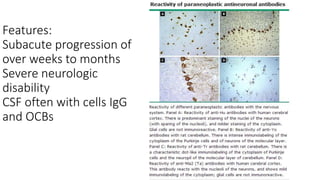
Features:
Subacute progression of
over weeks to months
Severe neurologic
disability
CSF often with cells IgG
and OCBs
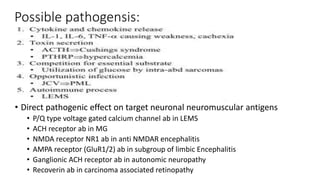
• Direct pathogenic effect on target neuronal neuromuscular antigens
• P/Q type voltage gated calcium channel ab in LEMS
• ACH receptor ab in MG
• NMDA receptor NR1 ab in anti NMDAR encephalitis
• AMPA receptor (GluR1/2) ab in subgroup of limbic Encephalitis
• Ganglionic ACH receptor ab in autonomic neuropathy
• Recoverin ab in carcinoma associated retinopathy
Possible pathogensis:
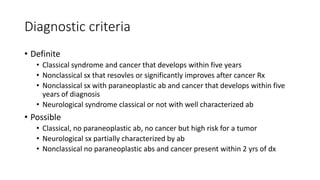
Diagnostic criteria
• Definite
• Classical syndrome and cancer that develops within five years
• Nonclassical sx that resovles or significantly improves after cancer Rx
• Nonclassical sx with paraneoplastic ab and cancer that develops within five
years of diagnosis
• Neurological syndrome classical or not with well characterized ab
• Possible
• Classical, no paraneoplastic ab, no cancer but high risk for a tumor
• Neurological sx partially characterized by ab
• Nonclassical no paraneoplastic abs and cancer present within 2 yrs of dx
Antibody screening
• CSF may reveal antibody undetected in serum
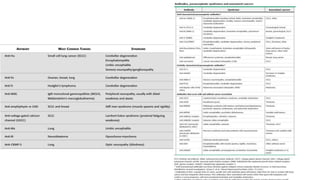
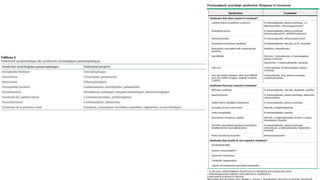
• Well characterized and described in a table previously
• Important tenents:
• P/Q type voltage gated ca channel or ACH receptor ab with specific disorders
do not differentiate between paraneoplastic and non paraneoplastic cases
e.g., stiff person syndrome associated with GAD or amphiphysin
• Serum of cancer patients without paraneoplastic neurologic sx may contain
paraneoplastic ab although titers are usually lower
• Different ab can be associated with the same paraneoplastic and conversely
also that different paraneoplastic with same antibody
• Several paraneoplastic antibodies may co-occur in the same patients
Other diagnostics
• Can be difficult when antibodies not detected
• Absence of ab does not exclude paraneoplastic syndrome
• Several diagnostic tests are helpful:
• MRI: limbic encephalitis because medial temporal lobe show increased FLAIR
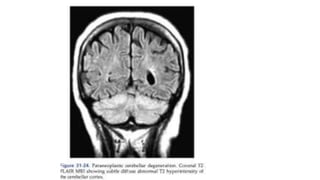
• Paraneoplastic cerebellar degeneration may develop atrophy significant on MRI
• PET: fluorodeoxyglucose will occasionally identify hypermetabolism of medial
temporal lobe with limbic encephalopathy
• LP: detection of AB confirms diagnosis, anti-Tr antibodies and patients with
antibodies to antigen expressed in the cell membrane of neurons of the
neuropil of hippocampus ANTI NMDA receptor titres in the CSF but not serum
• Electrophysiology: LEMS, myasthenia gravis, neuromyotonia, dermatomyositis
• Cancer search: Lung with LEMS, thymus with MG
Occult malignancy
• Not uncommon to develop before cancer is identified
• Antibody suggest specific underlying tumor
• Aided with best radiography to diagnose tumor
• PET scan for small occult neoplasms
• However negative PET/CT does not R/O cancer
• Workup done to R/O tumours is often carried
• LEMS screening for two years
• If found another cancer not related to specific paraneoplastic
syndrome then search again till you find it haha!
Treatment
• Two approaches:
• Removal of antigen source by treatment of underlying tumours
• Suppression of immune system
• LEMS and MG plasma exchange or IVIG
• Anti-B cell therapy rituximab for Ab mediated such as: stiff man sx,
dermatomyositis anti Yo positive paraneoplatic cerebellar degeneration,
and anti Hu antibody associated encephalomyelitis
• Oncologic treatment and immunotherapy (immunomodulation,
immunosuppression) can be beneficial
• Immunologic tx adjunct to oncologic should stratified accordingly
• Corticosteriods IV IG
• Immunosuppressive cyclophosphamide, tacrolimus or cycosporine
Paraneoplastic Neurological Syndrome

Paraneoplastic Neurological Syndrome

  • 1.
  • 2.
    Introduction • Heterogeneous groupof disorders caused by mechanisms other than metastases, metabolic, and nutritional deficits, infections coagulopathy or side effects of cancer treatment • May affect any part of nervous system • Cerebral cortex  NMJ  Muscle • Damaging one area (purkinje cell, presynaptic cholinergic synapses) • Multiple areas ( encephalomyelitis)
  • 3.
    Remote effect ofcancer on nervous system Differ from non metastatic complications: Often precede identification of canceer Time of development, cancer often small and non metastatic Neurological disability Irreversible
  • 4.
    Pathogenesis • Not understood •Believed immunologic because ab and T cell response • Directed against antigens that are ectopically expressed by tumor • Immune system identifies these antigen as foreign and mount immune reaction against them • T cell response to normal protein in cancer cell • Suggest different expression of self antigen protein in cancer cells • Ab can be detected in serum and CSF of many neoplastic syndromes • Small cell lung cancer accounts for a disproportionate number of variety of paraneoplastic
  • 5.
    Features: Subacute progression of overweeks to months Severe neurologic disability CSF often with cells IgG and OCBs
  • 6.
    • Direct pathogeniceffect on target neuronal neuromuscular antigens • P/Q type voltage gated calcium channel ab in LEMS • ACH receptor ab in MG • NMDA receptor NR1 ab in anti NMDAR encephalitis • AMPA receptor (GluR1/2) ab in subgroup of limbic Encephalitis • Ganglionic ACH receptor ab in autonomic neuropathy • Recoverin ab in carcinoma associated retinopathy Possible pathogensis:
  • 8.
    Diagnostic criteria • Definite •Classical syndrome and cancer that develops within five years • Nonclassical sx that resovles or significantly improves after cancer Rx • Nonclassical sx with paraneoplastic ab and cancer that develops within five years of diagnosis • Neurological syndrome classical or not with well characterized ab • Possible • Classical, no paraneoplastic ab, no cancer but high risk for a tumor • Neurological sx partially characterized by ab • Nonclassical no paraneoplastic abs and cancer present within 2 yrs of dx
  • 9.
    Antibody screening • CSFmay reveal antibody undetected in serum • Well characterized and described in a table previously • Important tenents: • P/Q type voltage gated ca channel or ACH receptor ab with specific disorders do not differentiate between paraneoplastic and non paraneoplastic cases e.g., stiff person syndrome associated with GAD or amphiphysin • Serum of cancer patients without paraneoplastic neurologic sx may contain paraneoplastic ab although titers are usually lower • Different ab can be associated with the same paraneoplastic and conversely also that different paraneoplastic with same antibody • Several paraneoplastic antibodies may co-occur in the same patients
  • 10.
    Other diagnostics • Canbe difficult when antibodies not detected • Absence of ab does not exclude paraneoplastic syndrome • Several diagnostic tests are helpful: • MRI: limbic encephalitis because medial temporal lobe show increased FLAIR • Paraneoplastic cerebellar degeneration may develop atrophy significant on MRI • PET: fluorodeoxyglucose will occasionally identify hypermetabolism of medial temporal lobe with limbic encephalopathy • LP: detection of AB confirms diagnosis, anti-Tr antibodies and patients with antibodies to antigen expressed in the cell membrane of neurons of the neuropil of hippocampus ANTI NMDA receptor titres in the CSF but not serum • Electrophysiology: LEMS, myasthenia gravis, neuromyotonia, dermatomyositis • Cancer search: Lung with LEMS, thymus with MG
  • 12.
    Occult malignancy • Notuncommon to develop before cancer is identified • Antibody suggest specific underlying tumor • Aided with best radiography to diagnose tumor • PET scan for small occult neoplasms • However negative PET/CT does not R/O cancer • Workup done to R/O tumours is often carried • LEMS screening for two years • If found another cancer not related to specific paraneoplastic syndrome then search again till you find it haha!
  • 13.
    Treatment • Two approaches: •Removal of antigen source by treatment of underlying tumours • Suppression of immune system • LEMS and MG plasma exchange or IVIG • Anti-B cell therapy rituximab for Ab mediated such as: stiff man sx, dermatomyositis anti Yo positive paraneoplatic cerebellar degeneration, and anti Hu antibody associated encephalomyelitis • Oncologic treatment and immunotherapy (immunomodulation, immunosuppression) can be beneficial • Immunologic tx adjunct to oncologic should stratified accordingly • Corticosteriods IV IG • Immunosuppressive cyclophosphamide, tacrolimus or cycosporine