Abdominal Pain
Objectives 
• To be able to elucidate the various mechanism 
of abdominal pain 
• To clearly be able to describe the importance 
of history, physical examination, and other 
investigations in defining the origin of 
abdominal pain 
• To be able to list a good differential for 
abdominal pain and solve real life examples
Why should we care? 
• Abdominal Pain is a huge topic 
• To understand it fully it requires a good clinical 
judgment 
• It serves as a good case for history and physical 
examination 
• Many chronic diseases go by unchecked with only 
minor symptoms like abdominal pain 
• There are multiple classification or systems for 
abdominal pain
Abdominal Pain and its mechanism 
• It can be due to multiple ways or origins, it 
includes: 
– Parietal Peritoneum Inflammation 
– Obstruction of the lumen of the gut 
– Vascular problems in the gut 
– Referred pain from somewhere else 
– Abdominal wall problems 
– Metabolic problems 
– Nerve problems
Parietal Peritoneum Problems 
• The characteristic of the pain: 
– Steady and aching 
– Almost always localized in the area of the pain
Obstruction of the Gut 
• The characteristic of the pain: 
– Intermittent pain, or colicky 
– It can be steady ‘’sometimes’’ – due to distention
Obstruction - 2 
• Billiary tree pain 
– Can produce steady pain ‘’REMEMBER 
DISTENSION’’ 
– Billiary colic can be steady 
– It radiates to tip of right scapular (supscapular 
pain) + epigastric 
• Carcinoma Head of the pancreas usually silent 
• Urinary bladder obstruction is suprapubic
Vascular Problems 
• Sometimes sudden and catastrophic like 
sudden bleed, eg., Aortic Aneurysm 
• Mesenteric artery occlusion: 
• Can be continuous and diffuse before the 
vascular bleed ( e.g., mesenteric artery 
occlusion)
Abdominal Wall 
• Usually the pain from abdominal wall 
• It is constant, and aching
Referred Pain in Abdominal Disease 
• It can be from anywhere: 
– thorax, spine, or genitalia 
• It can be abdominal disease causing referred 
pain somewhere else 
– Ex: acute cholecystitis or perforated ulcer 
• Common interthoracic diseases: 
– Especially in upper abdominal pain 
• MI, Pulmonary Infarction, pneumonia, pericarditis, and 
esophageal disease
Metabolic Abdominal Crises 
• Many mechanisms cause this type of pain: 
– Hyperlipidemia – accompanies by a process such as pancreatitis 
– C’1 esterase deficiency associated with angioneurotic edema – with 
severe abdominal pain 
• If you don’t know the cause, think of metabolic causes!! 
• It is difficult to do a differential because many diseases have similar 
nature of pain 
– Porphyria or lead colic is similar to intestinal obstruction 
– Uremia or diabetes is non-specific type of pain 
– Diabetic acidosis is similar to acute pancreatitis or intestinal 
obstruction 
• As a rule, if pain does not resolve with correction of metabolic 
abnormality 
– Underlying ORGANIC problem is suspected!
Nerve problems 
• Spinal nerve or roots of spinal nerve pain: 
– Comes and goes suddenly 
– lacinating type of pain 
– Many causes: 
• Herpes zoster, impingement by arthritis, tumors, 
herniated nucleus pulposus, diabetes, or syphilis.
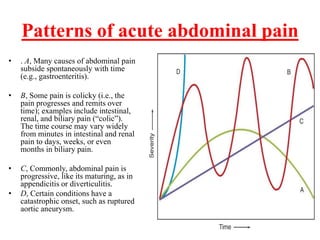
Patterns of acute abdominal pain 
• . A, Many causes of abdominal pain 
subside spontaneously with time 
(e.g., gastroenteritis). 
• B, Some pain is colicky (i.e., the 
pain progresses and remits over 
time); examples include intestinal, 
renal, and biliary pain (“colic”). 
The time course may vary widely 
from minutes in intestinal and renal 
pain to days, weeks, or even 
months in biliary pain. 
• C, Commonly, abdominal pain is 
progressive, like its maturing, as in 
appendicitis or diverticulitis. 
• D, Certain conditions have a 
catastrophic onset, such as ruptured 
aortic aneurysm.
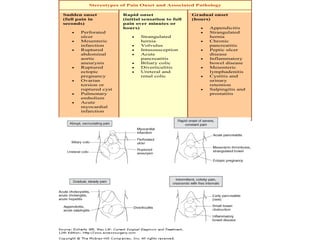
Stereotypes of Pain Onset and Associated Pathology 
Sudden onset 
(full pain in 
seconds) 
 Perforated 
ulcer 
 Mesenteric 
infarction 
 Ruptured 
abdominal 
aortic 
aneurysm 
 Ruptured 
ectopic 
pregnancy 
 Ovarian 
torsion or 
ruptured cyst 
 Pulmonary 
embolism 
 Acute 
myocardial 
infarction 
Rapid onset 
(initial sensation to full 
pain over minutes or 
hours) 
 Strangulated 
hernia 
 Volvulus 
 Intussusception 
 Acute 
pancreatitis 
 Biliary colic 
 Diverticulitis 
 Ureteral and 
renal colic 
Gradual onset 
(hours) 
 Appendicitis 
 Strangulated 
hernia 
 Chronic 
pancreatitis 
 Peptic ulcer 
disease 
 Inflammatory 
bowel disease 
 Mesenteric 
lymphadenitis 
 Cystitis and 
urinary 
retention 
 Salpingitis and 
prostatitis
History 
• Course of pain 
• Radiation of pain 
• Factors that exacerbate or improve symptoms 
• Associated symptoms including fevers, chills 
weight loss 
• Past medical and surgical history 
• Family history of bowel disorder 
• Alcohol intake 
• Intake of medications 
• Menstrual and contraceptive history in women
Physical Examination 
• Measurement of blood pressure, pulse, and 
temperature 
• Examination of the eyes and skin for jaundice 
• Auscultation and percussion of the chest 
• Auscultation of the abdomen for bowel sounds 
• Palpitation of the Abdomen for masses, 
tenderness, and peritoneal signs 
• Rectal exam include Occult blood 
• Pelvic Examination in women with lower 
abdominal pain
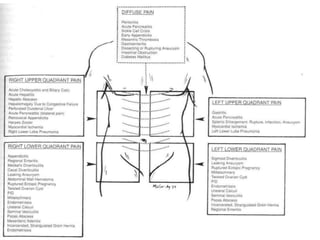
• DETAILED HISTORY IS MOST IMPORTANT THAN 
ANYTHING! 
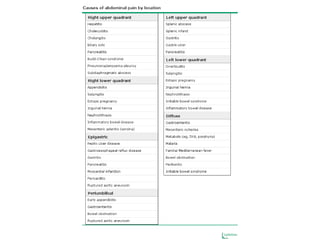
• Location of pain is very helpful 
• Time sequence of events is important 
• Be open minded and ask the right questions 
• Check extra-abdominal manifestation 
• If female, ask menstrual history
• Critical inspection is inmportant 
– Facies, position in bed, respiratory activity 
– Be gentle and detailed 
– do not elicit rebound tenderness by sudden release of 
a deeply palpating hand, IT’S CRUEL! 
• Same way can be done by gentle percussion (rebound 
tenderness on a miniature scale) 
• Ask patient to cough will elicit true rebound tenderness 
without placing hand on abdomen 
• Sometimes, reactionary protective spasm will hinder your 
other findings, eg., palpating gallbladder
• Abdominal signs can be absent in cases of 
pelvic peritonitis 
– Careful pelvic and rectal examinations are 
mandatory in patients with abdominal pain 
• Tenderness in such examination: 
– Operative indication: 
» Perforated appenditis 
» Diverticulitis 
» Twisted ovarian cyst
• Absence of peristaltic sound 
– Auscultation is one of the least revealing aspect 
– Catastrophes such as: Strangulating small 
intestinal obstruction or perforated appendicitis 
• Occur in presence of normal peristaltic sounds 
• Conversely, when proximal area above obstruction 
becomes edematous and distended 
– Peristaltic sound lose characteristics of borborygmi 
» Become weak and absent 
– Sudden Chemical peritonitis = silent abdomen 
– Remember, assess patient’s hydration status
LABS 
• Labs are very valuable but they rarely establish 
diagnosis – focus on History & physical 
Example: Leukocytosis does not mean a person having 
appendicitis and he should be admitted to operation 
room 
Other conditions occur in pancreatitis, acute cholecystitis, 
pelvic inflammatory disease, intestinal infarction 
We can establish diagnosis of anemia based on 
CBC and history
• We do urinary analysis to rule out: 
– renal disease, diabetes, urinary infection 
• Serum amylase levels can increase: 
• pancreatitis 
• Perforated ulcer 
• Strangulating intestinal obstruction 
• Acute cholecystitis 
• Other important tests: Blood urea nitrogen, 
glucose, serum bilirubin
• Radiographs of abdomen can show Perforated 
ulcer, and other conditions 
• Water-soluble contrast or barium studies can 
demonstrate partial upper GI obstruction 
• Contrast enema Suspected colonic obstruction 
(with no perforation) – contrast enema may 
be diagnostic
US  detect enlarged gallbladder or pancreas 
• Presence of gallstones, enlarged ovary or tubal 
pregnancy 
– Helpful in diagnosing pelvic conditions: 
• Ovarian cysts, tubal pregnancies, salpingitis, and acute 
appendicitis
Cases… 
• A 23 year old female presents with severe, 
intermittent right lower quadrant pain associated 
with nausea and vomiting. 
• She has no medical history. 
• Her vital signs reveal tachycardia but are otherwise 
normal. 
• Physical exam shows a soft abdomen, RLQ TTP 
without peritoneal signs. Pelvic (which is part of 
the physical exam), shows scant discharge. 
• If you could only order one test, what would it be? 
• What is on your differential?
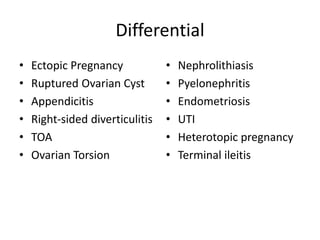
Differential 
• Ectopic Pregnancy 
• Ruptured Ovarian Cyst 
• Appendicitis 
• Right-sided diverticulitis 
• TOA 
• Ovarian Torsion 
• Nephrolithiasis 
• Pyelonephritis 
• Endometriosis 
• UTI 
• Heterotopic pregnancy 
• Terminal ileitis
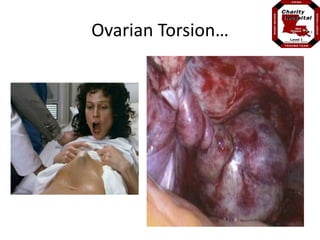
Ovarian Torsion…
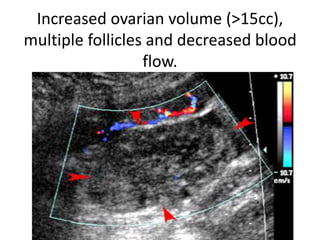
Increased ovarian volume (>15cc), 
multiple follicles and decreased blood 
flow.
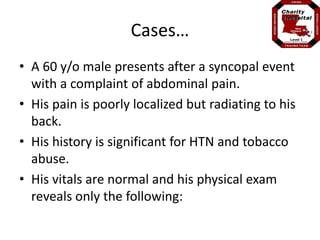
Cases… 
• A 60 y/o male presents after a syncopal event 
with a complaint of abdominal pain. 
• His pain is poorly localized but radiating to his 
back. 
• His history is significant for HTN and tobacco 
abuse. 
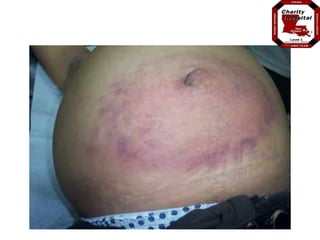
• His vitals are normal and his physical exam 
reveals only the following:
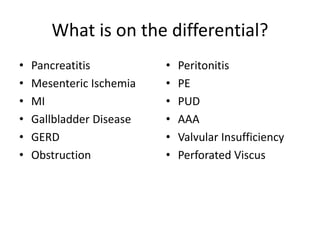
What is on the differential? 
• Pancreatitis 
• Mesenteric Ischemia 
• MI 
• Gallbladder Disease 
• GERD 
• Obstruction 
• Peritonitis 
• PE 
• PUD 
• AAA 
• Valvular Insufficiency 
• Perforated Viscus
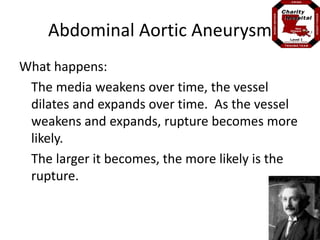
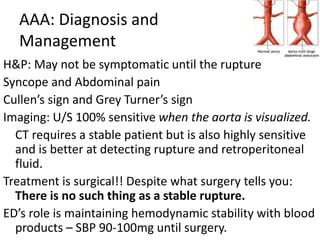
Abdominal Aortic Aneurysm 
What happens: 
The media weakens over time, the vessel 
dilates and expands over time. As the vessel 
weakens and expands, rupture becomes more 
likely. 
The larger it becomes, the more likely is the 
rupture.
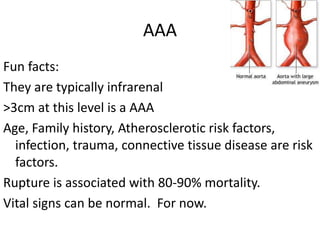
AAA 
Fun facts: 
They are typically infrarenal 
>3cm at this level is a AAA 
Age, Family history, Atherosclerotic risk factors, 
infection, trauma, connective tissue disease are risk 
factors. 
Rupture is associated with 80-90% mortality. 
Vital signs can be normal. For now.
AAA: Diagnosis and 
Management 
H&P: May not be symptomatic until the rupture 
Syncope and Abdominal pain 
Cullen’s sign and Grey Turner’s sign 
Imaging: U/S 100% sensitive when the aorta is visualized. 
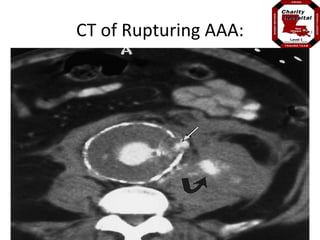
CT requires a stable patient but is also highly sensitive 
and is better at detecting rupture and retroperitoneal 
fluid. 
Treatment is surgical!! Despite what surgery tells you: 
There is no such thing as a stable rupture. 
ED’s role is maintaining hemodynamic stability with blood 
products – SBP 90-100mg until surgery.
CT of Rupturing AAA:
Thank you! 

Abdominal Pain

  • 1.
  • 2.
    Objectives • Tobe able to elucidate the various mechanism of abdominal pain • To clearly be able to describe the importance of history, physical examination, and other investigations in defining the origin of abdominal pain • To be able to list a good differential for abdominal pain and solve real life examples
  • 3.
    Why should wecare? • Abdominal Pain is a huge topic • To understand it fully it requires a good clinical judgment • It serves as a good case for history and physical examination • Many chronic diseases go by unchecked with only minor symptoms like abdominal pain • There are multiple classification or systems for abdominal pain
  • 4.
    Abdominal Pain andits mechanism • It can be due to multiple ways or origins, it includes: – Parietal Peritoneum Inflammation – Obstruction of the lumen of the gut – Vascular problems in the gut – Referred pain from somewhere else – Abdominal wall problems – Metabolic problems – Nerve problems
  • 5.
    Parietal Peritoneum Problems • The characteristic of the pain: – Steady and aching – Almost always localized in the area of the pain
  • 6.
    Obstruction of theGut • The characteristic of the pain: – Intermittent pain, or colicky – It can be steady ‘’sometimes’’ – due to distention
  • 7.
    Obstruction - 2 • Billiary tree pain – Can produce steady pain ‘’REMEMBER DISTENSION’’ – Billiary colic can be steady – It radiates to tip of right scapular (supscapular pain) + epigastric • Carcinoma Head of the pancreas usually silent • Urinary bladder obstruction is suprapubic
  • 8.
    Vascular Problems •Sometimes sudden and catastrophic like sudden bleed, eg., Aortic Aneurysm • Mesenteric artery occlusion: • Can be continuous and diffuse before the vascular bleed ( e.g., mesenteric artery occlusion)
  • 9.
    Abdominal Wall •Usually the pain from abdominal wall • It is constant, and aching
  • 10.
    Referred Pain inAbdominal Disease • It can be from anywhere: – thorax, spine, or genitalia • It can be abdominal disease causing referred pain somewhere else – Ex: acute cholecystitis or perforated ulcer • Common interthoracic diseases: – Especially in upper abdominal pain • MI, Pulmonary Infarction, pneumonia, pericarditis, and esophageal disease
  • 11.
    Metabolic Abdominal Crises • Many mechanisms cause this type of pain: – Hyperlipidemia – accompanies by a process such as pancreatitis – C’1 esterase deficiency associated with angioneurotic edema – with severe abdominal pain • If you don’t know the cause, think of metabolic causes!! • It is difficult to do a differential because many diseases have similar nature of pain – Porphyria or lead colic is similar to intestinal obstruction – Uremia or diabetes is non-specific type of pain – Diabetic acidosis is similar to acute pancreatitis or intestinal obstruction • As a rule, if pain does not resolve with correction of metabolic abnormality – Underlying ORGANIC problem is suspected!
  • 12.
    Nerve problems •Spinal nerve or roots of spinal nerve pain: – Comes and goes suddenly – lacinating type of pain – Many causes: • Herpes zoster, impingement by arthritis, tumors, herniated nucleus pulposus, diabetes, or syphilis.

  • 13.
    Patterns of acuteabdominal pain • . A, Many causes of abdominal pain subside spontaneously with time (e.g., gastroenteritis). • B, Some pain is colicky (i.e., the pain progresses and remits over time); examples include intestinal, renal, and biliary pain (“colic”). The time course may vary widely from minutes in intestinal and renal pain to days, weeks, or even months in biliary pain. • C, Commonly, abdominal pain is progressive, like its maturing, as in appendicitis or diverticulitis. • D, Certain conditions have a catastrophic onset, such as ruptured aortic aneurysm.
  • 14.
    Stereotypes of PainOnset and Associated Pathology Sudden onset (full pain in seconds)  Perforated ulcer  Mesenteric infarction  Ruptured abdominal aortic aneurysm  Ruptured ectopic pregnancy  Ovarian torsion or ruptured cyst  Pulmonary embolism  Acute myocardial infarction Rapid onset (initial sensation to full pain over minutes or hours)  Strangulated hernia  Volvulus  Intussusception  Acute pancreatitis  Biliary colic  Diverticulitis  Ureteral and renal colic Gradual onset (hours)  Appendicitis  Strangulated hernia  Chronic pancreatitis  Peptic ulcer disease  Inflammatory bowel disease  Mesenteric lymphadenitis  Cystitis and urinary retention  Salpingitis and prostatitis
  • 15.
    History • Courseof pain • Radiation of pain • Factors that exacerbate or improve symptoms • Associated symptoms including fevers, chills weight loss • Past medical and surgical history • Family history of bowel disorder • Alcohol intake • Intake of medications • Menstrual and contraceptive history in women
  • 16.
    Physical Examination •Measurement of blood pressure, pulse, and temperature • Examination of the eyes and skin for jaundice • Auscultation and percussion of the chest • Auscultation of the abdomen for bowel sounds • Palpitation of the Abdomen for masses, tenderness, and peritoneal signs • Rectal exam include Occult blood • Pelvic Examination in women with lower abdominal pain
  • 18.
    • DETAILED HISTORYIS MOST IMPORTANT THAN ANYTHING! • Location of pain is very helpful • Time sequence of events is important • Be open minded and ask the right questions • Check extra-abdominal manifestation • If female, ask menstrual history
  • 20.
    • Critical inspectionis inmportant – Facies, position in bed, respiratory activity – Be gentle and detailed – do not elicit rebound tenderness by sudden release of a deeply palpating hand, IT’S CRUEL! • Same way can be done by gentle percussion (rebound tenderness on a miniature scale) • Ask patient to cough will elicit true rebound tenderness without placing hand on abdomen • Sometimes, reactionary protective spasm will hinder your other findings, eg., palpating gallbladder
  • 21.
    • Abdominal signscan be absent in cases of pelvic peritonitis – Careful pelvic and rectal examinations are mandatory in patients with abdominal pain • Tenderness in such examination: – Operative indication: » Perforated appenditis » Diverticulitis » Twisted ovarian cyst
  • 22.
    • Absence ofperistaltic sound – Auscultation is one of the least revealing aspect – Catastrophes such as: Strangulating small intestinal obstruction or perforated appendicitis • Occur in presence of normal peristaltic sounds • Conversely, when proximal area above obstruction becomes edematous and distended – Peristaltic sound lose characteristics of borborygmi » Become weak and absent – Sudden Chemical peritonitis = silent abdomen – Remember, assess patient’s hydration status
  • 23.
    LABS • Labsare very valuable but they rarely establish diagnosis – focus on History & physical Example: Leukocytosis does not mean a person having appendicitis and he should be admitted to operation room Other conditions occur in pancreatitis, acute cholecystitis, pelvic inflammatory disease, intestinal infarction We can establish diagnosis of anemia based on CBC and history
  • 24.
    • We dourinary analysis to rule out: – renal disease, diabetes, urinary infection • Serum amylase levels can increase: • pancreatitis • Perforated ulcer • Strangulating intestinal obstruction • Acute cholecystitis • Other important tests: Blood urea nitrogen, glucose, serum bilirubin
  • 25.
    • Radiographs ofabdomen can show Perforated ulcer, and other conditions • Water-soluble contrast or barium studies can demonstrate partial upper GI obstruction • Contrast enema Suspected colonic obstruction (with no perforation) – contrast enema may be diagnostic
  • 26.
    US  detectenlarged gallbladder or pancreas • Presence of gallstones, enlarged ovary or tubal pregnancy – Helpful in diagnosing pelvic conditions: • Ovarian cysts, tubal pregnancies, salpingitis, and acute appendicitis
  • 27.
    Cases… • A23 year old female presents with severe, intermittent right lower quadrant pain associated with nausea and vomiting. • She has no medical history. • Her vital signs reveal tachycardia but are otherwise normal. • Physical exam shows a soft abdomen, RLQ TTP without peritoneal signs. Pelvic (which is part of the physical exam), shows scant discharge. • If you could only order one test, what would it be? • What is on your differential?
  • 28.
    Differential • EctopicPregnancy • Ruptured Ovarian Cyst • Appendicitis • Right-sided diverticulitis • TOA • Ovarian Torsion • Nephrolithiasis • Pyelonephritis • Endometriosis • UTI • Heterotopic pregnancy • Terminal ileitis
  • 29.
  • 30.
    Increased ovarian volume(>15cc), multiple follicles and decreased blood flow.
  • 31.
    Cases… • A60 y/o male presents after a syncopal event with a complaint of abdominal pain. • His pain is poorly localized but radiating to his back. • His history is significant for HTN and tobacco abuse. • His vitals are normal and his physical exam reveals only the following:
  • 33.
    What is onthe differential? • Pancreatitis • Mesenteric Ischemia • MI • Gallbladder Disease • GERD • Obstruction • Peritonitis • PE • PUD • AAA • Valvular Insufficiency • Perforated Viscus
  • 34.
    Abdominal Aortic Aneurysm What happens: The media weakens over time, the vessel dilates and expands over time. As the vessel weakens and expands, rupture becomes more likely. The larger it becomes, the more likely is the rupture.
  • 35.
    AAA Fun facts: They are typically infrarenal >3cm at this level is a AAA Age, Family history, Atherosclerotic risk factors, infection, trauma, connective tissue disease are risk factors. Rupture is associated with 80-90% mortality. Vital signs can be normal. For now.
  • 36.
    AAA: Diagnosis and Management H&P: May not be symptomatic until the rupture Syncope and Abdominal pain Cullen’s sign and Grey Turner’s sign Imaging: U/S 100% sensitive when the aorta is visualized. CT requires a stable patient but is also highly sensitive and is better at detecting rupture and retroperitoneal fluid. Treatment is surgical!! Despite what surgery tells you: There is no such thing as a stable rupture. ED’s role is maintaining hemodynamic stability with blood products – SBP 90-100mg until surgery.
  • 37.
  • 38.