Gene expression and Transcript
profiling
priyanka Mudad
M.Sc. Biochemistry
central university of Haryana
 next step after sequencing a genome
 determination of the pattern of genes expressed, at the level
of transcription, under specific circumstances
 measurement of the activity (the expression) of thousands of
genes at once, to create a global picture of cellular function.
 Sequence based techniques, like RNA-Seq, provide
information on the sequences of genes in addition to their
expression level.
 expression profile allows one to deduce a cell's type, state,
environment, and so forth.
Methods
for
profiling
DNA
microarray
RNA Seq
EST Tags
 DNA chip or biochip
 collection of microscopic DNA spots attached to a solid surface.
 measure the expression levels of large numbers of genes simultaneously or
to genotype multiple regions of a genome.
 Each DNA spot contains picomoles (10−12 moles) of a specific DNA sequence, known
as probes (or reporters or oligos).
 These can be a short section of a gene or other DNA element that are used
to hybridize a cDNA or cRNA (also called anti-sense RNA) sample (called target) under
high-stringency conditions.
 Probe-target hybridization is usually detected and quantified by detection
of fluorophore-, silver-, or chemiluminescence-labeled targets to determine relative
abundance of nucleic acid sequences in the target.
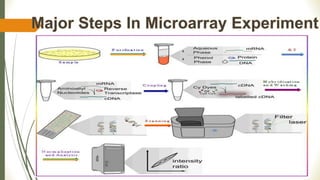
DNA Microarray
Basic
mechanism of
DNA
Microarray
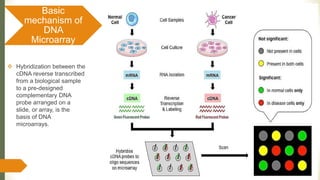
 Hybridization between the
cDNA reverse transcribed
from a biological sample
to a pre-designed
complementary DNA
probe arranged on a
slide, or array, is the
basis of DNA
microarrays.
Applications of Microarrays
Gene Discovery
Disease Diagnosis
Drug Discovery
Toxicological Research
For easing the accessibility to this data, the National Center
for Biotechnology Information (NCBI) has formulated
the Gene Expression Omnibus or GEO. It is a data
repository facility which includes data on gene expression
from varied sources.
Limitations of DNA Microarray
 cross-hybridization artifacts,
 poor quantification of lowly and highly expressed
genes
needing to know the sequence a priori
A/C whole transcriptome shotgun sequencing
RNA-Seq
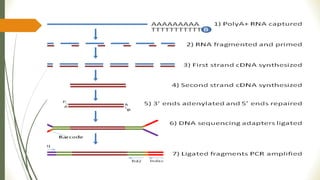
 It uses next-generation sequencing to reveal the presence and quantity of RNA in a biological
sample at a given moment.
 RNA-Seq is used to analyze the continuously changing cellular transcriptome. alternative
gene spliced transcripts, post-transcriptional modifications, gene fusion, mutations/SNPs and
changes in gene expression over time, or differences in gene expression in different groups or
treatments.
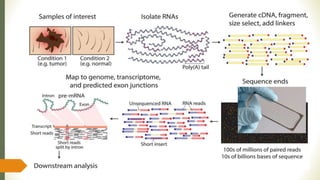
 Fragmented cDNA is sequenced, the resulting sequences (“reads”) are mapped and
compared to known genomes or transcriptomes.
 In addition to mRNA transcripts, RNA-Seq can look at different populations of RNA to include
total RNA, small RNA, such as miRNA, tRNA, and ribosomal profiling.
 Three most widely used NGS platforms for RNA-seq are SOLiD and Ion Torrent, both
marketed by ThermoFisher, and Illumina’s HiSeq.
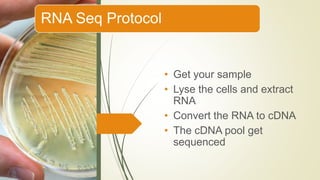
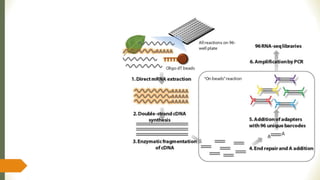
• Get your sample
• Lyse the cells and extract
RNA
• Convert the RNA to cDNA
• The cDNA pool get
sequenced
RNA Seq Protocol
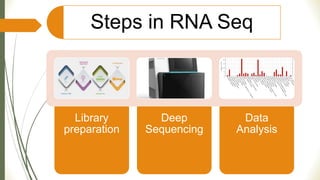
Steps in RNA Seq
Library
preparation
Deep
Sequencing
Data
Analysis
description smallmiRNA Degradome-
seq
Digital gene
expression
Poly[A]-RNA
Seq
Total RNA seq
Library
preparation-
RNA selection
Size selection-
small RNA
Poly[A] tail
selection-
miRNA
Poly[A] tail
selection-
mRNA
Poly[A] tail
selection-
mRNA
rRNA depletion
-
mRNA+IncRNA
Sequencing
cycles
50 50 50 2×100 2×100
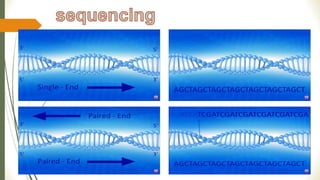
Single vs.
paired end
Single end Single end Single end Paired end Paired end
Data analysis discovery
expression
annotation
miRNA target
ID degradation
plots
Expression
annotation
discovery
expression
annotation
discovery
expression
annotation
Basic steps
Gene expression profiling

Gene expression profiling

  • 1.
    Gene expression andTranscript profiling priyanka Mudad M.Sc. Biochemistry central university of Haryana
  • 2.
     next stepafter sequencing a genome  determination of the pattern of genes expressed, at the level of transcription, under specific circumstances  measurement of the activity (the expression) of thousands of genes at once, to create a global picture of cellular function.  Sequence based techniques, like RNA-Seq, provide information on the sequences of genes in addition to their expression level.  expression profile allows one to deduce a cell's type, state, environment, and so forth.
  • 3.
  • 4.
     DNA chipor biochip  collection of microscopic DNA spots attached to a solid surface.  measure the expression levels of large numbers of genes simultaneously or to genotype multiple regions of a genome.  Each DNA spot contains picomoles (10−12 moles) of a specific DNA sequence, known as probes (or reporters or oligos).  These can be a short section of a gene or other DNA element that are used to hybridize a cDNA or cRNA (also called anti-sense RNA) sample (called target) under high-stringency conditions.  Probe-target hybridization is usually detected and quantified by detection of fluorophore-, silver-, or chemiluminescence-labeled targets to determine relative abundance of nucleic acid sequences in the target. DNA Microarray
  • 5.
    Basic mechanism of DNA Microarray  Hybridizationbetween the cDNA reverse transcribed from a biological sample to a pre-designed complementary DNA probe arranged on a slide, or array, is the basis of DNA microarrays.
  • 7.
    Applications of Microarrays GeneDiscovery Disease Diagnosis Drug Discovery Toxicological Research For easing the accessibility to this data, the National Center for Biotechnology Information (NCBI) has formulated the Gene Expression Omnibus or GEO. It is a data repository facility which includes data on gene expression from varied sources.
  • 8.
    Limitations of DNAMicroarray  cross-hybridization artifacts,  poor quantification of lowly and highly expressed genes needing to know the sequence a priori
  • 9.
    A/C whole transcriptomeshotgun sequencing
  • 10.
    RNA-Seq  It usesnext-generation sequencing to reveal the presence and quantity of RNA in a biological sample at a given moment.  RNA-Seq is used to analyze the continuously changing cellular transcriptome. alternative gene spliced transcripts, post-transcriptional modifications, gene fusion, mutations/SNPs and changes in gene expression over time, or differences in gene expression in different groups or treatments.  Fragmented cDNA is sequenced, the resulting sequences (“reads”) are mapped and compared to known genomes or transcriptomes.  In addition to mRNA transcripts, RNA-Seq can look at different populations of RNA to include total RNA, small RNA, such as miRNA, tRNA, and ribosomal profiling.  Three most widely used NGS platforms for RNA-seq are SOLiD and Ion Torrent, both marketed by ThermoFisher, and Illumina’s HiSeq.
  • 11.
    • Get yoursample • Lyse the cells and extract RNA • Convert the RNA to cDNA • The cDNA pool get sequenced RNA Seq Protocol
  • 12.
    Steps in RNASeq Library preparation Deep Sequencing Data Analysis
  • 13.
    description smallmiRNA Degradome- seq Digitalgene expression Poly[A]-RNA Seq Total RNA seq Library preparation- RNA selection Size selection- small RNA Poly[A] tail selection- miRNA Poly[A] tail selection- mRNA Poly[A] tail selection- mRNA rRNA depletion - mRNA+IncRNA Sequencing cycles 50 50 50 2×100 2×100 Single vs. paired end Single end Single end Single end Paired end Paired end Data analysis discovery expression annotation miRNA target ID degradation plots Expression annotation discovery expression annotation discovery expression annotation
  • 17.