VENTRICULARARRYHTHMIASDr.PRAVEEN NAGULA
INTRODUCTION1.PREMATURE VENTRICULAR COMPLEXES.2.IDIOVENTRICULAR RHYTHM 3.NONSUSTAINED VT MONOMORPHICPOLYMORPHIC4.SUSTAINED VTMONOMORPHICPOLYMORPHIC5.BUNDLE BRANCH REENTRANT TACHYCARDIA6.BIDIRECTIONAL VT7.TORSADES DE POINTES8.VENTRICULAR FLUTTER9.VENTRICULAR FIBRILLATION
caseA 39-year-old lady presents to you with frequent palpitations lasting a few months, which are not associated with dizziness, syncope or angina. She has enjoyed good health and is not on any medication or herbal medicine. She is a non-smoker and has no known diabetes, hypertension or hypercholesterolaemia. Her menses is regular and physical examination is unremarkable other than a few premature beats. This is her ECG.
Typical configuration of outflow tract premature ventricular contraction (PVCs) in the 12-lead ECG.Niwano S et al. Heart 2009;95:1230-1237©2009 by BMJ Publishing Group Ltd and British Cardiovascular Society
A diagnosis of VPC s have been made…..Is it benign ?Is it abnormal?Does it need therapy after absence of heart disease?Holter monitoring when is needed?When do you call VT ?Can you localise the origin of VPCs?How to differentiate from APC s.When there is a inferior wall MI what is its importance?A student on ECG read as VPC with R on T phenomenon ..what will the importance of the word?VPC s of ischemic heartdisease usually arise from ?
VENTRICULAR ACTION POTENTIAL
VULNERABLE PERIOD
WHERE THERE IS A POSSIBILITY
PREMATURE VENTRICULAR COMPLEXESOccur before the next expected normal sinus impulse.Not preceded by P waves.Wide QRS complex >0.12 sec (0.14sec)---below bundle of HIS.QRS  is wide,slurred and notched.Direct muscle to muscle transmission.ST segment and T waves are discordant to QRS complex.QRS complex followed by a compensatory pause.
PVC sCommonIncrease with age.Causes:AnxietyCaffeine intakeAminophyllineEpinephrineIsoproteronolDigitalis Valvular ,HTN,Ischemia,Acute MIHypokalemia,hypomagnesemia,hypoxemia
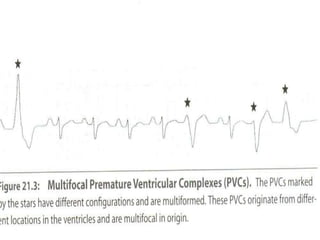
PVCsThey are called as ventricular extrasystoles.Unifocal--- arise from a single location in the ventricle, uniform and have identical configuration. Multifocal–two or more locations.Interpolated PVCs – inserted between two sinus impulses without altering the basic sinus rate…it is not followed by a pause.Fully compensatory pause--- does not discharge the sinus node prematurely…regularity of sinus impulse not altered– differentiates from premature atrial complex.If conducted retrogradely to the atria –less then full compensatory pause.. May suppress the SA node –more than full compensatory pause.
Sinus beat following a interpolated VPC s has a prolonged PR interval.Abnormal VPC SMultifocal and VPC s in pairsUnifocal abnormal in crops,bigeminy,>40 yrs ,assosciated cardiac disease.Interpolated extrasystoles—bradycardia.
PVCsRetrograde activation– leads to P  wave  formation –but may not be visible –buried in the PVCsR on T phenomenon---- early PVC striking the T wave of the previous complex…short coupling interval..End diastolic  PVC s --- if it occurs late in the diastole such that already P wave of the sinus impulse is formed…fusion complex..long coupling interval.Coupling interval – distance between the PVC s and the preceding QRS complex…Usually constant.Short coupling interval <0.4 sec.R on T phenomenon may trigger a potential arryhthmia..
PVC sBigeminy --- if every other complex on the strip is a PVCs.Trigeminy– if every third complex is a PVC.It is also trigeminy if every two PVCs are followed by a sinus impulse.Quadrigeminy– every fourth complex is a PVC.Paired PVC –couplets consecutively..
COUPLET
APCs
PVC s
PVC s Right ventricular PVC Has a LBBB configuration.RV apex – LBBB + LAD.RV outflow --- LBBB + RADRV inflow --- LBBB + normal axis. (tricuspid area). Just remember apex on left side,outflow on right side,inflow tricuspid valve in direction of lead II –normal axis.
PVC sLeft ventricular PVC s Anterosuperior area --- RBBB +RAD supplied by  anterior fascicle of the LBB.Inferoposterior area – left posterior fascicle –RBBB +LAD.
VPC s without obvious cardiovascular heart diseases have RV origin >LV origin.In with heart disease –LV originApex and base of ventricle–  heart disease.LBB ---donot indicate cardiac disease.
TreatmentReversible cardiomyopathy –depressed LV function with bigeminy or freq non sustained VTB Blockers in presence of STEMI .Prognosis:No prognostic significance in absence of structural heart disease.Freq VPCs or runs of non sustained VT ---SCD in presence of heart disease.No reduction in risk of arryhthmic death by use of antiarryhthmic drugsProphylactic pharmacotherapy c/I
VENTRICULAR PARASYSTOLESIndependent ectopic impulse that competes with the sinus node as the pacemaker of the heart.Located in the atria,AV junction or the ventricles.Ventricular para systole is manifested when the sinus node fails. The cells are protected and cannot be reset by the sinus impulse.May or may not catch the ventricles depending upon the refractory period of the ventricles.May result in fusion beats.
Consider as parasystoleCoupling intervals are variable.Fusion complexes are present.Mathematically related.Longer are multiples of the shorter one..
parasystole
Fusion beat
Conduction of beats
Capture beatWhen interference dissosciation occurs between sinus rhythm and a faster subsidiary(ventricular or AV nodal rhythm),the mutual impedence or interference occurs within the AV node.The ventricular or AV nodal impulses cannot be conducted retrogradely---upper AV nodal refractoriness consequent to partial penetration of the sinus impulse to AV node.Sinus impulses cannot be conducted anterogradely to the ventricles,as a result of lower  AV nodal refractoriness consequent to retrograde penetration of ventricular impulses to AV node.
Capture beatTwo pacemakers discharge asynchronously.Sinus impulse occurs progressively later in relation to the AV nodal or ventricular discharge----p wave falls away from the QRS complex of the subsidiary rhythmSinus impulse may reach the AV node when it is no longer refractory.Able to penetrate the AV node and be conducted to and activate the ventricles.Momentary activation of the ventricles by the sinus impulses in AV dissosciation is known as a ventricular capture beat.It is an early beat..preceding p wave to be present.
Capture beatWhen a tachycardia with bizzare QRS complexes  is complicated by capture beats…..see the morphology of the captured beat.Capture beat has a normal or near normal  narrow QRS configuration---the diagnosis of ectopic ventricular tachycardia is favoured.Capture beat resembles the bizarre   QRS  pattern of the tachycardia,a diagnosis of SVT with aberration is favoured.This because the course of activation of both the capturing and supraventricular ectopic impulse must be the same.
Capture beats
ACCELERATED IDIOVENTRICULAR RHYTHMVentricular rhythm3 0r more complexes >40/min and <120 bpmAbnormal automaticityBenign rhythmGradual onset and offsetBrief,self limiting arryhthmia
Idioventricular rhythm
causesCan be seen in absence of structural heart diseaseFrequently seen in presence of acute MICocaine intoxicationAcute myocarditisDigoxin intoxicationPost operative cardiac surgerySustained forms--- acute MI ,POST OP,hemodynamiccompromise,AVdissosciation
RVMI with proximal RCA occlusion has been more prone for bradyarryhthmias--------ventricular rhythm—AIVR ---hemodynamic compromise worsensTreatment atrialpacing,atropine.Overlap between AIVR and slow VT ---90-120 bpmSlow VT has to be differentiated.
answers1. benign 2.not abnormal3.no4.frequent palpitations,syncope,chest pain5. prsence of 3 0r more complexes,>100 bpm …6.it is on outflow tract VPC with LAD.7.absence of compensatory pause.8.hypotension –atrial pacing required9.risk of getting arryhthmia10. left ventricle ---base and apex
Diagnose…
diagnose
Take home messageVPC s may be in presence or absence of heart disease.Only abnormal VPCs are to be treatedProphylactic antiarryhthmic therapy is not indicated.Ventricular parasystole diagnosed by varying coupling intervals and fusion complexesB blockers can be given for VPC s in ischemiaAIVR is a benign rhythm usually self limited arryhthmiaCan be cause of hypotension in RVMI with RCA proximal occlusion.Capture beats morhology differentiate VT and SVTR on T phenomenon can cause arryhthmiaThree consequetive VPC s >100 bpm  is VT.
ReferencesLeo SCHAMROTH an introdcution to electrocardiogarphy. ,7 thedHARRISON’S principles of internal medicine,17 th ed.Lifeinthefastlane/ecg library/clinical casesBasic and bedside electrocardiography----- Romulo.F.Baltazar
Thank you sagittarian

Vpcs

  • 1.
  • 2.
    INTRODUCTION1.PREMATURE VENTRICULAR COMPLEXES.2.IDIOVENTRICULARRHYTHM 3.NONSUSTAINED VT MONOMORPHICPOLYMORPHIC4.SUSTAINED VTMONOMORPHICPOLYMORPHIC5.BUNDLE BRANCH REENTRANT TACHYCARDIA6.BIDIRECTIONAL VT7.TORSADES DE POINTES8.VENTRICULAR FLUTTER9.VENTRICULAR FIBRILLATION
  • 3.
    caseA 39-year-old ladypresents to you with frequent palpitations lasting a few months, which are not associated with dizziness, syncope or angina. She has enjoyed good health and is not on any medication or herbal medicine. She is a non-smoker and has no known diabetes, hypertension or hypercholesterolaemia. Her menses is regular and physical examination is unremarkable other than a few premature beats. This is her ECG.
  • 4.
    Typical configuration ofoutflow tract premature ventricular contraction (PVCs) in the 12-lead ECG.Niwano S et al. Heart 2009;95:1230-1237©2009 by BMJ Publishing Group Ltd and British Cardiovascular Society
  • 5.
    A diagnosis ofVPC s have been made…..Is it benign ?Is it abnormal?Does it need therapy after absence of heart disease?Holter monitoring when is needed?When do you call VT ?Can you localise the origin of VPCs?How to differentiate from APC s.When there is a inferior wall MI what is its importance?A student on ECG read as VPC with R on T phenomenon ..what will the importance of the word?VPC s of ischemic heartdisease usually arise from ?
  • 6.
  • 7.
  • 8.
    WHERE THERE ISA POSSIBILITY
  • 10.
    PREMATURE VENTRICULAR COMPLEXESOccurbefore the next expected normal sinus impulse.Not preceded by P waves.Wide QRS complex >0.12 sec (0.14sec)---below bundle of HIS.QRS is wide,slurred and notched.Direct muscle to muscle transmission.ST segment and T waves are discordant to QRS complex.QRS complex followed by a compensatory pause.
  • 11.
    PVC sCommonIncrease withage.Causes:AnxietyCaffeine intakeAminophyllineEpinephrineIsoproteronolDigitalis Valvular ,HTN,Ischemia,Acute MIHypokalemia,hypomagnesemia,hypoxemia
  • 12.
    PVCsThey are calledas ventricular extrasystoles.Unifocal--- arise from a single location in the ventricle, uniform and have identical configuration. Multifocal–two or more locations.Interpolated PVCs – inserted between two sinus impulses without altering the basic sinus rate…it is not followed by a pause.Fully compensatory pause--- does not discharge the sinus node prematurely…regularity of sinus impulse not altered– differentiates from premature atrial complex.If conducted retrogradely to the atria –less then full compensatory pause.. May suppress the SA node –more than full compensatory pause.
  • 13.
    Sinus beat followinga interpolated VPC s has a prolonged PR interval.Abnormal VPC SMultifocal and VPC s in pairsUnifocal abnormal in crops,bigeminy,>40 yrs ,assosciated cardiac disease.Interpolated extrasystoles—bradycardia.
  • 18.
    PVCsRetrograde activation– leadsto P wave formation –but may not be visible –buried in the PVCsR on T phenomenon---- early PVC striking the T wave of the previous complex…short coupling interval..End diastolic PVC s --- if it occurs late in the diastole such that already P wave of the sinus impulse is formed…fusion complex..long coupling interval.Coupling interval – distance between the PVC s and the preceding QRS complex…Usually constant.Short coupling interval <0.4 sec.R on T phenomenon may trigger a potential arryhthmia..
  • 22.
    PVC sBigeminy ---if every other complex on the strip is a PVCs.Trigeminy– if every third complex is a PVC.It is also trigeminy if every two PVCs are followed by a sinus impulse.Quadrigeminy– every fourth complex is a PVC.Paired PVC –couplets consecutively..
  • 26.
  • 27.
  • 28.
  • 29.
    PVC s Rightventricular PVC Has a LBBB configuration.RV apex – LBBB + LAD.RV outflow --- LBBB + RADRV inflow --- LBBB + normal axis. (tricuspid area). Just remember apex on left side,outflow on right side,inflow tricuspid valve in direction of lead II –normal axis.
  • 33.
    PVC sLeft ventricularPVC s Anterosuperior area --- RBBB +RAD supplied by anterior fascicle of the LBB.Inferoposterior area – left posterior fascicle –RBBB +LAD.
  • 35.
    VPC s withoutobvious cardiovascular heart diseases have RV origin >LV origin.In with heart disease –LV originApex and base of ventricle– heart disease.LBB ---donot indicate cardiac disease.
  • 36.
    TreatmentReversible cardiomyopathy –depressedLV function with bigeminy or freq non sustained VTB Blockers in presence of STEMI .Prognosis:No prognostic significance in absence of structural heart disease.Freq VPCs or runs of non sustained VT ---SCD in presence of heart disease.No reduction in risk of arryhthmic death by use of antiarryhthmic drugsProphylactic pharmacotherapy c/I
  • 37.
    VENTRICULAR PARASYSTOLESIndependent ectopicimpulse that competes with the sinus node as the pacemaker of the heart.Located in the atria,AV junction or the ventricles.Ventricular para systole is manifested when the sinus node fails. The cells are protected and cannot be reset by the sinus impulse.May or may not catch the ventricles depending upon the refractory period of the ventricles.May result in fusion beats.
  • 39.
    Consider as parasystoleCouplingintervals are variable.Fusion complexes are present.Mathematically related.Longer are multiples of the shorter one..
  • 41.
  • 42.
  • 43.
  • 44.
    Capture beatWhen interferencedissosciation occurs between sinus rhythm and a faster subsidiary(ventricular or AV nodal rhythm),the mutual impedence or interference occurs within the AV node.The ventricular or AV nodal impulses cannot be conducted retrogradely---upper AV nodal refractoriness consequent to partial penetration of the sinus impulse to AV node.Sinus impulses cannot be conducted anterogradely to the ventricles,as a result of lower AV nodal refractoriness consequent to retrograde penetration of ventricular impulses to AV node.
  • 45.
    Capture beatTwo pacemakersdischarge asynchronously.Sinus impulse occurs progressively later in relation to the AV nodal or ventricular discharge----p wave falls away from the QRS complex of the subsidiary rhythmSinus impulse may reach the AV node when it is no longer refractory.Able to penetrate the AV node and be conducted to and activate the ventricles.Momentary activation of the ventricles by the sinus impulses in AV dissosciation is known as a ventricular capture beat.It is an early beat..preceding p wave to be present.
  • 46.
    Capture beatWhen atachycardia with bizzare QRS complexes is complicated by capture beats…..see the morphology of the captured beat.Capture beat has a normal or near normal narrow QRS configuration---the diagnosis of ectopic ventricular tachycardia is favoured.Capture beat resembles the bizarre QRS pattern of the tachycardia,a diagnosis of SVT with aberration is favoured.This because the course of activation of both the capturing and supraventricular ectopic impulse must be the same.
  • 48.
  • 51.
    ACCELERATED IDIOVENTRICULAR RHYTHMVentricularrhythm3 0r more complexes >40/min and <120 bpmAbnormal automaticityBenign rhythmGradual onset and offsetBrief,self limiting arryhthmia
  • 52.
  • 53.
    causesCan be seenin absence of structural heart diseaseFrequently seen in presence of acute MICocaine intoxicationAcute myocarditisDigoxin intoxicationPost operative cardiac surgerySustained forms--- acute MI ,POST OP,hemodynamiccompromise,AVdissosciation
  • 54.
    RVMI with proximalRCA occlusion has been more prone for bradyarryhthmias--------ventricular rhythm—AIVR ---hemodynamic compromise worsensTreatment atrialpacing,atropine.Overlap between AIVR and slow VT ---90-120 bpmSlow VT has to be differentiated.
  • 55.
    answers1. benign 2.notabnormal3.no4.frequent palpitations,syncope,chest pain5. prsence of 3 0r more complexes,>100 bpm …6.it is on outflow tract VPC with LAD.7.absence of compensatory pause.8.hypotension –atrial pacing required9.risk of getting arryhthmia10. left ventricle ---base and apex
  • 56.
  • 57.
  • 58.
    Take home messageVPCs may be in presence or absence of heart disease.Only abnormal VPCs are to be treatedProphylactic antiarryhthmic therapy is not indicated.Ventricular parasystole diagnosed by varying coupling intervals and fusion complexesB blockers can be given for VPC s in ischemiaAIVR is a benign rhythm usually self limited arryhthmiaCan be cause of hypotension in RVMI with RCA proximal occlusion.Capture beats morhology differentiate VT and SVTR on T phenomenon can cause arryhthmiaThree consequetive VPC s >100 bpm is VT.
  • 59.
    ReferencesLeo SCHAMROTH anintrodcution to electrocardiogarphy. ,7 thedHARRISON’S principles of internal medicine,17 th ed.Lifeinthefastlane/ecg library/clinical casesBasic and bedside electrocardiography----- Romulo.F.Baltazar
  • 60.