PREMATURE VENTRICULAR COMPLEXES
PREPARED BY,
VANAJA.R, MSN,
CRITICAL CARE NURSE EDUCATOR
INTRODUCTION
• Premature ventricular contractions (PVCs) are extra
heartbeats that begin in one of your heart's two lower
pumping chambers (ventricles). These extra beats
disrupt your regular heart rhythm, sometimes causing
you to feel a fluttering or a skipped beat in your chest.
• If you have occasional premature ventricular
contractions, but you're otherwise healthy, there's
probably no reason for concern, and no need for
treatment. If you have frequent premature ventricular
contractions or underlying heart disease, you might need
treatment.
• OVERVIEW
• Premature ventricular contractions are common — they
occur in many people. They're also called:
• Premature ventricular complexes
• Ventricular premature beats
• Ventricular extrasystoles
PATHOPHYSIOLOGY
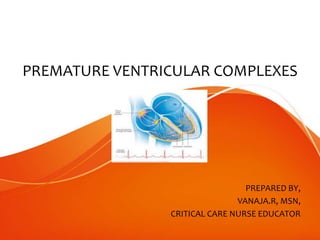
• The rhythm of your heart is normally controlled by the sinoatrial (SA)
node — or sinus node — an area of specialized cells in the right atrium.
• This natural pacemaker produces the electrical impulses that trigger the
normal heartbeat. From the sinus node, electrical impulses travel across
the atria to the ventricles, causing them to contract and pump blood to
your lungs and body.
• PVCs are abnormal contractions that begin in the ventricles. These extra
contractions usually beat sooner than the next expected regular
heartbeat. And they often interrupt the normal order of pumping,
which is the atria first, then the ventricles.
CAUSES
following can increase your risk of PVCs:
• Caffeine , tobacco, alcohol and illicit drugs
• Exercise — if you have certain types of PVCs
• High blood pressure (hypertension)
• Anxiety
• Heart disease, including congenital heart disease, coronary artery
disease, heart attack, heart failure and a weakened heart muscle
(cardiomyopathy)
TYPES OF PVC
Classification
PVCs may be either:
• Unifocal — arising from a single ectopic focus; each PVC is identical
• Multifocal — arising from two or more ectopic foci; multiple QRS
morphologies
• The origin of each PVC can be discerned from the QRS morphology:
• PVCs arising from the right ventricle have a left bundle branch block
morphology (dominant S wave in V1)
• PVCs arising from the left ventricle have a right bundle branch block
morphology (dominant R wave in V1)
Classification
PVCs often occur in repeating patterns:
• Bigeminy — every other beat is a PVC
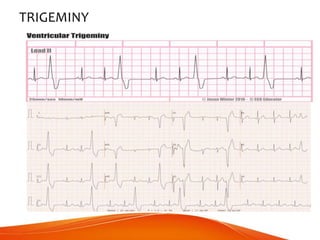
• Trigeminy — every third beat is a PVC
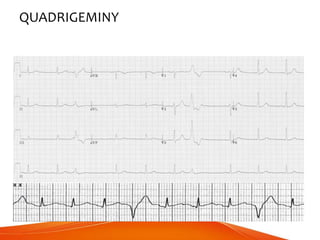
• Quadrigeminy — every fourth beat is a PVC
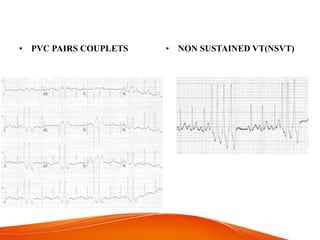
• Couplet — two consecutive PVCs
• NSVT — between three and thirty consecutive PVCs (see below)
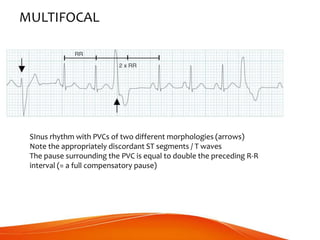
MULTIFOCAL
SInus rhythm with PVCs of two different morphologies (arrows)
Note the appropriately discordant ST segments / T waves
The pause surrounding the PVC is equal to double the preceding R-R
interval (= a full compensatory pause)
BIGEMINY
TRIGEMINY
QUADRIGEMINY
• PVC PAIRS COUPLETS • NON SUSTAINED VT(NSVT)
Characteristics of VPB
The characteristics of VPBs that confer poor prognosis include:
• An "arrhythmic burden" with VPBs more than 500 in 24 hours on Holter
monitoring
• VPBs morphologies with LBBB or RBBB
• VPBs with intermediate or superior axis and wide QRS complexes
• Short-coupled VPBs
• VPBs superimposed on preceding T-waves
• VPBs induced by adrenergic stimulation
Management
• Life style management
• Antiarrythmic drugs(ex: cardrone)
• Conservative treatment
• Ablation therapy
Complications
• Frequent VPBs are often associated with complications if
remained unattended, which include;
• Left ventricular dysfunction
• Dilated cardiomyopathy
• Sustained Ventricular tachycardia
• Sudden cardiac arrest
Pre mature ventricular complex

Pre mature ventricular complex

  • 1.
    PREMATURE VENTRICULAR COMPLEXES PREPAREDBY, VANAJA.R, MSN, CRITICAL CARE NURSE EDUCATOR
  • 2.
    INTRODUCTION • Premature ventricularcontractions (PVCs) are extra heartbeats that begin in one of your heart's two lower pumping chambers (ventricles). These extra beats disrupt your regular heart rhythm, sometimes causing you to feel a fluttering or a skipped beat in your chest. • If you have occasional premature ventricular contractions, but you're otherwise healthy, there's probably no reason for concern, and no need for treatment. If you have frequent premature ventricular contractions or underlying heart disease, you might need treatment.
  • 3.
    • OVERVIEW • Prematureventricular contractions are common — they occur in many people. They're also called: • Premature ventricular complexes • Ventricular premature beats • Ventricular extrasystoles
  • 4.
    PATHOPHYSIOLOGY • The rhythmof your heart is normally controlled by the sinoatrial (SA) node — or sinus node — an area of specialized cells in the right atrium. • This natural pacemaker produces the electrical impulses that trigger the normal heartbeat. From the sinus node, electrical impulses travel across the atria to the ventricles, causing them to contract and pump blood to your lungs and body. • PVCs are abnormal contractions that begin in the ventricles. These extra contractions usually beat sooner than the next expected regular heartbeat. And they often interrupt the normal order of pumping, which is the atria first, then the ventricles.
  • 5.
    CAUSES following can increaseyour risk of PVCs: • Caffeine , tobacco, alcohol and illicit drugs • Exercise — if you have certain types of PVCs • High blood pressure (hypertension) • Anxiety • Heart disease, including congenital heart disease, coronary artery disease, heart attack, heart failure and a weakened heart muscle (cardiomyopathy)
  • 6.
    TYPES OF PVC Classification PVCsmay be either: • Unifocal — arising from a single ectopic focus; each PVC is identical • Multifocal — arising from two or more ectopic foci; multiple QRS morphologies • The origin of each PVC can be discerned from the QRS morphology: • PVCs arising from the right ventricle have a left bundle branch block morphology (dominant S wave in V1) • PVCs arising from the left ventricle have a right bundle branch block morphology (dominant R wave in V1)
  • 7.
    Classification PVCs often occurin repeating patterns: • Bigeminy — every other beat is a PVC • Trigeminy — every third beat is a PVC • Quadrigeminy — every fourth beat is a PVC • Couplet — two consecutive PVCs • NSVT — between three and thirty consecutive PVCs (see below)
  • 8.
    MULTIFOCAL SInus rhythm withPVCs of two different morphologies (arrows) Note the appropriately discordant ST segments / T waves The pause surrounding the PVC is equal to double the preceding R-R interval (= a full compensatory pause)
  • 9.
  • 10.
  • 11.
  • 12.
    • PVC PAIRSCOUPLETS • NON SUSTAINED VT(NSVT)
  • 13.
    Characteristics of VPB Thecharacteristics of VPBs that confer poor prognosis include: • An "arrhythmic burden" with VPBs more than 500 in 24 hours on Holter monitoring • VPBs morphologies with LBBB or RBBB • VPBs with intermediate or superior axis and wide QRS complexes • Short-coupled VPBs • VPBs superimposed on preceding T-waves • VPBs induced by adrenergic stimulation
  • 14.
    Management • Life stylemanagement • Antiarrythmic drugs(ex: cardrone) • Conservative treatment • Ablation therapy
  • 15.
    Complications • Frequent VPBsare often associated with complications if remained unattended, which include; • Left ventricular dysfunction • Dilated cardiomyopathy • Sustained Ventricular tachycardia • Sudden cardiac arrest