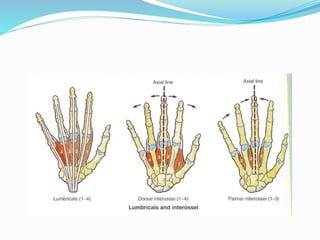
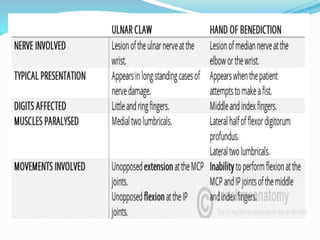
DR.PRASHANTH KUMAR
2ND YR PG
Definition
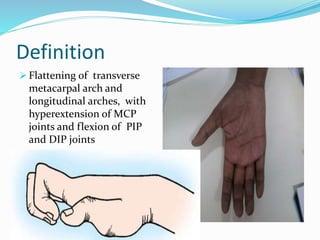
 Flattening of transverse
metacarpal arch and
longitudinal arches, with
hyperextension of MCP
joints and flexion of PIP
and DIP joints
Normal anatomy
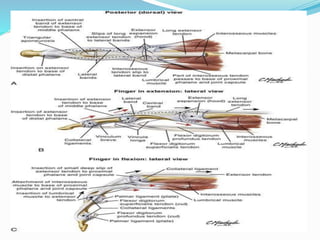
 Movements of MP joints and IP joints independent
 Movements of 2 IP joints coordinated ; flexion of
DIP joint brings about flexion of PIP joint
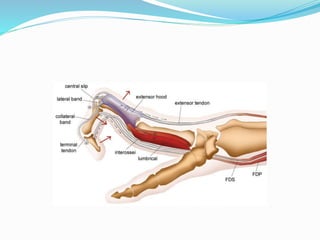
 (1) Flexion of distal phalanx draws dorsal expansion
distally by loosening tension on central tendon
 (2) Flexion of DIP joint tenses oblique retinacular
ligament causing this ligament to slide volarward
and impart flexion force to PIP joint
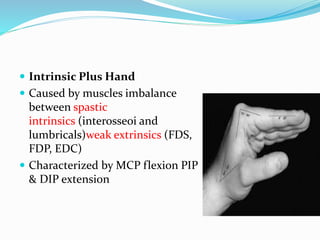
 Intrinsic Plus Hand
 Caused by muscles imbalance
between spastic
intrinsics (interosseoi and
lumbricals)weak extrinsics (FDS,
FDP, EDC)
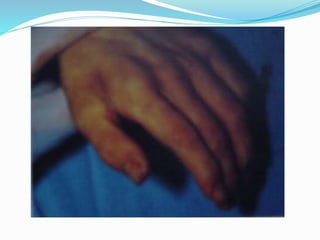
 Characterized by MCP flexion PIP
& DIP extension
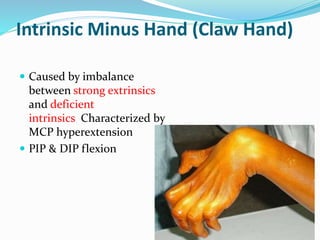
Intrinsic Minus Hand (Claw Hand)
 Caused by imbalance
between strong extrinsics
and deficient
intrinsics Characterized by
MCP hyperextension
 PIP & DIP flexion
Patho-anatomy of deformity
 Paralysis of interossei and lumbricals
Unopposed MCP joint extension & IP joint flexion by
digital extensors & flexors
 Without stabilization of MCP joints in neutral/slight
flexed position, long extensor function “blocked” at
MP joint by diversion of this tension to sagittal band,
producing hyperextension and effectively blocking the
extensor's ability to extend PIP joint.‡
 Middle and distal phalanges collapse into flexion
Normal cascade of digital extension disrupted, in that
during any attempt to actively open finger, MP joint
extends first and will extend more than the PIP joint,
 Normal sequence of digital closure also reversed, in
that IP joint flexion precedes MP joint flexion
 Independence of MP and IP joint motion lost
Claw thumb in Ulnar palsy
 CMC joint affected by paralysis of adductor pollicis,
FPB, and first dorsal interosseous
 MP and IP joints of thumb under control of extrinsic
flexors and extensors, with proximal phalanx
behaving like intercalated bone.
MP joint will go into hyperextension and IP joint into
flexion because of the greater extensor moment at the
MP joint and the lesser extensor moment at the IP
joint, respectively.
 “Z”-thumb deformity
Types of claw hand
 Complete : Involving all digits and resulting from
combined Ulnar and Median Nerve palsy
 Incomplete : Involving only ulnar 2 digits as in
isolated Ulnar Nerve palsy
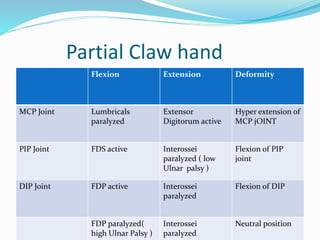
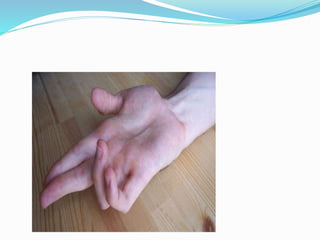
Partial Claw hand
Flexion Extension Deformity
MCP Joint Lumbricals
paralyzed
Extensor
Digitorum active
Hyper extension of
MCP jOINT
PIP Joint FDS active Interossei
paralyzed ( low
Ulnar palsy )
Flexion of PIP
joint
DIP Joint FDP active Interossei
paralyzed
Flexion of DIP
FDP paralyzed(
high Ulnar Palsy )
Interossei
paralyzed
Neutral position
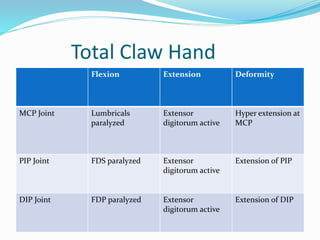
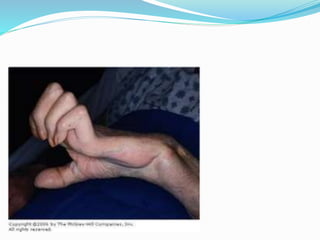
Total Claw Hand
Flexion Extension Deformity
MCP Joint Lumbricals
paralyzed
Extensor
digitorum active
Hyper extension at
MCP
PIP Joint FDS paralyzed Extensor
digitorum active
Extension of PIP
DIP Joint FDP paralyzed Extensor
digitorum active
Extension of DIP
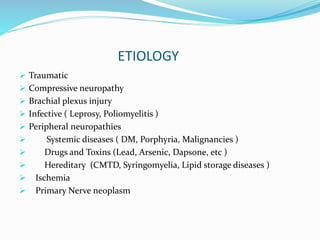
ETIOLOGY
 Traumatic
 Compressive neuropathy
 Brachial plexus injury
 Infective ( Leprosy, Poliomyelitis )
 Peripheral neuropathies
 Systemic diseases ( DM, Porphyria, Malignancies )
 Drugs and Toxins (Lead, Arsenic, Dapsone, etc )
 Hereditary (CMTD, Syringomyelia, Lipid storage diseases )
 Ischemia
 Primary Nerve neoplasm
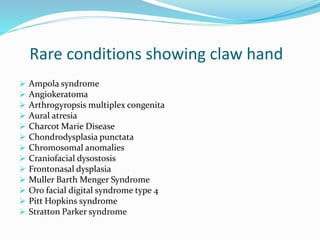
Rare conditions showing claw hand
 Ampola syndrome
 Angiokeratoma
 Arthrogyropsis multiplex congenita
 Aural atresia
 Charcot Marie Disease
 Chondrodysplasia punctata
 Chromosomal anomalies
 Craniofacial dysostosis
 Frontonasal dysplasia
 Muller Barth Menger Syndrome
 Oro facial digital syndrome type 4
 Pitt Hopkins syndrome
 Stratton Parker syndrome
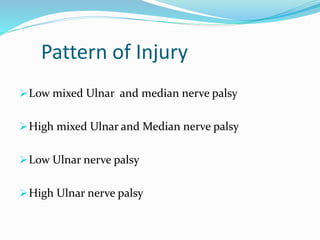
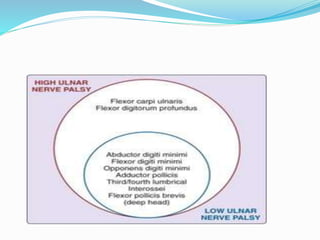
Pattern of Injury
Low mixed Ulnar and median nerve palsy
High mixed Ulnar and Median nerve palsy
Low Ulnar nerve palsy
High Ulnar nerve palsy
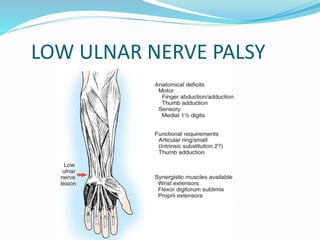
LOW ULNAR NERVE PALSY
Evaluation for Surgical Reconstruction
Specific signs and tests for motor dysfunction
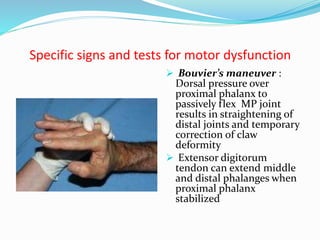
 Bouvier’s maneuver :
Dorsal pressure over
proximal phalanx to
passively flex MP joint
results in straightening of
distal joints and temporary
correction of claw
deformity
 Extensor digitorum
tendon can extend middle
and distal phalanges when
proximal phalanx
stabilized
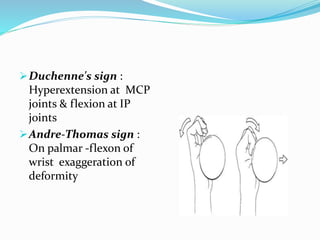
Duchenne's sign :
Hyperextension at MCP
joints & flexion at IP
joints
Andre-Thomas sign :
On palmar -flexon of
wrist exaggeration of
deformity
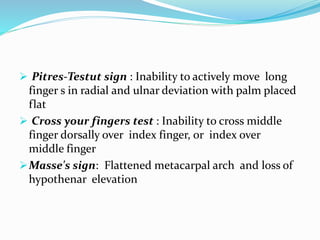
 Pitres-Testut sign : Inability to actively move long
finger s in radial and ulnar deviation with palm placed
flat
 Cross your fingers test : Inability to cross middle
finger dorsally over index finger, or index over
middle finger
Masse's sign: Flattened metacarpal arch and loss of
hypothenar elevation
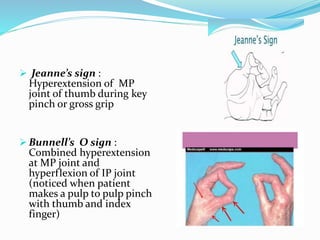
 Jeanne’s sign :
Hyperextension of MP
joint of thumb during key
pinch or gross grip
 Bunnell’s O sign :
Combined hyperextension
at MP joint and
hyperflexion of IP joint
(noticed when patient
makes a pulp to pulp pinch
with thumb and index
finger)
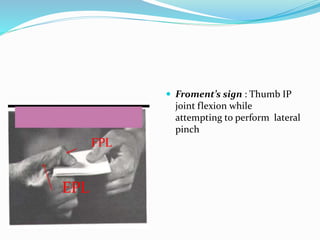
FPL
EPL
 Froment’s sign : Thumb IP
joint flexion while
attempting to perform lateral
pinch
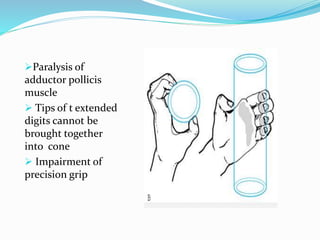
Paralysis of
adductor pollicis
muscle
 Tips of t extended
digits cannot be
brought together
into cone
 Impairment of
precision grip
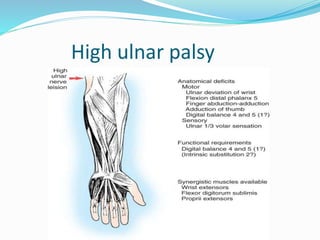
High ulnar palsy
 Pollock's sign : Inability to flex distal phalanges of
ring and little fingers
 Partial loss of wrist flexion may occur because of
paralysis of FCU
Weakness of ulnar side grip
PREOPERATIVE ANGLE MEASUREMENTS
 Measured at PIP joint of each finger and IP joint of thumb
using a goniometer placed on dorsal aspect of joint
 Unassisted angle : Maintain “lumbrical-plus” position of
MP flexion and IP extension, and extension deficit at PIP
joint measured
 Assisted angle : Proximal segment of finger supported to
maintain flexion at the MP joint and instructs the patient
to extend IP joints ;In absence of contracture of IP joints,
this angle o
 Contracture angle : Incomplete passive extension
,contracture with deficiency of volar skin and volar plate
and/or capsule PIP joint
 Adaptive shortening angle of extrinsic flexors :
Habitual posturing of wrist in flexion to minimize the claw
deformity ; increased angulation at PIP joint as wrist is
passively moved into extension
 Hypermobile angle: Ligamentous laxity ; hypermobile
jointswith passive hyperextension of PIP joints > 20
CLASSIFICATION OF PARALYTIC CLAW HANDS
 Type I: Supple claw hands with no hypermobile joints
and no contractures at IP joints
 Type II: Hypermobile joints; PIP joints hyperextension >
20 degrees
 Type III: Mobile joints in association with adaptive
shortening of long flexors, usually superficialis tendons ,
with no IP joint contracture
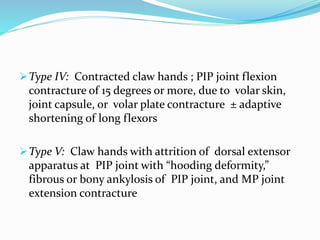
Type IV: Contracted claw hands ; PIP joint flexion
contracture of 15 degrees or more, due to volar skin,
joint capsule, or volar plate contracture ± adaptive
shortening of long flexors
Type V: Claw hands with attrition of dorsal extensor
apparatus at PIP joint with “hooding deformity,”
fibrous or bony ankylosis of PIP joint, and MP joint
extension contracture
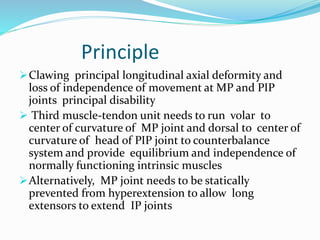
Principle
Clawing principal longitudinal axial deformity and
loss of independence of movement at MP and PIP
joints principal disability
 Third muscle-tendon unit needs to run volar to
center of curvature of MP joint and dorsal to center of
curvature of head of PIP joint to counterbalance
system and provide equilibrium and independence of
normally functioning intrinsic muscles
Alternatively, MP joint needs to be statically
prevented from hyperextension to allow long
extensors to extend IP joints
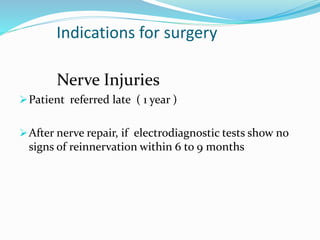
Indications for surgery
Nerve Injuries
Patient referred late ( 1 year )
After nerve repair, if electrodiagnostic tests show no
signs of reinnervation within 6 to 9 months
Leprosy
 Understanding of stage and activity of disease, presence of
intact, healthy skin, patient motivation.*
 Recommended when
 patient's medical treatment optimized
 skin smears for the bacillus negative
 bacteriological index negative on two successive tests
 disease activity quiescent for at least a year before date of
intended surgery,
 paralysis established
 patient free of corticosteroid treatment for several months
before surgery
Poliomyelitis
 Ulnar innervated lumbricals can be paralyzed,
sparing a part of or whole of interosseous muscles or
vice versa
 Paralysis typically nonprogressive and with no loss of
sensation
Children affected, and joints hypermobile
 Surgery be delayed until child is at least 5 years of
age, so that child will be able to cooperate with
postoperative re-education program
Appropriate use of splints, fabricated for each patient
and altered or changed whenever indicated can help to
manage claw deformity
Splints interfere with rehabilitation of sensibility and
are generally used intermittently
Tendon transfers
Principles and biomechanics
 Homeostasis of involved extremity established *
 Soft tissues free of scar contracture
 Vascularity of extremity adequate
 Chronic wounds fully settled for 3 months before surgery
 Proper physiotherapy, occupational therapy and splinting
 Mobile joints and correct alignment of bone
 Power of transferred muscle : Good or normal (4 or 5)
 Muscle should be expendable
 Synergestic muscles
 Path of Tendon: Best in straight line; If change in direction
necessary - Pulley
Absolute contraindication: Non-compliant patient
with poor motivation who will not follow appropriate
postop rehabilitation
Internal splints (Early Tendon Transfers)
 Allow early function of hand while awaiting nerve
regeneration
 Can prevent deformities that lead to contractures
 Improve coordination of residual muscle-tendon
units
 Stimulate sensory re-education during nerve recovery
Inhibition of trick movements
Functions as internal splints for paralyzed muscles
 In the event of a failure of nerve recovery will remain
and function as a permanent solution
 Proximal phalanx flexion for ring and little
fingers : Ulnar half of FDSR with split insertion to
ring and little fingers to lateral band of DEE or A1, A2,
or A1 + A2a pulleys
 Restoration of transverse metacarpal arch and
adduction of little finger : FDSR Y insertion
Thumb adduction for key pinch : FDSR radial half
to abductor tubercle, FDSL to hypothenar insertion,
near fifth MP joint
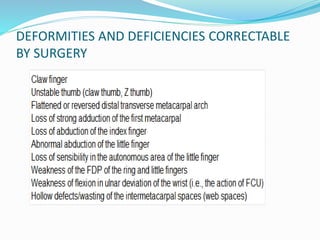
DEFORMITIES AND DEFICIENCIES CORRECTABLE
BY SURGERY
METHODS OF CLAW HAND RECONSTRUCTION
 Static and Dynamic procedures

Static procedures :
 To maintain MP joint in some degree of flexion or to limit
MP joint hyperextension
 claw posture reversed by functioning long extensors
 Flexion of MP joint unrestricted in static procedures
 Disadvantages : restore normal finger coordination
and sequence but do not provide an additional motor to
restore MP flexion.
 Recurrence : rule unless there is radical change in
patient's work style and paralyzed hand more protected
than used
Proximal Phalangeal Flexion Static Techniques
 Flexor Pulley Advancement ( Bunnell )*
 Each side of proximal pulley system split 1.5 to 2.5 cm
up to middle of the proximal phalanx.
 Flexor tendons then “bow string,” to bring about flexion
at MP joint
 Fasciodermadesis ( Zancolli )‡
 Excision of 2 cm of the palmar skin (dermadesis) at MP
joint level combined with shortening of pretendinous
band of palmar aponeurosis (fasciodermadesis) to correct
claw hands with weak extensors
Zancolli
Capsulodesis
Volar MP joint Capsulodesis
 A1 pulley release with MP
joint volar plate advancement
 Complicated claw hands
with MP joint contracture
Zancolli incorporated collateral
ligament release on both sides
of MP joint with volar
capsuloplasty
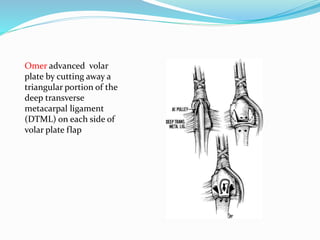
Omer advanced volar
plate by cutting away a
triangular portion of the
deep transverse
metacarpal ligament
(DTML) on each side of
volar plate flap
Dorsal Methods (Howard; Mikhail)
To provide bony block to proximal phalangeal
extension
Enables long extensors to extend IP joints and correct
deformity.
Mikhail inserted bone block on dorsum of the
metacarpal head
Howard suggested elevation of bone wedge as block
from the dorsal aspect of the metacarpal head itself
Static Tenodesis Techniques
 Riordan
One half of ECRL and ECU tendons made use of
as “grafts” to prevent hyperextension of MP joint while
remaining half continue to actively extend wrist
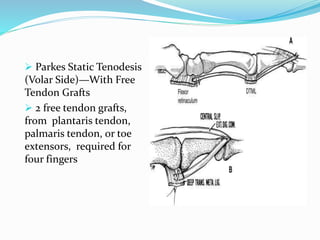
 Parkes Static Tenodesis
(Volar Side)—With Free
Tendon Grafts
 2 free tendon grafts,
from plantaris tendon,
palmaris tendon, or toe
extensors, required for
four fingers
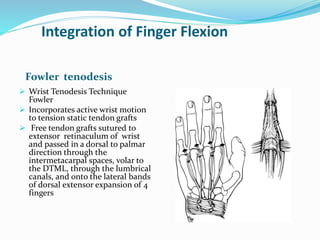
Integration of Finger Flexion
Fowler tenodesis
 Wrist Tenodesis Technique
Fowler
 Incorporates active wrist motion
to tension static tendon grafts
 Free tendon grafts sutured to
extensor retinaculum of wrist
and passed in a dorsal to palmar
direction through the
intermetacarpal spaces, volar to
the DTML, through the lumbrical
canals, and onto the lateral bands
of dorsal extensor expansion of 4
fingers
Dynamic Tendon Transfers
First reported by Sir Harold Stiles and Forrester-Brown
in 1922
 By passing tendon graft slips volar to deep transverse
metacarpal ligament and into lateral band of dorsal
extensor apparatus, procedure designed to improve
synchronous motion of the finger joints and duplicate
lumbrical muscle action
Transfer of Extrinsic Finger Flexors
Superficialis Tendon Transfer Techniques and
Modifications (Stiles; Bunnell; Littler)
 FDS detached , splitted, & transferred to dorsum of
fingers to extensors tendons
 Removes powerful flexor of PIP joint & converts it into
extensor
 Intrinsic plus deformity
 Bunnell (1942) : rerouted both slips of all superficialis tendons through
lumbrical canals and anchored them to both sides of lateral band of
dorsal extensor expansion (Stiles-Bunnell procedure)
 Transfer involved passage of
 Split FDSI for radial side of lateral bands of index and middle
fingers
 Split FDSM for ulnar side lateral band of index, middle, and ring
fingers
 Split FDSR to radial side of ring and little fingers
 Split FDSL to the ulnar side of little finger
Disadvantages
 PIP flexion contractures and DIP extension lag in donor
finger most frequent when superficialis removed through
conventional midlateral approach
 Midlateral approach exposed distal part of lateral band to
injury and contributed to DIP extension lag
 High incidence of swan neck deformity in one or more of
operated fingers owing to excessive tension on transferred
tendon slip
 Loss of PIP joint flexion due to adhesions between
profundus and superficialis tendon remnant
To prevent these complications, North and Littler :
removal of superficialis through volar incision
between A1 and A2 pulleys
Brand :
 Ulnar nerve palsy results in claw deformities in all
four fingers, Weakness is not limited only to fingers
with obvious clawing.
Recommendation : surgery be done in all fingers of a
claw hand
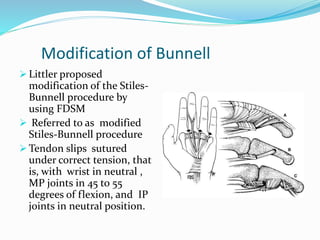
Modification of Bunnell
 Littler proposed
modification of the Stiles-
Bunnell procedure by
using FDSM
 Referred to as modified
Stiles-Bunnell procedure
 Tendon slips sutured
under correct tension, that
is, with wrist in neutral ,
MP joints in 45 to 55
degrees of flexion, and IP
joints in neutral position.
4 primary insertion sites of FDS are
classified as:
A. Lateral band insertion—intrinsic replacement (Stiles and
Forrester-Brown , Bunnell , Littler , Brand , Riordan ,
Lennox-Fritschi )
B. Phalangeal insertion (Burkhalter )
C. Pulley insertion (Riordan , Zancolli , Brooks and Jones ,
Anderson )
D. Interosseous insertion (Zancolli , Palande , Anderson )
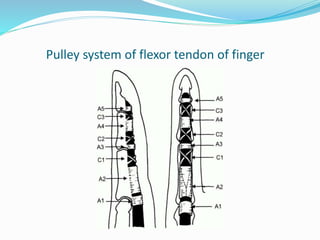
Pulley system of flexor tendon of finger
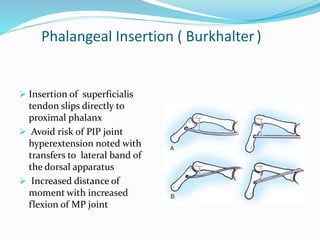
Phalangeal Insertion ( Burkhalter)
 Insertion of superficialis
tendon slips directly to
proximal phalanx
 Avoid risk of PIP joint
hyperextension noted with
transfers to lateral band of
the dorsal apparatus
 Increased distance of
moment with increased
flexion of MP joint
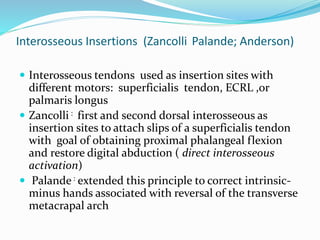
Interosseous Insertions (Zancolli Palande; Anderson)
 Interosseous tendons used as insertion sites with
different motors: superficialis tendon, ECRL ,or
palmaris longus
 Zancolli : first and second dorsal interosseous as
insertion sites to attach slips of a superficialis tendon
with goal of obtaining proximal phalangeal flexion
and restore digital abduction ( direct interosseous
activation)
 Palande: extended this principle to correct intrinsic-
minus hands associated with reversal of the transverse
metacrapal arch
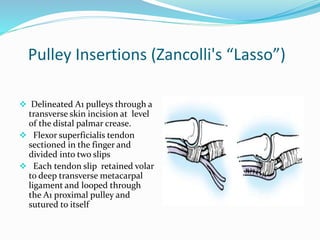
Pulley Insertions (Zancolli's “Lasso”)
 Delineated A1 pulleys through a
transverse skin incision at level
of the distal palmar crease.
 Flexor superficialis tendon
sectioned in the finger and
divided into two slips
 Each tendon slip retained volar
to deep transverse metacarpal
ligament and looped through
the A1 proximal pulley and
sutured to itself
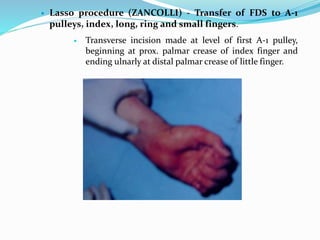
 Lasso procedure (ZANCOLLI) - Transfer of FDS to A-1
pulleys, index, long, ring and small fingers.
 Transverse incision made at level of first A-1 pulley,
beginning at prox. palmar crease of index finger and
ending ulnarly at distal palmar crease of little finger.
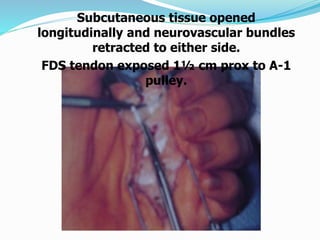
Subcutaneous tissue opened
longitudinally and neurovascular bundles
retracted to either side.
FDS tendon exposed 1½ cm prox to A-1
pulley.
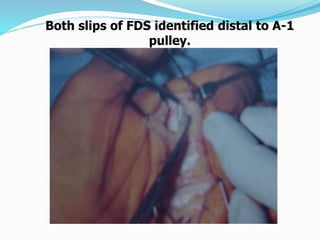
Both slips of FDS identified distal to A-1
pulley.
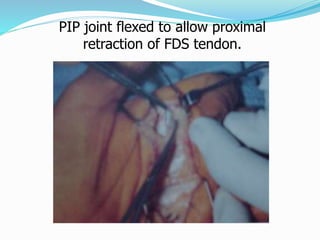
PIP joint flexed to allow proximal
retraction of FDS tendon.
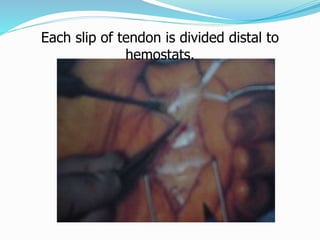
Each slip of tendon is divided distal to
hemostats.
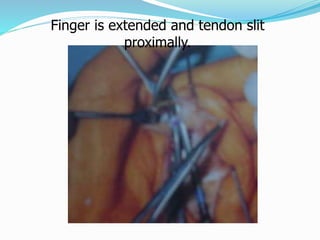
Finger is extended and tendon slit
proximally.
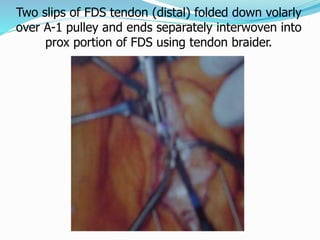
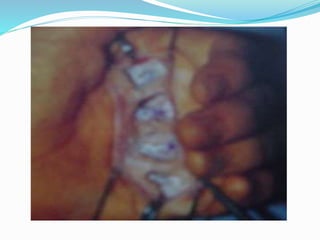
Two slips of FDS tendon (distal) folded down volarly
over A-1 pulley and ends separately interwoven into
prox portion of FDS using tendon braider.
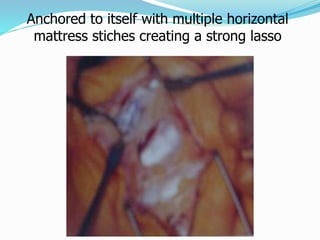
Anchored to itself with multiple horizontal
mattress stiches creating a strong lasso
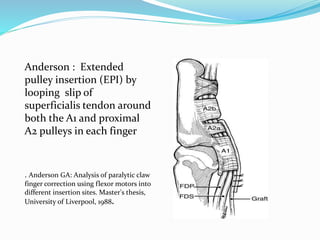
Anderson : Extended
pulley insertion (EPI) by
looping slip of
superficialis tendon around
both the A1 and proximal
A2 pulleys in each finger
. Anderson GA: Analysis of paralytic claw
finger correction using flexor motors into
different insertion sites. Master's thesis,
University of Liverpool, 1988.
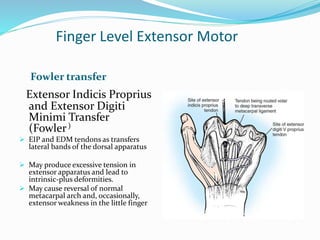
Finger Level Extensor Motor
Fowler transfer
Extensor Indicis Proprius
and Extensor Digiti
Minimi Transfer
(Fowler)
 EIP and EDM tendons as transfers
lateral bands of the dorsal apparatus
 May produce excessive tension in
extensor apparatus and lead to
intrinsic-plus deformities.
 May cause reversal of normal
metacarpal arch and, occasionally,
extensor weakness in the little finger
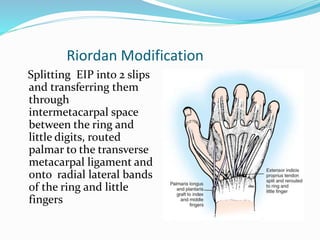
Riordan Modification
Splitting EIP into 2 slips
and transferring them
through
intermetacarpal space
between the ring and
little digits, routed
palmar to the transverse
metacarpal ligament and
onto radial lateral bands
of the ring and little
fingers
Wrist-Level Motors for Proximal Phalanx Power and Integration of
Finger Flexion (Brand; Burkhalter; Brooks; Fowler; Riordan)
To simultaneously correct claw deformity and gain
grip strength, add additional muscle-tendon unit to
power train for flexion of proximal phalanx
Best achieved by transferring wrist motor or
brachioradialis to flex proximal phalanges
Require free grafts to provide sufficient length to reach
insertion site( plantaris, palmaris, fascia lata, or toe
extensors)
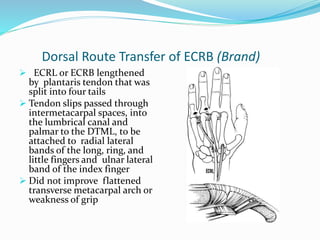
Dorsal Route Transfer of ECRB (Brand)
 ECRL or ECRB lengthened
by plantaris tendon that was
split into four tails
 Tendon slips passed through
intermetacarpal spaces, into
the lumbrical canal and
palmar to the DTML, to be
attached to radial lateral
bands of the long, ring, and
little fingers and ulnar lateral
band of the index finger
 Did not improve flattened
transverse metacarpal arch or
weakness of grip
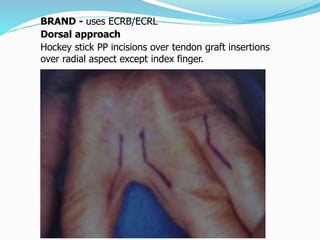
BRAND - uses ECRB/ECRL
Dorsal approach
Hockey stick PP incisions over tendon graft insertions
over radial aspect except index finger.
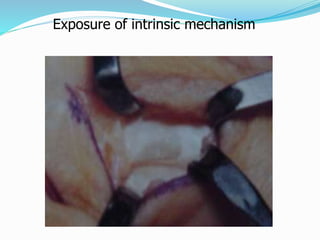
Exposure of intrinsic mechanism
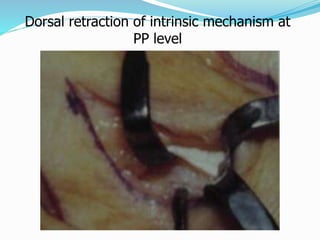
Dorsal retraction of intrinsic mechanism at
PP level
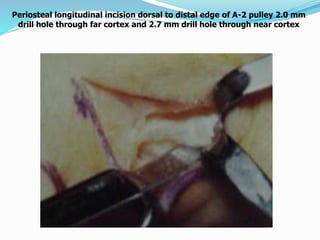
Periosteal longitudinal incision dorsal to distal edge of A-2 pulley 2.0 mm
drill hole through far cortex and 2.7 mm drill hole through near cortex
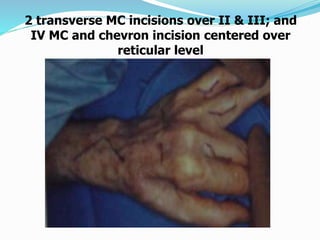
2 transverse MC incisions over II & III; and
IV MC and chevron incision centered over
reticular level
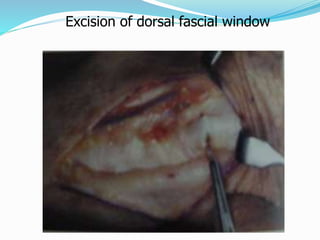
Excision of dorsal fascial window
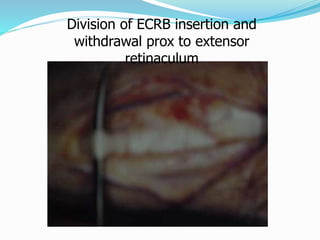
Division of ECRB insertion and
withdrawal prox to extensor
retinaculum
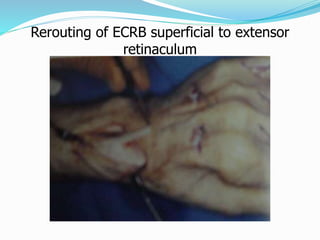
Rerouting of ECRB superficial to extensor
retinaculum
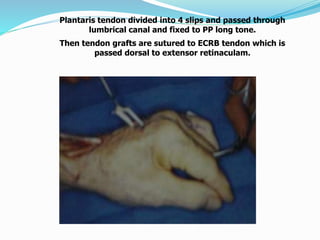
Plantaris tendon divided into 4 slips and passed through
lumbrical canal and fixed to PP long tone.
Then tendon grafts are sutured to ECRB tendon which is
passed dorsal to extensor retinaculam.
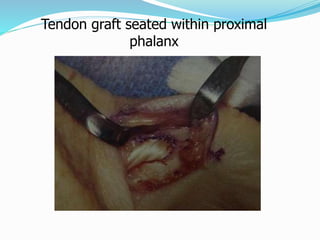
Tendon graft seated within proximal
phalanx
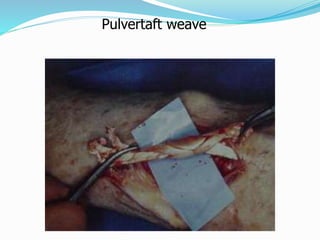
Pulvertaft weave
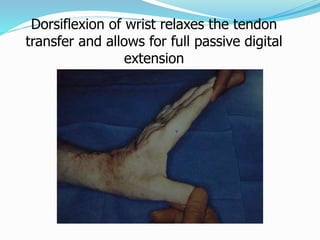
Dorsiflexion of wrist relaxes the tendon
transfer and allows for full passive digital
extension
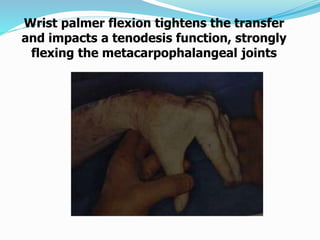
Wrist palmer flexion tightens the transfer
and impacts a tenodesis function, strongly
flexing the metacarpophalangeal joints
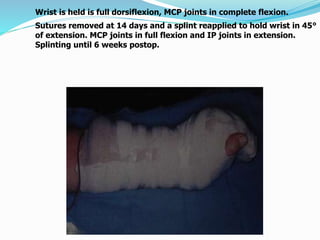
Wrist is held is full dorsiflexion, MCP joints in complete flexion.
Sutures removed at 14 days and a splint reapplied to hold wrist in 45°
of extension. MCP joints in full flexion and IP joints in extension.
Splinting until 6 weeks postop.
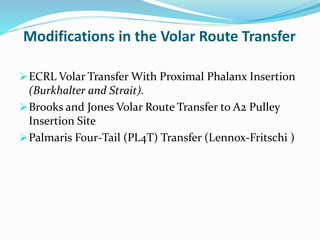
Modifications in the Volar Route Transfer
ECRL Volar Transfer With Proximal Phalanx Insertion
(Burkhalter and Strait).
Brooks and Jones Volar Route Transfer to A2 Pulley
Insertion Site
Palmaris Four-Tail (PL4T) Transfer (Lennox-Fritschi )
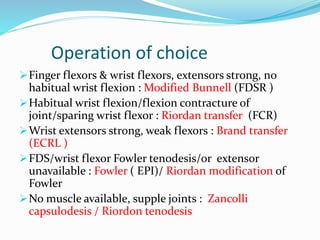
Operation of choice
Finger flexors & wrist flexors, extensors strong, no
habitual wrist flexion : Modified Bunnell (FDSR )
Habitual wrist flexion/flexion contracture of
joint/sparing wrist flexor : Riordan transfer (FCR)
Wrist extensors strong, weak flexors : Brand transfer
(ECRL )
FDS/wrist flexor Fowler tenodesis/or extensor
unavailable : Fowler ( EPI)/ Riordan modification of
Fowler
No muscle available, supple joints : Zancolli
capsulodesis / Riordon tenodesis
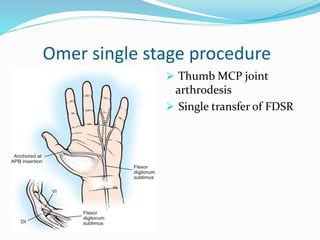
Omer single stage procedure
 Thumb MCP joint
arthrodesis
 Single transfer of FDSR
Postoperative Hand Therapy for Claw Correction
 In first week patient supervised to attain and maintain
lumbrical-plus position and use a thermoplastic splint
between exercises
 Over next 7 to 10 days active IP joint flexion begun while
MP joints remain in flexion
 At no point during first and second stages patient
allowed to extend MP joints
 During third stage patient encouraged to maintain IP
joint in absolute neutral extension and then extend MP
joints
 Exercises at this stage combined with supervised light
functional activities that encourage lumbrical posture
Thumb Adduction Techniques
 Adduction of thumb necessary for strong pinch
 Adductor pollicis paralyzed
Brachioradialis (Boyes)
FDSR ( Brand)
FDSR (Royle –Thompson )
FDSM as Motor With Dual Insertion to the Thumb
(Goldner)
ECRB (Smith)
Combination of EI and ED (Little) Tendon Transfers for
Pinch (Robinson et al)
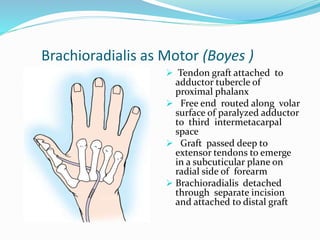
Brachioradialis as Motor (Boyes )
 Tendon graft attached to
adductor tubercle of
proximal phalanx
 Free end routed along volar
surface of paralyzed adductor
to third intermetacarpal
space
 Graft passed deep to
extensor tendons to emerge
in a subcuticular plane on
radial side of forearm
 Brachioradialis detached
through separate incision
and attached to distal graft
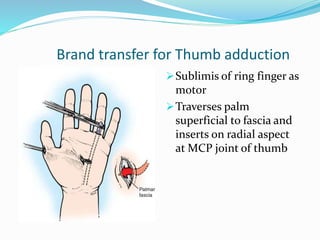
Brand transfer for Thumb adduction
Sublimis of ring finger as
motor
Traverses palm
superficial to fascia and
inserts on radial aspect
at MCP joint of thumb
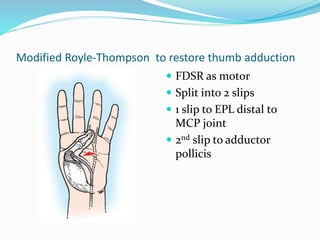
Modified Royle-Thompson to restore thumb adduction
 FDSR as motor
 Split into 2 slips
 1 slip to EPL distal to
MCP joint
 2nd slip to adductor
pollicis
Restoration of Index Abduction
 Thumb more important in pinch , but index finger needs
to be stabilized to provide effective pinch
 For tip pinch, index finger in abduction and slight radial
rotation
 Provides substitute for first dorsal interosseous muscle
Accessory Slip of APL Transfer (Neviaser et al )
 EIP to first dorsal interosseous muscle (Bunnell)
Extensor Pollicis Brevis (EPB) Transfer
Palmaris Longus to the First Dorsal Interosseous
FDSR Transfer (Graham and Riordan)
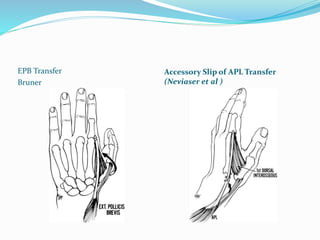
EPB Transfer
Bruner
Accessory Slip of APL Transfer
(Neviaser et al )
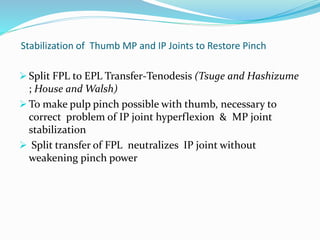
Stabilization of Thumb MP and IP Joints to Restore Pinch
 Split FPL to EPL Transfer-Tenodesis (Tsuge and Hashizume
; House and Walsh)
 To make pulp pinch possible with thumb, necessary to
correct problem of IP joint hyperflexion & MP joint
stabilization
 Split transfer of FPL neutralizes IP joint without
weakening pinch power
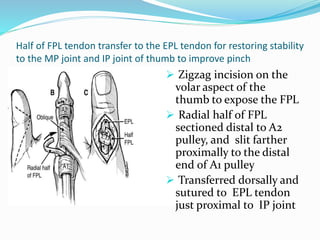
Half of FPL tendon transfer to the EPL tendon for restoring stability
to the MP joint and IP joint of thumb to improve pinch
 Zigzag incision on the
volar aspect of the
thumb to expose the FPL
 Radial half of FPL
sectioned distal to A2
pulley, and slit farther
proximally to the distal
end of A1 pulley
 Transferred dorsally and
sutured to EPL tendon
just proximal to IP joint
Arthrodesis of Thumb Joints
 Stabilizes key pinch and improve tip pinch
 Simultaneously restore complex flexor-pronator
function of FPB and adductor-supinator function of
adductor pollicis with tendon transfers
Enable extrinsic flexor and extensors to better stabilize
remaining joint
 Fixed deformity of remaining joint ia contraindication
for arthrodesis of either one
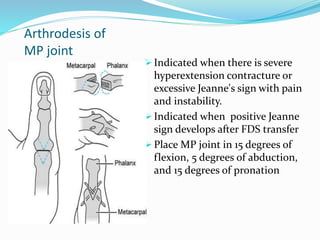
Arthrodesis of
MP joint
 Indicated when there is severe
hyperextension contracture or
excessive Jeanne's sign with pain
and instability.
 Indicated when positive Jeanne
sign develops after FDS transfer
 Place MP joint in 15 degrees of
flexion, 5 degrees of abduction,
and 15 degrees of pronation
RESTORATION OF TRANSVERSE METACARPAL ARCH
 Normal stability of distal transverse metacarpal arch
lost owing to paralysis of the interossei, and the
hypothenar muscles
 Metacarpals remain together as though held by
transverse sling, strong deep transverse metacarpal
ligaments, while fingers are in collapsed state
Abolishes ability of palsied hand to contour itself
around object placed within its domain
Simple act of opening lid of a jar or turning a valve
becomes clumsy and palm is unable to be “cupped” to
hold fluid, gather grain, or mold dough.
 Even claw hand corrected by lumbrical replacement
procedure likely to recur if transverse metacarpal
arch remains unstable or flat
Bunnell's “Tendon T” Operation
 Littler's Split Superficialis Tendon Procedure
Ranney's EDM Transfer
LITTLE FINGER ABDUCTION (Blacker et al[; Goldner ; Voche and Merle)
EDM has potential to abduct little finger through its
indirect insertion into abductor tubercle on proximal
phalanx.
Third palmar interosseous counters this effect in
normal hands
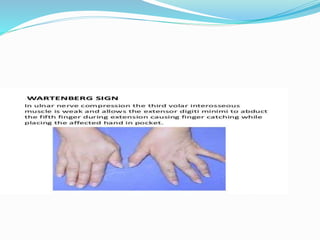
In ulnar nerve palsy intrinsic paralysis leaves the EDM
unopposed (Wartenberg's sign)
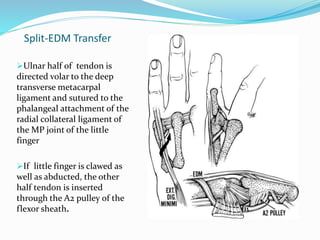
Split-EDM Transfer
Ulnar half of tendon is
directed volar to the deep
transverse metacarpal
ligament and sutured to the
phalangeal attachment of the
radial collateral ligament of
the MP joint of the little
finger
If little finger is clawed as
well as abducted, the other
half tendon is inserted
through the A2 pulley of the
flexor sheath.
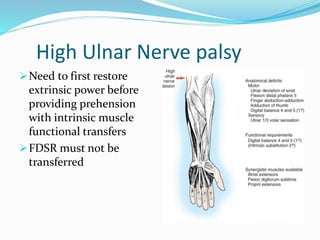
High Ulnar Nerve palsy
Need to first restore
extrinsic power before
providing prehension
with intrinsic muscle
functional transfers
FDSR must not be
transferred
Side-to-side transfer of FDPM to FDPR and FDPL just
proximal to flexor zone V in distal forearm
After 3 weeks of immobilization, muscle strengthening
exercises supervised for next 4 weeks, knuckle bender
splint worn
Palmaris longus to FCU,
in absence of palmaris longus, section ulnar half of
FCR just proximal to wrist crease and split it
proximally for 10 to 12 cm before transferring this to
FCU
RESTORATION OF SENSIBILITY
Loss of sensibility in ulnar border of hand and loss of
proprioception in little finger significant functional
limitations
 Repeated ulceration at tips of digits can lead to
absorption and shortening
In patients who have leprosy, successful medical
treatment does not restore sensation and their
insensate digits remain liability for life
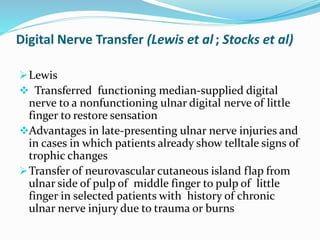
Digital Nerve Transfer (Lewis et al ; Stocks et al)
Lewis
 Transferred functioning median-supplied digital
nerve to a nonfunctioning ulnar digital nerve of little
finger to restore sensation
Advantages in late-presenting ulnar nerve injuries and
in cases in which patients already show telltale signs of
trophic changes
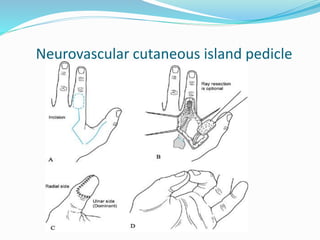
Transfer of neurovascular cutaneous island flap from
ulnar side of pulp of middle finger to pulp of little
finger in selected patients with history of chronic
ulnar nerve injury due to trauma or burns
Neurovascular cutaneous island pedicle
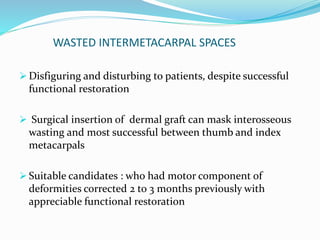
WASTED INTERMETACARPAL SPACES
 Disfiguring and disturbing to patients, despite successful
functional restoration
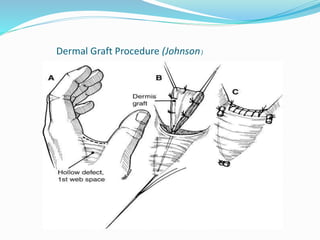
 Surgical insertion of dermal graft can mask interosseous
wasting and most successful between thumb and index
metacarpals
 Suitable candidates : who had motor component of
deformities corrected 2 to 3 months previously with
appreciable functional restoration
Dermal Graft Procedure (Johnson)
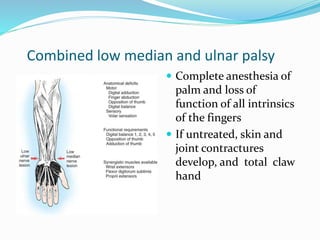
Combined low median and ulnar palsy
 Complete anesthesia of
palm and loss of
function of all intrinsics
of the fingers
 If untreated, skin and
joint contractures
develop, and total claw
hand
Restoration of opposition of thumb
 Necessary for pinch
 Opposition of thumb : abdduction of thumb, flexion of
MCP joint, pronation of thumb,radial deviation of
proximal phalanx of thumb on metacarpal, motion of
thumb towards fingers
 Abductor pollicis brevis
 FDSR ( Riordan, Brand )
 EIP ( Burkhalter)
 FCU +FDSR (Groves and Goldner )
 PL (Camitz )
 Abductor Digiti Quinti ( Huber, Littler )
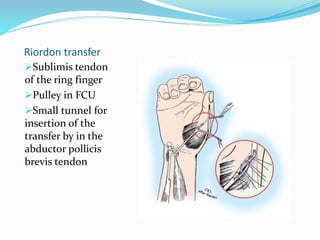
Riordon transfer
Sublimis tendon
of the ring finger
Pulley in FCU
Small tunnel for
insertion of the
transfer by in the
abductor pollicis
brevis tendon
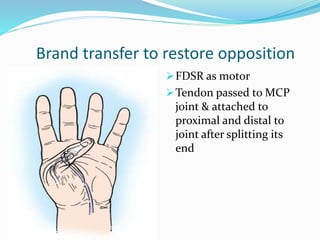
Brand transfer to restore opposition
FDSR as motor
Tendon passed to MCP
joint & attached to
proximal and distal to
joint after splitting its
end
Combined High Median and Ulnar Nerve Palsy
 Entire hand anesthetic except for the dorsal surface
Muscles available for transfer are muscles innervated
by the radial nerve—the brachioradialis, the extensor
carpi radialis brevis, the extensor carpi radialis longus,
the extensor carpi ulnaris, and the extensor indicis
proprius
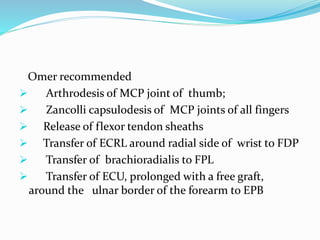
Omer recommended
 Arthrodesis of MCP joint of thumb;
 Zancolli capsulodesis of MCP joints of all fingers
 Release of flexor tendon sheaths
 Transfer of ECRL around radial side of wrist to FDP
 Transfer of brachioradialis to FPL
 Transfer of ECU, prolonged with a free graft,
around the ulnar border of the forearm to EPB
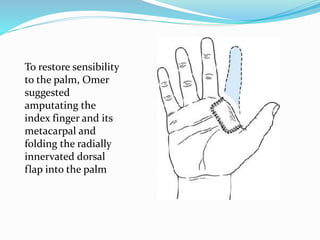
To restore sensibility
to the palm, Omer
suggested
amputating the
index finger and its
metacarpal and
folding the radially
innervated dorsal
flap into the palm
management of claw hand

management of claw hand

  • 1.
  • 2.
    Definition  Flattening oftransverse metacarpal arch and longitudinal arches, with hyperextension of MCP joints and flexion of PIP and DIP joints
  • 3.
    Normal anatomy  Movementsof MP joints and IP joints independent  Movements of 2 IP joints coordinated ; flexion of DIP joint brings about flexion of PIP joint  (1) Flexion of distal phalanx draws dorsal expansion distally by loosening tension on central tendon  (2) Flexion of DIP joint tenses oblique retinacular ligament causing this ligament to slide volarward and impart flexion force to PIP joint
  • 6.
     Intrinsic PlusHand  Caused by muscles imbalance between spastic intrinsics (interosseoi and lumbricals)weak extrinsics (FDS, FDP, EDC)  Characterized by MCP flexion PIP & DIP extension
  • 7.
    Intrinsic Minus Hand(Claw Hand)  Caused by imbalance between strong extrinsics and deficient intrinsics Characterized by MCP hyperextension  PIP & DIP flexion
  • 8.
    Patho-anatomy of deformity Paralysis of interossei and lumbricals Unopposed MCP joint extension & IP joint flexion by digital extensors & flexors  Without stabilization of MCP joints in neutral/slight flexed position, long extensor function “blocked” at MP joint by diversion of this tension to sagittal band, producing hyperextension and effectively blocking the extensor's ability to extend PIP joint.‡
  • 10.
     Middle anddistal phalanges collapse into flexion Normal cascade of digital extension disrupted, in that during any attempt to actively open finger, MP joint extends first and will extend more than the PIP joint,  Normal sequence of digital closure also reversed, in that IP joint flexion precedes MP joint flexion  Independence of MP and IP joint motion lost
  • 11.
    Claw thumb inUlnar palsy  CMC joint affected by paralysis of adductor pollicis, FPB, and first dorsal interosseous  MP and IP joints of thumb under control of extrinsic flexors and extensors, with proximal phalanx behaving like intercalated bone. MP joint will go into hyperextension and IP joint into flexion because of the greater extensor moment at the MP joint and the lesser extensor moment at the IP joint, respectively.  “Z”-thumb deformity
  • 12.
    Types of clawhand  Complete : Involving all digits and resulting from combined Ulnar and Median Nerve palsy  Incomplete : Involving only ulnar 2 digits as in isolated Ulnar Nerve palsy
  • 13.
    Partial Claw hand FlexionExtension Deformity MCP Joint Lumbricals paralyzed Extensor Digitorum active Hyper extension of MCP jOINT PIP Joint FDS active Interossei paralyzed ( low Ulnar palsy ) Flexion of PIP joint DIP Joint FDP active Interossei paralyzed Flexion of DIP FDP paralyzed( high Ulnar Palsy ) Interossei paralyzed Neutral position
  • 15.
    Total Claw Hand FlexionExtension Deformity MCP Joint Lumbricals paralyzed Extensor digitorum active Hyper extension at MCP PIP Joint FDS paralyzed Extensor digitorum active Extension of PIP DIP Joint FDP paralyzed Extensor digitorum active Extension of DIP
  • 18.
    ETIOLOGY  Traumatic  Compressiveneuropathy  Brachial plexus injury  Infective ( Leprosy, Poliomyelitis )  Peripheral neuropathies  Systemic diseases ( DM, Porphyria, Malignancies )  Drugs and Toxins (Lead, Arsenic, Dapsone, etc )  Hereditary (CMTD, Syringomyelia, Lipid storage diseases )  Ischemia  Primary Nerve neoplasm
  • 19.
    Rare conditions showingclaw hand  Ampola syndrome  Angiokeratoma  Arthrogyropsis multiplex congenita  Aural atresia  Charcot Marie Disease  Chondrodysplasia punctata  Chromosomal anomalies  Craniofacial dysostosis  Frontonasal dysplasia  Muller Barth Menger Syndrome  Oro facial digital syndrome type 4  Pitt Hopkins syndrome  Stratton Parker syndrome
  • 20.
    Pattern of Injury Lowmixed Ulnar and median nerve palsy High mixed Ulnar and Median nerve palsy Low Ulnar nerve palsy High Ulnar nerve palsy
  • 21.
  • 22.
  • 23.
    Specific signs andtests for motor dysfunction  Bouvier’s maneuver : Dorsal pressure over proximal phalanx to passively flex MP joint results in straightening of distal joints and temporary correction of claw deformity  Extensor digitorum tendon can extend middle and distal phalanges when proximal phalanx stabilized
  • 24.
    Duchenne's sign : Hyperextensionat MCP joints & flexion at IP joints Andre-Thomas sign : On palmar -flexon of wrist exaggeration of deformity
  • 25.
     Pitres-Testut sign: Inability to actively move long finger s in radial and ulnar deviation with palm placed flat  Cross your fingers test : Inability to cross middle finger dorsally over index finger, or index over middle finger Masse's sign: Flattened metacarpal arch and loss of hypothenar elevation
  • 26.
     Jeanne’s sign: Hyperextension of MP joint of thumb during key pinch or gross grip  Bunnell’s O sign : Combined hyperextension at MP joint and hyperflexion of IP joint (noticed when patient makes a pulp to pulp pinch with thumb and index finger)
  • 27.
    FPL EPL  Froment’s sign: Thumb IP joint flexion while attempting to perform lateral pinch
  • 29.
    Paralysis of adductor pollicis muscle Tips of t extended digits cannot be brought together into cone  Impairment of precision grip
  • 30.
  • 31.
     Pollock's sign: Inability to flex distal phalanges of ring and little fingers  Partial loss of wrist flexion may occur because of paralysis of FCU Weakness of ulnar side grip
  • 33.
    PREOPERATIVE ANGLE MEASUREMENTS Measured at PIP joint of each finger and IP joint of thumb using a goniometer placed on dorsal aspect of joint  Unassisted angle : Maintain “lumbrical-plus” position of MP flexion and IP extension, and extension deficit at PIP joint measured  Assisted angle : Proximal segment of finger supported to maintain flexion at the MP joint and instructs the patient to extend IP joints ;In absence of contracture of IP joints, this angle o
  • 34.
     Contracture angle: Incomplete passive extension ,contracture with deficiency of volar skin and volar plate and/or capsule PIP joint  Adaptive shortening angle of extrinsic flexors : Habitual posturing of wrist in flexion to minimize the claw deformity ; increased angulation at PIP joint as wrist is passively moved into extension  Hypermobile angle: Ligamentous laxity ; hypermobile jointswith passive hyperextension of PIP joints > 20
  • 35.
    CLASSIFICATION OF PARALYTICCLAW HANDS  Type I: Supple claw hands with no hypermobile joints and no contractures at IP joints  Type II: Hypermobile joints; PIP joints hyperextension > 20 degrees  Type III: Mobile joints in association with adaptive shortening of long flexors, usually superficialis tendons , with no IP joint contracture
  • 36.
    Type IV: Contractedclaw hands ; PIP joint flexion contracture of 15 degrees or more, due to volar skin, joint capsule, or volar plate contracture ± adaptive shortening of long flexors Type V: Claw hands with attrition of dorsal extensor apparatus at PIP joint with “hooding deformity,” fibrous or bony ankylosis of PIP joint, and MP joint extension contracture
  • 37.
    Principle Clawing principal longitudinalaxial deformity and loss of independence of movement at MP and PIP joints principal disability  Third muscle-tendon unit needs to run volar to center of curvature of MP joint and dorsal to center of curvature of head of PIP joint to counterbalance system and provide equilibrium and independence of normally functioning intrinsic muscles Alternatively, MP joint needs to be statically prevented from hyperextension to allow long extensors to extend IP joints
  • 38.
    Indications for surgery NerveInjuries Patient referred late ( 1 year ) After nerve repair, if electrodiagnostic tests show no signs of reinnervation within 6 to 9 months
  • 39.
    Leprosy  Understanding ofstage and activity of disease, presence of intact, healthy skin, patient motivation.*  Recommended when  patient's medical treatment optimized  skin smears for the bacillus negative  bacteriological index negative on two successive tests  disease activity quiescent for at least a year before date of intended surgery,  paralysis established  patient free of corticosteroid treatment for several months before surgery
  • 40.
    Poliomyelitis  Ulnar innervatedlumbricals can be paralyzed, sparing a part of or whole of interosseous muscles or vice versa  Paralysis typically nonprogressive and with no loss of sensation Children affected, and joints hypermobile  Surgery be delayed until child is at least 5 years of age, so that child will be able to cooperate with postoperative re-education program
  • 41.
    Appropriate use ofsplints, fabricated for each patient and altered or changed whenever indicated can help to manage claw deformity Splints interfere with rehabilitation of sensibility and are generally used intermittently
  • 42.
    Tendon transfers Principles andbiomechanics  Homeostasis of involved extremity established *  Soft tissues free of scar contracture  Vascularity of extremity adequate  Chronic wounds fully settled for 3 months before surgery  Proper physiotherapy, occupational therapy and splinting  Mobile joints and correct alignment of bone
  • 43.
     Power oftransferred muscle : Good or normal (4 or 5)  Muscle should be expendable  Synergestic muscles  Path of Tendon: Best in straight line; If change in direction necessary - Pulley Absolute contraindication: Non-compliant patient with poor motivation who will not follow appropriate postop rehabilitation
  • 44.
    Internal splints (EarlyTendon Transfers)  Allow early function of hand while awaiting nerve regeneration  Can prevent deformities that lead to contractures  Improve coordination of residual muscle-tendon units
  • 45.
     Stimulate sensoryre-education during nerve recovery Inhibition of trick movements Functions as internal splints for paralyzed muscles  In the event of a failure of nerve recovery will remain and function as a permanent solution
  • 46.
     Proximal phalanxflexion for ring and little fingers : Ulnar half of FDSR with split insertion to ring and little fingers to lateral band of DEE or A1, A2, or A1 + A2a pulleys  Restoration of transverse metacarpal arch and adduction of little finger : FDSR Y insertion Thumb adduction for key pinch : FDSR radial half to abductor tubercle, FDSL to hypothenar insertion, near fifth MP joint
  • 47.
    DEFORMITIES AND DEFICIENCIESCORRECTABLE BY SURGERY
  • 48.
    METHODS OF CLAWHAND RECONSTRUCTION  Static and Dynamic procedures 
  • 49.
    Static procedures : To maintain MP joint in some degree of flexion or to limit MP joint hyperextension  claw posture reversed by functioning long extensors  Flexion of MP joint unrestricted in static procedures  Disadvantages : restore normal finger coordination and sequence but do not provide an additional motor to restore MP flexion.  Recurrence : rule unless there is radical change in patient's work style and paralyzed hand more protected than used
  • 50.
    Proximal Phalangeal FlexionStatic Techniques  Flexor Pulley Advancement ( Bunnell )*  Each side of proximal pulley system split 1.5 to 2.5 cm up to middle of the proximal phalanx.  Flexor tendons then “bow string,” to bring about flexion at MP joint  Fasciodermadesis ( Zancolli )‡  Excision of 2 cm of the palmar skin (dermadesis) at MP joint level combined with shortening of pretendinous band of palmar aponeurosis (fasciodermadesis) to correct claw hands with weak extensors
  • 51.
    Zancolli Capsulodesis Volar MP jointCapsulodesis  A1 pulley release with MP joint volar plate advancement  Complicated claw hands with MP joint contracture Zancolli incorporated collateral ligament release on both sides of MP joint with volar capsuloplasty
  • 52.
    Omer advanced volar plateby cutting away a triangular portion of the deep transverse metacarpal ligament (DTML) on each side of volar plate flap
  • 53.
    Dorsal Methods (Howard;Mikhail) To provide bony block to proximal phalangeal extension Enables long extensors to extend IP joints and correct deformity. Mikhail inserted bone block on dorsum of the metacarpal head Howard suggested elevation of bone wedge as block from the dorsal aspect of the metacarpal head itself
  • 54.
    Static Tenodesis Techniques Riordan One half of ECRL and ECU tendons made use of as “grafts” to prevent hyperextension of MP joint while remaining half continue to actively extend wrist
  • 55.
     Parkes StaticTenodesis (Volar Side)—With Free Tendon Grafts  2 free tendon grafts, from plantaris tendon, palmaris tendon, or toe extensors, required for four fingers
  • 56.
    Integration of FingerFlexion Fowler tenodesis  Wrist Tenodesis Technique Fowler  Incorporates active wrist motion to tension static tendon grafts  Free tendon grafts sutured to extensor retinaculum of wrist and passed in a dorsal to palmar direction through the intermetacarpal spaces, volar to the DTML, through the lumbrical canals, and onto the lateral bands of dorsal extensor expansion of 4 fingers
  • 57.
    Dynamic Tendon Transfers Firstreported by Sir Harold Stiles and Forrester-Brown in 1922  By passing tendon graft slips volar to deep transverse metacarpal ligament and into lateral band of dorsal extensor apparatus, procedure designed to improve synchronous motion of the finger joints and duplicate lumbrical muscle action
  • 58.
    Transfer of ExtrinsicFinger Flexors Superficialis Tendon Transfer Techniques and Modifications (Stiles; Bunnell; Littler)  FDS detached , splitted, & transferred to dorsum of fingers to extensors tendons  Removes powerful flexor of PIP joint & converts it into extensor  Intrinsic plus deformity
  • 59.
     Bunnell (1942): rerouted both slips of all superficialis tendons through lumbrical canals and anchored them to both sides of lateral band of dorsal extensor expansion (Stiles-Bunnell procedure)  Transfer involved passage of  Split FDSI for radial side of lateral bands of index and middle fingers  Split FDSM for ulnar side lateral band of index, middle, and ring fingers  Split FDSR to radial side of ring and little fingers  Split FDSL to the ulnar side of little finger
  • 60.
    Disadvantages  PIP flexioncontractures and DIP extension lag in donor finger most frequent when superficialis removed through conventional midlateral approach  Midlateral approach exposed distal part of lateral band to injury and contributed to DIP extension lag  High incidence of swan neck deformity in one or more of operated fingers owing to excessive tension on transferred tendon slip  Loss of PIP joint flexion due to adhesions between profundus and superficialis tendon remnant
  • 61.
    To prevent thesecomplications, North and Littler : removal of superficialis through volar incision between A1 and A2 pulleys Brand :  Ulnar nerve palsy results in claw deformities in all four fingers, Weakness is not limited only to fingers with obvious clawing. Recommendation : surgery be done in all fingers of a claw hand
  • 62.
    Modification of Bunnell Littler proposed modification of the Stiles- Bunnell procedure by using FDSM  Referred to as modified Stiles-Bunnell procedure  Tendon slips sutured under correct tension, that is, with wrist in neutral , MP joints in 45 to 55 degrees of flexion, and IP joints in neutral position.
  • 63.
    4 primary insertionsites of FDS are classified as: A. Lateral band insertion—intrinsic replacement (Stiles and Forrester-Brown , Bunnell , Littler , Brand , Riordan , Lennox-Fritschi ) B. Phalangeal insertion (Burkhalter ) C. Pulley insertion (Riordan , Zancolli , Brooks and Jones , Anderson ) D. Interosseous insertion (Zancolli , Palande , Anderson )
  • 64.
    Pulley system offlexor tendon of finger
  • 65.
    Phalangeal Insertion (Burkhalter)  Insertion of superficialis tendon slips directly to proximal phalanx  Avoid risk of PIP joint hyperextension noted with transfers to lateral band of the dorsal apparatus  Increased distance of moment with increased flexion of MP joint
  • 66.
    Interosseous Insertions (ZancolliPalande; Anderson)  Interosseous tendons used as insertion sites with different motors: superficialis tendon, ECRL ,or palmaris longus  Zancolli : first and second dorsal interosseous as insertion sites to attach slips of a superficialis tendon with goal of obtaining proximal phalangeal flexion and restore digital abduction ( direct interosseous activation)  Palande: extended this principle to correct intrinsic- minus hands associated with reversal of the transverse metacrapal arch
  • 67.
    Pulley Insertions (Zancolli's“Lasso”)  Delineated A1 pulleys through a transverse skin incision at level of the distal palmar crease.  Flexor superficialis tendon sectioned in the finger and divided into two slips  Each tendon slip retained volar to deep transverse metacarpal ligament and looped through the A1 proximal pulley and sutured to itself
  • 68.
     Lasso procedure(ZANCOLLI) - Transfer of FDS to A-1 pulleys, index, long, ring and small fingers.  Transverse incision made at level of first A-1 pulley, beginning at prox. palmar crease of index finger and ending ulnarly at distal palmar crease of little finger.
  • 69.
    Subcutaneous tissue opened longitudinallyand neurovascular bundles retracted to either side. FDS tendon exposed 1½ cm prox to A-1 pulley.
  • 70.
    Both slips ofFDS identified distal to A-1 pulley.
  • 71.
    PIP joint flexedto allow proximal retraction of FDS tendon.
  • 72.
    Each slip oftendon is divided distal to hemostats.
  • 73.
    Finger is extendedand tendon slit proximally.
  • 74.
    Two slips ofFDS tendon (distal) folded down volarly over A-1 pulley and ends separately interwoven into prox portion of FDS using tendon braider.
  • 75.
    Anchored to itselfwith multiple horizontal mattress stiches creating a strong lasso
  • 78.
    Anderson : Extended pulleyinsertion (EPI) by looping slip of superficialis tendon around both the A1 and proximal A2 pulleys in each finger . Anderson GA: Analysis of paralytic claw finger correction using flexor motors into different insertion sites. Master's thesis, University of Liverpool, 1988.
  • 79.
    Finger Level ExtensorMotor Fowler transfer Extensor Indicis Proprius and Extensor Digiti Minimi Transfer (Fowler)  EIP and EDM tendons as transfers lateral bands of the dorsal apparatus  May produce excessive tension in extensor apparatus and lead to intrinsic-plus deformities.  May cause reversal of normal metacarpal arch and, occasionally, extensor weakness in the little finger
  • 80.
    Riordan Modification Splitting EIPinto 2 slips and transferring them through intermetacarpal space between the ring and little digits, routed palmar to the transverse metacarpal ligament and onto radial lateral bands of the ring and little fingers
  • 81.
    Wrist-Level Motors forProximal Phalanx Power and Integration of Finger Flexion (Brand; Burkhalter; Brooks; Fowler; Riordan) To simultaneously correct claw deformity and gain grip strength, add additional muscle-tendon unit to power train for flexion of proximal phalanx Best achieved by transferring wrist motor or brachioradialis to flex proximal phalanges Require free grafts to provide sufficient length to reach insertion site( plantaris, palmaris, fascia lata, or toe extensors)
  • 82.
    Dorsal Route Transferof ECRB (Brand)  ECRL or ECRB lengthened by plantaris tendon that was split into four tails  Tendon slips passed through intermetacarpal spaces, into the lumbrical canal and palmar to the DTML, to be attached to radial lateral bands of the long, ring, and little fingers and ulnar lateral band of the index finger  Did not improve flattened transverse metacarpal arch or weakness of grip
  • 83.
    BRAND - usesECRB/ECRL Dorsal approach Hockey stick PP incisions over tendon graft insertions over radial aspect except index finger.
  • 84.
  • 85.
    Dorsal retraction ofintrinsic mechanism at PP level
  • 86.
    Periosteal longitudinal incisiondorsal to distal edge of A-2 pulley 2.0 mm drill hole through far cortex and 2.7 mm drill hole through near cortex
  • 87.
    2 transverse MCincisions over II & III; and IV MC and chevron incision centered over reticular level
  • 88.
    Excision of dorsalfascial window
  • 89.
    Division of ECRBinsertion and withdrawal prox to extensor retinaculum
  • 90.
    Rerouting of ECRBsuperficial to extensor retinaculum
  • 91.
    Plantaris tendon dividedinto 4 slips and passed through lumbrical canal and fixed to PP long tone. Then tendon grafts are sutured to ECRB tendon which is passed dorsal to extensor retinaculam.
  • 92.
    Tendon graft seatedwithin proximal phalanx
  • 93.
  • 94.
    Dorsiflexion of wristrelaxes the tendon transfer and allows for full passive digital extension
  • 95.
    Wrist palmer flexiontightens the transfer and impacts a tenodesis function, strongly flexing the metacarpophalangeal joints
  • 96.
    Wrist is heldis full dorsiflexion, MCP joints in complete flexion. Sutures removed at 14 days and a splint reapplied to hold wrist in 45° of extension. MCP joints in full flexion and IP joints in extension. Splinting until 6 weeks postop.
  • 97.
    Modifications in theVolar Route Transfer ECRL Volar Transfer With Proximal Phalanx Insertion (Burkhalter and Strait). Brooks and Jones Volar Route Transfer to A2 Pulley Insertion Site Palmaris Four-Tail (PL4T) Transfer (Lennox-Fritschi )
  • 98.
    Operation of choice Fingerflexors & wrist flexors, extensors strong, no habitual wrist flexion : Modified Bunnell (FDSR ) Habitual wrist flexion/flexion contracture of joint/sparing wrist flexor : Riordan transfer (FCR) Wrist extensors strong, weak flexors : Brand transfer (ECRL ) FDS/wrist flexor Fowler tenodesis/or extensor unavailable : Fowler ( EPI)/ Riordan modification of Fowler No muscle available, supple joints : Zancolli capsulodesis / Riordon tenodesis
  • 99.
    Omer single stageprocedure  Thumb MCP joint arthrodesis  Single transfer of FDSR
  • 100.
    Postoperative Hand Therapyfor Claw Correction  In first week patient supervised to attain and maintain lumbrical-plus position and use a thermoplastic splint between exercises  Over next 7 to 10 days active IP joint flexion begun while MP joints remain in flexion  At no point during first and second stages patient allowed to extend MP joints  During third stage patient encouraged to maintain IP joint in absolute neutral extension and then extend MP joints  Exercises at this stage combined with supervised light functional activities that encourage lumbrical posture
  • 101.
    Thumb Adduction Techniques Adduction of thumb necessary for strong pinch  Adductor pollicis paralyzed Brachioradialis (Boyes) FDSR ( Brand) FDSR (Royle –Thompson ) FDSM as Motor With Dual Insertion to the Thumb (Goldner) ECRB (Smith) Combination of EI and ED (Little) Tendon Transfers for Pinch (Robinson et al)
  • 102.
    Brachioradialis as Motor(Boyes )  Tendon graft attached to adductor tubercle of proximal phalanx  Free end routed along volar surface of paralyzed adductor to third intermetacarpal space  Graft passed deep to extensor tendons to emerge in a subcuticular plane on radial side of forearm  Brachioradialis detached through separate incision and attached to distal graft
  • 103.
    Brand transfer forThumb adduction Sublimis of ring finger as motor Traverses palm superficial to fascia and inserts on radial aspect at MCP joint of thumb
  • 104.
    Modified Royle-Thompson torestore thumb adduction  FDSR as motor  Split into 2 slips  1 slip to EPL distal to MCP joint  2nd slip to adductor pollicis
  • 105.
    Restoration of IndexAbduction  Thumb more important in pinch , but index finger needs to be stabilized to provide effective pinch  For tip pinch, index finger in abduction and slight radial rotation  Provides substitute for first dorsal interosseous muscle Accessory Slip of APL Transfer (Neviaser et al )  EIP to first dorsal interosseous muscle (Bunnell) Extensor Pollicis Brevis (EPB) Transfer Palmaris Longus to the First Dorsal Interosseous FDSR Transfer (Graham and Riordan)
  • 106.
    EPB Transfer Bruner Accessory Slipof APL Transfer (Neviaser et al )
  • 107.
    Stabilization of ThumbMP and IP Joints to Restore Pinch  Split FPL to EPL Transfer-Tenodesis (Tsuge and Hashizume ; House and Walsh)  To make pulp pinch possible with thumb, necessary to correct problem of IP joint hyperflexion & MP joint stabilization  Split transfer of FPL neutralizes IP joint without weakening pinch power
  • 108.
    Half of FPLtendon transfer to the EPL tendon for restoring stability to the MP joint and IP joint of thumb to improve pinch  Zigzag incision on the volar aspect of the thumb to expose the FPL  Radial half of FPL sectioned distal to A2 pulley, and slit farther proximally to the distal end of A1 pulley  Transferred dorsally and sutured to EPL tendon just proximal to IP joint
  • 109.
    Arthrodesis of ThumbJoints  Stabilizes key pinch and improve tip pinch  Simultaneously restore complex flexor-pronator function of FPB and adductor-supinator function of adductor pollicis with tendon transfers Enable extrinsic flexor and extensors to better stabilize remaining joint  Fixed deformity of remaining joint ia contraindication for arthrodesis of either one
  • 110.
    Arthrodesis of MP joint Indicated when there is severe hyperextension contracture or excessive Jeanne's sign with pain and instability.  Indicated when positive Jeanne sign develops after FDS transfer  Place MP joint in 15 degrees of flexion, 5 degrees of abduction, and 15 degrees of pronation
  • 111.
    RESTORATION OF TRANSVERSEMETACARPAL ARCH  Normal stability of distal transverse metacarpal arch lost owing to paralysis of the interossei, and the hypothenar muscles  Metacarpals remain together as though held by transverse sling, strong deep transverse metacarpal ligaments, while fingers are in collapsed state Abolishes ability of palsied hand to contour itself around object placed within its domain
  • 112.
    Simple act ofopening lid of a jar or turning a valve becomes clumsy and palm is unable to be “cupped” to hold fluid, gather grain, or mold dough.  Even claw hand corrected by lumbrical replacement procedure likely to recur if transverse metacarpal arch remains unstable or flat
  • 113.
    Bunnell's “Tendon T”Operation  Littler's Split Superficialis Tendon Procedure Ranney's EDM Transfer
  • 114.
    LITTLE FINGER ABDUCTION(Blacker et al[; Goldner ; Voche and Merle) EDM has potential to abduct little finger through its indirect insertion into abductor tubercle on proximal phalanx. Third palmar interosseous counters this effect in normal hands In ulnar nerve palsy intrinsic paralysis leaves the EDM unopposed (Wartenberg's sign)
  • 115.
    Split-EDM Transfer Ulnar halfof tendon is directed volar to the deep transverse metacarpal ligament and sutured to the phalangeal attachment of the radial collateral ligament of the MP joint of the little finger If little finger is clawed as well as abducted, the other half tendon is inserted through the A2 pulley of the flexor sheath.
  • 116.
    High Ulnar Nervepalsy Need to first restore extrinsic power before providing prehension with intrinsic muscle functional transfers FDSR must not be transferred
  • 117.
    Side-to-side transfer ofFDPM to FDPR and FDPL just proximal to flexor zone V in distal forearm After 3 weeks of immobilization, muscle strengthening exercises supervised for next 4 weeks, knuckle bender splint worn Palmaris longus to FCU, in absence of palmaris longus, section ulnar half of FCR just proximal to wrist crease and split it proximally for 10 to 12 cm before transferring this to FCU
  • 118.
    RESTORATION OF SENSIBILITY Lossof sensibility in ulnar border of hand and loss of proprioception in little finger significant functional limitations  Repeated ulceration at tips of digits can lead to absorption and shortening In patients who have leprosy, successful medical treatment does not restore sensation and their insensate digits remain liability for life
  • 119.
    Digital Nerve Transfer(Lewis et al ; Stocks et al) Lewis  Transferred functioning median-supplied digital nerve to a nonfunctioning ulnar digital nerve of little finger to restore sensation Advantages in late-presenting ulnar nerve injuries and in cases in which patients already show telltale signs of trophic changes Transfer of neurovascular cutaneous island flap from ulnar side of pulp of middle finger to pulp of little finger in selected patients with history of chronic ulnar nerve injury due to trauma or burns
  • 120.
  • 121.
    WASTED INTERMETACARPAL SPACES Disfiguring and disturbing to patients, despite successful functional restoration  Surgical insertion of dermal graft can mask interosseous wasting and most successful between thumb and index metacarpals  Suitable candidates : who had motor component of deformities corrected 2 to 3 months previously with appreciable functional restoration
  • 122.
  • 123.
    Combined low medianand ulnar palsy  Complete anesthesia of palm and loss of function of all intrinsics of the fingers  If untreated, skin and joint contractures develop, and total claw hand
  • 124.
    Restoration of oppositionof thumb  Necessary for pinch  Opposition of thumb : abdduction of thumb, flexion of MCP joint, pronation of thumb,radial deviation of proximal phalanx of thumb on metacarpal, motion of thumb towards fingers  Abductor pollicis brevis  FDSR ( Riordan, Brand )  EIP ( Burkhalter)  FCU +FDSR (Groves and Goldner )  PL (Camitz )  Abductor Digiti Quinti ( Huber, Littler )
  • 125.
    Riordon transfer Sublimis tendon ofthe ring finger Pulley in FCU Small tunnel for insertion of the transfer by in the abductor pollicis brevis tendon
  • 126.
    Brand transfer torestore opposition FDSR as motor Tendon passed to MCP joint & attached to proximal and distal to joint after splitting its end
  • 127.
    Combined High Medianand Ulnar Nerve Palsy  Entire hand anesthetic except for the dorsal surface Muscles available for transfer are muscles innervated by the radial nerve—the brachioradialis, the extensor carpi radialis brevis, the extensor carpi radialis longus, the extensor carpi ulnaris, and the extensor indicis proprius
  • 128.
    Omer recommended  Arthrodesisof MCP joint of thumb;  Zancolli capsulodesis of MCP joints of all fingers  Release of flexor tendon sheaths  Transfer of ECRL around radial side of wrist to FDP  Transfer of brachioradialis to FPL  Transfer of ECU, prolonged with a free graft, around the ulnar border of the forearm to EPB
  • 129.
    To restore sensibility tothe palm, Omer suggested amputating the index finger and its metacarpal and folding the radially innervated dorsal flap into the palm