Mechanism of Skeletal
Muscle Contraction
(Excitation Contraction
Coupling)
Contraction
 For contraction, skeletal muscle
must:
 be stimulated by a nerve ending
 propagate an action potential, along its
sarcolemma
 have a rise in intracellular Ca2+ levels,
the final stimulus for contraction
 Ca2+ levels may rise from its resting
level of less than 10-7 M to greater than
10-5 M
Theories of Muscle Contraction
 New elastic body theory (1840 – 1920 )
 Fenn observed that total energy released by
muscle (work +heat) increases as muscle work
increases this is known as “FENN EFFECT”
 Continuous filament theory –
 According to this theory, during contraction
actin & myosin combine to form 1 continuous
filament which undergoes folding & shortening
 Electron microscope observations do not
support this theory as after contraction length
of thick & thin filament is not altered only their
relative position changes
Theories of Muscle Contraction
 Sliding Filament Theory (1954): Huxley
and Niedergerke
 Sliding filament theory was transformed into
 Cross Bridge cycle (1957): Huxley
 Thin filament slides past thick filament
 Molecular basis of sliding motion is by
globular head of myosin forming cross
bridges with actin monomers (Huxley’s
Cross Bridge theory) or Ratchet theory of
muscle contraction / Walk along Theory
Sliding Filament Theory
 Thin filament slides
over the thick
 Width of A band
constant
 Z-lines
 move closer –
contraction
 move apart –
relaxation
A. Relaxed
I band A band
sarcomere
M lineZ
disk
B. Contracted
Sliding Filament Theory
Excitation –Contraction Coupling
 Sequence of events linking the
transmission of an action potential along
the sarcolemma
to
muscle contraction
(the sliding of myofilaments)
Excitation Contraction(EC) coupling
 The entire process, extending from
depolarization of the T-tubule membrane
to the initiation of cross-bridge cycling, is
termed Excitation Contraction coupling or
EC coupling
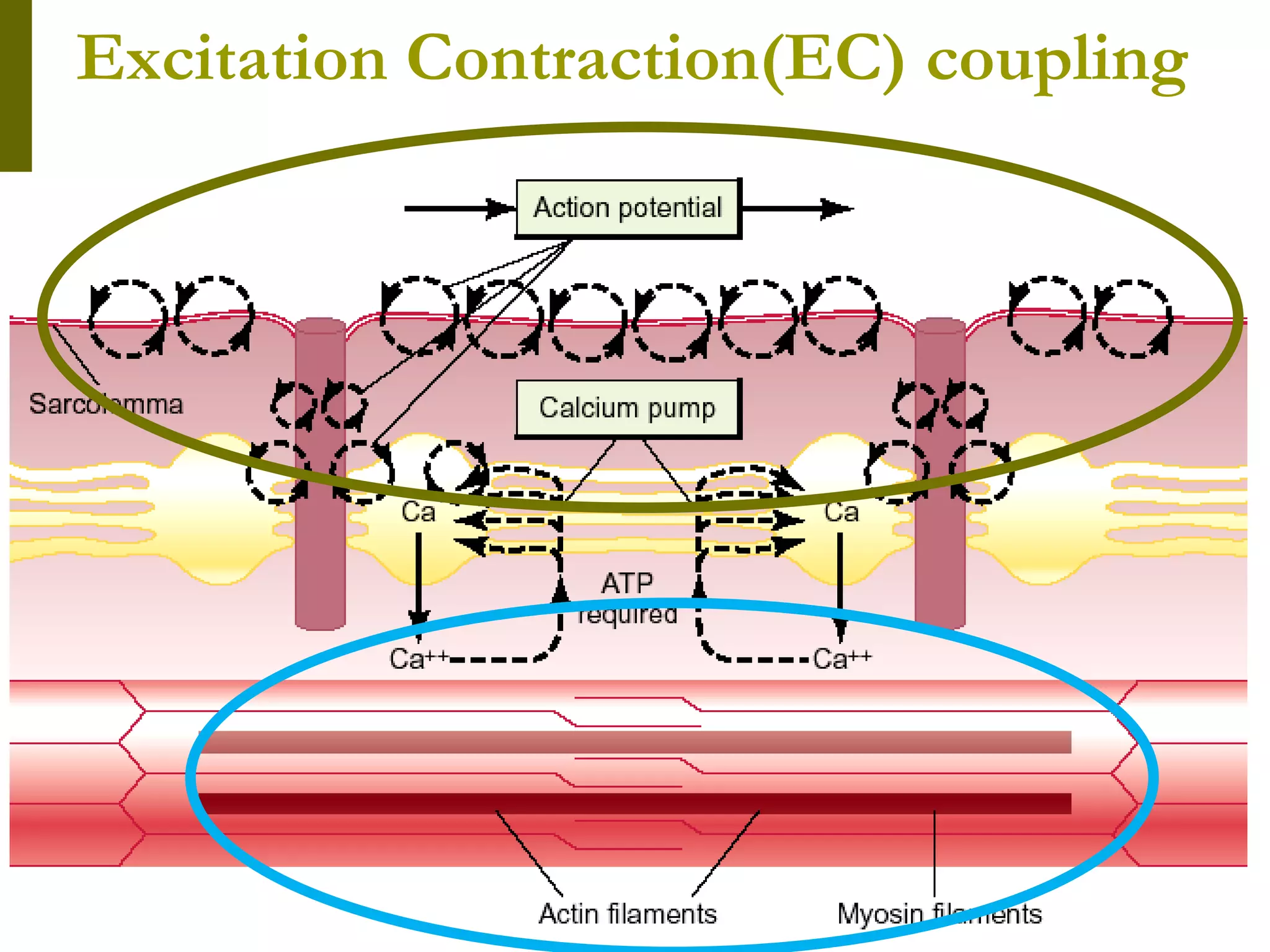
 Action potential travels along T-Tubules
leading to Ca++ release from sarcoplasmic
reticulum leading to contraction
Excitation Contraction(EC) coupling
 Electrical Event
 Action potential generated in muscle fiber memb.
due to depolarization of motor end plate
 AP transmitted along muscle fiber – initiates
contractile response
 Mechanical Event
 Contraction via contractile protein myosin and
cytoskeletal protein actin
 `
 Single AP causes a brief contraction followed
by relaxation – Simple Muscle Twitch
Electrical and Mechanical Response
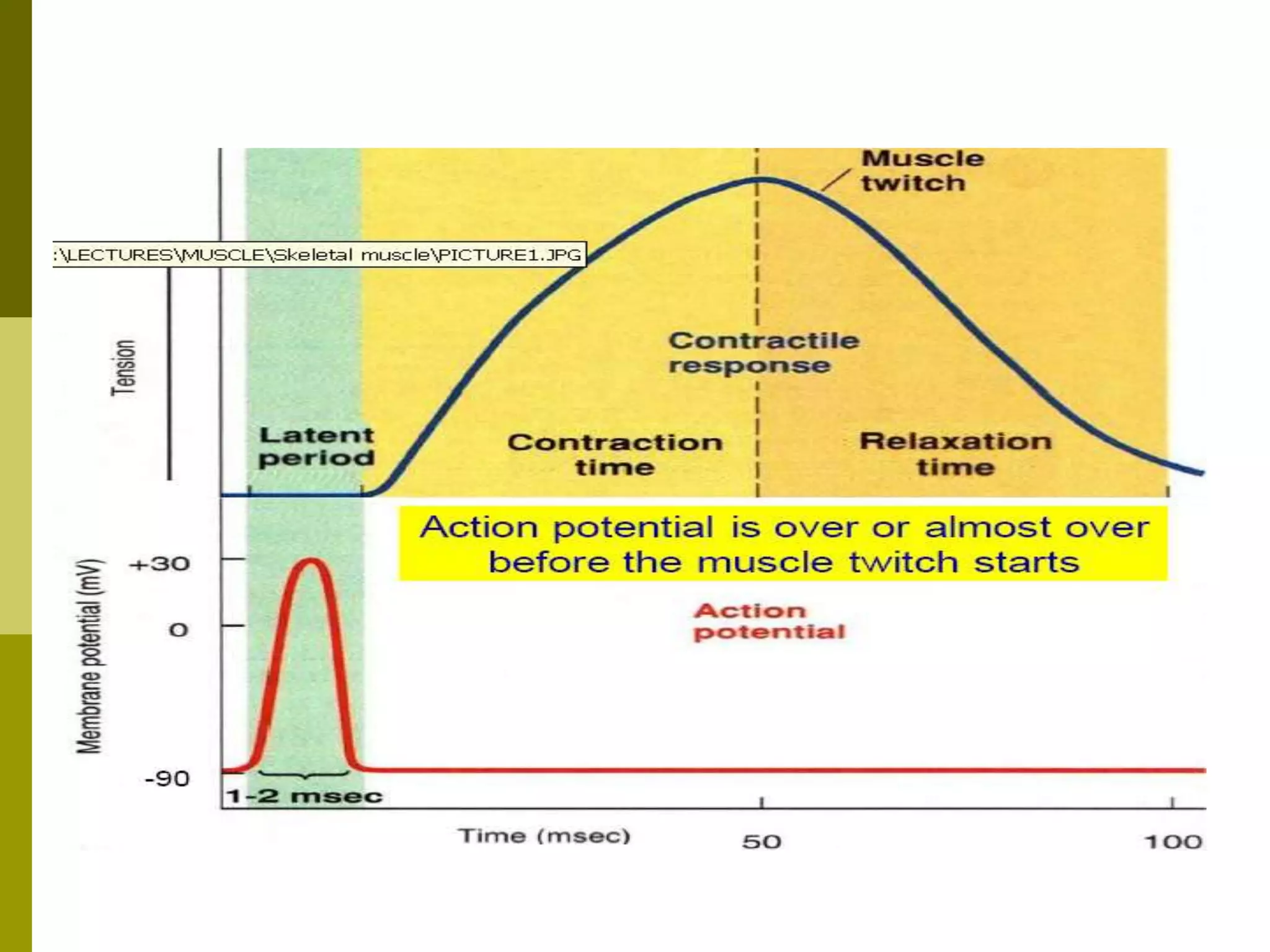
 Plotted on the
same time scale
 Twitch starts about 2 ms
after start of depolarization
of membrane & before
repolarization is complete
 Duration of twitch varies
with type of muscle
 "Fast" muscle fibers- fine, rapid,
precise movement - twitch
durations as short as 7.5 ms
 "Slow" muscle fibers - strong,
gross, sustained movements -
twitch durations up to 100 ms
Action Potential
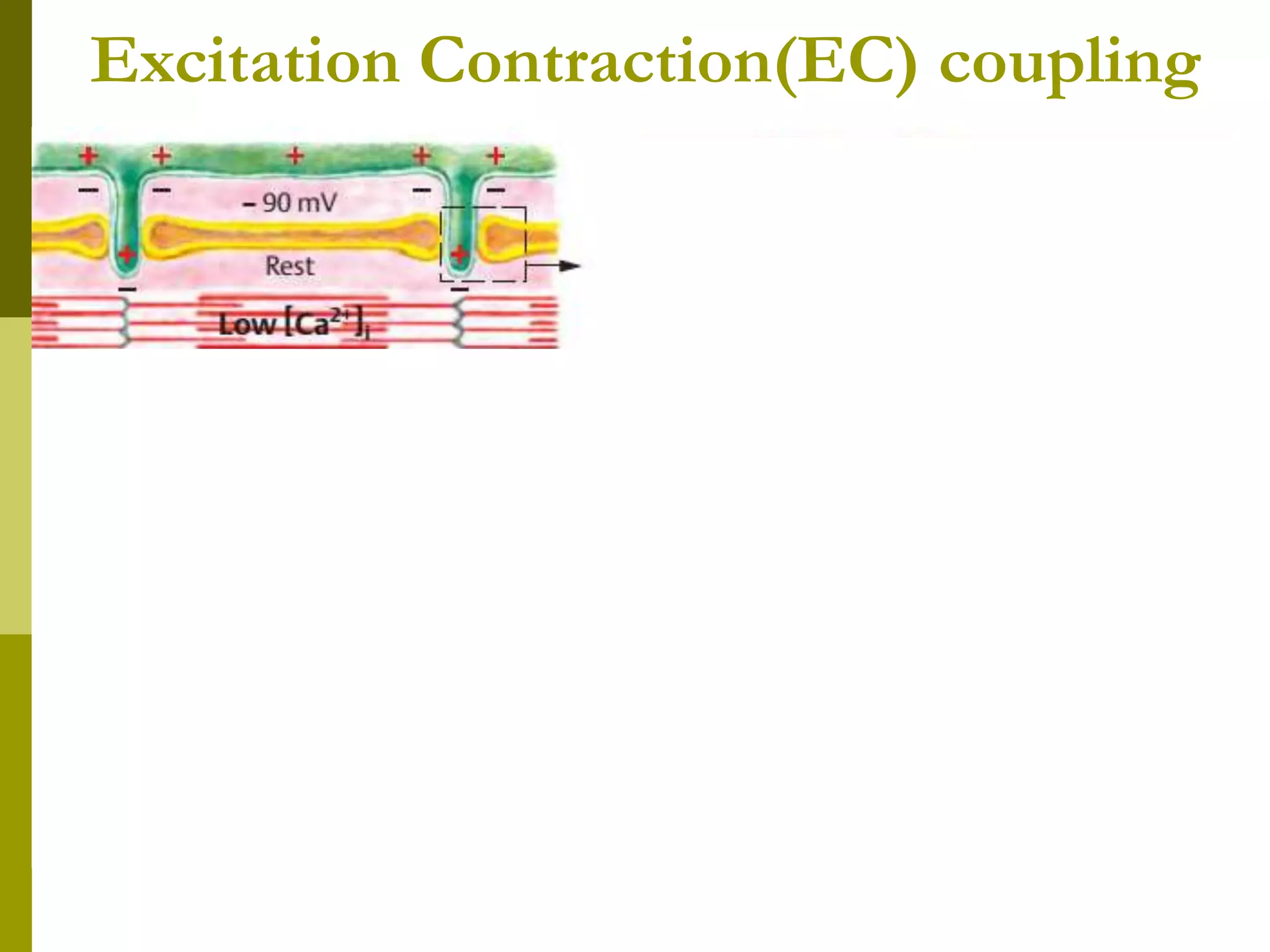
 RMP = -90mv
 AP lasts for 2-4 milliseconds (ms),
conducted along muscle fiber at 5 m/sec
with ARP = 1-3 msec
 Ends before contraction occurs
 Period between action potential initiation
and the beginning of contraction is called
the latent period
 Excitation-contraction coupling occurs
within the latent period
Excitation Contraction(EC) coupling
STEPS IN CONTRACTION
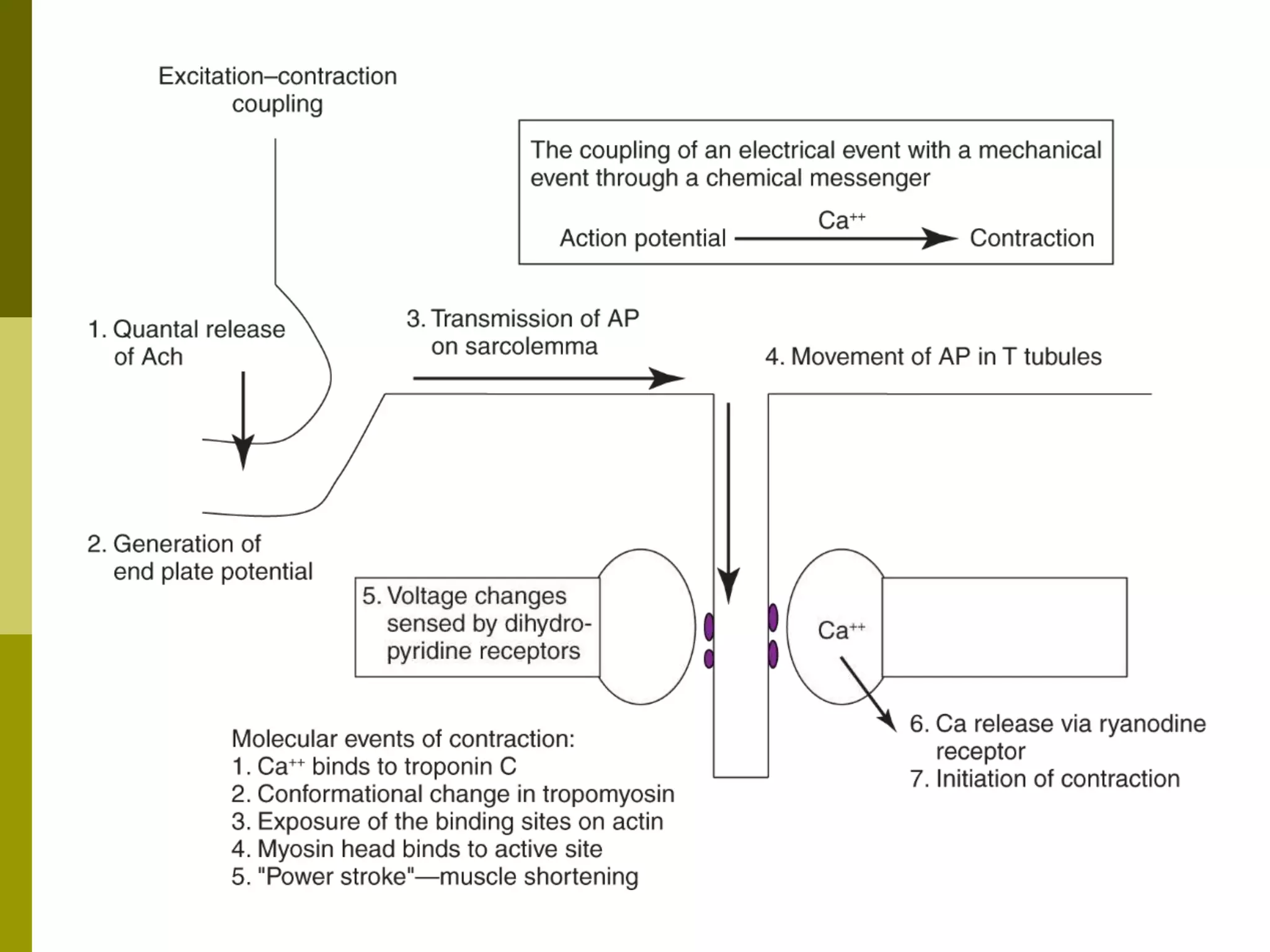
 Neurotransmitter acetylcholine (ACh)
binds to its receptors on the motor end
plate
 Ligand gated ion channels in the receptors
open and allow Na+ and K+ to move
across the membrane
depolarization
Action Potential
Propagated along Sarcolemma
Reaches the T Tubules
Triads
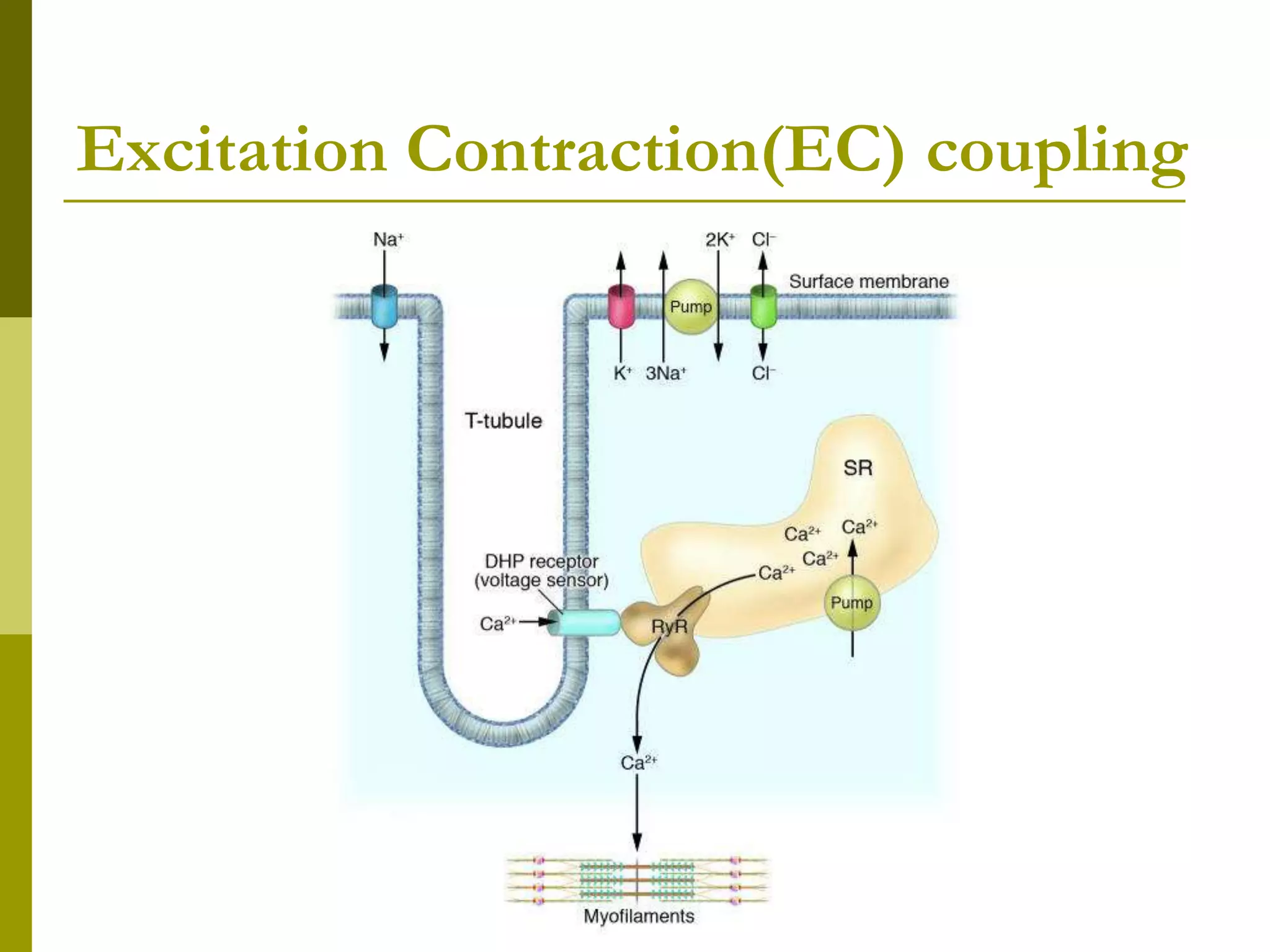
T – system or Transverse Tubular System
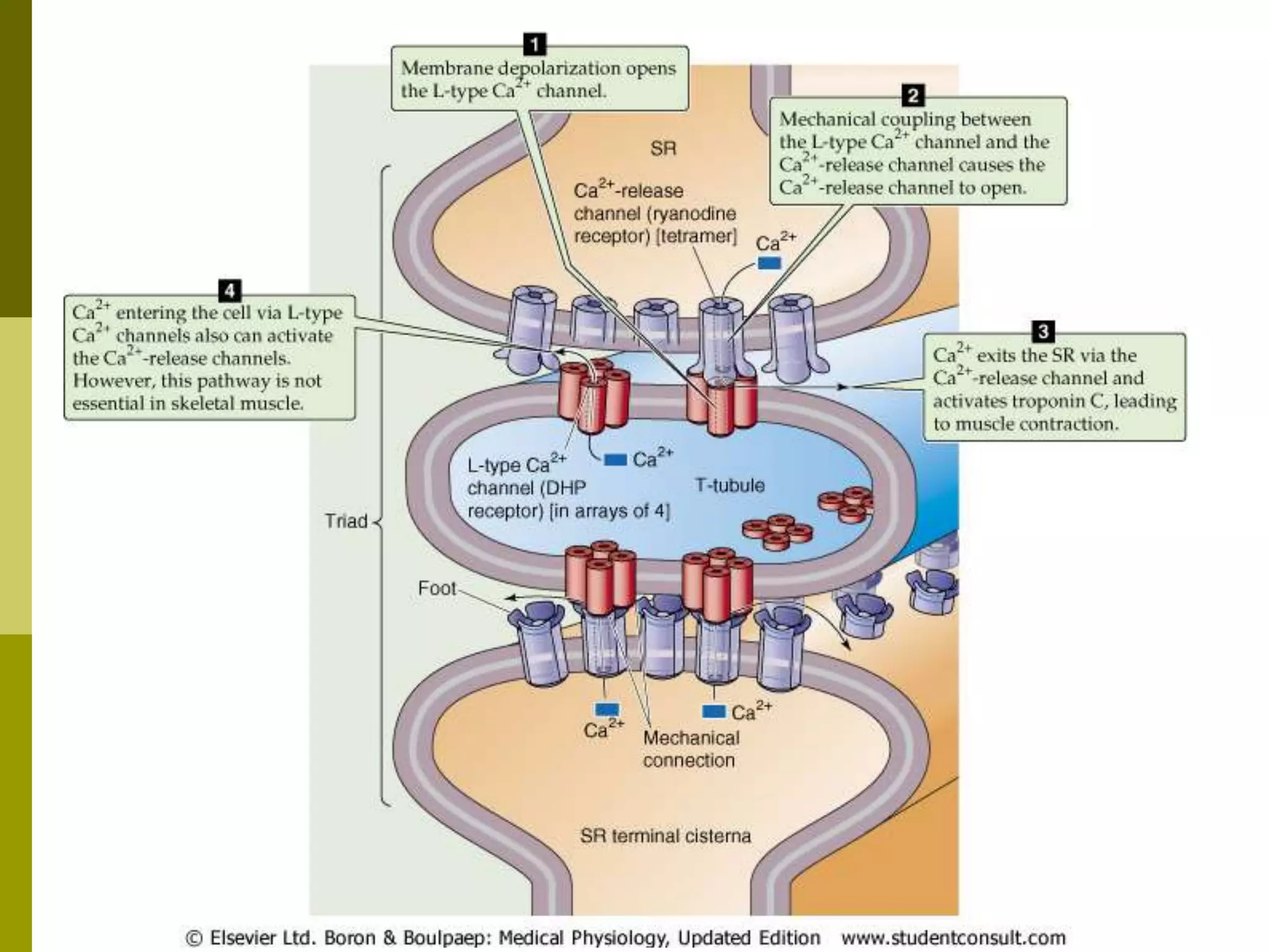
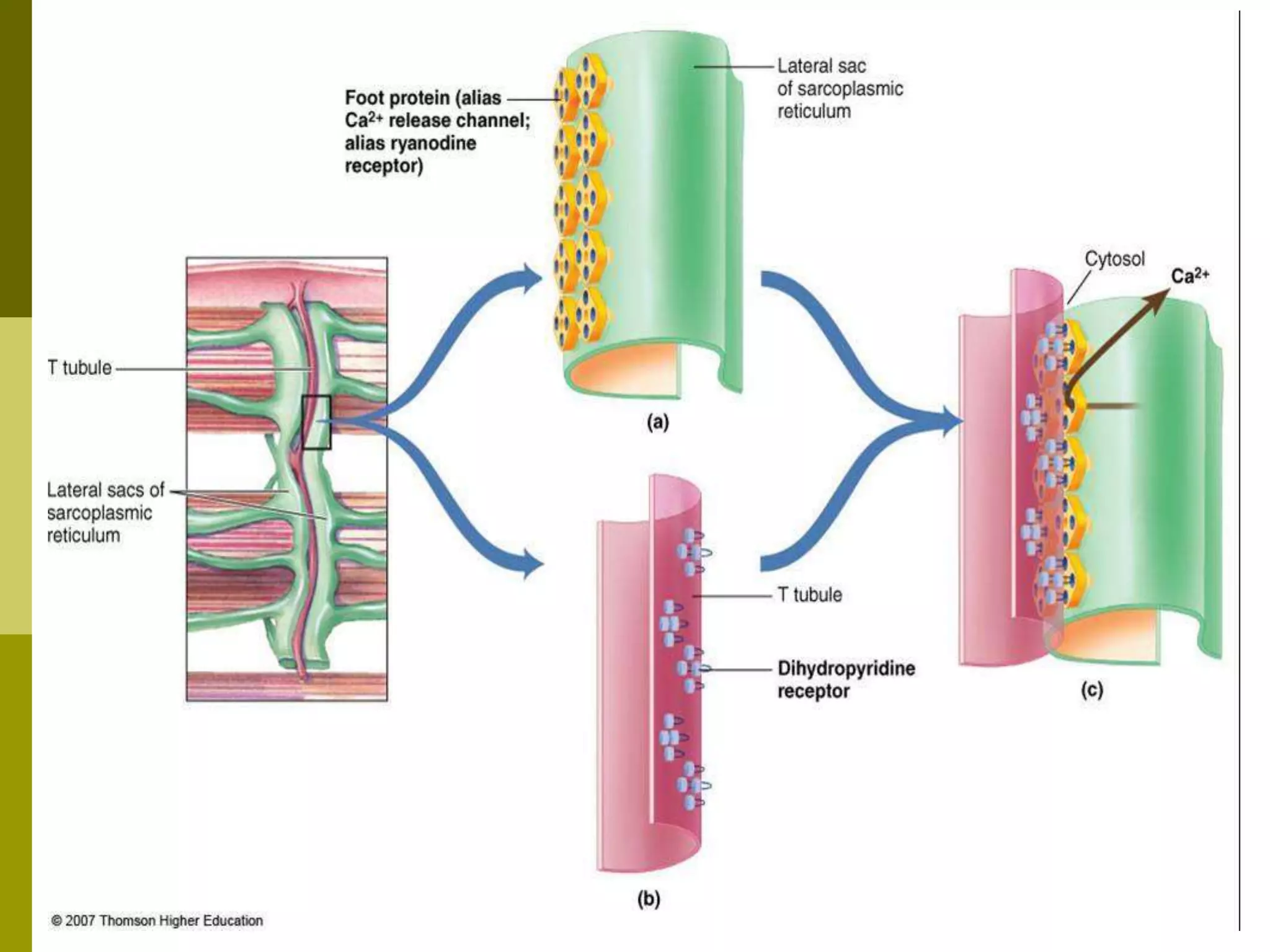
 Contains L-type Ca2+ channels clustered in
groups of four called "tetrads“
 Each is in fact a heteropentameric protein
 Each of the four Ca2+ channels is also called a
DHP receptor because inhibited by class of
antihypertensive drugs known as
dihydropyridines
 Function as voltage sensor in EC coupling
 Depolarization of T-tubule activates
longitudinal sarcoplasmic reticulum via
DHP receptors
Ca2+ channel in Sarcoplasmic Reticulum
 a.k.a ryanodine receptor
 Because inhibited by class of drugs that include
the plant alkaloids ryanodine and caffeine
 Homotetrameric structure
 Each of the four subunits of these channels
has a large extension-also known as a
"foot.“
 Ligand gated Ca2+ channel with calcium as
its natural ligand
 Ca2+ -induced Ca2+ release (CICR)
Depolarization of T-tubule
 Each L-type Ca2+ channel interacts with foot of
one of the 4 subunits of the Ca2+-release channel
 Depolarization of T-tubule evokes conformational
changes in each of the four L-type Ca2+ channels
and has two effects
 Conformational changes allow Ca2+ to enter through the
four channel pores
 Second, and much more important, the conformational
changes in the four L-type Ca2+ channels induce a
conformational change in each of the four subunits of
another channel-the Ca2+-release channel-that is located
in the SR membrane
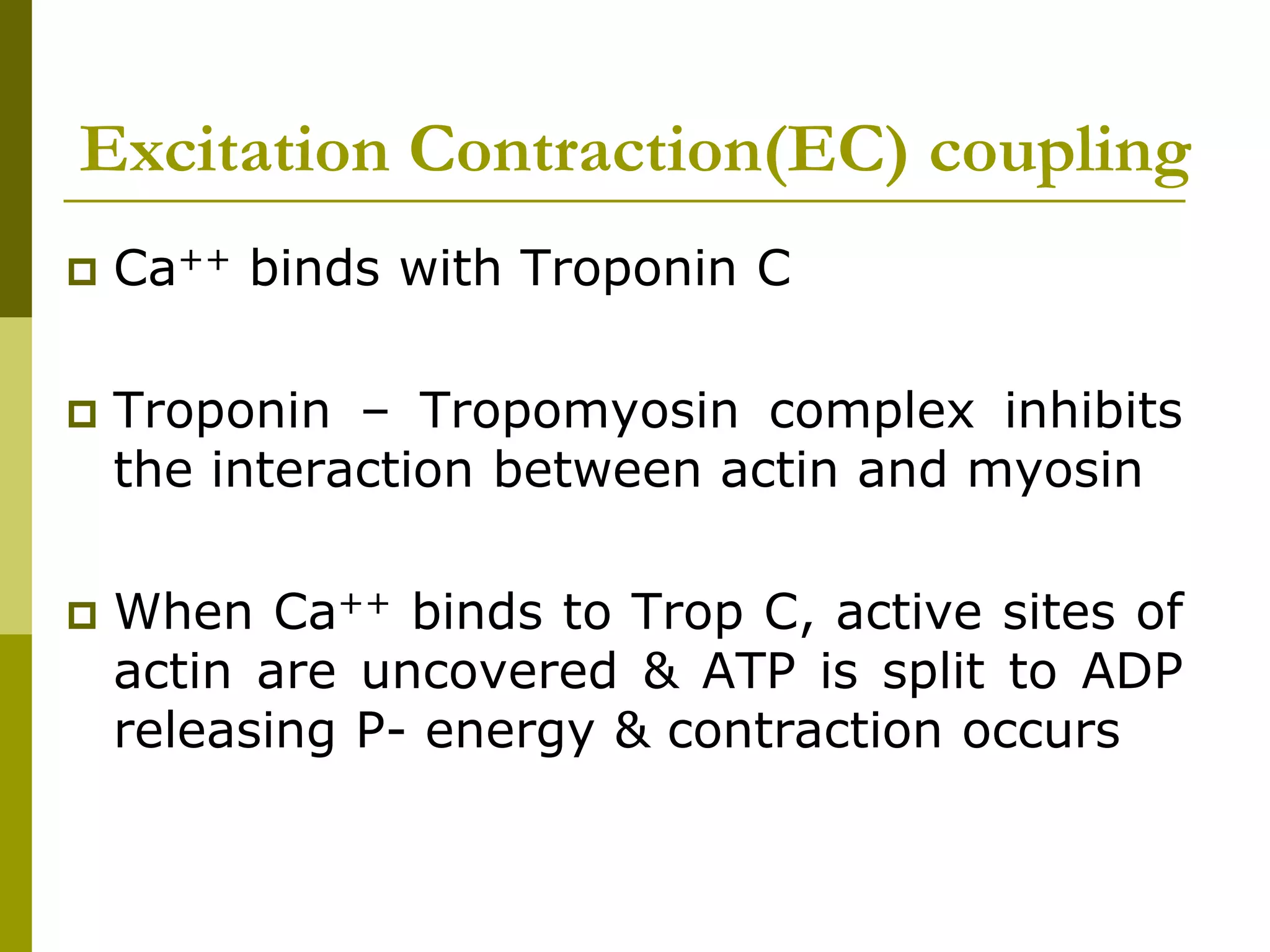
 Ca++ binds with Troponin C
 Troponin – Tropomyosin complex inhibits
the interaction between actin and myosin
 When Ca++ binds to Trop C, active sites of
actin are uncovered & ATP is split to ADP
releasing P- energy & contraction occurs
Excitation Contraction(EC) coupling
Troponin
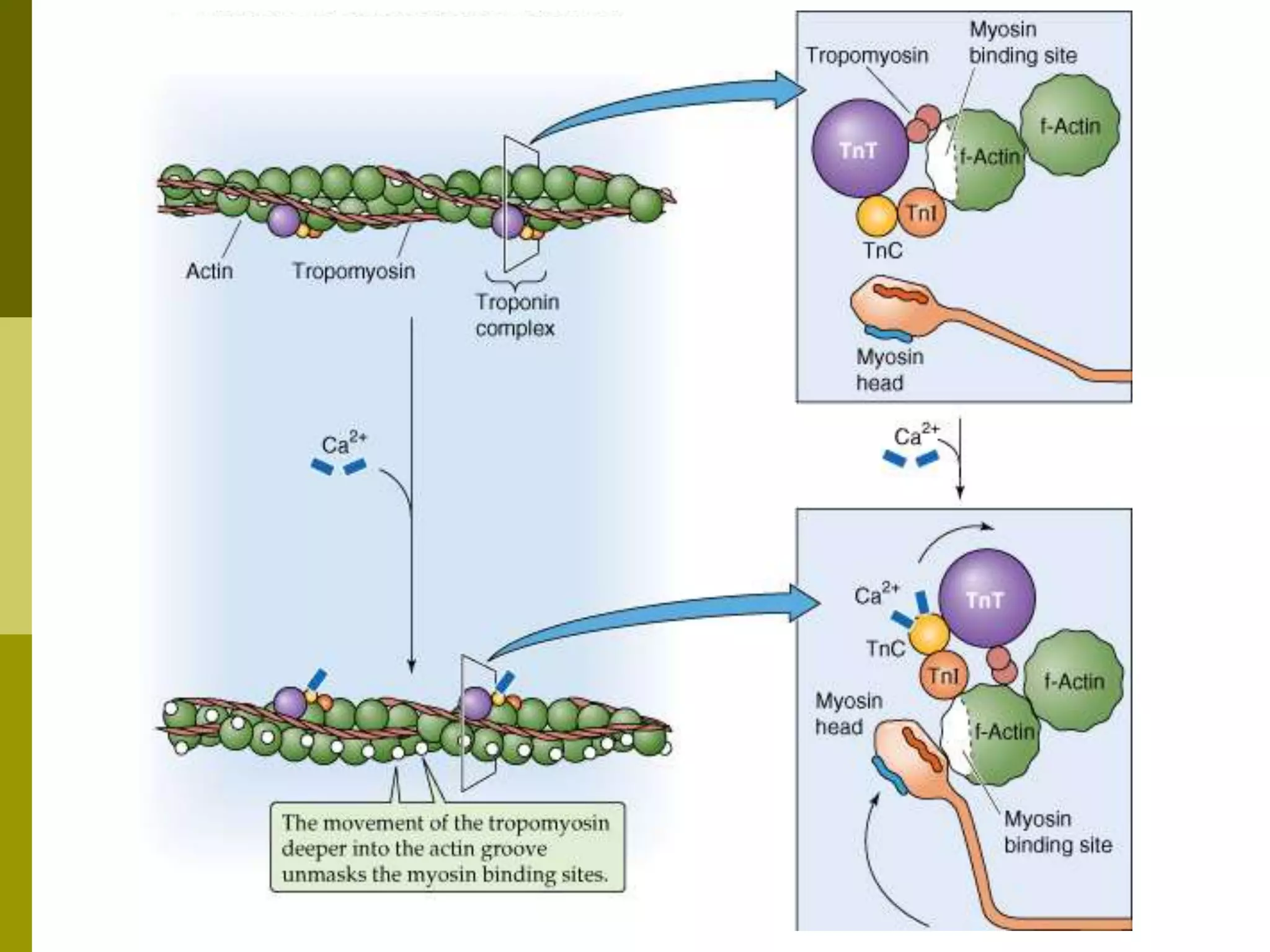
 Each troponin C molecule in skeletal muscle has
 2 high-affinity Ca2+ -binding sites
 2 low-affinity Ca2+-binding sites
 Binding of Ca2+ to low-affinity sites induces a
conformational change in the troponin complex
that has two effects
 troponin I moves away from the actin/tropomyosin
filament, thereby permitting the tropomyosin molecule
to move
 troponin T pushes tropomyosin away from the myosin-
binding site on the actin and into the actin groove
 With the steric hindrance removed, the myosin
head is able to interact with actin and engage in
cross-bridge cycling
Cross Bridge Cycle
 In presence of calcium, myosin head binds to an
actin filament
 Changes its orientation relative to myosin filament
which causes filaments to slide relative to each
other - Power Stroke
 During the Cross-Bridge Cycle, Contractile Proteins
Convert the Energy of ATP Hydrolysis Into
Mechanical Energy
 Each power stroke shortens sarcomere by 10nm
 Cross bridge cycling is asynchronous
 500 myosin in one thick filament, each head cycling 5
times per second
Cross Bridge Cycle
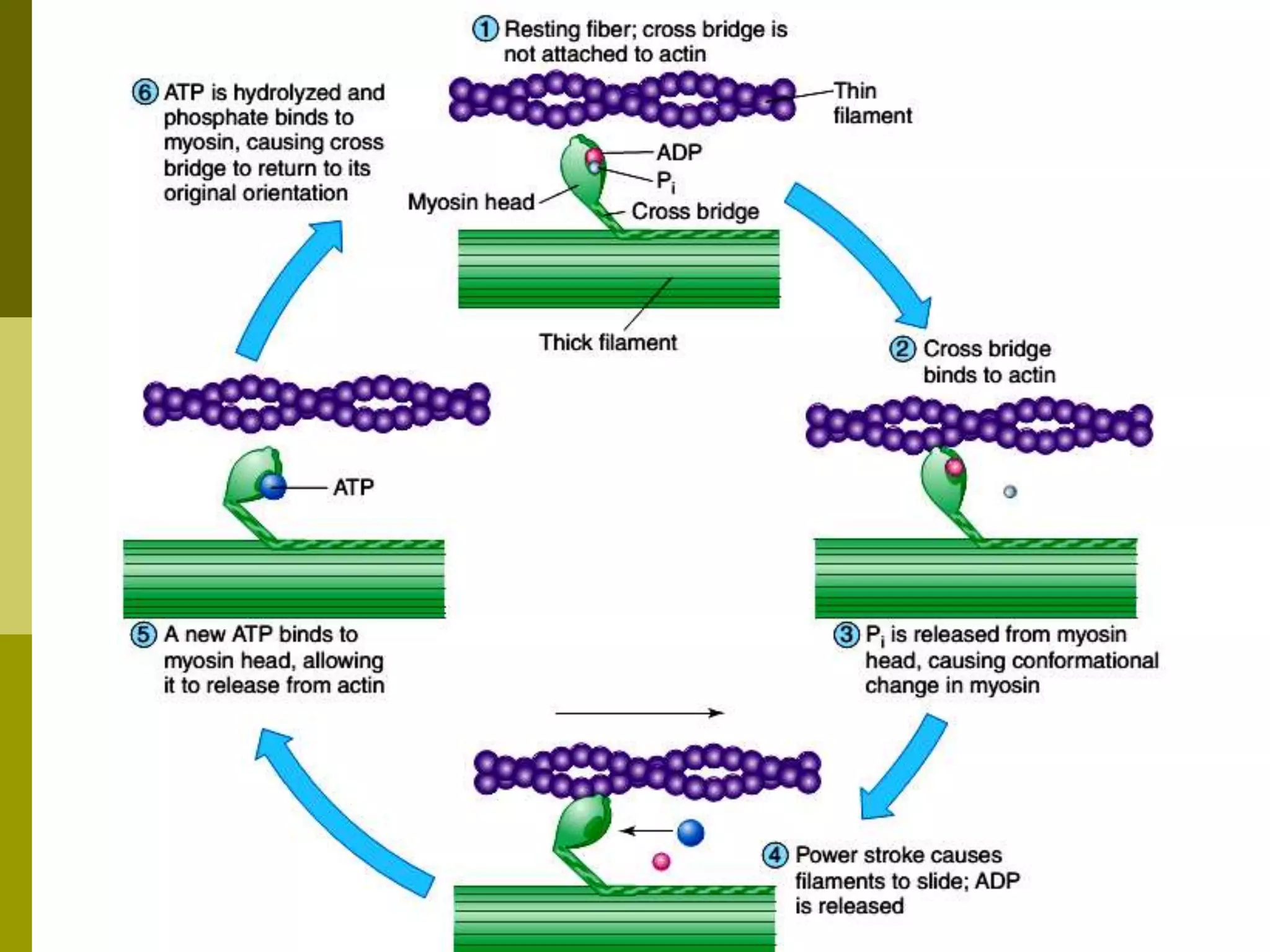
 Occurs in 5 steps :-
1. Cross – Bridge formation –
 cocked myosin head (perpendicular or
at a 90-degree angle to the thick and
thin filaments) binds to actin filament
 Cocked head has the stored energy
derived from the cleaved ATP
Cross Bridge Cycle
2. Release of Pi from the myosin
 Dissociation of Pi from the myosin head
triggers power stroke
 Conformational change - myosin
head bends approximately 45º about
the hinge
 Pulls the actin filament about 11 nm
toward the tail of the myosin
molecule
 Generating force and motion
Cross Bridge Cycle
3. ADP release –
 Dissociation of ADP from myosin
 Myosin head remains in the same position
(45º angle with respect to the thick and
thin filaments)
4. ATP binding –
 ATP binding to the head of the myosin
heavy chain (MHC) reduces the affinity of
myosin for actin
 Myosin head releases actin filament
Cross Bridge Cycle
5. ATP hydrolysis –
 Breakdown of ATP to ADP and inorganic
phosphate (Pi) occurs on myosin head
 Products of hydrolysis are retained on the myosin
 As a result of hydrolysis, the myosin head pivots
around the hinge into a "cocked" position
(perpendicular or at a 90º angle to the thick and
thin filaments)
 Rotation causes the tip of the myosin to move
about 11 nm along the actin filament so that it
now lines up with a new actin monomer two
monomers further along the actin filament
Cross Bridge Cycle
 Cycle repeats as long as Ca2+ is elevated
and sufficient ATP is there
 Muscle cells do not regulate cross-bridge
cycling by modifying [ATP]i
 Instead, skeletal muscle and cardiac
muscle control this cycle by preventing
cross-bridge formation until the
tropomyosin moves out of the way in
response to an increase in [Ca2+]i
Cross Bridge cycle
Cross Bridge cycle
Movement of 10 nm
Force in pico N
Cross Bridge cycle
Cross Bridge cycle
Cross Bridge cycle
Cross Bridge cycle
Cross Bridge cycle
Excitation Contraction(EC) coupling
Steps in Relaxation
 Cell may extrude Ca2+ using either an Na-
Ca exchanger (NCX) or a Ca2+ pump(PMCA)
 However, would eventually deplete the cell of
Ca2+ and is thus a minor mechanism for Ca2+
removal from the cytoplasm
 Instead, Ca2+ re-uptake into the SR is the
most important mechanism by which the
cell returns [Ca2+]i to resting levels
 Ca2+ re-uptake by the SR is mediated by a
SERCA(s arcoplasmic or e ndoplasmic
r eticulum C a2+A TPase )-type Ca2+ pump
Steps in Relaxation
 SR Ca2+-pump activity is inhibited by high [Ca2+]
within the SR lumen
 Inhibition of SR Ca2+-pump activity is delayed by
Ca2+-binding proteins within the SR lumen
 Buffer the Ca2+ increase in the SR during Ca2+ re-uptake
and thus markedly increase the Ca2+ capacity of SR
 Proteins have a tremendous capacity to bind Ca2+ with
up to 50 binding sites per protein molecule
 Principal Ca2+ binding protein in skeletal muscle,
calsequestrin
 also present in cardiac and some smooth muscle
 Calreticulin - Ca2+-binding protein found in particularly
high concentrations within the SR of smooth muscle
Steps in Relaxation
 When Ca++ conc. outside has lowered,
interaction of actin & myosin ceases & muscle
relaxes
 ATP required for both contraction &relaxation
 Pump concentrates Ca++ about 10,000fold
 Normal/Resting Ca++ conc. (less than 10-7
moles of Ca++ ) rises to 10-5 M
 Total duration of Ca++ ions stay in fluid is
1/30th of sec
Contracture
 Ca2+ movement inhibited
 Relaxation fails to occur
 Cross bridges don’t break
 Sustained contraction despite no action
potential
Role of ATP
 Provides energy for power stroke of
myosin head
 Brings about a dissociation of myosin head
from actin filament
 Brings about muscle relaxation by
pumping Ca2+ back into sarcoplasmic
reticulum
Rigor Mortis
 Muscles of body become very stiff and
rigid shortly after death
 Due to loss of ATP in the muscle cell
 In absence of ATP, the myosin cross
bridges with actin is not broken, so, no
relaxation occurs
 15-25 hrs later, muscle proteins
deteriorate and rigor disappears
EC Coupling: Drugs
 Blocking release of Ca++ from SR
 keeps muscle relaxed, even in the presence of
action potential eg Ryanodine receptor blocker
like Protamine sulphate
 Caffeine cause release of Ca++
 produces contraction without action potential
 Drugs which increase the release of Ca++
from sarcoplasmic reticulum. eg. Digitalis
 increase the force of cardiac muscle
contraction
Malignant Hyperthermia
 Channelopathy of calcium release channel in
muscle (Ryanodine receptors)
 constant leak of SR Ca2+ through ryanodine receptor
 triggered by halogenated anesthetics (isoflurane, halothane)
or severe exercise
 familial tendency - can be tested for by muscle biopsy
 Symptoms
 Normal muscle function under normal conditions
 increased body temperature -more heat produced
 skeletal muscle rigidity
 lactic acidosis (hypermetabolism)
Thank you
References:
Guyton- Textbook of Medical Physiology
Ganong’s- Review of Medical Physiology
Boron-Medical Physiology
Kandel-Principles of Neural Science
Silbernagl-Color atlas of Physiology
Ira Fox- Medical Physiology

Excitation - Contraction coupling

  • 1.
    Mechanism of Skeletal MuscleContraction (Excitation Contraction Coupling)
  • 2.
    Contraction  For contraction,skeletal muscle must:  be stimulated by a nerve ending  propagate an action potential, along its sarcolemma  have a rise in intracellular Ca2+ levels, the final stimulus for contraction  Ca2+ levels may rise from its resting level of less than 10-7 M to greater than 10-5 M
  • 3.
    Theories of MuscleContraction  New elastic body theory (1840 – 1920 )  Fenn observed that total energy released by muscle (work +heat) increases as muscle work increases this is known as “FENN EFFECT”  Continuous filament theory –  According to this theory, during contraction actin & myosin combine to form 1 continuous filament which undergoes folding & shortening  Electron microscope observations do not support this theory as after contraction length of thick & thin filament is not altered only their relative position changes
  • 4.
    Theories of MuscleContraction  Sliding Filament Theory (1954): Huxley and Niedergerke  Sliding filament theory was transformed into  Cross Bridge cycle (1957): Huxley  Thin filament slides past thick filament  Molecular basis of sliding motion is by globular head of myosin forming cross bridges with actin monomers (Huxley’s Cross Bridge theory) or Ratchet theory of muscle contraction / Walk along Theory
  • 5.
    Sliding Filament Theory Thin filament slides over the thick  Width of A band constant  Z-lines  move closer – contraction  move apart – relaxation A. Relaxed I band A band sarcomere M lineZ disk B. Contracted
  • 6.
  • 8.
    Excitation –Contraction Coupling Sequence of events linking the transmission of an action potential along the sarcolemma to muscle contraction (the sliding of myofilaments)
  • 9.
    Excitation Contraction(EC) coupling The entire process, extending from depolarization of the T-tubule membrane to the initiation of cross-bridge cycling, is termed Excitation Contraction coupling or EC coupling  Action potential travels along T-Tubules leading to Ca++ release from sarcoplasmic reticulum leading to contraction
  • 10.
    Excitation Contraction(EC) coupling Electrical Event  Action potential generated in muscle fiber memb. due to depolarization of motor end plate  AP transmitted along muscle fiber – initiates contractile response  Mechanical Event  Contraction via contractile protein myosin and cytoskeletal protein actin  `  Single AP causes a brief contraction followed by relaxation – Simple Muscle Twitch
  • 11.
    Electrical and MechanicalResponse  Plotted on the same time scale  Twitch starts about 2 ms after start of depolarization of membrane & before repolarization is complete  Duration of twitch varies with type of muscle  "Fast" muscle fibers- fine, rapid, precise movement - twitch durations as short as 7.5 ms  "Slow" muscle fibers - strong, gross, sustained movements - twitch durations up to 100 ms
  • 12.
    Action Potential  RMP= -90mv  AP lasts for 2-4 milliseconds (ms), conducted along muscle fiber at 5 m/sec with ARP = 1-3 msec  Ends before contraction occurs  Period between action potential initiation and the beginning of contraction is called the latent period  Excitation-contraction coupling occurs within the latent period
  • 15.
  • 16.
    STEPS IN CONTRACTION Neurotransmitter acetylcholine (ACh) binds to its receptors on the motor end plate  Ligand gated ion channels in the receptors open and allow Na+ and K+ to move across the membrane depolarization
  • 17.
    Action Potential Propagated alongSarcolemma Reaches the T Tubules Triads
  • 18.
    T – systemor Transverse Tubular System  Contains L-type Ca2+ channels clustered in groups of four called "tetrads“  Each is in fact a heteropentameric protein  Each of the four Ca2+ channels is also called a DHP receptor because inhibited by class of antihypertensive drugs known as dihydropyridines  Function as voltage sensor in EC coupling  Depolarization of T-tubule activates longitudinal sarcoplasmic reticulum via DHP receptors
  • 19.
    Ca2+ channel inSarcoplasmic Reticulum  a.k.a ryanodine receptor  Because inhibited by class of drugs that include the plant alkaloids ryanodine and caffeine  Homotetrameric structure  Each of the four subunits of these channels has a large extension-also known as a "foot.“  Ligand gated Ca2+ channel with calcium as its natural ligand  Ca2+ -induced Ca2+ release (CICR)
  • 20.
    Depolarization of T-tubule Each L-type Ca2+ channel interacts with foot of one of the 4 subunits of the Ca2+-release channel  Depolarization of T-tubule evokes conformational changes in each of the four L-type Ca2+ channels and has two effects  Conformational changes allow Ca2+ to enter through the four channel pores  Second, and much more important, the conformational changes in the four L-type Ca2+ channels induce a conformational change in each of the four subunits of another channel-the Ca2+-release channel-that is located in the SR membrane
  • 25.
     Ca++ bindswith Troponin C  Troponin – Tropomyosin complex inhibits the interaction between actin and myosin  When Ca++ binds to Trop C, active sites of actin are uncovered & ATP is split to ADP releasing P- energy & contraction occurs Excitation Contraction(EC) coupling
  • 26.
    Troponin  Each troponinC molecule in skeletal muscle has  2 high-affinity Ca2+ -binding sites  2 low-affinity Ca2+-binding sites  Binding of Ca2+ to low-affinity sites induces a conformational change in the troponin complex that has two effects  troponin I moves away from the actin/tropomyosin filament, thereby permitting the tropomyosin molecule to move  troponin T pushes tropomyosin away from the myosin- binding site on the actin and into the actin groove  With the steric hindrance removed, the myosin head is able to interact with actin and engage in cross-bridge cycling
  • 28.
    Cross Bridge Cycle In presence of calcium, myosin head binds to an actin filament  Changes its orientation relative to myosin filament which causes filaments to slide relative to each other - Power Stroke  During the Cross-Bridge Cycle, Contractile Proteins Convert the Energy of ATP Hydrolysis Into Mechanical Energy  Each power stroke shortens sarcomere by 10nm  Cross bridge cycling is asynchronous  500 myosin in one thick filament, each head cycling 5 times per second
  • 30.
    Cross Bridge Cycle Occurs in 5 steps :- 1. Cross – Bridge formation –  cocked myosin head (perpendicular or at a 90-degree angle to the thick and thin filaments) binds to actin filament  Cocked head has the stored energy derived from the cleaved ATP
  • 31.
    Cross Bridge Cycle 2.Release of Pi from the myosin  Dissociation of Pi from the myosin head triggers power stroke  Conformational change - myosin head bends approximately 45º about the hinge  Pulls the actin filament about 11 nm toward the tail of the myosin molecule  Generating force and motion
  • 32.
    Cross Bridge Cycle 3.ADP release –  Dissociation of ADP from myosin  Myosin head remains in the same position (45º angle with respect to the thick and thin filaments) 4. ATP binding –  ATP binding to the head of the myosin heavy chain (MHC) reduces the affinity of myosin for actin  Myosin head releases actin filament
  • 33.
    Cross Bridge Cycle 5.ATP hydrolysis –  Breakdown of ATP to ADP and inorganic phosphate (Pi) occurs on myosin head  Products of hydrolysis are retained on the myosin  As a result of hydrolysis, the myosin head pivots around the hinge into a "cocked" position (perpendicular or at a 90º angle to the thick and thin filaments)  Rotation causes the tip of the myosin to move about 11 nm along the actin filament so that it now lines up with a new actin monomer two monomers further along the actin filament
  • 34.
    Cross Bridge Cycle Cycle repeats as long as Ca2+ is elevated and sufficient ATP is there  Muscle cells do not regulate cross-bridge cycling by modifying [ATP]i  Instead, skeletal muscle and cardiac muscle control this cycle by preventing cross-bridge formation until the tropomyosin moves out of the way in response to an increase in [Ca2+]i
  • 36.
  • 37.
  • 38.
    Movement of 10nm Force in pico N Cross Bridge cycle
  • 39.
  • 40.
  • 41.
  • 42.
  • 43.
  • 44.
  • 45.
    Steps in Relaxation Cell may extrude Ca2+ using either an Na- Ca exchanger (NCX) or a Ca2+ pump(PMCA)  However, would eventually deplete the cell of Ca2+ and is thus a minor mechanism for Ca2+ removal from the cytoplasm  Instead, Ca2+ re-uptake into the SR is the most important mechanism by which the cell returns [Ca2+]i to resting levels  Ca2+ re-uptake by the SR is mediated by a SERCA(s arcoplasmic or e ndoplasmic r eticulum C a2+A TPase )-type Ca2+ pump
  • 46.
    Steps in Relaxation SR Ca2+-pump activity is inhibited by high [Ca2+] within the SR lumen  Inhibition of SR Ca2+-pump activity is delayed by Ca2+-binding proteins within the SR lumen  Buffer the Ca2+ increase in the SR during Ca2+ re-uptake and thus markedly increase the Ca2+ capacity of SR  Proteins have a tremendous capacity to bind Ca2+ with up to 50 binding sites per protein molecule  Principal Ca2+ binding protein in skeletal muscle, calsequestrin  also present in cardiac and some smooth muscle  Calreticulin - Ca2+-binding protein found in particularly high concentrations within the SR of smooth muscle
  • 48.
    Steps in Relaxation When Ca++ conc. outside has lowered, interaction of actin & myosin ceases & muscle relaxes  ATP required for both contraction &relaxation  Pump concentrates Ca++ about 10,000fold  Normal/Resting Ca++ conc. (less than 10-7 moles of Ca++ ) rises to 10-5 M  Total duration of Ca++ ions stay in fluid is 1/30th of sec
  • 49.
    Contracture  Ca2+ movementinhibited  Relaxation fails to occur  Cross bridges don’t break  Sustained contraction despite no action potential
  • 50.
    Role of ATP Provides energy for power stroke of myosin head  Brings about a dissociation of myosin head from actin filament  Brings about muscle relaxation by pumping Ca2+ back into sarcoplasmic reticulum
  • 51.
    Rigor Mortis  Musclesof body become very stiff and rigid shortly after death  Due to loss of ATP in the muscle cell  In absence of ATP, the myosin cross bridges with actin is not broken, so, no relaxation occurs  15-25 hrs later, muscle proteins deteriorate and rigor disappears
  • 57.
    EC Coupling: Drugs Blocking release of Ca++ from SR  keeps muscle relaxed, even in the presence of action potential eg Ryanodine receptor blocker like Protamine sulphate  Caffeine cause release of Ca++  produces contraction without action potential  Drugs which increase the release of Ca++ from sarcoplasmic reticulum. eg. Digitalis  increase the force of cardiac muscle contraction
  • 58.
    Malignant Hyperthermia  Channelopathyof calcium release channel in muscle (Ryanodine receptors)  constant leak of SR Ca2+ through ryanodine receptor  triggered by halogenated anesthetics (isoflurane, halothane) or severe exercise  familial tendency - can be tested for by muscle biopsy  Symptoms  Normal muscle function under normal conditions  increased body temperature -more heat produced  skeletal muscle rigidity  lactic acidosis (hypermetabolism)
  • 59.
    Thank you References: Guyton- Textbookof Medical Physiology Ganong’s- Review of Medical Physiology Boron-Medical Physiology Kandel-Principles of Neural Science Silbernagl-Color atlas of Physiology Ira Fox- Medical Physiology

Editor's Notes

  • #4 When muscle contracts, work is performed and energy required. Greater the amount of work performed by muscle, greater is the amount of ATP cleaved – phenomenon is called FENN Effect
  • #23 A tetrad of four L-type Ca2+ channels on the T tubules faces a single Ca2+-release channel of the SR, so that each L-type Ca2+ channel interacts with the foot of one of the four subunits of the Ca2+-release channel.
  • #56 Contraction remainder after fatigued muscle due to ATP depletion also. Heat Rigor – temp above 50°C cause coagulation of muscle protein – can be demonstrated in isolated muscle preparations