 It is a process of partial depolarization at the
MEP caused by A-ch release due to a nerve
impulse in the motor nerve
 Its amplitude is proportional to the amount of A-
ch released
 If it reaches the firing level a propagated A.P
produced & spreads along the muscle fiber
 Its similar to the local excitatory state of the
neuron
Skeletal muscle can contract either:
1. In response to a nerve impulse in
the motor nerve supplying the
muscle (inside the body)
2. By direct stimulation of the muscle
(e.g. experimental or during
physiotherapy)
 The RMP of the muscle is -90
 The initiation of muscle contraction begins with AP
at the muscle fibers that is conducted from the
surface to the interior of the muscle fiber along the
T- tubules
 The AP is the same as that of the nerve regarding the
phases the ionic distribution & the ionic fluxes
 It differs from the AP of the nerve in the duration
being longer than that of the nerve, & in the velocity
of conduction begin slower than the nerve
The mechanical changes mean the
contractile response itself
It follow the electrical change (AP) &
the link between them is called
excitation- contraction coupling
1. Discharge of the motor neuron &
arrived of the nerve impulse to the
nerve terminal at the motor end plate
2. Depolarization of the nerve terminal at
MEP allows the entry of Ca2+ from the
extracellular space (through voltage
gated Ca2+ channels) & rupture of the
vesicle releasing their content of A-ch
at the MEP
3. Generation of end plate potential:
 A-ch crosses the gap between the
nerve terminal & the surface of the
muscle (synaptic cleft) & binds to
receptors on the surface of the
muscle, this binding ↑ the
permeability of the muscle membrane
to Na+.
 Na+ enters from the ECF to the inside
of the muscle fiber → rapid
depolarization(EPP)
When the EPP reaches the firing
level, an AP is generated at the MEP
& propagates on either side of the
muscle surface as well as to the
inside of the muscle fiber along the
T-tubules
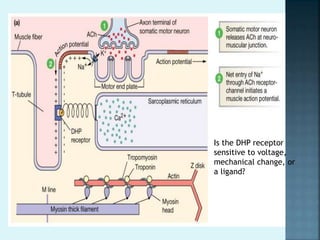
Is the DHP receptor
sensitive to voltage,
mechanical change, or
a ligand?
4. Release of Ca2+ from the sarcotubular
system:
 Depolarization of the T tubule
membrane activates the sarcoplasmic
reticulum via dihydropyridine
receptors (DHPR), named for the
drug dihydropyridine, which blocks
them
 DHPR are voltage-gated Ca2+ channels
in the T tubule membrane.
the DHPR that serves as the voltage
sensor unlocks release of Ca2+ from
the nearby sarcoplasmic reticulum via
physical interaction with the
ryanodine receptor (RyR).
The RyR is named after the plant
alkaloid ryanodine that was used in
its discovery.
Ca2+ diffuses to adjacent myofibrils
where it binds strongly with troponin C
5. The role of Ca2+ :
 during relaxation of the muscle,
troponin I is tightly bound to actin &
tropomyosin covers the active sites
on actin, thus preventing the
interaction of myosin heads with
actin to cause contraction.
When Ca2+ binds to troponin C
→the binding of troponin I to
actin is weakened & tropomyosin
moves laterally from actin
exposing its active sites
6. Formation of cross linkages between
actin &myosin:
 Once the active site of actin are
exposed, the myosin heads(cross
bridges) become attacted to them,
thus allowing sliding of actin on the
myosin (the actin filaments move
towards the center of the myosin &
shortening occurs)
The heads of myosin when in
contact with the active sites:
ATPase that catalyze the splitting of
ATP to
ATP ATPase ADP + Pi + energy
The energy liberated is consumed in
contraction which is an active
process
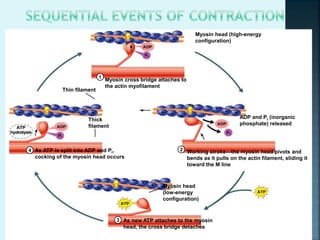
Myosin cross bridge attaches to
the actin myofilament
1
2
3
4 Working stroke—the myosin head pivots and
bends as it pulls on the actin filament, sliding it
toward the M line
As new ATP attaches to the myosin
head, the cross bridge detaches
As ATP is split into ADP and Pi,
cocking of the myosin head occurs
Myosin head (high-energy
configuration)
Thick
filament
Myosin head
(low-energy
configuration)
ADP and Pi (inorganic
phosphate) released
Thin filament
THANK YOU FOR
ATTENTION

exitatoin contraction coupling.pptx

  • 3.
     It isa process of partial depolarization at the MEP caused by A-ch release due to a nerve impulse in the motor nerve  Its amplitude is proportional to the amount of A- ch released  If it reaches the firing level a propagated A.P produced & spreads along the muscle fiber  Its similar to the local excitatory state of the neuron
  • 4.
    Skeletal muscle cancontract either: 1. In response to a nerve impulse in the motor nerve supplying the muscle (inside the body) 2. By direct stimulation of the muscle (e.g. experimental or during physiotherapy)
  • 5.
     The RMPof the muscle is -90  The initiation of muscle contraction begins with AP at the muscle fibers that is conducted from the surface to the interior of the muscle fiber along the T- tubules  The AP is the same as that of the nerve regarding the phases the ionic distribution & the ionic fluxes  It differs from the AP of the nerve in the duration being longer than that of the nerve, & in the velocity of conduction begin slower than the nerve
  • 6.
    The mechanical changesmean the contractile response itself It follow the electrical change (AP) & the link between them is called excitation- contraction coupling
  • 7.
    1. Discharge ofthe motor neuron & arrived of the nerve impulse to the nerve terminal at the motor end plate 2. Depolarization of the nerve terminal at MEP allows the entry of Ca2+ from the extracellular space (through voltage gated Ca2+ channels) & rupture of the vesicle releasing their content of A-ch at the MEP
  • 10.
    3. Generation ofend plate potential:  A-ch crosses the gap between the nerve terminal & the surface of the muscle (synaptic cleft) & binds to receptors on the surface of the muscle, this binding ↑ the permeability of the muscle membrane to Na+.  Na+ enters from the ECF to the inside of the muscle fiber → rapid depolarization(EPP)
  • 11.
    When the EPPreaches the firing level, an AP is generated at the MEP & propagates on either side of the muscle surface as well as to the inside of the muscle fiber along the T-tubules
  • 12.
    Is the DHPreceptor sensitive to voltage, mechanical change, or a ligand?
  • 13.
    4. Release ofCa2+ from the sarcotubular system:  Depolarization of the T tubule membrane activates the sarcoplasmic reticulum via dihydropyridine receptors (DHPR), named for the drug dihydropyridine, which blocks them  DHPR are voltage-gated Ca2+ channels in the T tubule membrane.
  • 14.
    the DHPR thatserves as the voltage sensor unlocks release of Ca2+ from the nearby sarcoplasmic reticulum via physical interaction with the ryanodine receptor (RyR). The RyR is named after the plant alkaloid ryanodine that was used in its discovery.
  • 17.
    Ca2+ diffuses toadjacent myofibrils where it binds strongly with troponin C 5. The role of Ca2+ :  during relaxation of the muscle, troponin I is tightly bound to actin & tropomyosin covers the active sites on actin, thus preventing the interaction of myosin heads with actin to cause contraction.
  • 19.
    When Ca2+ bindsto troponin C →the binding of troponin I to actin is weakened & tropomyosin moves laterally from actin exposing its active sites
  • 20.
    6. Formation ofcross linkages between actin &myosin:  Once the active site of actin are exposed, the myosin heads(cross bridges) become attacted to them, thus allowing sliding of actin on the myosin (the actin filaments move towards the center of the myosin & shortening occurs)
  • 22.
    The heads ofmyosin when in contact with the active sites: ATPase that catalyze the splitting of ATP to ATP ATPase ADP + Pi + energy The energy liberated is consumed in contraction which is an active process
  • 23.
    Myosin cross bridgeattaches to the actin myofilament 1 2 3 4 Working stroke—the myosin head pivots and bends as it pulls on the actin filament, sliding it toward the M line As new ATP attaches to the myosin head, the cross bridge detaches As ATP is split into ADP and Pi, cocking of the myosin head occurs Myosin head (high-energy configuration) Thick filament Myosin head (low-energy configuration) ADP and Pi (inorganic phosphate) released Thin filament
  • 26.