Chapter 1
Introduction to Materials Science
and Engineering
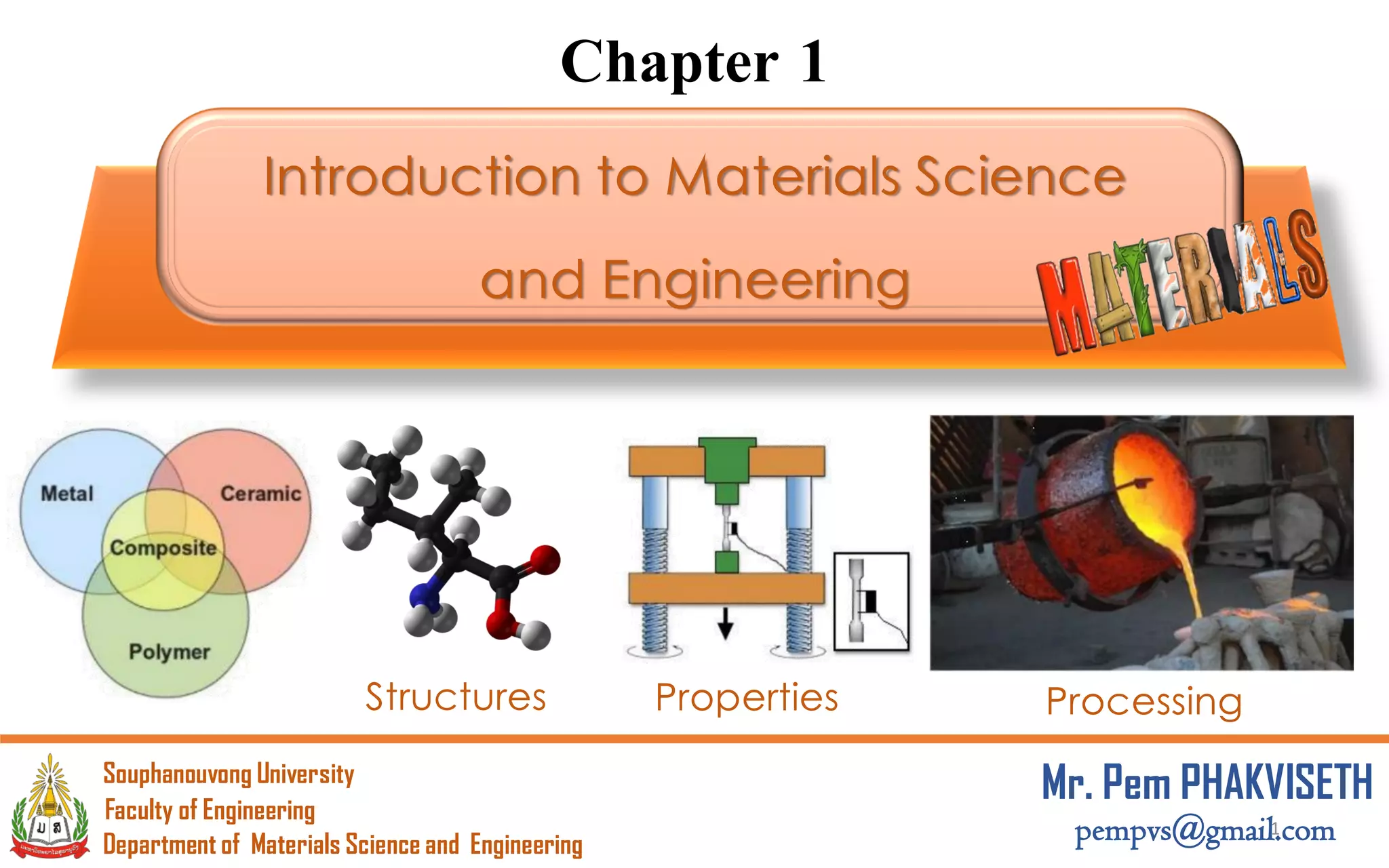
Structures Properties Processing
1
Department of Materials Science and Engineering
Souphanouvong University
Faculty of Engineering
Mr. Pem PHAKVISETH
pempvs@gmail.com
objective of Learning
• Understand the meaning of materials and engineering
• can explain types of materials used in the field of engineering as
well as their properties and applications.
2
What is Materials ?
What is Materials Engineering ?
What is Materials Science ?
1.Structure
2. Properties
3. Processing
4. Classification
5. Smart Materials
6. Nanotechnology
Example Apply materials
to work
Topic
3
What is Materials ?
• Materials is
• We have Known that basic materials such as concrete, steel, glass,
rubber, aluminum, copper, paper, plastic.
o Substances that humans have assembled or produced as products,
appliances, inventions, various constructions.
Topic
4
What is Materials Engineering?
• Materials Engineering is
o Materials is used in field work of engineering
o Or is a material that has been used through design and
engineering calculations concerning the structure or production
process of that material In order to obtain the desired properties
or according to defined in the engineering design process.
o Requires knowledge of materials science
Topic
5
What is Materials Science ?
• Materials Science is
o Basic knowledge about the relationships between internal
structure and properties including processing of materials
Topic
6
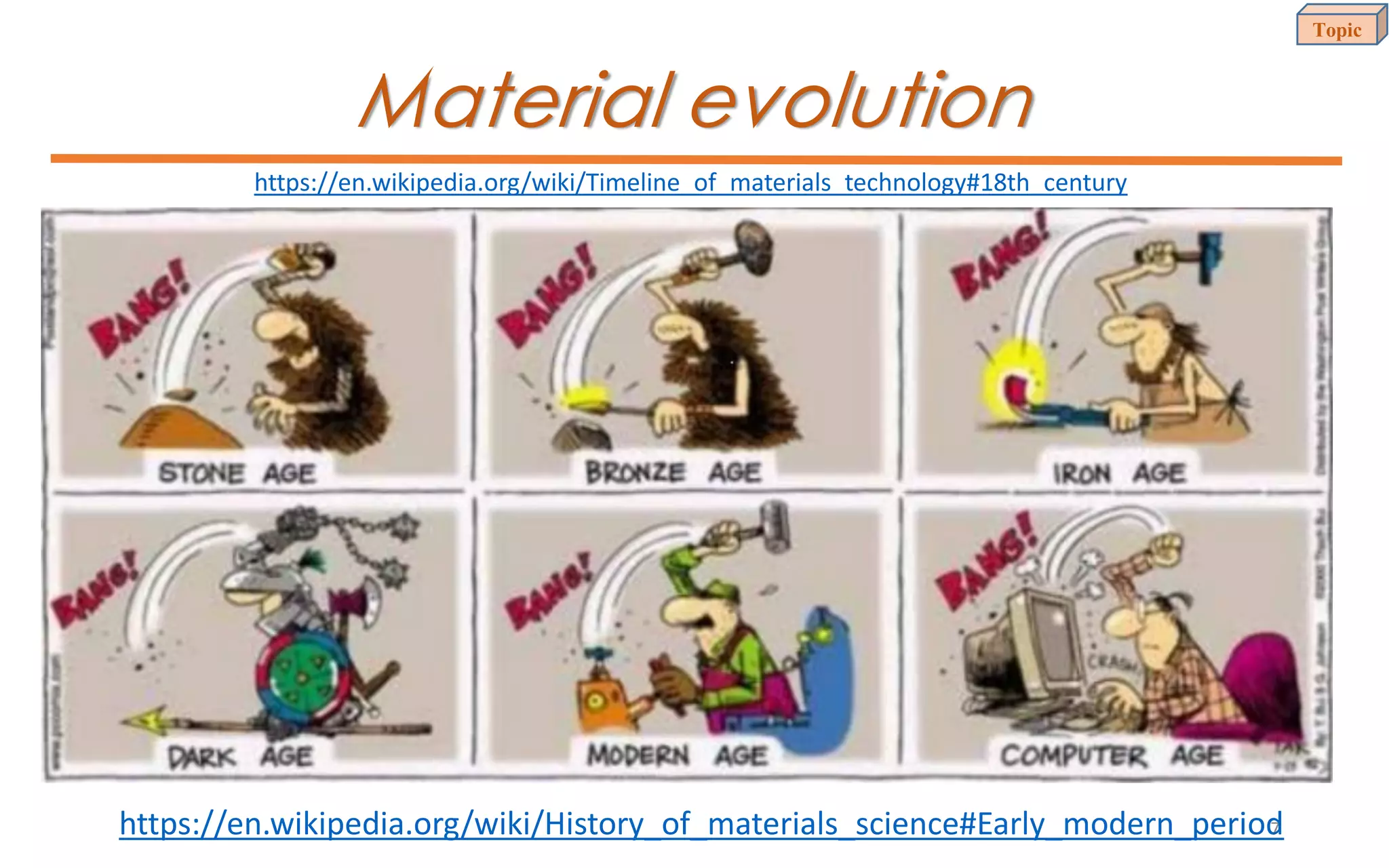
Material evolution
Topic
7https://en.wikipedia.org/wiki/History_of_materials_science#Early_modern_period
https://en.wikipedia.org/wiki/Timeline_of_materials_technology#18th_century
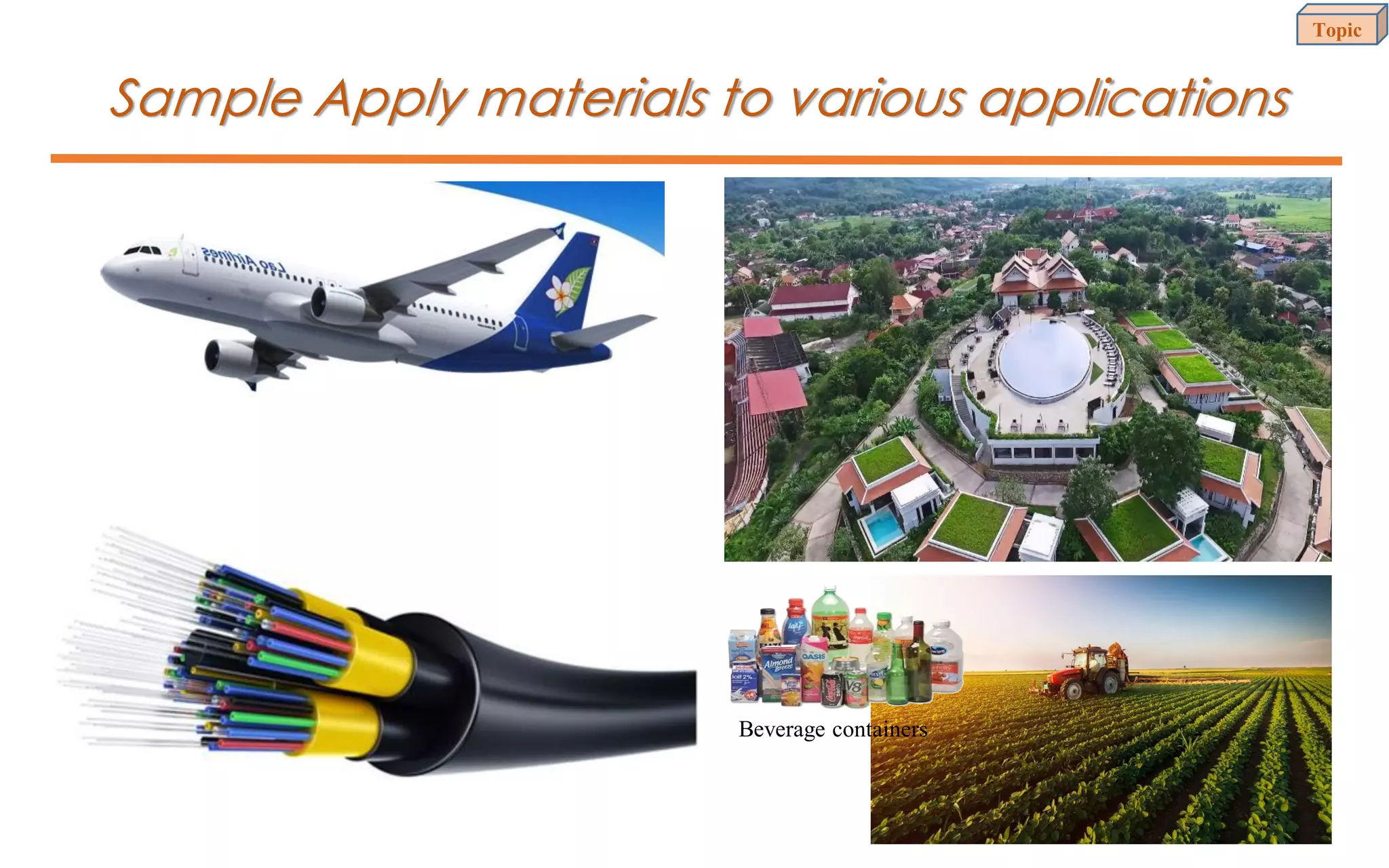
Sample Apply materials to various applications
Topic
8
Beverage containers
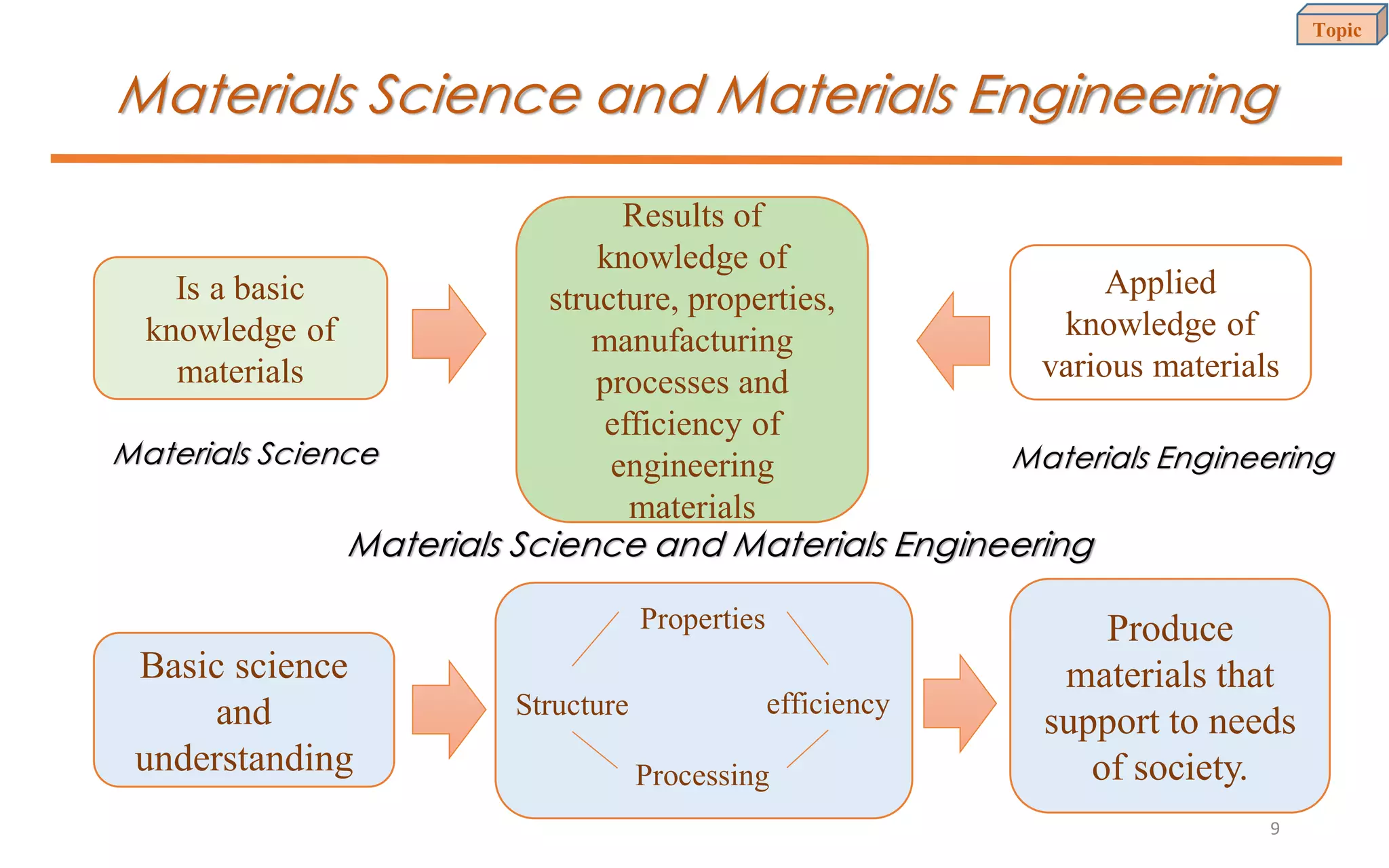
Materials Science and Materials Engineering
Is a basic
knowledge of
materials
Results of
knowledge of
structure, properties,
manufacturing
processes and
efficiency of
engineering
materials
Basic science
and
understanding
Structure
Properties
Processing
efficiency
Produce
materials that
support to needs
of society.
Applied
knowledge of
various materials
Materials Science Materials Engineering
Materials Science and Materials Engineering
Topic
9
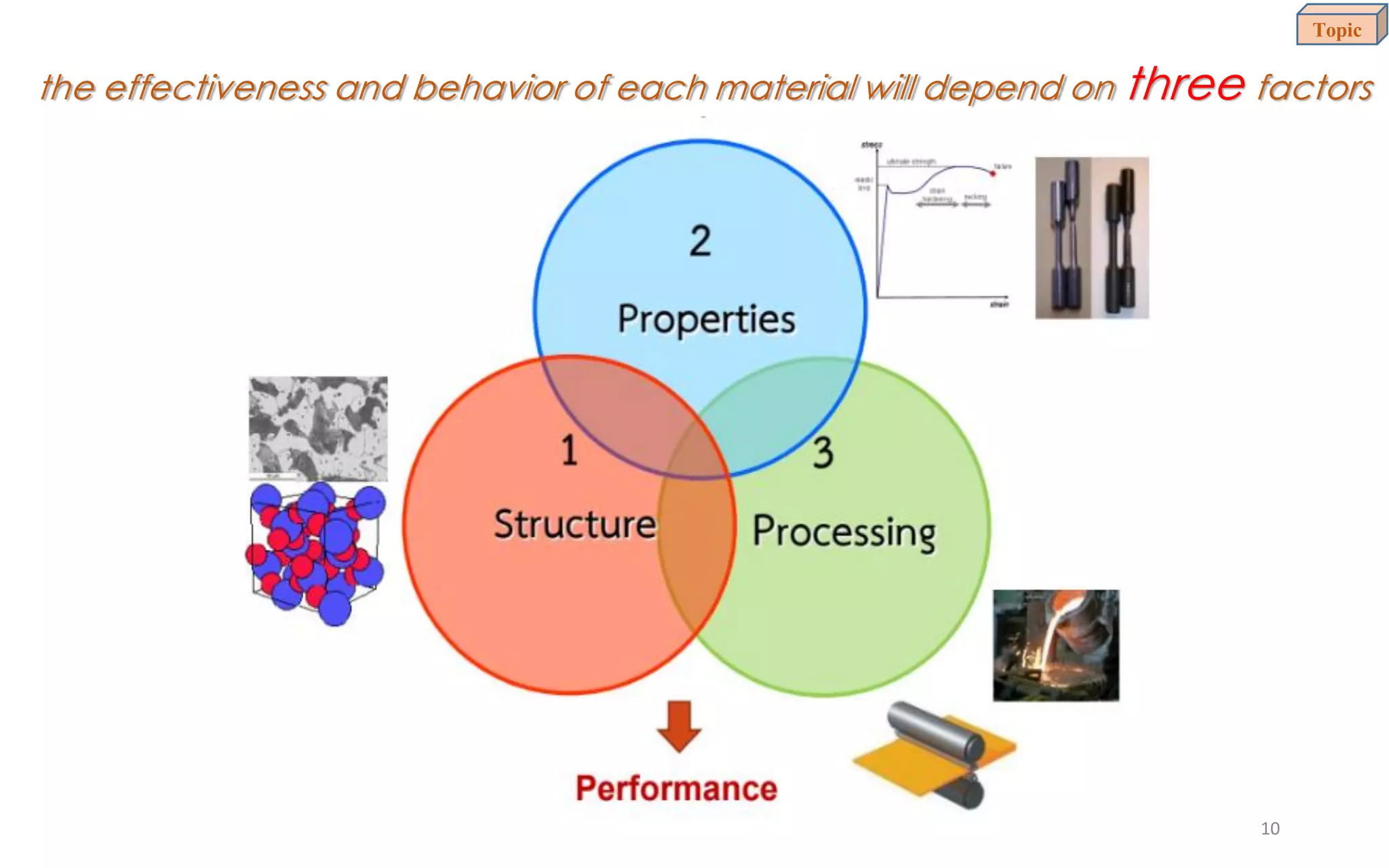
the effectiveness and behavior of each material will depend on three factors
Topic
10
1.Structure
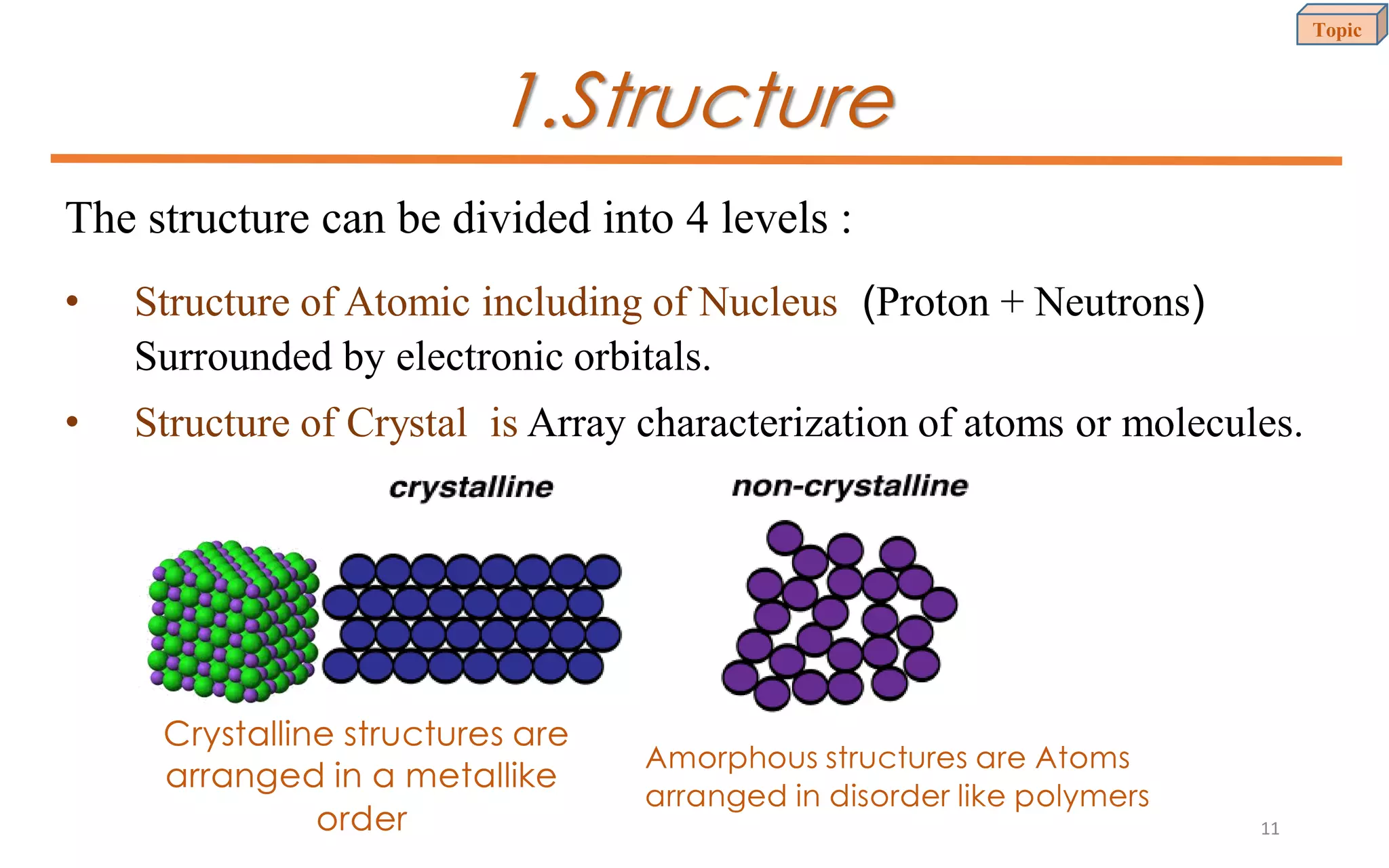
The structure can be divided into 4 levels :
• Structure of Atomic including of Nucleus (Proton + Neutrons)
Surrounded by electronic orbitals.
• Structure of Crystal is Array characterization of atoms or molecules.
Crystalline structures are
arranged in a metallike
order
Amorphous structures are Atoms
arranged in disorder like polymers
Topic
11
1. Structure (continues)
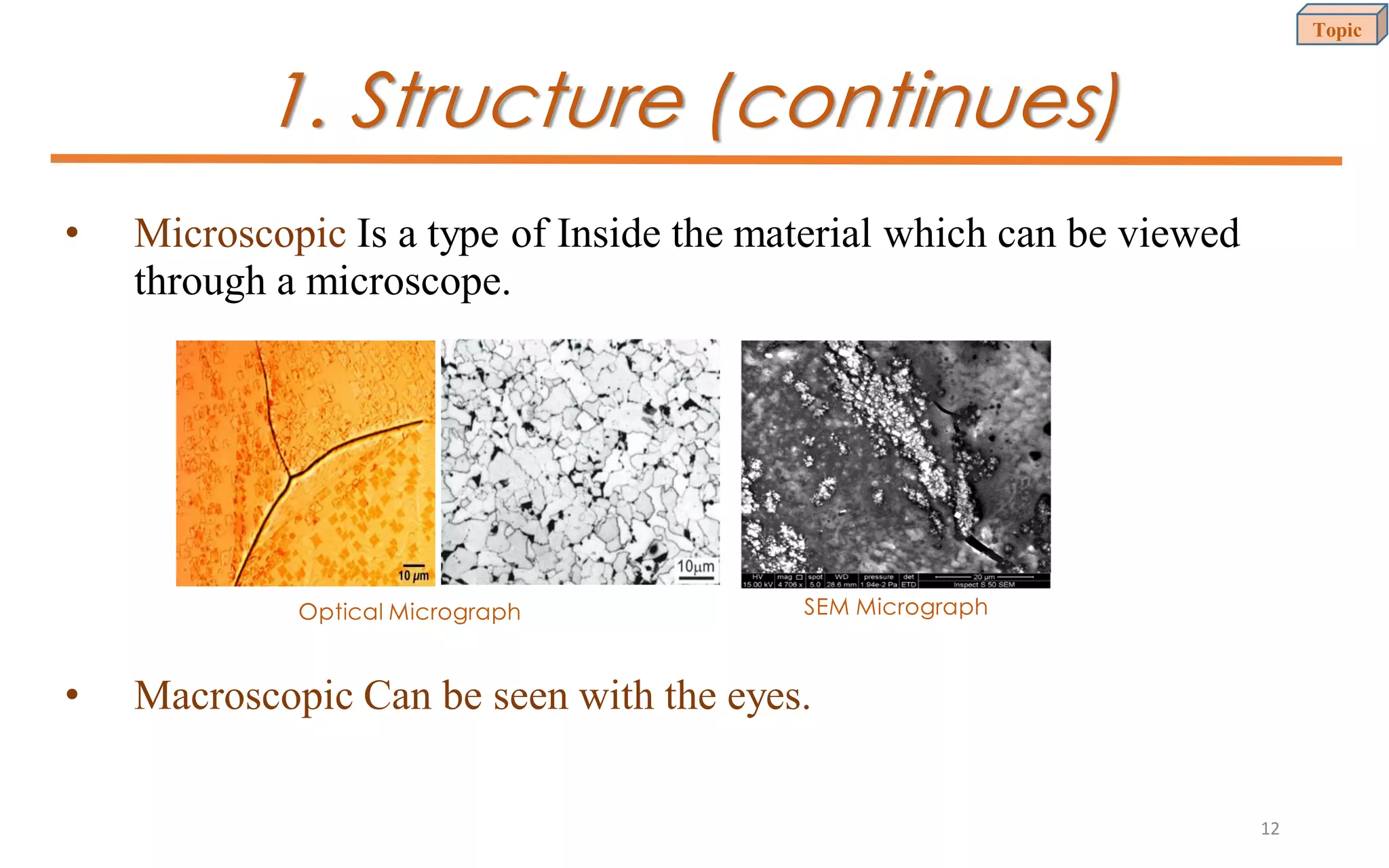
• Microscopic Is a type of Inside the material which can be viewed
through a microscope.
• Macroscopic Can be seen with the eyes.
Optical Micrograph SEM Micrograph
Topic
12
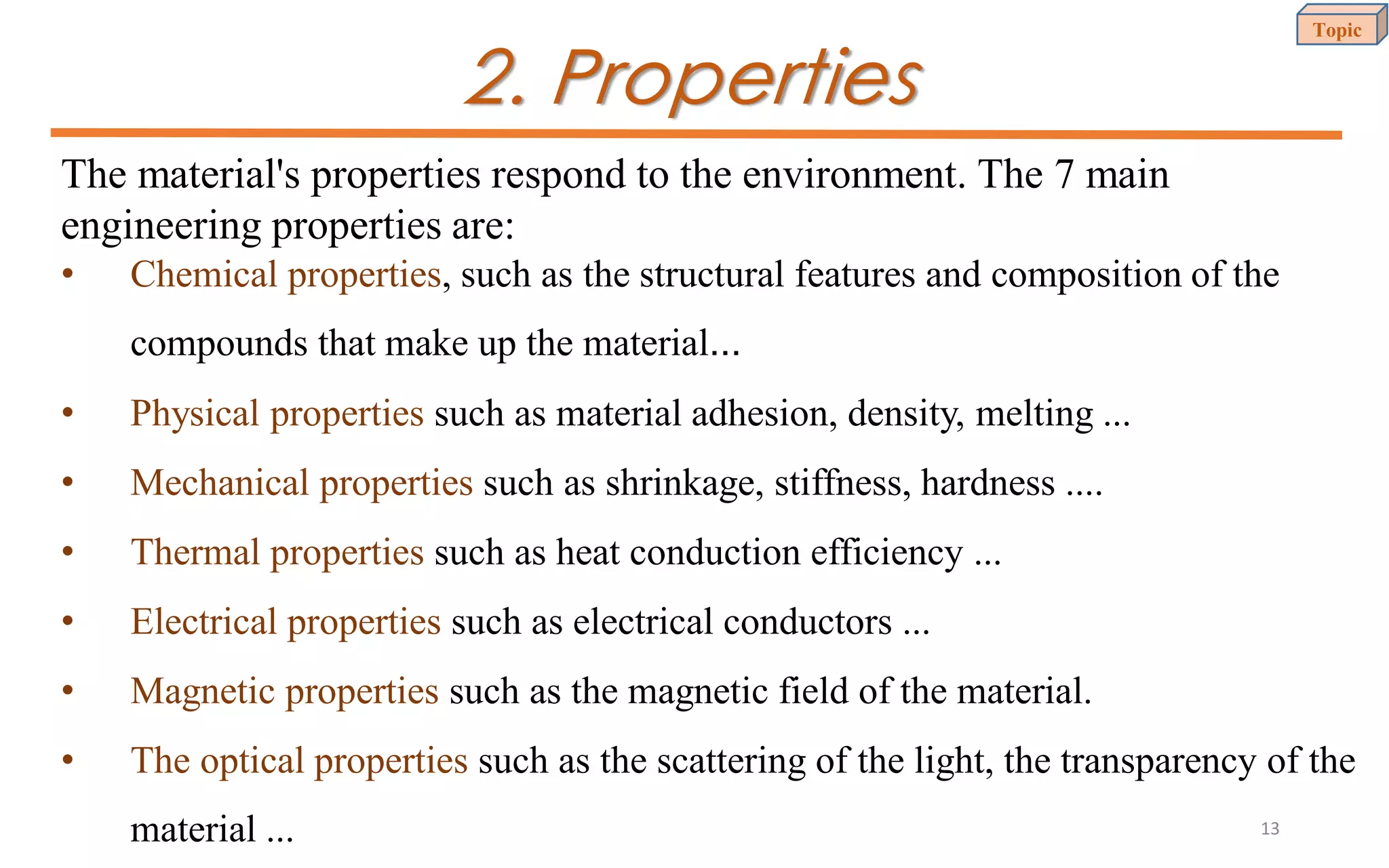
2. Properties
The material's properties respond to the environment. The 7 main
engineering properties are:
• Chemical properties, such as the structural features and composition of the
compounds that make up the material...
• Physical properties such as material adhesion, density, melting ...
• Mechanical properties such as shrinkage, stiffness, hardness ....
• Thermal properties such as heat conduction efficiency ...
• Electrical properties such as electrical conductors ...
• Magnetic properties such as the magnetic field of the material.
• The optical properties such as the scattering of the light, the transparency of the
material ...
Topic
13
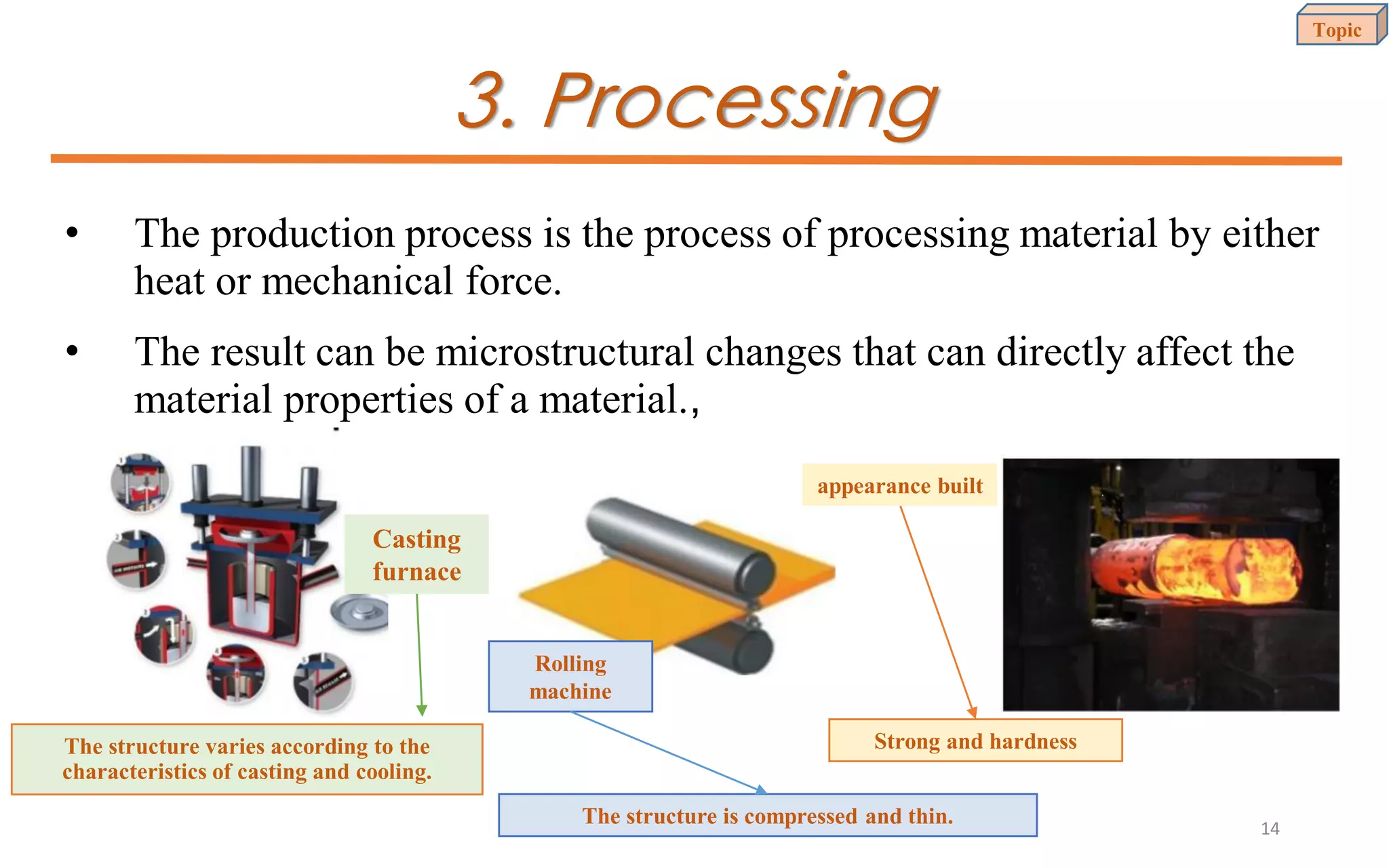
3. Processing
• The production process is the process of processing material by either
heat or mechanical force.
• The result can be microstructural changes that can directly affect the
material properties of a material.,
Casting
furnace
Rolling
machine
appearance built
The structure varies according to the
characteristics of casting and cooling.
The structure is compressed and thin.
Strong and hardness
Topic
14
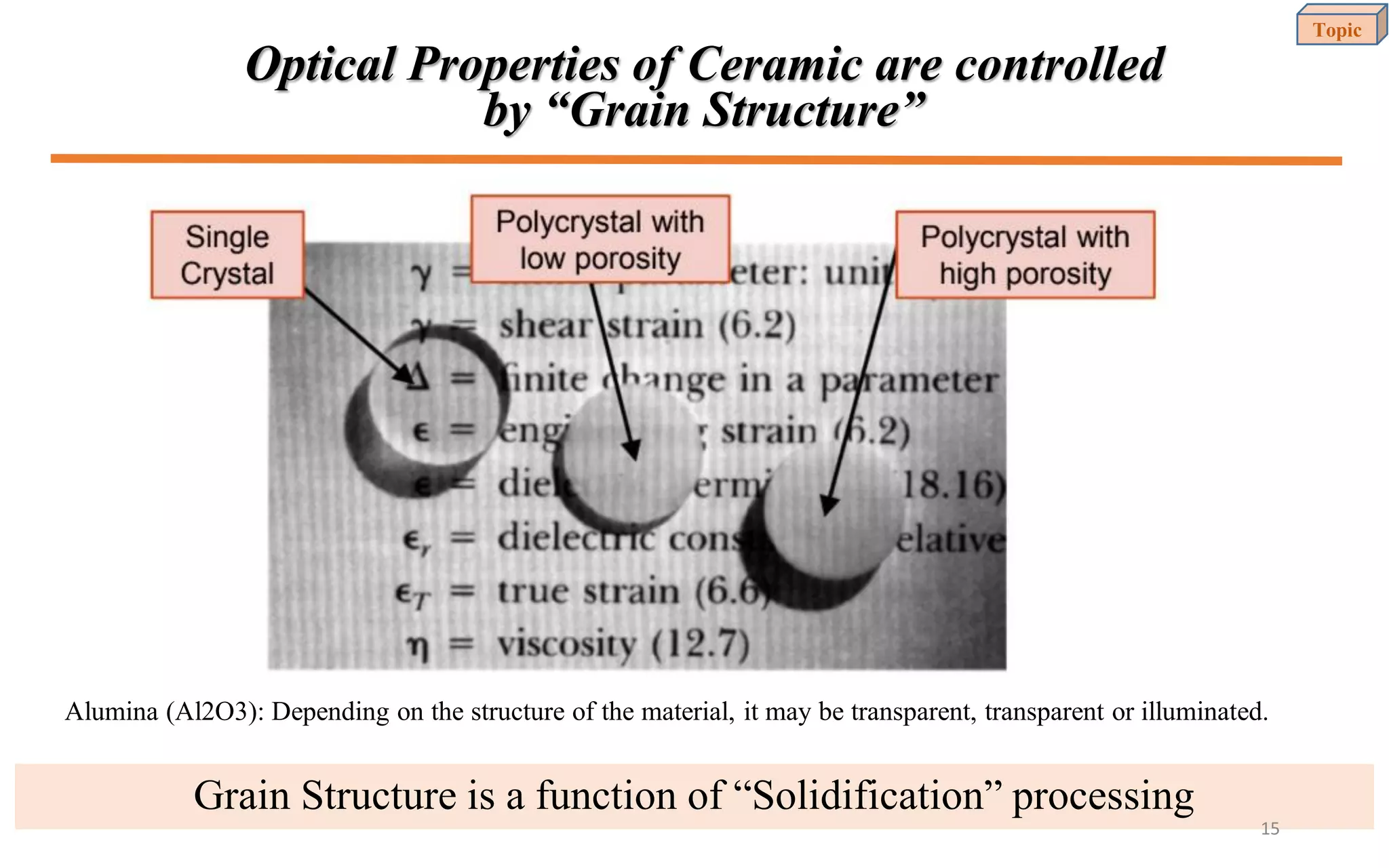
Optical Properties of Ceramic are controlled
by “Grain Structure”
Alumina (Al2O3): Depending on the structure of the material, it may be transparent, transparent or illuminated.
Grain Structure is a function of “Solidification” processing
Topic
15
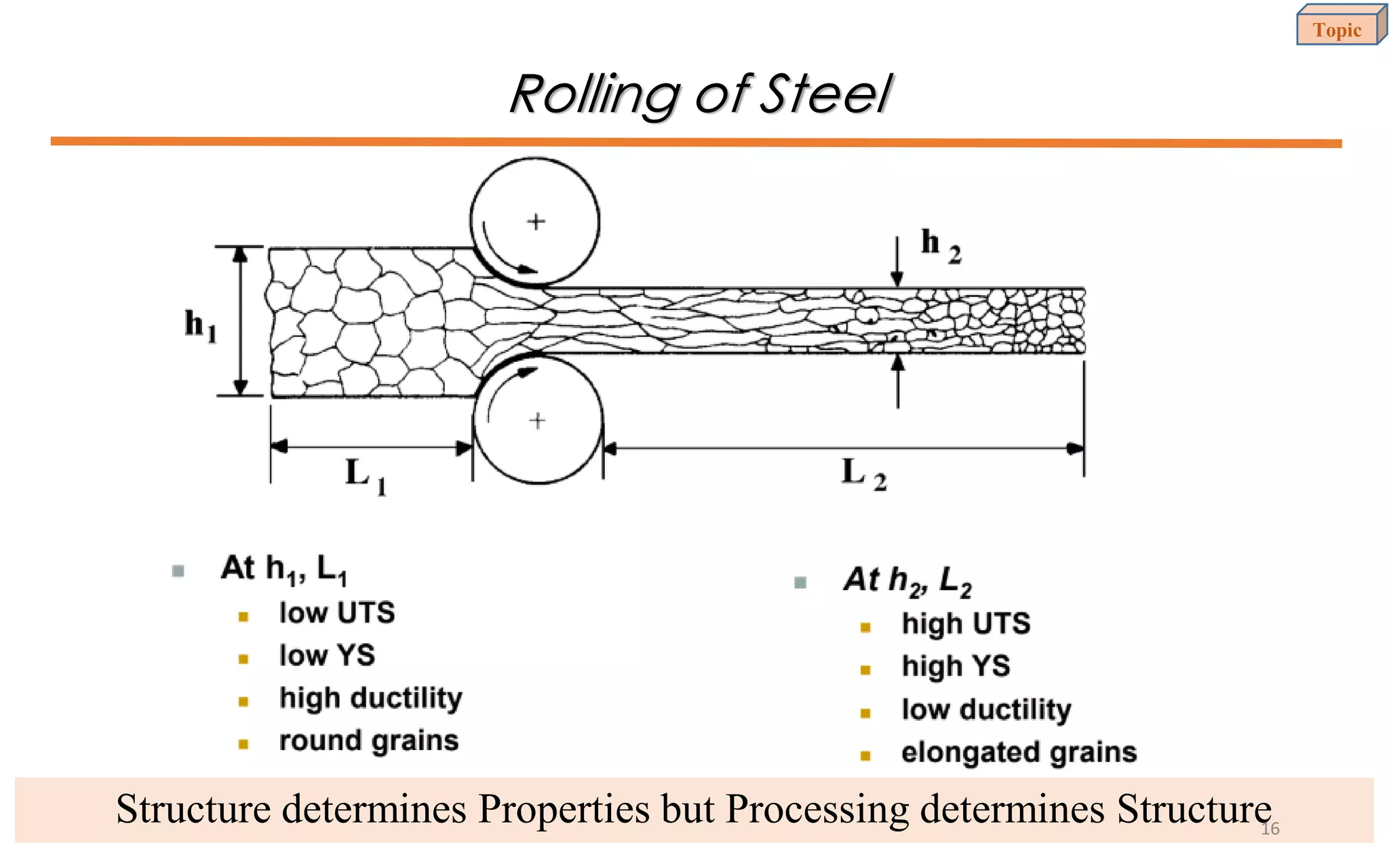
Rolling of Steel
Structure determines Properties but Processing determines Structure
Topic
16
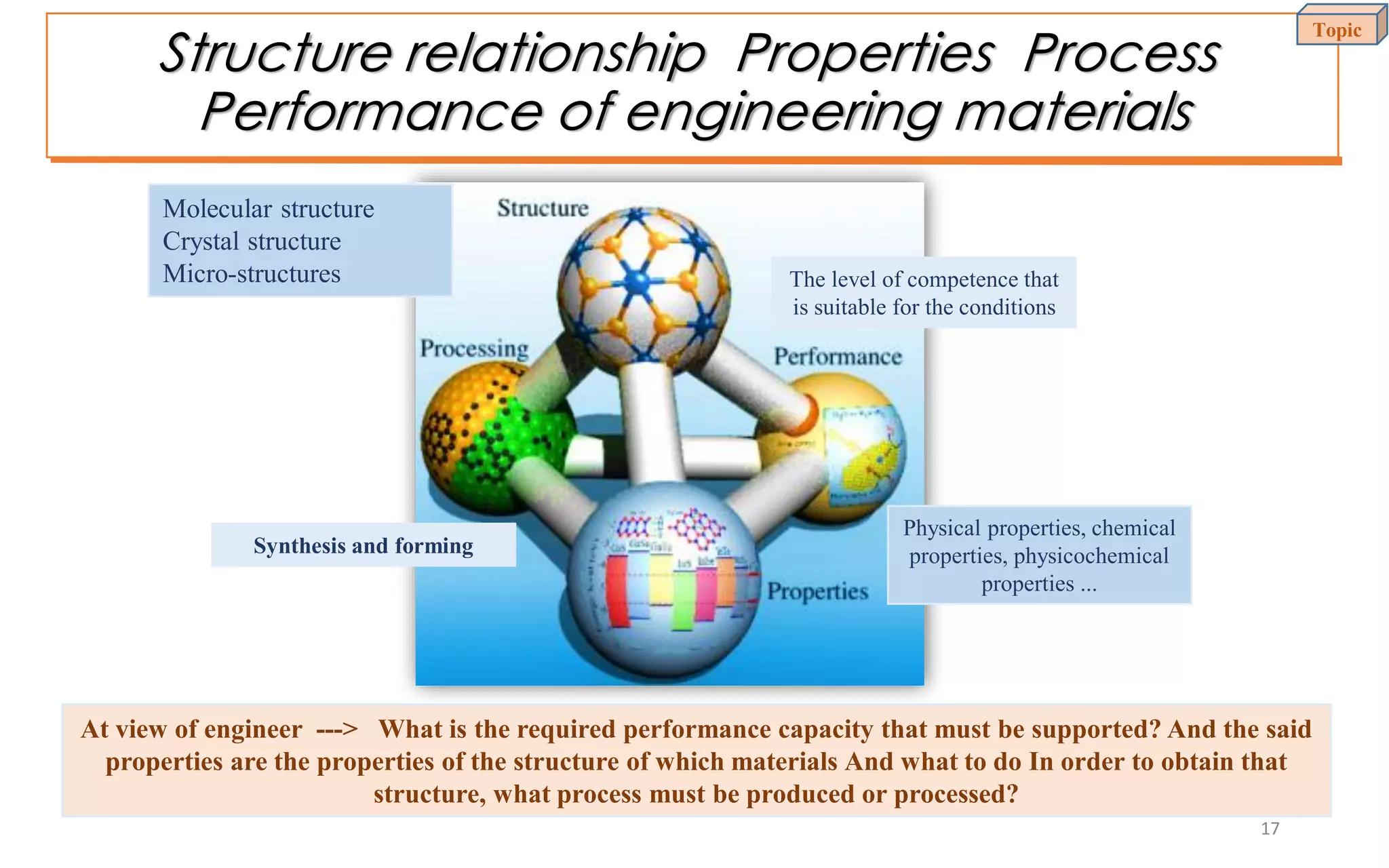
Structure relationship Properties Process
Performance of engineering materials
The level of competence that
is suitable for the conditions
Molecular structure
Crystal structure
Micro-structures
Physical properties, chemical
properties, physicochemical
properties ...
Synthesis and forming
At view of engineer ---> What is the required performance capacity that must be supported? And the said
properties are the properties of the structure of which materials And what to do In order to obtain that
structure, what process must be produced or processed?
Topic
17
Topic
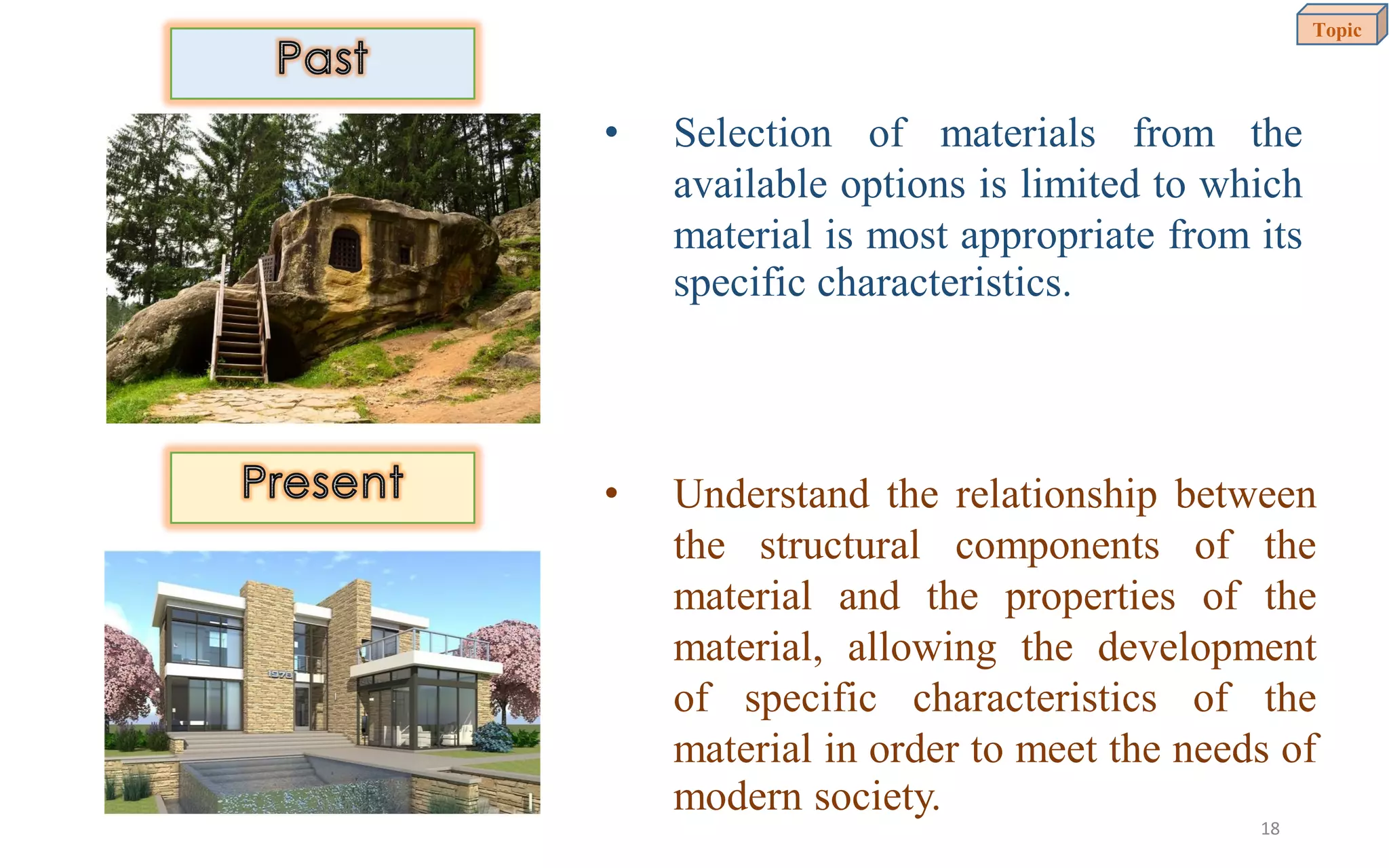
• Selection of materials from the
available options is limited to which
material is most appropriate from its
specific characteristics.
• Understand the relationship between
the structural components of the
material and the properties of the
material, allowing the development
of specific characteristics of the
material in order to meet the needs of
modern society.
18
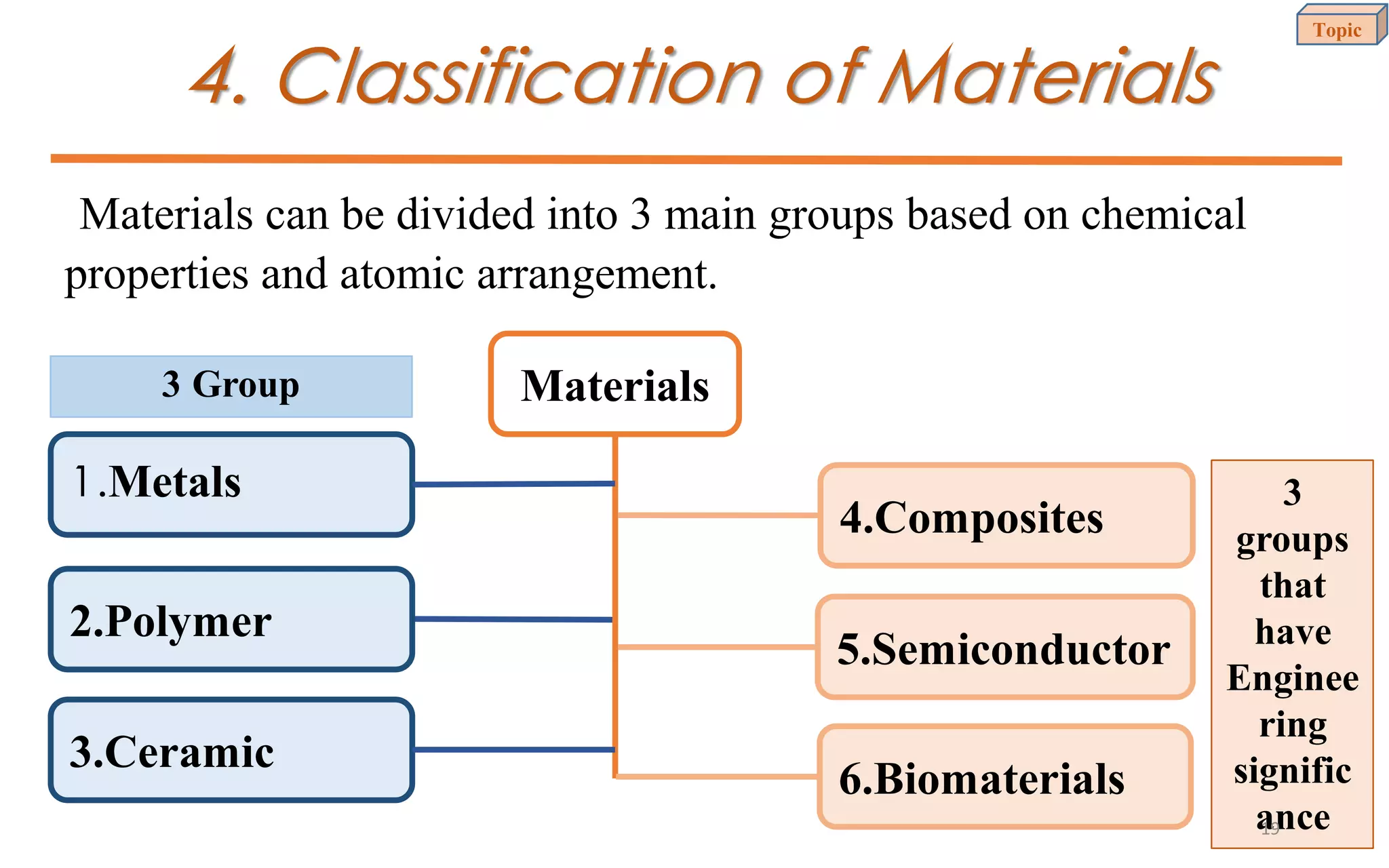
4. Classification of Materials
Materials can be divided into 3 main groups based on chemical
properties and atomic arrangement.
Materials
1.Metals
2.Polymer
3.Ceramic
4.Composites
5.Semiconductor
6.Biomaterials
3 Group
3
groups
that
have
Enginee
ring
signific
ance
Topic
19
4.1 Metals
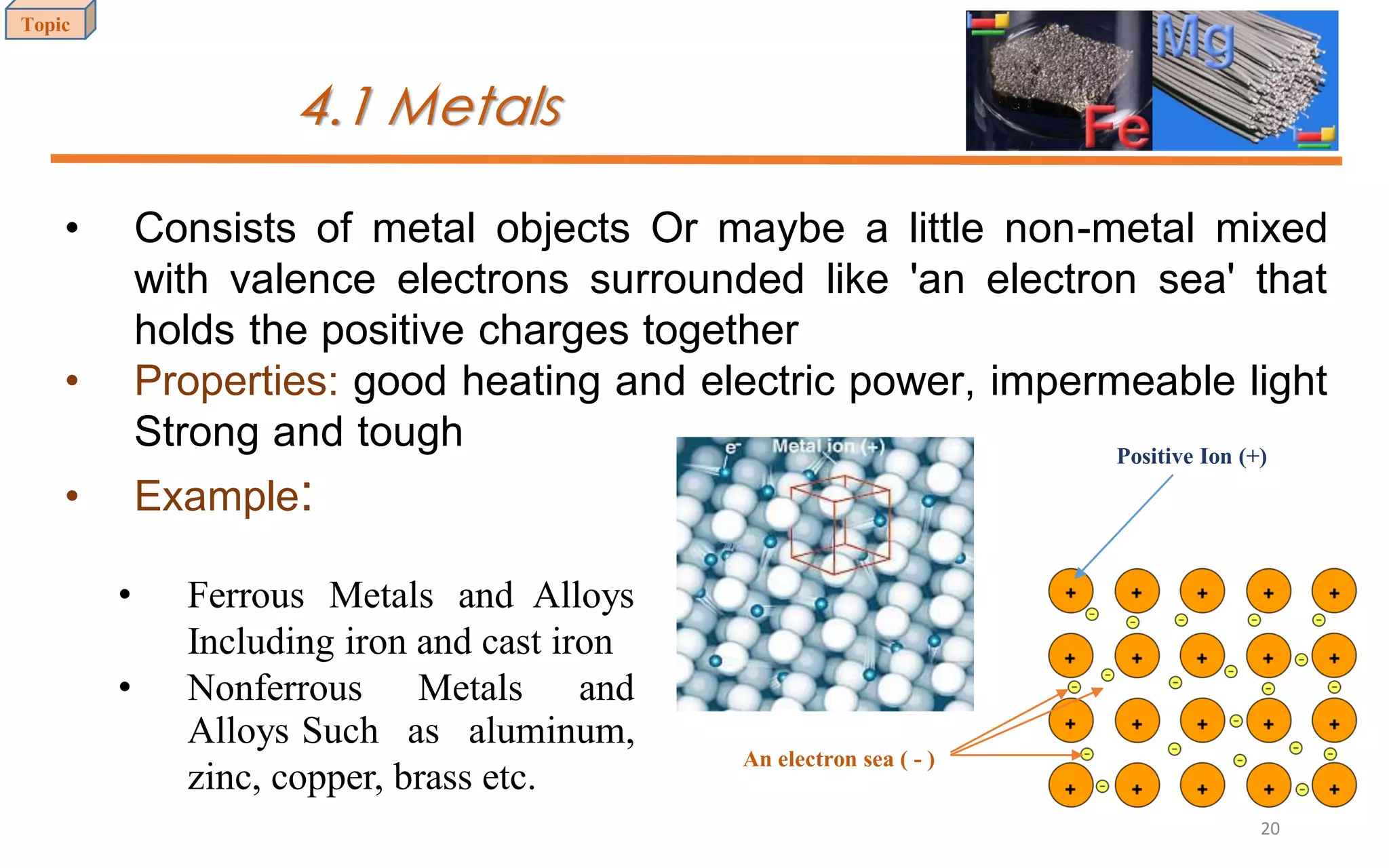
• Consists of metal objects Or maybe a little non-metal mixed
with valence electrons surrounded like 'an electron sea' that
holds the positive charges together
• Properties: good heating and electric power, impermeable light
Strong and tough
• Example:
• Ferrous Metals and Alloys
Including iron and cast iron
• Nonferrous Metals and
Alloys Such as aluminum,
zinc, copper, brass etc.
Topic
An electron sea ( - )
Positive Ion (+)
20
4.2 Polymer
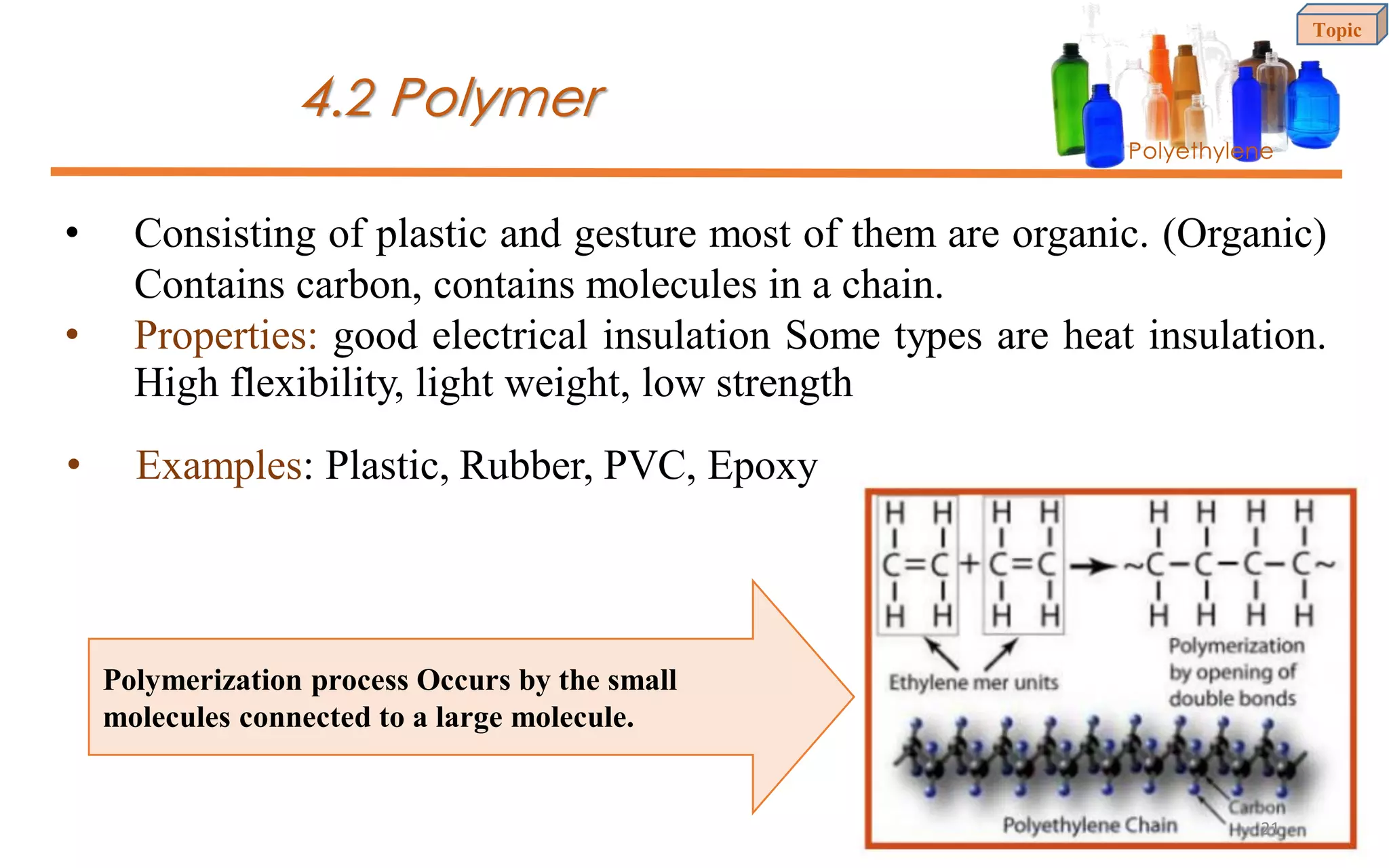
Polyethylene
• Consisting of plastic and gesture most of them are organic. (Organic)
Contains carbon, contains molecules in a chain.
• Properties: good electrical insulation Some types are heat insulation.
High flexibility, light weight, low strength
• Examples: Plastic, Rubber, PVC, Epoxy
Polymerization process Occurs by the small
molecules connected to a large molecule.
Topic
21
4.3 Ceramic
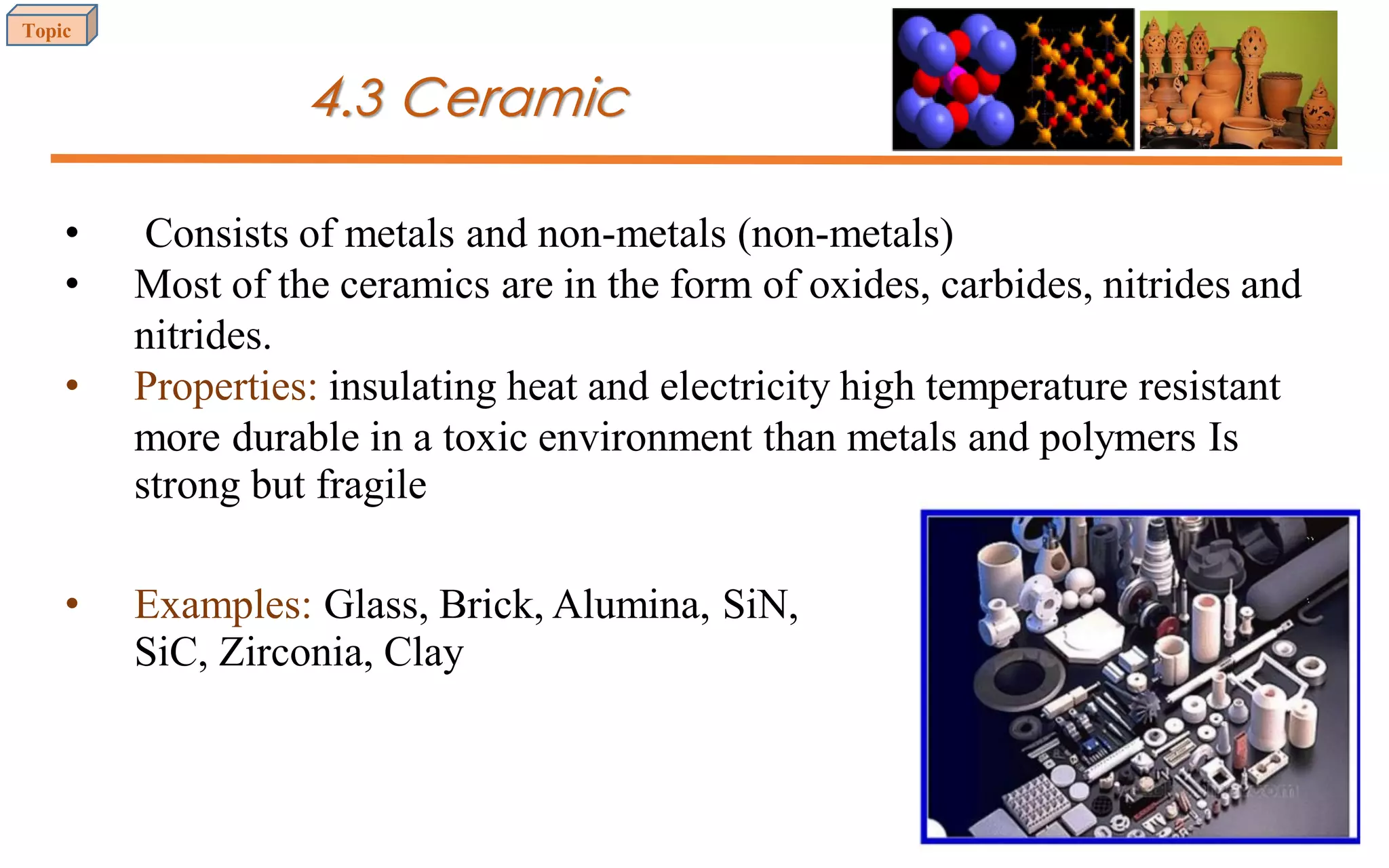
• Consists of metals and non-metals (non-metals)
• Most of the ceramics are in the form of oxides, carbides, nitrides and
nitrides.
• Properties: insulating heat and electricity high temperature resistant
more durable in a toxic environment than metals and polymers Is
strong but fragile
• Examples: Glass, Brick, Alumina, SiN,
SiC, Zirconia, Clay
Topic
22
4.4 Composites
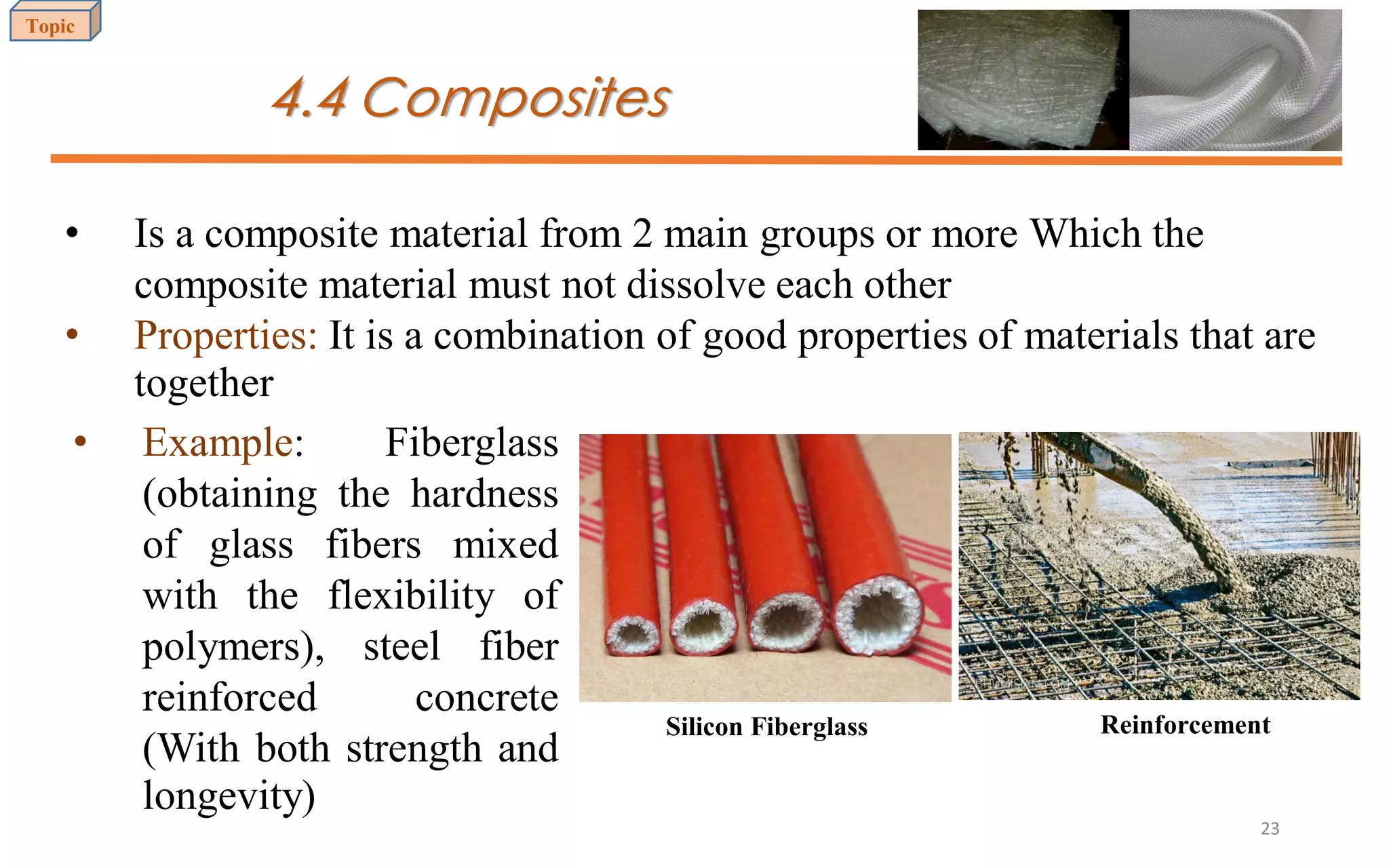
• Is a composite material from 2 main groups or more Which the
composite material must not dissolve each other
• Properties: It is a combination of good properties of materials that are
together
• Example: Fiberglass
(obtaining the hardness
of glass fibers mixed
with the flexibility of
polymers), steel fiber
reinforced concrete
(With both strength and
longevity)
Silicon Fiberglass Reinforcement
Topic
23
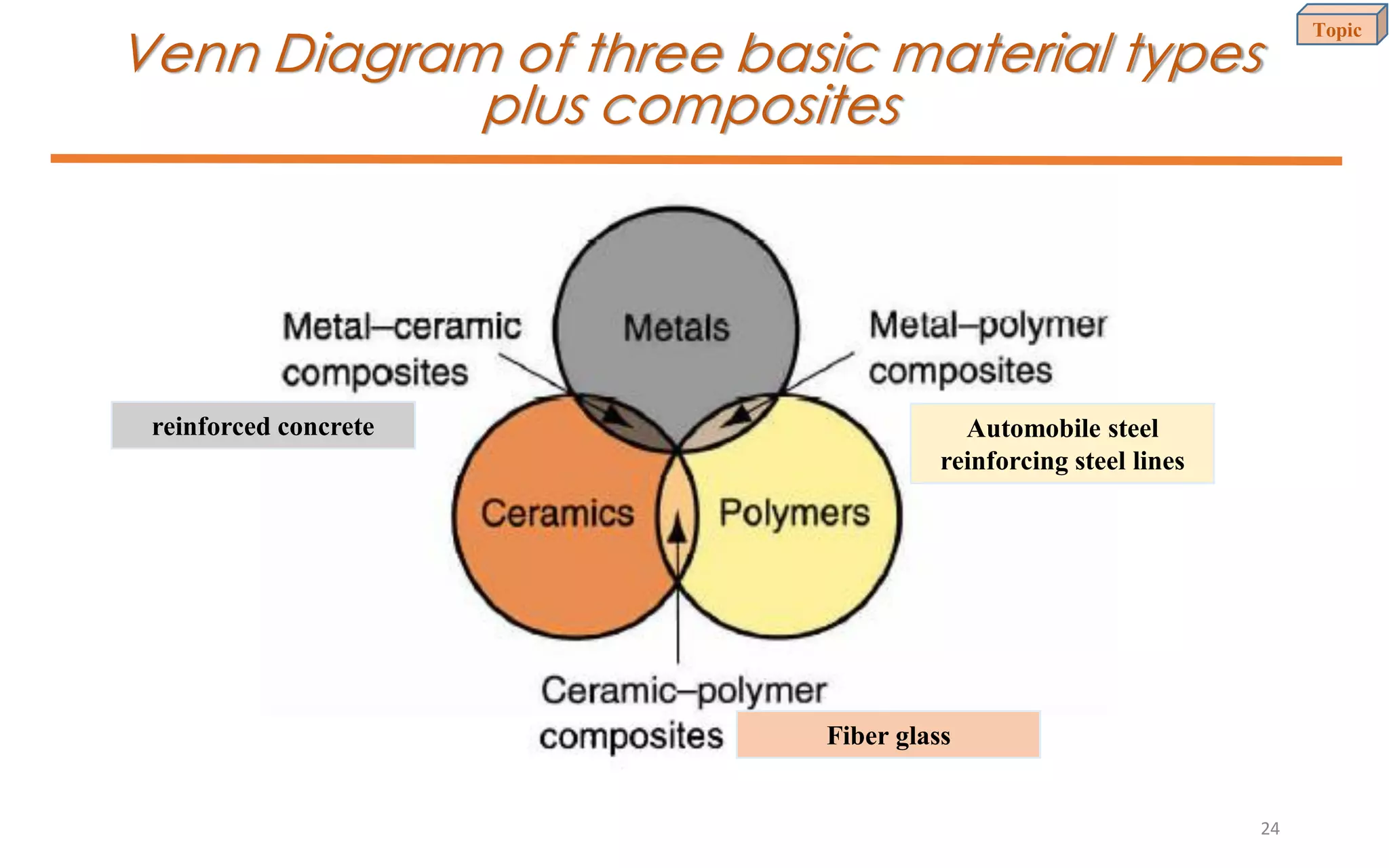
Venn Diagram of three basic material types
plus composites
reinforced concrete Automobile steel
reinforcing steel lines
Fiber glass
Topic
24
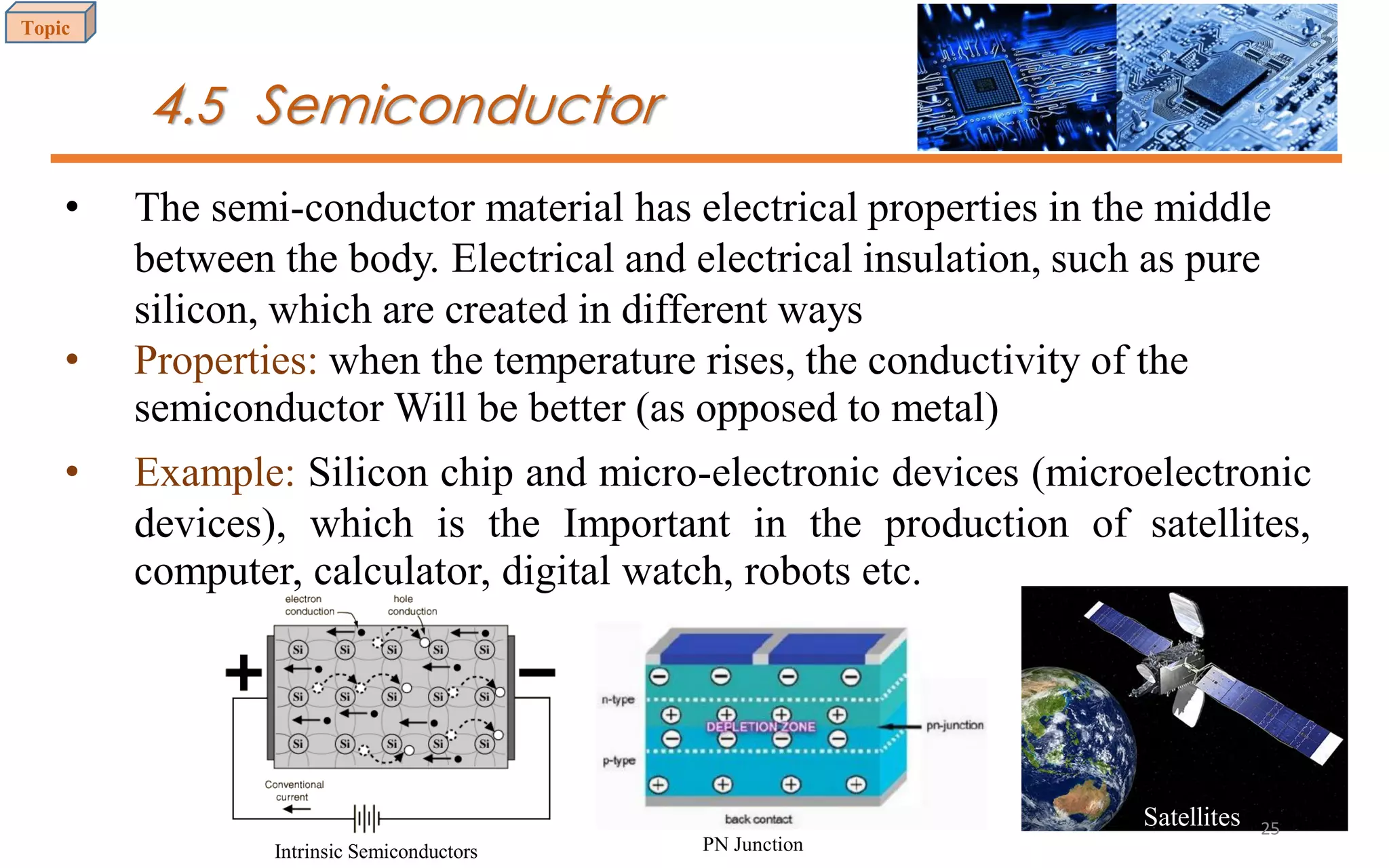
4.5 Semiconductor
• The semi-conductor material has electrical properties in the middle
between the body. Electrical and electrical insulation, such as pure
silicon, which are created in different ways
• Properties: when the temperature rises, the conductivity of the
semiconductor Will be better (as opposed to metal)
• Example: Silicon chip and micro-electronic devices (microelectronic
devices), which is the Important in the production of satellites,
computer, calculator, digital watch, robots etc.
Intrinsic Semiconductors
Satellites
PN Junction
Topic
25
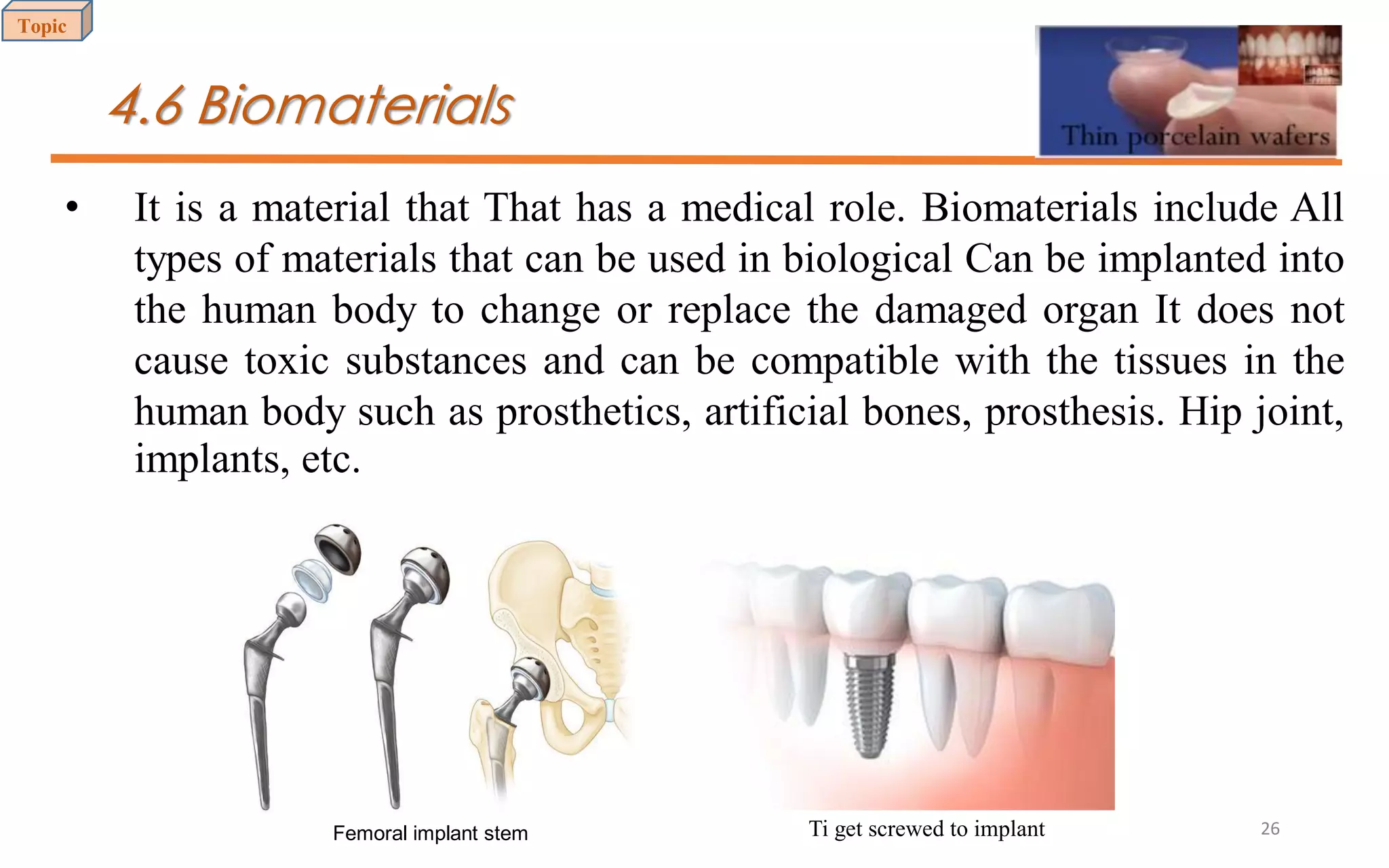
4.6 Biomaterials
• It is a material that That has a medical role. Biomaterials include All
types of materials that can be used in biological Can be implanted into
the human body to change or replace the damaged organ It does not
cause toxic substances and can be compatible with the tissues in the
human body such as prosthetics, artificial bones, prosthesis. Hip joint,
implants, etc.
Femoral implant stem Ti get screwed to implant
Topic
26
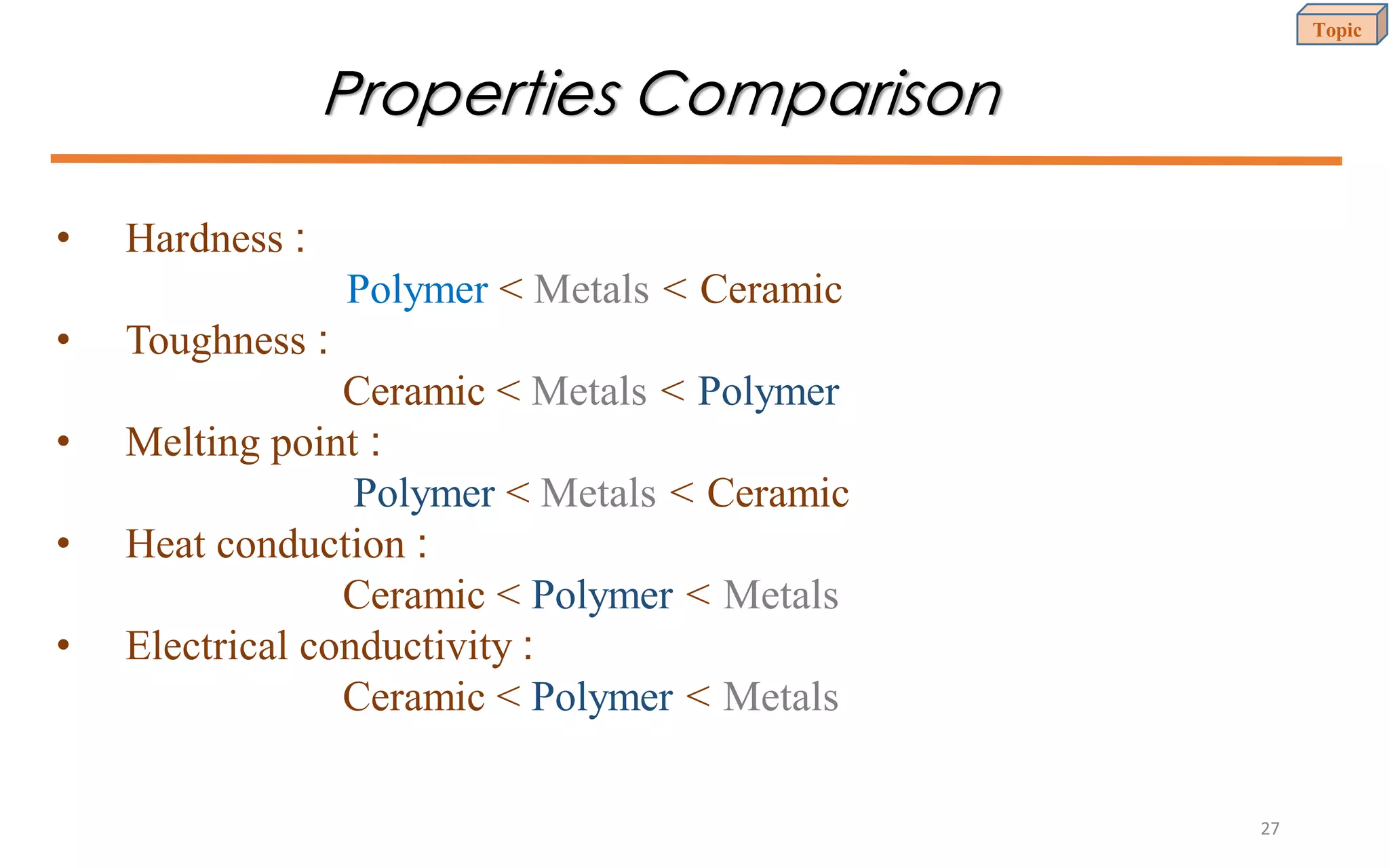
Properties Comparison
• Hardness :
Polymer < Metals < Ceramic
• Toughness :
Ceramic < Metals < Polymer
• Melting point :
Polymer < Metals < Ceramic
• Heat conduction :
Ceramic < Polymer < Metals
• Electrical conductivity :
Ceramic < Polymer < Metals
Topic
27
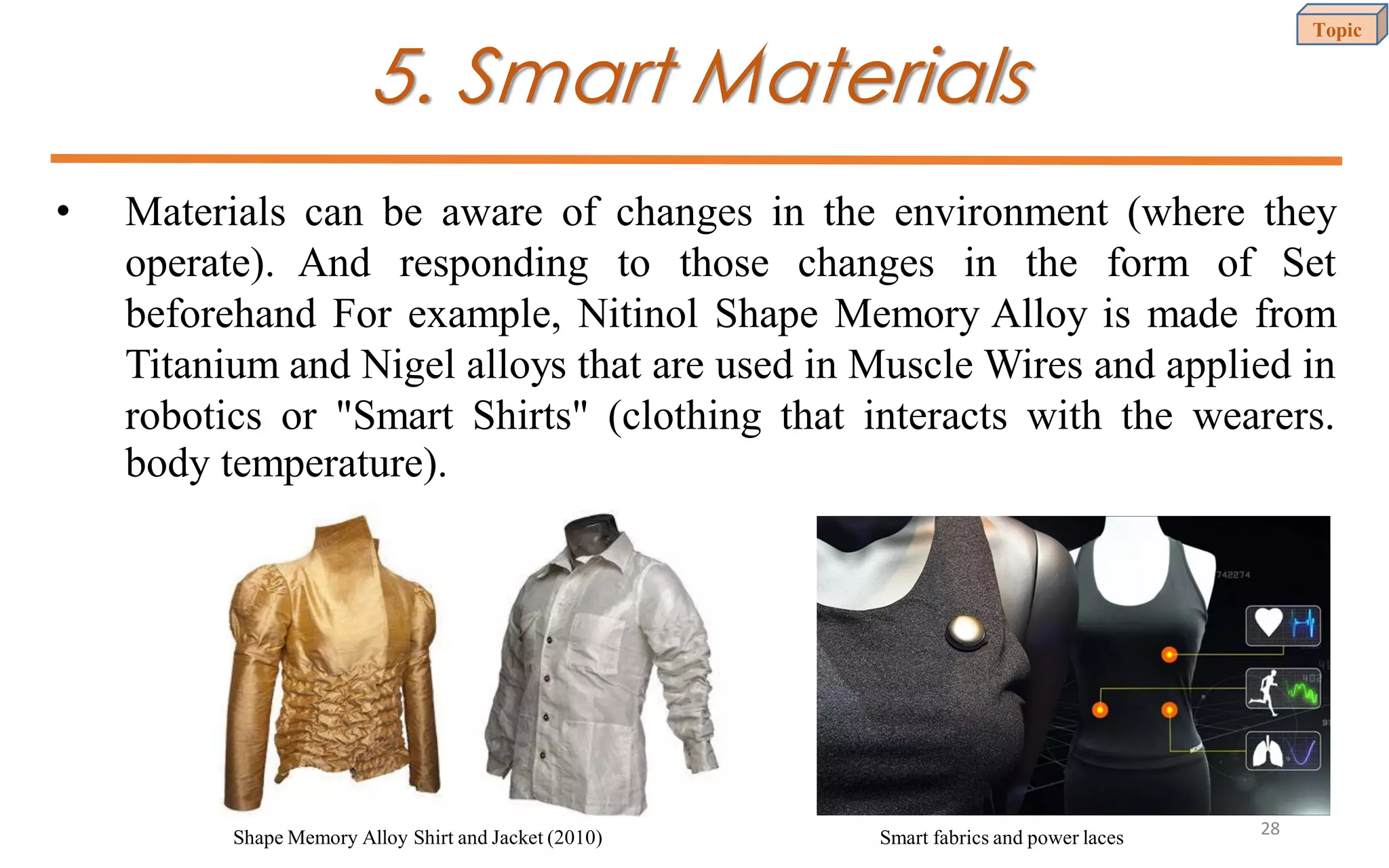
5. Smart Materials
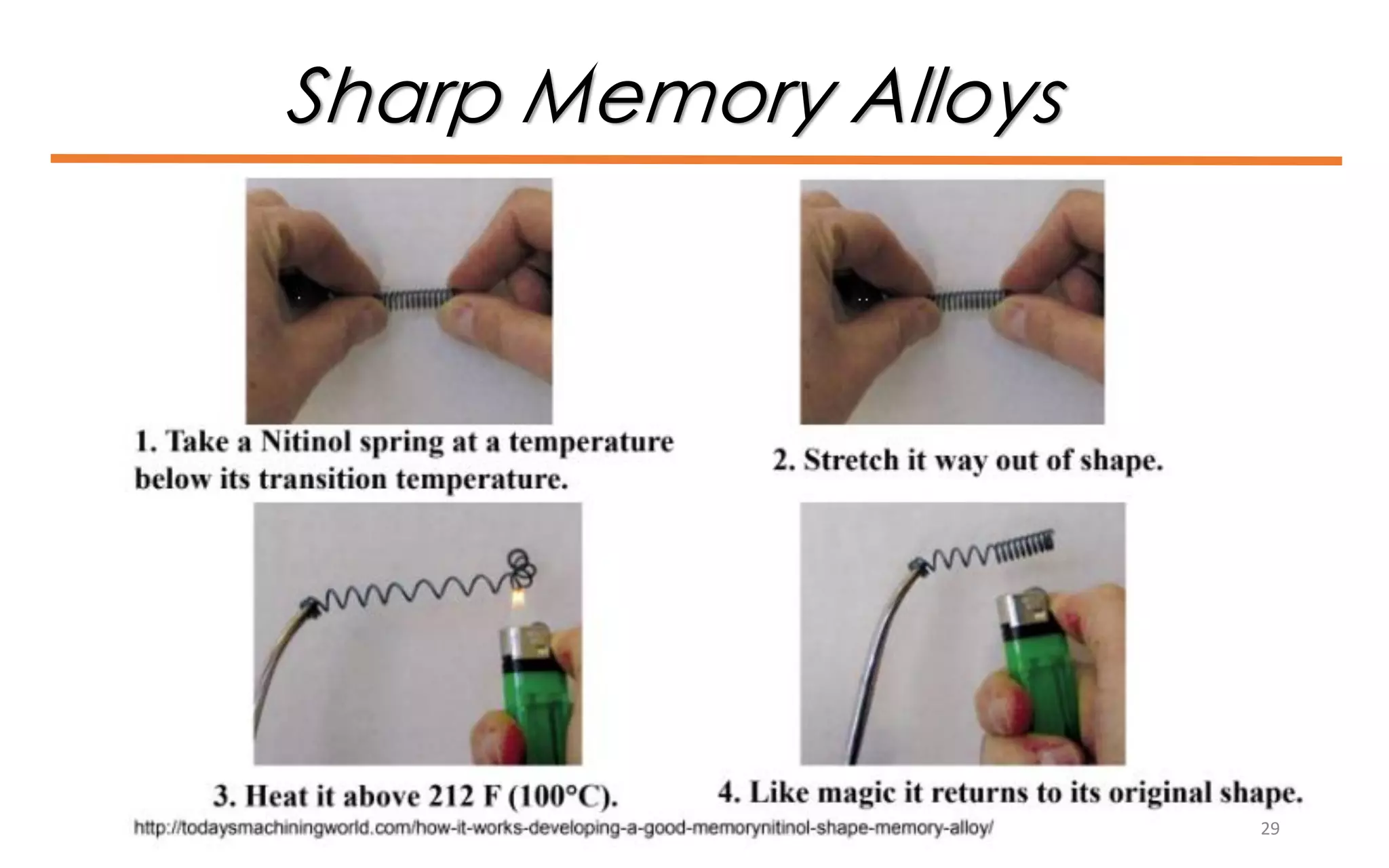
• Materials can be aware of changes in the environment (where they
operate). And responding to those changes in the form of Set
beforehand For example, Nitinol Shape Memory Alloy is made from
Titanium and Nigel alloys that are used in Muscle Wires and applied in
robotics or "Smart Shirts" (clothing that interacts with the wearers.
body temperature).
Shape Memory Alloy Shirt and Jacket (2010) Smart fabrics and power laces
Topic
28
Sharp Memory Alloys
29
5. Smart Materials) (continues)
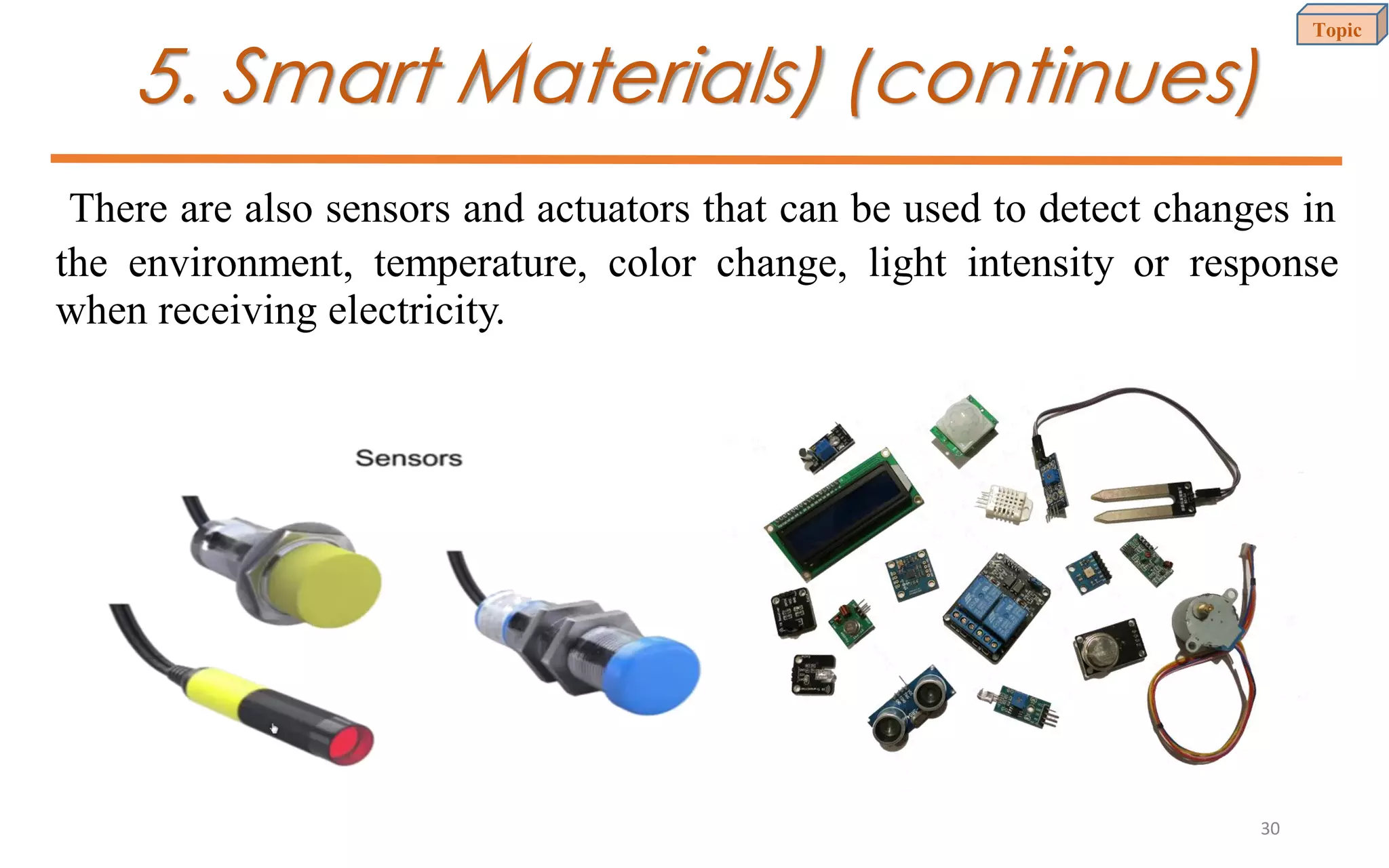
There are also sensors and actuators that can be used to detect changes in
the environment, temperature, color change, light intensity or response
when receiving electricity.
Topic
30
6. Nanotechnology
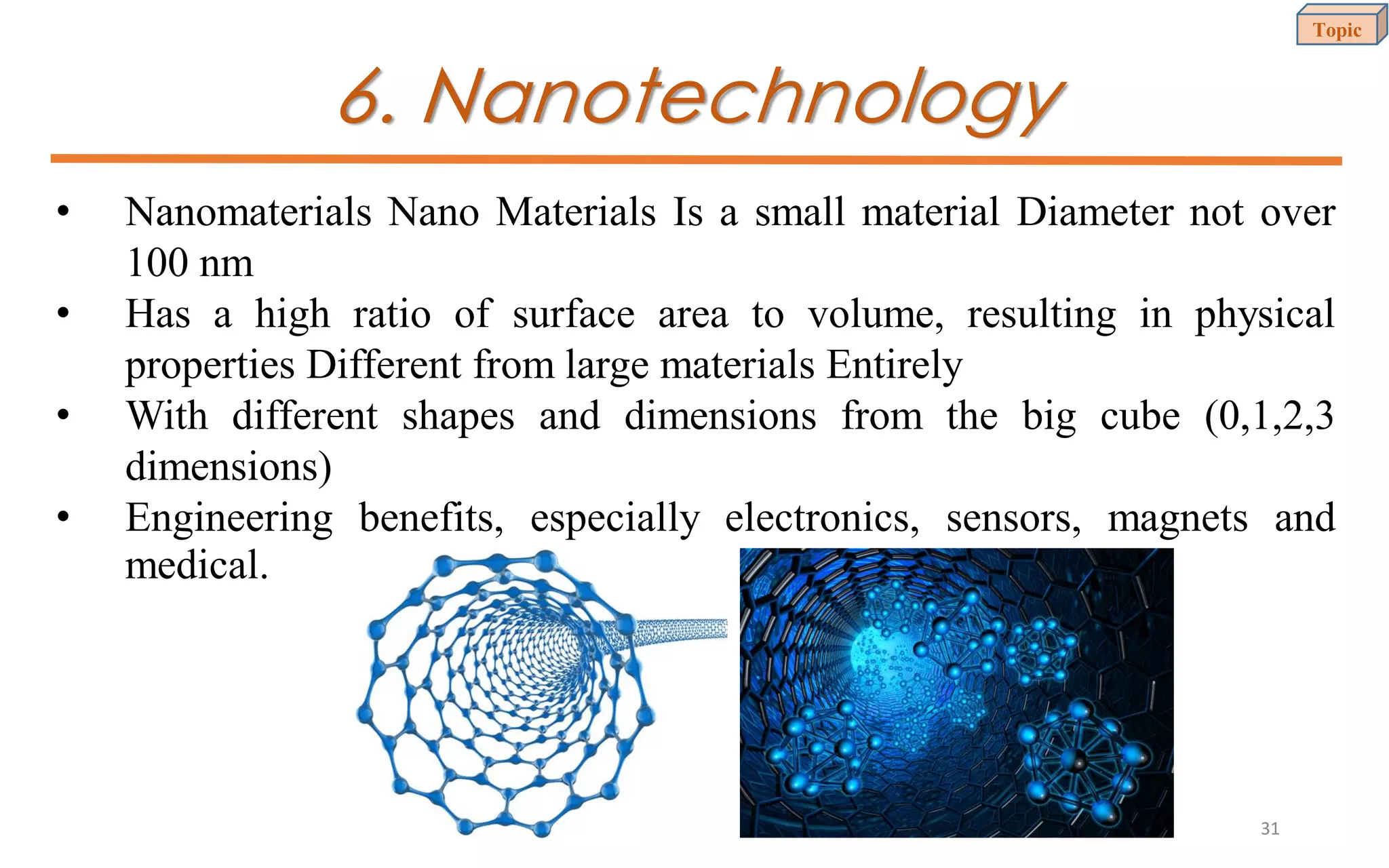
• Nanomaterials Nano Materials Is a small material Diameter not over
100 nm
• Has a high ratio of surface area to volume, resulting in physical
properties Different from large materials Entirely
• With different shapes and dimensions from the big cube (0,1,2,3
dimensions)
• Engineering benefits, especially electronics, sensors, magnets and
medical.
Topic
31
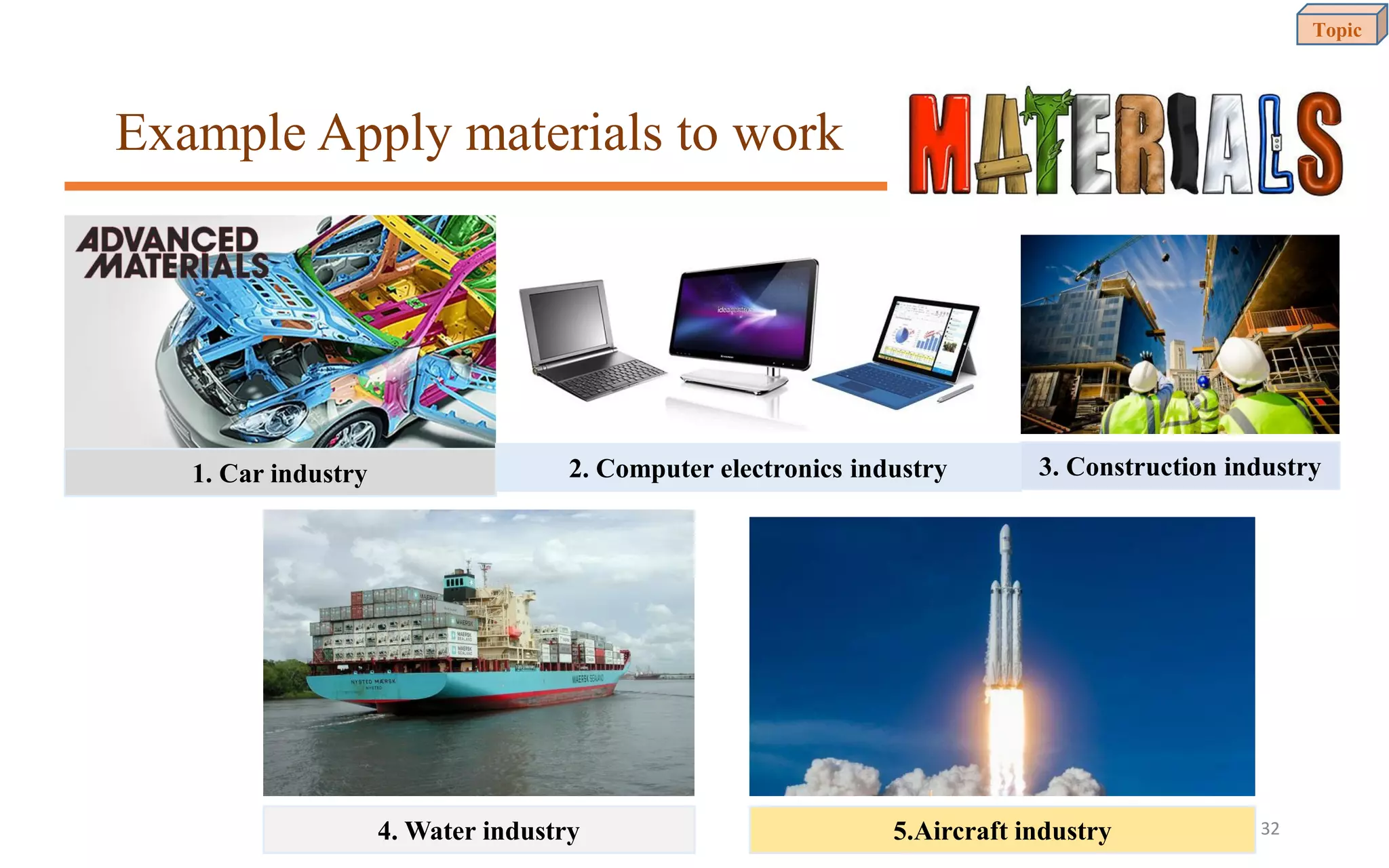
Example Apply materials to work
1. Car industry 2. Computer electronics industry 3. Construction industry
4. Water industry 5.Aircraft industry
Topic
32
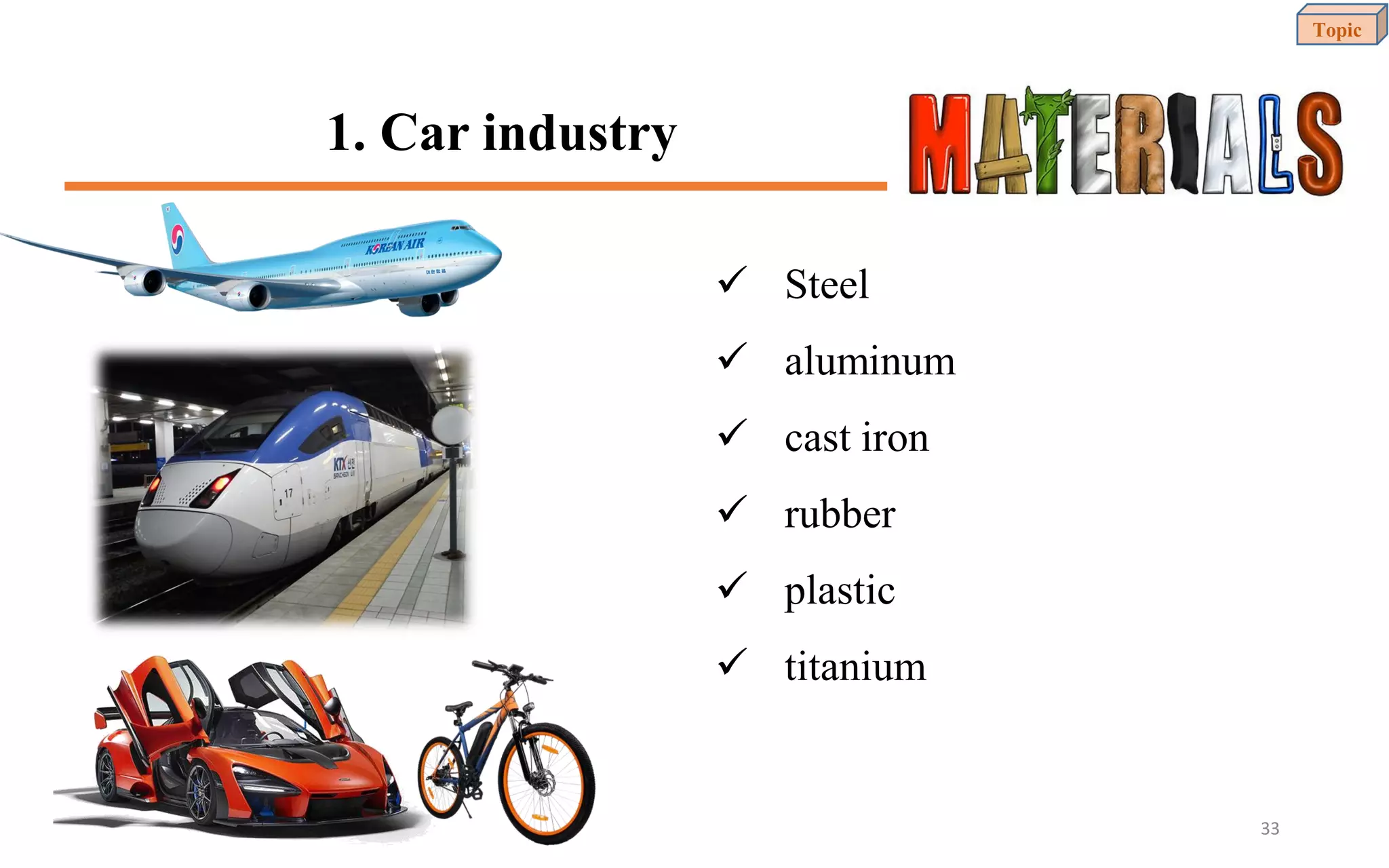
1. Car industry
✓ Steel
✓ aluminum
✓ cast iron
✓ rubber
✓ plastic
✓ titanium
Topic
33
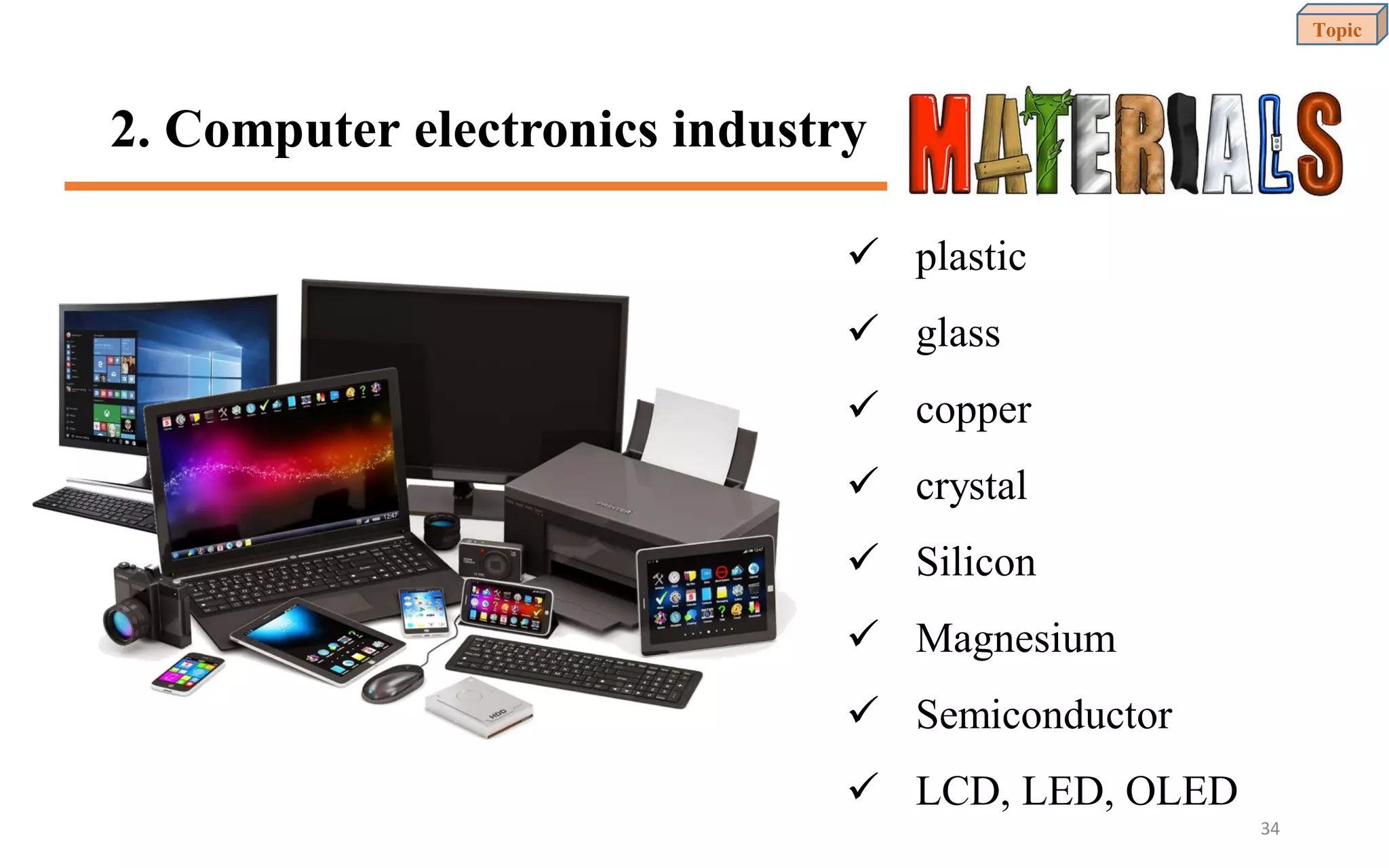
2. Computer electronics industry
✓ plastic
✓ glass
✓ copper
✓ crystal
✓ Silicon
✓ Magnesium
✓ Semiconductor
✓ LCD, LED, OLED
Topic
34
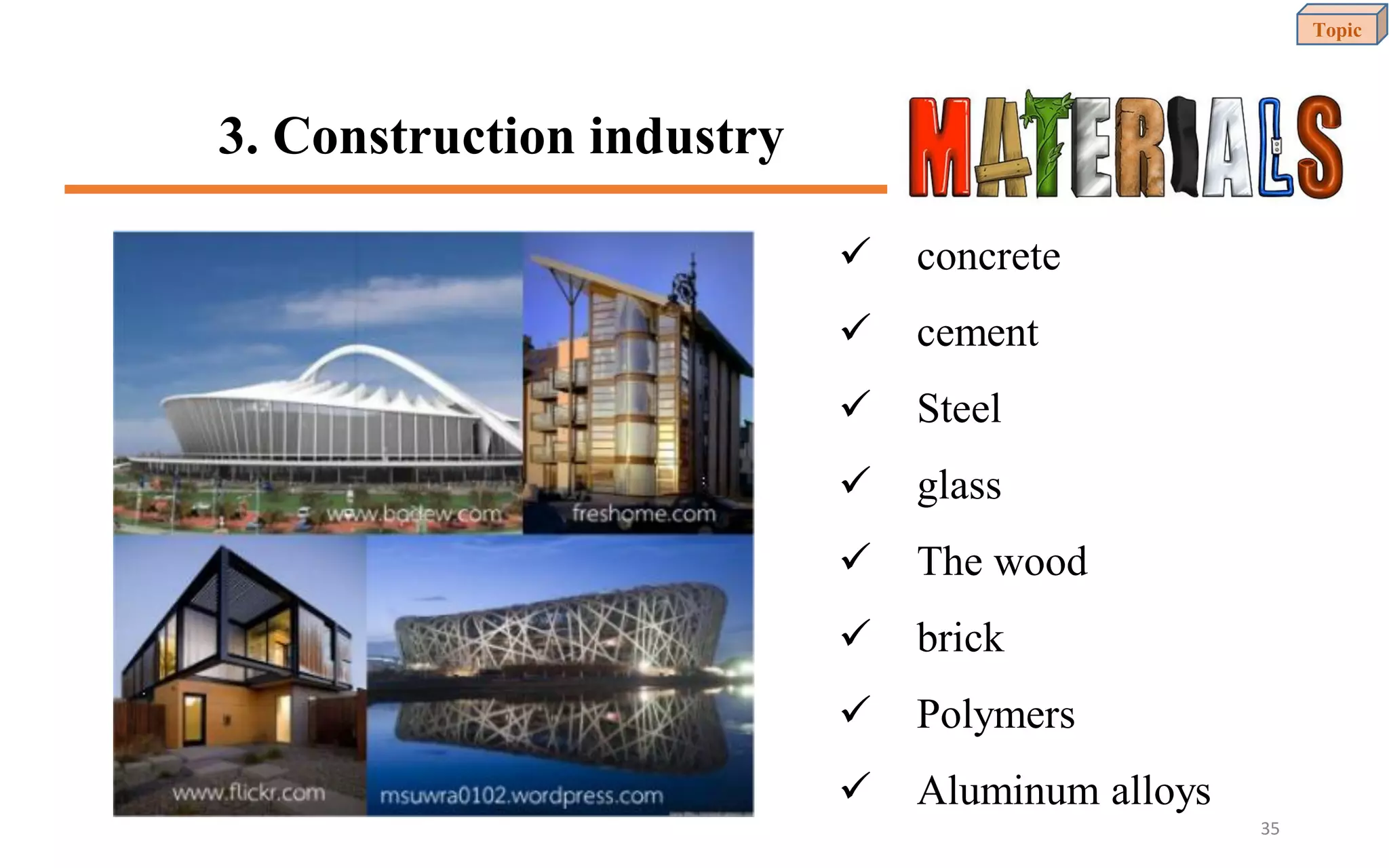
3. Construction industry
✓ concrete
✓ cement
✓ Steel
✓ glass
✓ The wood
✓ brick
✓ Polymers
✓ Aluminum alloys
Topic
35
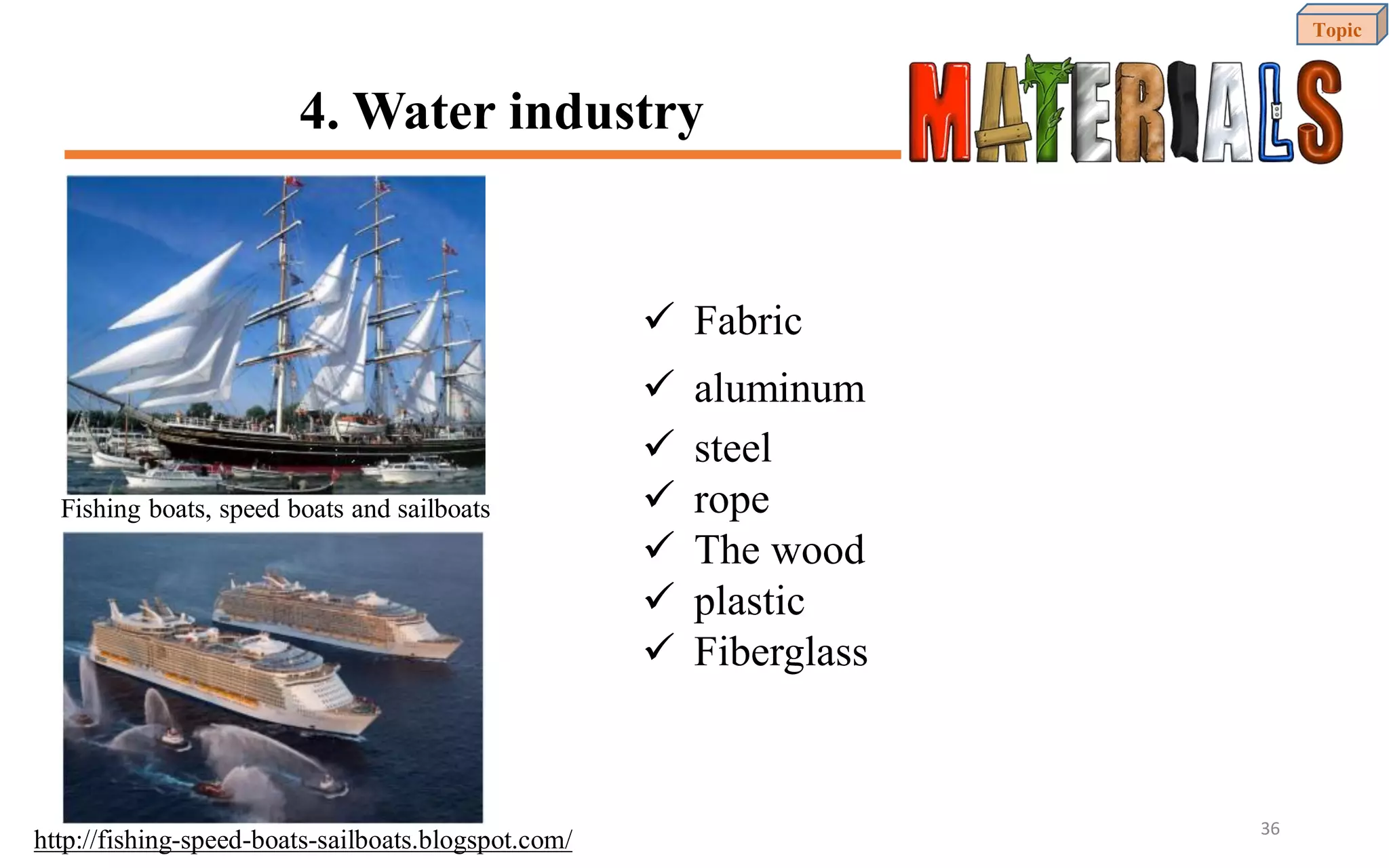
4. Water industry
✓ Fabric
✓ aluminum
✓ steel
✓ rope
✓ The wood
✓ plastic
✓ Fiberglass
Fishing boats, speed boats and sailboats
http://fishing-speed-boats-sailboats.blogspot.com/
Topic
36
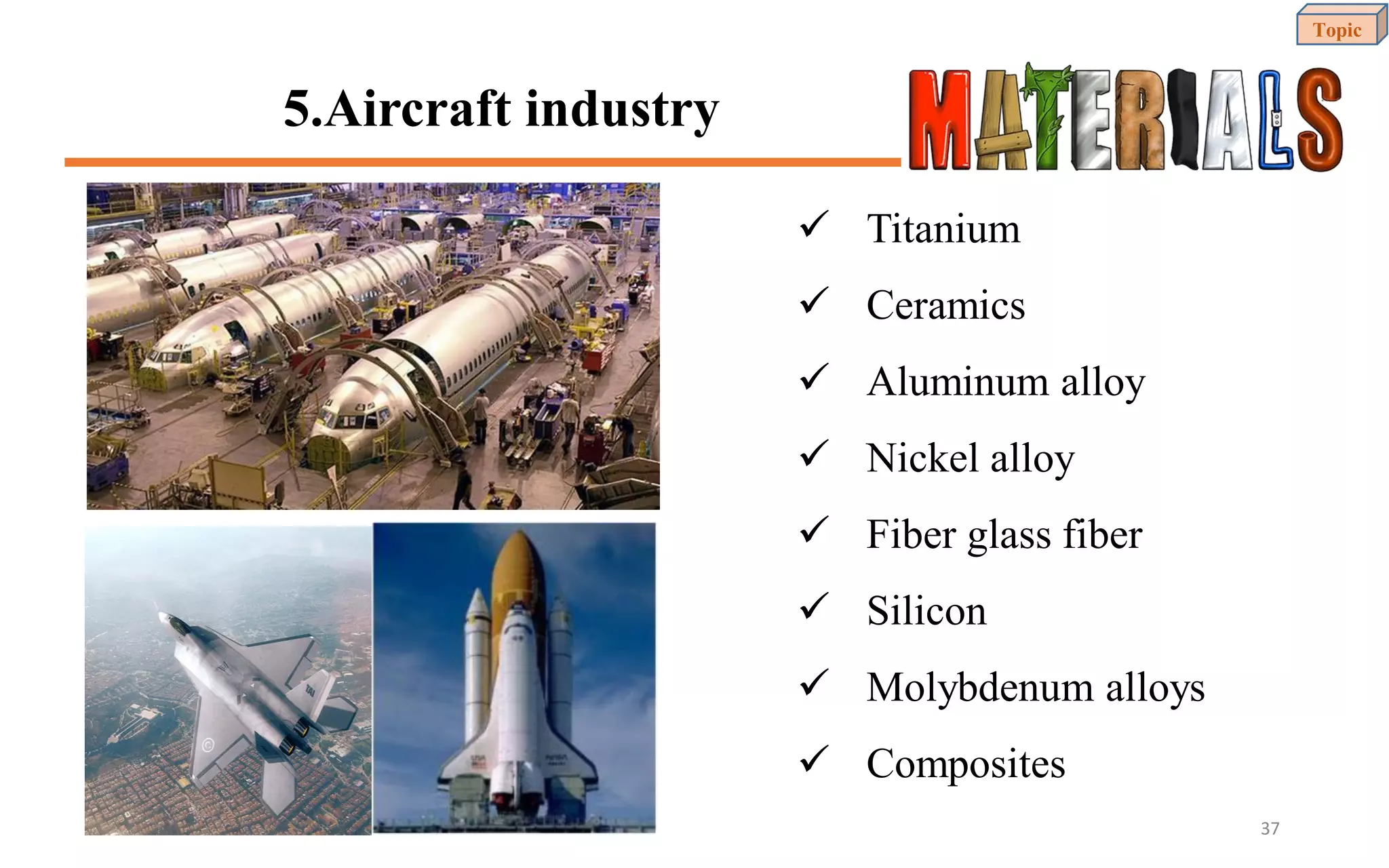
5.Aircraft industry
✓ Titanium
✓ Ceramics
✓ Aluminum alloy
✓ Nickel alloy
✓ Fiber glass fiber
✓ Silicon
✓ Molybdenum alloys
✓ Composites
Topic
37
38
Thank you for your attention !!!
감사합니다 !!!
Department of Materials Science and Engineering
Souphanouvong University
Faculty of Engineering
Next Chapter is Atomic
Structure

Chapter 1 Introduction to Materials Science and Engineering

  • 1.
    Chapter 1 Introduction toMaterials Science and Engineering Structures Properties Processing 1 Department of Materials Science and Engineering Souphanouvong University Faculty of Engineering Mr. Pem PHAKVISETH pempvs@gmail.com
  • 2.
    objective of Learning •Understand the meaning of materials and engineering • can explain types of materials used in the field of engineering as well as their properties and applications. 2
  • 3.
    What is Materials? What is Materials Engineering ? What is Materials Science ? 1.Structure 2. Properties 3. Processing 4. Classification 5. Smart Materials 6. Nanotechnology Example Apply materials to work Topic 3
  • 4.
    What is Materials? • Materials is • We have Known that basic materials such as concrete, steel, glass, rubber, aluminum, copper, paper, plastic. o Substances that humans have assembled or produced as products, appliances, inventions, various constructions. Topic 4
  • 5.
    What is MaterialsEngineering? • Materials Engineering is o Materials is used in field work of engineering o Or is a material that has been used through design and engineering calculations concerning the structure or production process of that material In order to obtain the desired properties or according to defined in the engineering design process. o Requires knowledge of materials science Topic 5
  • 6.
    What is MaterialsScience ? • Materials Science is o Basic knowledge about the relationships between internal structure and properties including processing of materials Topic 6
  • 7.
  • 8.
    Sample Apply materialsto various applications Topic 8 Beverage containers
  • 9.
    Materials Science andMaterials Engineering Is a basic knowledge of materials Results of knowledge of structure, properties, manufacturing processes and efficiency of engineering materials Basic science and understanding Structure Properties Processing efficiency Produce materials that support to needs of society. Applied knowledge of various materials Materials Science Materials Engineering Materials Science and Materials Engineering Topic 9
  • 10.
    the effectiveness andbehavior of each material will depend on three factors Topic 10
  • 11.
    1.Structure The structure canbe divided into 4 levels : • Structure of Atomic including of Nucleus (Proton + Neutrons) Surrounded by electronic orbitals. • Structure of Crystal is Array characterization of atoms or molecules. Crystalline structures are arranged in a metallike order Amorphous structures are Atoms arranged in disorder like polymers Topic 11
  • 12.
    1. Structure (continues) •Microscopic Is a type of Inside the material which can be viewed through a microscope. • Macroscopic Can be seen with the eyes. Optical Micrograph SEM Micrograph Topic 12
  • 13.
    2. Properties The material'sproperties respond to the environment. The 7 main engineering properties are: • Chemical properties, such as the structural features and composition of the compounds that make up the material... • Physical properties such as material adhesion, density, melting ... • Mechanical properties such as shrinkage, stiffness, hardness .... • Thermal properties such as heat conduction efficiency ... • Electrical properties such as electrical conductors ... • Magnetic properties such as the magnetic field of the material. • The optical properties such as the scattering of the light, the transparency of the material ... Topic 13
  • 14.
    3. Processing • Theproduction process is the process of processing material by either heat or mechanical force. • The result can be microstructural changes that can directly affect the material properties of a material., Casting furnace Rolling machine appearance built The structure varies according to the characteristics of casting and cooling. The structure is compressed and thin. Strong and hardness Topic 14
  • 15.
    Optical Properties ofCeramic are controlled by “Grain Structure” Alumina (Al2O3): Depending on the structure of the material, it may be transparent, transparent or illuminated. Grain Structure is a function of “Solidification” processing Topic 15
  • 16.
    Rolling of Steel Structuredetermines Properties but Processing determines Structure Topic 16
  • 17.
    Structure relationship PropertiesProcess Performance of engineering materials The level of competence that is suitable for the conditions Molecular structure Crystal structure Micro-structures Physical properties, chemical properties, physicochemical properties ... Synthesis and forming At view of engineer ---> What is the required performance capacity that must be supported? And the said properties are the properties of the structure of which materials And what to do In order to obtain that structure, what process must be produced or processed? Topic 17
  • 18.
    Topic • Selection ofmaterials from the available options is limited to which material is most appropriate from its specific characteristics. • Understand the relationship between the structural components of the material and the properties of the material, allowing the development of specific characteristics of the material in order to meet the needs of modern society. 18
  • 19.
    4. Classification ofMaterials Materials can be divided into 3 main groups based on chemical properties and atomic arrangement. Materials 1.Metals 2.Polymer 3.Ceramic 4.Composites 5.Semiconductor 6.Biomaterials 3 Group 3 groups that have Enginee ring signific ance Topic 19
  • 20.
    4.1 Metals • Consistsof metal objects Or maybe a little non-metal mixed with valence electrons surrounded like 'an electron sea' that holds the positive charges together • Properties: good heating and electric power, impermeable light Strong and tough • Example: • Ferrous Metals and Alloys Including iron and cast iron • Nonferrous Metals and Alloys Such as aluminum, zinc, copper, brass etc. Topic An electron sea ( - ) Positive Ion (+) 20
  • 21.
    4.2 Polymer Polyethylene • Consistingof plastic and gesture most of them are organic. (Organic) Contains carbon, contains molecules in a chain. • Properties: good electrical insulation Some types are heat insulation. High flexibility, light weight, low strength • Examples: Plastic, Rubber, PVC, Epoxy Polymerization process Occurs by the small molecules connected to a large molecule. Topic 21
  • 22.
    4.3 Ceramic • Consistsof metals and non-metals (non-metals) • Most of the ceramics are in the form of oxides, carbides, nitrides and nitrides. • Properties: insulating heat and electricity high temperature resistant more durable in a toxic environment than metals and polymers Is strong but fragile • Examples: Glass, Brick, Alumina, SiN, SiC, Zirconia, Clay Topic 22
  • 23.
    4.4 Composites • Isa composite material from 2 main groups or more Which the composite material must not dissolve each other • Properties: It is a combination of good properties of materials that are together • Example: Fiberglass (obtaining the hardness of glass fibers mixed with the flexibility of polymers), steel fiber reinforced concrete (With both strength and longevity) Silicon Fiberglass Reinforcement Topic 23
  • 24.
    Venn Diagram ofthree basic material types plus composites reinforced concrete Automobile steel reinforcing steel lines Fiber glass Topic 24
  • 25.
    4.5 Semiconductor • Thesemi-conductor material has electrical properties in the middle between the body. Electrical and electrical insulation, such as pure silicon, which are created in different ways • Properties: when the temperature rises, the conductivity of the semiconductor Will be better (as opposed to metal) • Example: Silicon chip and micro-electronic devices (microelectronic devices), which is the Important in the production of satellites, computer, calculator, digital watch, robots etc. Intrinsic Semiconductors Satellites PN Junction Topic 25
  • 26.
    4.6 Biomaterials • Itis a material that That has a medical role. Biomaterials include All types of materials that can be used in biological Can be implanted into the human body to change or replace the damaged organ It does not cause toxic substances and can be compatible with the tissues in the human body such as prosthetics, artificial bones, prosthesis. Hip joint, implants, etc. Femoral implant stem Ti get screwed to implant Topic 26
  • 27.
    Properties Comparison • Hardness: Polymer < Metals < Ceramic • Toughness : Ceramic < Metals < Polymer • Melting point : Polymer < Metals < Ceramic • Heat conduction : Ceramic < Polymer < Metals • Electrical conductivity : Ceramic < Polymer < Metals Topic 27
  • 28.
    5. Smart Materials •Materials can be aware of changes in the environment (where they operate). And responding to those changes in the form of Set beforehand For example, Nitinol Shape Memory Alloy is made from Titanium and Nigel alloys that are used in Muscle Wires and applied in robotics or "Smart Shirts" (clothing that interacts with the wearers. body temperature). Shape Memory Alloy Shirt and Jacket (2010) Smart fabrics and power laces Topic 28
  • 29.
  • 30.
    5. Smart Materials)(continues) There are also sensors and actuators that can be used to detect changes in the environment, temperature, color change, light intensity or response when receiving electricity. Topic 30
  • 31.
    6. Nanotechnology • NanomaterialsNano Materials Is a small material Diameter not over 100 nm • Has a high ratio of surface area to volume, resulting in physical properties Different from large materials Entirely • With different shapes and dimensions from the big cube (0,1,2,3 dimensions) • Engineering benefits, especially electronics, sensors, magnets and medical. Topic 31
  • 32.
    Example Apply materialsto work 1. Car industry 2. Computer electronics industry 3. Construction industry 4. Water industry 5.Aircraft industry Topic 32
  • 33.
    1. Car industry ✓Steel ✓ aluminum ✓ cast iron ✓ rubber ✓ plastic ✓ titanium Topic 33
  • 34.
    2. Computer electronicsindustry ✓ plastic ✓ glass ✓ copper ✓ crystal ✓ Silicon ✓ Magnesium ✓ Semiconductor ✓ LCD, LED, OLED Topic 34
  • 35.
    3. Construction industry ✓concrete ✓ cement ✓ Steel ✓ glass ✓ The wood ✓ brick ✓ Polymers ✓ Aluminum alloys Topic 35
  • 36.
    4. Water industry ✓Fabric ✓ aluminum ✓ steel ✓ rope ✓ The wood ✓ plastic ✓ Fiberglass Fishing boats, speed boats and sailboats http://fishing-speed-boats-sailboats.blogspot.com/ Topic 36
  • 37.
    5.Aircraft industry ✓ Titanium ✓Ceramics ✓ Aluminum alloy ✓ Nickel alloy ✓ Fiber glass fiber ✓ Silicon ✓ Molybdenum alloys ✓ Composites Topic 37
  • 38.
    38 Thank you foryour attention !!! 감사합니다 !!! Department of Materials Science and Engineering Souphanouvong University Faculty of Engineering Next Chapter is Atomic Structure