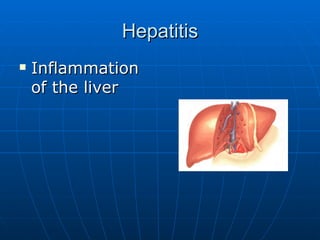
Hepatitis Inflammation of the liver
Causes of Hepatitis Reactions to chemical agents, drugs & toxins Autoimmune diseases Viruses
Acute Viral Hepatitis Hepatitis A, B, C, D, E Hepatitis B is 9 th  leading cause of death in the world 75% of those chronically infected with Hep B live in the Asia-pacific region In NZ approx 1% of population has been exposed to the Hep C virus Approx 40% of HIV infected pts have Hep C virus
Hepatitis A Usually transmitted through faecal-oral route Can occur sporadically but frequently occurs in small outbreaks caused by faecal contamination of food or drinking water Also spread by drinking contaminated milk & eating shellfish from infected waters
Hepatitis A (cont.) Present in the blood only briefly Virus replicates in liver, excreted in bile & shed in the stool  Found in faeces 2 or more weeks before the onset of symptoms & up to 1 week after the onset of jaundice
Risk factors for Hep A People travelling overseas who have not previously been exposed to virus Young children are asymptomatic therefore play important role in spread of disease Institutions housing large numbers of people Oral behaviour & lack of toilet training promote spread in daycare centres
Clinical Manifestations Abrupt onset Fever Malaise Nausea Anorexia Abdominal discomfort Dark urine Jaundice Children under 6yrs usually asymptomatic Symptoms last approx 2 mths but can last longer
Hepatitis B More serious health problem than Hep A Highest rate of disease occurs in 20 – 49 year age group Incidence is decreasing because of Hep B vaccine Can cause chronic hepatitis, cirrhosis of liver, liver necrosis & a carrier state 30% asympotomatic
Mode of Transmission Inoculation with infected blood or serum Found in body secretions so can be transmitted by oral or sexual contact Highly prevalent among injecting drug users, persons with multiple sexual partners & men who have sex with men
Hepatitis B Health care workers are at risk because of exposure to blood & needle stick injuries Virus can be spread through blood/blood products transfusion 2 – 10% of adults infected with hep B become chronic carriers & may transmit the disease Chronic carriers may have normal liver, low grade or severe liver disease & are at greater risk of liver cancer
Hepatitis C Most common cause of chronic hepatitis, cirrhosis and liver cancer Many are unaware they are chronically affected because they are not clinically ill Infected persons serve as source of infection to others & are at risk of chronic liver disease during 2 or more decades after infection
Hepatitis C Injecting drug use most important risk factor Transmission of small amts of blood during tattooing, acupuncture & body piercing Incidence of sexual & mother-to-child transmission is uncertain Occupational exposure due to needle stick injuries
Hepatitis C Incubation period 15-150 days (average 50 days) Clinical symptoms milder than other types of viral hepatitis Can be asymptomatic Non-specific – fatigue, malaise, anorexia, weight loss Jaundice uncommon
Hepatitis C High rate of persistence Able to induce chronic hepatitis and cirrhosis Increases risk of liver failure *No vaccine that protects against Hep C
Phases of Hepatitis Preicteric Precedes jaundice, lasts 1-21 days Period of maximum infectivity for hep A Anorexia, nausea, vomiting R) upper quadrant abdominal discomfort Constipation or diarrhoea Malaise, headache, low grade fever, arthralgias, skin rashes
Icteric Phase Lasts 2-4 weeks & characterised by jaundice Jaundice Pruritus (accumulation of bile salts under skin) Dark urine (excess bilirubin excreted by kidneys) Light or clay coloured stools (obstruction of bile ducts) Fatigue, weight loss
Posticteric Phase Begins as jaundice is disappearing & lasts weeks to months (average 2-4mths) Malaise, easy fatigability Hepatomegaly Relapses can occur Disappearance of jaundice does not indicate total recovery
Chronic Hepatitis Inflammatory reaction of liver of more than 3 – 6 months duration Chronic viral hepatitis ranks as chief reason for liver transplants in adults Clinical features highly variable Most common – fatigue, malaise, anorexia, bouts of jaundice No simple & effective treatment
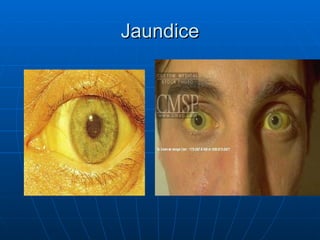
Jaundice Results from abnormally high accumulation of bilirubin in the blood A yellowish discolouration to the skin & deep tissues Becomes evident when serum bilirubin is above 40 µg/L (normal 5-20µg/L) Often hard to detect in persons with dark skin
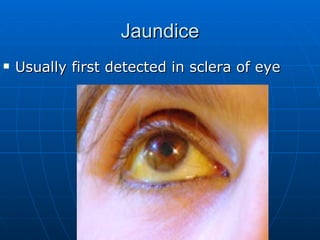
Jaundice Usually first detected in sclera of eye
Jaundice
Causes of Jaundice Excessive destruction of RBCs Impaired uptake of bilirubin by liver Decreased conjugation of bilirubin Obstruction of bile flow in liver or bile ducts

Hepatitis Ppt Sept 2006

  • 1.
  • 2.
    Causes of HepatitisReactions to chemical agents, drugs & toxins Autoimmune diseases Viruses
  • 3.
    Acute Viral HepatitisHepatitis A, B, C, D, E Hepatitis B is 9 th leading cause of death in the world 75% of those chronically infected with Hep B live in the Asia-pacific region In NZ approx 1% of population has been exposed to the Hep C virus Approx 40% of HIV infected pts have Hep C virus
  • 4.
    Hepatitis A Usuallytransmitted through faecal-oral route Can occur sporadically but frequently occurs in small outbreaks caused by faecal contamination of food or drinking water Also spread by drinking contaminated milk & eating shellfish from infected waters
  • 5.
    Hepatitis A (cont.)Present in the blood only briefly Virus replicates in liver, excreted in bile & shed in the stool Found in faeces 2 or more weeks before the onset of symptoms & up to 1 week after the onset of jaundice
  • 6.
    Risk factors forHep A People travelling overseas who have not previously been exposed to virus Young children are asymptomatic therefore play important role in spread of disease Institutions housing large numbers of people Oral behaviour & lack of toilet training promote spread in daycare centres
  • 7.
    Clinical Manifestations Abruptonset Fever Malaise Nausea Anorexia Abdominal discomfort Dark urine Jaundice Children under 6yrs usually asymptomatic Symptoms last approx 2 mths but can last longer
  • 8.
    Hepatitis B Moreserious health problem than Hep A Highest rate of disease occurs in 20 – 49 year age group Incidence is decreasing because of Hep B vaccine Can cause chronic hepatitis, cirrhosis of liver, liver necrosis & a carrier state 30% asympotomatic
  • 9.
    Mode of TransmissionInoculation with infected blood or serum Found in body secretions so can be transmitted by oral or sexual contact Highly prevalent among injecting drug users, persons with multiple sexual partners & men who have sex with men
  • 10.
    Hepatitis B Healthcare workers are at risk because of exposure to blood & needle stick injuries Virus can be spread through blood/blood products transfusion 2 – 10% of adults infected with hep B become chronic carriers & may transmit the disease Chronic carriers may have normal liver, low grade or severe liver disease & are at greater risk of liver cancer
  • 11.
    Hepatitis C Mostcommon cause of chronic hepatitis, cirrhosis and liver cancer Many are unaware they are chronically affected because they are not clinically ill Infected persons serve as source of infection to others & are at risk of chronic liver disease during 2 or more decades after infection
  • 12.
    Hepatitis C Injectingdrug use most important risk factor Transmission of small amts of blood during tattooing, acupuncture & body piercing Incidence of sexual & mother-to-child transmission is uncertain Occupational exposure due to needle stick injuries
  • 13.
    Hepatitis C Incubationperiod 15-150 days (average 50 days) Clinical symptoms milder than other types of viral hepatitis Can be asymptomatic Non-specific – fatigue, malaise, anorexia, weight loss Jaundice uncommon
  • 14.
    Hepatitis C Highrate of persistence Able to induce chronic hepatitis and cirrhosis Increases risk of liver failure *No vaccine that protects against Hep C
  • 15.
    Phases of HepatitisPreicteric Precedes jaundice, lasts 1-21 days Period of maximum infectivity for hep A Anorexia, nausea, vomiting R) upper quadrant abdominal discomfort Constipation or diarrhoea Malaise, headache, low grade fever, arthralgias, skin rashes
  • 16.
    Icteric Phase Lasts2-4 weeks & characterised by jaundice Jaundice Pruritus (accumulation of bile salts under skin) Dark urine (excess bilirubin excreted by kidneys) Light or clay coloured stools (obstruction of bile ducts) Fatigue, weight loss
  • 17.
    Posticteric Phase Beginsas jaundice is disappearing & lasts weeks to months (average 2-4mths) Malaise, easy fatigability Hepatomegaly Relapses can occur Disappearance of jaundice does not indicate total recovery
  • 18.
    Chronic Hepatitis Inflammatoryreaction of liver of more than 3 – 6 months duration Chronic viral hepatitis ranks as chief reason for liver transplants in adults Clinical features highly variable Most common – fatigue, malaise, anorexia, bouts of jaundice No simple & effective treatment
  • 19.
    Jaundice Results fromabnormally high accumulation of bilirubin in the blood A yellowish discolouration to the skin & deep tissues Becomes evident when serum bilirubin is above 40 µg/L (normal 5-20µg/L) Often hard to detect in persons with dark skin
  • 20.
    Jaundice Usually firstdetected in sclera of eye
  • 21.
  • 22.
    Causes of JaundiceExcessive destruction of RBCs Impaired uptake of bilirubin by liver Decreased conjugation of bilirubin Obstruction of bile flow in liver or bile ducts