Basal cell carcinoma 
Dr. firas kassab 
FIRAS BCC
Basal cell carcinoma is a slow-growing 
form of skin cancer. 
Skin cancer falls into two major groups: 
Nonmelanoma and melanoma. 
Basal cell carcinoma is a type of nonmelanoma skin 
cancer 
FIRAS BCC
Basics of BCC 
 Background 
 Most common cutaneous malignancy (~80-90%) 
 Typically slow-growing, rarely metastasizes 
 Sun-exposed skin, mostly face and scalp, esp nose, 
cheek, and periorbital regions (~80%) 
 Frequency 
 900,000 Dx in US/year 
 estimated lifetime risk of 33-39% for 
men and 23-28% for women 
 Sex 
 Men 2X over women 
FIRAS BCC
Basics of BCC 
 Mortality/Morbidity 
 <0.1% metastasize 
 Very low mortality 
 Significant morbidity with direct invasion of adjacent 
tissues, especially when on face or near an eye 
 Age 
 Likelihood increases with age 
 Rare in <40 yo 
 Race 
 Most often in light-skinned, rare in dark-skinned 
races 
FIRAS BCC
Classification 
according to 
 Appearance 
 Histological 
FIRAS BCC
Appearance 
we can divide basal-cell carcinoma into 3 groups, based on location and 
difficulty of therapy: 
1. . Superficial basal-cell carcinoma :is very responsive to 
topical chemotherapy such as .It is the only type that can be 
effectively treated with topical chemotherapy. 
2. Infiltrative basal-cell carcinoma: which often encompasses 
morpheaform and micronodular basal-cell cance. More difficult to 
treat with conservative treatment methods such as 
electrodessiccation and curettage, or with curettage alone. 
3. Nodular basal-cell carcinoma: which essentially includes most 
of the remaining categories of basal-cell cancer. It is not unusual to 
encounter morphologic features of several variants of basal-cell 
cancer in the same tumor. 
FIRAS BCC
Histological 
Basal-cell carcinomas may be divided into the following types: 
 Nodular basal-cell carcinoma is a subtype of basal-cell carcinoma, most 
commonly occurring on the sun-exposed areas of the head and neck.[ 
 Cystic basal-cell carcinoma is characterized by dome-shaped, blue-gray 
cystic nodules. 
 Cicatricial basal-cell carcinoma is an aggressive variant with a distinct 
clinical and histologic appearance. 
 Infiltrative basal-cell carcinoma is an aggressive type of basal-cell 
carcinoma characterized by deep infiltration. 
 Micronodular basal-cell carcinoma is characterized by a micronodular 
growth pattern. 
 Superficial basal-cell carcinoma that occurs most commonly on the trunk 
and appears as an erythematous patch. 
FIRAS BCC
 Pigmented basal-cell carcinoma that exhibits increased 
melanization.About 80% of all basal cell carcinoma in chinese are 
pigmented while this subtype is uncommon in white people. 
 Rodent ulcer is a large skin lesionof nodular basal cell carcinoma 
with central necrosis 
 Fibroepithelioma of pinkus most commonly occurring on the lower 
back. 
 Polypoid basal-cell carcinoma is characterized by exophytic 
nodules (polyp-like structures) on the head and neck. 
 Pore-like basal-cell carcinoma is characterized by a basal-cell 
carcinoma that resembles an enlarged pore or stellate pit. 
 Aberrant basal-cell carcinoma is characterized by the formation of 
basal-cell carcinoma in the absence of any apparent carcinogenic 
factor, occurring in odd sites such as scrotum, vulva, perineum, 
nipple, and axilla. 
FIRAS BCC
See also: 
 Nevoid basal cell carcinoma syndrom 
 Cystic basal-cell carcinoma 
 Micronodular basal cell carcinoma 
 Superficial basal cell carcinoma 
 Micrograph of a fibroepithelioma of Pinkus. 
FIRAS BCC
Variants of Basal Cell Carcinoma 
 Superficial 
 Nodular 
 Micronodular 
 Infiltrating (5%) 
 Sclerosing/ morpheaform (5%) 
 Metatypical 
 Infundibulocystic 
 Nodulocystic 
 Adenoid 
 Clear cell 
 Follicular 
 Sebaceous 
 Perineurally invasive 
FIRAS BCC
Nodular 
FIRAS BCC
Superficial 
FIRAS BCC
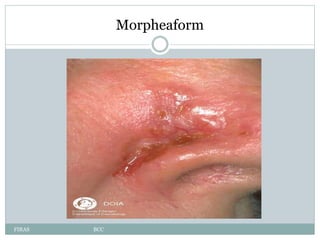
Morpheaform 
FIRAS BCC
Pigmented 
FIRAS BCC
Infiltrating 
FIRAS BCC
Differential Diagnosis 
 Malignant melanoma 
 Squamous cell carcinoma 
 Basal cell carcinoma, infiltrative 
 Infectious 
FIRAS BCC
Causes, incidence, and risk factors: 
Basal cell carcinoma starts in the top layer of the skin called the 
epidermis. Most basal cell cancers occur on skin that is regularly 
exposed to sunlight or other ultraviolet radiation. This includes 
the top of your head, or scalp. 
Basal cell skin cancer is most common in people over age 40. 
However, it occurs in younger people, too. 
FIRAS BCC
You are more likely to get basal cell skin cancer if you have: 
 Light-colored or freckled skin 
 Blue, green, or grey eyes 
 Blond or red hair 
 Overexposure to x-rays or other forms of radiation 
 Many moles 
 Close relatives who have or had skin cancer 
 Many severe sunburns early in life 
 Long-term daily sun exposure (such as the sun exposure people who 
work outside receive) 
FIRAS BCC
Sings and Symptoms: 
Basal cell skin cancer grows slowly and is usually painless. It may 
not look that different from normal skin. 
patient may have a skin bump or growth that is: 
 Pearly or waxy 
 White or light pink 
 Flesh-colored or brownIn 
some cases the skin may be just slightly raised or even flat. 
FIRAS BCC
patient may have: 
 A skin sore that bleeds easily 
 A sore that does not heal 
 Oozing or crusting spots in a sore 
 A scar-like sore without having injured the area 
 Irregular blood vessels in or around the spot 
 A sore with a depressed (sunken) area in the 
middle 
FIRAS BCC
Diagnosis: 
 doctor should check the skin and look at the size, 
shape, color, and texture of any suspicious areas. 
 If the patient might has skin cancer, a piece of skin 
will be removed and sent to a lab for examination 
under a microscope. This is called a skin biopsy. 
There are different types of skin biopsies. 
FIRAS BCC
The most common method is a shave biopsy under locale 
anesthesia. 
Most nodular basal-cell cancers can be diagnosed clinically; 
however, other variants can be very difficult to distinguish from 
benign lesions such as: 
 intradermal naevus 
 sebaceomas 
 Fibrous papules 
 early acnes scars 
 and hypertrophing scarring. 
FIRAS BCC
Treatment Options 
 Electrodessication and curettage 
 Curettage alone 
 Surgical excision 
 Mohs micrographically controlled surgery 
 Cryosurgery 
 Ionizing radiation 
 Surgical excision plus radiation 
 Exenteration 
FIRAS BCC
Treatment depends on the size 
 depth 
 location of the skin cancer 
 overall health. 
Treatment 
FIRAS BCC
may involve: 
Treatment 
 Excision: Cutting out the skin cancer and stitching the skin 
together 
 Curettage and electrodesiccation: Scraping away cancer cells 
and using electricity to kill any that remain 
 Cryosurgery: Freezing the cancer cells, which kills them 
 Medication: Skin creams containing imiquimod or 5- 
fluorouracil for superficial (not very deep) basal cell cancer 
FIRAS BCC
Treatment 
 Mohs surgery: Removing a layer of skin and looking at it 
immediately under a microscope, then removing many layers of 
skin until there are no signs of the cancer; usually used for skin 
cancers on the nose, ears, and other areas of the face. 
 Photodynamic therapy: Treatment using light 
 Radiation may be used if a basal cell cancer cannot be treated 
with surgery 
FIRAS BCC
Is excellent 
prognosis 
 How well a patient does depends on many things, 
including how quickly the cancer was diagnosed. 
Most of these cancers are cured when treated early. 
 Some basal cell cancers may return. Smaller ones are 
less likely to come back. 
 Basal cell carcinoma almost never spreads to other 
parts of the body ,Because basal-cell carcinoma 
rarely metastasis, it grows locally with invasion and 
destruction of local tissues 
FIRAS BCC
Complications 
Basal cell skin cancer almost never spreads. But, if left 
untreated, it may grow into surrounding areas and 
nearby tissues and bone. This is most worrisome 
around the nose, eyes, and ears. 
FIRAS BCC
Prevention 
 The best way to prevent skin cancer is to reduce exposure to 
sunlight. 
 Ultraviolet light is most intense between 10 a.m. and 4 p.m., so 
try to avoid sun exposure during these hours. 
 Protect the skin by wearing hats, long-sleeved shirts, long skirts, 
or pants. 
 Always use sunscreen 
FIRAS BCC
Conclusion 
 Basal cell carcinomas are not always as innocent as we tend to 
believe 
 In formulating treatment course: 
 Strong pt preference and 
other pt factors 
 Current research 
FIRAS BCC

Basal cell carcnoma

  • 1.
    Basal cell carcinoma Dr. firas kassab FIRAS BCC
  • 2.
    Basal cell carcinomais a slow-growing form of skin cancer. Skin cancer falls into two major groups: Nonmelanoma and melanoma. Basal cell carcinoma is a type of nonmelanoma skin cancer FIRAS BCC
  • 3.
    Basics of BCC  Background  Most common cutaneous malignancy (~80-90%)  Typically slow-growing, rarely metastasizes  Sun-exposed skin, mostly face and scalp, esp nose, cheek, and periorbital regions (~80%)  Frequency  900,000 Dx in US/year  estimated lifetime risk of 33-39% for men and 23-28% for women  Sex  Men 2X over women FIRAS BCC
  • 4.
    Basics of BCC  Mortality/Morbidity  <0.1% metastasize  Very low mortality  Significant morbidity with direct invasion of adjacent tissues, especially when on face or near an eye  Age  Likelihood increases with age  Rare in <40 yo  Race  Most often in light-skinned, rare in dark-skinned races FIRAS BCC
  • 5.
    Classification according to  Appearance  Histological FIRAS BCC
  • 6.
    Appearance we candivide basal-cell carcinoma into 3 groups, based on location and difficulty of therapy: 1. . Superficial basal-cell carcinoma :is very responsive to topical chemotherapy such as .It is the only type that can be effectively treated with topical chemotherapy. 2. Infiltrative basal-cell carcinoma: which often encompasses morpheaform and micronodular basal-cell cance. More difficult to treat with conservative treatment methods such as electrodessiccation and curettage, or with curettage alone. 3. Nodular basal-cell carcinoma: which essentially includes most of the remaining categories of basal-cell cancer. It is not unusual to encounter morphologic features of several variants of basal-cell cancer in the same tumor. FIRAS BCC
  • 7.
    Histological Basal-cell carcinomasmay be divided into the following types:  Nodular basal-cell carcinoma is a subtype of basal-cell carcinoma, most commonly occurring on the sun-exposed areas of the head and neck.[  Cystic basal-cell carcinoma is characterized by dome-shaped, blue-gray cystic nodules.  Cicatricial basal-cell carcinoma is an aggressive variant with a distinct clinical and histologic appearance.  Infiltrative basal-cell carcinoma is an aggressive type of basal-cell carcinoma characterized by deep infiltration.  Micronodular basal-cell carcinoma is characterized by a micronodular growth pattern.  Superficial basal-cell carcinoma that occurs most commonly on the trunk and appears as an erythematous patch. FIRAS BCC
  • 8.
     Pigmented basal-cellcarcinoma that exhibits increased melanization.About 80% of all basal cell carcinoma in chinese are pigmented while this subtype is uncommon in white people.  Rodent ulcer is a large skin lesionof nodular basal cell carcinoma with central necrosis  Fibroepithelioma of pinkus most commonly occurring on the lower back.  Polypoid basal-cell carcinoma is characterized by exophytic nodules (polyp-like structures) on the head and neck.  Pore-like basal-cell carcinoma is characterized by a basal-cell carcinoma that resembles an enlarged pore or stellate pit.  Aberrant basal-cell carcinoma is characterized by the formation of basal-cell carcinoma in the absence of any apparent carcinogenic factor, occurring in odd sites such as scrotum, vulva, perineum, nipple, and axilla. FIRAS BCC
  • 9.
    See also: Nevoid basal cell carcinoma syndrom  Cystic basal-cell carcinoma  Micronodular basal cell carcinoma  Superficial basal cell carcinoma  Micrograph of a fibroepithelioma of Pinkus. FIRAS BCC
  • 10.
    Variants of BasalCell Carcinoma  Superficial  Nodular  Micronodular  Infiltrating (5%)  Sclerosing/ morpheaform (5%)  Metatypical  Infundibulocystic  Nodulocystic  Adenoid  Clear cell  Follicular  Sebaceous  Perineurally invasive FIRAS BCC
  • 11.
  • 12.
  • 13.
  • 14.
  • 15.
  • 16.
    Differential Diagnosis Malignant melanoma  Squamous cell carcinoma  Basal cell carcinoma, infiltrative  Infectious FIRAS BCC
  • 17.
    Causes, incidence, andrisk factors: Basal cell carcinoma starts in the top layer of the skin called the epidermis. Most basal cell cancers occur on skin that is regularly exposed to sunlight or other ultraviolet radiation. This includes the top of your head, or scalp. Basal cell skin cancer is most common in people over age 40. However, it occurs in younger people, too. FIRAS BCC
  • 18.
    You are morelikely to get basal cell skin cancer if you have:  Light-colored or freckled skin  Blue, green, or grey eyes  Blond or red hair  Overexposure to x-rays or other forms of radiation  Many moles  Close relatives who have or had skin cancer  Many severe sunburns early in life  Long-term daily sun exposure (such as the sun exposure people who work outside receive) FIRAS BCC
  • 19.
    Sings and Symptoms: Basal cell skin cancer grows slowly and is usually painless. It may not look that different from normal skin. patient may have a skin bump or growth that is:  Pearly or waxy  White or light pink  Flesh-colored or brownIn some cases the skin may be just slightly raised or even flat. FIRAS BCC
  • 20.
    patient may have:  A skin sore that bleeds easily  A sore that does not heal  Oozing or crusting spots in a sore  A scar-like sore without having injured the area  Irregular blood vessels in or around the spot  A sore with a depressed (sunken) area in the middle FIRAS BCC
  • 21.
    Diagnosis:  doctorshould check the skin and look at the size, shape, color, and texture of any suspicious areas.  If the patient might has skin cancer, a piece of skin will be removed and sent to a lab for examination under a microscope. This is called a skin biopsy. There are different types of skin biopsies. FIRAS BCC
  • 22.
    The most commonmethod is a shave biopsy under locale anesthesia. Most nodular basal-cell cancers can be diagnosed clinically; however, other variants can be very difficult to distinguish from benign lesions such as:  intradermal naevus  sebaceomas  Fibrous papules  early acnes scars  and hypertrophing scarring. FIRAS BCC
  • 23.
    Treatment Options Electrodessication and curettage  Curettage alone  Surgical excision  Mohs micrographically controlled surgery  Cryosurgery  Ionizing radiation  Surgical excision plus radiation  Exenteration FIRAS BCC
  • 24.
    Treatment depends onthe size  depth  location of the skin cancer  overall health. Treatment FIRAS BCC
  • 25.
    may involve: Treatment  Excision: Cutting out the skin cancer and stitching the skin together  Curettage and electrodesiccation: Scraping away cancer cells and using electricity to kill any that remain  Cryosurgery: Freezing the cancer cells, which kills them  Medication: Skin creams containing imiquimod or 5- fluorouracil for superficial (not very deep) basal cell cancer FIRAS BCC
  • 26.
    Treatment  Mohssurgery: Removing a layer of skin and looking at it immediately under a microscope, then removing many layers of skin until there are no signs of the cancer; usually used for skin cancers on the nose, ears, and other areas of the face.  Photodynamic therapy: Treatment using light  Radiation may be used if a basal cell cancer cannot be treated with surgery FIRAS BCC
  • 27.
    Is excellent prognosis  How well a patient does depends on many things, including how quickly the cancer was diagnosed. Most of these cancers are cured when treated early.  Some basal cell cancers may return. Smaller ones are less likely to come back.  Basal cell carcinoma almost never spreads to other parts of the body ,Because basal-cell carcinoma rarely metastasis, it grows locally with invasion and destruction of local tissues FIRAS BCC
  • 28.
    Complications Basal cellskin cancer almost never spreads. But, if left untreated, it may grow into surrounding areas and nearby tissues and bone. This is most worrisome around the nose, eyes, and ears. FIRAS BCC
  • 29.
    Prevention  Thebest way to prevent skin cancer is to reduce exposure to sunlight.  Ultraviolet light is most intense between 10 a.m. and 4 p.m., so try to avoid sun exposure during these hours.  Protect the skin by wearing hats, long-sleeved shirts, long skirts, or pants.  Always use sunscreen FIRAS BCC
  • 30.
    Conclusion  Basalcell carcinomas are not always as innocent as we tend to believe  In formulating treatment course:  Strong pt preference and other pt factors  Current research FIRAS BCC