Rheumatoid Arthritis
         (RA)
• A chronic, systemic disease
  characterized by inflammation of
  connective tissue in the synovial
  joints
• Typically have periods of remission
  and exacerbation
Rheumatoid Arthritis
           (RA)
• Affects all ethnic groups
• Can occur at any time of life
• Incidence ↑ with age
• Women are affected 2-3 times more
  frequently then men
• Smoking appears to be a link
Etiology and
      Pathophysiology
• Cause of RA is unknown
• No infectious agent has been
  cultured from blood and synovial
  tissue or fluid
• Autoimmune etiology is currently the
  most widely accepted
Etiology and
      Pathophysiology
• Autoimmunity
  – Changes begin when a susceptible host
    experiences an initial immune response
    to an antigen
  – Antigen triggers the formation of an
    abnormal immunoglobulin G (IgG)
Etiology and
       Pathophysiology
• Autoimmunity
  – RA is characterized by the presence of
    autoantibodies (rheumatoid factor [RF])
  – RF and IgG form immune complexes that
    initially deposit on synovial membranes
    or superficial articular cartilage in the
    joints
  – An inflammatory response results
Etiology and
    Pathophysiology
• Autoimmunity
  – Joint changes from chronic inflammation
    begin when the hypertrophied synovial
    membrane invades the surrounding
    •   Cartilage
    •   Ligaments
    •   Tendons
    •   Joint capsule
Etiology and
        Pathophysiology
• Autoimmunity
  – Pannus (a proliferation of synovial tissue)
    forms within the joint
  – Eventually covers and erodes the entire
    surface of the articular cartilage
  – Pannus scars and shortens supporting
    structures
     • Tendons
     • Ligaments
  – Causing joint laxity, subluxation, and
    contracture
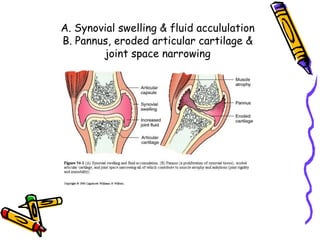
A. Synovial swelling & fluid accululation
B. Pannus, eroded articular cartilage &
        joint space narrowing
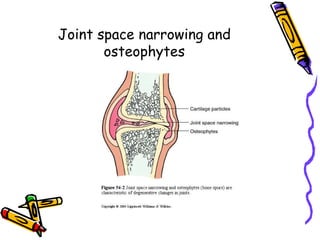
Joint space narrowing and
       osteophytes
Etiology and
       Pathophysiology
• Genetic factors
  – Genetic predisposition appears to be
    important in the development of RA
  – Strongest evidence for a familial
    influence is the ↑ occurrence of certain
    human leukocyte antigens (HLA)
Clinical Manifestations
                 Joints
• Onset of RA is typically insidious
• Nonspecific manifestations may
  precede the onset of arthritic
  complaints
  –   Fatigue
  –   Anorexia
  –   Weight loss
  –   Generalized stiffness
Clinical Manifestations
               Joints
• Stiffness becomes more localized in
  the following weeks to months
• Some patients report a history of
  precipitating stressful events
  – Research has been unable to correlate
    such events directly with the onset of
    RA
Clinical Manifestations
                 Joints
• Specific joint involvement
  –   Pain
  –   Stiffness
  –   Limitation of motion
  –   Signs of inflammation
      • Heat
      • Swelling
      • Tenderness
Clinical Manifestations
                Joints
• Joint symptoms occur symmetrically
  and frequently
  – Small joints of the hands and feet
  – Larger peripheral joints
    • Wrists, elbows, shoulders, knees, hips,
      ankles, and jaw
  – Cervical spine
Clinical Manifestations
             Joints
• Often experience joint stiffness
  after periods of inactivity
• Morning stiffness may last from 60
  minutes to several hours or more
• Joints become tender, painful, and
  warm to the touch
Clinical Manifestations
                Joints
• Joint pain
  – ↑ with motion
  – Varies in intensity
  – May not be proportional to the degree
    of inflammation
  – Tenosynovitis
    • Difficult for patients to grasp objects
Clinical Manifestations
               Joints
• Inflammation and fibrosis of the
  joint capsule and supporting
  structures may lead to deformity and
  disability
• Subluxation
  – Atrophy of muscles and destruction of
    tendons around the joint cause one
    articular surface to slip past the other
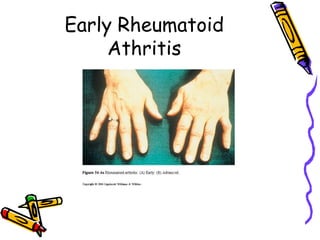
Early Rheumatoid
     Athritis
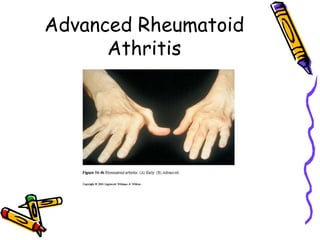
Advanced Rheumatoid
      Athritis
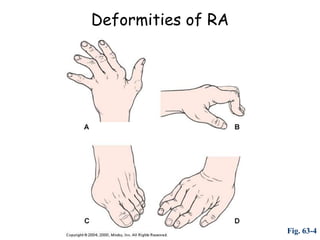
Deformities of RA


                    Fig. 63-4
Clinical Manifestations
Extraarticular Manifestations
• RA can affect nearly every system of
  the body
• Three most common
  – Rheumatoid nodules
  – Sjögren syndrome
  – Felty syndrome
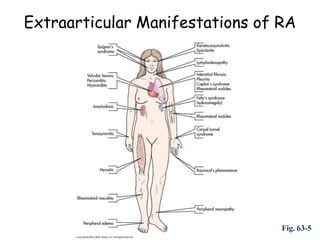
Extraarticular Manifestations of RA


                                 Fig. 63-5
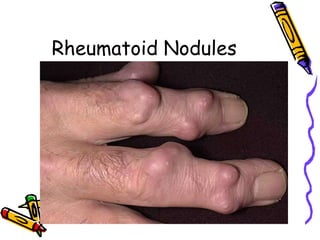
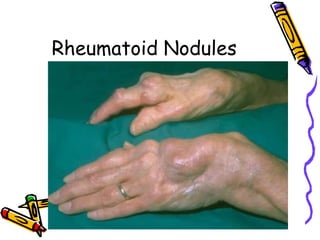
Rheumatoid Nodules
• Develop in 25% of all patients with
  RA
• Usually have high titers of RF
• Appear as firm, nontender,
  granuloma-type masses
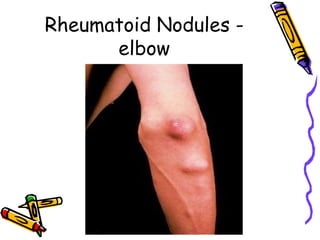
• Usually over the extensor surfaces
  of joints such as fingers and elbows
Rheumatoid Nodules
• Nodules at the base of the spine and
  back of the head are common in older
  adults
• Develop insidiously
• Can persist or regress spontaneously
• Usually not removed
Rheumatoid Nodules
Rheumatoid Nodules -
      elbow
Rheumatoid Nodules
Complications
• Flexion contractures and hand
  deformities
  – Cause diminished grasp strength
  – Affect the patient’s ability to perform
    self-care tasks
Complications
• Cataract development and loss of
  vision possible from scleral nodules
• Rheumatoid nodules can ulcerate,
  similar to pressure ulcers
• Hoarseness from nodules on the vocal
  cords
Complications
• Bone destruction from nodules in the
  vertebral bodies
• Cardiopulmonary effects later in the
  disease
  – Pleurisy, pleural effusion, pericarditis,
    pericardial effusion, cardiomyopathy
• Carpal tunnel syndrome

4 Rheumatoid Arthriis 2010

  • 1.
    Rheumatoid Arthritis (RA) • A chronic, systemic disease characterized by inflammation of connective tissue in the synovial joints • Typically have periods of remission and exacerbation
  • 2.
    Rheumatoid Arthritis (RA) • Affects all ethnic groups • Can occur at any time of life • Incidence ↑ with age • Women are affected 2-3 times more frequently then men • Smoking appears to be a link
  • 3.
    Etiology and Pathophysiology • Cause of RA is unknown • No infectious agent has been cultured from blood and synovial tissue or fluid • Autoimmune etiology is currently the most widely accepted
  • 4.
    Etiology and Pathophysiology • Autoimmunity – Changes begin when a susceptible host experiences an initial immune response to an antigen – Antigen triggers the formation of an abnormal immunoglobulin G (IgG)
  • 5.
    Etiology and Pathophysiology • Autoimmunity – RA is characterized by the presence of autoantibodies (rheumatoid factor [RF]) – RF and IgG form immune complexes that initially deposit on synovial membranes or superficial articular cartilage in the joints – An inflammatory response results
  • 6.
    Etiology and Pathophysiology • Autoimmunity – Joint changes from chronic inflammation begin when the hypertrophied synovial membrane invades the surrounding • Cartilage • Ligaments • Tendons • Joint capsule
  • 7.
    Etiology and Pathophysiology • Autoimmunity – Pannus (a proliferation of synovial tissue) forms within the joint – Eventually covers and erodes the entire surface of the articular cartilage – Pannus scars and shortens supporting structures • Tendons • Ligaments – Causing joint laxity, subluxation, and contracture
  • 8.
    A. Synovial swelling& fluid accululation B. Pannus, eroded articular cartilage & joint space narrowing
  • 9.
    Joint space narrowingand osteophytes
  • 10.
    Etiology and Pathophysiology • Genetic factors – Genetic predisposition appears to be important in the development of RA – Strongest evidence for a familial influence is the ↑ occurrence of certain human leukocyte antigens (HLA)
  • 11.
    Clinical Manifestations Joints • Onset of RA is typically insidious • Nonspecific manifestations may precede the onset of arthritic complaints – Fatigue – Anorexia – Weight loss – Generalized stiffness
  • 12.
    Clinical Manifestations Joints • Stiffness becomes more localized in the following weeks to months • Some patients report a history of precipitating stressful events – Research has been unable to correlate such events directly with the onset of RA
  • 13.
    Clinical Manifestations Joints • Specific joint involvement – Pain – Stiffness – Limitation of motion – Signs of inflammation • Heat • Swelling • Tenderness
  • 14.
    Clinical Manifestations Joints • Joint symptoms occur symmetrically and frequently – Small joints of the hands and feet – Larger peripheral joints • Wrists, elbows, shoulders, knees, hips, ankles, and jaw – Cervical spine
  • 15.
    Clinical Manifestations Joints • Often experience joint stiffness after periods of inactivity • Morning stiffness may last from 60 minutes to several hours or more • Joints become tender, painful, and warm to the touch
  • 16.
    Clinical Manifestations Joints • Joint pain – ↑ with motion – Varies in intensity – May not be proportional to the degree of inflammation – Tenosynovitis • Difficult for patients to grasp objects
  • 17.
    Clinical Manifestations Joints • Inflammation and fibrosis of the joint capsule and supporting structures may lead to deformity and disability • Subluxation – Atrophy of muscles and destruction of tendons around the joint cause one articular surface to slip past the other
  • 18.
  • 19.
  • 20.
  • 21.
    Clinical Manifestations Extraarticular Manifestations •RA can affect nearly every system of the body • Three most common – Rheumatoid nodules – Sjögren syndrome – Felty syndrome
  • 22.
  • 23.
    Rheumatoid Nodules • Developin 25% of all patients with RA • Usually have high titers of RF • Appear as firm, nontender, granuloma-type masses • Usually over the extensor surfaces of joints such as fingers and elbows
  • 24.
    Rheumatoid Nodules • Nodulesat the base of the spine and back of the head are common in older adults • Develop insidiously • Can persist or regress spontaneously • Usually not removed
  • 25.
  • 26.
  • 27.
  • 28.
    Complications • Flexion contracturesand hand deformities – Cause diminished grasp strength – Affect the patient’s ability to perform self-care tasks
  • 29.
    Complications • Cataract developmentand loss of vision possible from scleral nodules • Rheumatoid nodules can ulcerate, similar to pressure ulcers • Hoarseness from nodules on the vocal cords
  • 30.
    Complications • Bone destructionfrom nodules in the vertebral bodies • Cardiopulmonary effects later in the disease – Pleurisy, pleural effusion, pericarditis, pericardial effusion, cardiomyopathy • Carpal tunnel syndrome