Critical Path Method
Project Management
Critical Path Method
• Scheduling and Project Management tool developed in the 1950’s
• Allow us to plan all tasks which must be completed in a project
• Aids time scheduling and resource planning
• They allow progress towards project goals to be tracked
Using the Critical Path Method
• Some activities cannot be started until previous activities have been
completed
• Activities in a critical path method therefore need to be completed in
sequence
• These activities are known as sequential activities
• In addition to these activities there are tasks which can be completed
at any time
• These activities are known as non-dependent or parallel tasks
Drawing a Critical Path Method Chart
Step 1:
• List all the tasks needed for the project in the plan
• This can be done using a Work Breakdown Structure
For each task state:
• The earliest start date
• The estimated time it will take
Drawing a Critical Path Method Chart
Step 2:
• Establish whether the activity is sequential or parallel
• For sequential tasks dependant tasks should be highlighted
Establish sequence by looking at:
• Which tasks should take place before this task happens.
• Which tasks should be completed at the same time as this task.
• Which tasks should happen immediately after this task.
Drawing a Critical Path Method Chart
Step 3:
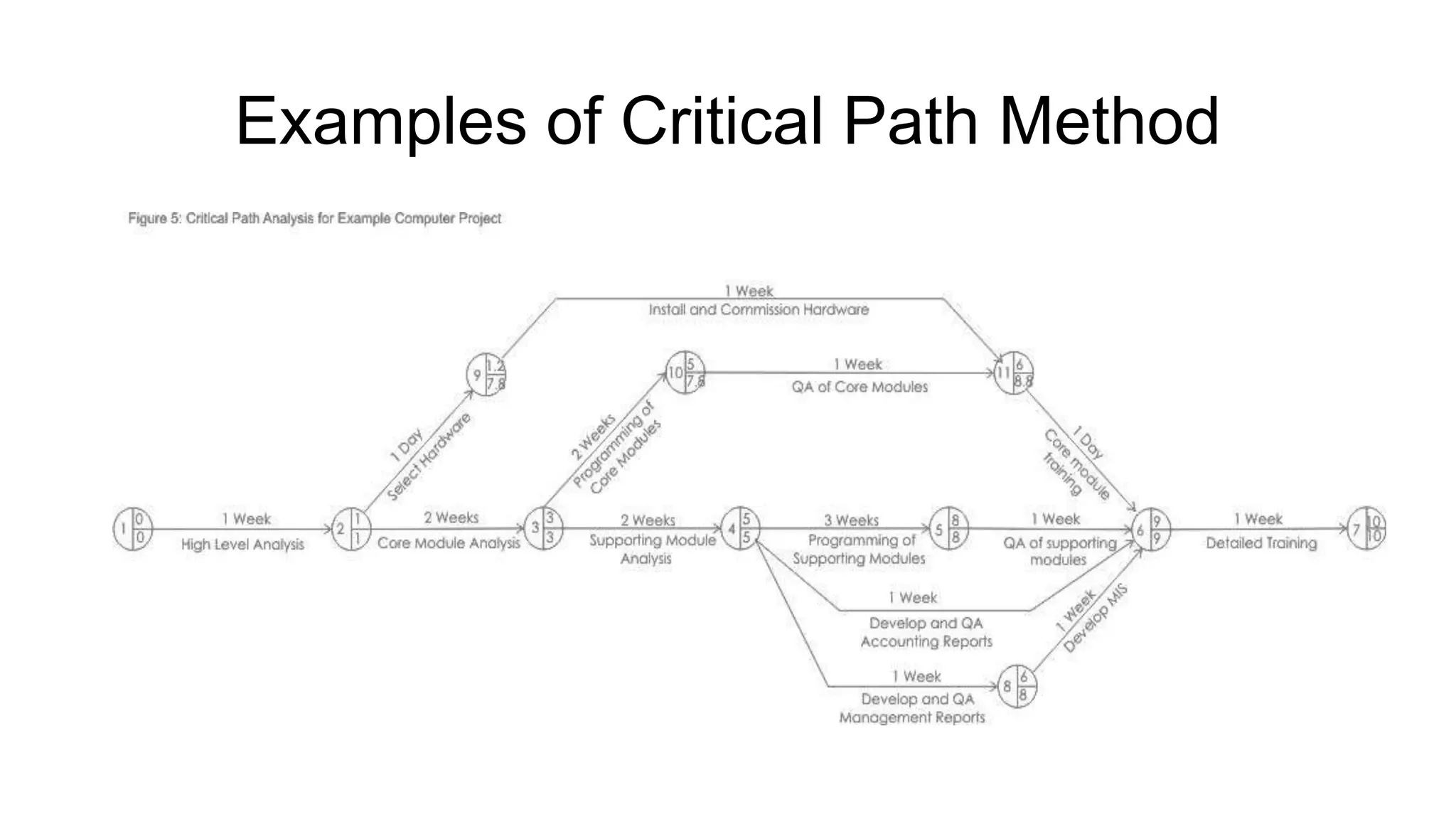
• Draw each task as part of a circle and arrow diagram
• Each circle or node should show a task within the project and give start and finish
times
• The circles are numbered to allow them to be easily identifiable
• The arrows or arcs which run from circle to circle show the activities needed to
complete the tasks
• A description of the task should be written under the arrow, with the duration of
the task written above it.
• Arrows always run left to right
Examples of Critical Path Method
Drawing a Critical Method Chart
Step 4:
• Identify the critical path
• This is done by determining the four parameters of each task in the network
• Earliest start time (ES) - The earliest time an activity can start once the previous dependent
activities are over.
• Earliest finish time (EF) - ES + activity duration.
• Latest finish time (LF) - The latest time an activity can finish without delaying the project.
• Latest start time (LS) - LF - activity duration.
• The float time for an activity is the time between the earliest (ES) and the latest (LS) start time or
between the earliest (EF) and latest (LF) finish times.
• During the float time, an activity can be delayed without delaying the project finish date.
• The activities in the critical path have an effect on the deadline of the project.
• If an activity of this path is delayed, the project will be delayed.
Benefits of the Critical Path Method
The benefits of CPM are:

• Visual representation
• The project plan can be tested to ensure it is well thought out
• It identifies key tasks which could cause delays to the project if not completed on
time
• It identifies tasks which could be delayed in order to complete other tasks which
are more time crucial
• It identifies the minimum amount of time a project will take to complete
• It identifies any project steps which can be completed faster in order to complete
the project on time
Disadvantages of Critical Path Method
The disadvantages of CPM are:

• Can be more difficult to understand than Gantt Charts
• The time needed for tasks is not as clear as with Gantt Charts
More Information on Critical Path Method
• This is a useful video which sums the information given in the slides
and will aid understanding of the critical path method
http://www.youtube.com/watch?v=SF53ZZsP4ik
Further Reading
• Kelley, J. E. (1963). The critical-path method: Resources planning and
scheduling. Industrial scheduling, 347-365.
• Leach, L. P. (1999). Critical chain project management improves
project performance. Project Management Journal, 30, 39-51.
• Maylor, Project Management. Chapter 7
References
• Maylor, H., 2010. Project Management. 4th Ed. Chester: Pearson.
• MindTools, 2013. Critical Path Analysis and PERT Charts. [Online] Available at:
http://www.mindtools.com/critpath.html [Accessed on 07/11/13]
• Margaret Rouse, 2011. Critical Path Method (CPM). [Online] Available at:
http://whatis.techtarget.com/definition/critical-path-method-CPM [Accessed on
07/11/13]
• Tutorialspoint, 2013. Critical Path Method. [Online] Available at:
http://www.tutorialspoint.com/management_concepts/critical_path_method.ht
m [Accessed on 07/11/13]

The Critical Path Method

  • 1.
  • 2.
    Critical Path Method •Scheduling and Project Management tool developed in the 1950’s • Allow us to plan all tasks which must be completed in a project • Aids time scheduling and resource planning • They allow progress towards project goals to be tracked
  • 3.
    Using the CriticalPath Method • Some activities cannot be started until previous activities have been completed • Activities in a critical path method therefore need to be completed in sequence • These activities are known as sequential activities • In addition to these activities there are tasks which can be completed at any time • These activities are known as non-dependent or parallel tasks
  • 4.
    Drawing a CriticalPath Method Chart Step 1: • List all the tasks needed for the project in the plan • This can be done using a Work Breakdown Structure For each task state: • The earliest start date • The estimated time it will take
  • 5.
    Drawing a CriticalPath Method Chart Step 2: • Establish whether the activity is sequential or parallel • For sequential tasks dependant tasks should be highlighted Establish sequence by looking at: • Which tasks should take place before this task happens. • Which tasks should be completed at the same time as this task. • Which tasks should happen immediately after this task.
  • 6.
    Drawing a CriticalPath Method Chart Step 3: • Draw each task as part of a circle and arrow diagram • Each circle or node should show a task within the project and give start and finish times • The circles are numbered to allow them to be easily identifiable • The arrows or arcs which run from circle to circle show the activities needed to complete the tasks • A description of the task should be written under the arrow, with the duration of the task written above it. • Arrows always run left to right
  • 7.
  • 8.
    Drawing a CriticalMethod Chart Step 4: • Identify the critical path • This is done by determining the four parameters of each task in the network • Earliest start time (ES) - The earliest time an activity can start once the previous dependent activities are over. • Earliest finish time (EF) - ES + activity duration. • Latest finish time (LF) - The latest time an activity can finish without delaying the project. • Latest start time (LS) - LF - activity duration. • The float time for an activity is the time between the earliest (ES) and the latest (LS) start time or between the earliest (EF) and latest (LF) finish times. • During the float time, an activity can be delayed without delaying the project finish date. • The activities in the critical path have an effect on the deadline of the project. • If an activity of this path is delayed, the project will be delayed.
  • 9.
    Benefits of theCritical Path Method The benefits of CPM are: • Visual representation • The project plan can be tested to ensure it is well thought out • It identifies key tasks which could cause delays to the project if not completed on time • It identifies tasks which could be delayed in order to complete other tasks which are more time crucial • It identifies the minimum amount of time a project will take to complete • It identifies any project steps which can be completed faster in order to complete the project on time
  • 10.
    Disadvantages of CriticalPath Method The disadvantages of CPM are: • Can be more difficult to understand than Gantt Charts • The time needed for tasks is not as clear as with Gantt Charts
  • 11.
    More Information onCritical Path Method • This is a useful video which sums the information given in the slides and will aid understanding of the critical path method http://www.youtube.com/watch?v=SF53ZZsP4ik
  • 12.
    Further Reading • Kelley,J. E. (1963). The critical-path method: Resources planning and scheduling. Industrial scheduling, 347-365. • Leach, L. P. (1999). Critical chain project management improves project performance. Project Management Journal, 30, 39-51. • Maylor, Project Management. Chapter 7
  • 13.
    References • Maylor, H.,2010. Project Management. 4th Ed. Chester: Pearson. • MindTools, 2013. Critical Path Analysis and PERT Charts. [Online] Available at: http://www.mindtools.com/critpath.html [Accessed on 07/11/13] • Margaret Rouse, 2011. Critical Path Method (CPM). [Online] Available at: http://whatis.techtarget.com/definition/critical-path-method-CPM [Accessed on 07/11/13] • Tutorialspoint, 2013. Critical Path Method. [Online] Available at: http://www.tutorialspoint.com/management_concepts/critical_path_method.ht m [Accessed on 07/11/13]