Presented by
Nishanth S
Nucleic acids
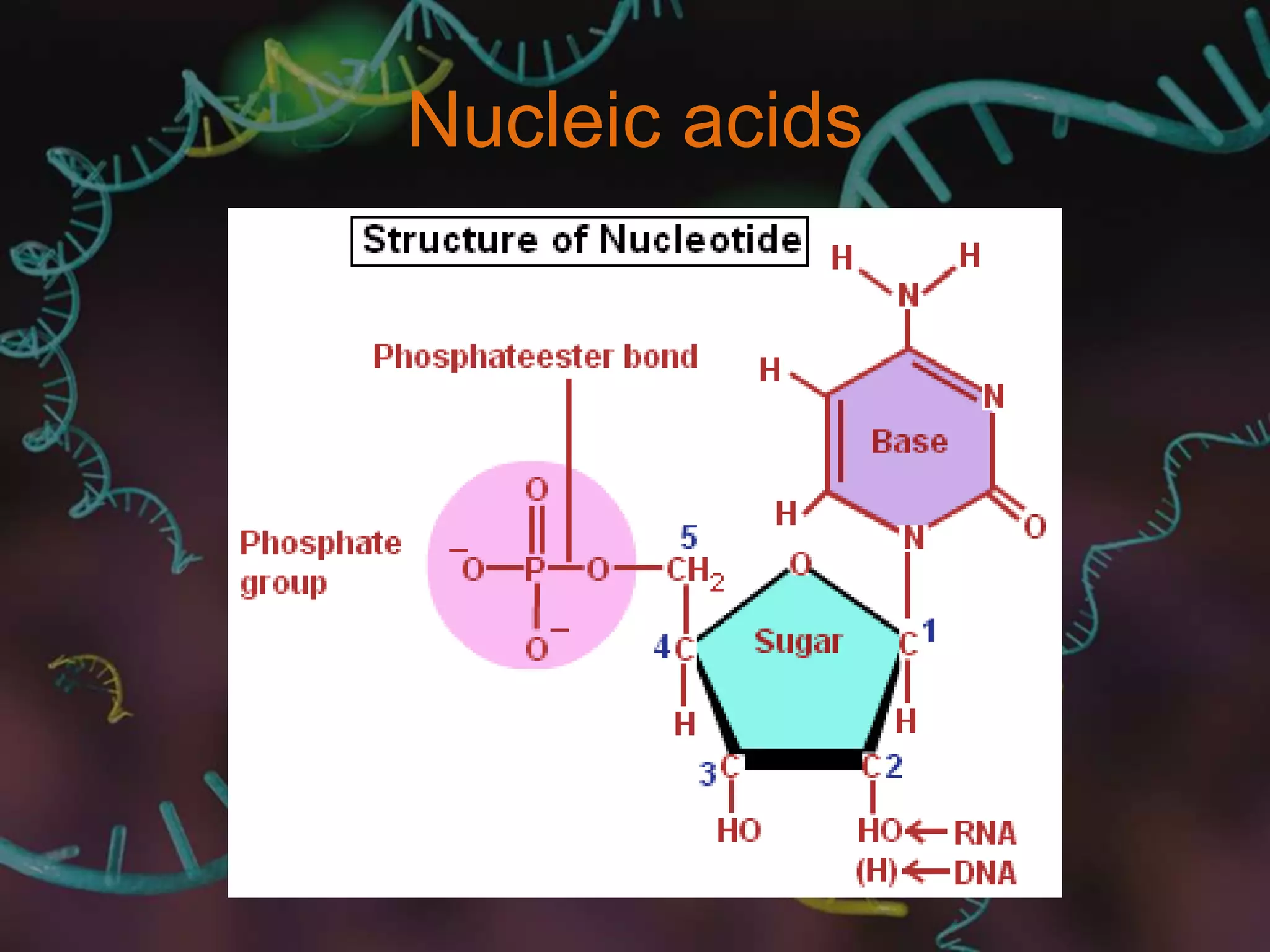
• Nucleic acid consists of ---------
Sugar (5 Carbon)
Nitrogenous base
Phosphate group
Nitrogenous bases includes ---
 Adenine
 Guanine
 Cytosine
 Thymine (DNA)
 Uracil (RNA)
NUCLEOSIDE = Sugar + Nitrogenous
base
NUCLEOTIDE = Sugar + Nitrogenous
base + Phosphate group
C
C
C
C
N
N
O
O
C
C
C
C
C
N
N
O
N
C
C
C
C
N
N
N
N
N
C
C
C
C
C
N
N
O
N
N
N
C
C
C
C
C
N
N
O
O
CC
C
C
C
N
N
O
N
C
C
C
C
N
N
O
N
N
N
C
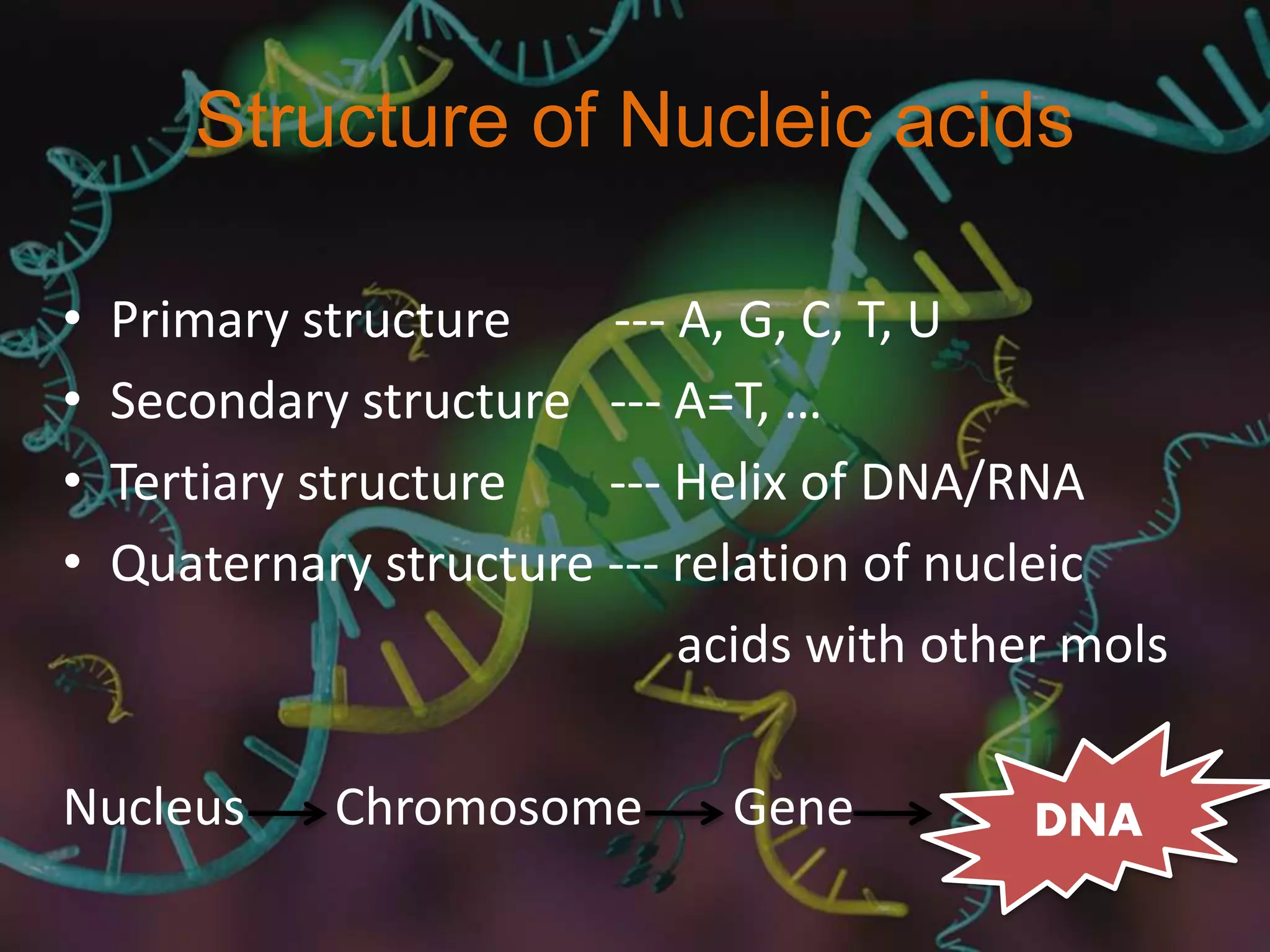
Structure of Nucleic acids
• Primary structure --- A, G, C, T, U
• Secondary structure --- A=T, …
• Tertiary structure --- Helix of DNA/RNA
• Quaternary structure --- relation of nucleic
acids with other mols
Nucleus Chromosome Gene DNA
Difference between RNA and
DNA
RNA
(Ribonucleic acid)
DNA
(Deoxyribo nucleic acid)
RNA is more primitive than DNA. DNA is originated from RNA.
RNA is the genetic material of some plants,
animals and bacterial viruses.
DNA is the genetic material of almost all
living organisms.
Pentose sugar is ribose. Pentose sugar is deoxyribose.
The bases are adenine, guanine, cytosine
and uracil.
The bases are adenine, guanine, cytosine
and thymine.
Base pairing occurs between adenine,
uracil (A-U) and guanine, cytosine (G-C).
Base pairing occurs between adenine,
thymine (A-T) and guanine, cytosine (G-C).
RNA DNA
The RNA molecules are of three types viz.,
mRNA, tRNA, and rRNA.
DNA is of only one type.
The mRNA is found in nucleus, tRNA and
rRNA are found on cytoplasm.
DNA is found in chromosomes,
mitochondria, and chloroplast.
RNAs translate the transcripts DNA into
proteins.
DNA encodes the genetic messages in the
form of mRNA.
Base pairing is seen only in hairpin
structure and helical region.
Base pairing occurs throughout the length
of the DNA molecule.
RNA contains a few nucleotides. DNA contains millions of nucleotides.
Difference between mRNA and
tRNA
mRNA tRNA
Transcribed from DNA in the nucleus and
posted out to the ribosomes for translation.
Used to translate mRNA by the ribosome,
making a new polypeptide.
Codons are complementary to DNA
triplets.
Anticodons are complementary to mRNA
codons and correspond to specific amino
acids.
mRNA is a simple strand. tRNA has a clover-shaped loop structure.
Broken down after translation.
Reactivated with a new amino acid after
translation.
DNA double helix structure is
stable – why ?
1) Both internal and external hydrogen
bonds stabilizes the double helix.
2) The negatively charges phosphate groups
are all situated on the exterior surface of
the helix.
3) The base pairs are bonded together with
hydrophobic interactions and Vanderwall
forces besides hydrogen bonding.
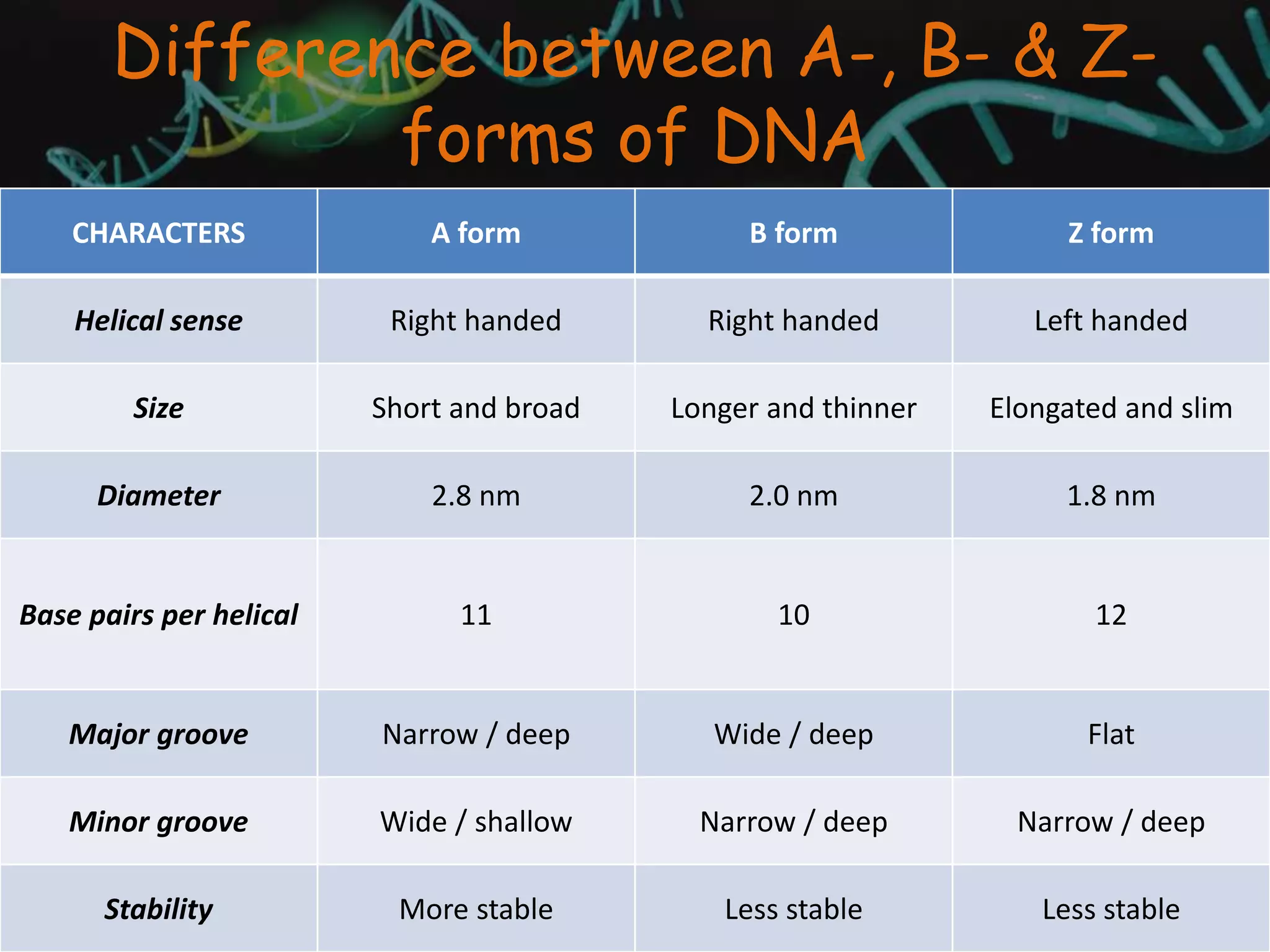
Difference between A-, B- & Z-
forms of DNA
CHARACTERS A form B form Z form
Helical sense Right handed Right handed Left handed
Size Short and broad Longer and thinner Elongated and slim
Diameter 2.8 nm 2.0 nm 1.8 nm
Base pairs per helical 11 10 12
Major groove Narrow / deep Wide / deep Flat
Minor groove Wide / shallow Narrow / deep Narrow / deep
Stability More stable Less stable Less stable
Structure of nucleic acids

Structure of nucleic acids

  • 1.
  • 2.
  • 3.
    • Nucleic acidconsists of --------- Sugar (5 Carbon) Nitrogenous base Phosphate group Nitrogenous bases includes ---  Adenine  Guanine  Cytosine  Thymine (DNA)  Uracil (RNA) NUCLEOSIDE = Sugar + Nitrogenous base NUCLEOTIDE = Sugar + Nitrogenous base + Phosphate group
  • 4.
  • 5.
  • 6.
    Structure of Nucleicacids • Primary structure --- A, G, C, T, U • Secondary structure --- A=T, … • Tertiary structure --- Helix of DNA/RNA • Quaternary structure --- relation of nucleic acids with other mols Nucleus Chromosome Gene DNA
  • 8.
    Difference between RNAand DNA RNA (Ribonucleic acid) DNA (Deoxyribo nucleic acid) RNA is more primitive than DNA. DNA is originated from RNA. RNA is the genetic material of some plants, animals and bacterial viruses. DNA is the genetic material of almost all living organisms. Pentose sugar is ribose. Pentose sugar is deoxyribose. The bases are adenine, guanine, cytosine and uracil. The bases are adenine, guanine, cytosine and thymine. Base pairing occurs between adenine, uracil (A-U) and guanine, cytosine (G-C). Base pairing occurs between adenine, thymine (A-T) and guanine, cytosine (G-C).
  • 9.
    RNA DNA The RNAmolecules are of three types viz., mRNA, tRNA, and rRNA. DNA is of only one type. The mRNA is found in nucleus, tRNA and rRNA are found on cytoplasm. DNA is found in chromosomes, mitochondria, and chloroplast. RNAs translate the transcripts DNA into proteins. DNA encodes the genetic messages in the form of mRNA. Base pairing is seen only in hairpin structure and helical region. Base pairing occurs throughout the length of the DNA molecule. RNA contains a few nucleotides. DNA contains millions of nucleotides.
  • 10.
    Difference between mRNAand tRNA mRNA tRNA Transcribed from DNA in the nucleus and posted out to the ribosomes for translation. Used to translate mRNA by the ribosome, making a new polypeptide. Codons are complementary to DNA triplets. Anticodons are complementary to mRNA codons and correspond to specific amino acids. mRNA is a simple strand. tRNA has a clover-shaped loop structure. Broken down after translation. Reactivated with a new amino acid after translation.
  • 11.
    DNA double helixstructure is stable – why ? 1) Both internal and external hydrogen bonds stabilizes the double helix. 2) The negatively charges phosphate groups are all situated on the exterior surface of the helix. 3) The base pairs are bonded together with hydrophobic interactions and Vanderwall forces besides hydrogen bonding.
  • 14.
    Difference between A-,B- & Z- forms of DNA CHARACTERS A form B form Z form Helical sense Right handed Right handed Left handed Size Short and broad Longer and thinner Elongated and slim Diameter 2.8 nm 2.0 nm 1.8 nm Base pairs per helical 11 10 12 Major groove Narrow / deep Wide / deep Flat Minor groove Wide / shallow Narrow / deep Narrow / deep Stability More stable Less stable Less stable