Biochemistry Lecture
Post RN (Unit 4)
Nucleic acid and nucleotide
by,
Miss Areesha Ahmad
Lecturer
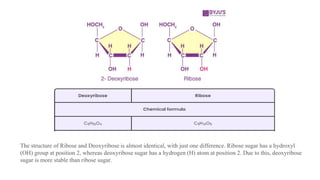
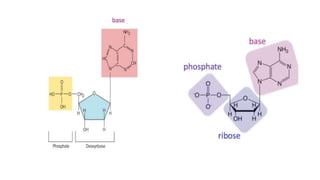
The structure of Ribose and Deoxyribose is almost identical, with just one difference. Ribose sugar has a hydroxyl
(OH) group at position 2, whereas deoxyribose sugar has a hydrogen (H) atom at position 2. Due to this, deoxyribose
sugar is more stable than ribose sugar.
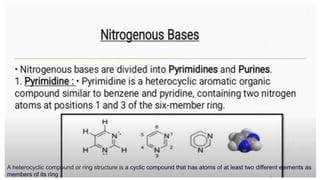
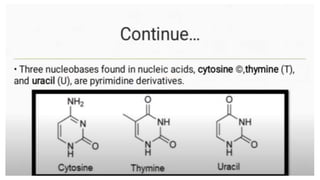
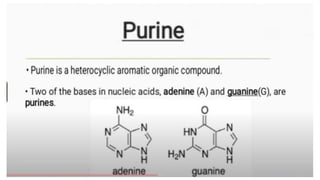
A heterocyclic compound or ring structure is a cyclic compound that has atoms of at least two different elements as
members of its ring
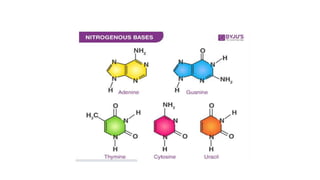
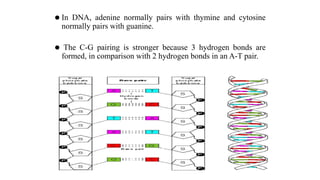
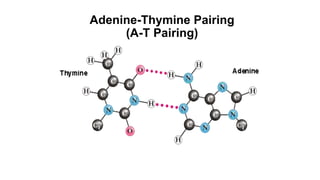
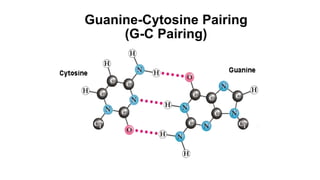
⚫ In DNA, adenine normally pairs with thymine and cytosine
normally pairs with guanine.
⚫ The C-G pairing is stronger because 3 hydrogen bonds are
formed, in comparison with 2 hydrogen bonds in an A-T pair.
Adenine-Thymine Pairing
(A-T Pairing)
Guanine-Cytosine Pairing
(G-C Pairing)
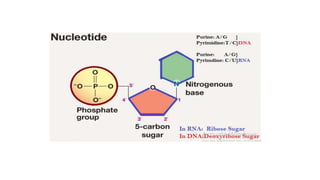
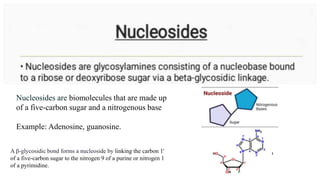
Nucleosides are biomolecules that are made up
of a five-carbon sugar and a nitrogenous base
Example: Adenosine, guanosine.
A β-glycosidic bond forms a nucleoside by linking the carbon 1'
of a five-carbon sugar to the nitrogen 9 of a purine or nitrogen 1
of a pyrimidine.
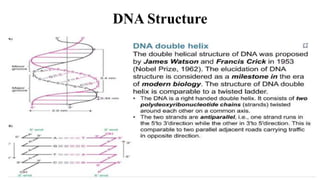
DNA Structure
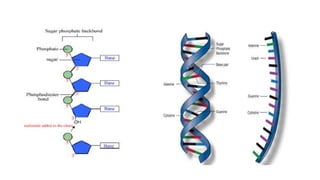
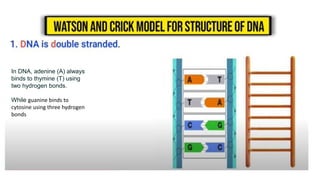
In DNA, adenine (A) always
binds to thymine (T) using
two hydrogen bonds.
While guanine binds to
cytosine using three hydrogen
bonds
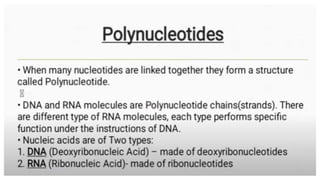
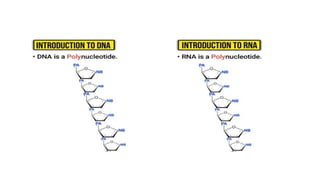
Ribonucleic acids (RNA)
⚫ The subunit of RNA molecules is the ribonucleotide made up of ribose, phosphate and
one of four nitrogenous bases (GCA or U)
⚫ In addition RNA is single stranded. (Though some RNA molecules have regions
where the strand folds back on itself and base-pairing occurs between two parallel
regions).
⚫ Presence of different sugar component and the difference between the bases form basis
for differences between RNA and DNA.
Types of RNA
❑ Messenger RNA
⚫Acts as an intermediary between DNA and proteins. The information
stored in the base sequence of DNA is passed to mRNA and the mRNA
acts as a guide to the amino acid sequence of proteins.
⚫mRNA travels from the nucleus (where the DNA is) to the cytoplasm
(where protein synthesis occurs.)
⚫Is only found in single-stranded form
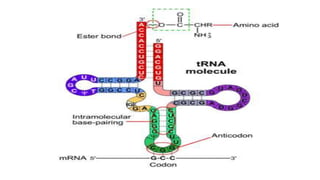
❑Transfer RNA
⚫ Present in the cytoplasm
⚫ Binds to an amino acid at first arm or loop
⚫ Has regions of base-pairing
⚫ Has an anti-codon region at third arm or loop
⚫ tRNA is specific for particular amino acids i.e. there are 20 different tRNAs, one for each
amino acid. At one end of the molecule the appropriate amino acid binds. At the other end
is a 3 base sequence which is complementary to the triplet codon on mRNA. This region
is called the anti-codon.
⚫ tRNA binds to its amino acid in the cytoplasm and transfers it to the site of protein
synthesis, the ribosome.
❑ Ribosomal RNA
⚫The third form of RNA is rRNA
⚫It is a component of ribosome so it is involved in protein synthesis.
⚫RNA found in ribosomes are called rRNA.
⚫During translation, rRNA provide site where polypeptides are
assembled.
Difference between DNA and RNA
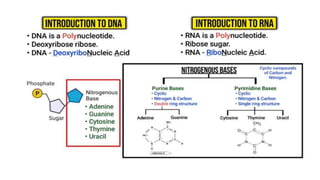
⚫In RNA, sugar is ribose while it is deoxyribose in DNA
⚫RNA does not contain thymine which is present in DNA. RNA contains
adenine, guanine, cytosine and uracil. DNA contain adenine, guanine,
cytosine and thymine.
⚫RNA is generally a single-stranded molecule while DNA is a double
stranded molecule.
⚫DNA is present in nucleus while RNA is found in cytoplasm and nucleus.
Biological functions of DNA
⚫Replication: It makes copies of itself and thus transfers genetic
information from one generation to the next.
⚫DNA also determines properties of a living cell and regulates
biological information by controlling protein synthesis.
⚫Transcription: Synthesis of mRNA OR a process during which
message of protein synthesis is given by DNA in the form of mRNA.
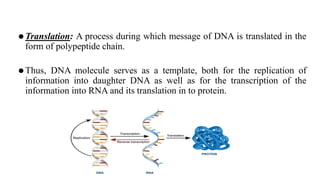
⚫Translation: A process during which message of DNA is translated in the
form of polypeptide chain.
⚫Thus, DNA molecule serves as a template, both for the replication of
information into daughter DNA as well as for the transcription of the
information into RNA and its translation in to protein.
Post RN - Biochemistry (Unit 4) Nucleic Acid & Nucleotide

Post RN - Biochemistry (Unit 4) Nucleic Acid & Nucleotide

  • 1.
    Biochemistry Lecture Post RN(Unit 4) Nucleic acid and nucleotide by, Miss Areesha Ahmad Lecturer
  • 8.
    The structure ofRibose and Deoxyribose is almost identical, with just one difference. Ribose sugar has a hydroxyl (OH) group at position 2, whereas deoxyribose sugar has a hydrogen (H) atom at position 2. Due to this, deoxyribose sugar is more stable than ribose sugar.
  • 12.
    A heterocyclic compoundor ring structure is a cyclic compound that has atoms of at least two different elements as members of its ring
  • 15.
    ⚫ In DNA,adenine normally pairs with thymine and cytosine normally pairs with guanine. ⚫ The C-G pairing is stronger because 3 hydrogen bonds are formed, in comparison with 2 hydrogen bonds in an A-T pair.
  • 16.
  • 17.
  • 18.
    Nucleosides are biomoleculesthat are made up of a five-carbon sugar and a nitrogenous base Example: Adenosine, guanosine. A β-glycosidic bond forms a nucleoside by linking the carbon 1' of a five-carbon sugar to the nitrogen 9 of a purine or nitrogen 1 of a pyrimidine.
  • 33.
  • 34.
    In DNA, adenine(A) always binds to thymine (T) using two hydrogen bonds. While guanine binds to cytosine using three hydrogen bonds
  • 35.
    Ribonucleic acids (RNA) ⚫The subunit of RNA molecules is the ribonucleotide made up of ribose, phosphate and one of four nitrogenous bases (GCA or U) ⚫ In addition RNA is single stranded. (Though some RNA molecules have regions where the strand folds back on itself and base-pairing occurs between two parallel regions). ⚫ Presence of different sugar component and the difference between the bases form basis for differences between RNA and DNA.
  • 37.
    Types of RNA ❑Messenger RNA ⚫Acts as an intermediary between DNA and proteins. The information stored in the base sequence of DNA is passed to mRNA and the mRNA acts as a guide to the amino acid sequence of proteins. ⚫mRNA travels from the nucleus (where the DNA is) to the cytoplasm (where protein synthesis occurs.) ⚫Is only found in single-stranded form
  • 38.
    ❑Transfer RNA ⚫ Presentin the cytoplasm ⚫ Binds to an amino acid at first arm or loop ⚫ Has regions of base-pairing ⚫ Has an anti-codon region at third arm or loop ⚫ tRNA is specific for particular amino acids i.e. there are 20 different tRNAs, one for each amino acid. At one end of the molecule the appropriate amino acid binds. At the other end is a 3 base sequence which is complementary to the triplet codon on mRNA. This region is called the anti-codon. ⚫ tRNA binds to its amino acid in the cytoplasm and transfers it to the site of protein synthesis, the ribosome.
  • 40.
    ❑ Ribosomal RNA ⚫Thethird form of RNA is rRNA ⚫It is a component of ribosome so it is involved in protein synthesis. ⚫RNA found in ribosomes are called rRNA. ⚫During translation, rRNA provide site where polypeptides are assembled.
  • 41.
    Difference between DNAand RNA ⚫In RNA, sugar is ribose while it is deoxyribose in DNA ⚫RNA does not contain thymine which is present in DNA. RNA contains adenine, guanine, cytosine and uracil. DNA contain adenine, guanine, cytosine and thymine. ⚫RNA is generally a single-stranded molecule while DNA is a double stranded molecule. ⚫DNA is present in nucleus while RNA is found in cytoplasm and nucleus.
  • 42.
    Biological functions ofDNA ⚫Replication: It makes copies of itself and thus transfers genetic information from one generation to the next. ⚫DNA also determines properties of a living cell and regulates biological information by controlling protein synthesis. ⚫Transcription: Synthesis of mRNA OR a process during which message of protein synthesis is given by DNA in the form of mRNA.
  • 43.
    ⚫Translation: A processduring which message of DNA is translated in the form of polypeptide chain. ⚫Thus, DNA molecule serves as a template, both for the replication of information into daughter DNA as well as for the transcription of the information into RNA and its translation in to protein.