Microbiology 
An 
introduction 
Presented by 
D. Mona 
Othman 
Albureikan 
Lecture (1,2)
Chapter 1 
The Microbial World and You 
1- What is Microbiology? 
• Micro - too small to be seen with the naked 
eye 
• Bio - life 
• ology - study of 
2- Microbes, also called microorganisms, are 
organisms that are too small to be seen with the 
unaided eye. 
Germ refers to a rapidly growing cell 
3- microorganisms are found almost 
everywhere.
1-1 List several ways in which microbes affect 
our lives. 
• A few are pathogenic (disease-causing). 
• Marine and freshwater microorganisms form the 
basis of the food chain in oceans, lakes, and rivers. 
• Soil microbes help break down wastes and 
incorporate nitrogen gas from the air into organic 
compounds. 
• Are producers in the ecosystem by photosynthesis, 
a food- and oxygen-generating process that is 
critical to life on Earth. 
• Humans and many other animals depend on the 
microbes for digestion and the synthesis of some 
vitamins that their bodies require, including some B 
v. for metabolism and v. K for blood clotting.
• Microorganisms are used in the synthesis of 
industrial chemical products as vitamins, organic 
acids, enzymes, alcohols, and many 
drugs.(commercial applications). 
• The food industry also uses microbes in 
producing vinegar, green olives, soy sauce, 
buttermilk, cheese, yogurt, and bread. 
• Enzymes from microbes can now be manipulated 
to cause the microbes to produce substances 
they normally do not synthesize , used in 
manufacturing (e.g., cellulase) and disease 
treatment (e.g., insulin).
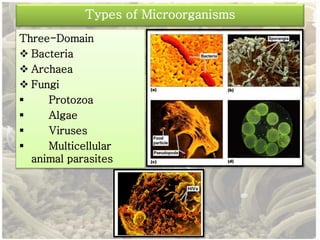
Types of Microorganisms 
Three-Domain 
 Bacteria 
 Archaea 
 Fungi 
 Protozoa 
 Algae 
 Viruses 
 Multicellular 
animal parasites
1-3 A Brief History of Microbiology 
The First Observations 
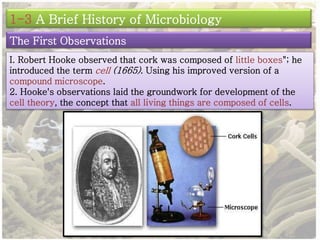
I. Robert Hooke observed that cork was composed of little boxes"; he 
introduced the term cell (1665). Using his improved version of a 
compound microscope. 
2. Hooke's observations laid the groundwork for development of the 
cell theory, the concept that all living things are composed of cells.
The First Observations 
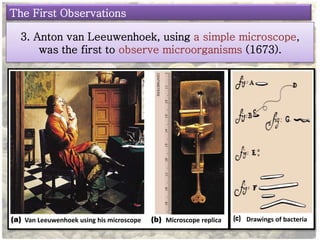
3. Anton van Leeuwenhoek, using a simple microscope, 
was the first to observe microorganisms (1673). 
Van Leeuwenhoek using his microscope Microscope replica Drawings of bacteria
The Debate over Spontaneous Generation 
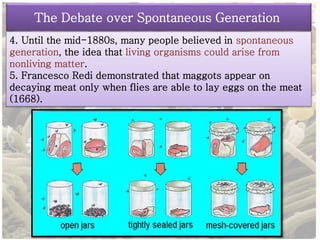
4. Until the mid-1880s, many people believed in spontaneous 
generation, the idea that living organisms could arise from 
nonliving matter. 
5. Francesco Redi demonstrated that maggots appear on 
decaying meat only when flies are able to lay eggs on the meat 
(1668).
The Debate over Spontaneous Generation 
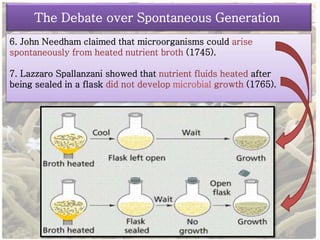
6. John Needham claimed that microorganisms could arise 
spontaneously from heated nutrient broth (1745). 
7. Lazzaro Spallanzani showed that nutrient fluids heated after 
being sealed in a flask did not develop microbial growth (1765).
The Theory of Biogenesis 
8. Rudolf Virchow introduced the concept of biogenesis: living cells 
can arise only from preexisting living cells (1858). 
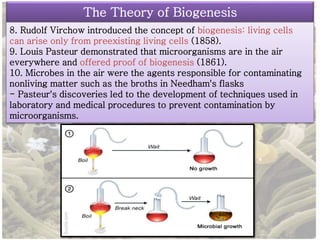
9. Louis Pasteur demonstrated that microorganisms are in the air 
everywhere and offered proof of biogenesis (1861). 
10. Microbes in the air were the agents responsible for contaminating 
nonliving matter such as the broths in Needham's flasks 
- Pasteur's discoveries led to the development of techniques used in 
laboratory and medical procedures to prevent contamination by 
microorganisms.
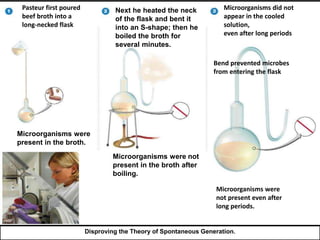
Pasteur first poured 
beef broth into a 
long-necked flask 
Next he heated the neck 
of the flask and bent it 
into an S-shape; then he 
boiled the broth for 
several minutes. 
Microorganisms did not 
appear in the cooled 
solution, 
even after long periods 
Microorganisms were 
present in the broth. 
Microorganisms were not 
present in the broth after 
boiling. 
Bend prevented microbes 
from entering the flask 
Microorganisms were 
not present even after 
long periods. 
Disproving the Theory of Spontaneous Generation.
The Golden Age of Microbiology 
The science of microbiology advanced rapidly between 1857 and 1914. 
Fermentation and Pasteurization 
12. Pasteur found that yeast ferment sugars to alcohol and that 
bacteria can oxidize the alcohol to acetic acid. 
13. A heating process called pasteurization is used to kill bacteria in 
some alcoholic beverages and milk. 
The Germ Theory of Disease 
14. Agostino Bassi (1835) and Pasteur (1865) showed a causal 
relationship between microorganisms and disease. 
15. Joseph Lister introduced the use of a disinfectant to dean surgical 
wounds in order to control infections in humans (1860s). 
16. Robert Koch proved that microorganisms cause disease. He used 
a sequence of procedures, now called Koch's postulates (1876), that 
are used today to prove that a particular microorganism causes a 
particular disease.
Vaccination 
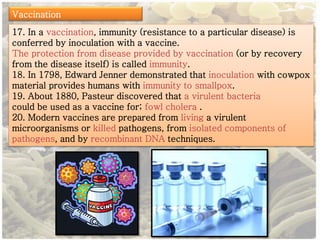
17. In a vaccination, immunity (resistance to a particular disease) is 
conferred by inoculation with a vaccine. 
The protection from disease provided by vaccination (or by recovery 
from the disease itself) is called immunity. 
18. In 1798, Edward Jenner demonstrated that inoculation with cowpox 
material provides humans with immunity to smallpox. 
19. About 1880, Pasteur discovered that a virulent bacteria 
could be used as a vaccine for; fowl cholera . 
20. Modern vaccines are prepared from living a virulent 
microorganisms or killed pathogens, from isolated components of 
pathogens, and by recombinant DNA techniques.
The Birth of Modern Chemotherapy: Dreams of a "Magic Bullet 
21. Chemotherapy is the chemical treatment of a disease. 
substances that could destroy pathogenic microorganisms 
without damaging the infected animal or human. Treatment of 
disease by using chemical substances is called chemotherapy. 
22. Two types of chemotherapeutic agents are synthetic drugs 
(chemically prepared in the laboratory) and antibiotics (substances 
produced naturally by bacteria and fungi against the growth of other 
microorganisms). 
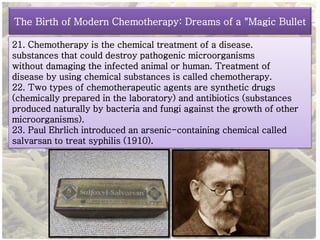
23. Paul Ehrlich introduced an arsenic-containing chemical called 
salvarsan to treat syphilis (1910).
The Birth of Modern Chemotherapy: Dreams of a "Magic Bullet 
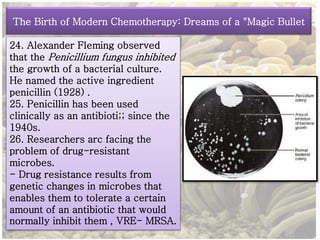
24. Alexander Fleming observed 
that the Penicillium fungus inhibited 
the growth of a bacterial culture. 
He named the active ingredient 
penicillin (1928) . 
25. Penicillin has been used 
clinically as an antibioti;; since the 
1940s. 
26. Researchers arc facing the 
problem of drug-resistant 
microbes. 
- Drug resistance results from 
genetic changes in microbes that 
enables them to tolerate a certain 
amount of an antibiotic that would 
normally inhibit them , VRE- MRSA.
Modern Developments in Microbiology 
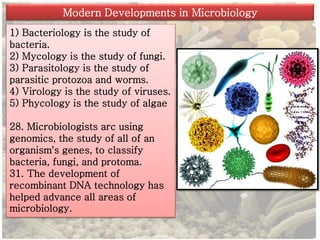
1) Bacteriology is the study of 
bacteria. 
2) Mycology is the study of fungi. 
3) Parasitology is the study of 
parasitic protozoa and worms. 
4) Virology is the study of viruses. 
5) Phycology is the study of algae 
28. Microbiologists arc using 
genomics, the study of all of an 
organism's genes, to classify 
bacteria, fungi, and protoma. 
31. The development of 
recombinant DNA technology has 
helped advance all areas of 
microbiology.
Microbes and Human Disease 
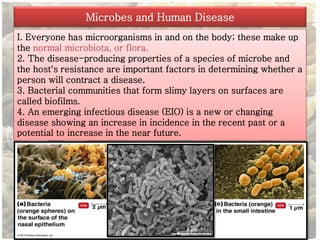
I. Everyone has microorganisms in and on the body; these make up 
the normal microbiota, or flora. 
2. The disease-producing properties of a species of microbe and 
the host's resistance are important factors in determining whether a 
person will contract a disease. 
3. Bacterial communities that form slimy layers on surfaces are 
called biofilms. 
4. An emerging infectious disease (EIO) is a new or changing 
disease showing an increase in incidence in the recent past or a 
potential to increase in the near future.
References 
• Microbiology: An Introduction Plus 
MasteringMicrobiology with eText - Access Card 
Package (11th Edition) Hardcover – January 2, 2012 
by Gerard J. Tortora, Berdell R. Funke, Christine L. 
Case. 
• Some pictures from different sits.

Presentation1

  • 1.
    Microbiology An introduction Presented by D. Mona Othman Albureikan Lecture (1,2)
  • 2.
    Chapter 1 TheMicrobial World and You 1- What is Microbiology? • Micro - too small to be seen with the naked eye • Bio - life • ology - study of 2- Microbes, also called microorganisms, are organisms that are too small to be seen with the unaided eye. Germ refers to a rapidly growing cell 3- microorganisms are found almost everywhere.
  • 3.
    1-1 List severalways in which microbes affect our lives. • A few are pathogenic (disease-causing). • Marine and freshwater microorganisms form the basis of the food chain in oceans, lakes, and rivers. • Soil microbes help break down wastes and incorporate nitrogen gas from the air into organic compounds. • Are producers in the ecosystem by photosynthesis, a food- and oxygen-generating process that is critical to life on Earth. • Humans and many other animals depend on the microbes for digestion and the synthesis of some vitamins that their bodies require, including some B v. for metabolism and v. K for blood clotting.
  • 4.
    • Microorganisms areused in the synthesis of industrial chemical products as vitamins, organic acids, enzymes, alcohols, and many drugs.(commercial applications). • The food industry also uses microbes in producing vinegar, green olives, soy sauce, buttermilk, cheese, yogurt, and bread. • Enzymes from microbes can now be manipulated to cause the microbes to produce substances they normally do not synthesize , used in manufacturing (e.g., cellulase) and disease treatment (e.g., insulin).
  • 5.
    Types of Microorganisms Three-Domain  Bacteria  Archaea  Fungi  Protozoa  Algae  Viruses  Multicellular animal parasites
  • 6.
    1-3 A BriefHistory of Microbiology The First Observations I. Robert Hooke observed that cork was composed of little boxes"; he introduced the term cell (1665). Using his improved version of a compound microscope. 2. Hooke's observations laid the groundwork for development of the cell theory, the concept that all living things are composed of cells.
  • 7.
    The First Observations 3. Anton van Leeuwenhoek, using a simple microscope, was the first to observe microorganisms (1673). Van Leeuwenhoek using his microscope Microscope replica Drawings of bacteria
  • 8.
    The Debate overSpontaneous Generation 4. Until the mid-1880s, many people believed in spontaneous generation, the idea that living organisms could arise from nonliving matter. 5. Francesco Redi demonstrated that maggots appear on decaying meat only when flies are able to lay eggs on the meat (1668).
  • 9.
    The Debate overSpontaneous Generation 6. John Needham claimed that microorganisms could arise spontaneously from heated nutrient broth (1745). 7. Lazzaro Spallanzani showed that nutrient fluids heated after being sealed in a flask did not develop microbial growth (1765).
  • 10.
    The Theory ofBiogenesis 8. Rudolf Virchow introduced the concept of biogenesis: living cells can arise only from preexisting living cells (1858). 9. Louis Pasteur demonstrated that microorganisms are in the air everywhere and offered proof of biogenesis (1861). 10. Microbes in the air were the agents responsible for contaminating nonliving matter such as the broths in Needham's flasks - Pasteur's discoveries led to the development of techniques used in laboratory and medical procedures to prevent contamination by microorganisms.
  • 11.
    Pasteur first poured beef broth into a long-necked flask Next he heated the neck of the flask and bent it into an S-shape; then he boiled the broth for several minutes. Microorganisms did not appear in the cooled solution, even after long periods Microorganisms were present in the broth. Microorganisms were not present in the broth after boiling. Bend prevented microbes from entering the flask Microorganisms were not present even after long periods. Disproving the Theory of Spontaneous Generation.
  • 12.
    The Golden Ageof Microbiology The science of microbiology advanced rapidly between 1857 and 1914. Fermentation and Pasteurization 12. Pasteur found that yeast ferment sugars to alcohol and that bacteria can oxidize the alcohol to acetic acid. 13. A heating process called pasteurization is used to kill bacteria in some alcoholic beverages and milk. The Germ Theory of Disease 14. Agostino Bassi (1835) and Pasteur (1865) showed a causal relationship between microorganisms and disease. 15. Joseph Lister introduced the use of a disinfectant to dean surgical wounds in order to control infections in humans (1860s). 16. Robert Koch proved that microorganisms cause disease. He used a sequence of procedures, now called Koch's postulates (1876), that are used today to prove that a particular microorganism causes a particular disease.
  • 13.
    Vaccination 17. Ina vaccination, immunity (resistance to a particular disease) is conferred by inoculation with a vaccine. The protection from disease provided by vaccination (or by recovery from the disease itself) is called immunity. 18. In 1798, Edward Jenner demonstrated that inoculation with cowpox material provides humans with immunity to smallpox. 19. About 1880, Pasteur discovered that a virulent bacteria could be used as a vaccine for; fowl cholera . 20. Modern vaccines are prepared from living a virulent microorganisms or killed pathogens, from isolated components of pathogens, and by recombinant DNA techniques.
  • 14.
    The Birth ofModern Chemotherapy: Dreams of a "Magic Bullet 21. Chemotherapy is the chemical treatment of a disease. substances that could destroy pathogenic microorganisms without damaging the infected animal or human. Treatment of disease by using chemical substances is called chemotherapy. 22. Two types of chemotherapeutic agents are synthetic drugs (chemically prepared in the laboratory) and antibiotics (substances produced naturally by bacteria and fungi against the growth of other microorganisms). 23. Paul Ehrlich introduced an arsenic-containing chemical called salvarsan to treat syphilis (1910).
  • 15.
    The Birth ofModern Chemotherapy: Dreams of a "Magic Bullet 24. Alexander Fleming observed that the Penicillium fungus inhibited the growth of a bacterial culture. He named the active ingredient penicillin (1928) . 25. Penicillin has been used clinically as an antibioti;; since the 1940s. 26. Researchers arc facing the problem of drug-resistant microbes. - Drug resistance results from genetic changes in microbes that enables them to tolerate a certain amount of an antibiotic that would normally inhibit them , VRE- MRSA.
  • 16.
    Modern Developments inMicrobiology 1) Bacteriology is the study of bacteria. 2) Mycology is the study of fungi. 3) Parasitology is the study of parasitic protozoa and worms. 4) Virology is the study of viruses. 5) Phycology is the study of algae 28. Microbiologists arc using genomics, the study of all of an organism's genes, to classify bacteria, fungi, and protoma. 31. The development of recombinant DNA technology has helped advance all areas of microbiology.
  • 17.
    Microbes and HumanDisease I. Everyone has microorganisms in and on the body; these make up the normal microbiota, or flora. 2. The disease-producing properties of a species of microbe and the host's resistance are important factors in determining whether a person will contract a disease. 3. Bacterial communities that form slimy layers on surfaces are called biofilms. 4. An emerging infectious disease (EIO) is a new or changing disease showing an increase in incidence in the recent past or a potential to increase in the near future.
  • 18.
    References • Microbiology:An Introduction Plus MasteringMicrobiology with eText - Access Card Package (11th Edition) Hardcover – January 2, 2012 by Gerard J. Tortora, Berdell R. Funke, Christine L. Case. • Some pictures from different sits.