Sir Alexander Fleming By: Brian J.
Early Life  Alexander Fleming, the third son of a Scottish farmer who died seven years after Alexander’s birth, He graduated from school and at the age of 21 he lived with his second brother Dr. Fleming in London, England.  His oldest brother remained at home to look after the family farm and to care for their mother
Accidental discovery  Dr. Fleming worked on antiseptics which he hoped would kill bacteria. He developed Lysozyme the strongest antiseptic of its time.  Six years later, in 1928, Fleming was investigating one of his theories, that nasal mucus had antibacterial properties. He spread a microscope slide with staphylococcus bacteria, left it in the laboratory, and went for a two-week vacation.  When he returned he noticed that bacteria growing near a mold had died.  The mold that had accidentally contaminated the slide was not known to him. He isolated a spore from the mold and found it to be a member of a family named Penicillium Notatum and had somehow drifted in from a laboratory on the floor above “ Chances favor the prepared mind the prepared mind makes its own chances”
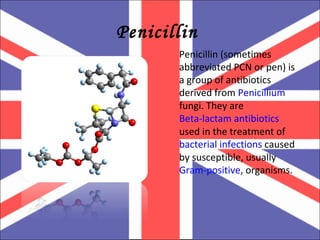
Penicillin  Penicillin (sometimes abbreviated PCN or pen) is a group of antibiotics derived from  Penicillium  fungi. They are  Beta-lactam antibiotics  used in the treatment of  bacterial   infections  caused by susceptible, usually  Gram-positive , organisms.
Thousands  Saved By Penicillin  Since its discovery penicillin has saved thousands of lives on all fronts during peace and war  Since its discovery causalities of war have been greatly reduced
Sir Alexander and Sir Winston  Sir Churchill loved swimming a popular myth is that one summer while visiting in the country he was saved by Alexander Fleming at this time Churchill was in his early teens
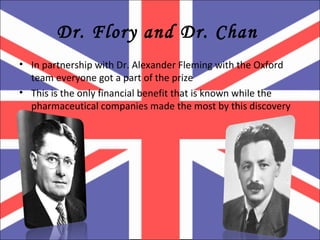
Dr. Flory and Dr. Chan  In partnership with Dr. Alexander Fleming with the Oxford team everyone got a part of the prize This is the only financial benefit that is known while the pharmaceutical companies made the most by this discovery
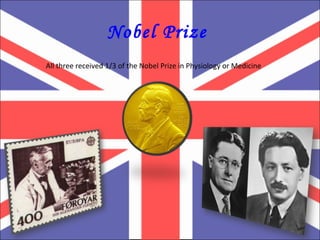
Nobel Prize  All three received 1/3 of the Nobel Prize in Physiology or Medicine
The End

Sir Alexander Fleming

  • 1.
  • 2.
    Early Life Alexander Fleming, the third son of a Scottish farmer who died seven years after Alexander’s birth, He graduated from school and at the age of 21 he lived with his second brother Dr. Fleming in London, England. His oldest brother remained at home to look after the family farm and to care for their mother
  • 3.
    Accidental discovery Dr. Fleming worked on antiseptics which he hoped would kill bacteria. He developed Lysozyme the strongest antiseptic of its time. Six years later, in 1928, Fleming was investigating one of his theories, that nasal mucus had antibacterial properties. He spread a microscope slide with staphylococcus bacteria, left it in the laboratory, and went for a two-week vacation. When he returned he noticed that bacteria growing near a mold had died. The mold that had accidentally contaminated the slide was not known to him. He isolated a spore from the mold and found it to be a member of a family named Penicillium Notatum and had somehow drifted in from a laboratory on the floor above “ Chances favor the prepared mind the prepared mind makes its own chances”
  • 4.
    Penicillin Penicillin(sometimes abbreviated PCN or pen) is a group of antibiotics derived from Penicillium fungi. They are Beta-lactam antibiotics used in the treatment of bacterial infections caused by susceptible, usually Gram-positive , organisms.
  • 5.
    Thousands SavedBy Penicillin Since its discovery penicillin has saved thousands of lives on all fronts during peace and war Since its discovery causalities of war have been greatly reduced
  • 6.
    Sir Alexander andSir Winston Sir Churchill loved swimming a popular myth is that one summer while visiting in the country he was saved by Alexander Fleming at this time Churchill was in his early teens
  • 7.
    Dr. Flory andDr. Chan In partnership with Dr. Alexander Fleming with the Oxford team everyone got a part of the prize This is the only financial benefit that is known while the pharmaceutical companies made the most by this discovery
  • 8.
    Nobel Prize All three received 1/3 of the Nobel Prize in Physiology or Medicine
  • 9.