Colorimetry and
spectrophotometry
Mohammed Siddig Ali
MSc. Clinical Chemistry
 When a monochromatic light passes through a
colored solution, amount of light transmitted
decreases exponentially with increase in
concentration of colored substance.
 I.e. the amount of light absorbed by a colored
solution is directly proportion to the conc. Of
substance in the colored solution.
Beer’s law
 The amount of light transmitted decreases
exponentially with increase in path length
(diameter) of the cuvette or thickness of colored
solution through which light passes.
 I.e. the amount of light absorbed by a colored
solution depends on path length of cuvette or
thickness or depth of the colored solution.
Lambert’s law
 Expressed as amount of light transmitted
through a colored solution decreases
exponentially with increases in conc. Of colored
solution & increase in the pathlength of cuvette
or thickness of the colored solution.
Beer’s- Lambert’s law
 It is the most common analytical technique used
in biochemical estimation in clinical laboratory.
 It involves the quantitative estimation of color.
 A substance to be estimated colorimetrically,
must be colored or it should be capable of
forming chromogens (colored complexes)
through the addition of reagents.
Colorimetry
 Colored substance absorb light in relation to
their color intensity.
 The color intensity will be proportional to the
conc. Of colored substance.
 The instruments used in this method are
colorimeter or photometer or absorptiometers.
 Colored solutions have the property of absorbing
certain wavelength of light when a monochromatic
light is passed through them.
 The amount of light absorbed or transmitted by a
colored solution is in accordance with two laws:
 Beer’s law
 Lambert’s law
Principle
 Is a sophisticated type of colorimeter where
monochromatic light is provided by prism.
 The band with of the light passed by a filter is
quite board, so that it may be difficult to
distinguish between two components of closely
related absorption with a colorimeter.
 A spectrophotometer is then needed.
The Spectrophotometer:
1- Visible spectrophotometer.
2- Ultraviolet (UV) spectrophotometer.
Types of spectrophotometer:
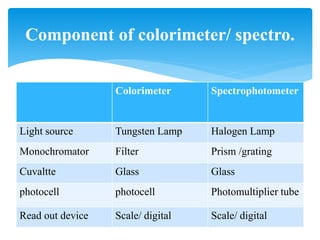
Colorimeter Spectrophotometer
Light source Tungsten Lamp Halogen Lamp
Monochromator Filter Prism /grating
Cuvaltte Glass Glass
photocell photocell Photomultiplier tube
Read out device Scale/ digital Scale/ digital
Component of colorimeter/ spectro.
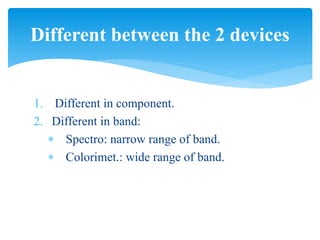
1. Different in component.
2. Different in band:
 Spectro: narrow range of band.
 Colorimet.: wide range of band.
Different between the 2 devices
1- White light from a tungsten lamp passes through a
slit, then a condenser lens, to give a parallel beam
which falls on the solution under investigation
contained in cuvette. The cell is made of glass.
How colorimeter/spectro. works?
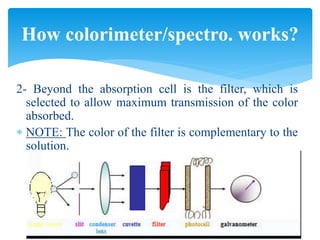
2- Beyond the absorption cell is the filter, which is
selected to allow maximum transmission of the color
absorbed.
 NOTE: The color of the filter is complementary to the
solution.
How colorimeter/spectro. works?
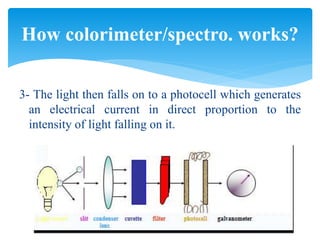
3- The light then falls on to a photocell which generates
an electrical current in direct proportion to the
intensity of light falling on it.
How colorimeter/spectro. works?
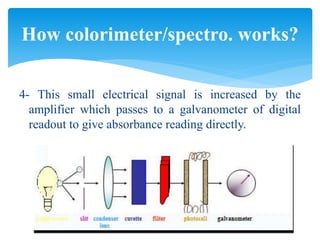
4- This small electrical signal is increased by the
amplifier which passes to a galvanometer of digital
readout to give absorbance reading directly.
How colorimeter/spectro. works?
𝒂𝒃𝒔𝒐𝒓𝒃𝒂𝒏𝒄𝒆 𝒐𝒇 𝒖𝒏𝒌𝒏𝒐𝒘𝒏 𝒄𝒐𝒄. = 𝒂𝒃𝒔𝒓𝒐𝒃𝒂𝒏𝒄𝒆 𝒐𝒇 𝑺𝑻𝑫
Concentration of unknown conc. = concentration of STD
CUn. = A Un. × C St.
A St.
Calculation
 Used in determination of amount of many
substances in blood, urine, saliva, CSF & other
specimens.
 Example for common colorimetric assay are :
determination of blood glucose, blood urea etc.
 Example for common spectrophotometric assay
is: determination of enzyme
Application of colorimetric/spectro.
assay
Thanks for attention

Colorimeter and Spectrophotometer.pptx

  • 1.
  • 2.
     When amonochromatic light passes through a colored solution, amount of light transmitted decreases exponentially with increase in concentration of colored substance.  I.e. the amount of light absorbed by a colored solution is directly proportion to the conc. Of substance in the colored solution. Beer’s law
  • 3.
     The amountof light transmitted decreases exponentially with increase in path length (diameter) of the cuvette or thickness of colored solution through which light passes.  I.e. the amount of light absorbed by a colored solution depends on path length of cuvette or thickness or depth of the colored solution. Lambert’s law
  • 4.
     Expressed asamount of light transmitted through a colored solution decreases exponentially with increases in conc. Of colored solution & increase in the pathlength of cuvette or thickness of the colored solution. Beer’s- Lambert’s law
  • 5.
     It isthe most common analytical technique used in biochemical estimation in clinical laboratory.  It involves the quantitative estimation of color.  A substance to be estimated colorimetrically, must be colored or it should be capable of forming chromogens (colored complexes) through the addition of reagents. Colorimetry
  • 6.
     Colored substanceabsorb light in relation to their color intensity.  The color intensity will be proportional to the conc. Of colored substance.  The instruments used in this method are colorimeter or photometer or absorptiometers.
  • 7.
     Colored solutionshave the property of absorbing certain wavelength of light when a monochromatic light is passed through them.  The amount of light absorbed or transmitted by a colored solution is in accordance with two laws:  Beer’s law  Lambert’s law Principle
  • 8.
     Is asophisticated type of colorimeter where monochromatic light is provided by prism.  The band with of the light passed by a filter is quite board, so that it may be difficult to distinguish between two components of closely related absorption with a colorimeter.  A spectrophotometer is then needed. The Spectrophotometer:
  • 9.
    1- Visible spectrophotometer. 2-Ultraviolet (UV) spectrophotometer. Types of spectrophotometer:
  • 10.
    Colorimeter Spectrophotometer Light sourceTungsten Lamp Halogen Lamp Monochromator Filter Prism /grating Cuvaltte Glass Glass photocell photocell Photomultiplier tube Read out device Scale/ digital Scale/ digital Component of colorimeter/ spectro.
  • 11.
    1. Different incomponent. 2. Different in band:  Spectro: narrow range of band.  Colorimet.: wide range of band. Different between the 2 devices
  • 12.
    1- White lightfrom a tungsten lamp passes through a slit, then a condenser lens, to give a parallel beam which falls on the solution under investigation contained in cuvette. The cell is made of glass. How colorimeter/spectro. works?
  • 13.
    2- Beyond theabsorption cell is the filter, which is selected to allow maximum transmission of the color absorbed.  NOTE: The color of the filter is complementary to the solution. How colorimeter/spectro. works?
  • 14.
    3- The lightthen falls on to a photocell which generates an electrical current in direct proportion to the intensity of light falling on it. How colorimeter/spectro. works?
  • 15.
    4- This smallelectrical signal is increased by the amplifier which passes to a galvanometer of digital readout to give absorbance reading directly. How colorimeter/spectro. works?
  • 16.
    𝒂𝒃𝒔𝒐𝒓𝒃𝒂𝒏𝒄𝒆 𝒐𝒇 𝒖𝒏𝒌𝒏𝒐𝒘𝒏𝒄𝒐𝒄. = 𝒂𝒃𝒔𝒓𝒐𝒃𝒂𝒏𝒄𝒆 𝒐𝒇 𝑺𝑻𝑫 Concentration of unknown conc. = concentration of STD CUn. = A Un. × C St. A St. Calculation
  • 17.
     Used indetermination of amount of many substances in blood, urine, saliva, CSF & other specimens.  Example for common colorimetric assay are : determination of blood glucose, blood urea etc.  Example for common spectrophotometric assay is: determination of enzyme Application of colorimetric/spectro. assay
  • 18.