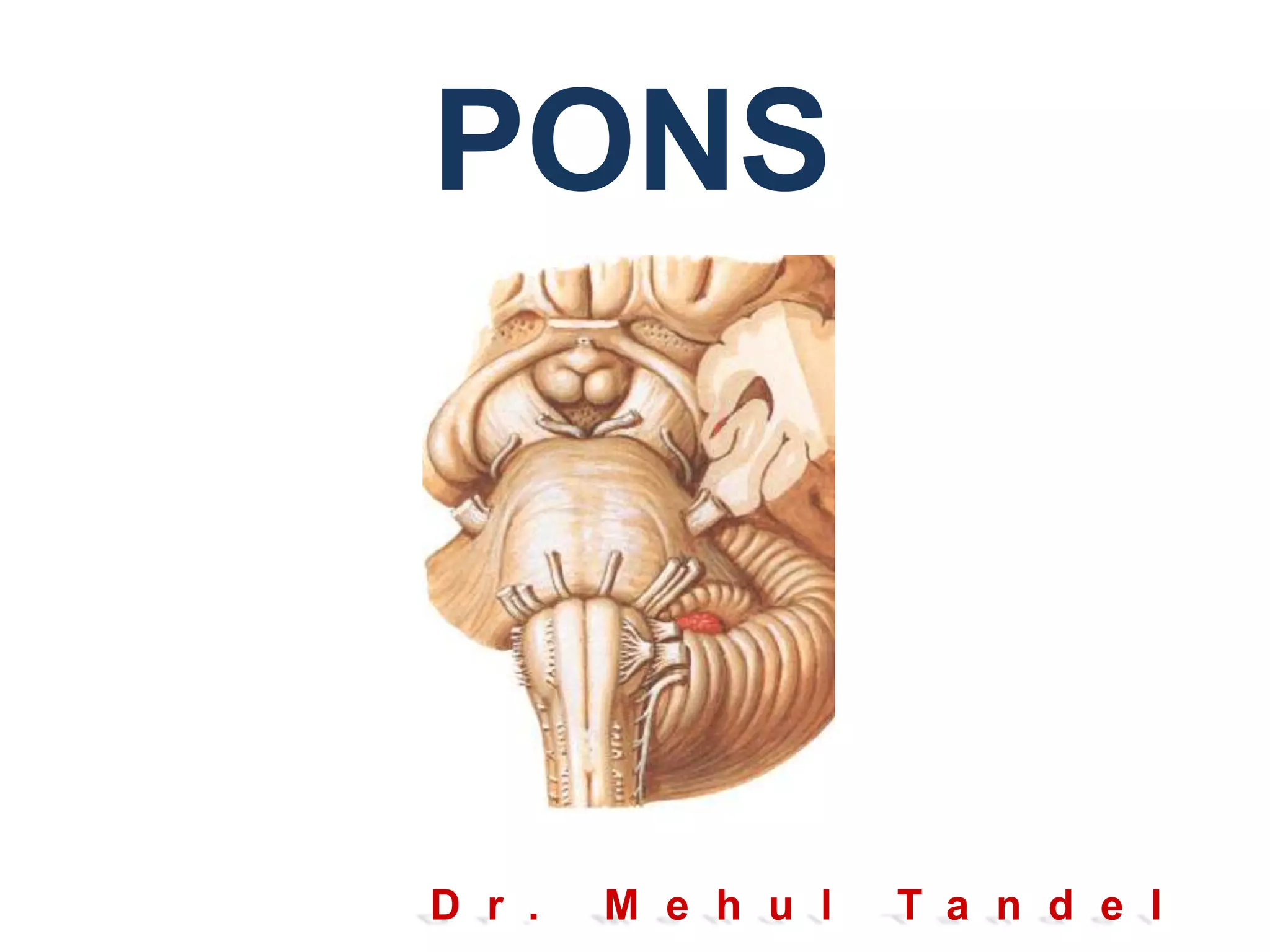
PONS
D r . M e h u l T a n d e l
Objectives:
(1) External features of Pons
(2) Internal features of Pons– cross sections
(1) At the level of Facial Colliculus
(2) At the level of Motor & Sensory Nucleus of
trigeminal nerve
(3) Blood supply with Applied aspects
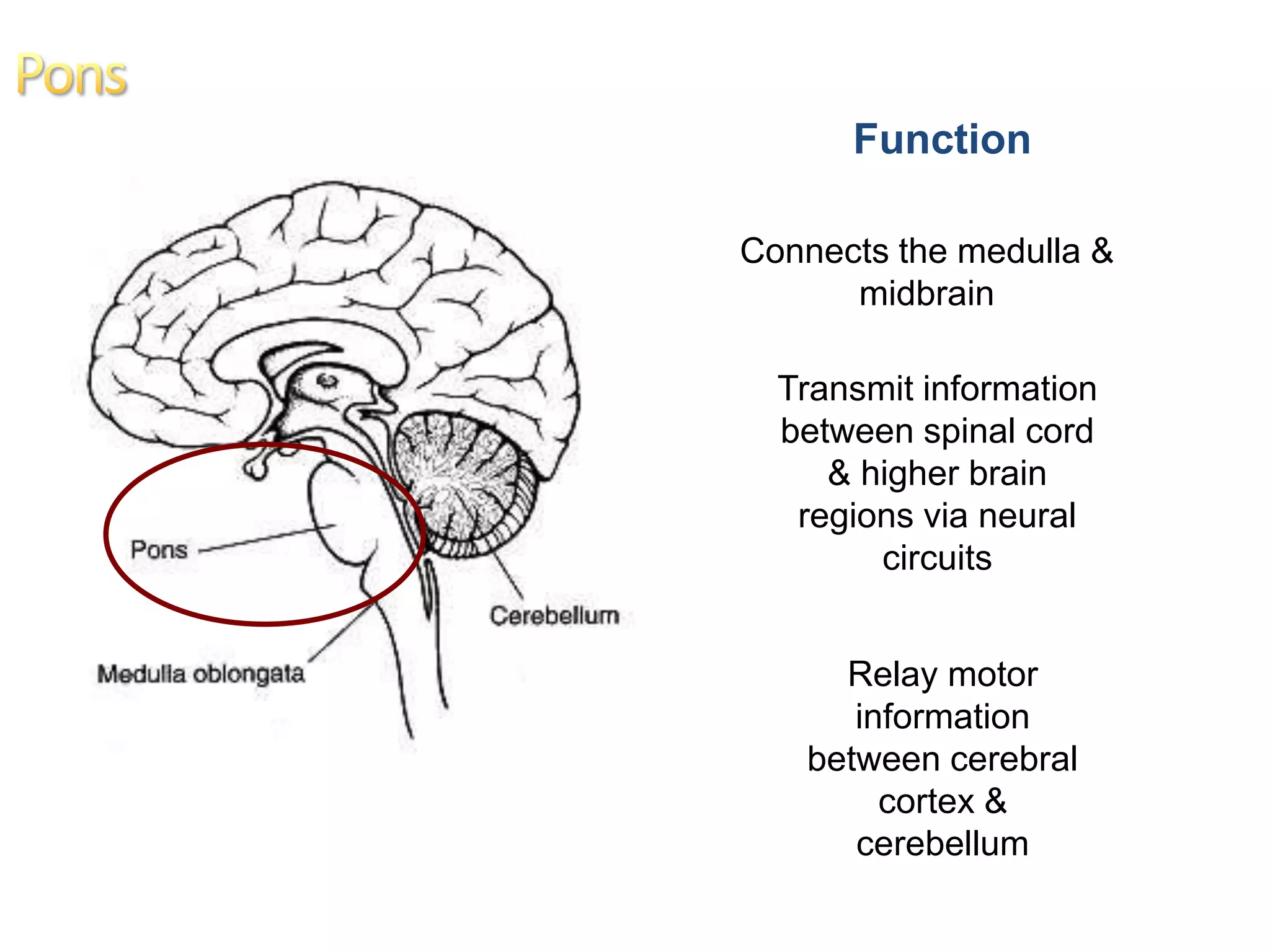
Connects the medulla &
midbrain
Function
Transmit information
between spinal cord
& higher brain
regions via neural
circuits
Relay motor
information
between cerebral
cortex &
cerebellum
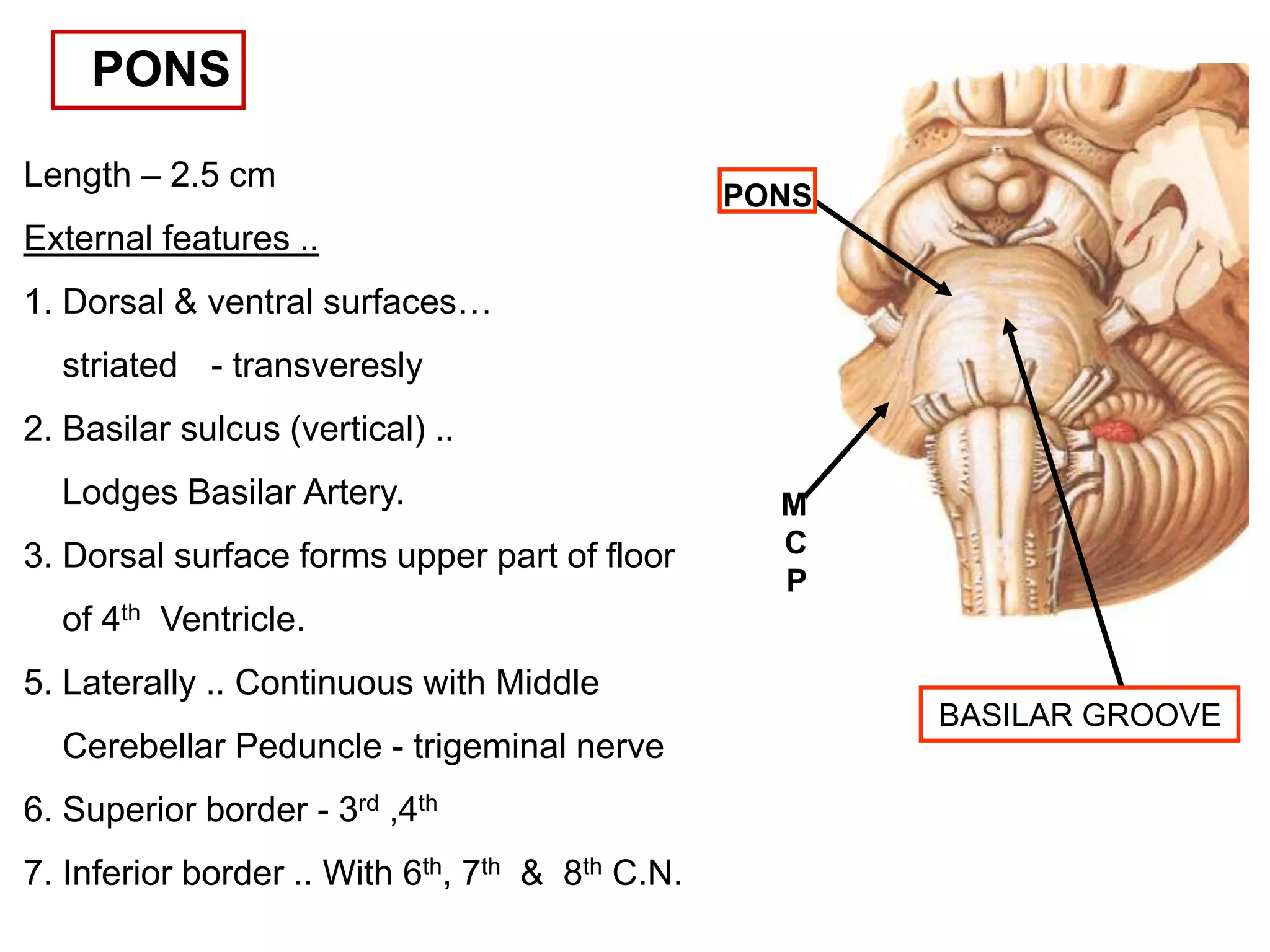
PONS
PONS
M
C
P
Length – 2.5 cm
External features ..
1. Dorsal & ventral surfaces…
- transvereslystriated
2. Basilar sulcus (vertical) ..
Lodges Basilar Artery.
3. Dorsal surface forms upper part of floor
of 4th Ventricle.
5. Laterally .. Continuous with Middle
Cerebellar Peduncle - trigeminal nerve
6. Superior border - 3rd ,4th
7. Inferior border .. With 6th, 7th & 8th C.N.
BASILAR GROOVE
PONS External features
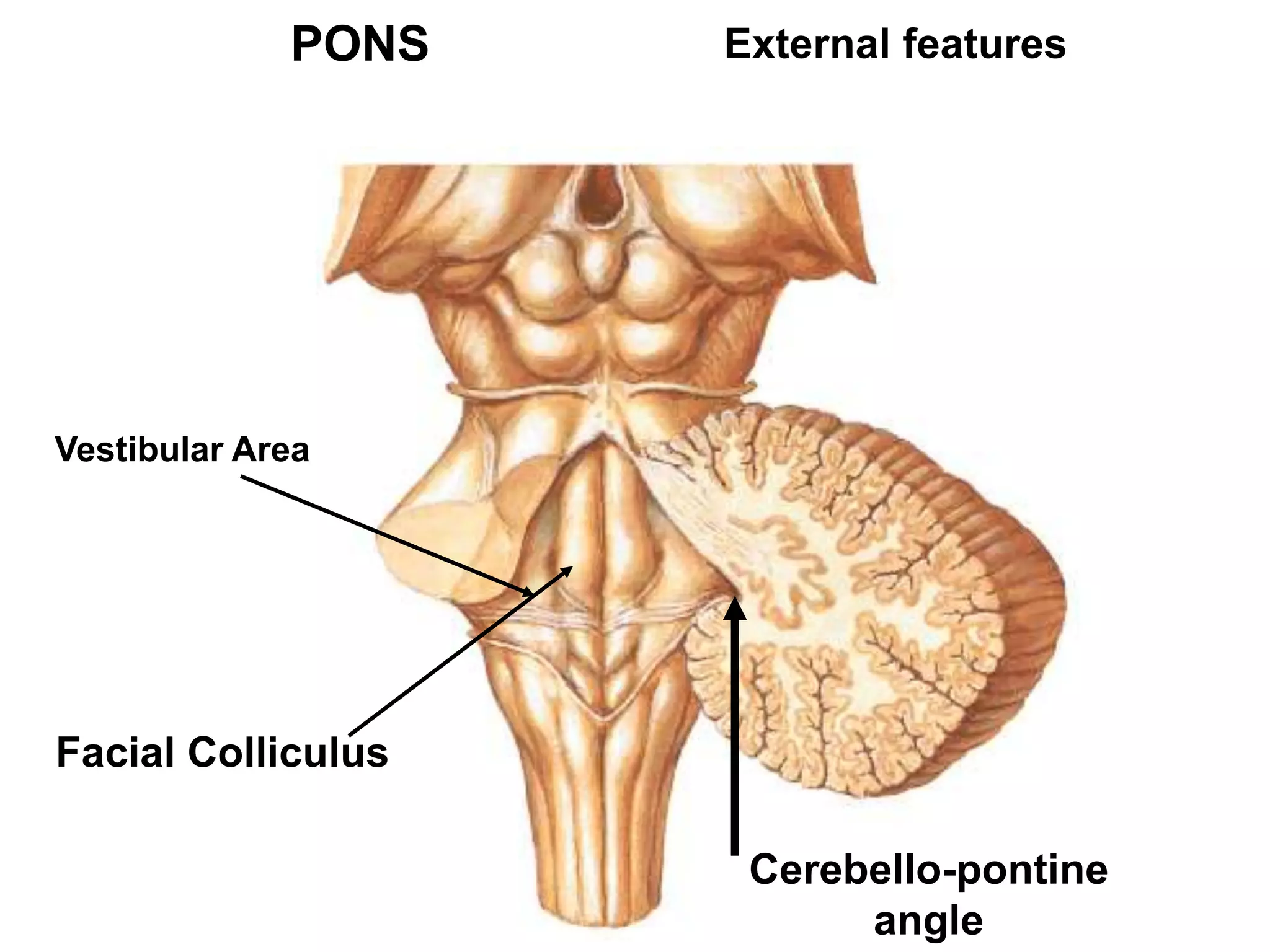
Cerebello-pontine
angle
Facial Colliculus
Vestibular Area
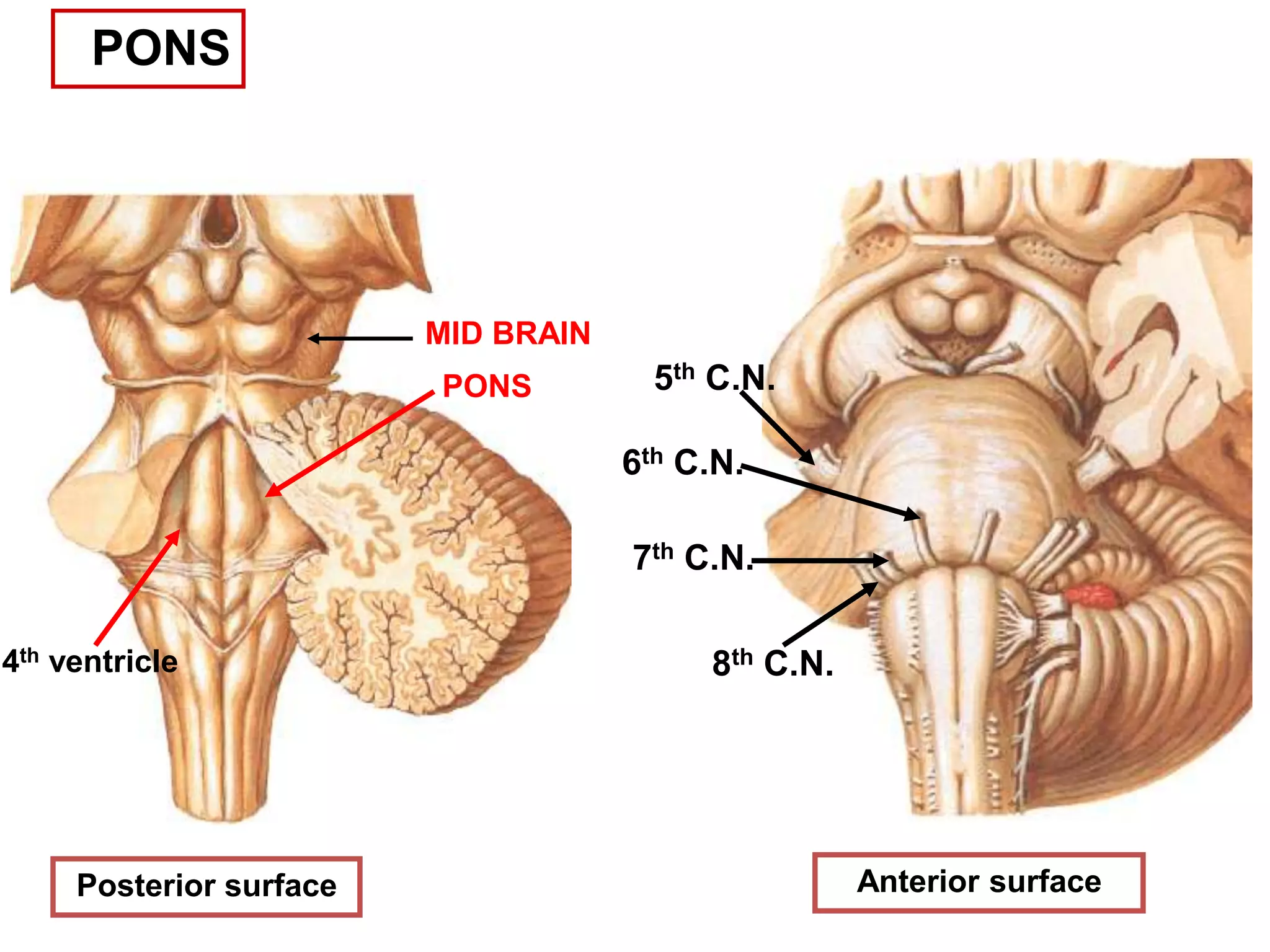
MID BRAIN
PONS
4th ventricle
PONS
Posterior surface
6th C.N.
7th C.N.
8th C.N.
Anterior surface
5th C.N.
Lower
part
Upper part
Internal features
• By 2 sections.
• (1) At lower part of medulla
Fascial Colliculus
• (2) At upper part
At motor & Sensory Nucleus
of Trigeminal nerve
• The pons is divisible into - ventral part (basilar) &
dorsal part (Tegmentum).
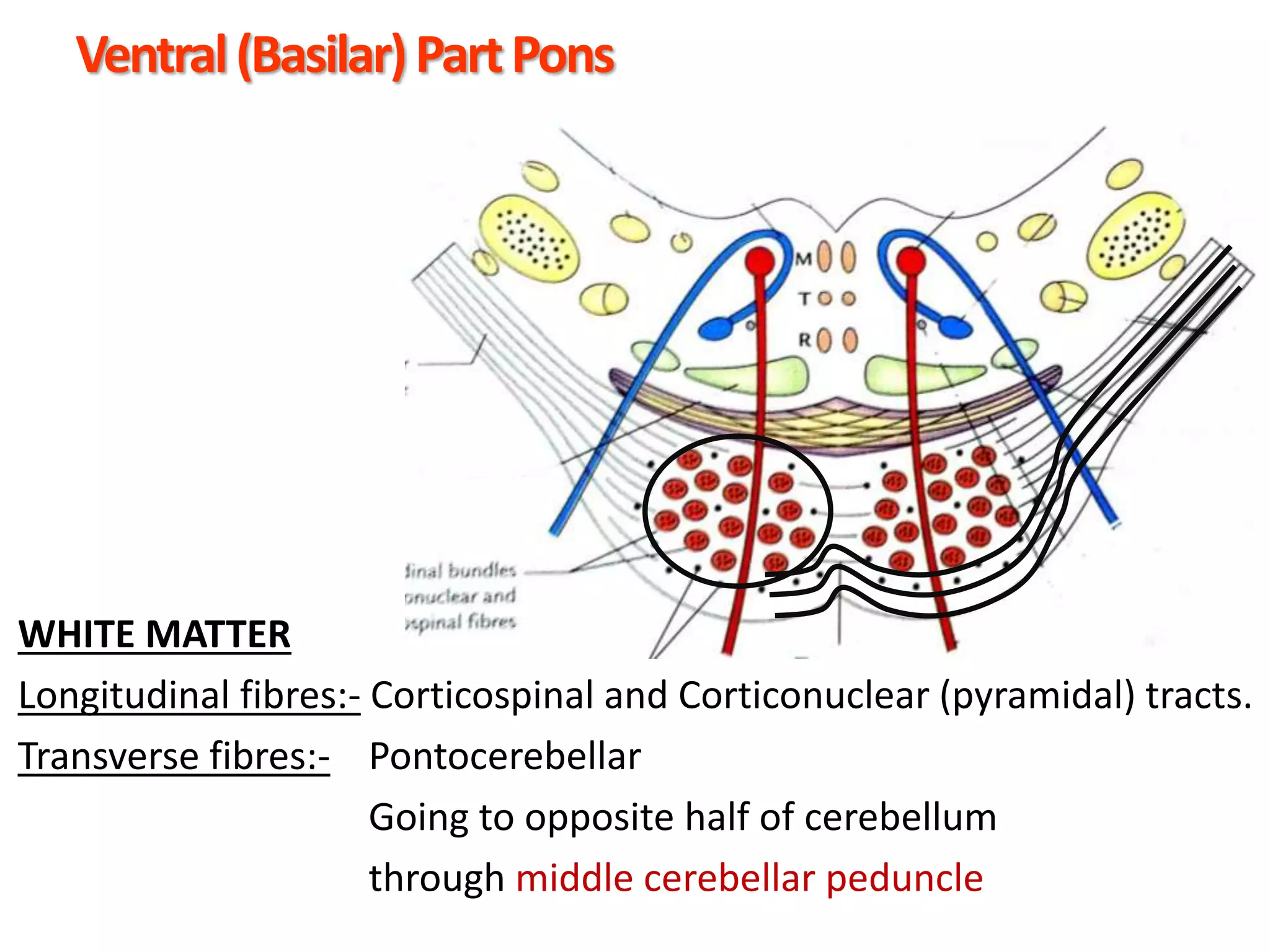
Ventral (basilar) part
- The basilar (ventral) part has a uniform structure throughout
length of pons.
- contains transverse and vertical fibres & Pontine nuclei.
(i) Transverse fibres are the pontocerebellar fibres- cross the
midline to enter the opposite middle cerebellar peduncle.
(ii) The vertical fibres -
- Some of them descend from cerebral cortex to end in
the pontine nuclei. (corticopontine)
- Corticospinal fibres that descend through the pons in
to the medulla .
- Corticonuclear fibres end in the motor nuclei of
cranial nerves mainly of opposite side.
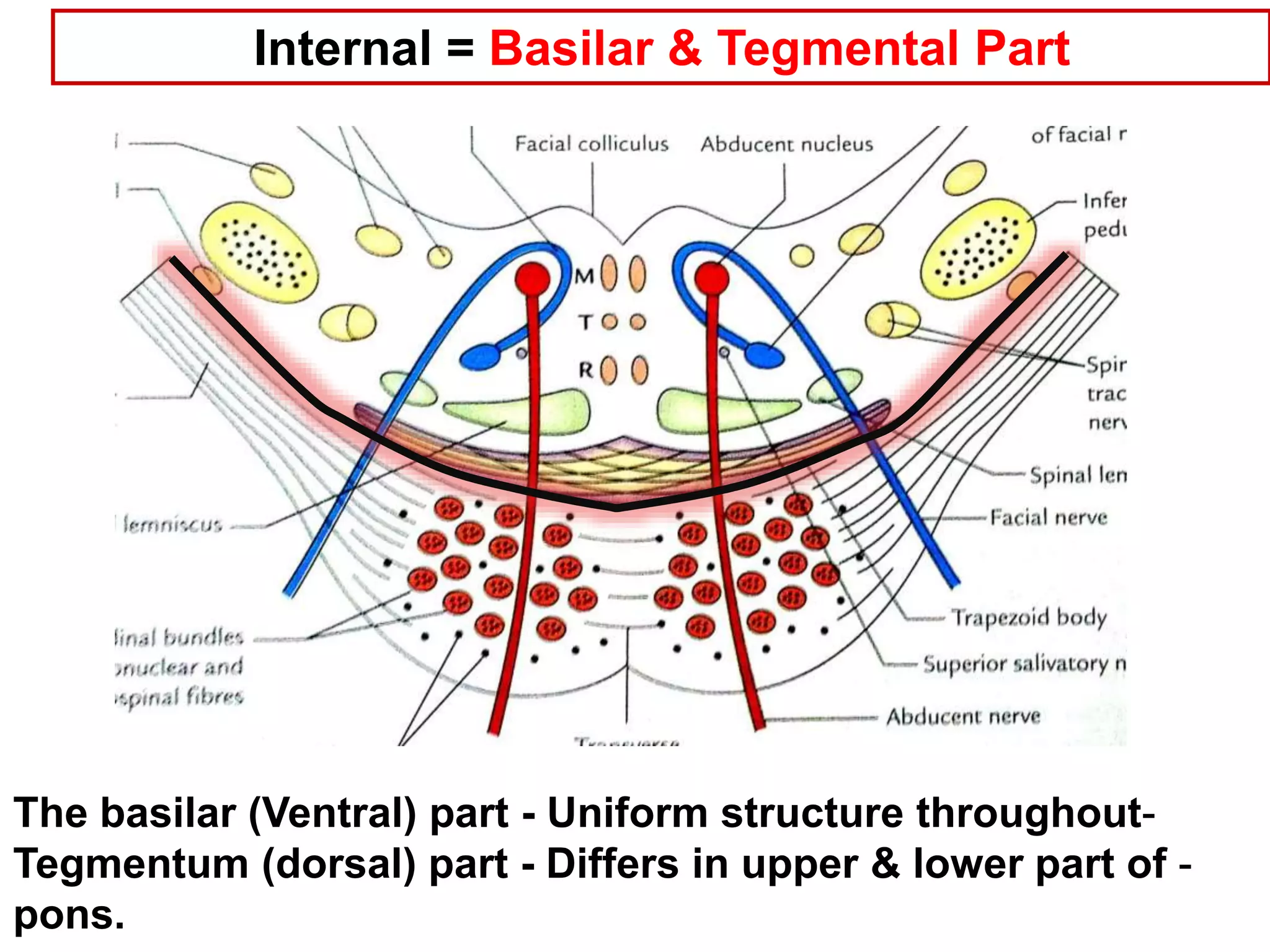
Internal = Basilar & Tegmental Part
-The basilar (Ventral) part - Uniform structure throughout
-Tegmentum (dorsal) part - Differs in upper & lower part of
pons.
C.S. at Fascial Colliculus
C.S. of At motor & Sensory Nucleus
of Trigeminal nerve
Basilar Part
VENTRAL (BASILAR) PART
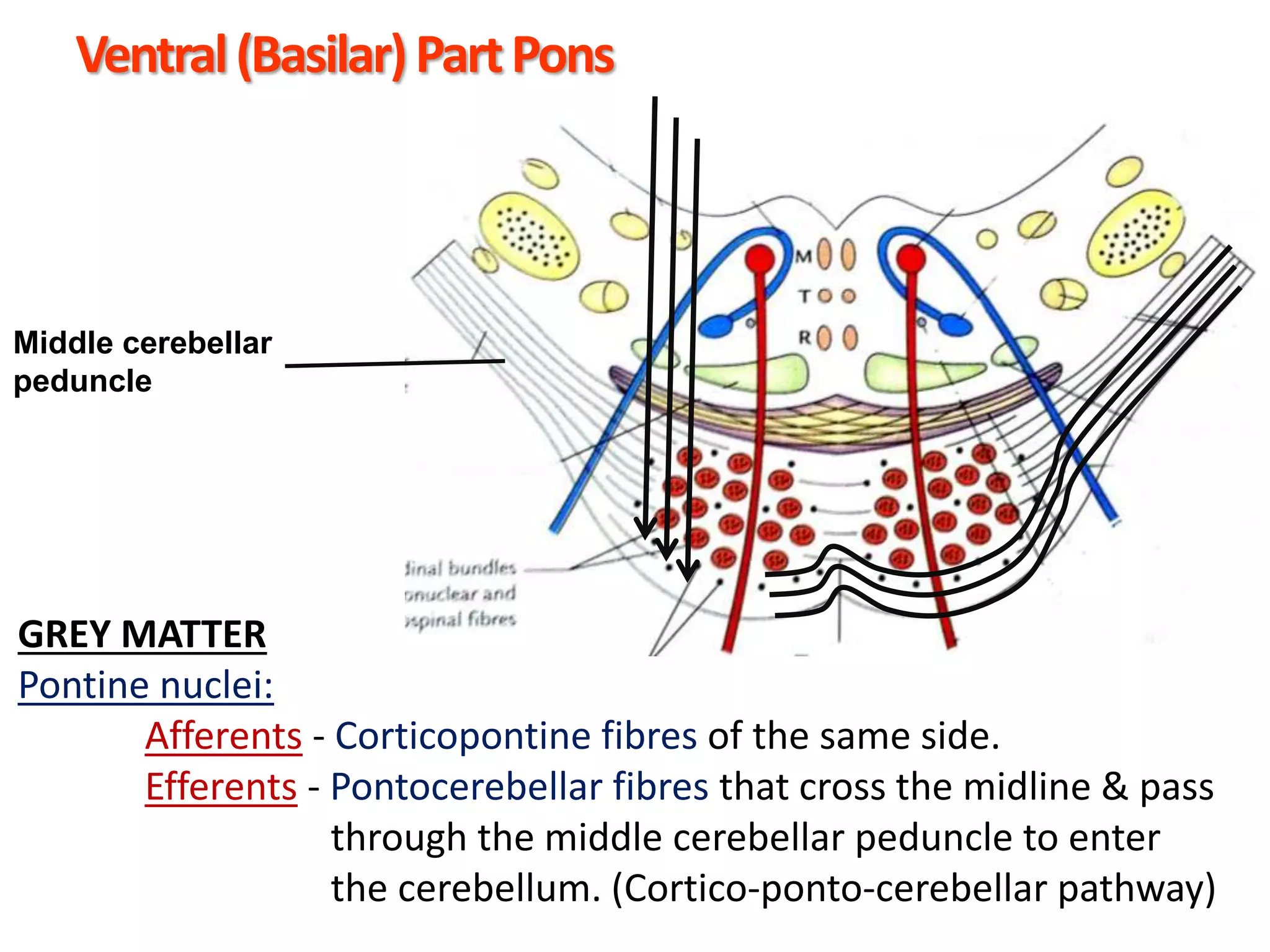
Ventral(Basilar)PartPons
GREY MATTER
Pontine nuclei:
Afferents - Corticopontine fibres of the same side.
Efferents - Pontocerebellar fibres that cross the midline & pass
through the middle cerebellar peduncle to enter
the cerebellum. (Cortico-ponto-cerebellar pathway)
Middle cerebellar
peduncle
WHITE MATTER
Longitudinal fibres:- Corticospinal and Corticonuclear (pyramidal) tracts.
Transverse fibres:- Pontocerebellar
Going to opposite half of cerebellum
through middle cerebellar peduncle
Ventral(Basilar)PartPons
Tegmentum of pons (dorsal part)
Differs in upper & lower part of pons
C.S. at Facial Colliculus
Abducent
Nucleus
Motor Nucleus
of Facial Nerve
Internal genu -
Facial Colliculus
Neurobiotaxis ?
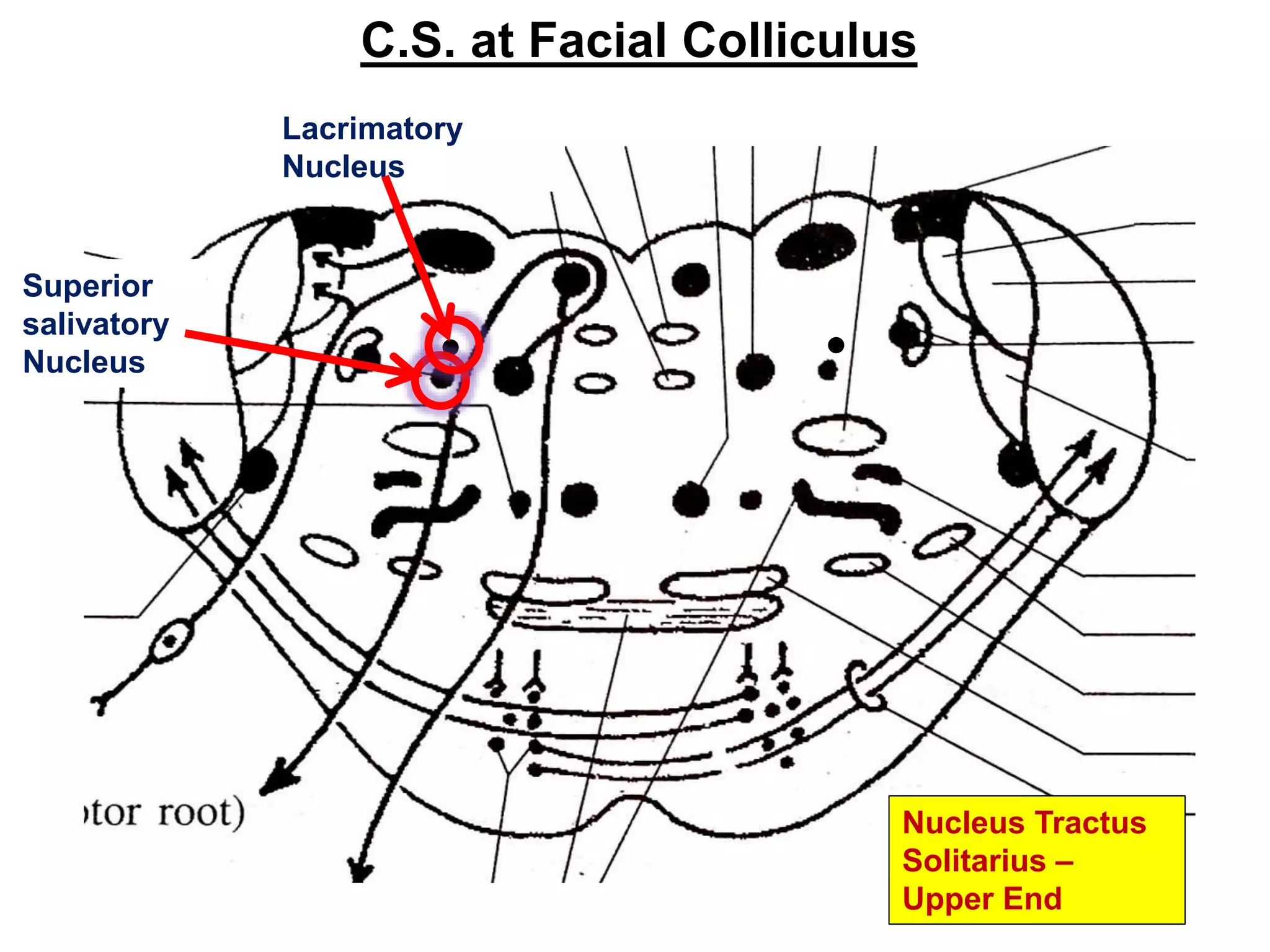
C.S. at Facial Colliculus
Superior
salivatory
Nucleus
Lacrimatory
Nucleus
Nucleus Tractus
Solitarius –
Upper End
C.S. at Facial Colliculus
Vestibular
Nucleus
Spinal Nucleus &
Spinal Tract of V
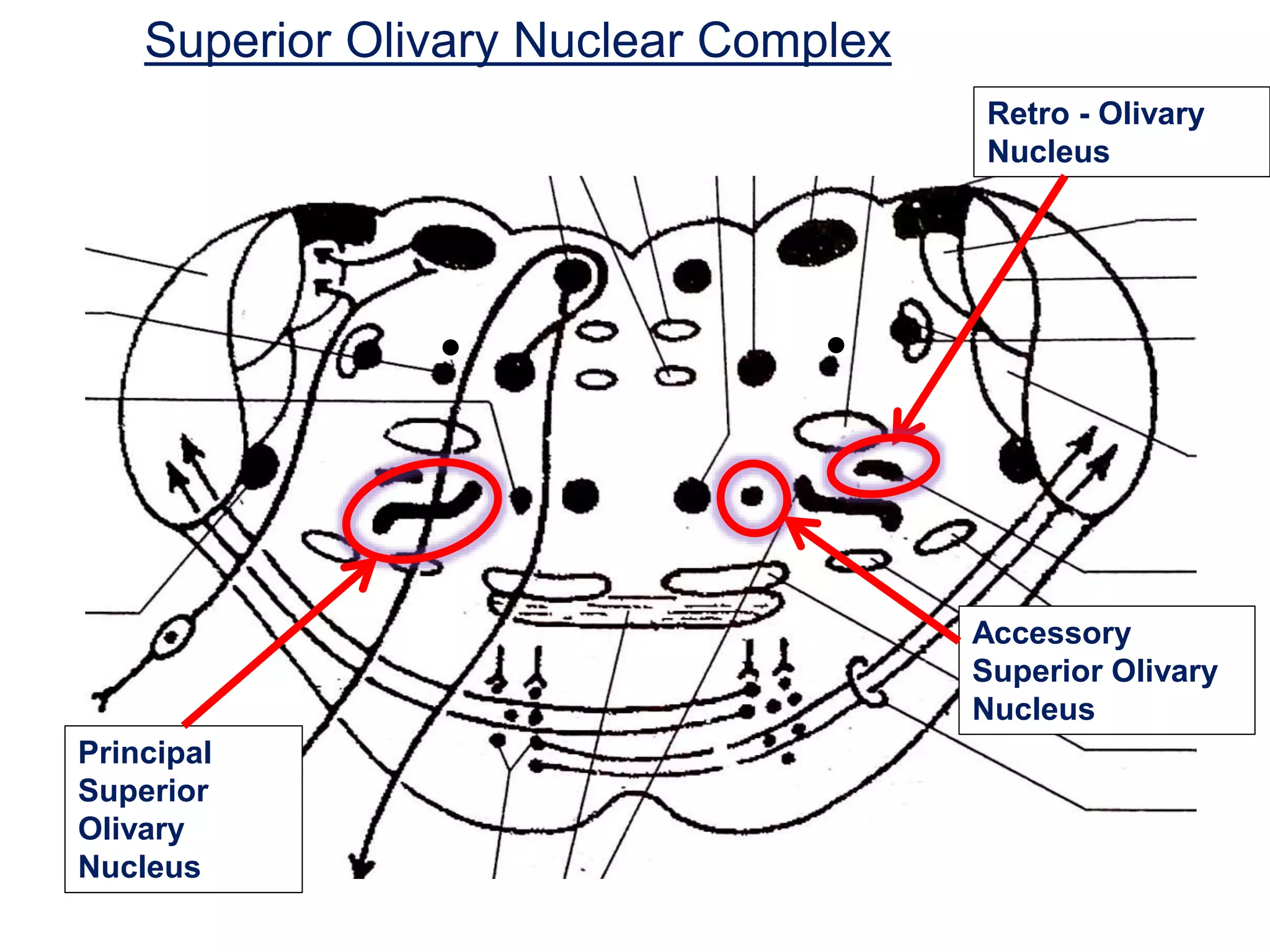
Superior Olivary Nuclear Complex
Principal
Superior
Olivary
Nucleus
Accessory
Superior Olivary
Nucleus
Retro - Olivary
Nucleus
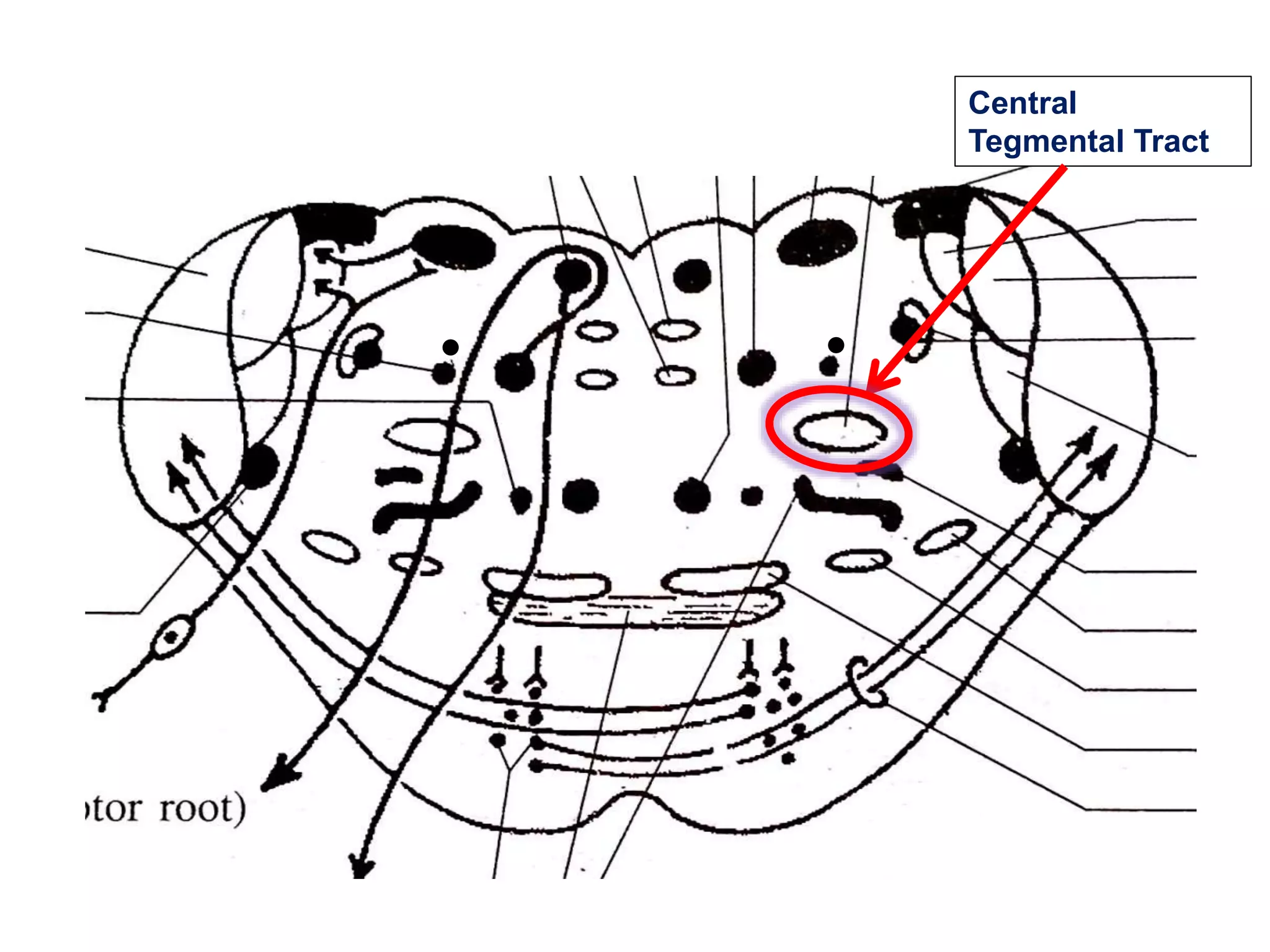
Central
Tegmental Tract
C.S. at Facial Colliculus
Middle
Cerebellar
Peduncle
Inferior
Cerebellar
Peduncle
C.S. at Facial Colliculus Dorsal
Cochlear
Nucleus
Ventral Cochlear
Nucleus
Juxta Restiform
Body
Vestibular
Nucleus
C.S. of At motor & Sensory Nucleus
of Trigeminal nerve
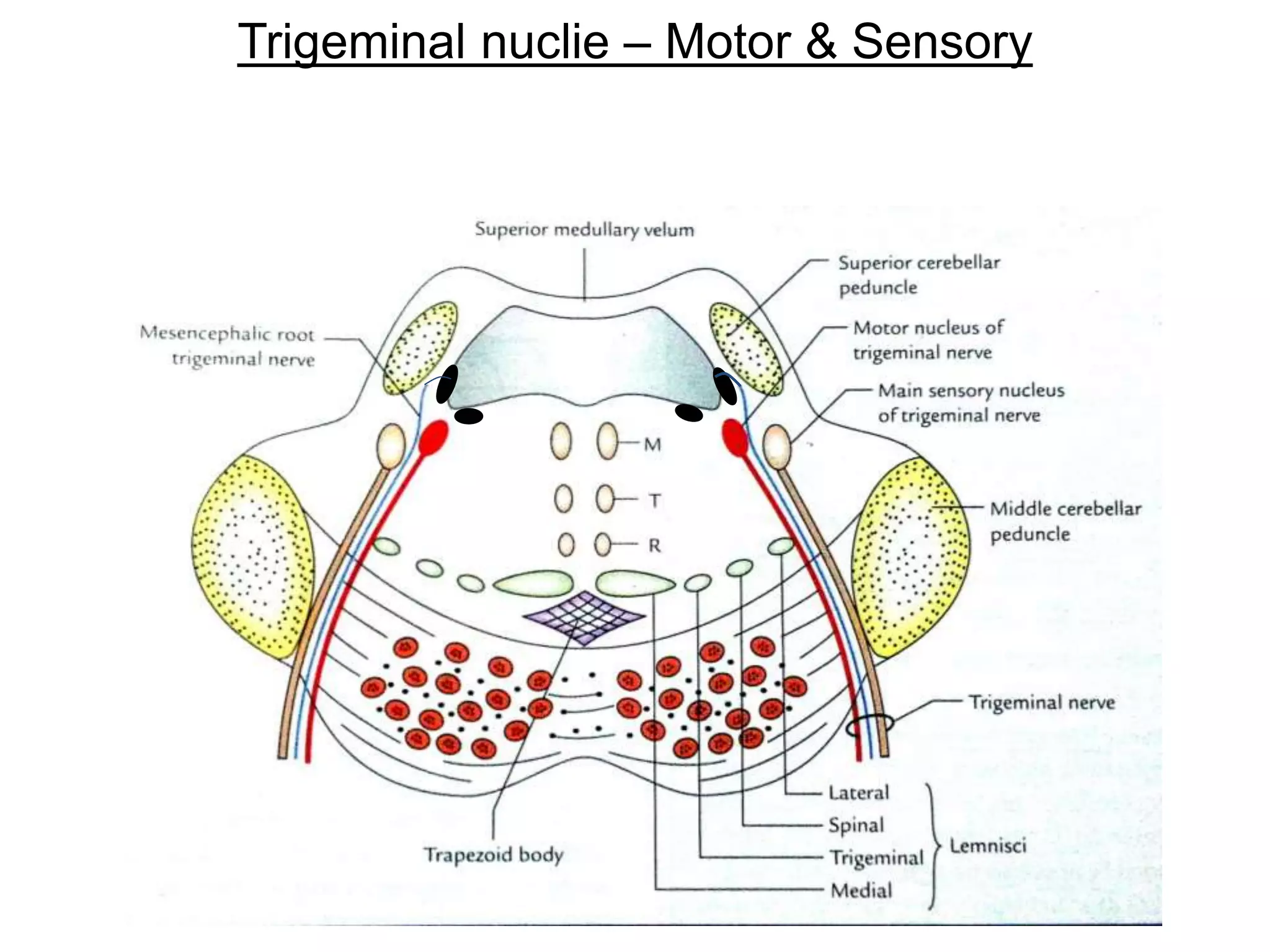
Trigeminal nuclie – Motor & Sensory
Nucleus Ceruleus
Trigeminal nuclie – Motor & Sensory
Trigeminal Ganglion
Muscles of Mastication
Tensor Tympani
Tensor veli Palatini
Ant Belly of Digastric
Motor Nucleus Of
V Nerve
Sensory Nuclei Of Vth Nerve
Spinal Nucleus
Pain & Temperature
Mesencephalic - Proprioceptive
Principal Sensory
Touch & Pressure
From- Ipsilateral Face
1st Order Neuron
Sensory Nuclei Of
V Nerve
Pain & Temperature
Spinal Nucleus Of V Nerve
Efferent:
- Ventral trigemino
thalamic tract
(Trigeminal Lemniscus)
- Terminate : VPM of
Thalamus
Nuclie Of
V Nerve
VPM
Vestibulo-cochlear Nerve
8th C.N.
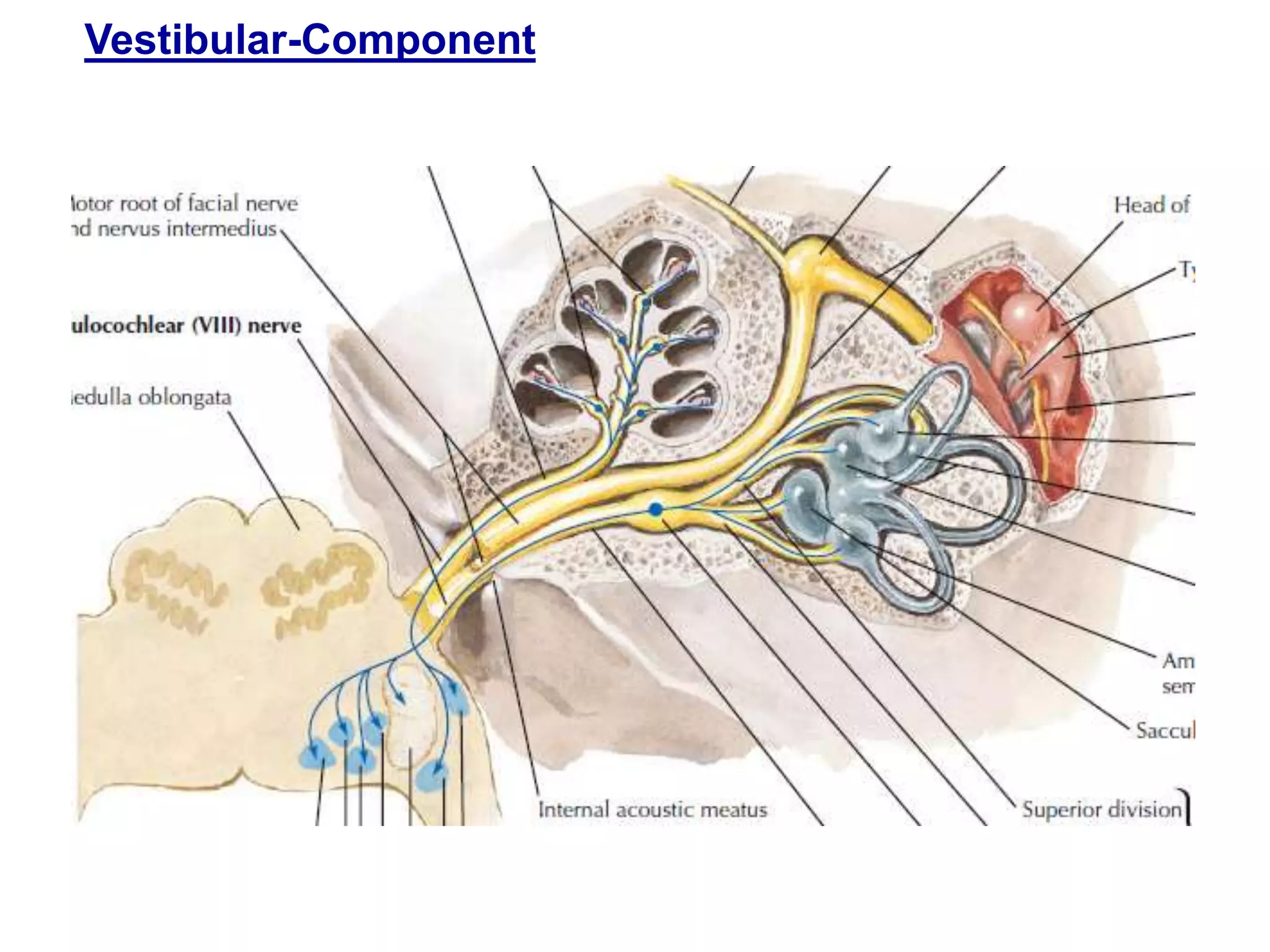
Vestibulo-Component
Inferior
Superior
Vestibular-Component
Afferent
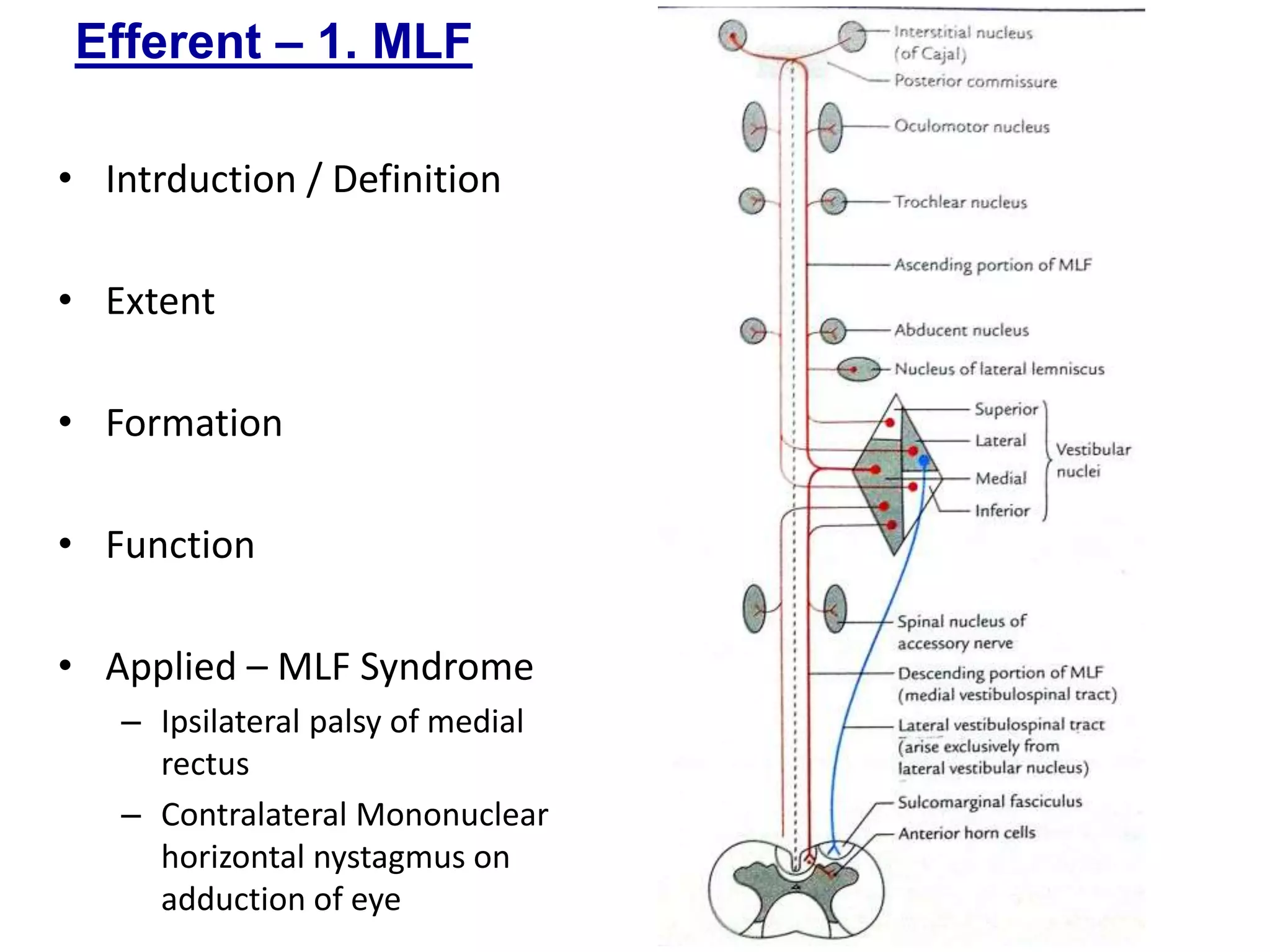
Efferent – 1. MLF
• Intrduction / Definition
• Extent
• Formation
• Function
• Applied – MLF Syndrome
– Ipsilateral palsy of medial
rectus
– Contralateral Mononuclear
horizontal nystagmus on
adduction of eye
Efferent – 2.
Cerebellum
Efferent – 3. Hair Cells of Macula & Ampullary crest
Modulation Of Sensory Input
Efferent – 4. Spinal Cord
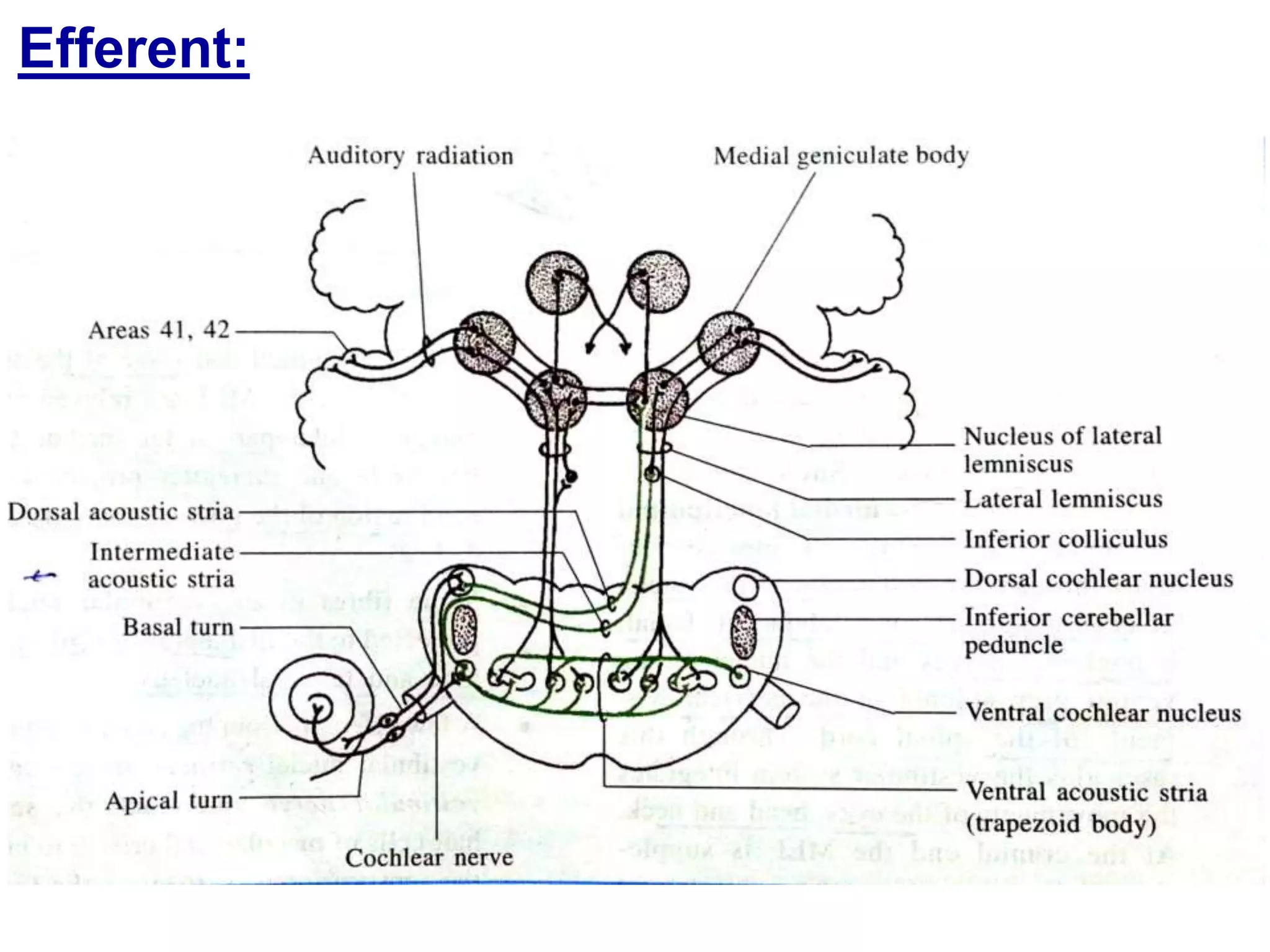
Cochlear-Component
Auditory Pathway
Afferent:
Efferent:
Efferent:
Efferent:
Area 41, 42
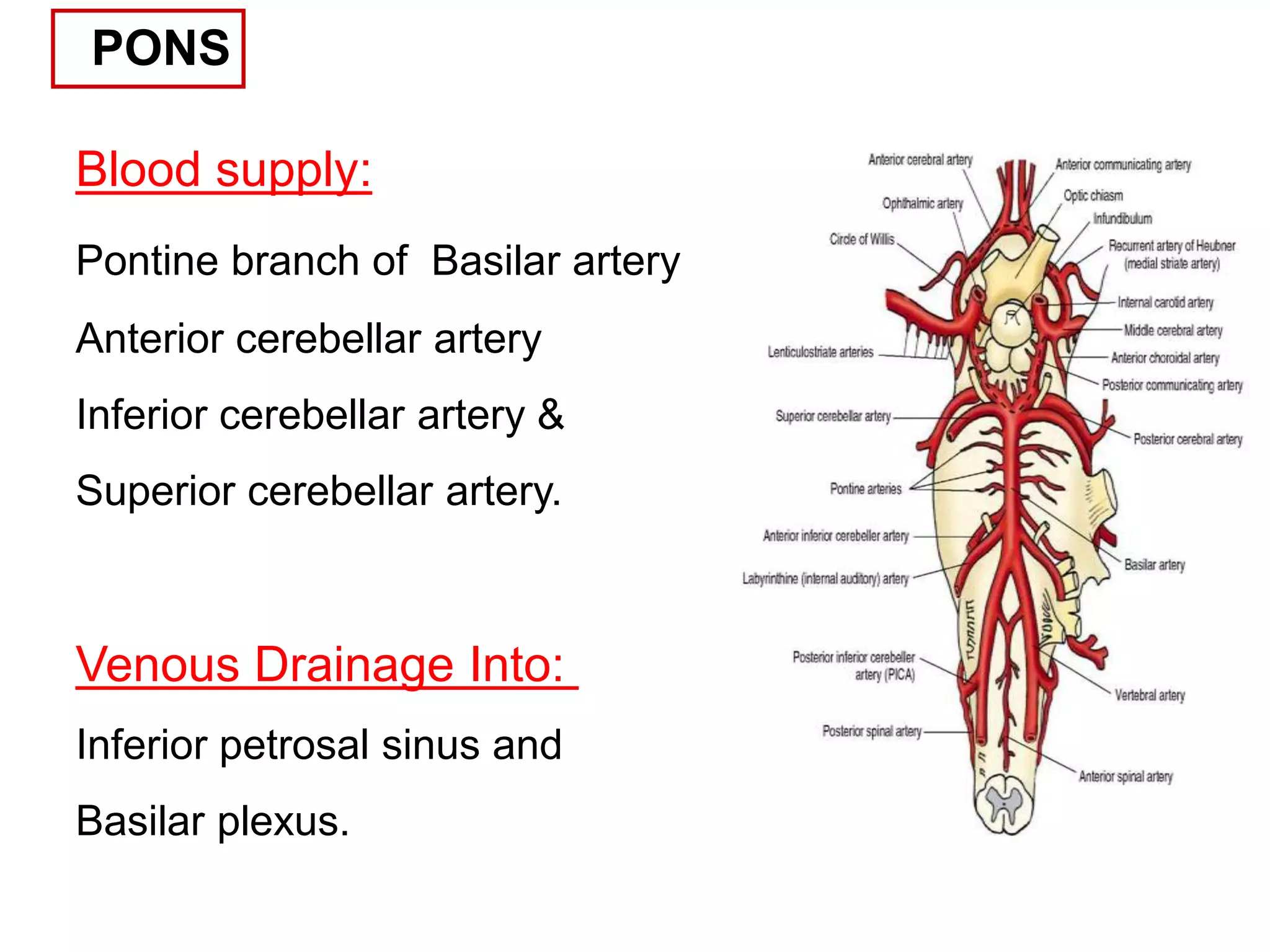
Blood supply:
Pontine branch of Basilar artery
Anterior cerebellar artery
Inferior cerebellar artery &
Superior cerebellar artery.
Venous Drainage Into:
Inferior petrosal sinus and
Basilar plexus.
PONS
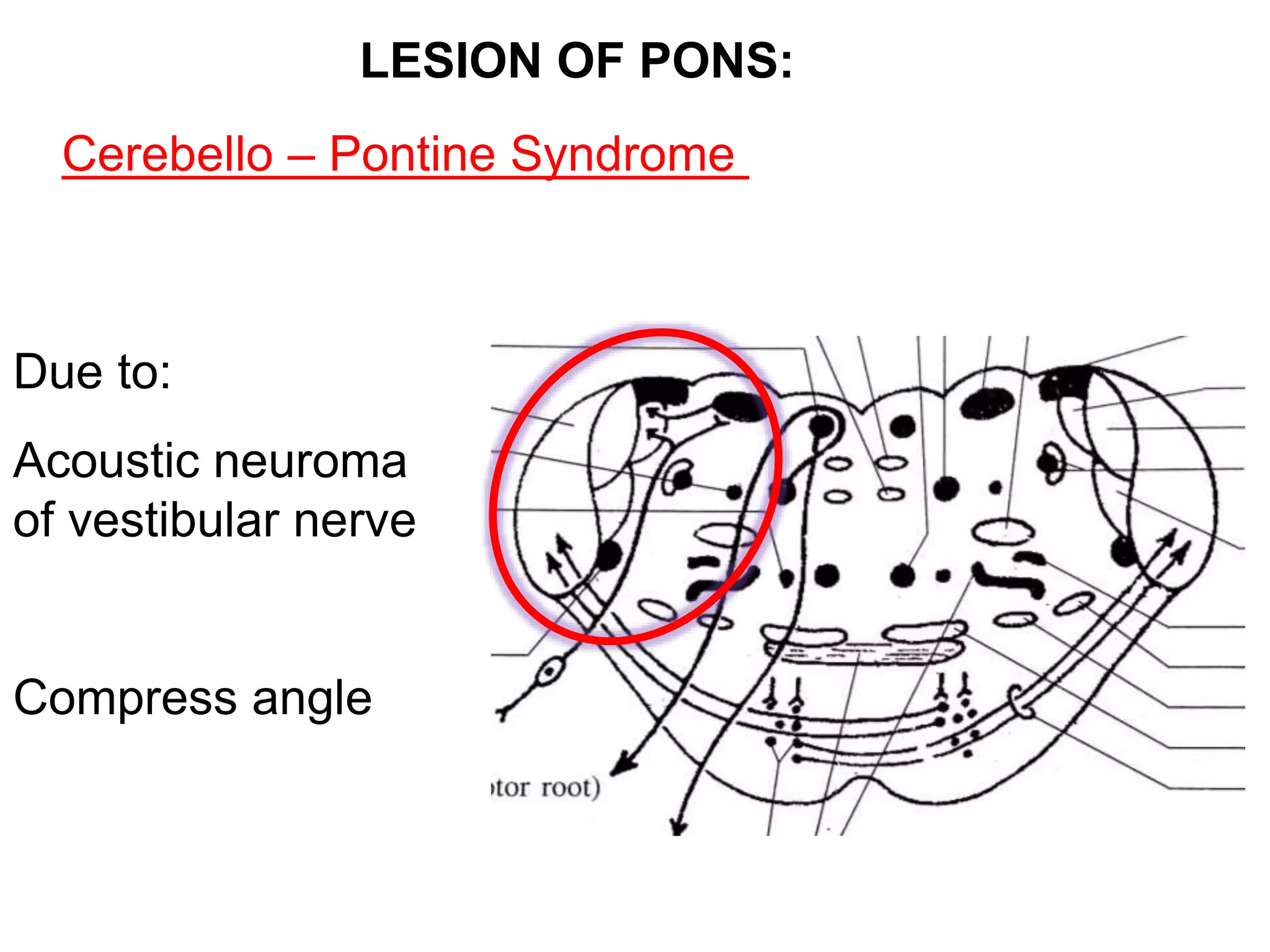
LESION OF PONS:
Cerebello – Pontine Syndrome
Due to:
Acoustic neuroma
of vestibular nerve
Compress angle
Cerebello – Pontine Syndrome
1. VIII Nerve
Persistent tinnitus, Progressive Deafness
Nystagmus, Nausea, Vomiting and Vertigo.
2. Cerebellar Lesions
Ipsilateral cerebellar signs
e.g.,Tremor,Ataxia, Dysmetria (Past Pointing)
3.Spinaltrigeminalnucleusandtract:
Ipsilaterallossofpainandtemperaturesensationfromthe
face(facialhemianesthesia)
4.FacialNerve: IpsilateralBellsPalsy, Hyperacusis,LossofTaste
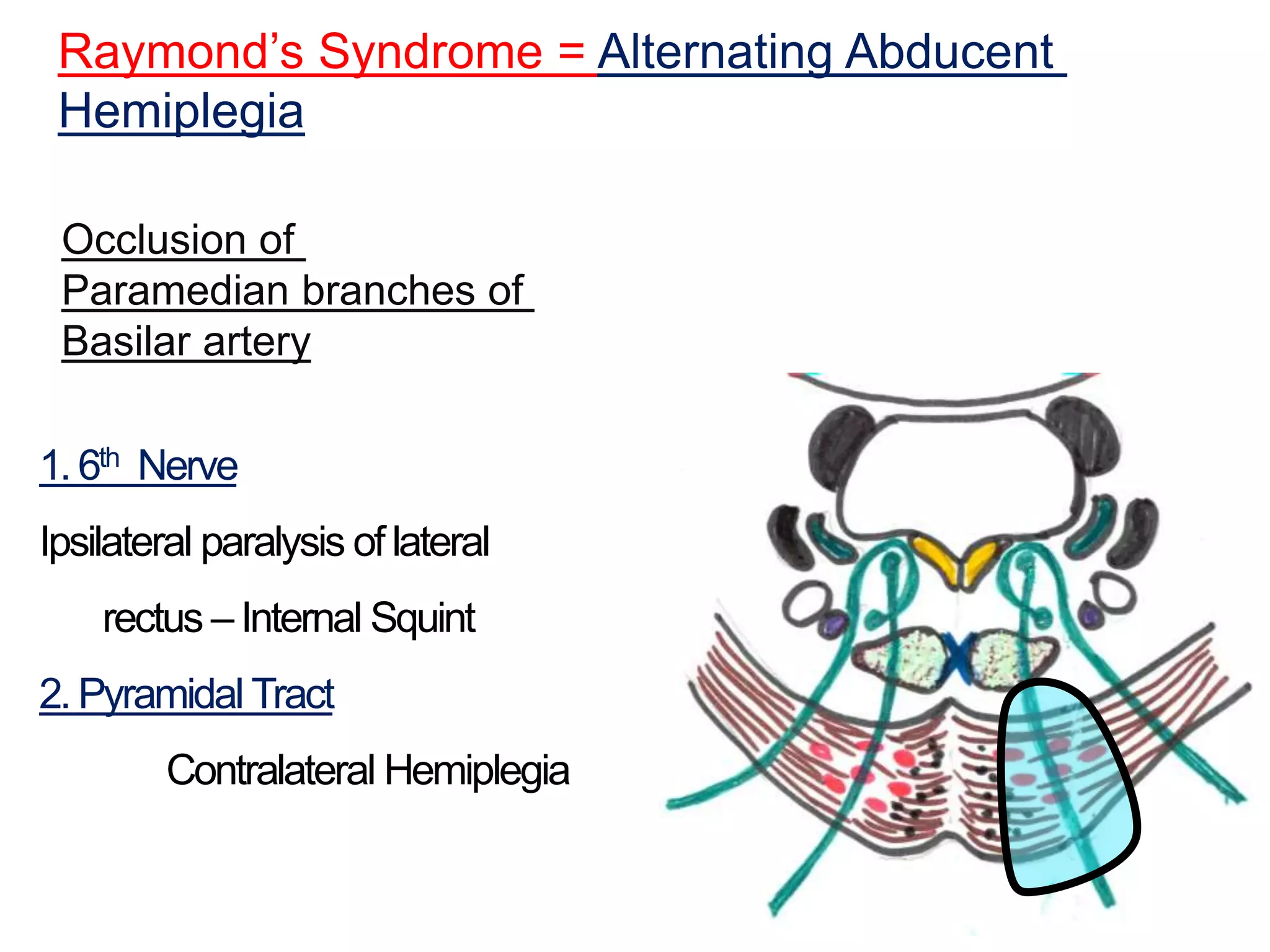
Raymond’s Syndrome = Alternating Abducent
Hemiplegia
Occlusion of
Paramedian branches of
Basilar artery
1. 6th Nerve
Ipsilateral paralysis of lateral
rectus – Internal Squint
2. Pyramidal Tract
Contralateral Hemiplegia
Millard - Gubler Syndrome = Alternating Facial
Hemiplegia
Occlusion of
Paramedian branches of
Basilar artery
1. 7th Nerve
IpsilateralBellsPalsy,
Hyperacusis,LossofTaste
2. Pyramidal Tract
Contralateral Hemiplegia
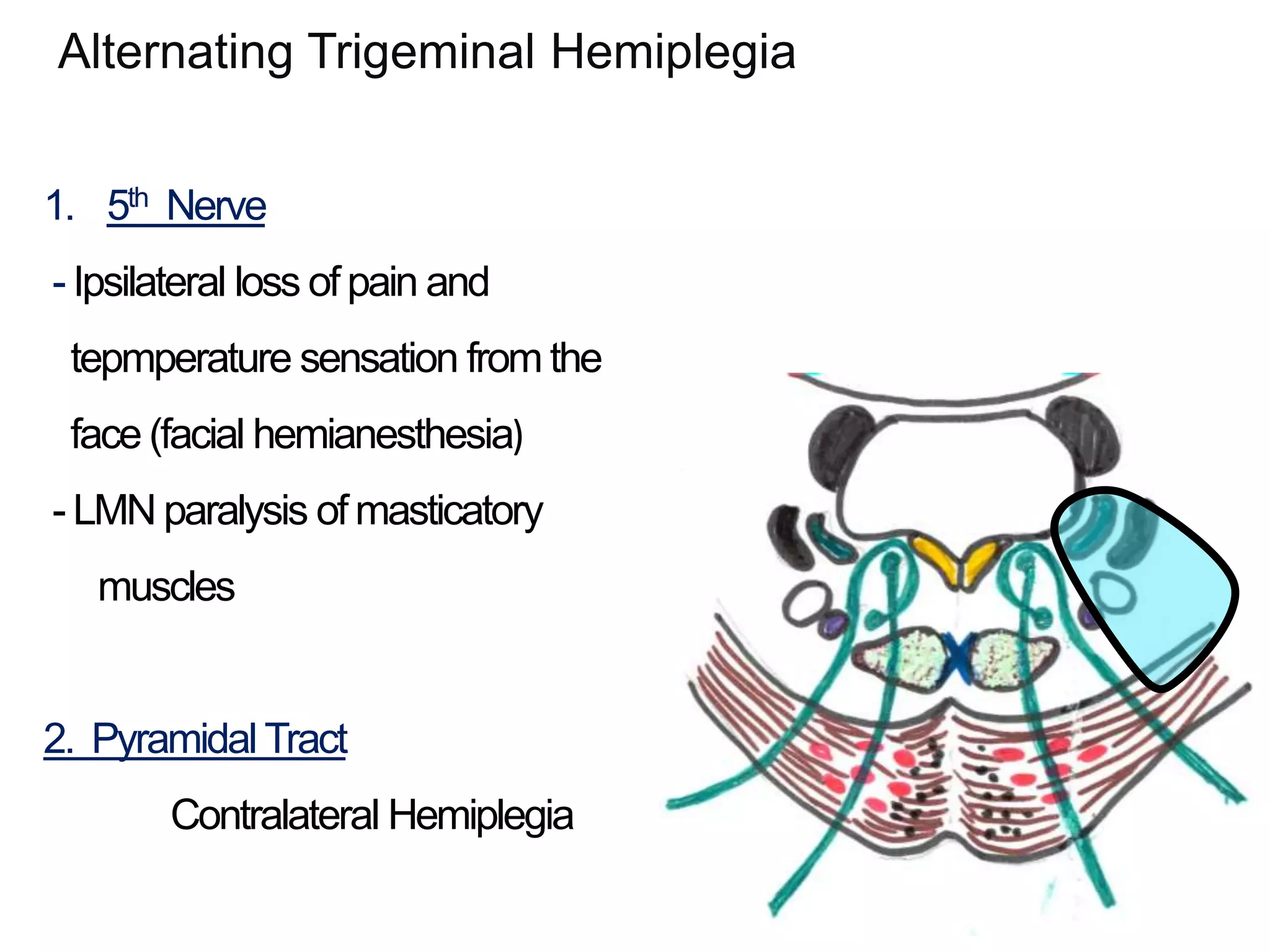
Alternating Trigeminal Hemiplegia
1. 5th Nerve
- Ipsilateral loss of pain and
tepmperature sensation from the
face (facial hemianesthesia)
- LMN paralysis of masticatory
muscles
2. Pyramidal Tract
Contralateral Hemiplegia
THANK YOU

Pons Anatomy