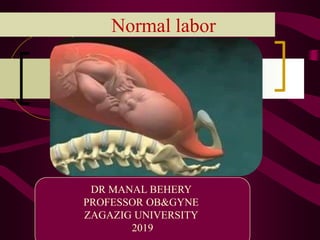
Normal labor
DR MANAL BEHERY
PROFESSOR OB&GYNE
ZAGAZIG UNIVERSITY
2019
Definition of normal labor
• Normal labour is contractions of the gravid
uterus that expel the fetus and the other
products of conception
• between 37 and 42 weeks from the last
menstrual period (Term Delivery)
Preterm labour:Preterm labor is that occurring
before 37 weeks of gestational age.
Postdate pregnancy:Postdate pregnancy occurs
after 42 weeks .
Criteria for normal labour
1. Spontaneous expulsion,
2. Of a single,
3. Mature fetus (37. completed weeks-42. weeks),
4. Presented by vertex,
5. Through the birth canal (vaginal delivery),
6. Within a reasonable time (more than 3, less than
18 hours),
7. Without complications to the mother,
8. Without complications to the fetus.
Influencing factors
 The 3 „P”: (progress of labor)
 Power: uterus (myometrium)
 Passenger: fetus (head mostly)
 Passage: (pelvis of the mother)
True Labor is
Uterine Contractions that cause-
–Progressive dilation and effacement
of cervix
–Descent of fetus
–Expulsion of fetus
and placenta
Cervical dilatation by vaginal examination
• Effacemant :is shortening and thining of the
cervical canal (from a length of 3 cm to a circular
aperture.
Effecemant
How is station (descent )measured and
recorded?
• -3: 3 cm above the ischial spines
0: at the ischial spines, engaged
+3: 3 cm below the ischial spines
Engagement and station of the fetus in
labour
Character which define the onset of labor:
 Ruptured membranes
 Bloody „show”
 Complete cervical effacement
True labour vs fales labour
• Regular contractions
• Increase in frequency
and intensity
• Cervix dilate
• No relive with
sedation
• Abd and back pain
• Irregular
• Remain the same
• Unchanged
• relive
• Lower abd
Stages of labor

 First stage:
 Starts with the onset of true labor contractions
 Ends when the cervix is fully dilated (10cm)
 Longest stage of labor
 Second stage:
 Begins with the complete dilatation of the cervix
 Ends with the birth of the baby
Duration is between 30 and 90 minutes
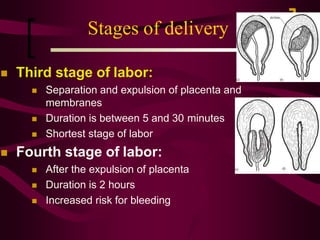
Stages of delivery
 Third stage of labor:
 Separation and expulsion of placenta and
membranes
 Duration is between 5 and 30 minutes
 Shortest stage of labor
 Fourth stage of labor:
 After the expulsion of placenta
 Duration is 2 hours
 Increased risk for bleeding
First stage of delivery
 1. Regular contractions
 2. increase in intensity
 3. Increasing in frequency (↑)
 4. increase in duration
 1
causes
Cervical dilatation and effacement
First stage of delivery
 Contraction and retraction of uterine muscle
 Mechanical pressure by the membrane
 The descend of the presenting part
 Cervical dilatation and effacement
Phases of cervical dilatation:
 Latent phase:
 the first 3 cm of dilatation, it is a slow process
{8 hours at nulliparous, 3 hours at multiparous}
 Active phase:
 faster dilatation, from 3 cm to fully dilatation
(apr. 10cm) {Normal rate is 1 cm / hour}
Effacement: thinning of the cervix
Effacment of the cervix
FRIEDMAN’S CURVE
Station
2nd stage of labor – expulsion
of the fetus
 Begins when cervical dilatation is complete
and ends with fetal delivery.
 Median duration 40-60 min for nulliparas
and 20-30 min for multiparas.
LOA position
How does the head negotiate the
pelvis?
(1) change it’s shape and size
(moulding)
(2) change it’s position (flexion and
rotation)
Left occiput position (LOA,
LOT, ROT
Cardinal movement of normal labor
External rotation
The cardinal movements of labor
Third stage of labour


 Begins after delivery of the baby and ends with the
delivery of the placenta and membranes
 It contains two phases
 A., Separation
 B., Expulsion
Duration: 5-20minutes (if actively managed)
Blood loss: 150-250 ml (average)
NORMAL LABOR VIDEO
Video of childbirth
Fetal lie
 The relation of the long axis of the fetus to
that of the mother!
 Longitudinal lie (~99%)
 Transverse lie (<1%)
 Oblique lie
unstable and always becomes longitudinal or transverse during
the course of labor
Fetal lie – longitudinal axis of the fetus in
relation to the long axis of the maternal uterus. assessed by
abdominal examination prior to delivery.
• Logitudinal transverse oblique
• (unstable)
Presentation
*
• the part of the fetus that is presenting or is the
closest in proximity to the birthing canal
• Vertex Breech
Presentation
*
• the part of the fetus that is presenting or is the
closest in proximity to the birthing canal
• Vertex Breech
Incidences of fetal presentation
 Cephalic
 Breech
 Transverse
 Compound
 Face
 Brow
96,8 %
2,7 %
0,3 %
0,1 %
0,5 %
0,01 %
Fetal attitude or posture
 The fetus becomes folded upon itself:
 the back becomes markedly convex,
 the head is sharply flexed,
 the thighs are flexed over the abdomen,
 the legs are bent at the knees,
Fetal position
According to the determinig points:
 the fetal occiput (vertex) – left or right
occipital,
 the fetal face (mental) – left or right mental,
 breech (sacrum) – left or right sacral
 shoulder (scapula is the arbitrarily chosen
for orientation)
presentations.
There are six varieties of each
of the three presentations
Labor with occiput presentations
 Occiput anterior
position (ROA)
 Occiput transverse
position (ROT)
 Occiput posterior
position (ROP)
LOA position
Us for detection of position

Normal labor for undergraduate

  • 1.
    Normal labor DR MANALBEHERY PROFESSOR OB&GYNE ZAGAZIG UNIVERSITY 2019
  • 2.
    Definition of normallabor • Normal labour is contractions of the gravid uterus that expel the fetus and the other products of conception • between 37 and 42 weeks from the last menstrual period (Term Delivery)
  • 3.
    Preterm labour:Preterm laboris that occurring before 37 weeks of gestational age. Postdate pregnancy:Postdate pregnancy occurs after 42 weeks .
  • 4.
    Criteria for normallabour 1. Spontaneous expulsion, 2. Of a single, 3. Mature fetus (37. completed weeks-42. weeks), 4. Presented by vertex, 5. Through the birth canal (vaginal delivery), 6. Within a reasonable time (more than 3, less than 18 hours), 7. Without complications to the mother, 8. Without complications to the fetus.
  • 5.
    Influencing factors  The3 „P”: (progress of labor)  Power: uterus (myometrium)  Passenger: fetus (head mostly)  Passage: (pelvis of the mother)
  • 6.
    True Labor is UterineContractions that cause- –Progressive dilation and effacement of cervix –Descent of fetus –Expulsion of fetus and placenta
  • 7.
    Cervical dilatation byvaginal examination
  • 8.
    • Effacemant :isshortening and thining of the cervical canal (from a length of 3 cm to a circular aperture. Effecemant
  • 9.
    How is station(descent )measured and recorded? • -3: 3 cm above the ischial spines 0: at the ischial spines, engaged +3: 3 cm below the ischial spines
  • 10.
    Engagement and stationof the fetus in labour
  • 11.
    Character which definethe onset of labor:  Ruptured membranes  Bloody „show”  Complete cervical effacement
  • 12.
    True labour vsfales labour • Regular contractions • Increase in frequency and intensity • Cervix dilate • No relive with sedation • Abd and back pain • Irregular • Remain the same • Unchanged • relive • Lower abd
  • 13.
    Stages of labor  First stage:  Starts with the onset of true labor contractions  Ends when the cervix is fully dilated (10cm)  Longest stage of labor  Second stage:  Begins with the complete dilatation of the cervix  Ends with the birth of the baby Duration is between 30 and 90 minutes
  • 14.
    Stages of delivery Third stage of labor:  Separation and expulsion of placenta and membranes  Duration is between 5 and 30 minutes  Shortest stage of labor  Fourth stage of labor:  After the expulsion of placenta  Duration is 2 hours  Increased risk for bleeding
  • 15.
    First stage ofdelivery  1. Regular contractions  2. increase in intensity  3. Increasing in frequency (↑)  4. increase in duration  1 causes Cervical dilatation and effacement
  • 16.
    First stage ofdelivery  Contraction and retraction of uterine muscle  Mechanical pressure by the membrane  The descend of the presenting part  Cervical dilatation and effacement
  • 17.
    Phases of cervicaldilatation:  Latent phase:  the first 3 cm of dilatation, it is a slow process {8 hours at nulliparous, 3 hours at multiparous}  Active phase:  faster dilatation, from 3 cm to fully dilatation (apr. 10cm) {Normal rate is 1 cm / hour}
  • 18.
  • 19.
  • 20.
  • 21.
  • 22.
    2nd stage oflabor – expulsion of the fetus  Begins when cervical dilatation is complete and ends with fetal delivery.  Median duration 40-60 min for nulliparas and 20-30 min for multiparas.
  • 23.
  • 24.
    How does thehead negotiate the pelvis? (1) change it’s shape and size (moulding) (2) change it’s position (flexion and rotation)
  • 25.
    Left occiput position(LOA, LOT, ROT
  • 26.
  • 39.
  • 42.
  • 48.
    Third stage oflabour    Begins after delivery of the baby and ends with the delivery of the placenta and membranes  It contains two phases  A., Separation  B., Expulsion Duration: 5-20minutes (if actively managed) Blood loss: 150-250 ml (average)
  • 50.
  • 51.
  • 52.
    Fetal lie  Therelation of the long axis of the fetus to that of the mother!  Longitudinal lie (~99%)  Transverse lie (<1%)  Oblique lie unstable and always becomes longitudinal or transverse during the course of labor
  • 53.
    Fetal lie –longitudinal axis of the fetus in relation to the long axis of the maternal uterus. assessed by abdominal examination prior to delivery. • Logitudinal transverse oblique • (unstable)
  • 54.
    Presentation * • the partof the fetus that is presenting or is the closest in proximity to the birthing canal • Vertex Breech
  • 55.
    Presentation * • the partof the fetus that is presenting or is the closest in proximity to the birthing canal • Vertex Breech
  • 57.
    Incidences of fetalpresentation  Cephalic  Breech  Transverse  Compound  Face  Brow 96,8 % 2,7 % 0,3 % 0,1 % 0,5 % 0,01 %
  • 58.
    Fetal attitude orposture  The fetus becomes folded upon itself:  the back becomes markedly convex,  the head is sharply flexed,  the thighs are flexed over the abdomen,  the legs are bent at the knees,
  • 59.
    Fetal position According tothe determinig points:  the fetal occiput (vertex) – left or right occipital,  the fetal face (mental) – left or right mental,  breech (sacrum) – left or right sacral  shoulder (scapula is the arbitrarily chosen for orientation) presentations.
  • 60.
    There are sixvarieties of each of the three presentations
  • 61.
    Labor with occiputpresentations  Occiput anterior position (ROA)  Occiput transverse position (ROT)  Occiput posterior position (ROP)
  • 62.
  • 63.
    Us for detectionof position