MULTIPLE PREGNANCYMULTIPLE PREGNANCY
Definition:Definition: It is the presence ofIt is the presence of
more than one fetus in themore than one fetus in the
abdomen of a pregnant women.abdomen of a pregnant women.
 According to their number, theyAccording to their number, they
could be categorized into:could be categorized into:
 twins (most common),twins (most common),
 triplet,triplet,
 quadriplet, …etc.quadriplet, …etc.
 This is a pregnancy with twoThis is a pregnancy with two
or more fetuses:or more fetuses:
 TwinsTwins == 2 fetuses2 fetuses
 TripletsTriplets == 3 fetuses3 fetuses
 Quadruplets=Quadruplets= 4 fetuses4 fetuses
 Quintuplets =Quintuplets = 5 fetuses5 fetuses
 Sextuplets =Sextuplets = 6 fetuses6 fetuses
 Septuplets =Septuplets = 7 fetuses7 fetuses
Risk factorsRisk factors
1- assisted reproductive1- assisted reproductive
techniques (techniques (IVF& induction ofIVF& induction of
ovulation )ovulation )
2-high parity2-high parity
3- black race3- black race
4- maternal family history4- maternal family history
5- increasing maternal age.5- increasing maternal age.
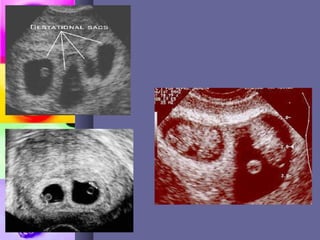
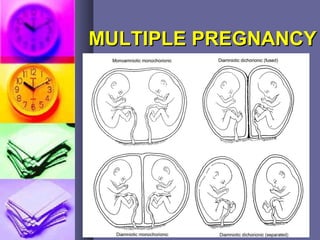
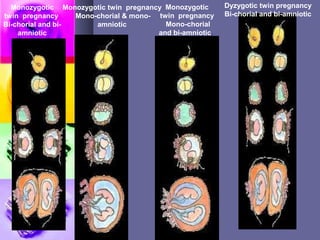
Dyzygotic twin pregnancy
Bi-chorial and bi-amniotic
Monozygotic twin pregnancy
Mono-chorial & mono-
amniotic
Monozygotic
twin pregnancy
Mono-chorial
and bi-amniotic.
Monozygotic
twin pregnancy
Bi-chorial and bi-
amniotic
ClassificationClassification
1- according to number of fetuses1- according to number of fetuses
2-number of fertilized eggs2-number of fertilized eggs
3-number of placentas ( chorionicity)3-number of placentas ( chorionicity)
4-number of amniotic cavities (amniocity)4-number of amniotic cavities (amniocity)
Non identical twins( dizygotic twins)Non identical twins( dizygotic twins)
• *Always have two separate placentas (DC)*Always have two separate placentas (DC)
• *separate amniotic cavities (DA)*separate amniotic cavities (DA)
• *the fetuses either the same or different*the fetuses either the same or different
sex pairingsex pairing
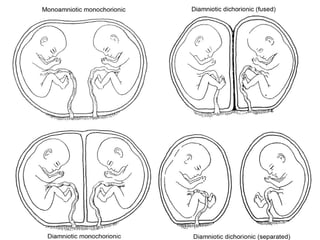
• Identical twins (monozygotic)Identical twins (monozygotic)
• Arise from fertilization of single eggArise from fertilization of single egg
• Always of same sexAlways of same sex
• Either MC or DCEither MC or DC
Results from division ofResults from division of
fertilized eggfertilized egg::
0-72 H. Diamniotic0-72 H. Diamniotic
dichorionic.dichorionic.
4-8 days Diamniotic4-8 days Diamniotic
monochor.monochor.
9-12 days9-12 days
Monoamnio.monochor.Monoamnio.monochor.
>12 days Conjoined>12 days Conjoined
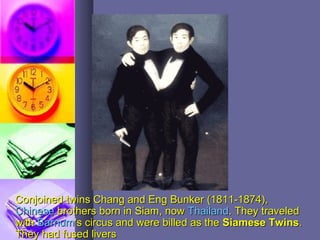
Conjoined twins Chang and Eng Bunker (1811-1874),Conjoined twins Chang and Eng Bunker (1811-1874),
ChineseChinese brothers born in Siam, nowbrothers born in Siam, now ThailandThailand.. They traveledThey traveled
withwith BarnumBarnum''s circus and were billed as thes circus and were billed as the Siamese TwinsSiamese Twins..
They had fused liversThey had fused livers
Conjoined TwinsConjoined Twins
 If the division occurredIf the division occurred
just after embryonic discjust after embryonic disc
formation, incomplete orformation, incomplete or
conjoined twins willconjoined twins will
occur. They may beoccur. They may be
joinedjoined
 anteriorly [thoracopagus-anteriorly [thoracopagus-
commonest],commonest],
 posteriorly [pyopagus]posteriorly [pyopagus]
 cephalad [craniopagus] orcephalad [craniopagus] or
 caudal [ischiopaguscaudal [ischiopagus].].
WHAT CAUSES MULTIPLEWHAT CAUSES MULTIPLE
PREGNANCYPREGNANCY
 There are many factorsThere are many factors
related to having a multiplerelated to having a multiple
pregnancy. Naturallypregnancy. Naturally
occurring factors include theoccurring factors include the
following:following:
 HeredityHeredity
 Older ageOlder age
 High parityHigh parity
 RaceRace
AetilogyAetilogy
Dizygotic twins may ariseDizygotic twins may arise
spontaneously from the release ofspontaneously from the release of
two eggs at ovulationtwo eggs at ovulation
CausesCauses
• FamilialFamilial
• RacialRacial
• Increasing maternal ageIncreasing maternal age
• Induction of ovulationInduction of ovulation
• IVFIVF
 Other factors that haveOther factors that have
greatly increased the multiplegreatly increased the multiple
birth rate in recent yearsbirth rate in recent years
include reproductiveinclude reproductive
technologiestechnologies
 Ovulation – stimulatingOvulation – stimulating
medications such asmedications such as
clomiphene citrate andclomiphene citrate and
follicle stimulating hormonefollicle stimulating hormone
 Assisted reproductiveAssisted reproductive
technoligies e.g. IVFtechnoligies e.g. IVF
HOW DOES MULTIPLEHOW DOES MULTIPLE
PREGNANCY OCCURPREGNANCY OCCUR
 Fraternal multiples(non-Fraternal multiples(non-
identical,dizygotic)identical,dizygotic)
 MaternalMaternal
multiples(identical,mono-multiples(identical,mono-
zygotic)zygotic)
COMPLICATIONSCOMPLICATIONS
 Preterm Labour and birthPreterm Labour and birth
About half of twins and all higherAbout half of twins and all higher
– order multiples are premature– order multiples are premature
 Respiratory distressRespiratory distress
syndromesyndrome
 Temp.Temp.
 InfectionInfection
 Pregnancy induced hypertensionPregnancy induced hypertension
 three times more likelythree times more likely
with multiple pregnancywith multiple pregnancy
 Occurs earlierOccurs earlier
 Increased risk of abruptioIncreased risk of abruptio
placentaeplacentae
Cont.Cont.
 AnaemiaAnaemia
Birth defectsBirth defects
 twice the risk of birthtwice the risk of birth
defects like neural tubedefects like neural tube
defects, gestrodefects, gestro
intestinalintestinal and heartand heart
abnormalitiesabnormalities
 MiscarriageMiscarriage
 Twin to twin transfusionTwin to twin transfusion
--occurs in about 15 percent ofoccurs in about 15 percent of
identical twinsidentical twins
Cont.Cont.
 PolyhydramniosPolyhydramnios
 Caesarean deliveryCaesarean delivery
 increased incidenceincreased incidence
from abnormal fetalfrom abnormal fetal
positionspositions
 Post partum haemorrhagePost partum haemorrhage
 large placental arealarge placental area
 uterine atonyuterine atony
DIAGNOSISDIAGNOSIS
♣♣ Symptoms & SignsSymptoms & Signs
 hyperemesis gravidarumhyperemesis gravidarum
 excessive weight gainexcessive weight gain
 fetal movts felt infetal movts felt in
differentdifferent parts of theparts of the
abdomenabdomen
 uterus larger than datesuterus larger than dates
Beta HCG – much higher forBeta HCG – much higher for
gestation. Ultrasoundgestation. Ultrasound
Diagnosis of Multiple FetusesDiagnosis of Multiple Fetuses
1.1. History.History.
2.2. ClinicalClinical
Examination.Examination.
3.3. Investigations.Investigations.
 History ovulation inducing drugHistory ovulation inducing drug
 Family history of twinFamily history of twin
 Exaggerated symptomsExaggerated symptoms
 Cardiopulmonary embarrassmentCardiopulmonary embarrassment
 Excessive fetal movementExcessive fetal movement
 General examinationGeneral examination
 Anaemia more than single pregnancyAnaemia more than single pregnancy
 Unusual weight gainUnusual weight gain
 Evidence of PET ( 25% more)Evidence of PET ( 25% more)
Per abdominal examinationPer abdominal examination
 Height of the uterus more than the periodHeight of the uterus more than the period
of gestationof gestation
 Too many fetal partsToo many fetal parts
 Two fetal headTwo fetal head
 Two distinct fetal heart sound, atTwo distinct fetal heart sound, at
separated spot, provided the difference atseparated spot, provided the difference at
least 10 beats per minuteleast 10 beats per minute
Complications unique to monoamnioticComplications unique to monoamniotic
twins is cord accidenttwins is cord accident
Differential diagnosis of twinDifferential diagnosis of twin
pregnancypregnancy
1-polyhydramnious1-polyhydramnious
2-big baby2-big baby
3-ovarian cyst or mass3-ovarian cyst or mass
4-uterine fibroid4-uterine fibroid
5-retntion of urine.5-retntion of urine.
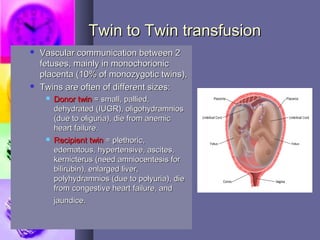
Twin to Twin transfusionTwin to Twin transfusion
 Vascular communication between 2Vascular communication between 2
fetuses, mainly in monochorionicfetuses, mainly in monochorionic
placenta (10% of monozygotic twins),placenta (10% of monozygotic twins),
 Twins are often of different sizes:Twins are often of different sizes:
 Donor twinDonor twin = small, pallied,= small, pallied,
dehydrated (IUGR), oligohydramniosdehydrated (IUGR), oligohydramnios
(due to oliguria), die from anemic(due to oliguria), die from anemic
heart failure.heart failure.
 Recipient twinRecipient twin = plethoric,= plethoric,
edematous, hypertensive, ascites,edematous, hypertensive, ascites,
kernicterus (need amniocentesis forkernicterus (need amniocentesis for
bilirubin), enlarged liver,bilirubin), enlarged liver,
polyhydramnios (due to polyuria), diepolyhydramnios (due to polyuria), die
from congestive heart failure, andfrom congestive heart failure, and
jaundice.jaundice.
MANAGEMENTMANAGEMENT
 Prevent anaemiaPrevent anaemia
 Tocolytic medicationTocolytic medication
 CorticosteroidsCorticosteroids
 Cervical cerclageCervical cerclage
? – for higher order multiples? – for higher order multiples
How are they going to be delivered?How are they going to be delivered?
DELIVERYDELIVERY
 Presentation of first fetus inPresentation of first fetus in
twins:twins:
 if cephalic, vaginal deliveryif cephalic, vaginal delivery
should be anticipatedshould be anticipated
 if breech, mode of deliveryif breech, mode of delivery
will depend on other factorswill depend on other factors
 higher order multiples arehigher order multiples are
usually delivered byusually delivered by
caesarean sectioncaesarean section
 Anticipate and prepare forAnticipate and prepare for
post-partum haemorrhagepost-partum haemorrhage
Vaginal Delivery for Multiple PregnancyVaginal Delivery for Multiple Pregnancy
 Always perform an episiotomy.Always perform an episiotomy.
 Delivery of twin A (Vertex): with minimal interferenceDelivery of twin A (Vertex): with minimal interference
(no artificial rupture of membranes, no augmentation,(no artificial rupture of membranes, no augmentation,
avoid difficult forceps or ventouse), no breechavoid difficult forceps or ventouse), no breech
extraction if breech.extraction if breech.
 On delivery of twin A:On delivery of twin A:
 Clamp and cut cord of twin A immediately, away from vulvaClamp and cut cord of twin A immediately, away from vulva
and mark it.and mark it.
 No ergometrine is given.No ergometrine is given.
 Assess twin B (abdominally/vaginally) i.e ; presentation,Assess twin B (abdominally/vaginally) i.e ; presentation,
position, exclude mono-amniotic pregnancy or cordposition, exclude mono-amniotic pregnancy or cord
 Delivery of twin B:Delivery of twin B:
 assess second sac:assess second sac:
 if no sac, immediate delivery.if no sac, immediate delivery.
 If there is a sac, examine for lie:If there is a sac, examine for lie:
 If longitudinal, wait 10 min (hasten if fetal distress or bleeding). IfIf longitudinal, wait 10 min (hasten if fetal distress or bleeding). If
inertia, give oxytocin. If the presenting part is high, moderate fundalinertia, give oxytocin. If the presenting part is high, moderate fundal
pressure and artificial rupture of membranes, then ventouse orpressure and artificial rupture of membranes, then ventouse or
breech extraction.breech extraction.
 If transverse, bring a leg by abdominovaginal manipulation i.e.;If transverse, bring a leg by abdominovaginal manipulation i.e.;
external cephalic version (ECV) or internal podalic version (IPV),external cephalic version (ECV) or internal podalic version (IPV),
then breech extraction.then breech extraction.
 Placental delivery and examination for zygosity:Placental delivery and examination for zygosity:
 If delayed, then do manual removal.If delayed, then do manual removal.
 Examine placenta for zygosity.Examine placenta for zygosity.
 Exploration of genital tract for retained products and lacerations.Exploration of genital tract for retained products and lacerations.
 Guard against postpartum hemorrhage (massage andGuard against postpartum hemorrhage (massage and
I.V ecbolics )I.V ecbolics )
Retained Twin BRetained Twin B
 The usual time interval between delivery of twin AThe usual time interval between delivery of twin A
and B is 15-20 minutesand B is 15-20 minutes
 If there are facilities for proper monitoring thisIf there are facilities for proper monitoring this
interval may be increasedinterval may be increased
 Indications of CS for Twin BIndications of CS for Twin B
 Transverse lieTransverse lie
 Fetal DistressFetal Distress
 Contracted cervixContracted cervix
 Prolapsed cordProlapsed cord
 Premature BreechPremature Breech
 Failed ExtractionFailed Extraction
Post-natal carePost-natal care
 Guard againstGuard against
puerperalpuerperal
sepsis.sepsis.
 PsychologicalPsychological
and possibleand possible
financialfinancial
support.support.
 Advise forAdvise for
contraception.contraception.

Multiple pregnancy

  • 1.
  • 2.
    Definition:Definition: It isthe presence ofIt is the presence of more than one fetus in themore than one fetus in the abdomen of a pregnant women.abdomen of a pregnant women.  According to their number, theyAccording to their number, they could be categorized into:could be categorized into:  twins (most common),twins (most common),  triplet,triplet,  quadriplet, …etc.quadriplet, …etc.
  • 3.
     This isa pregnancy with twoThis is a pregnancy with two or more fetuses:or more fetuses:  TwinsTwins == 2 fetuses2 fetuses  TripletsTriplets == 3 fetuses3 fetuses  Quadruplets=Quadruplets= 4 fetuses4 fetuses  Quintuplets =Quintuplets = 5 fetuses5 fetuses  Sextuplets =Sextuplets = 6 fetuses6 fetuses  Septuplets =Septuplets = 7 fetuses7 fetuses
  • 4.
    Risk factorsRisk factors 1-assisted reproductive1- assisted reproductive techniques (techniques (IVF& induction ofIVF& induction of ovulation )ovulation ) 2-high parity2-high parity 3- black race3- black race 4- maternal family history4- maternal family history 5- increasing maternal age.5- increasing maternal age.
  • 5.
    Dyzygotic twin pregnancy Bi-chorialand bi-amniotic Monozygotic twin pregnancy Mono-chorial & mono- amniotic Monozygotic twin pregnancy Mono-chorial and bi-amniotic. Monozygotic twin pregnancy Bi-chorial and bi- amniotic
  • 6.
    ClassificationClassification 1- according tonumber of fetuses1- according to number of fetuses 2-number of fertilized eggs2-number of fertilized eggs 3-number of placentas ( chorionicity)3-number of placentas ( chorionicity) 4-number of amniotic cavities (amniocity)4-number of amniotic cavities (amniocity) Non identical twins( dizygotic twins)Non identical twins( dizygotic twins) • *Always have two separate placentas (DC)*Always have two separate placentas (DC) • *separate amniotic cavities (DA)*separate amniotic cavities (DA) • *the fetuses either the same or different*the fetuses either the same or different sex pairingsex pairing • Identical twins (monozygotic)Identical twins (monozygotic) • Arise from fertilization of single eggArise from fertilization of single egg • Always of same sexAlways of same sex • Either MC or DCEither MC or DC
  • 7.
    Results from divisionofResults from division of fertilized eggfertilized egg:: 0-72 H. Diamniotic0-72 H. Diamniotic dichorionic.dichorionic. 4-8 days Diamniotic4-8 days Diamniotic monochor.monochor. 9-12 days9-12 days Monoamnio.monochor.Monoamnio.monochor. >12 days Conjoined>12 days Conjoined
  • 8.
    Conjoined twins Changand Eng Bunker (1811-1874),Conjoined twins Chang and Eng Bunker (1811-1874), ChineseChinese brothers born in Siam, nowbrothers born in Siam, now ThailandThailand.. They traveledThey traveled withwith BarnumBarnum''s circus and were billed as thes circus and were billed as the Siamese TwinsSiamese Twins.. They had fused liversThey had fused livers
  • 9.
    Conjoined TwinsConjoined Twins If the division occurredIf the division occurred just after embryonic discjust after embryonic disc formation, incomplete orformation, incomplete or conjoined twins willconjoined twins will occur. They may beoccur. They may be joinedjoined  anteriorly [thoracopagus-anteriorly [thoracopagus- commonest],commonest],  posteriorly [pyopagus]posteriorly [pyopagus]  cephalad [craniopagus] orcephalad [craniopagus] or  caudal [ischiopaguscaudal [ischiopagus].].
  • 10.
    WHAT CAUSES MULTIPLEWHATCAUSES MULTIPLE PREGNANCYPREGNANCY  There are many factorsThere are many factors related to having a multiplerelated to having a multiple pregnancy. Naturallypregnancy. Naturally occurring factors include theoccurring factors include the following:following:  HeredityHeredity  Older ageOlder age  High parityHigh parity  RaceRace
  • 11.
    AetilogyAetilogy Dizygotic twins mayariseDizygotic twins may arise spontaneously from the release ofspontaneously from the release of two eggs at ovulationtwo eggs at ovulation CausesCauses • FamilialFamilial • RacialRacial • Increasing maternal ageIncreasing maternal age • Induction of ovulationInduction of ovulation • IVFIVF
  • 12.
     Other factorsthat haveOther factors that have greatly increased the multiplegreatly increased the multiple birth rate in recent yearsbirth rate in recent years include reproductiveinclude reproductive technologiestechnologies  Ovulation – stimulatingOvulation – stimulating medications such asmedications such as clomiphene citrate andclomiphene citrate and follicle stimulating hormonefollicle stimulating hormone  Assisted reproductiveAssisted reproductive technoligies e.g. IVFtechnoligies e.g. IVF
  • 13.
    HOW DOES MULTIPLEHOWDOES MULTIPLE PREGNANCY OCCURPREGNANCY OCCUR  Fraternal multiples(non-Fraternal multiples(non- identical,dizygotic)identical,dizygotic)  MaternalMaternal multiples(identical,mono-multiples(identical,mono- zygotic)zygotic)
  • 14.
    COMPLICATIONSCOMPLICATIONS  Preterm Labourand birthPreterm Labour and birth About half of twins and all higherAbout half of twins and all higher – order multiples are premature– order multiples are premature  Respiratory distressRespiratory distress syndromesyndrome  Temp.Temp.  InfectionInfection  Pregnancy induced hypertensionPregnancy induced hypertension  three times more likelythree times more likely with multiple pregnancywith multiple pregnancy  Occurs earlierOccurs earlier  Increased risk of abruptioIncreased risk of abruptio placentaeplacentae
  • 15.
    Cont.Cont.  AnaemiaAnaemia Birth defectsBirthdefects  twice the risk of birthtwice the risk of birth defects like neural tubedefects like neural tube defects, gestrodefects, gestro intestinalintestinal and heartand heart abnormalitiesabnormalities  MiscarriageMiscarriage  Twin to twin transfusionTwin to twin transfusion --occurs in about 15 percent ofoccurs in about 15 percent of identical twinsidentical twins
  • 16.
    Cont.Cont.  PolyhydramniosPolyhydramnios  CaesareandeliveryCaesarean delivery  increased incidenceincreased incidence from abnormal fetalfrom abnormal fetal positionspositions  Post partum haemorrhagePost partum haemorrhage  large placental arealarge placental area  uterine atonyuterine atony
  • 17.
    DIAGNOSISDIAGNOSIS ♣♣ Symptoms &SignsSymptoms & Signs  hyperemesis gravidarumhyperemesis gravidarum  excessive weight gainexcessive weight gain  fetal movts felt infetal movts felt in differentdifferent parts of theparts of the abdomenabdomen  uterus larger than datesuterus larger than dates Beta HCG – much higher forBeta HCG – much higher for gestation. Ultrasoundgestation. Ultrasound
  • 18.
    Diagnosis of MultipleFetusesDiagnosis of Multiple Fetuses 1.1. History.History. 2.2. ClinicalClinical Examination.Examination. 3.3. Investigations.Investigations.
  • 19.
     History ovulationinducing drugHistory ovulation inducing drug  Family history of twinFamily history of twin  Exaggerated symptomsExaggerated symptoms  Cardiopulmonary embarrassmentCardiopulmonary embarrassment  Excessive fetal movementExcessive fetal movement
  • 20.
     General examinationGeneralexamination  Anaemia more than single pregnancyAnaemia more than single pregnancy  Unusual weight gainUnusual weight gain  Evidence of PET ( 25% more)Evidence of PET ( 25% more)
  • 21.
    Per abdominal examinationPerabdominal examination  Height of the uterus more than the periodHeight of the uterus more than the period of gestationof gestation  Too many fetal partsToo many fetal parts  Two fetal headTwo fetal head  Two distinct fetal heart sound, atTwo distinct fetal heart sound, at separated spot, provided the difference atseparated spot, provided the difference at least 10 beats per minuteleast 10 beats per minute
  • 23.
    Complications unique tomonoamnioticComplications unique to monoamniotic twins is cord accidenttwins is cord accident Differential diagnosis of twinDifferential diagnosis of twin pregnancypregnancy 1-polyhydramnious1-polyhydramnious 2-big baby2-big baby 3-ovarian cyst or mass3-ovarian cyst or mass 4-uterine fibroid4-uterine fibroid 5-retntion of urine.5-retntion of urine.
  • 24.
    Twin to TwintransfusionTwin to Twin transfusion  Vascular communication between 2Vascular communication between 2 fetuses, mainly in monochorionicfetuses, mainly in monochorionic placenta (10% of monozygotic twins),placenta (10% of monozygotic twins),  Twins are often of different sizes:Twins are often of different sizes:  Donor twinDonor twin = small, pallied,= small, pallied, dehydrated (IUGR), oligohydramniosdehydrated (IUGR), oligohydramnios (due to oliguria), die from anemic(due to oliguria), die from anemic heart failure.heart failure.  Recipient twinRecipient twin = plethoric,= plethoric, edematous, hypertensive, ascites,edematous, hypertensive, ascites, kernicterus (need amniocentesis forkernicterus (need amniocentesis for bilirubin), enlarged liver,bilirubin), enlarged liver, polyhydramnios (due to polyuria), diepolyhydramnios (due to polyuria), die from congestive heart failure, andfrom congestive heart failure, and jaundice.jaundice.
  • 25.
    MANAGEMENTMANAGEMENT  Prevent anaemiaPreventanaemia  Tocolytic medicationTocolytic medication  CorticosteroidsCorticosteroids  Cervical cerclageCervical cerclage ? – for higher order multiples? – for higher order multiples
  • 26.
    How are theygoing to be delivered?How are they going to be delivered?
  • 27.
    DELIVERYDELIVERY  Presentation offirst fetus inPresentation of first fetus in twins:twins:  if cephalic, vaginal deliveryif cephalic, vaginal delivery should be anticipatedshould be anticipated  if breech, mode of deliveryif breech, mode of delivery will depend on other factorswill depend on other factors  higher order multiples arehigher order multiples are usually delivered byusually delivered by caesarean sectioncaesarean section  Anticipate and prepare forAnticipate and prepare for post-partum haemorrhagepost-partum haemorrhage
  • 28.
    Vaginal Delivery forMultiple PregnancyVaginal Delivery for Multiple Pregnancy  Always perform an episiotomy.Always perform an episiotomy.  Delivery of twin A (Vertex): with minimal interferenceDelivery of twin A (Vertex): with minimal interference (no artificial rupture of membranes, no augmentation,(no artificial rupture of membranes, no augmentation, avoid difficult forceps or ventouse), no breechavoid difficult forceps or ventouse), no breech extraction if breech.extraction if breech.  On delivery of twin A:On delivery of twin A:  Clamp and cut cord of twin A immediately, away from vulvaClamp and cut cord of twin A immediately, away from vulva and mark it.and mark it.  No ergometrine is given.No ergometrine is given.  Assess twin B (abdominally/vaginally) i.e ; presentation,Assess twin B (abdominally/vaginally) i.e ; presentation, position, exclude mono-amniotic pregnancy or cordposition, exclude mono-amniotic pregnancy or cord
  • 29.
     Delivery oftwin B:Delivery of twin B:  assess second sac:assess second sac:  if no sac, immediate delivery.if no sac, immediate delivery.  If there is a sac, examine for lie:If there is a sac, examine for lie:  If longitudinal, wait 10 min (hasten if fetal distress or bleeding). IfIf longitudinal, wait 10 min (hasten if fetal distress or bleeding). If inertia, give oxytocin. If the presenting part is high, moderate fundalinertia, give oxytocin. If the presenting part is high, moderate fundal pressure and artificial rupture of membranes, then ventouse orpressure and artificial rupture of membranes, then ventouse or breech extraction.breech extraction.  If transverse, bring a leg by abdominovaginal manipulation i.e.;If transverse, bring a leg by abdominovaginal manipulation i.e.; external cephalic version (ECV) or internal podalic version (IPV),external cephalic version (ECV) or internal podalic version (IPV), then breech extraction.then breech extraction.  Placental delivery and examination for zygosity:Placental delivery and examination for zygosity:  If delayed, then do manual removal.If delayed, then do manual removal.  Examine placenta for zygosity.Examine placenta for zygosity.  Exploration of genital tract for retained products and lacerations.Exploration of genital tract for retained products and lacerations.  Guard against postpartum hemorrhage (massage andGuard against postpartum hemorrhage (massage and I.V ecbolics )I.V ecbolics )
  • 30.
    Retained Twin BRetainedTwin B  The usual time interval between delivery of twin AThe usual time interval between delivery of twin A and B is 15-20 minutesand B is 15-20 minutes  If there are facilities for proper monitoring thisIf there are facilities for proper monitoring this interval may be increasedinterval may be increased  Indications of CS for Twin BIndications of CS for Twin B  Transverse lieTransverse lie  Fetal DistressFetal Distress  Contracted cervixContracted cervix  Prolapsed cordProlapsed cord  Premature BreechPremature Breech  Failed ExtractionFailed Extraction
  • 31.
    Post-natal carePost-natal care Guard againstGuard against puerperalpuerperal sepsis.sepsis.  PsychologicalPsychological and possibleand possible financialfinancial support.support.  Advise forAdvise for contraception.contraception.