




Normal Labor
The mechanism of labor
Occiput presentation occurs more than 95% of
pregnancy, so we take the position of LOA for
example in talking about the mechanism of labor.
The mechanism of labor means that several
cooporated movements of the baby enable the baby
to adapt to the pelvis and be delivered from the birth
canal. It is a passive movement of the baby, it is
enitiated by the uterine contractions and finished by
the cooporation of uterine contraction and the
bearing-down efforts.
Seven passive movements of the baby presentation
are:
1. engagement
2. descent
3. flexion
4. internal rotation
5. extension
6. restitution and external rotation
7. expulsion
1. Engagement: It’s a state that the infant head
entered the true pelvis inlet. The biparietal
diameter(BPD) is inside the inlet. At this time the
head partially flexed and the occipito-frantal
diameter is on the right-oblique diameter of the inlet.
The lowest point of vertex
reaches the interspinous
diameter (station zero,s-0).
2. Descent: Denscent continued progressively
during labor until baby is delivered. It is brought
about by the contractions of uterus and the bearing-
down efforts. Other movements are superimposed on
it .
3. Flexion: Partial flexion of the head exists before
labor and on engagement .When the fetus descents,
the head meets the resistance of the pelvic floor,
especially the levator ani, the fetus neck vertebra
further flexed, and the chin
approach the chest,
at this time, the fetus
suboccipito-bregmatic
diameter(9.5cm) is
on the diameter of
mid plane of true pelvis .
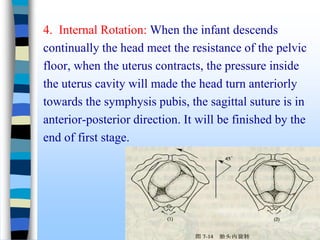
4. Internal Rotation: When the infant descends
continually the head meet the resistance of the pelvic
floor, when the uterus contracts, the pressure inside
the uterus cavity will made the head turn anteriorly
towards the symphysis pubis, the sagittal suture is in
anterior-posterior direction. It will be finished by the
end of first stage.
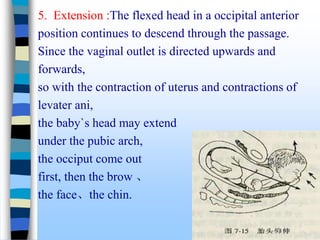
5. Extension :The flexed head in a occipital anterior
position continues to descend through the passage.
Since the vaginal outlet is directed upwards and
forwards,
so with the contraction of uterus and contractions of
levater ani,
the baby`s head may extend
under the pubic arch,
the occiput come out
first, then the brow 、
the face、the chin.
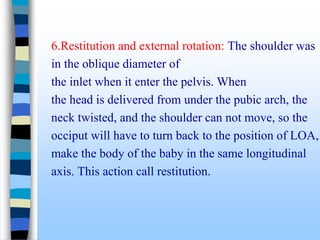
6.Restitution and external rotation: The shoulder was
in the oblique diameter of
the inlet when it enter the pelvis. When
the head is delivered from under the pubic arch, the
neck twisted, and the shoulder can not move, so the
occiput will have to turn back to the position of LOA,
make the body of the baby in the same longitudinal
axis. This action call restitution.
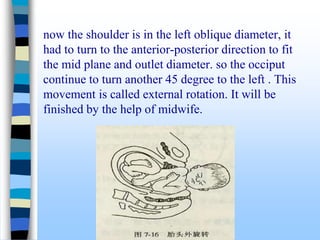
now the shoulder is in the left oblique diameter, it
had to turn to the anterior-posterior direction to fit
the mid plane and outlet diameter. so the occiput
continue to turn another 45 degree to the left . This
movement is called external rotation. It will be
finished by the help of midwife.
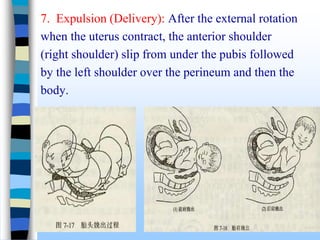
7. Expulsion (Delivery): After the external rotation
when the uterus contract, the anterior shoulder
(right shoulder) slip from under the pubis followed
by the left shoulder over the perineum and then the
body.
THE COURSE AND
MANAGEMENT OF LABOR
There are three stages of labor, each of which is
considered separately.
The first stage (stage of dilatation of the cervix) is
from the onset of true labor (regular uterine
contractions) to complete dilatation of the cervix.
The second stage (stage of fetal delivery ) is from
complete dilatation of the cervix to the birth of the
baby.
The third stage (stage of placental delivery) is from
the birth of the baby to delivery of the placenta.
The first stage :1st stage is about 11--12 hrs. in
primipara and 6--8hrs. in multipara.
1. Clinical manifestation
(1) Regular uterine contraction
(2) Cervical dilatation
(3) Rupture of membranes,
usually at the end of this stage.
2.Observation and management of 1st stage
First of all, we must recognize the true labor and the
false labor:
True labor False labor
1.Regular contractions Irregular contractions
2.Show No show
3.Progressive Not progressive
4.Effacement and No
dilatation of cervix
Observation and management of 1st stage
During this stage of labor, routine observation
should be charted on partogram at regular intervals
to note the progress of the labor, the condition of the
mother and to monitor the fetus. These observations
include:
(1)Strength,duration and frequency of
uterine contraction
In the beginning of labor, the uterine contractions last 30’s,
and the interal is 5_10min.When the labor proceed, the
contractions last longer and longer,and stronger and
stronger,in the end of the first stage,the duration will be 60’s
and the interal will be 1_2min, the mother will feel more and
more unconfertable in lower abdomen and upper sacral region.
We check the contractions by palpation(using one hand
gentally put on the abdominal wall).Recording the
Strength,duration and freguency of uterine contraction on a
chart,called partogram.
(2) Fetal heart rate
May be monitored as often as every 1-2 hrs. in
the early stage, but every 10-15 minutes in the late
stage or if the mother and/or the fetus is regarded as
being at risk.
(3)Determination of cervical dilatation, descent
and position of the presenting part by rectal or
vaginal examination.
We also judge the presentation by rectal or vaginal
examination by palpating the sagittal suture,bregma
and the ears of the foetus.
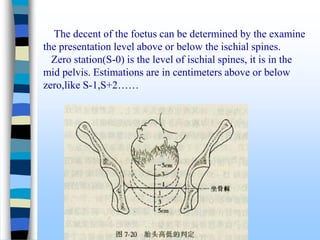
The decent of the foetus can be determined by the examine
the presentation level above or below the ischial spines.
Zero station(S-0) is the level of ischial spines, it is in the
mid pelvis. Estimations are in centimeters above or below
zero,like S-1,S+2……
(4)Rupture of the membrane.
The membrane usually rupture spontaneously by the
end of first stage,when the membrane rupture we
should check and record the liquo state and monitor
the fetus heart rate immediately.If the liquo has been
meconium(the water is green or yellow),the baby may
be suffered from hypoxia,the baby must be delivered
as soon as possible.
(5) Mother`s care:
The mother’s pulse rate ,blood pressure and
temperature taken every 4-6 hrs.
Vulva should be shaved in the first stage.some
times warm enema is needed to clean the bowel and
enhance the uterine contractions.
the second stage : 2nd stage lasts about 1-2 hrs in
primipara and lest than 1 hr. or only a few minutes in
multipara.
1. Clinical manifestation
Once the cervix is fully dilated, the fetus will
proceed through the pelvis with the aid of uterine
contractions and expulsive efforts.
The fetal head flexes ,descends ,moulds and
undergoes internal rotation so that
the occiput comes to lie anteriorly under the
symphysis pubis. From this position, expulsive
efforts assist in the fetal head undergoing extension
and eventual delivery from under the symphysis
pubis. Then external rotation takes place followed by
the delivery of the anterior and posterior shoulders in
succession.
2.Observation and management of 2nd stage
(1)Fetal heart rate
May be monitored every 10 minutes.
Labor should be ended as soon as possible if
abnormality is found
(<120bpm or>160bpm).
.
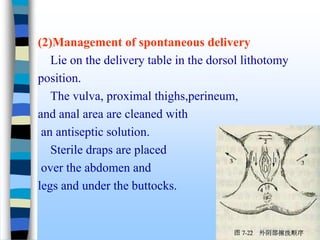
(2)Management of spontaneous delivery
Lie on the delivery table in the dorsol lithotomy
position.
The vulva, proximal thighs,perineum,
and anal area are cleaned with
an antiseptic solution.
Sterile draps are placed
over the abdomen and
legs and under the buttocks.
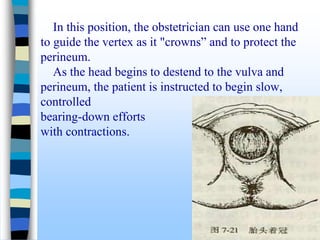
In this position, the obstetrician can use one hand
to guide the vertex as it "crowns” and to protect the
perineum.
As the head begins to destend to the vulva and
perineum, the patient is instructed to begin slow,
controlled
bearing-down efforts
with contractions.
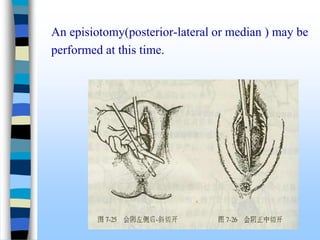
An episiotomy(posterior-lateral or median ) may be
performed at this time.
After the occiput has descended below the symphysis,
a hand is placed over the vertex, and light pressure is
exerted to prevent rapid expulsion of the head.
Excessive pressure should never be applied. The head
is generally delivered between contractions to enable
slow delivery and maximum control. Once the head has
been born, it should be supported as external rotation
occurs. The nose, mouth and oral pharynx are gently
suctioned with bulb syringe.
(3) Management of the infant
Immediate care of the infant is very important.
Secretions from the nose, mouth, and oral phyarynx
are again aspirated with a bulb syringe.
The umbilical cord should be doubly clamped and
cut as soon as is convenient.
The baby is checked immediately for gross
abnormalities,wrapped in a warm blanket and show
it to the mother to ascertain whether it is a boy of girl.
The third stage :
3rd stage lasts about 5-15 minutes and normally not
exceed 30 minutes.
Signs of placental separation are as follows:
l. The uterine body becomes firm and
globular with the fundus rise up to the
level of the umbilicus.
2. The umbilical cord lengthens outside the
vagina.
3. A fresh show of blood from vagina.
4. The umbilical cord does not recede when
the uterus is elevated.
Only when these signs have appeared should the
obstetrician attempt to pull the cord with gentle
traction, maternal bearing-down and counter some
pressure between symphysis and fundus, the placenta
is delivered.
The placenta should be examined to assure its
completely separated ,and the membrane is
completely separated and removed.
Cervix ,vagina and perineum should be checked after
delivery ,if they are ruptured,repair the wound.
The hour immediately following delivery requires
close observation of the patient. Blood pressure,
pulse rate, and uterine blood loss must be monitored
closely.
Mother will stay in the delivery room for two hours
after delivery, It is during this time that postpartum
hemorrhage commonly occurs, usually because of
uterus relaxation, retained placental fragments, or
undiagnosed laceration.
Summary points
1.the three P:the powers the passage the
passenger
2. Fetus’ Seven passive movements during labor
3. Signs of placental separation
4. Apgar score
Normal labour

Normal labour

  • 1.
  • 2.
  • 3.
    Occiput presentation occursmore than 95% of pregnancy, so we take the position of LOA for example in talking about the mechanism of labor.
  • 4.
    The mechanism oflabor means that several cooporated movements of the baby enable the baby to adapt to the pelvis and be delivered from the birth canal. It is a passive movement of the baby, it is enitiated by the uterine contractions and finished by the cooporation of uterine contraction and the bearing-down efforts.
  • 5.
    Seven passive movementsof the baby presentation are: 1. engagement 2. descent 3. flexion 4. internal rotation 5. extension 6. restitution and external rotation 7. expulsion
  • 6.
    1. Engagement: It’sa state that the infant head entered the true pelvis inlet. The biparietal diameter(BPD) is inside the inlet. At this time the head partially flexed and the occipito-frantal diameter is on the right-oblique diameter of the inlet. The lowest point of vertex reaches the interspinous diameter (station zero,s-0).
  • 7.
    2. Descent: Denscentcontinued progressively during labor until baby is delivered. It is brought about by the contractions of uterus and the bearing- down efforts. Other movements are superimposed on it .
  • 8.
    3. Flexion: Partialflexion of the head exists before labor and on engagement .When the fetus descents, the head meets the resistance of the pelvic floor, especially the levator ani, the fetus neck vertebra further flexed, and the chin approach the chest, at this time, the fetus suboccipito-bregmatic diameter(9.5cm) is on the diameter of mid plane of true pelvis .
  • 9.
    4. Internal Rotation:When the infant descends continually the head meet the resistance of the pelvic floor, when the uterus contracts, the pressure inside the uterus cavity will made the head turn anteriorly towards the symphysis pubis, the sagittal suture is in anterior-posterior direction. It will be finished by the end of first stage.
  • 10.
    5. Extension :Theflexed head in a occipital anterior position continues to descend through the passage. Since the vaginal outlet is directed upwards and forwards, so with the contraction of uterus and contractions of levater ani, the baby`s head may extend under the pubic arch, the occiput come out first, then the brow 、 the face、the chin.
  • 11.
    6.Restitution and externalrotation: The shoulder was in the oblique diameter of the inlet when it enter the pelvis. When the head is delivered from under the pubic arch, the neck twisted, and the shoulder can not move, so the occiput will have to turn back to the position of LOA, make the body of the baby in the same longitudinal axis. This action call restitution.
  • 12.
    now the shoulderis in the left oblique diameter, it had to turn to the anterior-posterior direction to fit the mid plane and outlet diameter. so the occiput continue to turn another 45 degree to the left . This movement is called external rotation. It will be finished by the help of midwife.
  • 13.
    7. Expulsion (Delivery):After the external rotation when the uterus contract, the anterior shoulder (right shoulder) slip from under the pubis followed by the left shoulder over the perineum and then the body.
  • 14.
  • 15.
    There are threestages of labor, each of which is considered separately. The first stage (stage of dilatation of the cervix) is from the onset of true labor (regular uterine contractions) to complete dilatation of the cervix. The second stage (stage of fetal delivery ) is from complete dilatation of the cervix to the birth of the baby. The third stage (stage of placental delivery) is from the birth of the baby to delivery of the placenta.
  • 16.
    The first stage:1st stage is about 11--12 hrs. in primipara and 6--8hrs. in multipara. 1. Clinical manifestation (1) Regular uterine contraction (2) Cervical dilatation (3) Rupture of membranes, usually at the end of this stage.
  • 17.
    2.Observation and managementof 1st stage First of all, we must recognize the true labor and the false labor: True labor False labor 1.Regular contractions Irregular contractions 2.Show No show 3.Progressive Not progressive 4.Effacement and No dilatation of cervix
  • 18.
    Observation and managementof 1st stage During this stage of labor, routine observation should be charted on partogram at regular intervals to note the progress of the labor, the condition of the mother and to monitor the fetus. These observations include:
  • 19.
    (1)Strength,duration and frequencyof uterine contraction In the beginning of labor, the uterine contractions last 30’s, and the interal is 5_10min.When the labor proceed, the contractions last longer and longer,and stronger and stronger,in the end of the first stage,the duration will be 60’s and the interal will be 1_2min, the mother will feel more and more unconfertable in lower abdomen and upper sacral region.
  • 20.
    We check thecontractions by palpation(using one hand gentally put on the abdominal wall).Recording the Strength,duration and freguency of uterine contraction on a chart,called partogram.
  • 21.
    (2) Fetal heartrate May be monitored as often as every 1-2 hrs. in the early stage, but every 10-15 minutes in the late stage or if the mother and/or the fetus is regarded as being at risk.
  • 22.
    (3)Determination of cervicaldilatation, descent and position of the presenting part by rectal or vaginal examination. We also judge the presentation by rectal or vaginal examination by palpating the sagittal suture,bregma and the ears of the foetus.
  • 23.
    The decent ofthe foetus can be determined by the examine the presentation level above or below the ischial spines. Zero station(S-0) is the level of ischial spines, it is in the mid pelvis. Estimations are in centimeters above or below zero,like S-1,S+2……
  • 24.
    (4)Rupture of themembrane. The membrane usually rupture spontaneously by the end of first stage,when the membrane rupture we should check and record the liquo state and monitor the fetus heart rate immediately.If the liquo has been meconium(the water is green or yellow),the baby may be suffered from hypoxia,the baby must be delivered as soon as possible.
  • 25.
    (5) Mother`s care: Themother’s pulse rate ,blood pressure and temperature taken every 4-6 hrs. Vulva should be shaved in the first stage.some times warm enema is needed to clean the bowel and enhance the uterine contractions.
  • 26.
    the second stage: 2nd stage lasts about 1-2 hrs in primipara and lest than 1 hr. or only a few minutes in multipara. 1. Clinical manifestation Once the cervix is fully dilated, the fetus will proceed through the pelvis with the aid of uterine contractions and expulsive efforts.
  • 27.
    The fetal headflexes ,descends ,moulds and undergoes internal rotation so that the occiput comes to lie anteriorly under the symphysis pubis. From this position, expulsive efforts assist in the fetal head undergoing extension and eventual delivery from under the symphysis pubis. Then external rotation takes place followed by the delivery of the anterior and posterior shoulders in succession.
  • 28.
    2.Observation and managementof 2nd stage (1)Fetal heart rate May be monitored every 10 minutes. Labor should be ended as soon as possible if abnormality is found (<120bpm or>160bpm). .
  • 29.
    (2)Management of spontaneousdelivery Lie on the delivery table in the dorsol lithotomy position. The vulva, proximal thighs,perineum, and anal area are cleaned with an antiseptic solution. Sterile draps are placed over the abdomen and legs and under the buttocks.
  • 30.
    In this position,the obstetrician can use one hand to guide the vertex as it "crowns” and to protect the perineum. As the head begins to destend to the vulva and perineum, the patient is instructed to begin slow, controlled bearing-down efforts with contractions.
  • 31.
    An episiotomy(posterior-lateral ormedian ) may be performed at this time.
  • 32.
    After the occiputhas descended below the symphysis, a hand is placed over the vertex, and light pressure is exerted to prevent rapid expulsion of the head. Excessive pressure should never be applied. The head is generally delivered between contractions to enable slow delivery and maximum control. Once the head has been born, it should be supported as external rotation occurs. The nose, mouth and oral pharynx are gently suctioned with bulb syringe.
  • 33.
    (3) Management ofthe infant Immediate care of the infant is very important. Secretions from the nose, mouth, and oral phyarynx are again aspirated with a bulb syringe. The umbilical cord should be doubly clamped and cut as soon as is convenient. The baby is checked immediately for gross abnormalities,wrapped in a warm blanket and show it to the mother to ascertain whether it is a boy of girl.
  • 34.
    The third stage: 3rd stage lasts about 5-15 minutes and normally not exceed 30 minutes. Signs of placental separation are as follows: l. The uterine body becomes firm and globular with the fundus rise up to the level of the umbilicus. 2. The umbilical cord lengthens outside the vagina. 3. A fresh show of blood from vagina. 4. The umbilical cord does not recede when the uterus is elevated.
  • 35.
    Only when thesesigns have appeared should the obstetrician attempt to pull the cord with gentle traction, maternal bearing-down and counter some pressure between symphysis and fundus, the placenta is delivered. The placenta should be examined to assure its completely separated ,and the membrane is completely separated and removed.
  • 36.
    Cervix ,vagina andperineum should be checked after delivery ,if they are ruptured,repair the wound.
  • 37.
    The hour immediatelyfollowing delivery requires close observation of the patient. Blood pressure, pulse rate, and uterine blood loss must be monitored closely. Mother will stay in the delivery room for two hours after delivery, It is during this time that postpartum hemorrhage commonly occurs, usually because of uterus relaxation, retained placental fragments, or undiagnosed laceration.
  • 38.
    Summary points 1.the threeP:the powers the passage the passenger 2. Fetus’ Seven passive movements during labor 3. Signs of placental separation 4. Apgar score