Pathophysiology of Normal
Labor
PRESENTED BY:
ANISH DHAKAL
(ARYAN)
DEFINITION
 A series of events that take place in female genital organs to
expel the product of conception that are fetus, placenta,
membranes) out of womb through the vagina into the outer
world.
 At the National Maternity Hospital in Dublin (O’Driscoll and colleagues,
1984). Criteria for onset of labor:
 at term require painful uterine contractions accompanied by any one of
the following:
(1) ruptured membranes, (2) bloody “show,” or (3) complete cervical
effacement.
NORMAL LABOR/
EUTOCIA spontaneous in onset and at term
 with vertex presentation
 without undue prolongation
 Natural termination without minimal aid
 without having any complications affecting the health of the mother
and/or the baby
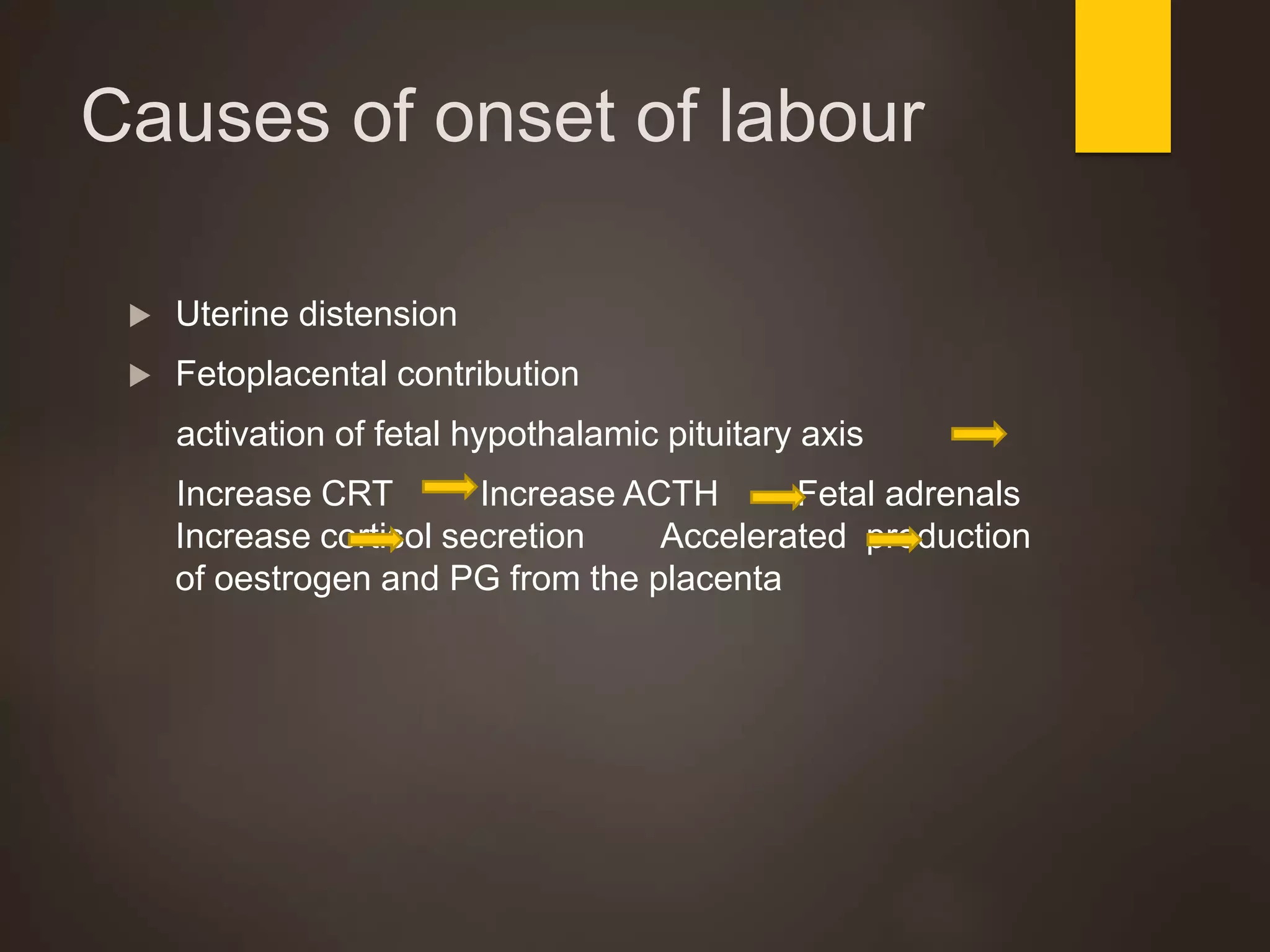
Causes of onset of labour
 Uterine distension
 Fetoplacental contribution
activation of fetal hypothalamic pituitary axis
Increase CRT Increase ACTH Fetal adrenals
Increase cortisol secretion Accelerated production
of oestrogen and PG from the placenta
Oestrogen
 Increases release of oxytocin from maternal pituitary
 Promotes synthesis of myometrial receptors for oxytocin, prostaglandin.
 Stimulates synthesis of myometrial contraction protein
 Increases excitability of myometrial cell
Progesterone:
Alteration of oestrogen and progesterone ratio is associated with PG
synthesis.
Prostaglandin
 Major site of production: Amnion,chorion, decidual cells and
myometrium
 Triggered by rise in estrogen, glucocorticoids, mechanical stretching
in late pregnancy, separation or rupture of membrane
 Enhances gap junction formation
Oxytocin
 Actions
o Stimulate uterine contractions
o Stimulate PG production from amnion/decidua
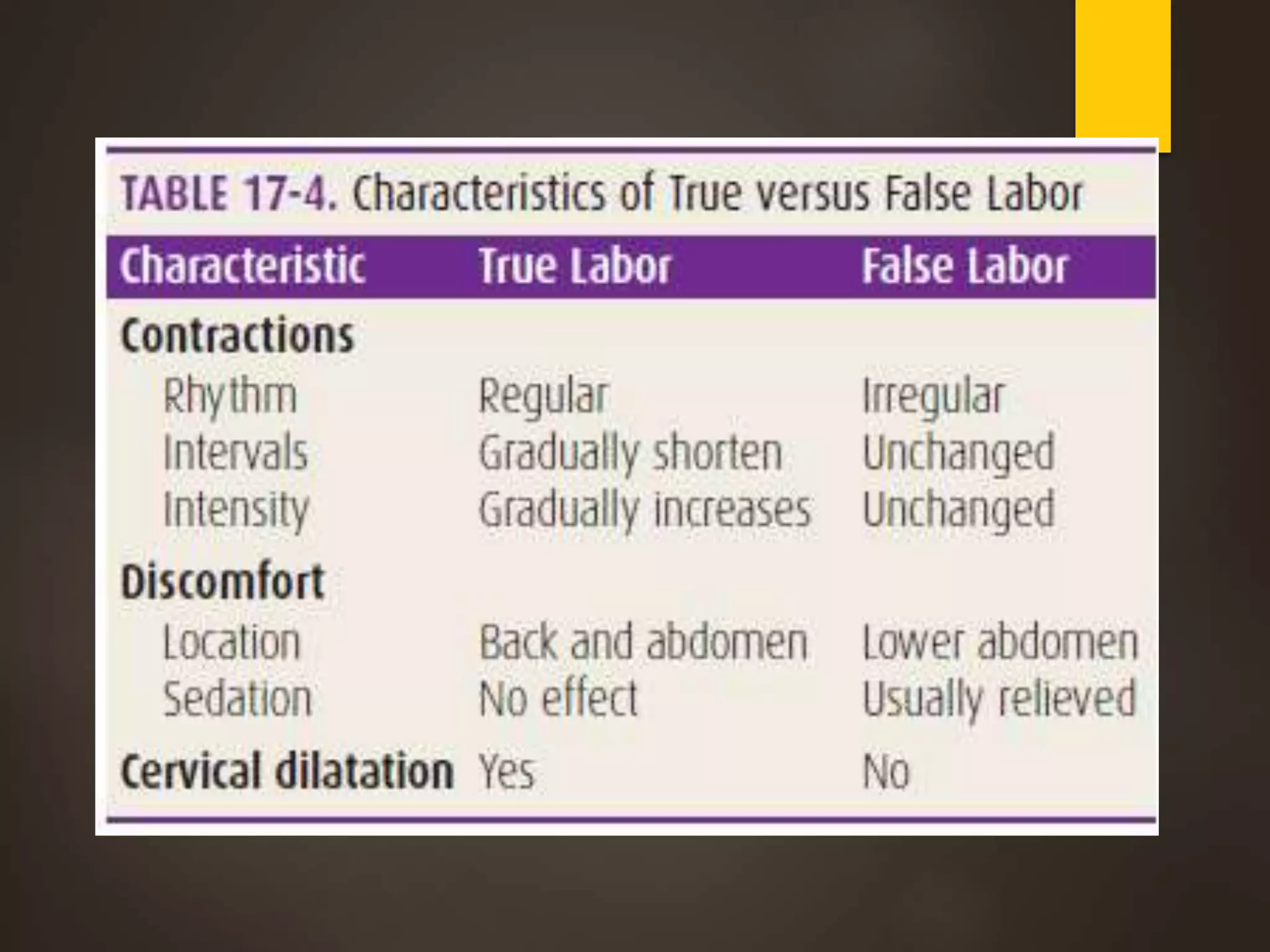
TRUE AND FALSE LABOR
 True labor
o Uterine contractions at regular intervals
o Contraction frequency, intensity, duration
increases gradually
o Associated with show
o Progressive effacement and dilatation of
cervix
o Descent of presenting part
o Formation of “bags of water”
o Not relieved by enema/ sedative
 False labor
o Dull pain confined to groin and
abdomen
o Pain interval doesn’t shorten
o Pain intensity remains same
o No cervical dilatation
o No hardening of uterus
o Relieved by enema or sedative
Physiology of normal labour
 Marked hypertrophy and hyperplasia of uterine muscles
 Length of uterus + cervix = 35 cm at term
 Uterus assumes pyriform/ ovoid shape
 Cervical canal occluded by thick, tenacious mucus plug
PATTERN OF CONTRACTION
o Good synchronization of contraction waves from both
halves of the uterus
o Fundal dominance
o Regular wave of contraction
o Intra-amniotic pressure rises beyond 20mm Hg during
uterine contraction
o Good relaxation occurs in between contraction
RETRACTION
 Phenomenon of uterus in labor in which muscle fibers are permanently
shortened
 Effects of retraction:
o Formation of lower uterine segment and dilatation and effacement of cervix
o Decent of presenting part  expulsion of fetus
o Reduce surface area  separation of placenta
o Effective homeostasis after separation of placenta
STAGES OF LABOR
 First phase
 Second phase
 Propulsive
 Expulsive
 Third phase
 Fourth phase
FIRST STAGE
 Concerned with formation of birth canal
 Main events:
o Dilatation of cervix and effacement of cervix
o Lower uterine segment formation
FACTORS RESPONSIBLE IN
DILATATION
 Uterine contraction and retraction
FACTORS RESPONSIBLE IN
DILATATION
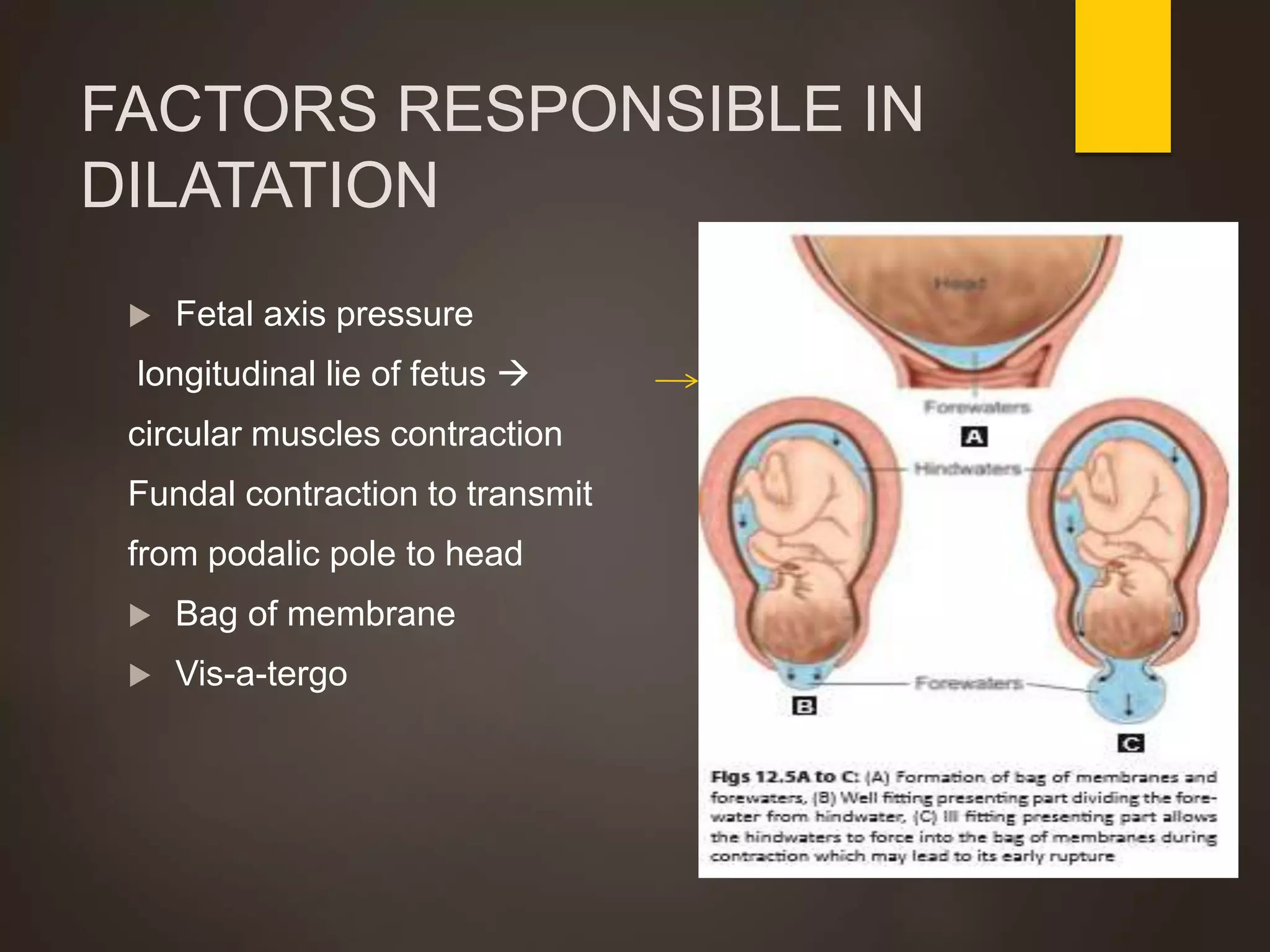
 Fetal axis pressure
longitudinal lie of fetus 
circular muscles contraction
Fundal contraction to transmit
from podalic pole to head
 Bag of membrane
 Vis-a-tergo
EFFACEMENT OF CERVIX
 Muscular fibers of cervix pulled upward and merge
with fibers of lower uterine segment
 Primigravidae: effacement before dilation of cervix
 Multiparae: effacement and dilatation occur at same
time
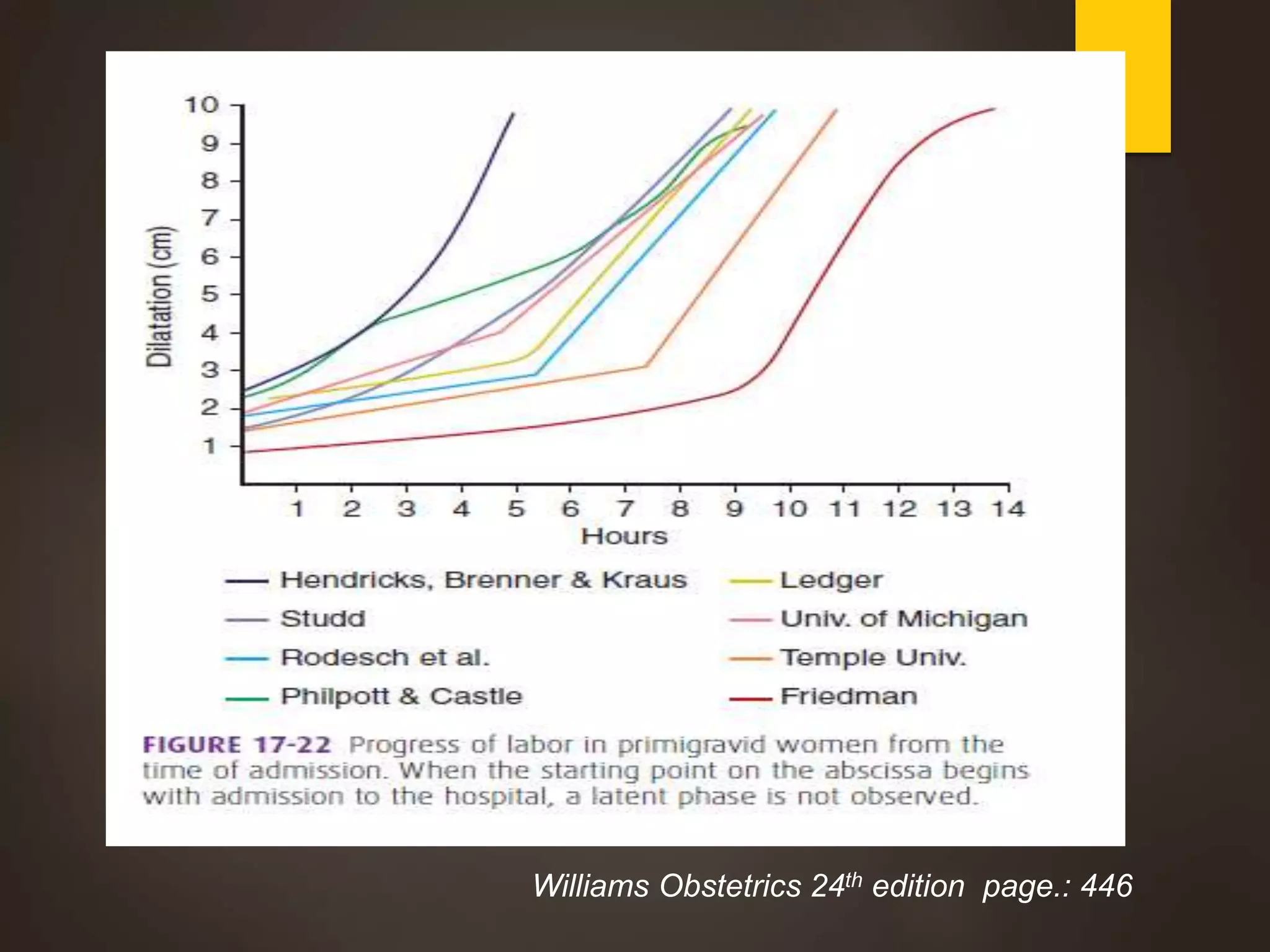
Latent Phase
 3 to 5 cm of dilation
 After that clinically active labor can be expected
Prolonged latent phase:
 > 20 hours in nullipara and 14 hours in multipara
(Friedman and Sachtleben)
 Following heavy sedation:
1. 85 percent to active labor
2. 10 percent uterine contraction ceased
3. 5 % persisted: require oxytocin stimulation
Williams Obstetrics 24th edition page.: 446
Active Phase
 Cervical dilation of 3 to 5 cm in presence of uterine
contractions: threshold for active labor
 Cervical dilatation: 1.2 to 6.8 cm/hour. Multiparas:
minimum 1.5 cm/hr
 Descent begins after 7 to 8 cm dilation, most rapid
after 8 cm
Williams Obstetrics 24th edition page.: 445
SECOND STAGE OF
LABOR
 Begins when cervical dilatation is complete and ends
with fetal delivery.
 Median duration
 2 hr in primigravidae
 30 minutes in multiparae
 Uterine contractions and accompanying expulsive
forces last:
 60-90 seconds and
 recur every 60 seconds
Events
 Propulsive phase:
 Period of full dilation until head touches pelvic floor
 Expulsive phase:
 Since the time mother has irresistible desire to ‘bear
down’ and push until the baby is delivered
THIRD STAGE OF LABOR
 Includes separation, descent and
expulsion of placenta with its membrane.
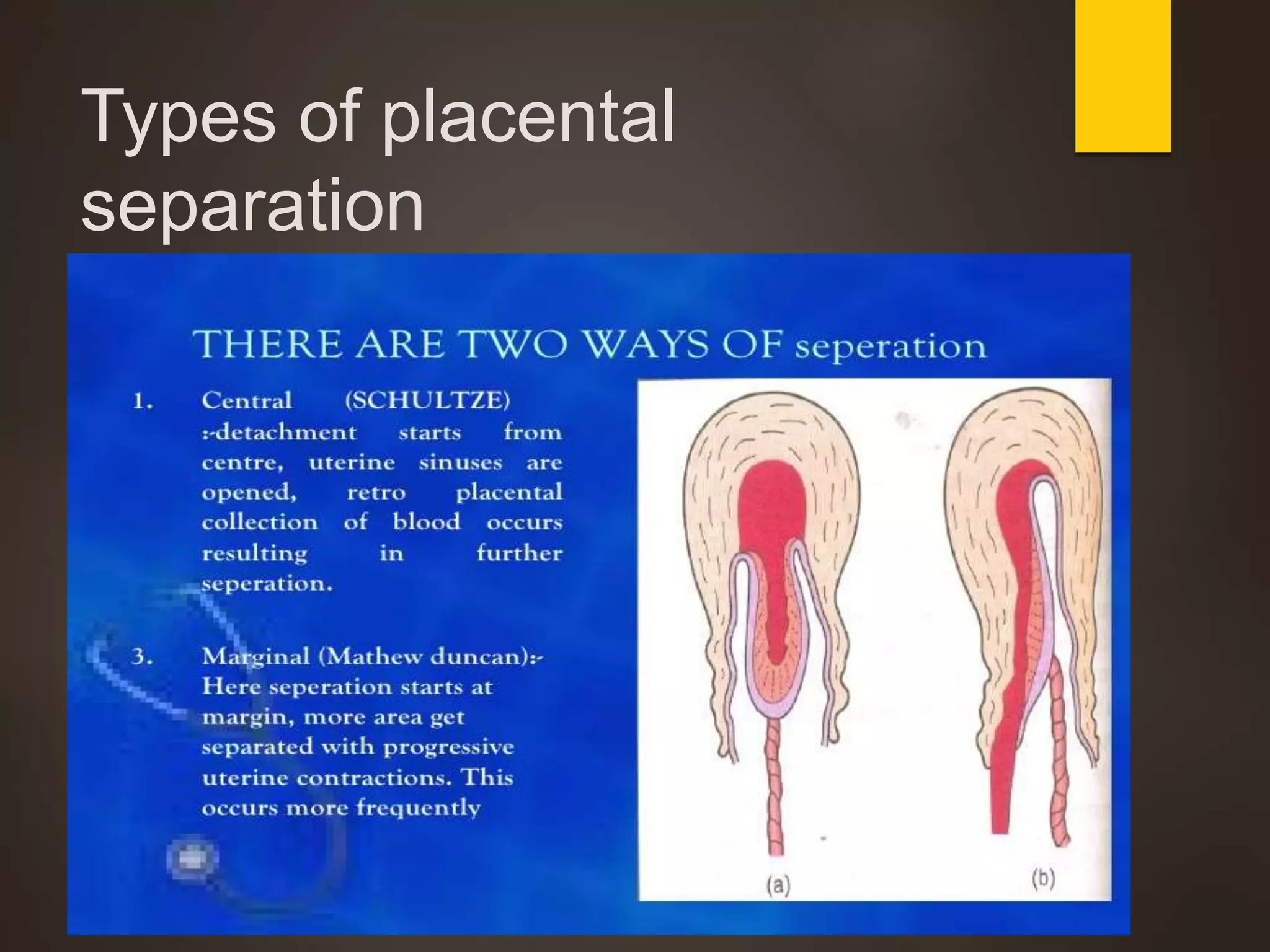
Types of placental
separation
 Signs of placental separation:
 The uterus becomes globular and as a rule, firm-
woody
 Sudden gush of blood
 Uterus rises in abdomen because the placenta,
having separated, passes down in the lower uterine
segment and vagina.
 Umbilical cord protrudes farther out of the vagina,
indicating that the placenta has descended.
FOURTH STAGE OF LABOR
 The placenta, membranes and umbilical cord should be examined
for completeness and for anomalies
 Laceration of birth canal(vagina and perineum):
 First degree laceration: Involved the perineal skin, vaginal mucus
membrane but not underlying fascia and muscle
 2nd degree laceration: Involve in addition, the fascia and muscle of
perineal body but not anal sphincter
 3rd degree laceration: Extent further to involve the anal sphincter
 4th degree laceration: Laceration extend through the rectum’s
mucosa to exposed its lumen
MANAGEMENT OF FIRST STAGE
LABOR
1. Rest and ambulation
2. Oral intake
3. Urinary bladder function
 Bladder distention-avoided, because it can hinder descent of the fetal
presenting parts
4. Pain relief
5. Monitoring fetal well-being during labor
6. Uterine contractions
 to evaluate the frequency, duration, and intensity of uterine
contractions.
CONTD..
8. Maternal vital signs
 Maternal temperature, pulse, and blood pressure are evaluated at
least every 4 hours
 with prolonged membrane rupture(>18 hours) antimicrobial
administration for prevention of group B streptococcal infections is
recommended
9. Subsequent vaginal examinations
10.Maternal position
 position that she finds most comfortable, which will be lateral
recumbency most of the time
Management of second stage labor
Assist in natural expulsion of fetus slowly and steadily
Prevent perineal injuries
1. Preparation for delivery
• Put the patient in dorsal lithotomy position or lying flat on
bed
• Clean the vulva, and perineum with antiseptic solution
• Clean hands, Clean surface, Clean cutting and ligaturing of
the cord
• Catheterize the bladder, if full
 2. Conduction of delivery
 Delivery of head:
• Maintain flexion of the head
• Prevent early extension
• Regulate the escape out of vulval outlet
• Patient asked for bearing down efforts
during uterine contractions
• When the scalp is visible for about 5cm in
diameter, push occiput downward and
backwards using thumb and index fingers
while pressing the perineum by right hand
with sterile vulval pad
• BPD stretches the vulval outlet without
any recession of the head even after the
contraction is over
• With each contraction, perineum bulge increasing
• Slow delivery of the head in between the contractions
• Ritgen maneuver:
• A towel-draped ,gloved hand –used to exert forward
pressure on the chin of fetus through the perineum
• This maneuver allow delivery of head and also favors
the neck extension so that head is delivered with small
diameter
Management of third stage labor
 Expectant management
• Placental separation and its descent into the vagina are
allowed to occur spontaneously
• Constant watch
• Changed to dorsal position
• Hand placed over the fundus (signs of separation, state
of uterine activity, detect inversion of uterus)
• Expulsion of placenta
• Patient asked to bear down
• Placenta grasped by hands and twisted round and
round with gentle traction
• Assisted expulsion
1. Controlled Cord Traction 2.Fundal Pressure
• Examination of
placenta
• Maternal surface:
completeness, anomalies
• Membranes:
completeness, abnormal
vessels
• Cord: number of vessels
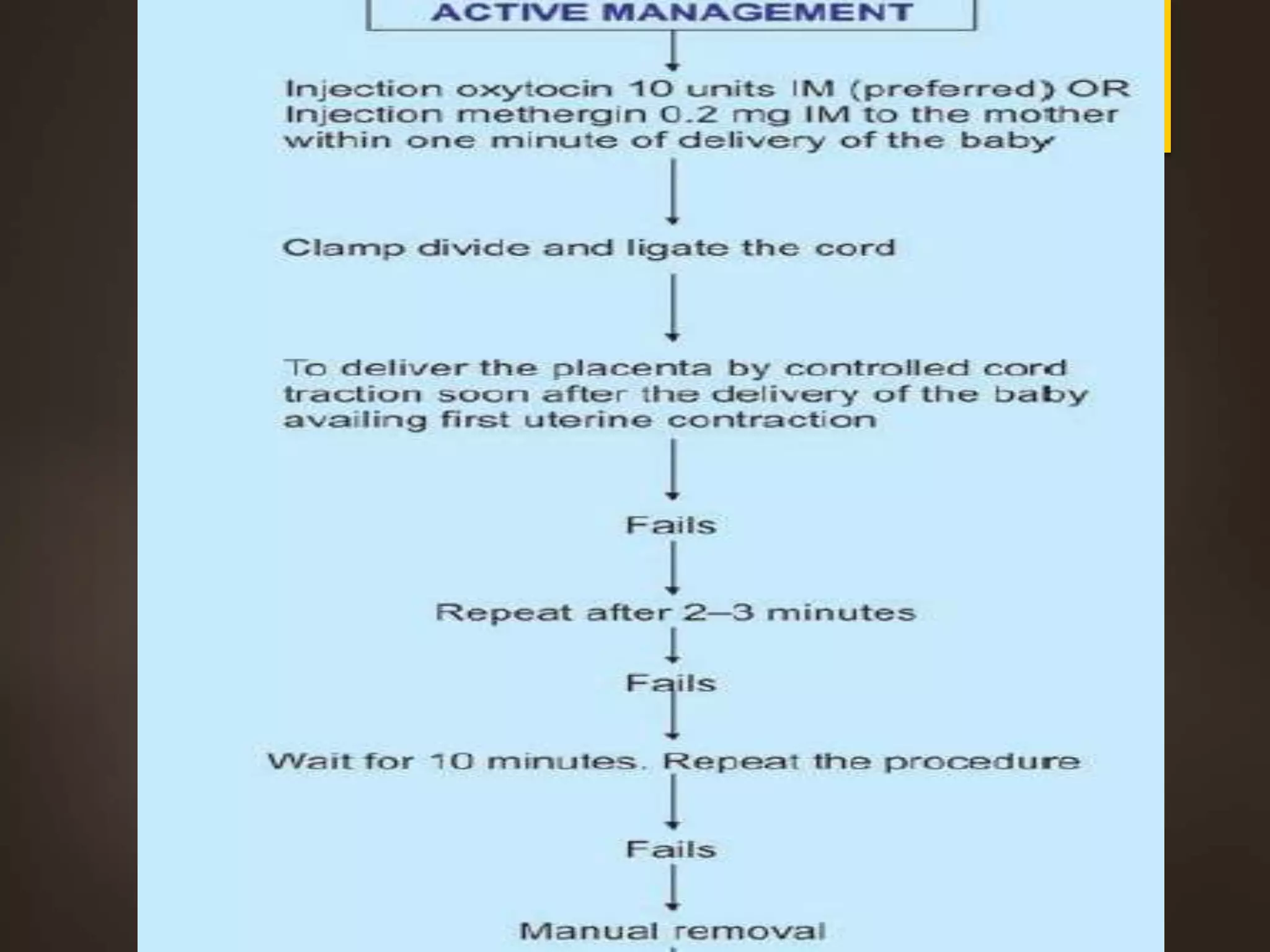
 Active management
• To excite powerful uterine contractions within one
minute of delivery of the baby by giving parenteral
oxytocic
• Injection Oxytocin 10 units IM
• Controlled Cord Traction
• Massaging the uterus
• To minimise blood loss in third stage to approx 1/5th
• To shorten the duration of third stage to half
• Disadvantage: increased incidence of retained placenta and
consequent increased incidence of manual removal
• Not to be used in cardiac failure, severe pre-eclampsia
Management of fourth stage labor
• Suture the episiotomy or any laceration
• Estimate blood loss, take cord blood for Hb, blood group, Rh,
bilirubin, and Coomb’s test for Rh negative mother
• Check BP, Pulse, Temperature, abnormal vaginal bleeding and
firmness of the uterus before transferring the patient
Cardinal Movements of
Labor
1. Engagement
2. Descent
3. Flexion
4. Internal rotation
5. Extension
6. External rotation
7. Expulsion
Engagement
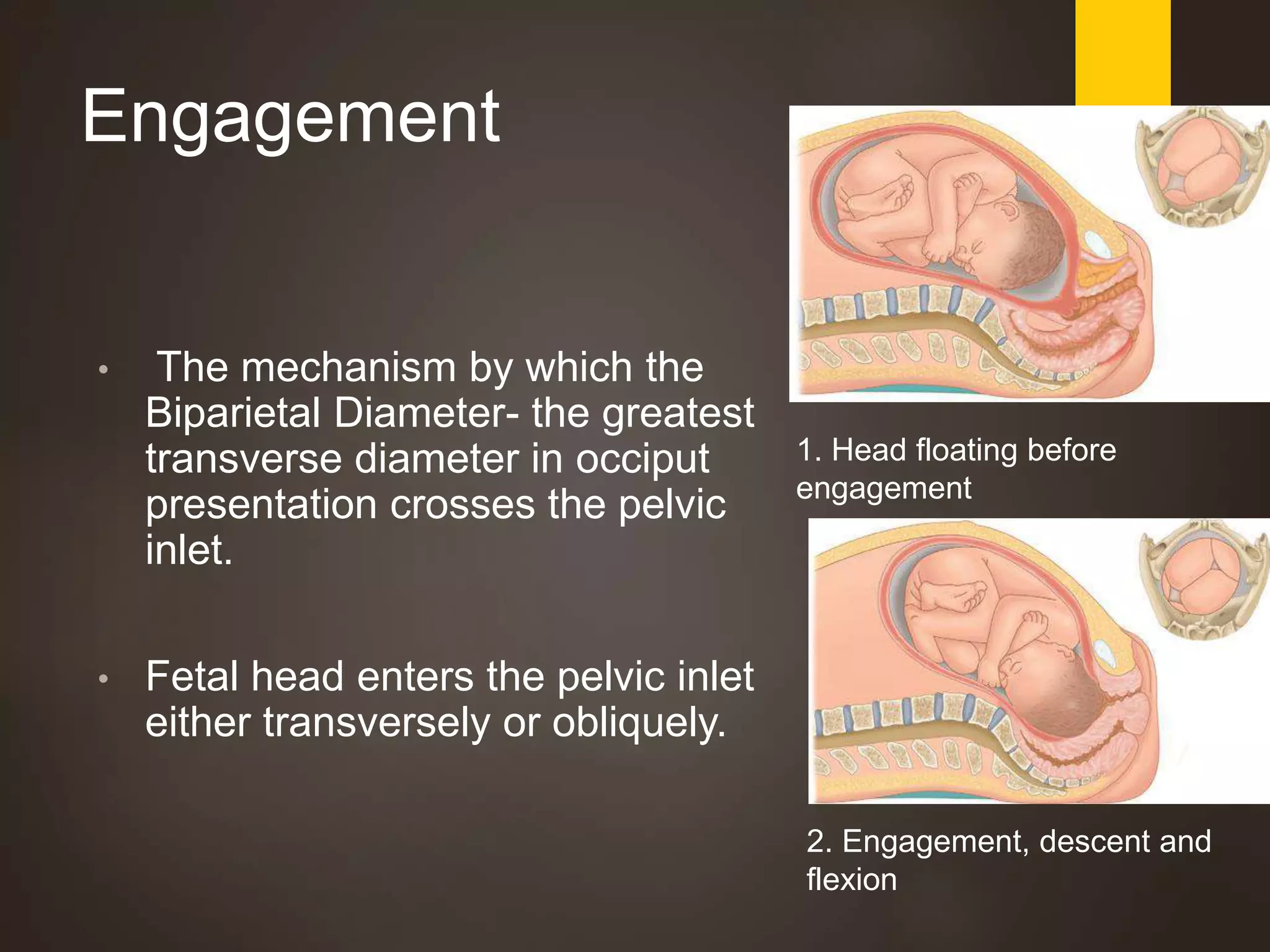
• The mechanism by which the
Biparietal Diameter- the greatest
transverse diameter in occiput
presentation crosses the pelvic
inlet.
• Fetal head enters the pelvic inlet
either transversely or obliquely.
1. Head floating before
engagement
2. Engagement, descent and
flexion
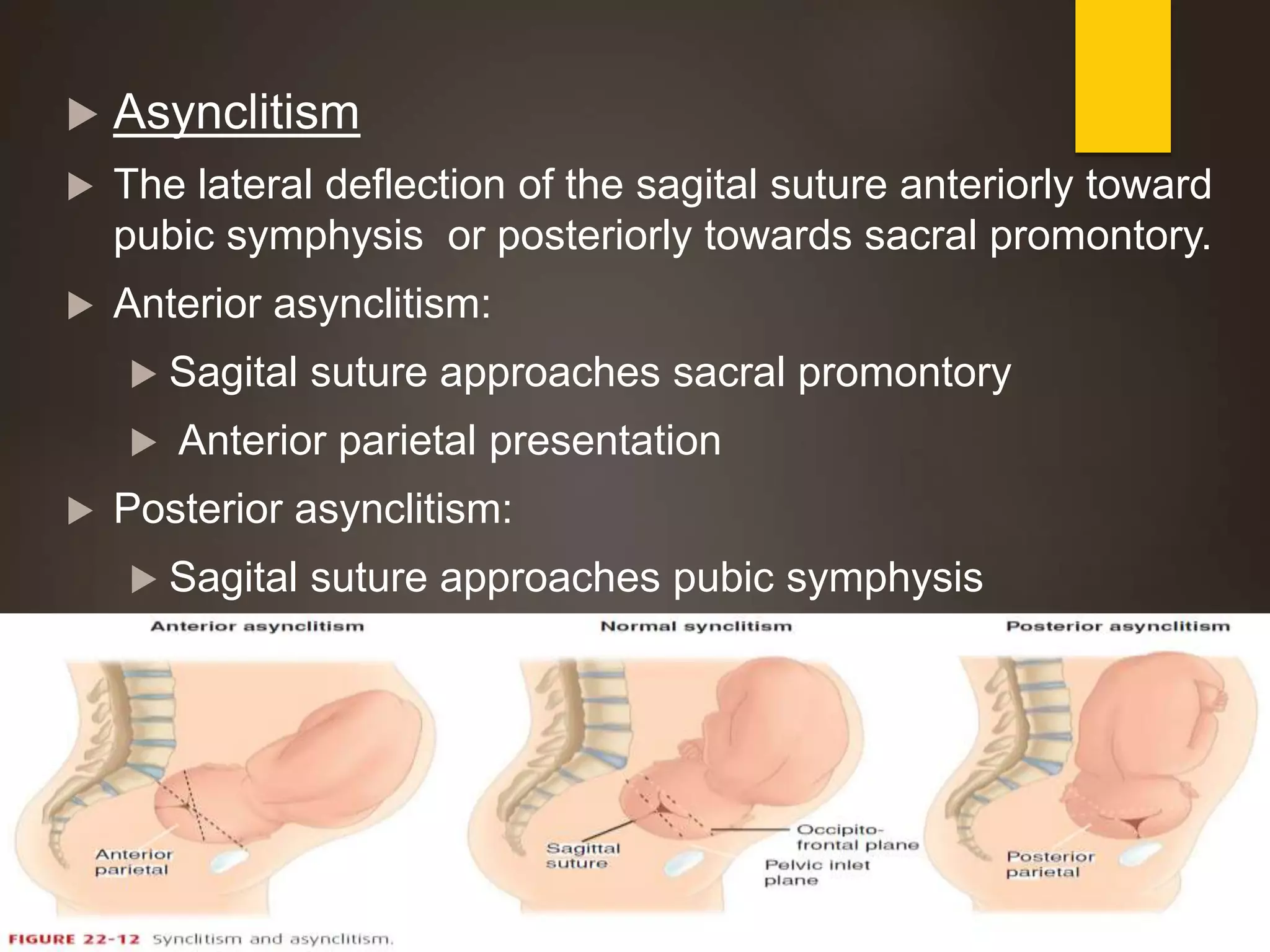
 Asynclitism
 The lateral deflection of the sagital suture anteriorly toward
pubic symphysis or posteriorly towards sacral promontory.
 Anterior asynclitism:
 Sagital suture approaches sacral promontory
 Anterior parietal presentation
 Posterior asynclitism:
 Sagital suture approaches pubic symphysis
 Posterior parietal presentation
Descent
• Downward passage of the presenting part
through the pelvis
• Forces involved:-
 Pressure of amniotic fluid
 Pressure of fundus upon breech with contraction
 Bearing down efforts of maternal abdominal muscles
 Extension and straightening of fetal body
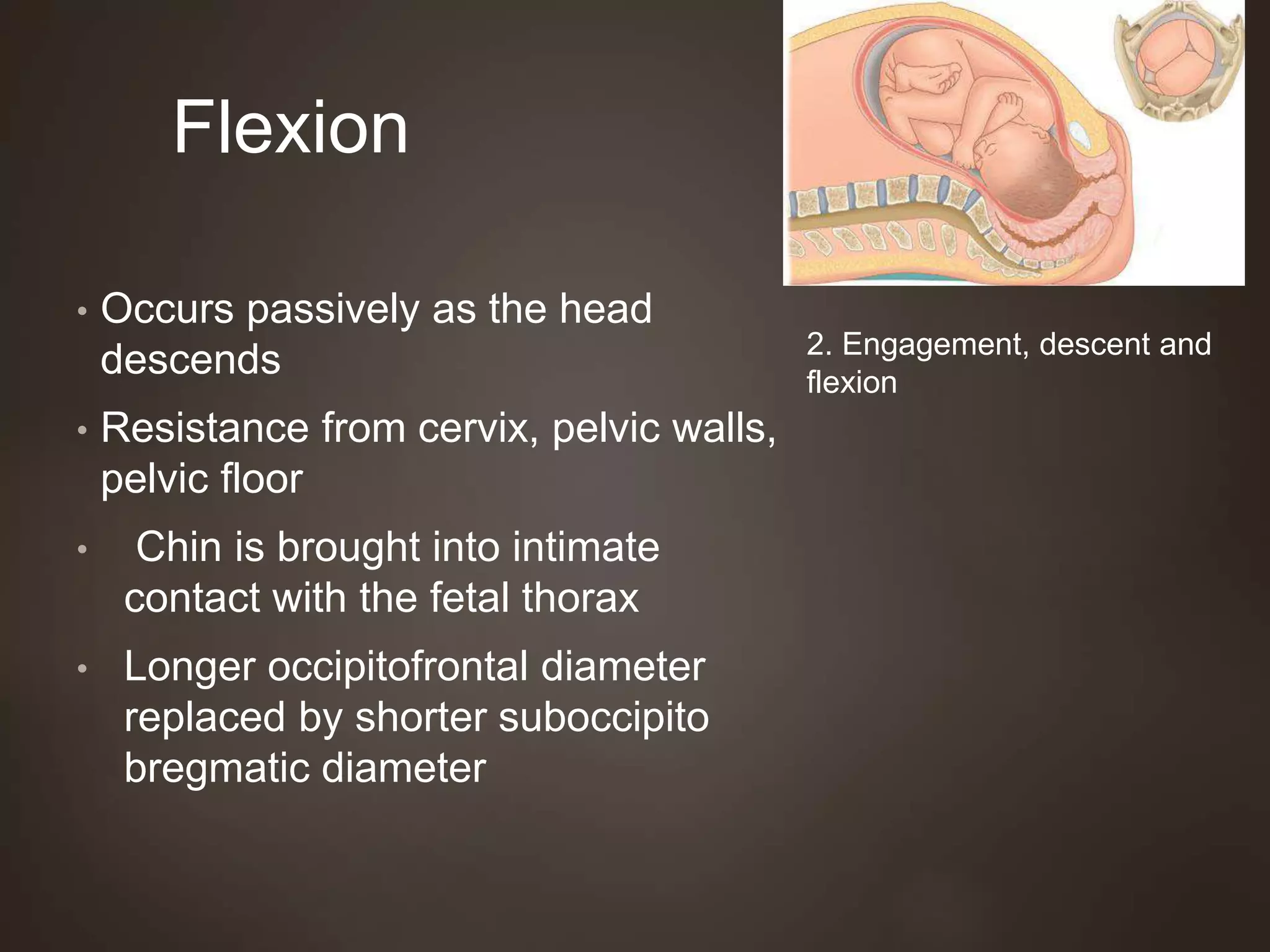
Flexion
• Occurs passively as the head
descends
• Resistance from cervix, pelvic walls,
pelvic floor
• Chin is brought into intimate
contact with the fetal thorax
• Longer occipitofrontal diameter
replaced by shorter suboccipito
bregmatic diameter
2. Engagement, descent and
flexion
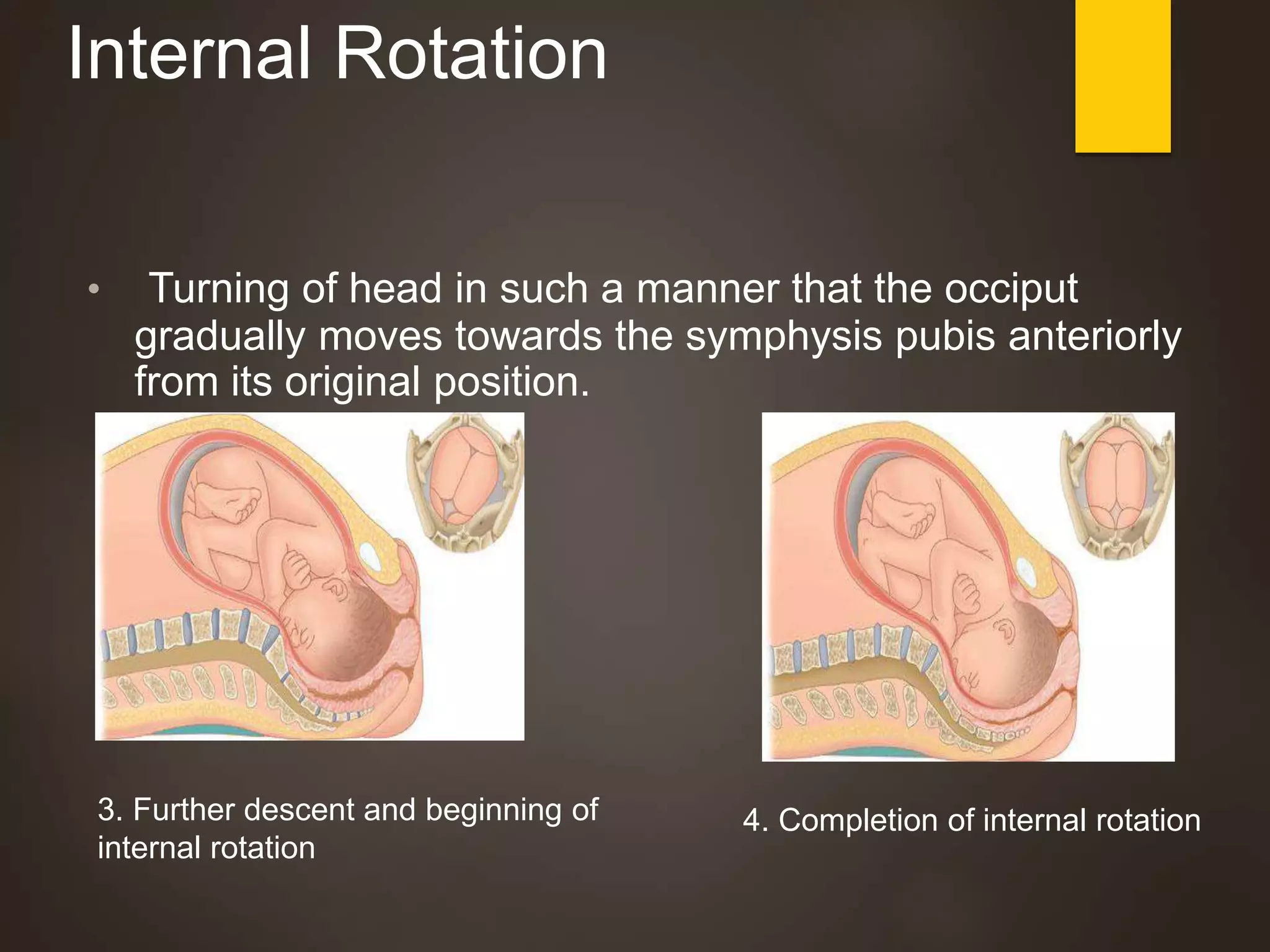
Internal Rotation
• Turning of head in such a manner that the occiput
gradually moves towards the symphysis pubis anteriorly
from its original position.
3. Further descent and beginning of
internal rotation
4. Completion of internal rotation
Extension
• The sharply flexed head reaches the vulva and
undergoes extension
• Driving force exerted by uterus
• Resistance offered by pelvic floor and symphysis
• Resultant vector: direction of vulvar opening causing
head extension
• Occiput in direct contact with the inferior margin of
symphysis pubis
External Rotation
•Movement of rotation of head visible externally due to the
internal rotation of the shoulders
•Anterior shoulder rotates towards symphysis pubis from
oblique diameter
•Occiput points directly toward maternal thigh
corresponding to the side to which it
originally directed at the time of engagement.
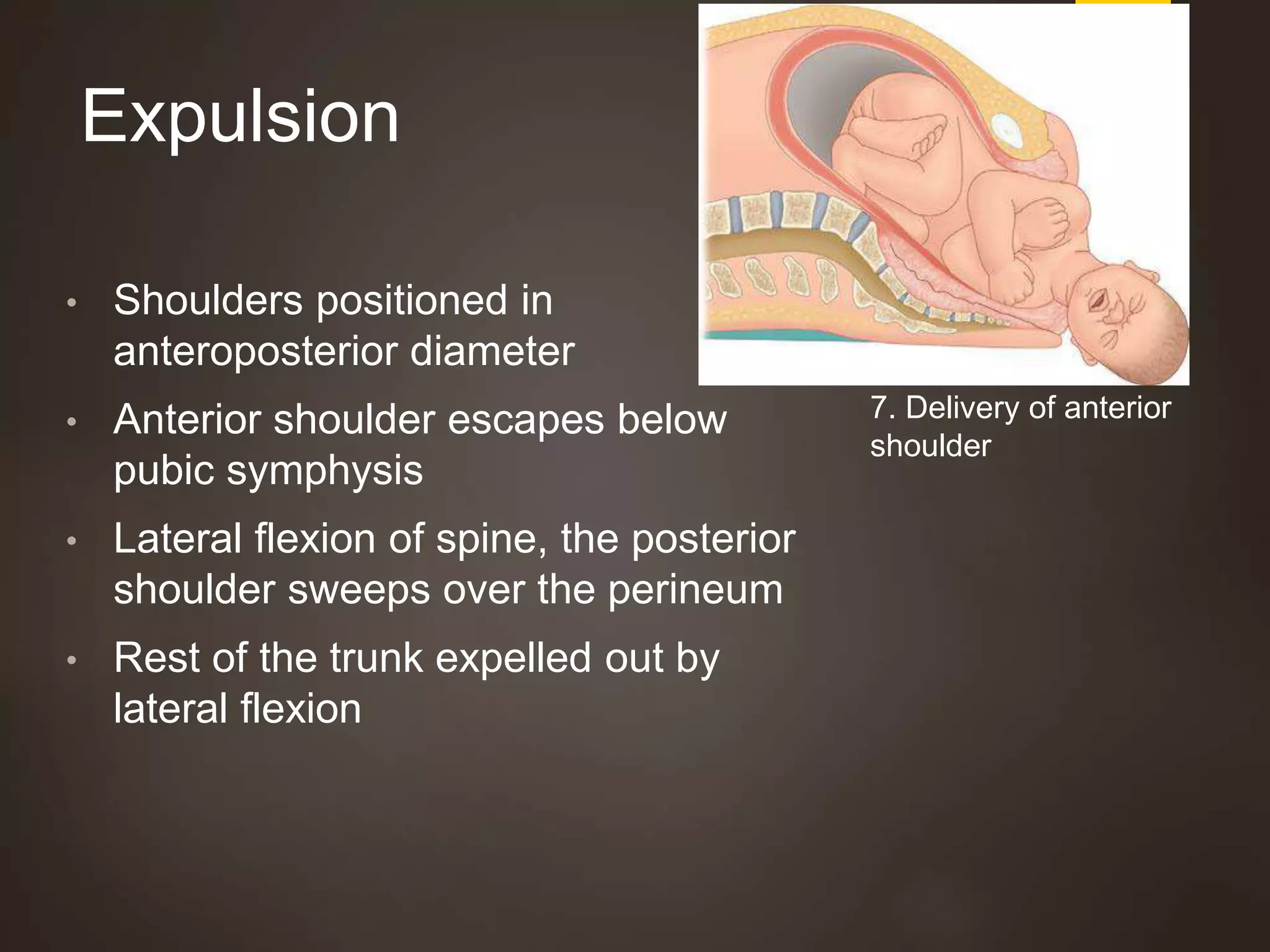
Expulsion
• Shoulders positioned in
anteroposterior diameter
• Anterior shoulder escapes below
pubic symphysis
• Lateral flexion of spine, the posterior
shoulder sweeps over the perineum
• Rest of the trunk expelled out by
lateral flexion
7. Delivery of anterior
shoulder
Reference
 Williams Obstetrics 24th edition
 D.C. Dutta, Textbook of Obstetrics, 9th Edition

Normal Labor in Obstetrics

  • 1.
  • 2.
    DEFINITION  A seriesof events that take place in female genital organs to expel the product of conception that are fetus, placenta, membranes) out of womb through the vagina into the outer world.  At the National Maternity Hospital in Dublin (O’Driscoll and colleagues, 1984). Criteria for onset of labor:  at term require painful uterine contractions accompanied by any one of the following: (1) ruptured membranes, (2) bloody “show,” or (3) complete cervical effacement.
  • 3.
    NORMAL LABOR/ EUTOCIA spontaneousin onset and at term  with vertex presentation  without undue prolongation  Natural termination without minimal aid  without having any complications affecting the health of the mother and/or the baby
  • 4.
    Causes of onsetof labour  Uterine distension  Fetoplacental contribution activation of fetal hypothalamic pituitary axis Increase CRT Increase ACTH Fetal adrenals Increase cortisol secretion Accelerated production of oestrogen and PG from the placenta
  • 5.
    Oestrogen  Increases releaseof oxytocin from maternal pituitary  Promotes synthesis of myometrial receptors for oxytocin, prostaglandin.  Stimulates synthesis of myometrial contraction protein  Increases excitability of myometrial cell Progesterone: Alteration of oestrogen and progesterone ratio is associated with PG synthesis.
  • 6.
    Prostaglandin  Major siteof production: Amnion,chorion, decidual cells and myometrium  Triggered by rise in estrogen, glucocorticoids, mechanical stretching in late pregnancy, separation or rupture of membrane  Enhances gap junction formation Oxytocin  Actions o Stimulate uterine contractions o Stimulate PG production from amnion/decidua
  • 7.
    TRUE AND FALSELABOR  True labor o Uterine contractions at regular intervals o Contraction frequency, intensity, duration increases gradually o Associated with show o Progressive effacement and dilatation of cervix o Descent of presenting part o Formation of “bags of water” o Not relieved by enema/ sedative  False labor o Dull pain confined to groin and abdomen o Pain interval doesn’t shorten o Pain intensity remains same o No cervical dilatation o No hardening of uterus o Relieved by enema or sedative
  • 9.
    Physiology of normallabour  Marked hypertrophy and hyperplasia of uterine muscles  Length of uterus + cervix = 35 cm at term  Uterus assumes pyriform/ ovoid shape  Cervical canal occluded by thick, tenacious mucus plug
  • 10.
    PATTERN OF CONTRACTION oGood synchronization of contraction waves from both halves of the uterus o Fundal dominance o Regular wave of contraction o Intra-amniotic pressure rises beyond 20mm Hg during uterine contraction o Good relaxation occurs in between contraction
  • 11.
    RETRACTION  Phenomenon ofuterus in labor in which muscle fibers are permanently shortened  Effects of retraction: o Formation of lower uterine segment and dilatation and effacement of cervix o Decent of presenting part  expulsion of fetus o Reduce surface area  separation of placenta o Effective homeostasis after separation of placenta
  • 12.
    STAGES OF LABOR First phase  Second phase  Propulsive  Expulsive  Third phase  Fourth phase
  • 13.
    FIRST STAGE  Concernedwith formation of birth canal  Main events: o Dilatation of cervix and effacement of cervix o Lower uterine segment formation
  • 14.
    FACTORS RESPONSIBLE IN DILATATION Uterine contraction and retraction
  • 15.
    FACTORS RESPONSIBLE IN DILATATION Fetal axis pressure longitudinal lie of fetus  circular muscles contraction Fundal contraction to transmit from podalic pole to head  Bag of membrane  Vis-a-tergo
  • 16.
    EFFACEMENT OF CERVIX Muscular fibers of cervix pulled upward and merge with fibers of lower uterine segment  Primigravidae: effacement before dilation of cervix  Multiparae: effacement and dilatation occur at same time
  • 17.
    Latent Phase  3to 5 cm of dilation  After that clinically active labor can be expected Prolonged latent phase:  > 20 hours in nullipara and 14 hours in multipara (Friedman and Sachtleben)  Following heavy sedation: 1. 85 percent to active labor 2. 10 percent uterine contraction ceased 3. 5 % persisted: require oxytocin stimulation
  • 18.
    Williams Obstetrics 24thedition page.: 446
  • 19.
    Active Phase  Cervicaldilation of 3 to 5 cm in presence of uterine contractions: threshold for active labor  Cervical dilatation: 1.2 to 6.8 cm/hour. Multiparas: minimum 1.5 cm/hr  Descent begins after 7 to 8 cm dilation, most rapid after 8 cm
  • 20.
    Williams Obstetrics 24thedition page.: 445
  • 21.
    SECOND STAGE OF LABOR Begins when cervical dilatation is complete and ends with fetal delivery.  Median duration  2 hr in primigravidae  30 minutes in multiparae  Uterine contractions and accompanying expulsive forces last:  60-90 seconds and  recur every 60 seconds
  • 22.
    Events  Propulsive phase: Period of full dilation until head touches pelvic floor  Expulsive phase:  Since the time mother has irresistible desire to ‘bear down’ and push until the baby is delivered
  • 23.
    THIRD STAGE OFLABOR  Includes separation, descent and expulsion of placenta with its membrane.
  • 24.
  • 25.
     Signs ofplacental separation:  The uterus becomes globular and as a rule, firm- woody  Sudden gush of blood  Uterus rises in abdomen because the placenta, having separated, passes down in the lower uterine segment and vagina.  Umbilical cord protrudes farther out of the vagina, indicating that the placenta has descended.
  • 26.
    FOURTH STAGE OFLABOR  The placenta, membranes and umbilical cord should be examined for completeness and for anomalies  Laceration of birth canal(vagina and perineum):  First degree laceration: Involved the perineal skin, vaginal mucus membrane but not underlying fascia and muscle  2nd degree laceration: Involve in addition, the fascia and muscle of perineal body but not anal sphincter  3rd degree laceration: Extent further to involve the anal sphincter  4th degree laceration: Laceration extend through the rectum’s mucosa to exposed its lumen
  • 27.
    MANAGEMENT OF FIRSTSTAGE LABOR 1. Rest and ambulation 2. Oral intake 3. Urinary bladder function  Bladder distention-avoided, because it can hinder descent of the fetal presenting parts 4. Pain relief 5. Monitoring fetal well-being during labor 6. Uterine contractions  to evaluate the frequency, duration, and intensity of uterine contractions.
  • 28.
    CONTD.. 8. Maternal vitalsigns  Maternal temperature, pulse, and blood pressure are evaluated at least every 4 hours  with prolonged membrane rupture(>18 hours) antimicrobial administration for prevention of group B streptococcal infections is recommended 9. Subsequent vaginal examinations 10.Maternal position  position that she finds most comfortable, which will be lateral recumbency most of the time
  • 29.
    Management of secondstage labor Assist in natural expulsion of fetus slowly and steadily Prevent perineal injuries 1. Preparation for delivery • Put the patient in dorsal lithotomy position or lying flat on bed • Clean the vulva, and perineum with antiseptic solution • Clean hands, Clean surface, Clean cutting and ligaturing of the cord • Catheterize the bladder, if full
  • 30.
     2. Conductionof delivery  Delivery of head: • Maintain flexion of the head • Prevent early extension • Regulate the escape out of vulval outlet
  • 31.
    • Patient askedfor bearing down efforts during uterine contractions • When the scalp is visible for about 5cm in diameter, push occiput downward and backwards using thumb and index fingers while pressing the perineum by right hand with sterile vulval pad • BPD stretches the vulval outlet without any recession of the head even after the contraction is over
  • 32.
    • With eachcontraction, perineum bulge increasing • Slow delivery of the head in between the contractions • Ritgen maneuver: • A towel-draped ,gloved hand –used to exert forward pressure on the chin of fetus through the perineum • This maneuver allow delivery of head and also favors the neck extension so that head is delivered with small diameter
  • 34.
    Management of thirdstage labor  Expectant management • Placental separation and its descent into the vagina are allowed to occur spontaneously • Constant watch • Changed to dorsal position • Hand placed over the fundus (signs of separation, state of uterine activity, detect inversion of uterus) • Expulsion of placenta • Patient asked to bear down • Placenta grasped by hands and twisted round and round with gentle traction
  • 35.
    • Assisted expulsion 1.Controlled Cord Traction 2.Fundal Pressure
  • 36.
    • Examination of placenta •Maternal surface: completeness, anomalies • Membranes: completeness, abnormal vessels • Cord: number of vessels
  • 37.
     Active management •To excite powerful uterine contractions within one minute of delivery of the baby by giving parenteral oxytocic • Injection Oxytocin 10 units IM • Controlled Cord Traction • Massaging the uterus • To minimise blood loss in third stage to approx 1/5th • To shorten the duration of third stage to half • Disadvantage: increased incidence of retained placenta and consequent increased incidence of manual removal • Not to be used in cardiac failure, severe pre-eclampsia
  • 39.
    Management of fourthstage labor • Suture the episiotomy or any laceration • Estimate blood loss, take cord blood for Hb, blood group, Rh, bilirubin, and Coomb’s test for Rh negative mother • Check BP, Pulse, Temperature, abnormal vaginal bleeding and firmness of the uterus before transferring the patient
  • 40.
    Cardinal Movements of Labor 1.Engagement 2. Descent 3. Flexion 4. Internal rotation 5. Extension 6. External rotation 7. Expulsion
  • 41.
    Engagement • The mechanismby which the Biparietal Diameter- the greatest transverse diameter in occiput presentation crosses the pelvic inlet. • Fetal head enters the pelvic inlet either transversely or obliquely. 1. Head floating before engagement 2. Engagement, descent and flexion
  • 42.
     Asynclitism  Thelateral deflection of the sagital suture anteriorly toward pubic symphysis or posteriorly towards sacral promontory.  Anterior asynclitism:  Sagital suture approaches sacral promontory  Anterior parietal presentation  Posterior asynclitism:  Sagital suture approaches pubic symphysis  Posterior parietal presentation
  • 43.
    Descent • Downward passageof the presenting part through the pelvis • Forces involved:-  Pressure of amniotic fluid  Pressure of fundus upon breech with contraction  Bearing down efforts of maternal abdominal muscles  Extension and straightening of fetal body
  • 44.
    Flexion • Occurs passivelyas the head descends • Resistance from cervix, pelvic walls, pelvic floor • Chin is brought into intimate contact with the fetal thorax • Longer occipitofrontal diameter replaced by shorter suboccipito bregmatic diameter 2. Engagement, descent and flexion
  • 45.
    Internal Rotation • Turningof head in such a manner that the occiput gradually moves towards the symphysis pubis anteriorly from its original position. 3. Further descent and beginning of internal rotation 4. Completion of internal rotation
  • 46.
    Extension • The sharplyflexed head reaches the vulva and undergoes extension • Driving force exerted by uterus • Resistance offered by pelvic floor and symphysis • Resultant vector: direction of vulvar opening causing head extension • Occiput in direct contact with the inferior margin of symphysis pubis
  • 47.
    External Rotation •Movement ofrotation of head visible externally due to the internal rotation of the shoulders •Anterior shoulder rotates towards symphysis pubis from oblique diameter •Occiput points directly toward maternal thigh corresponding to the side to which it originally directed at the time of engagement.
  • 48.
    Expulsion • Shoulders positionedin anteroposterior diameter • Anterior shoulder escapes below pubic symphysis • Lateral flexion of spine, the posterior shoulder sweeps over the perineum • Rest of the trunk expelled out by lateral flexion 7. Delivery of anterior shoulder
  • 49.
    Reference  Williams Obstetrics24th edition  D.C. Dutta, Textbook of Obstetrics, 9th Edition

Editor's Notes

  • #4 ABNORMAL LABOR/ DYSTOCIA: DEVIATION FROM NORMAL LABOR
  • #8 Bags of water: detached membrane with liquor that presents below the presenting part; almost certain sign of labor False pain/ suurious labor is usual in primimother, 1-2 weeks prior to labor, may be due to stretching of cervix or lower uterine segment Prelabor: lightening (good sign:presenting part sinks to true pelvis) + false pain + ripening of cervix (soft, 80%effaced, dilatable)
  • #15 Normal polarity of uterus: contraction starts from the fallopian tube  fundus contracts more than lower segment  when fundus contracts to push fetus, lower segment and cervix dialate in response to force Bag of membrane:—The membranes (amnion and chorion) are attached loosely to the decidua lining the uterine cavity except over the internal os. In vertex presentation, the girdle of contact of the head (that part of the circumference of the head which first comes in contact with the pelvic brim) being spherical, may well fit with the wall of the lower uterine segment. Thus, the amniotic cavity is divided into two compartments (Fig. 12.5). The part above the girdle of contact contains the fetus with bulk of the liquor called hindwaters and the one below it containing small amount of liquor called forewaters. With the onset of labor, the membranes attached to the lower uterine segment are detached and with the rise of intrauterine pressure during contractions there is herniation of the membranes through the cervical canal. There is ball-valve like action by the well flexed head. Uterine contractions generate hydrostatic pressure in the forewaters that in turn dilate the cervical canal like a wedge. When the bag of forewater is absent (PROM) the pressure of the presenting part pushes the cervix centrifugally Vis- a-tergo: The final phase of dilatation and retraction of the cervix is achieved by downward thrust of the presenting part of the fetus and upward pull of the cervix over the lower segment. This phenomenon is lacking in transverse lie where a thin cervical rim fails to disappear.
  • #27 First degree laceration: Involved the perineal skin, vaginal mucus membrane but not underlying fascia and muscle 2nd degree laceration: Involve in addition, the fascia and muscle of perineal body but not anal sphincter 3rd degree laceration: Extent further to involve the anal sphincter 4th degree laceration: Laceration extend through the rectum’s mucosa to exposed its lumen
  • #30 The Ritgen maneuver is an obstetric procedure used by midwives and doctors in order to control the delivery of the fetal head. It involves applying an upward pressure from the coccygeal region to extend the head during actual delivery, thereby protecting the musculature of theperineum.