NORMAL LABOR
BY:
NAYYARA UROOJ.K
FINAL YEAR,GUMC.
Series of events that take place in the genital organs in an effort to expel
the viable products of conception (fetus, placenta& the membranes) out
of the womb through the vagina into the outer world is called ‘ labor ’.
LABOR
DELIVERY
Delivery is the expulsion Or extraction of viable Fetus out of the
Womb. Delivery can take place without Labor as in elective cesarian
section.
NORMAL LABOR
[EUTOCIA]
Labor is called normal if it fullfils the following criteria;
• Spontaneous in onset and at term
• With vertex presentation
• Without undue prolongation
• Natural termination with minimal aids
• Without having any complications affecting the health of
mother and/ Or the baby.
ABNORMAL LABOR
(DYSTOCIA)
Any deviation from the definition of
normal labor is called
Abnormal labor.
Eg:Breech presentation
CAUSE OF ONSET OF
LABOR
The precise mechanism of initiation of human labor is
still obscure.
However following hypothesis have been put forth;
Uterine distension
Fetoplacental contribution
Estrogen theory
Progesterone theory
Prostaglandins theory
PRELABOR
The premonitory stage may begin 2–3 weeks before the
onset of true labor in primigravidae and a few days before in multiparae.
The features are inconsistent and may consist of the following:
• Lightening (welcome sign)
• Appearance of false pain
• Cervical changes
“Ripe cervix ”Includes:
• Soft
• 80℅effaced
• Admit one finger easily
• Cervical canal is dilatable
TRUE LABOR PAIN FALSE LABOR PAIN
TRUE LABOR PAIN IS
CHARACTERIZED BY;
1. Painful uterine contractions at regular intervals.
1. Frequency of contractions increases gradually.
2. Intensity & duration of contraction increases
progressively.
3. Associated with “show”.
4. Progressive Effacement & dilatation of cervix.
5. Descent of presenting part.
6. Formation of “bag of forewater”.
7. Not relieved by enema Or sedatives.
SHOW:-
Expulsion of cervical mucus plug mixed with blood is called “show”.
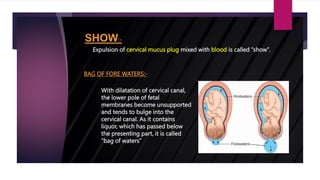
BAG OF FORE WATERS:-
With dilatation of cervical canal,
the lower pole of fetal
membranes become unsupported
and tends to bulge into the
cervical canal. As it contains
liquor, which has passed below
the presenting part, it is called
“bag of waters”
CERTAIN TERMINOLOGIES IN PHYSIOLOGY OF NORMAL LABOR
TONUS:-
It is the intrauterine pressure in between contractions.
• During pregnancy, Tonus=2-3mmhg.
• During1st stage of labor=8-10mm Hg
INTENSITY:-
It describes the degree of uterine systole.
• During1st stage of labor, IUP= 40-50mm Hg.
• During 2nd stage of labor, IUP= 100-120mm Hg
DURATION:-
• During 1st stage, contraction last for about 30 seconds.
• In 2nd stage, it last longer than 1st stage.
FREQUENCY:-
In early stage, contractions come at interval of 10-15minutes.
• The interval gradually shortens.
In 2nd stage, it comes every 2-3minutes.
RETRACTION:-
It is a phenomenon of the uterus in labor in which the muscle fibers
are Permanently Shortened.
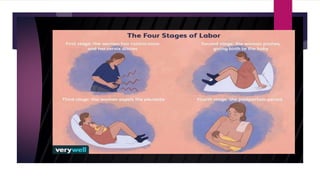
STAGES OF LABOR
Conventionally, events of labor are divided into three stages;
1st STAGE:-
Time from the onset of labor Until complete
cervical dilatation.
2nd STAGE:-
Time from complete cervical dilatation of
uterus to expulsion Of fetus.
3rd STAGE:-
Time from expulsion of fetus to expulsion of
placenta.
4TH STAGE:-
The first postpartum hour.
EVENTS IN
1ST STAGE
OF LABOR
EVENTS IN
2ND STAGE
OF LABOR
EVENTS IN
3RD STAGE
OF LABOR
Chiefly concerned with the
preparation of birth canal so
as to facilitate the expulsion of
fetus in the 2nd stage.
The main events that occur
are:
• Dilatation & effacement of
cervix
• Full formation of lower
uterine segment
This stage is concerned with
the descent and delivery of fetus.
This stage has two phases:-
• Propulsive phase
• Expulsive phase
The third stage of Labor com
the phase of placental separa
its descent to the lower segm
& finally its membrane expuls
There are two ways of expu
placenta:-
• Central separation (Schultz
• Marginal separation.
(Mathews- duncan )
MECHANISM
OF
LABOR
DEFINITION:-
• “The series of movements that occur on the head in the process adaptation during its
journey through the pelvis is called mechanism of labor”.
• Mechanism: In normal labor, head enters Brim more commonly through Available
• TRANSVERSE DIAMETER- 70% & Less commonly through any of oblique diameters.
• Position:occipitolateral Or oblique occipitoanterior (LOA More common than ROA)
• The engaging Anterio-posterior diameter of head is either;
• Suboccipitobregmatic = 9.5cm • Suboccipitofrontal = 10cm
• The engaging transverse diameter is:
• Biparietal = 9.5cm
LIE, PRESENTATION, ATTITUDE & POSITION
FETAL LIE:-
• The relation of long axis Of fetus
to that of mother.
• The most common lie to occur is;
• Longitudinal lie – 99.5%
• Transverse Or oblique lie = 0.5%
FETAL PRESENTATION:-
Part of the fetus which occupies the lower pole of uterus (pelvic brim).
• Cephalic (head) (96.5%)
• Breech/podal ( feet) 3%).
• Shoulder (0.5%)
PRESENTING PART:-
Part of the presentation which overlies the
Internal OS & felt by examining finger through
cervical opening.
1) CEPHALIC:-
• Vertex(96%)
• Brow and face (3%)
2) BREECH:-
• Complete
• Flank
• Footlin
FETAL ATTITUDE:-
• Relation of different parts of fetus to one another.
• Universal attitude - FLEXION
DENOMINATOR:-
• Arbitrary bony fixed point On presenting part, comes in relation with Various
quadrant of maternal pelvis.
• VERTEX- OCCIPUT
• BROW- FRONTAL EMINENCE
• BREECH- SACRUM
• SHOULDER- ACROMIAN
FETAL POSITION:-
• Relation of denominator to different quadrant of pelvis.
• Pelvis is divided into equal of 8 positions.
• ANTERIOR OR POSTERIOR OR OBLIQUE - LEFT OR RIGHT.
• First- LOA( Most common)
• Second - ROA
• Third- ROP
• Fourth- LOP
• The mechanism of labour covers the passive movement the fetus
undergoes in order to negotiate through the maternal bony pelvis.
• The mechanism of labor can be broken down conventionally
Into few Cardinal Movements which are now discussed Briefly!
MECHANISM
1) Engagement
2) Descent
3) Flexion
4) Internal rotation
5) Crowning
6) Extension
7) Restitution
8) External Rotation &
9) Birth of shoulders & trunk.
Although the Movements are described separately but in reality, the Movements
atleast some, may be going on simultaneously.
THE CARDINAL MOVEMENTS ARE:
1. ENGAGEMENT:-
The greatest transverse diameter,
Biparietal diameter(BPD) passes
through the pelvic inlet.
• In primigravidae, this occurs before
the onset of labor.
• In multiparae, the same may occur
in late first stage of labor.
2) DESCENT:-
Descent is a continuous process & it is completed by expulsion of the fetus.
• In 1st stage , it is slow Or insignificant.
• In 2nd stage, it is pronounced.
Factors facilitating descent are :-
• UTERINE CONTRACTION & RETRACTION
• BEARING DOWN EFFORTS
• STRAGIHTENING OF THE OVOID FETUS
3) FLEXION:-
• When the descending head meets the resistance of the birth canal, it is considered to
achieve full flexion.
• Flexion is essential for descent,
since it reduces the advancing
diameter of the head.
• As the head flexed, it brings the shortest longitudinal diameter of the head to pass
through the birth canal. (Sub-occipito – bregmatic = 9.5cm)
4) INTERNAL ROTATION:-
• It is a Movement of great importance without
which there will be no further descent.
• The occiput leads and meets the pelvic floor
first and rotates anteriorly 2/8 of the circle.
• In majority of cases, rotation Occur at the
pelvic floor.
5) CROWNING:-
• After internal rotation Of the head, further
descent occurs until the subocciput lies
underneath the pubic arch.
• At this stage, the maximum diameter of
the head Stretches the vulval outlet & is
called “CROWNING OF HEAD”.
• This is clinically evident when the head visible at the vulva, no
longer retreats between contractions.
6) EXTENSION:-
• The occiput slips beneath the suprapubic
arch allowing the head to extend.
• The fetal head is now born and will be
facing the maternal back with its occiput
anterior.
7)RESTITUTION:-
• It is the visible passive Movement of the
head due to untwisting of the neck
sustained during internal rotation.
• Occiput lies to maternal thigh
corresponding to original lay.
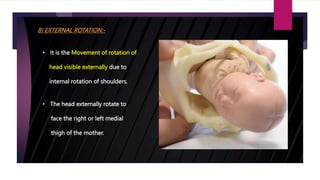
8) EXTERNAL ROTATION:-
• It is the Movement of rotation of
head visible externally due to
internal rotation of shoulders.
• The head externally rotate to
face the right or left medial
thigh of the mother.
9) BIRTH OF SHOULDERS & TRUNK:-
• After shoulder in AP Diameter – further
descent – Anterior shoulder escapes below
Symphysis pubic first.
• Lateral flexion of spine –posterior shoulder
sweeps over perineum.
• Lateral flexion – Rest of the trunk expelled out.
THANK
YOU!

Normal labor (1).pptx

  • 1.
  • 2.
    Series of eventsthat take place in the genital organs in an effort to expel the viable products of conception (fetus, placenta& the membranes) out of the womb through the vagina into the outer world is called ‘ labor ’. LABOR DELIVERY Delivery is the expulsion Or extraction of viable Fetus out of the Womb. Delivery can take place without Labor as in elective cesarian section.
  • 4.
    NORMAL LABOR [EUTOCIA] Labor iscalled normal if it fullfils the following criteria; • Spontaneous in onset and at term • With vertex presentation • Without undue prolongation • Natural termination with minimal aids • Without having any complications affecting the health of mother and/ Or the baby.
  • 5.
    ABNORMAL LABOR (DYSTOCIA) Any deviationfrom the definition of normal labor is called Abnormal labor. Eg:Breech presentation
  • 6.
    CAUSE OF ONSETOF LABOR The precise mechanism of initiation of human labor is still obscure. However following hypothesis have been put forth; Uterine distension Fetoplacental contribution Estrogen theory Progesterone theory Prostaglandins theory
  • 7.
    PRELABOR The premonitory stagemay begin 2–3 weeks before the onset of true labor in primigravidae and a few days before in multiparae. The features are inconsistent and may consist of the following: • Lightening (welcome sign) • Appearance of false pain • Cervical changes “Ripe cervix ”Includes: • Soft • 80℅effaced • Admit one finger easily • Cervical canal is dilatable
  • 8.
    TRUE LABOR PAINFALSE LABOR PAIN
  • 9.
    TRUE LABOR PAINIS CHARACTERIZED BY; 1. Painful uterine contractions at regular intervals. 1. Frequency of contractions increases gradually. 2. Intensity & duration of contraction increases progressively. 3. Associated with “show”. 4. Progressive Effacement & dilatation of cervix. 5. Descent of presenting part. 6. Formation of “bag of forewater”. 7. Not relieved by enema Or sedatives.
  • 10.
    SHOW:- Expulsion of cervicalmucus plug mixed with blood is called “show”. BAG OF FORE WATERS:- With dilatation of cervical canal, the lower pole of fetal membranes become unsupported and tends to bulge into the cervical canal. As it contains liquor, which has passed below the presenting part, it is called “bag of waters”
  • 11.
    CERTAIN TERMINOLOGIES INPHYSIOLOGY OF NORMAL LABOR TONUS:- It is the intrauterine pressure in between contractions. • During pregnancy, Tonus=2-3mmhg. • During1st stage of labor=8-10mm Hg INTENSITY:- It describes the degree of uterine systole. • During1st stage of labor, IUP= 40-50mm Hg. • During 2nd stage of labor, IUP= 100-120mm Hg
  • 12.
    DURATION:- • During 1ststage, contraction last for about 30 seconds. • In 2nd stage, it last longer than 1st stage. FREQUENCY:- In early stage, contractions come at interval of 10-15minutes. • The interval gradually shortens. In 2nd stage, it comes every 2-3minutes. RETRACTION:- It is a phenomenon of the uterus in labor in which the muscle fibers are Permanently Shortened.
  • 13.
    STAGES OF LABOR Conventionally,events of labor are divided into three stages; 1st STAGE:- Time from the onset of labor Until complete cervical dilatation. 2nd STAGE:- Time from complete cervical dilatation of uterus to expulsion Of fetus. 3rd STAGE:- Time from expulsion of fetus to expulsion of placenta. 4TH STAGE:- The first postpartum hour.
  • 15.
    EVENTS IN 1ST STAGE OFLABOR EVENTS IN 2ND STAGE OF LABOR EVENTS IN 3RD STAGE OF LABOR Chiefly concerned with the preparation of birth canal so as to facilitate the expulsion of fetus in the 2nd stage. The main events that occur are: • Dilatation & effacement of cervix • Full formation of lower uterine segment This stage is concerned with the descent and delivery of fetus. This stage has two phases:- • Propulsive phase • Expulsive phase The third stage of Labor com the phase of placental separa its descent to the lower segm & finally its membrane expuls There are two ways of expu placenta:- • Central separation (Schultz • Marginal separation. (Mathews- duncan )
  • 19.
  • 20.
    DEFINITION:- • “The seriesof movements that occur on the head in the process adaptation during its journey through the pelvis is called mechanism of labor”. • Mechanism: In normal labor, head enters Brim more commonly through Available • TRANSVERSE DIAMETER- 70% & Less commonly through any of oblique diameters. • Position:occipitolateral Or oblique occipitoanterior (LOA More common than ROA) • The engaging Anterio-posterior diameter of head is either; • Suboccipitobregmatic = 9.5cm • Suboccipitofrontal = 10cm • The engaging transverse diameter is: • Biparietal = 9.5cm
  • 21.
    LIE, PRESENTATION, ATTITUDE& POSITION FETAL LIE:- • The relation of long axis Of fetus to that of mother. • The most common lie to occur is; • Longitudinal lie – 99.5% • Transverse Or oblique lie = 0.5%
  • 22.
    FETAL PRESENTATION:- Part ofthe fetus which occupies the lower pole of uterus (pelvic brim). • Cephalic (head) (96.5%) • Breech/podal ( feet) 3%). • Shoulder (0.5%)
  • 23.
    PRESENTING PART:- Part ofthe presentation which overlies the Internal OS & felt by examining finger through cervical opening. 1) CEPHALIC:- • Vertex(96%) • Brow and face (3%) 2) BREECH:- • Complete • Flank • Footlin
  • 24.
    FETAL ATTITUDE:- • Relationof different parts of fetus to one another. • Universal attitude - FLEXION
  • 25.
    DENOMINATOR:- • Arbitrary bonyfixed point On presenting part, comes in relation with Various quadrant of maternal pelvis. • VERTEX- OCCIPUT • BROW- FRONTAL EMINENCE • BREECH- SACRUM • SHOULDER- ACROMIAN
  • 26.
    FETAL POSITION:- • Relationof denominator to different quadrant of pelvis. • Pelvis is divided into equal of 8 positions. • ANTERIOR OR POSTERIOR OR OBLIQUE - LEFT OR RIGHT. • First- LOA( Most common) • Second - ROA • Third- ROP • Fourth- LOP
  • 27.
    • The mechanismof labour covers the passive movement the fetus undergoes in order to negotiate through the maternal bony pelvis. • The mechanism of labor can be broken down conventionally Into few Cardinal Movements which are now discussed Briefly! MECHANISM
  • 28.
    1) Engagement 2) Descent 3)Flexion 4) Internal rotation 5) Crowning 6) Extension 7) Restitution 8) External Rotation & 9) Birth of shoulders & trunk. Although the Movements are described separately but in reality, the Movements atleast some, may be going on simultaneously. THE CARDINAL MOVEMENTS ARE:
  • 29.
    1. ENGAGEMENT:- The greatesttransverse diameter, Biparietal diameter(BPD) passes through the pelvic inlet. • In primigravidae, this occurs before the onset of labor. • In multiparae, the same may occur in late first stage of labor.
  • 30.
    2) DESCENT:- Descent isa continuous process & it is completed by expulsion of the fetus. • In 1st stage , it is slow Or insignificant. • In 2nd stage, it is pronounced. Factors facilitating descent are :- • UTERINE CONTRACTION & RETRACTION • BEARING DOWN EFFORTS • STRAGIHTENING OF THE OVOID FETUS
  • 31.
    3) FLEXION:- • Whenthe descending head meets the resistance of the birth canal, it is considered to achieve full flexion. • Flexion is essential for descent, since it reduces the advancing diameter of the head. • As the head flexed, it brings the shortest longitudinal diameter of the head to pass through the birth canal. (Sub-occipito – bregmatic = 9.5cm)
  • 32.
    4) INTERNAL ROTATION:- •It is a Movement of great importance without which there will be no further descent. • The occiput leads and meets the pelvic floor first and rotates anteriorly 2/8 of the circle. • In majority of cases, rotation Occur at the pelvic floor.
  • 33.
    5) CROWNING:- • Afterinternal rotation Of the head, further descent occurs until the subocciput lies underneath the pubic arch. • At this stage, the maximum diameter of the head Stretches the vulval outlet & is called “CROWNING OF HEAD”. • This is clinically evident when the head visible at the vulva, no longer retreats between contractions.
  • 34.
    6) EXTENSION:- • Theocciput slips beneath the suprapubic arch allowing the head to extend. • The fetal head is now born and will be facing the maternal back with its occiput anterior.
  • 35.
    7)RESTITUTION:- • It isthe visible passive Movement of the head due to untwisting of the neck sustained during internal rotation. • Occiput lies to maternal thigh corresponding to original lay.
  • 36.
    8) EXTERNAL ROTATION:- •It is the Movement of rotation of head visible externally due to internal rotation of shoulders. • The head externally rotate to face the right or left medial thigh of the mother.
  • 37.
    9) BIRTH OFSHOULDERS & TRUNK:- • After shoulder in AP Diameter – further descent – Anterior shoulder escapes below Symphysis pubic first. • Lateral flexion of spine –posterior shoulder sweeps over perineum. • Lateral flexion – Rest of the trunk expelled out.
  • 40.