
THROUGH ONE EXAMPLE………….
MADE BY:-
MAYANK
MULCHANDANI
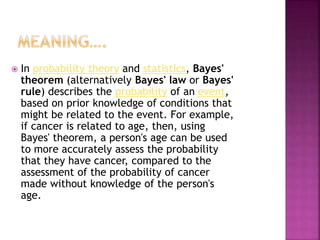
 In probability theory and statistics, Bayes'
theorem (alternatively Bayes' law or Bayes'
rule) describes the probability of an event,
based on prior knowledge of conditions that
might be related to the event. For example,
if cancer is related to age, then, using
Bayes' theorem, a person's age can be used
to more accurately assess the probability
that they have cancer, compared to the
assessment of the probability of cancer
made without knowledge of the person's
age.
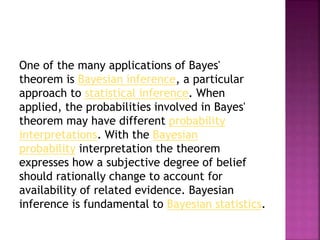
One of the many applications of Bayes'
theorem is Bayesian inference, a particular
approach to statistical inference. When
applied, the probabilities involved in Bayes'
theorem may have different probability
interpretations. With the Bayesian
probability interpretation the theorem
expresses how a subjective degree of belief
should rationally change to account for
availability of related evidence. Bayesian
inference is fundamental to Bayesian statistics.
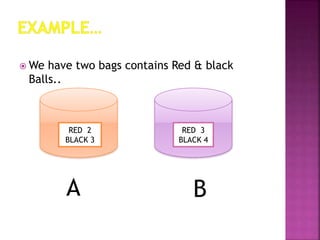
 We have two bags contains Red & black
Balls..
A B
RED 2
BLACK 3
A
RED 3
BLACK 4
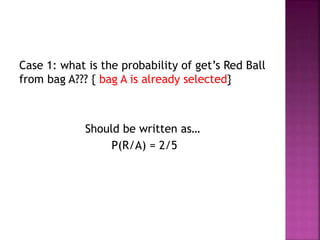
Case 1: what is the probability of get’s Red Ball
from bag A??? { bag A is already selected}
Should be written as…
P(R/A) = 2/5
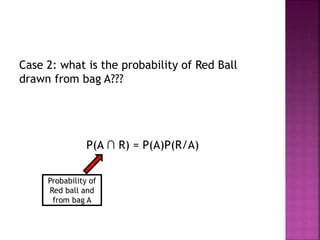
Case 2: what is the probability of Red Ball
drawn from bag A???
P(A ∩ R) = P(A)P(R/A)
Probability of
Red ball and
from bag A
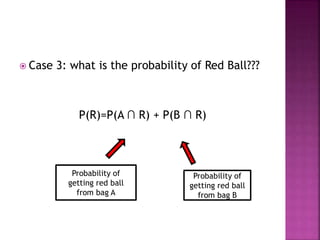
 Case 3: what is the probability of Red Ball???
P(R)=P(A ∩ R) + P(B ∩ R)
Probability of
getting red ball
from bag A
Probability of
getting red ball
from bag B
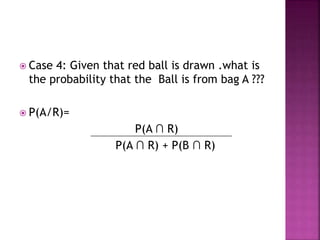
 Case 4: Given that red ball is drawn .what is
the probability that the Ball is from bag A ???
 P(A/R)=
P(A ∩ R)
P(A ∩ R) + P(B ∩ R)
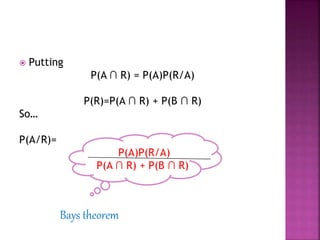
 Putting
P(A ∩ R) = P(A)P(R/A)
P(R)=P(A ∩ R) + P(B ∩ R)
So…
P(A/R)=
P(A)P(R/A)
P(A ∩ R) + P(B ∩ R)
Bays theorem
Made by:-
MAYANK MULCHANDANI

Bays theorem of probability

  • 1.
  • 2.
     In probabilitytheory and statistics, Bayes' theorem (alternatively Bayes' law or Bayes' rule) describes the probability of an event, based on prior knowledge of conditions that might be related to the event. For example, if cancer is related to age, then, using Bayes' theorem, a person's age can be used to more accurately assess the probability that they have cancer, compared to the assessment of the probability of cancer made without knowledge of the person's age.
  • 3.
    One of themany applications of Bayes' theorem is Bayesian inference, a particular approach to statistical inference. When applied, the probabilities involved in Bayes' theorem may have different probability interpretations. With the Bayesian probability interpretation the theorem expresses how a subjective degree of belief should rationally change to account for availability of related evidence. Bayesian inference is fundamental to Bayesian statistics.
  • 4.
     We havetwo bags contains Red & black Balls.. A B RED 2 BLACK 3 A RED 3 BLACK 4
  • 5.
    Case 1: whatis the probability of get’s Red Ball from bag A??? { bag A is already selected} Should be written as… P(R/A) = 2/5
  • 6.
    Case 2: whatis the probability of Red Ball drawn from bag A??? P(A ∩ R) = P(A)P(R/A) Probability of Red ball and from bag A
  • 7.
     Case 3:what is the probability of Red Ball??? P(R)=P(A ∩ R) + P(B ∩ R) Probability of getting red ball from bag A Probability of getting red ball from bag B
  • 8.
     Case 4:Given that red ball is drawn .what is the probability that the Ball is from bag A ???  P(A/R)= P(A ∩ R) P(A ∩ R) + P(B ∩ R)
  • 9.
     Putting P(A ∩R) = P(A)P(R/A) P(R)=P(A ∩ R) + P(B ∩ R) So… P(A/R)= P(A)P(R/A) P(A ∩ R) + P(B ∩ R) Bays theorem
  • 10.