Automatic
Tagging Using
Deep
Convolutional
Neural
Networks
Keunwoo.Choi
@qmul.ac.uk
Problem
definition
The proposed
architectures
Experiments
Automatic Tagging Using
Deep Convolutional Neural Networks
Keunwoo.Choi
@qmul.ac.uk
Centre for Digital Music, Queen Mary University of London, UK
Ɓ
@keunwoochoi
11 Aug 2016, ISMIR 2016, NY
1/19
Automatic
Tagging Using
Deep
Convolutional
Neural
Networks
Keunwoo.Choi
@qmul.ac.uk
Problem
definition
The proposed
architectures
Experiments
1 Problem definition
What is auto-tagging?
2 The proposed architectures
But why?
3 Experiments
MagnaTagATune
MSD: Reported (and incorrect) results
MSD: Correct results
Conclusions
2/19
Automatic
Tagging Using
Deep
Convolutional
Neural
Networks
Keunwoo.Choi
@qmul.ac.uk
Problem
definition
What is
auto-tagging?
The proposed
architectures
Experiments
Problem definition
What is auto-tagging?
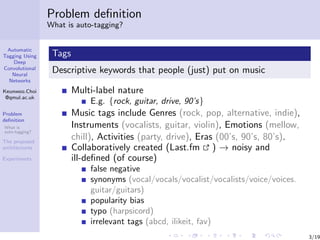
Tags
Descriptive keywords that people (just) put on music
Multi-label nature
E.g. {rock, guitar, drive, 90’s}
Music tags include Genres (rock, pop, alternative, indie),
Instruments (vocalists, guitar, violin), Emotions (mellow,
chill), Activities (party, drive), Eras (00’s, 90’s, 80’s).
Collaboratively created (Last.fm ) → noisy and
ill-defined (of course)
false negative
synonyms (vocal/vocals/vocalist/vocalists/voice/voices.
guitar/guitars)
popularity bias
typo (harpsicord)
irrelevant tags (abcd, ilikeit, fav)
3/19
Automatic
Tagging Using
Deep
Convolutional
Neural
Networks
Keunwoo.Choi
@qmul.ac.uk
Problem
definition
What is
auto-tagging?
The proposed
architectures
Experiments
Problem definition
What is auto-tagging?
Multi-label classification
Criteria: AUC-ROC (Area Under an ROC Curve)
0.5 <= AUC-ROC <= 1.0
Robust to unbalanced datasets
Higher if lower false positive rate
Higher if higher true positive rate
4/19
Automatic
Tagging Using
Deep
Convolutional
Neural
Networks
Keunwoo.Choi
@qmul.ac.uk
Problem
definition
The proposed
architectures
But why?
Experiments
The proposed architectures
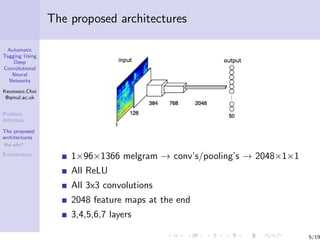
1×96×1366 melgram → conv’s/pooling’s → 2048×1×1
All ReLU
All 3x3 convolutions
2048 feature maps at the end
3,4,5,6,7 layers
5/19
Automatic
Tagging Using
Deep
Convolutional
Neural
Networks
Keunwoo.Choi
@qmul.ac.uk
Problem
definition
The proposed
architectures
But why?
Experiments
Assumptions
Why (I think) would it work?
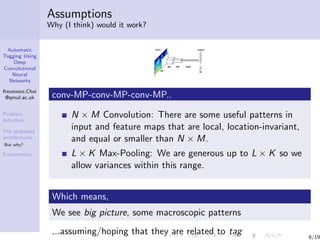
conv-MP-conv-MP-conv-MP..
N × M Convolution: There are some useful patterns in
input and feature maps that are local, location-invariant,
and equal or smaller than N × M.
L × K Max-Pooling: We are generous up to L × K so we
allow variances within this range.
Which means,
We see big picture, some macroscopic patterns
...assuming/hoping that they are related to tag 6/19
Automatic
Tagging Using
Deep
Convolutional
Neural
Networks
Keunwoo.Choi
@qmul.ac.uk
Problem
definition
The proposed
architectures
Experiments
MagnaTagATune
MSD: Reported
(and incorrect)
results
MSD: Correct
results
Conclusions
Experiments and discussions
MTT MSD
# tracks 25k 214K (out of total 1M)
# songs 5-6k 214K (out of total 1M)
Length 29.1s 30-60s
Benchmarks 10+ 0
Labels Tags, genres
Tags, genres,
EchoNest features,
bag-of-word lyrics,...
7/19
Automatic
Tagging Using
Deep
Convolutional
Neural
Networks
Keunwoo.Choi
@qmul.ac.uk
Problem
definition
The proposed
architectures
Experiments
MagnaTagATune
MSD: Reported
(and incorrect)
results
MSD: Correct
results
Conclusions
Experiments and discussions
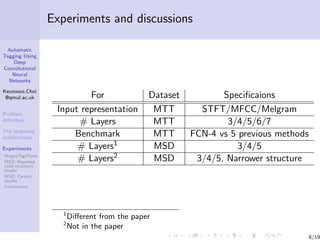
For Dataset Specificaions
Input representation MTT STFT/MFCC/Melgram
# Layers MTT 3/4/5/6/7
Benchmark MTT FCN-4 vs 5 previous methods
# Layers1 MSD 3/4/5
# Layers2 MSD 3/4/5, Narrower structure
1
Different from the paper
2
Not in the paper
8/19
Automatic
Tagging Using
Deep
Convolutional
Neural
Networks
Keunwoo.Choi
@qmul.ac.uk
Problem
definition
The proposed
architectures
Experiments
MagnaTagATune
MSD: Reported
(and incorrect)
results
MSD: Correct
results
Conclusions
Experiments and discussions
MagnaTagATune - Input representations
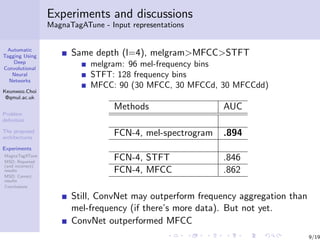
Same depth (l=4), melgram>MFCC>STFT
melgram: 96 mel-frequency bins
STFT: 128 frequency bins
MFCC: 90 (30 MFCC, 30 MFCCd, 30 MFCCdd)
Methods AUC
FCN-3, mel-spectrogram .852
FCN-4, mel-spectrogram .894
FCN-5, mel-spectrogram .890
FCN-4, STFT .846
FCN-4, MFCC .862
Still, ConvNet may outperform frequency aggregation than
mel-frequency (if there’s more data). But not yet.
ConvNet outperformed MFCC
9/19
Automatic
Tagging Using
Deep
Convolutional
Neural
Networks
Keunwoo.Choi
@qmul.ac.uk
Problem
definition
The proposed
architectures
Experiments
MagnaTagATune
MSD: Reported
(and incorrect)
results
MSD: Correct
results
Conclusions
Experiments and discussions
MagnaTagATune - Number of layers
Methods AUC
FCN-3, mel-spectrogram .852
FCN-4, mel-spectrogram .894
FCN-5, mel-spectrogram .890
FCN-4, STFT .846
FCN-4, MFCC .862
FCN-4>FCN-3: Depth worked!
FCN-4>FCN-5 by .004
Deeper model might make it equal after ages of training
Deeper models requires more data
Deeper models take more time (deep residual network[4])
4 layers are enough vs. matter of size(data)?
10/19
Automatic
Tagging Using
Deep
Convolutional
Neural
Networks
Keunwoo.Choi
@qmul.ac.uk
Problem
definition
The proposed
architectures
Experiments
MagnaTagATune
MSD: Reported
(and incorrect)
results
MSD: Correct
results
Conclusions
Experiments and discussions
MagnaTagATune
Methods AUC
The proposed system, FCN-4 .894
2015, Bag of features and RBM [5] .888
2014, 1-D convolutions[2] .882
2014, Transferred learning [6] .88
2012, Multi-scale approach [1] .898
2011, Pooling MFCC [3] .861
All deep and NN approaches are around .88-.89
Are we touching the glass ceiling?
Perhaps due to the noise of MTT, but tricky to prove it
26K tracks are not enough for millions of parameters
11/19
Automatic
Tagging Using
Deep
Convolutional
Neural
Networks
Keunwoo.Choi
@qmul.ac.uk
Problem
definition
The proposed
architectures
Experiments
MagnaTagATune
MSD: Reported
(and incorrect)
results
MSD: Correct
results
Conclusions
Experiments and discussions
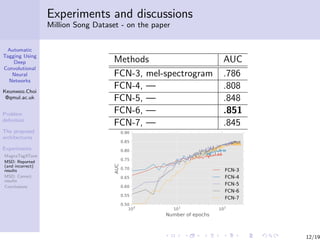
Million Song Dataset - on the paper
Methods AUC
FCN-3, mel-spectrogram .786
FCN-4, — .808
FCN-5, — .848
FCN-6, — .851
FCN-7, — .845
12/19
Automatic
Tagging Using
Deep
Convolutional
Neural
Networks
Keunwoo.Choi
@qmul.ac.uk
Problem
definition
The proposed
architectures
Experiments
MagnaTagATune
MSD: Reported
(and incorrect)
results
MSD: Correct
results
Conclusions
WARNING!
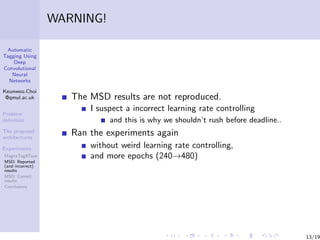
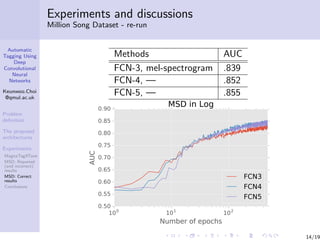
The MSD results are not reproduced.
I suspect a incorrect learning rate controlling
and this is why we shouldn’t rush before deadline..
Ran the experiments again
without weird learning rate controlling,
and more epochs (240→480)
13/19
Automatic
Tagging Using
Deep
Convolutional
Neural
Networks
Keunwoo.Choi
@qmul.ac.uk
Problem
definition
The proposed
architectures
Experiments
MagnaTagATune
MSD: Reported
(and incorrect)
results
MSD: Correct
results
Conclusions
Experiments and discussions
Million Song Dataset - re-run
Methods AUC
FCN-3, mel-spectrogram .839
FCN-4, — .852
FCN-5, — .855
100 101 102
Number of epochs
0.50
0.55
0.60
0.65
0.70
0.75
0.80
0.85
0.90
AUC
MSD in Log
FCN3
FCN4
FCN5
14/19
Automatic
Tagging Using
Deep
Convolutional
Neural
Networks
Keunwoo.Choi
@qmul.ac.uk
Problem
definition
The proposed
architectures
Experiments
MagnaTagATune
MSD: Reported
(and incorrect)
results
MSD: Correct
results
Conclusions
Smaller (narrower) convnet
No. of feature maps: [128@1 – 2048@5] → [32@1 – 256@5],
i.e.narrower network, because there’s no difference between
FCN-4 and FCN-5.
100 101 102
Number of epochs
0.50
0.55
0.60
0.65
0.70
0.75
0.80
0.85
0.90
AUC MSD, small convnet, log
FCN3_small
FCN4_small
FCN5_small
15/19
Automatic
Tagging Using
Deep
Convolutional
Neural
Networks
Keunwoo.Choi
@qmul.ac.uk
Problem
definition
The proposed
architectures
Experiments
MagnaTagATune
MSD: Reported
(and incorrect)
results
MSD: Correct
results
Conclusions
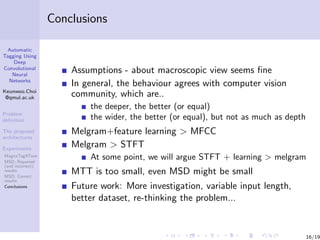
Conclusions
Assumptions - about macroscopic view seems fine
In general, the behaviour agrees with computer vision
community, which are..
the deeper, the better (or equal)
the wider, the better (or equal), but not as much as depth
Melgram+feature learning > MFCC
Melgram > STFT
At some point, we will argue STFT + learning > melgram
MTT is too small, even MSD might be small
Future work: More investigation, variable input length,
better dataset, re-thinking the problem...
16/19
Automatic
Tagging Using
Deep
Convolutional
Neural
Networks
Keunwoo.Choi
@qmul.ac.uk
Problem
definition
The proposed
architectures
Experiments
MagnaTagATune
MSD: Reported
(and incorrect)
results
MSD: Correct
results
Conclusions
Thank you for listening and...
You can plug-and-predict
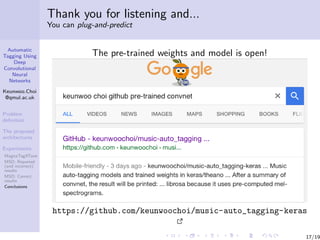
The pre-trained weights and model is open!
https://github.com/keunwoochoi/music-auto_tagging-keras
17/19
Automatic
Tagging Using
Deep
Convolutional
Neural
Networks
Keunwoo.Choi
@qmul.ac.uk
Problem
definition
The proposed
architectures
Experiments
MagnaTagATune
MSD: Reported
(and incorrect)
results
MSD: Correct
results
Conclusions
References I
Dieleman, S., Schrauwen, B.: Multiscale approaches to
music audio feature learning. In: ISMIR. pp. 3–8 (2013)
Dieleman, S., Schrauwen, B.: End-to-end learning for
music audio. In: Acoustics, Speech and Signal Processing
(ICASSP), 2014 IEEE International Conference on. pp.
6964–6968. IEEE (2014)
Hamel, P., Lemieux, S., Bengio, Y., Eck, D.: Temporal
pooling and multiscale learning for automatic annotation
and ranking of music audio. In: ISMIR. pp. 729–734 (2011)
He, K., Zhang, X., Ren, S., Sun, J.: Deep residual learning
for image recognition. arXiv preprint arXiv:1512.03385
(2015)
18/19
Automatic
Tagging Using
Deep
Convolutional
Neural
Networks
Keunwoo.Choi
@qmul.ac.uk
Problem
definition
The proposed
architectures
Experiments
MagnaTagATune
MSD: Reported
(and incorrect)
results
MSD: Correct
results
Conclusions
References II
Nam, J., Herrera, J., Lee, K.: A deep bag-of-features
model for music auto-tagging. arXiv preprint
arXiv:1508.04999 (2015)
Van Den Oord, A., Dieleman, S., Schrauwen, B.: Transfer
learning by supervised pre-training for audio-based music
classification. In: Conference of the International Society
for Music Information Retrieval (ISMIR 2014) (2014)
19/19

Automatic Tagging using Deep Convolutional Neural Networks - ISMIR 2016