Exploiting Dissimilarity Representations for Person Re-Identification Riccardo Satta, Giorgio Fumera, Fabio Roli Pattern Recognition and Applications Group Dept. of Electrical and Electronic Engineering University of Cagliari, Italy
Outline Introduction to the  Person Re-Identification  problem Approaching Person Re-Identification through  dissimilarity representations :  motivations  and  advantages A  dissimilarity-based framework  for Person Re-Identification Preliminary  experimental analysis Further  developments
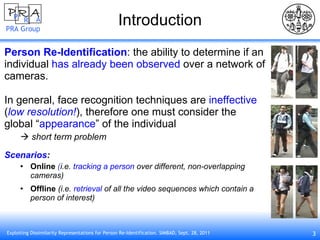
Introduction Person Re-Identification : the ability to determine if an individual  has already been observed  over a network of cameras. In general, face recognition techniques are  ineffective   ( low resolution! ), therefore one must consider the  global “ appearance ” of the individual    short term problem Scenarios : Online  ( i.e.   tracking a person   over different, non-overlapping cameras) Offline  (i.e.  retrieval  of all the video sequences which contain a person of interest)
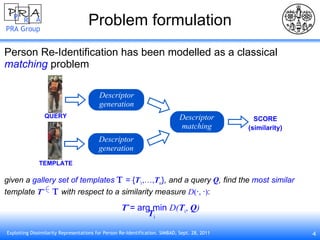
Problem formulation Person Re-Identification has been modelled as a classical  matching   problem TEMPLATE QUERY SCORE (similarity) given a  gallery set of templates  T  =  { T 1 ,…, T n } , and a query  Q , find the  most similar template  T *   T  with respect to a similarity measure  D ( · ,  · ) : T * =  arg min  D( T i ,  Q ) T i Descriptor generation Descriptor matching Descriptor generation
An unifying view of the methods in literature Despite the wide variety of methods in literature,  most of the existing works adopt some  part-based body subdivision  (e.g.  torso – legs ), and/or represent the body or its parts via  multiple components  (e.g.  patches, SIFT points ). The authors exploited such similarities in a previous work to develop  a general framework for person re-identification,  MCM , able to frame most existing works: [Satta et al.,  A Multiple Component Matching Framework for Person Re-Identification , ICIAP 2011] Part subdivision in this example, upper and lower body   Multiple components represented here as coloured dots
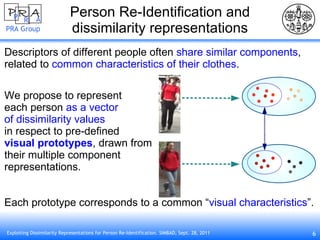
Person Re-Identification and dissimilarity representations Descriptors of different people often  share similar components , related to  common characteristics of their clothes . We propose to represent  each person  as a vector  of dissimilarity values in respect to pre-defined  visual prototypes , drawn from their multiple component representations. Each prototype corresponds to a common “ visual characteristics ”.
Person Re-Identification and dissimilarity representations Advantages Reduced storage requirements people descriptors become  as compact as a vector of real values Extremely fast matching comparing two descriptors is equivalent to computing distances between vectors,  an almost immediate operation  with modern CPUs
A dissimilarity-based framework for Person Re-Identification We present a new dissimilarity-based framework called Multiple Component Dissimilarity (MCD) , aimed at  transposing  a generic person re-identification method  to a  dissimilarity-based form . MCD  is based on the MCM framework  introduced previously, and inherits the concepts of  part subdivision  and  multiple components representation , in order to be applicable to any method that can be framed in MCM.
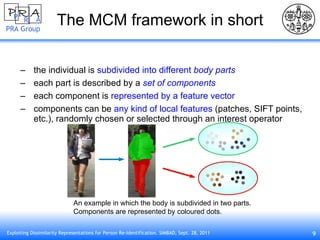
The MCM framework in short Descriptor creation the individual is  subdivided into different  body parts each part is described by a  set of components each component is  represented by a feature vector components can be  any kind of local features  (patches, SIFT points, etc.), randomly chosen or selected through an interest operator An example in which the body is subdivided in two parts. Components are represented by coloured dots.
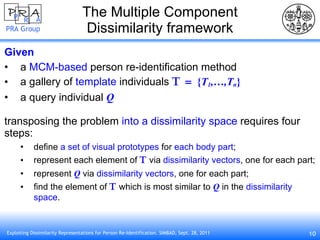
The Multiple Component Dissimilarity framework Given a  MCM-based  person re-identification method a gallery of  template  individuals  T =  { T 1 ,…,T n } a query individual  Q transposing the problem  into a dissimilarity space  requires four steps: define  a set of visual prototypes  for  each body part ; represent each element of  T  via  dissimilarity vectors , one for each part; represent  Q  via  dissimilarity vectors , one for each part; find the element of  T  which is most similar to  Q  in the  dissimilarity space .
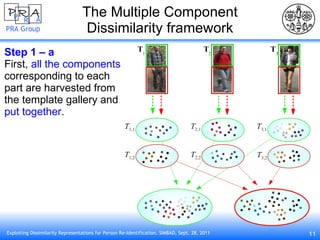
The Multiple Component Dissimilarity framework Step 1 – a  First,  all the components corresponding to each part are harvested from the template gallery and put together .
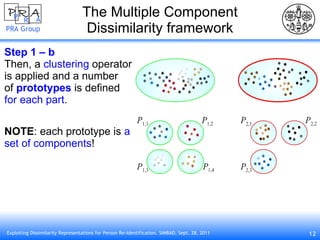
The Multiple Component Dissimilarity framework Step 1 – b  Then, a  clustering  operator  is applied and a number  of  prototypes  is defined for each part . NOTE : each prototype is  a set of components !
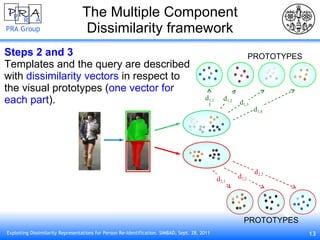
The Multiple Component Dissimilarity framework Steps 2 and 3  Templates and the query are described with  dissimilarity vectors  in respect to the visual prototypes ( one vector for each part ). PROTOTYPES d 1,1 d 2,1 PROTOTYPES d 1,2 d 1,3 d 1,4 d 2,2 d 2,3
The Multiple Component Dissimilarity framework Steps 2 and 3  Since each descriptor  (either a template or the query)  is made up of a set of components   for each part, and  each prototype is itself a set of components, dissimilarities are distances between sets . [d 1,1 , d 1,2 , d 1,3 , d 1,4 ] [d 2,1 , d 2,2 , d 2,3 ]
The Multiple Component Dissimilarity framework Steps 2 and 3  [d 1,1 , d 1,2 , d 1,3 , d 1,4 ] [d 2,1 , d 2,2 , d 2,3 ] [d 1,1 , d 1,2 , d 1,3 , d 1,4 ] [d 2,1 , d 2,2 , d 2,3 ] [d 1,1 , d 1,2 , d 1,3 , d 1,4 ] [d 2,1 , d 2,2 , d 2,3 ] [d 1,1 , d 1,2 , d 1,3 , d 1,4 ] [d 2,1 , d 2,2 , d 2,3 ] TEMPLATES QUERY
The Multiple Component Dissimilarity framework Step 4  Similarities between the query and each template are evaluated by  computing vector distances separately for each part , then fusing the part-level scores. [d 1,1 , d 1,2 , d 1,3 , d 1,4 ] [d 2,1 , d 2,2 , d 2,3 ] [d 1,1 , d 1,2 , d 1,3 , d 1,4 ] [d 2,1 , d 2,2 , d 2,3 ] TEMPLATE QUERY D part 1 D part 2 SIMILARITY =  f  (  D part 1  ,  D part 2  )
Experimental evaluation Preliminary experiments were conducted by  applying MCD  to MCMimpl , a method proposed in [Satta et al., ICIAP 2011] MCMimpl  in short: part subdivision : torso – legs,  discarding the head multiple component representation : for each part, randomly taken and partly overlapping patches,  described by HSV histograms Application of MCD to  MCMimpl : visual prototypes generated through a  two-stage clustering algorithm modified  k-th Hausdorff distance  to compute dissimilarities
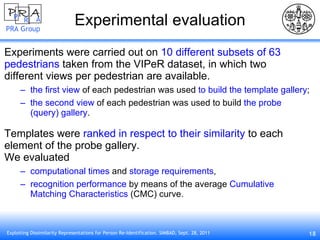
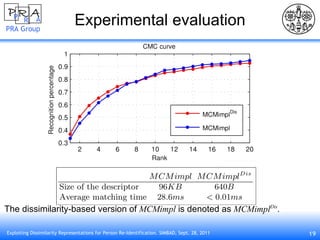
Experimental evaluation Experiments were carried out on  10 different subsets of 63 pedestrians  taken from the VIPeR dataset, in which two different views per pedestrian are available. the first view  of each pedestrian was used  to build the template gallery ; the second view  of each pedestrian was used to build  the probe (query) gallery . Templates were  ranked in respect to their similarity  to each element of the probe gallery.  We evaluated computational times  and  storage requirements , recognition performance  by means of the average  Cumulative Matching Characteristics  (CMC) curve.
Experimental evaluation The dissimilarity-based version of  MCMimpl  is denoted as  MCMimpl Dis .
Further developments Appearance-based people grouping Visual prototypes actually encode  common visual characteristics  of the clothes. Dissimilarity representations can then be exploited  to group people in respect to some visual characteristics of interest  (e.g.  all people wearing a black shirt ). Possible applications: reducing the number of candidates  in a person re-identification task, by considering only those who share a certain amount of visual characteristics with the query appearance-based people retrieval , that is, retrieve people according to  a given query related to some visual characteristics  of interest
Thank  you Time for questions

Exploiting Dissimilarity Representations for Person Re-Identification

  • 1.
    Exploiting Dissimilarity Representationsfor Person Re-Identification Riccardo Satta, Giorgio Fumera, Fabio Roli Pattern Recognition and Applications Group Dept. of Electrical and Electronic Engineering University of Cagliari, Italy
  • 2.
    Outline Introduction tothe Person Re-Identification problem Approaching Person Re-Identification through dissimilarity representations : motivations and advantages A dissimilarity-based framework for Person Re-Identification Preliminary experimental analysis Further developments
  • 3.
    Introduction Person Re-Identification: the ability to determine if an individual has already been observed over a network of cameras. In general, face recognition techniques are ineffective ( low resolution! ), therefore one must consider the global “ appearance ” of the individual  short term problem Scenarios : Online ( i.e. tracking a person over different, non-overlapping cameras) Offline (i.e. retrieval of all the video sequences which contain a person of interest)
  • 4.
    Problem formulation PersonRe-Identification has been modelled as a classical matching problem TEMPLATE QUERY SCORE (similarity) given a gallery set of templates T = { T 1 ,…, T n } , and a query Q , find the most similar template T * T with respect to a similarity measure D ( · , · ) : T * = arg min D( T i , Q ) T i Descriptor generation Descriptor matching Descriptor generation
  • 5.
    An unifying viewof the methods in literature Despite the wide variety of methods in literature, most of the existing works adopt some part-based body subdivision (e.g. torso – legs ), and/or represent the body or its parts via multiple components (e.g. patches, SIFT points ). The authors exploited such similarities in a previous work to develop a general framework for person re-identification, MCM , able to frame most existing works: [Satta et al., A Multiple Component Matching Framework for Person Re-Identification , ICIAP 2011] Part subdivision in this example, upper and lower body Multiple components represented here as coloured dots
  • 6.
    Person Re-Identification anddissimilarity representations Descriptors of different people often share similar components , related to common characteristics of their clothes . We propose to represent each person as a vector of dissimilarity values in respect to pre-defined visual prototypes , drawn from their multiple component representations. Each prototype corresponds to a common “ visual characteristics ”.
  • 7.
    Person Re-Identification anddissimilarity representations Advantages Reduced storage requirements people descriptors become as compact as a vector of real values Extremely fast matching comparing two descriptors is equivalent to computing distances between vectors, an almost immediate operation with modern CPUs
  • 8.
    A dissimilarity-based frameworkfor Person Re-Identification We present a new dissimilarity-based framework called Multiple Component Dissimilarity (MCD) , aimed at transposing a generic person re-identification method to a dissimilarity-based form . MCD is based on the MCM framework introduced previously, and inherits the concepts of part subdivision and multiple components representation , in order to be applicable to any method that can be framed in MCM.
  • 9.
    The MCM frameworkin short Descriptor creation the individual is subdivided into different body parts each part is described by a set of components each component is represented by a feature vector components can be any kind of local features (patches, SIFT points, etc.), randomly chosen or selected through an interest operator An example in which the body is subdivided in two parts. Components are represented by coloured dots.
  • 10.
    The Multiple ComponentDissimilarity framework Given a MCM-based person re-identification method a gallery of template individuals T = { T 1 ,…,T n } a query individual Q transposing the problem into a dissimilarity space requires four steps: define a set of visual prototypes for each body part ; represent each element of T via dissimilarity vectors , one for each part; represent Q via dissimilarity vectors , one for each part; find the element of T which is most similar to Q in the dissimilarity space .
  • 11.
    The Multiple ComponentDissimilarity framework Step 1 – a First, all the components corresponding to each part are harvested from the template gallery and put together .
  • 12.
    The Multiple ComponentDissimilarity framework Step 1 – b Then, a clustering operator is applied and a number of prototypes is defined for each part . NOTE : each prototype is a set of components !
  • 13.
    The Multiple ComponentDissimilarity framework Steps 2 and 3 Templates and the query are described with dissimilarity vectors in respect to the visual prototypes ( one vector for each part ). PROTOTYPES d 1,1 d 2,1 PROTOTYPES d 1,2 d 1,3 d 1,4 d 2,2 d 2,3
  • 14.
    The Multiple ComponentDissimilarity framework Steps 2 and 3 Since each descriptor (either a template or the query) is made up of a set of components for each part, and each prototype is itself a set of components, dissimilarities are distances between sets . [d 1,1 , d 1,2 , d 1,3 , d 1,4 ] [d 2,1 , d 2,2 , d 2,3 ]
  • 15.
    The Multiple ComponentDissimilarity framework Steps 2 and 3 [d 1,1 , d 1,2 , d 1,3 , d 1,4 ] [d 2,1 , d 2,2 , d 2,3 ] [d 1,1 , d 1,2 , d 1,3 , d 1,4 ] [d 2,1 , d 2,2 , d 2,3 ] [d 1,1 , d 1,2 , d 1,3 , d 1,4 ] [d 2,1 , d 2,2 , d 2,3 ] [d 1,1 , d 1,2 , d 1,3 , d 1,4 ] [d 2,1 , d 2,2 , d 2,3 ] TEMPLATES QUERY
  • 16.
    The Multiple ComponentDissimilarity framework Step 4 Similarities between the query and each template are evaluated by computing vector distances separately for each part , then fusing the part-level scores. [d 1,1 , d 1,2 , d 1,3 , d 1,4 ] [d 2,1 , d 2,2 , d 2,3 ] [d 1,1 , d 1,2 , d 1,3 , d 1,4 ] [d 2,1 , d 2,2 , d 2,3 ] TEMPLATE QUERY D part 1 D part 2 SIMILARITY = f ( D part 1 , D part 2 )
  • 17.
    Experimental evaluation Preliminaryexperiments were conducted by applying MCD to MCMimpl , a method proposed in [Satta et al., ICIAP 2011] MCMimpl in short: part subdivision : torso – legs, discarding the head multiple component representation : for each part, randomly taken and partly overlapping patches, described by HSV histograms Application of MCD to MCMimpl : visual prototypes generated through a two-stage clustering algorithm modified k-th Hausdorff distance to compute dissimilarities
  • 18.
    Experimental evaluation Experimentswere carried out on 10 different subsets of 63 pedestrians taken from the VIPeR dataset, in which two different views per pedestrian are available. the first view of each pedestrian was used to build the template gallery ; the second view of each pedestrian was used to build the probe (query) gallery . Templates were ranked in respect to their similarity to each element of the probe gallery. We evaluated computational times and storage requirements , recognition performance by means of the average Cumulative Matching Characteristics (CMC) curve.
  • 19.
    Experimental evaluation Thedissimilarity-based version of MCMimpl is denoted as MCMimpl Dis .
  • 20.
    Further developments Appearance-basedpeople grouping Visual prototypes actually encode common visual characteristics of the clothes. Dissimilarity representations can then be exploited to group people in respect to some visual characteristics of interest (e.g. all people wearing a black shirt ). Possible applications: reducing the number of candidates in a person re-identification task, by considering only those who share a certain amount of visual characteristics with the query appearance-based people retrieval , that is, retrieve people according to a given query related to some visual characteristics of interest
  • 21.
    Thank youTime for questions