Tutorial on
Convolutional Neural Networks
SKKU Data Mining LAB
Hojin Yang
Index
Intro
Convolution Layer Basics
CNN Backprop Implementation
CNN in Practice
CNN Architecture
Most of materials are built upon previous effort of CS231n
http://cs231n.stanford.edu/2017/
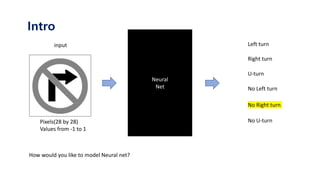
Intro
Neural
Net
Left turn
Right turn
No Left turn
No Right turn
U-turn
No U-turn
input
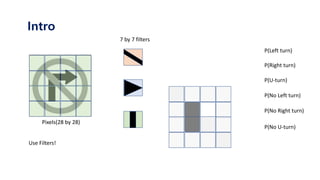
Pixels(28 by 28)
Values from -1 to 1
How would you like to model Neural net?
Intro
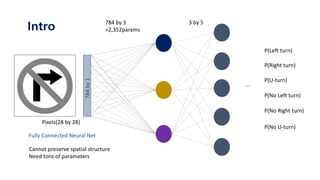
Pixels(28 by 28)
784 by 3
=2,352params
Fully Connected Neural Net
3 by 5
P(Left turn)
P(Right turn)
P(No Left turn)
P(U-turn)
P(No U-turn)
P(No Right turn)
…
Cannot preserve spatial structure
Need tons of parameters
784by1
Intro
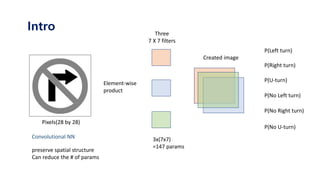
Pixels(28 by 28)
Convolutional NN
P(Left turn)
P(Right turn)
P(No Left turn)
P(U-turn)
P(No U-turn)
P(No Right turn)
Three
7 X 7 filters
preserve spatial structure
Can reduce the # of params
3x(7x7)
=147 params
Created image
Element-wise
product
Intro
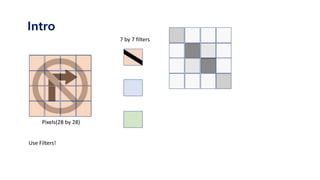
Pixels(28 by 28)
Use Filters!
7 by 7 filters
Intro
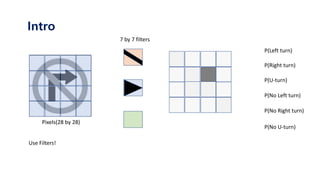
Pixels(28 by 28)
Use Filters!
P(Left turn)
P(Right turn)
P(No Left turn)
P(U-turn)
P(No U-turn)
P(No Right turn)
7 by 7 filters
Intro
Pixels(28 by 28)
Use Filters!
P(Left turn)
P(Right turn)
P(No Left turn)
P(U-turn)
P(No U-turn)
P(No Right turn)
7 by 7 filters
Intro
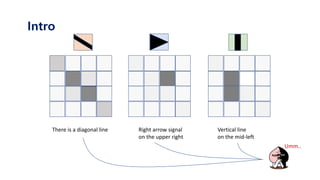
There is a diagonal line Right arrow signal
on the upper right
Vertical line
on the mid-left
Umm..
Intro
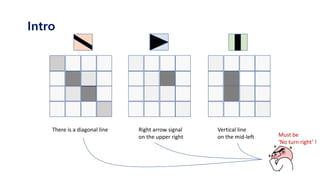
There is a diagonal line Right arrow signal
on the upper right
Vertical line
on the mid-left Must be
‘No turn right’ !
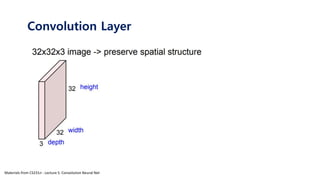
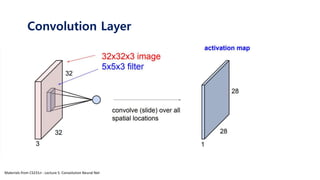
Convolution Layer
Materials from CS231n : Lecture 5. Convolution Neural Net
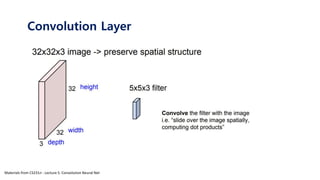
Convolution Layer
Materials from CS231n : Lecture 5. Convolution Neural Net
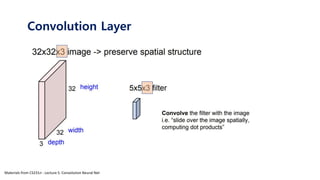
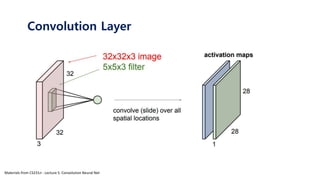
Convolution Layer
Materials from CS231n : Lecture 5. Convolution Neural Net
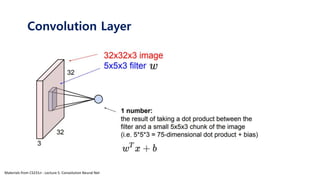
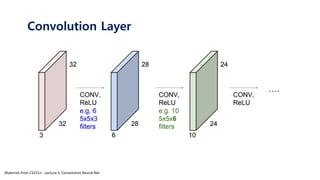
Convolution Layer
Materials from CS231n : Lecture 5. Convolution Neural Net
Convolution Layer
Materials from CS231n : Lecture 5. Convolution Neural Net
Convolution Layer
Materials from CS231n : Lecture 5. Convolution Neural Net
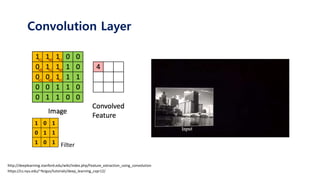
Convolution Layer
1 0 1
0 1 1
1 0 1 Filter
http://deeplearning.stanford.edu/wiki/index.php/Feature_extraction_using_convolution
https://cs.nyu.edu/~fergus/tutorials/deep_learning_cvpr12/
Convolution Layer
Materials from CS231n : Lecture 5. Convolution Neural Net
Convolution Layer
Materials from CS231n : Lecture 5. Convolution Neural Net
Convolution Layer
In convolutional neural networks (CNN) every network layer acts as a
detection filter for the presence of specific features or patterns present in
the original data.
The first layers(filters) in a CNN detect features that can be recognized and
interpreted relatively easy.
Later layers(filters) detect increasingly features that are more abstract.
Convolution Layer
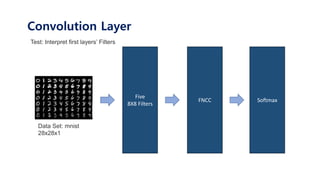
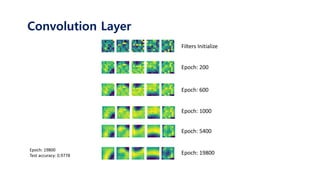
Test: Interpret first layers’ Filters
Five
8X8 Filters
FNCC Softmax
Data Set: mnist
28x28x1
Convolution Layer
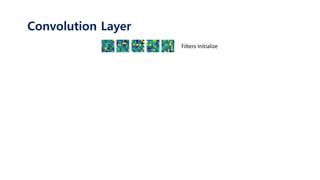
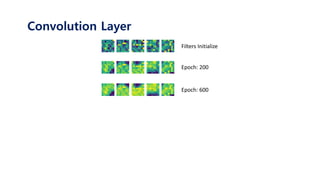
Filters Initialize
Convolution Layer
Epoch: 200
Epoch: 600
Filters Initialize
Convolution Layer
Filters Initialize
Epoch: 200
Epoch: 600
Epoch: 5400
Epoch: 19800
Epoch: 1000
Epoch: 19800
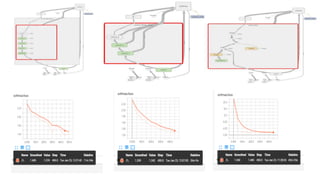
Test accuracy: 0.9778
Convolution Layer
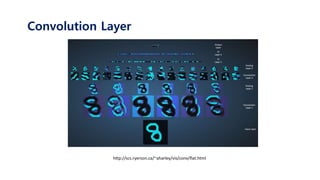
http://scs.ryerson.ca/~aharley/vis/conv/flat.html
Convolution Layer
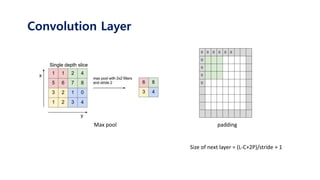
paddingMax pool
Size of next layer = (L-C+2P)/stride + 1
CNN Backprop Implementation
- Computational Graphs
- Backprop using for-loop
- im2col
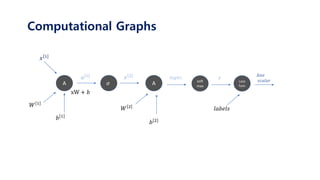
Computational Graphs
A 𝜎 A soft
max
Loss
func
𝑥 1
𝑊 1
𝑏 1
𝑊 2
𝑏 2
𝑥 2 𝑙𝑜𝑔𝑖𝑡𝑠
loss
𝑠𝑐𝑎𝑙𝑎𝑟
𝑙𝑎𝑏𝑒𝑙𝑠
𝑦𝑎 1
xW + 𝑏
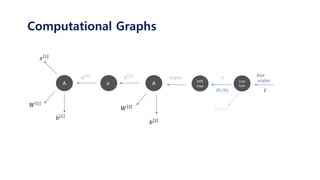
Computational Graphs
A 𝜎 A soft
max
Loss
func
𝑥 1
𝑊 1
𝑏 1
𝑊 2
𝑏 2
𝑥 2 𝑙𝑜𝑔𝑖𝑡𝑠
1
𝑙𝑎𝑏𝑒𝑙𝑠
𝑦
𝜕𝐿/𝜕𝑦
loss
𝑠𝑐𝑎𝑙𝑎𝑟
𝑎 1
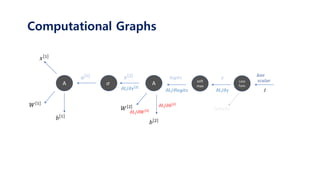
Computational Graphs
A 𝜎 A soft
max
Loss
func
𝑥 1
𝑊 1
𝑏 1
𝑊 2
𝑏 2
𝑥 2 𝑙𝑜𝑔𝑖𝑡𝑠
1
𝑙𝑎𝑏𝑒𝑙𝑠
𝑦
𝜕𝐿/𝜕𝑦
loss
𝑠𝑐𝑎𝑙𝑎𝑟
𝜕𝐿/𝜕𝑙𝑜𝑔𝑖𝑡𝑠
𝜕𝐿/𝜕𝑏 2
𝜕𝐿/𝜕𝑊 2
𝜕𝐿/𝜕𝑥 2
𝑎 1
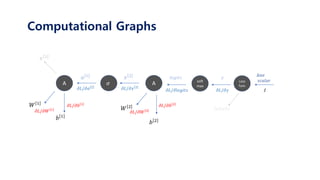
Computational Graphs
A 𝜎 A soft
max
Loss
func
𝑥 1
𝑊 1
𝑏 1
𝑊 2
𝑏 2
𝑥 2 𝑙𝑜𝑔𝑖𝑡𝑠
1
𝑙𝑎𝑏𝑒𝑙𝑠
𝑦
𝜕𝐿/𝜕𝑦
loss
𝑠𝑐𝑎𝑙𝑎𝑟
𝜕𝐿/𝜕𝑙𝑜𝑔𝑖𝑡𝑠
𝜕𝐿/𝜕𝑏 2
𝜕𝐿/𝜕𝑊 2
𝜕𝐿/𝜕𝑥 2
𝑎 1
𝜕𝐿/𝜕𝑎 2
𝜕𝐿/𝜕𝑏 1
𝜕𝐿/𝜕𝑊 1
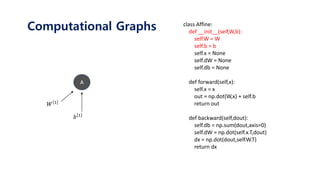
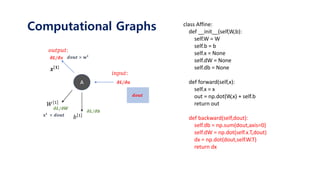
class Affine:
def __init__(self,W,b):
self.W = W
self.b = b
self.x = None
self.dW = None
self.db = None
def forward(self,x):
self.x = x
out = np.dot(W,x) + self.b
return out
def backward(self,dout):
self.db = np.sum(dout,axis=0)
self.dW = np.dot(self.x.T,dout)
dx = np.dot(dout,self.W.T)
return dx
A
𝑊 1
𝑏 1
Computational Graphs
class Affine:
def __init__(self,W,b):
self.W = W
self.b = b
self.x = None
self.dW = None
self.db = None
def forward(self,x):
self.x = x
out = np.dot(W,x) + self.b
return out
def backward(self,dout):
self.db = np.sum(dout,axis=0)
self.dW = np.dot(self.x.T,dout)
dx = np.dot(dout,self.W.T)
return dx
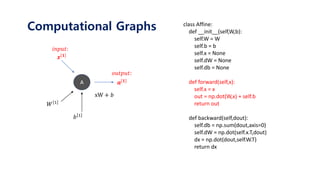
A
𝒙 𝟏
𝑊 1
𝑏 1
𝒂 𝟏
Computational Graphs
𝑖𝑛𝑝𝑢𝑡:
𝑜𝑢𝑡𝑝𝑢𝑡:
xW + 𝑏
class Affine:
def __init__(self,W,b):
self.W = W
self.b = b
self.x = None
self.dW = None
self.db = None
def forward(self,x):
self.x = x
out = np.dot(W,x) + self.b
return out
def backward(self,dout):
self.db = np.sum(dout,axis=0)
self.dW = np.dot(self.x.T,dout)
dx = np.dot(dout,self.W.T)
return dx
A
𝑊 1
𝑏 1
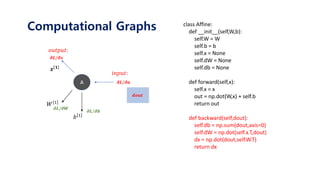
Computational Graphs
𝑜𝑢𝑡𝑝𝑢𝑡:
𝑖𝑛𝑝𝑢𝑡:
𝝏𝑳/𝝏𝒂
𝝏𝑳/𝝏𝒙
𝝏𝑳/𝝏𝒃
𝝏𝑳/𝝏𝑾
𝒅𝒐𝒖𝒕
𝒙 𝟏
class Affine:
def __init__(self,W,b):
self.W = W
self.b = b
self.x = None
self.dW = None
self.db = None
def forward(self,x):
self.x = x
out = np.dot(W,x) + self.b
return out
def backward(self,dout):
self.db = np.sum(dout,axis=0)
self.dW = np.dot(self.x.T,dout)
dx = np.dot(dout,self.W.T)
return dx
A
𝑊 1
𝑏 1
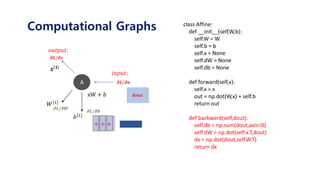
Computational Graphs
𝑜𝑢𝑡𝑝𝑢𝑡:
𝑖𝑛𝑝𝑢𝑡:
𝝏𝑳/𝝏𝒂
𝝏𝑳/𝝏𝒙
𝝏𝑳/𝝏𝒃
𝝏𝑳/𝝏𝑾
𝒅𝒐𝒖𝒕
+ + +
𝒙 𝟏
xW + 𝑏
class Affine:
def __init__(self,W,b):
self.W = W
self.b = b
self.x = None
self.dW = None
self.db = None
def forward(self,x):
self.x = x
out = np.dot(W,x) + self.b
return out
def backward(self,dout):
self.db = np.sum(dout,axis=0)
self.dW = np.dot(self.x.T,dout)
dx = np.dot(dout,self.W.T)
return dx
A
𝑊 1
𝑏 1
Computational Graphs
𝑖𝑛𝑝𝑢𝑡:
𝝏𝑳/𝝏𝒂
𝝏𝑳/𝝏𝒃
𝝏𝑳/𝝏𝑾
𝒅𝒐𝒖𝒕
𝐱 𝐭
× 𝒅𝒐𝒖𝒕
𝑜𝑢𝑡𝑝𝑢𝑡:
𝝏𝑳/𝝏𝒙
𝒙 𝟏
𝒅𝒐𝒖𝒕 × 𝐰 𝐭
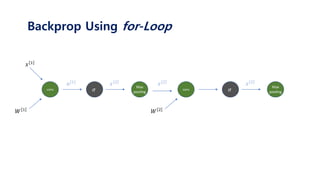
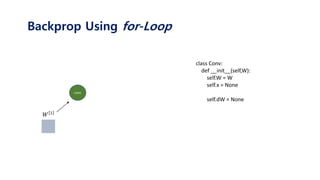
Backprop Using for-Loop
conv 𝜎
𝑥 1
𝑊 1
𝑥 2𝑎 1
Max
pooling
𝑥 2
conv
𝑊 2
𝜎
𝑥 2
Max
pooling
class Conv:
def __init__(self,W):
self.W = W
self.x = None
self.dW = None
conv
𝑊 1
Backprop Using for-Loop
conv
𝑥 1
𝑊 1
𝑎 1
def forward(self,x):
self.x = x
#input과 filter의 column(=row) 크기 계산
size_x = self.x.shape[0]
size_W = self.W.shape[0]
#convolution 크기 계산후 생성 (x-w)/stride + 1
size_c = size_x - size_W + 1
conv_result = np.zeros(shape=(size_c,size_c))
#합성곱 연산
for i in range(size_c) :
for j in range(size_c):
partial = x[i:i+size_W , j:j+size_W]
conv_result[i][j] = partial * size_W
return conv_result
Backprop Using for-Loop
conv
𝑥 1
𝑊 1
𝑎 1
def forward(self,x):
self.x = x
#input과 filter의 column(=row) 크기 계산
size_x = self.x.shape[0]
size_W = self.W.shape[0]
#convolution 크기 계산후 생성 (x-w)/stride + 1
size_c = size_x - size_W + 1
conv_result = np.zeros(shape=(size_c,size_c))
#합성곱 연산
for i in range(size_c) :
for j in range(size_c):
partial = x[i:i+size_W , j:j+size_W]
conv_result[i][j] = partial * size_W
return conv_result
Backprop Using for-Loop
conv
𝑥 1
𝑊 1
𝑎 1
def forward(self,x):
self.x = x
#input과 filter의 column(=row) 크기 계산
size_x = self.x.shape[0]
size_W = self.W.shape[0]
#convolution 크기 계산후 생성 (x-w)/stride + 1
size_c = size_x - size_W + 1
conv_result = np.zeros(shape=(size_c,size_c))
#합성곱 연산
for i in range(size_c) :
for j in range(size_c):
partial = x[i:i+size_W , j:j+size_W]
conv_result[i][j] = partial * size_W
return conv_result
Backprop Using for-Loop
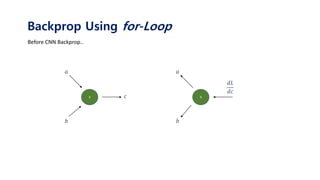
X
𝑎
𝑐
Backprop Using for-Loop
𝑏
X
𝑎
𝑑𝐿
𝑑𝑐
𝑏
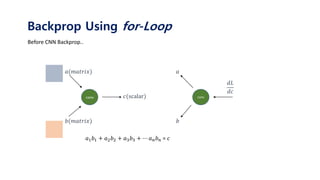
Before CNN Backprop..
X
𝑎
𝑐
Backprop Using for-Loop
𝑏
X
𝑎
𝑑𝐿
𝑑𝑐
𝑏
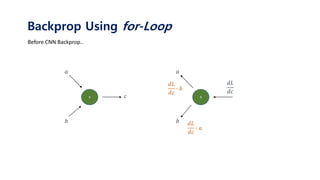
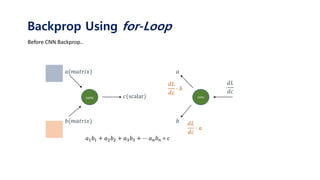
Before CNN Backprop..
𝑑𝐿
𝑑𝑐
∙ 𝑏
𝑑𝐿
𝑑𝑐
∙ 𝑎
𝑎(𝑚𝑎𝑡𝑟𝑖𝑥)
𝑐(scalar)
Backprop Using for-Loop
𝑏(𝑚𝑎𝑡𝑟𝑖𝑥)
conv
𝑎
𝑑𝐿
𝑑𝑐
𝑏
Before CNN Backprop..
conv
𝑎1 𝑏1 + 𝑎2 𝑏2 + 𝑎3 𝑏3 + ⋯ 𝑎 𝑛 𝑏 𝑛 = 𝑐
𝑐(scalar)
Backprop Using for-Loop
conv
𝑎
𝑑𝐿
𝑑𝑐
𝑏
Before CNN Backprop..
𝑑𝐿
𝑑𝑐
∙ 𝑏
𝑑𝐿
𝑑𝑐
∙ 𝑎
conv
𝑎(𝑚𝑎𝑡𝑟𝑖𝑥)
𝑏(𝑚𝑎𝑡𝑟𝑖𝑥)
𝑎1 𝑏1 + 𝑎2 𝑏2 + 𝑎3 𝑏3 + ⋯ 𝑎 𝑛 𝑏 𝑛 = 𝑐
conv
𝑥 1
𝑊 1
𝑎 1
def backward(self, dout):
#input과 filter,x의 column(=row) 크기 계산
size_x = self.x.shape[0] #column(=row) 크기
size_W = self.W.shape[0]
size_dout = dout.shape[0]
#filter의 미분 결과 matrix
self.dW = np.zeros(shape=(size_W,size_W))
#x의 미분 결과 matrix
dx = np.zeros(shape=(size_x,size_x))
for i in range(size_dout) :
for j in range(size_dout) :
partial = self.x[i:i+size_W, j:j+size_W]
self.dW += dout[i][j] * partial
dx[i:i+size_W,j:j+size+W] += dout[i][j] * self.W
return dx
Backprop Using for-Loop
conv
𝑥 1
𝑊 1
𝑎 1
Backprop Using for-Loop
def backward(self, dout):
#input과 filter,x의 column(=row) 크기 계산
size_x = self.x.shape[0] #column(=row) 크기
size_W = self.W.shape[0]
size_dout = dout.shape[0]
#filter의 미분 결과 matrix
self.dW = np.zeros(shape=(size_W,size_W))
#x의 미분 결과 matrix
dx = np.zeros(shape=(size_x,size_x))
for i in range(size_dout) :
for j in range(size_dout) :
partial = self.x[i:i+size_W, j:j+size_W]
self.dW += dout[i][j] * partial
dx[i:i+size_W,j:j+size+W] += dout[i][j] * self.W
return dx
conv
𝑥 1
𝑊 1
𝑎 1
Backprop Using for-Loop
def backward(self, dout):
#input과 filter,x의 column(=row) 크기 계산
size_x = self.x.shape[0] #column(=row) 크기
size_W = self.W.shape[0]
size_dout = dout.shape[0]
#filter의 미분 결과 matrix
self.dW = np.zeros(shape=(size_W,size_W))
#x의 미분 결과 matrix
dx = np.zeros(shape=(size_x,size_x))
for i in range(size_dout) :
for j in range(size_dout) :
partial = self.x[i:i+size_W, j:j+size_W]
self.dW += dout[i][j] * partial
dx[i:i+size_W,j:j+size+W] += dout[i][j] * self.W
return dx
im2col
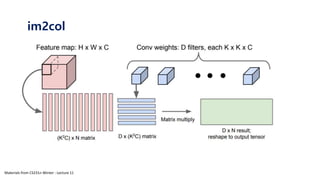
There are highly optimized matrix multiplication routines for just about every platform(ex. Numpy)
-> turn convolution into matrix multiplication!
im2col
Materials from CS231n Winter : Lecture 11
im2col def im2col(input_data, filter_h, filter_w, stride=1, pad=0):
"""다수의 이미지를 입력받아 2차원 배열로 변환한다(평탄화).
Parameters
----------
input_data : 4차원 배열 형태의 입력 데이터(이미지 수, 채널 수, 높이, 너비)
filter_h : 필터의 높이
filter_w : 필터의 너비
stride : 스트라이드
pad : 패딩
Returns
-------
col : 2차원 배열
"""
N, C, H, W = input_data.shape
out_h = (H + 2*pad - filter_h)//stride + 1
out_w = (W + 2*pad - filter_w)//stride + 1
img = np.pad(input_data, [(0,0), (0,0), (pad, pad), (pad, pad)], 'constant')
col = np.zeros((N, C, filter_h, filter_w, out_h, out_w))
for y in range(filter_h):
y_max = y + stride*out_h
for x in range(filter_w):
x_max = x + stride*out_w
col[:, :, y, x, :, :] = img[:, :, y:y_max:stride, x:x_max:stride]
col = col.transpose(0, 4, 5, 1, 2, 3).reshape(N*out_h*out_w, -1)
return col
https://github.com/WegraLee/deep-learning-from-scratch/blob/master/common/util.py
10
Backprop Using for-Loop
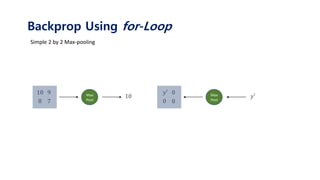
Simple 2 by 2 Max-pooling
Max
Pool
10 9
8 7
𝑦′Max
Pool
𝑦′ 0
0 0
CNN in Practice
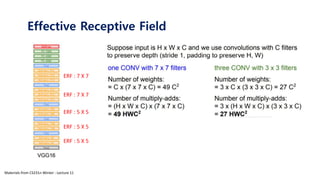
Effective Receptive Field
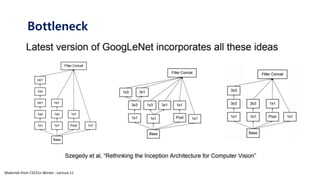
Bottleneck
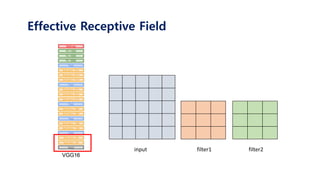
input filter1 filter2
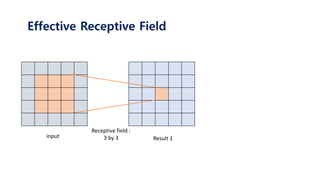
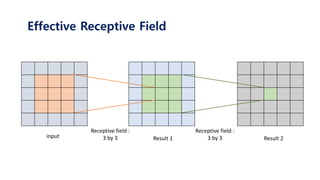
Effective Receptive Field
input Result 1
Receptive field :
3 by 3
Effective Receptive Field
input Result 1
Receptive field :
3 by 3 Result 2
Receptive field :
3 by 3
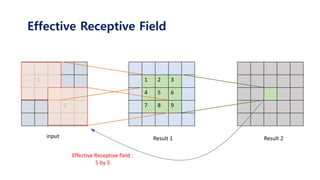
Effective Receptive Field
1
9
input Result 1
1 2 3
4 5 6
7 8 9
Result 2
Effective Receptive field :
5 by 5
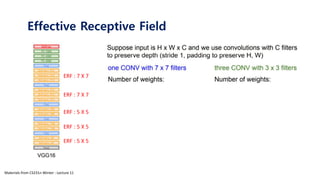
Effective Receptive Field
ERF : 5 X 5
ERF : 5 X 5
ERF : 5 X 5
ERF : 7 X 7
ERF : 7 X 7
Effective Receptive Field
Materials from CS231n Winter : Lecture 11
ERF : 5 X 5
ERF : 5 X 5
ERF : 5 X 5
ERF : 7 X 7
ERF : 7 X 7
Effective Receptive Field
Materials from CS231n Winter : Lecture 11
ERF : 5 X 5
ERF : 5 X 5
ERF : 5 X 5
ERF : 7 X 7
ERF : 7 X 7
Effective Receptive Field
Materials from CS231n Winter : Lecture 11
ERF : 5 X 5
ERF : 5 X 5
ERF : 5 X 5
ERF : 7 X 7
ERF : 7 X 7
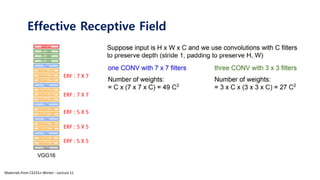
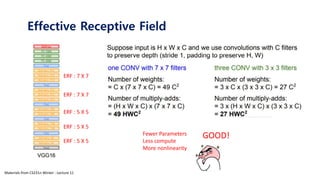
Fewer Parameters
Less compute
More nonlinearity
GOOD!
Effective Receptive Field
Materials from CS231n Winter : Lecture 11
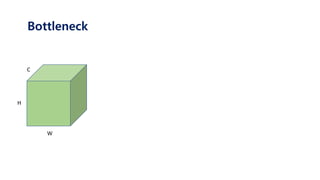
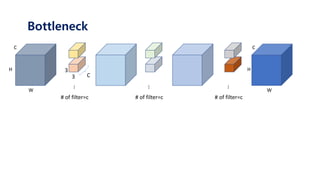
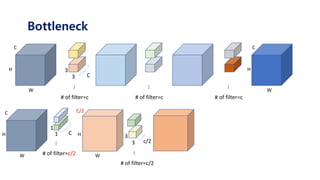
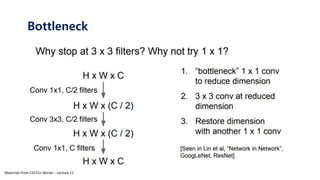
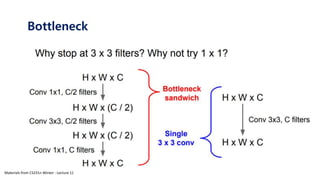
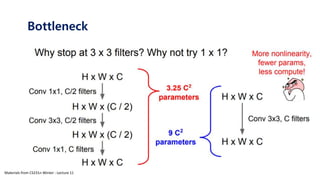
Bottleneck
H
W
C
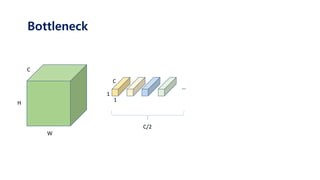
H
W
C
1
1
C
…
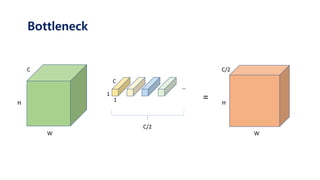
C/2
Bottleneck
H
W
C
1
1
C
H
W
C/2
…
C/2
=
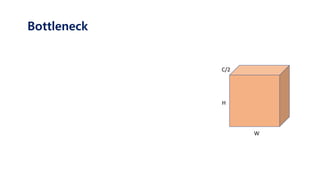
Bottleneck
H
W
C/2
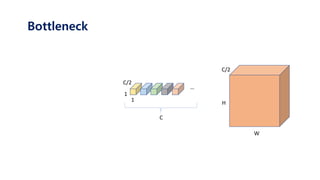
Bottleneck
1
1
C/2
H
W
C/2
…
C
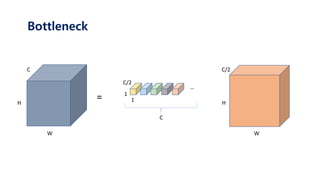
Bottleneck
H
W
C
1
1
C/2
H
W
C/2
…
C
=
Bottleneck
H
W
C
…
H
W
C
# of filter=c
3
3 C
…
# of filter=c
…
# of filter=c
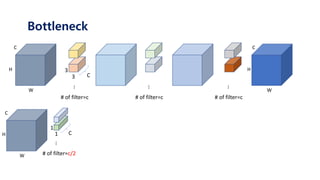
Bottleneck
H
W
C
…
H
W
C
# of filter=c
3
3 C
…
# of filter=c
…
# of filter=c
H
W
C
1
1 C
…
# of filter=c/2
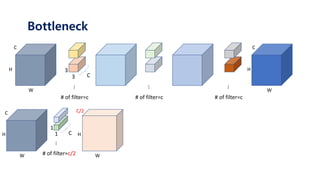
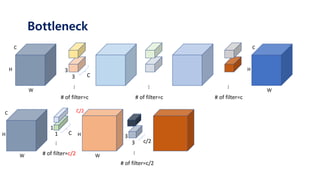
Bottleneck
H
W
C
…
H
W
C
# of filter=c
3
3 C
…
# of filter=c
…
# of filter=c
H
W
C
1
1 C
…
# of filter=c/2
C/2
H
W
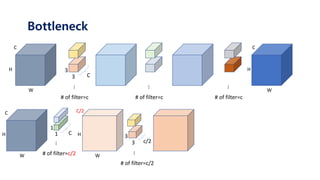
Bottleneck
H
W
C
…
H
W
C
# of filter=c
3
3 C
…
# of filter=c
…
# of filter=c
H
W
C
1
1 C
…
# of filter=c/2
C/2
H
W
…
# of filter=c/2
3
3 c/2
Bottleneck
H
W
C
…
H
W
C
# of filter=c
3
3 C
…
# of filter=c
…
# of filter=c
H
W
C
1
1 C
…
# of filter=c/2
C/2
H
W
…
# of filter=c/2
3
3 c/2
Bottleneck
H
W
C
…
H
W
C
# of filter=c
3
3 C
…
# of filter=c
…
# of filter=c
H
W
C
1
1 C
…
# of filter=c/2
C/2
H
W
…
# of filter=c/2
3
3 c/2
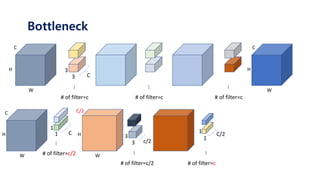
Bottleneck
H
W
C
…
H
W
C
# of filter=c
3
3 C
…
# of filter=c
…
# of filter=c
H
W
C
1
1 C
…
# of filter=c/2
C/2
H
W
…
# of filter=c/2
3
3 c/2
1
1
C/2
…
# of filter=c
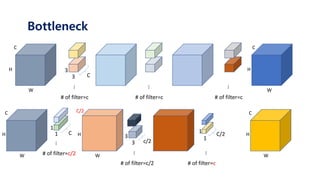
Bottleneck
H
W
C
…
H
W
C
# of filter=c
3
3 C
…
# of filter=c
…
# of filter=c
H
W
C
1
1 C
…
# of filter=c/2
C/2
H
W
…
# of filter=c/2
3
3 c/2
1
1
C/2
…
# of filter=c
H
W
C
Bottleneck
Materials from CS231n Winter : Lecture 11
Bottleneck
Materials from CS231n Winter : Lecture 11
Bottleneck
Materials from CS231n Winter : Lecture 11
Bottleneck
Bottleneck
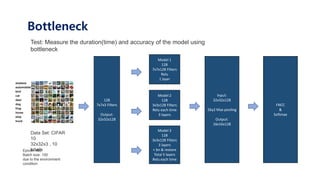
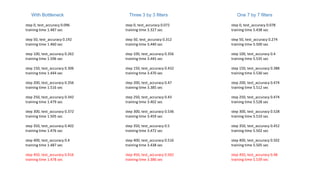
Test: Measure the duration(time) and accuracy of the model using
bottleneck
Data Set: CIFAR
10
32x32x3 , 10
labels
128
7x7x3 Filters
Output:
32x32x128
Model 1
128
7x7x128 Filters
Relu
1 layer
Model 2
128
3x3x128 Filters
Relu each time
3 layers
Model 3
128
3x3x128 Filters
3 layers
+ bn & restore
Total 5 layers
Relu each time
Input:
32x32x128
2by2 Max pooling
Output:
16x16x128
FNCC
&
Softmax
Epoch: 450
Batch size: 100
due to the environment
condition
step 0, test_accuracy 0.078
training time 5.438 sec
step 50, test_accuracy 0.274
training time 5.500 sec
step 100, test_accuracy 0.4
training time 5.535 sec
step 150, test_accuracy 0.388
training time 5.530 sec
step 200, test_accuracy 0.474
training time 5.512 sec
step 250, test_accuracy 0.474
training time 5.528 sec
step 300, test_accuracy 0.528
training time 5.510 sec
step 350, test_accuracy 0.452
training time 5.502 sec
step 400, test_accuracy 0.502
training time 5.505 sec
step 450, test_accuracy 0.48
training time 5.539 sec
step 0, test_accuracy 0.072
training time 3.327 sec
step 50, test_accuracy 0.312
training time 3.440 sec
step 100, test_accuracy 0.356
training time 3.445 sec
step 150, test_accuracy 0.432
training time 3.470 sec
step 200, test_accuracy 0.47
training time 3.385 sec
step 250, test_accuracy 0.43
training time 3.402 sec
step 300, test_accuracy 0.536
training time 3.459 sec
step 350, test_accuracy 0.5
training time 3.472 sec
step 400, test_accuracy 0.516
training time 3.438 sec
step 450, test_accuracy 0.562
training time 3.386 sec
step 0, test_accuracy 0.096
training time 1.487 sec
step 50, test_accuracy 0.192
training time 1.460 sec
step 100, test_accuracy 0.262
training time 1.596 sec
step 150, test_accuracy 0.306
training time 1.444 sec
step 200, test_accuracy 0.356
training time 1.516 sec
step 250, test_accuracy 0.342
training time 1.479 sec
step 300, test_accuracy 0.372
training time 1.505 sec
step 350, test_accuracy 0.402
training time 1.476 sec
step 400, test_accuracy 0.4
training time 1.487 sec
step 450, test_accuracy 0.416
training time 1.478 sec
With Bottleneck Three 3 by 3 filters One 7 by 7 filters
Materials from CS231n Winter : Lecture 11
Bottleneck
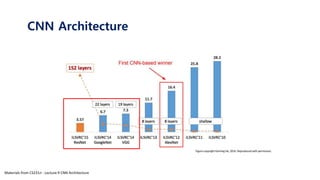
CNN Architecture
VGG/Inception/ResNet
Materials from CS231n : Lecture 9. CNN Architecture
CNN Architecture
Materials from CS231n : Lecture 9 CNN Architecture
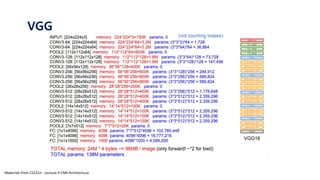
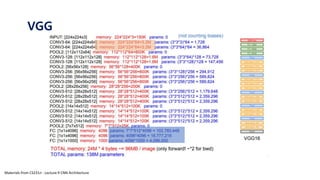
VGG
Materials from CS231n : Lecture 9 CNN Architecture
VGG
Materials from CS231n : Lecture 9 CNN Architecture
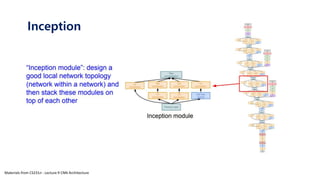
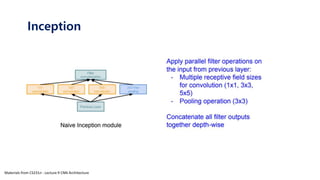
Inception
Materials from CS231n : Lecture 9 CNN Architecture
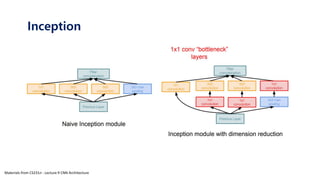
Inception
Materials from CS231n : Lecture 9 CNN Architecture
Inception
Materials from CS231n : Lecture 9 CNN Architecture
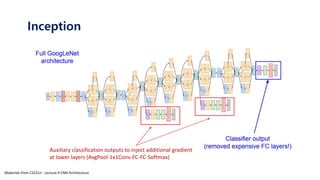
Inception
Auxiliary classification outputs to inject additional gradient
at lower layers (AvgPool-1x1Conv-FC-FC-Softmax)
Materials from CS231n : Lecture 9 CNN Architecture
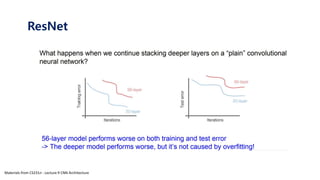
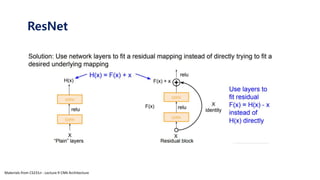
ResNet
Materials from CS231n : Lecture 9 CNN Architecture
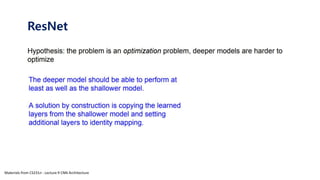
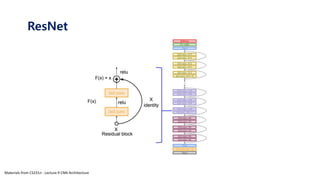
ResNet
Materials from CS231n : Lecture 9 CNN Architecture
ResNet
Materials from CS231n : Lecture 9 CNN Architecture
ResNet
Most of Materials from CS231n
References
http://cs231n.stanford.edu/index.html
Computational Graph
밑바닥부터 시작하는 딥러닝 https://github.com/WegraLee/deep-learning-from-scratch
Inception Model
https://norman3.github.io/papers/docs/google_inception.html
Using tensorflow & tensorboard
https://www.tensorflow.org/get_started/mnist/pros
Tutorials & Programmer’s guide are really useful for me!
https://ratsgo.github.io/deep%20learning/2017/04/05/CNNbackprop/

Tutorial on convolutional neural networks

  • 1.
    Tutorial on Convolutional NeuralNetworks SKKU Data Mining LAB Hojin Yang
  • 2.
    Index Intro Convolution Layer Basics CNNBackprop Implementation CNN in Practice CNN Architecture Most of materials are built upon previous effort of CS231n http://cs231n.stanford.edu/2017/
  • 3.
    Intro Neural Net Left turn Right turn NoLeft turn No Right turn U-turn No U-turn input Pixels(28 by 28) Values from -1 to 1 How would you like to model Neural net?
  • 4.
    Intro Pixels(28 by 28) 784by 3 =2,352params Fully Connected Neural Net 3 by 5 P(Left turn) P(Right turn) P(No Left turn) P(U-turn) P(No U-turn) P(No Right turn) … Cannot preserve spatial structure Need tons of parameters 784by1
  • 5.
    Intro Pixels(28 by 28) ConvolutionalNN P(Left turn) P(Right turn) P(No Left turn) P(U-turn) P(No U-turn) P(No Right turn) Three 7 X 7 filters preserve spatial structure Can reduce the # of params 3x(7x7) =147 params Created image Element-wise product
  • 6.
    Intro Pixels(28 by 28) UseFilters! 7 by 7 filters
  • 7.
    Intro Pixels(28 by 28) UseFilters! P(Left turn) P(Right turn) P(No Left turn) P(U-turn) P(No U-turn) P(No Right turn) 7 by 7 filters
  • 8.
    Intro Pixels(28 by 28) UseFilters! P(Left turn) P(Right turn) P(No Left turn) P(U-turn) P(No U-turn) P(No Right turn) 7 by 7 filters
  • 9.
    Intro There is adiagonal line Right arrow signal on the upper right Vertical line on the mid-left Umm..
  • 10.
    Intro There is adiagonal line Right arrow signal on the upper right Vertical line on the mid-left Must be ‘No turn right’ !
  • 11.
    Convolution Layer Materials fromCS231n : Lecture 5. Convolution Neural Net
  • 12.
    Convolution Layer Materials fromCS231n : Lecture 5. Convolution Neural Net
  • 13.
    Convolution Layer Materials fromCS231n : Lecture 5. Convolution Neural Net
  • 14.
    Convolution Layer Materials fromCS231n : Lecture 5. Convolution Neural Net
  • 15.
    Convolution Layer Materials fromCS231n : Lecture 5. Convolution Neural Net
  • 16.
    Convolution Layer Materials fromCS231n : Lecture 5. Convolution Neural Net
  • 17.
    Convolution Layer 1 01 0 1 1 1 0 1 Filter http://deeplearning.stanford.edu/wiki/index.php/Feature_extraction_using_convolution https://cs.nyu.edu/~fergus/tutorials/deep_learning_cvpr12/
  • 18.
    Convolution Layer Materials fromCS231n : Lecture 5. Convolution Neural Net
  • 19.
    Convolution Layer Materials fromCS231n : Lecture 5. Convolution Neural Net
  • 20.
    Convolution Layer In convolutionalneural networks (CNN) every network layer acts as a detection filter for the presence of specific features or patterns present in the original data. The first layers(filters) in a CNN detect features that can be recognized and interpreted relatively easy. Later layers(filters) detect increasingly features that are more abstract.
  • 21.
    Convolution Layer Test: Interpretfirst layers’ Filters Five 8X8 Filters FNCC Softmax Data Set: mnist 28x28x1
  • 22.
  • 23.
  • 24.
    Convolution Layer Filters Initialize Epoch:200 Epoch: 600 Epoch: 5400 Epoch: 19800 Epoch: 1000 Epoch: 19800 Test accuracy: 0.9778
  • 25.
  • 26.
    Convolution Layer paddingMax pool Sizeof next layer = (L-C+2P)/stride + 1
  • 27.
    CNN Backprop Implementation -Computational Graphs - Backprop using for-loop - im2col
  • 28.
    Computational Graphs A 𝜎A soft max Loss func 𝑥 1 𝑊 1 𝑏 1 𝑊 2 𝑏 2 𝑥 2 𝑙𝑜𝑔𝑖𝑡𝑠 loss 𝑠𝑐𝑎𝑙𝑎𝑟 𝑙𝑎𝑏𝑒𝑙𝑠 𝑦𝑎 1 xW + 𝑏
  • 29.
    Computational Graphs A 𝜎A soft max Loss func 𝑥 1 𝑊 1 𝑏 1 𝑊 2 𝑏 2 𝑥 2 𝑙𝑜𝑔𝑖𝑡𝑠 1 𝑙𝑎𝑏𝑒𝑙𝑠 𝑦 𝜕𝐿/𝜕𝑦 loss 𝑠𝑐𝑎𝑙𝑎𝑟 𝑎 1
  • 30.
    Computational Graphs A 𝜎A soft max Loss func 𝑥 1 𝑊 1 𝑏 1 𝑊 2 𝑏 2 𝑥 2 𝑙𝑜𝑔𝑖𝑡𝑠 1 𝑙𝑎𝑏𝑒𝑙𝑠 𝑦 𝜕𝐿/𝜕𝑦 loss 𝑠𝑐𝑎𝑙𝑎𝑟 𝜕𝐿/𝜕𝑙𝑜𝑔𝑖𝑡𝑠 𝜕𝐿/𝜕𝑏 2 𝜕𝐿/𝜕𝑊 2 𝜕𝐿/𝜕𝑥 2 𝑎 1
  • 31.
    Computational Graphs A 𝜎A soft max Loss func 𝑥 1 𝑊 1 𝑏 1 𝑊 2 𝑏 2 𝑥 2 𝑙𝑜𝑔𝑖𝑡𝑠 1 𝑙𝑎𝑏𝑒𝑙𝑠 𝑦 𝜕𝐿/𝜕𝑦 loss 𝑠𝑐𝑎𝑙𝑎𝑟 𝜕𝐿/𝜕𝑙𝑜𝑔𝑖𝑡𝑠 𝜕𝐿/𝜕𝑏 2 𝜕𝐿/𝜕𝑊 2 𝜕𝐿/𝜕𝑥 2 𝑎 1 𝜕𝐿/𝜕𝑎 2 𝜕𝐿/𝜕𝑏 1 𝜕𝐿/𝜕𝑊 1
  • 32.
    class Affine: def __init__(self,W,b): self.W= W self.b = b self.x = None self.dW = None self.db = None def forward(self,x): self.x = x out = np.dot(W,x) + self.b return out def backward(self,dout): self.db = np.sum(dout,axis=0) self.dW = np.dot(self.x.T,dout) dx = np.dot(dout,self.W.T) return dx A 𝑊 1 𝑏 1 Computational Graphs
  • 33.
    class Affine: def __init__(self,W,b): self.W= W self.b = b self.x = None self.dW = None self.db = None def forward(self,x): self.x = x out = np.dot(W,x) + self.b return out def backward(self,dout): self.db = np.sum(dout,axis=0) self.dW = np.dot(self.x.T,dout) dx = np.dot(dout,self.W.T) return dx A 𝒙 𝟏 𝑊 1 𝑏 1 𝒂 𝟏 Computational Graphs 𝑖𝑛𝑝𝑢𝑡: 𝑜𝑢𝑡𝑝𝑢𝑡: xW + 𝑏
  • 34.
    class Affine: def __init__(self,W,b): self.W= W self.b = b self.x = None self.dW = None self.db = None def forward(self,x): self.x = x out = np.dot(W,x) + self.b return out def backward(self,dout): self.db = np.sum(dout,axis=0) self.dW = np.dot(self.x.T,dout) dx = np.dot(dout,self.W.T) return dx A 𝑊 1 𝑏 1 Computational Graphs 𝑜𝑢𝑡𝑝𝑢𝑡: 𝑖𝑛𝑝𝑢𝑡: 𝝏𝑳/𝝏𝒂 𝝏𝑳/𝝏𝒙 𝝏𝑳/𝝏𝒃 𝝏𝑳/𝝏𝑾 𝒅𝒐𝒖𝒕 𝒙 𝟏
  • 35.
    class Affine: def __init__(self,W,b): self.W= W self.b = b self.x = None self.dW = None self.db = None def forward(self,x): self.x = x out = np.dot(W,x) + self.b return out def backward(self,dout): self.db = np.sum(dout,axis=0) self.dW = np.dot(self.x.T,dout) dx = np.dot(dout,self.W.T) return dx A 𝑊 1 𝑏 1 Computational Graphs 𝑜𝑢𝑡𝑝𝑢𝑡: 𝑖𝑛𝑝𝑢𝑡: 𝝏𝑳/𝝏𝒂 𝝏𝑳/𝝏𝒙 𝝏𝑳/𝝏𝒃 𝝏𝑳/𝝏𝑾 𝒅𝒐𝒖𝒕 + + + 𝒙 𝟏 xW + 𝑏
  • 36.
    class Affine: def __init__(self,W,b): self.W= W self.b = b self.x = None self.dW = None self.db = None def forward(self,x): self.x = x out = np.dot(W,x) + self.b return out def backward(self,dout): self.db = np.sum(dout,axis=0) self.dW = np.dot(self.x.T,dout) dx = np.dot(dout,self.W.T) return dx A 𝑊 1 𝑏 1 Computational Graphs 𝑖𝑛𝑝𝑢𝑡: 𝝏𝑳/𝝏𝒂 𝝏𝑳/𝝏𝒃 𝝏𝑳/𝝏𝑾 𝒅𝒐𝒖𝒕 𝐱 𝐭 × 𝒅𝒐𝒖𝒕 𝑜𝑢𝑡𝑝𝑢𝑡: 𝝏𝑳/𝝏𝒙 𝒙 𝟏 𝒅𝒐𝒖𝒕 × 𝐰 𝐭
  • 37.
    Backprop Using for-Loop conv𝜎 𝑥 1 𝑊 1 𝑥 2𝑎 1 Max pooling 𝑥 2 conv 𝑊 2 𝜎 𝑥 2 Max pooling
  • 38.
    class Conv: def __init__(self,W): self.W= W self.x = None self.dW = None conv 𝑊 1 Backprop Using for-Loop
  • 39.
    conv 𝑥 1 𝑊 1 𝑎1 def forward(self,x): self.x = x #input과 filter의 column(=row) 크기 계산 size_x = self.x.shape[0] size_W = self.W.shape[0] #convolution 크기 계산후 생성 (x-w)/stride + 1 size_c = size_x - size_W + 1 conv_result = np.zeros(shape=(size_c,size_c)) #합성곱 연산 for i in range(size_c) : for j in range(size_c): partial = x[i:i+size_W , j:j+size_W] conv_result[i][j] = partial * size_W return conv_result Backprop Using for-Loop
  • 40.
    conv 𝑥 1 𝑊 1 𝑎1 def forward(self,x): self.x = x #input과 filter의 column(=row) 크기 계산 size_x = self.x.shape[0] size_W = self.W.shape[0] #convolution 크기 계산후 생성 (x-w)/stride + 1 size_c = size_x - size_W + 1 conv_result = np.zeros(shape=(size_c,size_c)) #합성곱 연산 for i in range(size_c) : for j in range(size_c): partial = x[i:i+size_W , j:j+size_W] conv_result[i][j] = partial * size_W return conv_result Backprop Using for-Loop
  • 41.
    conv 𝑥 1 𝑊 1 𝑎1 def forward(self,x): self.x = x #input과 filter의 column(=row) 크기 계산 size_x = self.x.shape[0] size_W = self.W.shape[0] #convolution 크기 계산후 생성 (x-w)/stride + 1 size_c = size_x - size_W + 1 conv_result = np.zeros(shape=(size_c,size_c)) #합성곱 연산 for i in range(size_c) : for j in range(size_c): partial = x[i:i+size_W , j:j+size_W] conv_result[i][j] = partial * size_W return conv_result Backprop Using for-Loop
  • 42.
  • 43.
    X 𝑎 𝑐 Backprop Using for-Loop 𝑏 X 𝑎 𝑑𝐿 𝑑𝑐 𝑏 BeforeCNN Backprop.. 𝑑𝐿 𝑑𝑐 ∙ 𝑏 𝑑𝐿 𝑑𝑐 ∙ 𝑎
  • 44.
    𝑎(𝑚𝑎𝑡𝑟𝑖𝑥) 𝑐(scalar) Backprop Using for-Loop 𝑏(𝑚𝑎𝑡𝑟𝑖𝑥) conv 𝑎 𝑑𝐿 𝑑𝑐 𝑏 BeforeCNN Backprop.. conv 𝑎1 𝑏1 + 𝑎2 𝑏2 + 𝑎3 𝑏3 + ⋯ 𝑎 𝑛 𝑏 𝑛 = 𝑐
  • 45.
    𝑐(scalar) Backprop Using for-Loop conv 𝑎 𝑑𝐿 𝑑𝑐 𝑏 BeforeCNN Backprop.. 𝑑𝐿 𝑑𝑐 ∙ 𝑏 𝑑𝐿 𝑑𝑐 ∙ 𝑎 conv 𝑎(𝑚𝑎𝑡𝑟𝑖𝑥) 𝑏(𝑚𝑎𝑡𝑟𝑖𝑥) 𝑎1 𝑏1 + 𝑎2 𝑏2 + 𝑎3 𝑏3 + ⋯ 𝑎 𝑛 𝑏 𝑛 = 𝑐
  • 46.
    conv 𝑥 1 𝑊 1 𝑎1 def backward(self, dout): #input과 filter,x의 column(=row) 크기 계산 size_x = self.x.shape[0] #column(=row) 크기 size_W = self.W.shape[0] size_dout = dout.shape[0] #filter의 미분 결과 matrix self.dW = np.zeros(shape=(size_W,size_W)) #x의 미분 결과 matrix dx = np.zeros(shape=(size_x,size_x)) for i in range(size_dout) : for j in range(size_dout) : partial = self.x[i:i+size_W, j:j+size_W] self.dW += dout[i][j] * partial dx[i:i+size_W,j:j+size+W] += dout[i][j] * self.W return dx Backprop Using for-Loop
  • 47.
    conv 𝑥 1 𝑊 1 𝑎1 Backprop Using for-Loop def backward(self, dout): #input과 filter,x의 column(=row) 크기 계산 size_x = self.x.shape[0] #column(=row) 크기 size_W = self.W.shape[0] size_dout = dout.shape[0] #filter의 미분 결과 matrix self.dW = np.zeros(shape=(size_W,size_W)) #x의 미분 결과 matrix dx = np.zeros(shape=(size_x,size_x)) for i in range(size_dout) : for j in range(size_dout) : partial = self.x[i:i+size_W, j:j+size_W] self.dW += dout[i][j] * partial dx[i:i+size_W,j:j+size+W] += dout[i][j] * self.W return dx
  • 48.
    conv 𝑥 1 𝑊 1 𝑎1 Backprop Using for-Loop def backward(self, dout): #input과 filter,x의 column(=row) 크기 계산 size_x = self.x.shape[0] #column(=row) 크기 size_W = self.W.shape[0] size_dout = dout.shape[0] #filter의 미분 결과 matrix self.dW = np.zeros(shape=(size_W,size_W)) #x의 미분 결과 matrix dx = np.zeros(shape=(size_x,size_x)) for i in range(size_dout) : for j in range(size_dout) : partial = self.x[i:i+size_W, j:j+size_W] self.dW += dout[i][j] * partial dx[i:i+size_W,j:j+size+W] += dout[i][j] * self.W return dx
  • 49.
    im2col There are highlyoptimized matrix multiplication routines for just about every platform(ex. Numpy) -> turn convolution into matrix multiplication!
  • 50.
    im2col Materials from CS231nWinter : Lecture 11
  • 51.
    im2col def im2col(input_data,filter_h, filter_w, stride=1, pad=0): """다수의 이미지를 입력받아 2차원 배열로 변환한다(평탄화). Parameters ---------- input_data : 4차원 배열 형태의 입력 데이터(이미지 수, 채널 수, 높이, 너비) filter_h : 필터의 높이 filter_w : 필터의 너비 stride : 스트라이드 pad : 패딩 Returns ------- col : 2차원 배열 """ N, C, H, W = input_data.shape out_h = (H + 2*pad - filter_h)//stride + 1 out_w = (W + 2*pad - filter_w)//stride + 1 img = np.pad(input_data, [(0,0), (0,0), (pad, pad), (pad, pad)], 'constant') col = np.zeros((N, C, filter_h, filter_w, out_h, out_w)) for y in range(filter_h): y_max = y + stride*out_h for x in range(filter_w): x_max = x + stride*out_w col[:, :, y, x, :, :] = img[:, :, y:y_max:stride, x:x_max:stride] col = col.transpose(0, 4, 5, 1, 2, 3).reshape(N*out_h*out_w, -1) return col https://github.com/WegraLee/deep-learning-from-scratch/blob/master/common/util.py
  • 52.
    10 Backprop Using for-Loop Simple2 by 2 Max-pooling Max Pool 10 9 8 7 𝑦′Max Pool 𝑦′ 0 0 0
  • 53.
    CNN in Practice EffectiveReceptive Field Bottleneck
  • 54.
  • 55.
    input Result 1 Receptivefield : 3 by 3 Effective Receptive Field
  • 56.
    input Result 1 Receptivefield : 3 by 3 Result 2 Receptive field : 3 by 3 Effective Receptive Field
  • 57.
    1 9 input Result 1 12 3 4 5 6 7 8 9 Result 2 Effective Receptive field : 5 by 5 Effective Receptive Field
  • 58.
    ERF : 5X 5 ERF : 5 X 5 ERF : 5 X 5 ERF : 7 X 7 ERF : 7 X 7 Effective Receptive Field Materials from CS231n Winter : Lecture 11
  • 59.
    ERF : 5X 5 ERF : 5 X 5 ERF : 5 X 5 ERF : 7 X 7 ERF : 7 X 7 Effective Receptive Field Materials from CS231n Winter : Lecture 11
  • 60.
    ERF : 5X 5 ERF : 5 X 5 ERF : 5 X 5 ERF : 7 X 7 ERF : 7 X 7 Effective Receptive Field Materials from CS231n Winter : Lecture 11
  • 61.
    ERF : 5X 5 ERF : 5 X 5 ERF : 5 X 5 ERF : 7 X 7 ERF : 7 X 7 Fewer Parameters Less compute More nonlinearity GOOD! Effective Receptive Field Materials from CS231n Winter : Lecture 11
  • 62.
  • 63.
  • 64.
  • 65.
  • 66.
  • 67.
  • 68.
    H W C … H W C # of filter=c 3 3C … # of filter=c … # of filter=c Bottleneck
  • 69.
    H W C … H W C # of filter=c 3 3C … # of filter=c … # of filter=c H W C 1 1 C … # of filter=c/2 Bottleneck
  • 70.
    H W C … H W C # of filter=c 3 3C … # of filter=c … # of filter=c H W C 1 1 C … # of filter=c/2 C/2 H W Bottleneck
  • 71.
    H W C … H W C # of filter=c 3 3C … # of filter=c … # of filter=c H W C 1 1 C … # of filter=c/2 C/2 H W … # of filter=c/2 3 3 c/2 Bottleneck
  • 72.
    H W C … H W C # of filter=c 3 3C … # of filter=c … # of filter=c H W C 1 1 C … # of filter=c/2 C/2 H W … # of filter=c/2 3 3 c/2 Bottleneck
  • 73.
    H W C … H W C # of filter=c 3 3C … # of filter=c … # of filter=c H W C 1 1 C … # of filter=c/2 C/2 H W … # of filter=c/2 3 3 c/2 Bottleneck
  • 74.
    H W C … H W C # of filter=c 3 3C … # of filter=c … # of filter=c H W C 1 1 C … # of filter=c/2 C/2 H W … # of filter=c/2 3 3 c/2 1 1 C/2 … # of filter=c Bottleneck
  • 75.
    H W C … H W C # of filter=c 3 3C … # of filter=c … # of filter=c H W C 1 1 C … # of filter=c/2 C/2 H W … # of filter=c/2 3 3 c/2 1 1 C/2 … # of filter=c H W C Bottleneck
  • 76.
    Materials from CS231nWinter : Lecture 11 Bottleneck
  • 77.
    Materials from CS231nWinter : Lecture 11 Bottleneck
  • 78.
    Materials from CS231nWinter : Lecture 11 Bottleneck
  • 79.
    Bottleneck Test: Measure theduration(time) and accuracy of the model using bottleneck Data Set: CIFAR 10 32x32x3 , 10 labels 128 7x7x3 Filters Output: 32x32x128 Model 1 128 7x7x128 Filters Relu 1 layer Model 2 128 3x3x128 Filters Relu each time 3 layers Model 3 128 3x3x128 Filters 3 layers + bn & restore Total 5 layers Relu each time Input: 32x32x128 2by2 Max pooling Output: 16x16x128 FNCC & Softmax Epoch: 450 Batch size: 100 due to the environment condition
  • 81.
    step 0, test_accuracy0.078 training time 5.438 sec step 50, test_accuracy 0.274 training time 5.500 sec step 100, test_accuracy 0.4 training time 5.535 sec step 150, test_accuracy 0.388 training time 5.530 sec step 200, test_accuracy 0.474 training time 5.512 sec step 250, test_accuracy 0.474 training time 5.528 sec step 300, test_accuracy 0.528 training time 5.510 sec step 350, test_accuracy 0.452 training time 5.502 sec step 400, test_accuracy 0.502 training time 5.505 sec step 450, test_accuracy 0.48 training time 5.539 sec step 0, test_accuracy 0.072 training time 3.327 sec step 50, test_accuracy 0.312 training time 3.440 sec step 100, test_accuracy 0.356 training time 3.445 sec step 150, test_accuracy 0.432 training time 3.470 sec step 200, test_accuracy 0.47 training time 3.385 sec step 250, test_accuracy 0.43 training time 3.402 sec step 300, test_accuracy 0.536 training time 3.459 sec step 350, test_accuracy 0.5 training time 3.472 sec step 400, test_accuracy 0.516 training time 3.438 sec step 450, test_accuracy 0.562 training time 3.386 sec step 0, test_accuracy 0.096 training time 1.487 sec step 50, test_accuracy 0.192 training time 1.460 sec step 100, test_accuracy 0.262 training time 1.596 sec step 150, test_accuracy 0.306 training time 1.444 sec step 200, test_accuracy 0.356 training time 1.516 sec step 250, test_accuracy 0.342 training time 1.479 sec step 300, test_accuracy 0.372 training time 1.505 sec step 350, test_accuracy 0.402 training time 1.476 sec step 400, test_accuracy 0.4 training time 1.487 sec step 450, test_accuracy 0.416 training time 1.478 sec With Bottleneck Three 3 by 3 filters One 7 by 7 filters
  • 82.
    Materials from CS231nWinter : Lecture 11 Bottleneck
  • 83.
    CNN Architecture VGG/Inception/ResNet Materials fromCS231n : Lecture 9. CNN Architecture
  • 84.
    CNN Architecture Materials fromCS231n : Lecture 9 CNN Architecture
  • 85.
    VGG Materials from CS231n: Lecture 9 CNN Architecture
  • 86.
    VGG Materials from CS231n: Lecture 9 CNN Architecture
  • 87.
    Materials from CS231n: Lecture 9 CNN Architecture Inception
  • 88.
    Materials from CS231n: Lecture 9 CNN Architecture Inception
  • 89.
    Materials from CS231n: Lecture 9 CNN Architecture Inception
  • 90.
    Materials from CS231n: Lecture 9 CNN Architecture Inception Auxiliary classification outputs to inject additional gradient at lower layers (AvgPool-1x1Conv-FC-FC-Softmax)
  • 91.
    Materials from CS231n: Lecture 9 CNN Architecture ResNet
  • 92.
    Materials from CS231n: Lecture 9 CNN Architecture ResNet
  • 93.
    Materials from CS231n: Lecture 9 CNN Architecture ResNet
  • 94.
    Materials from CS231n: Lecture 9 CNN Architecture ResNet
  • 95.
    Most of Materialsfrom CS231n References http://cs231n.stanford.edu/index.html Computational Graph 밑바닥부터 시작하는 딥러닝 https://github.com/WegraLee/deep-learning-from-scratch Inception Model https://norman3.github.io/papers/docs/google_inception.html Using tensorflow & tensorboard https://www.tensorflow.org/get_started/mnist/pros Tutorials & Programmer’s guide are really useful for me! https://ratsgo.github.io/deep%20learning/2017/04/05/CNNbackprop/