Presented by : Kaustubh Singh
Pharm.D (PB) 1st Year
School of Pharmaceutical Sciences
SGRR University
INTRODUCTION
-It is a group of procedures that measures the function of
the lungs.
-Pulmonary function tests can provide valuable information
about the important individual processes that support gas
exchange.
CATEGORIES OF PFT
There are 2 categories of PFT measuring
i. Dynamic lung function test.
ii. Static lung function test.
.
PURPOSE OF PFT
- T
o identify and quantify the changes in pulmonary function
due to any disease.
- Evaluate effectiveness of therapy.
- Perform epidemiological surveillance for pulmonary disease.
- Assess patients for risk of postoperative complications.
- Determine pulmonary disability.
PATHOPHYSIOLOGY
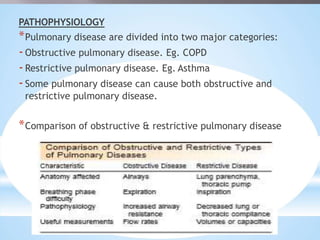
*Pulmonary disease are divided into two major categories:
-Obstructive pulmonary disease. Eg. COPD
-Restrictive pulmonary disease. Eg. Asthma
-Some pulmonary disease can cause both obstructive and
restrictive pulmonary disease.
*Comparison of obstructive & restrictive pulmonary disease
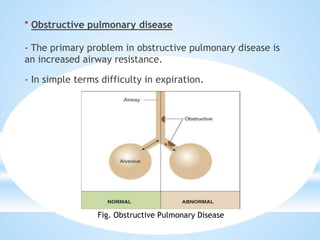
* Obstructive pulmonary disease
- The primary problem in obstructive pulmonary disease is
an increased airway resistance.
- In simple terms difficulty in expiration.
Fig. Obstructive Pulmonary Disease
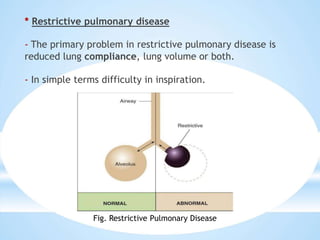
* Restrictive pulmonary disease
- The primary problem in restrictive pulmonary disease is
reduced lung compliance, lung volume or both.
- In simple terms difficulty in inspiration.
Fig. Restrictive Pulmonary Disease
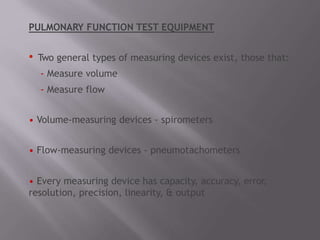
PULMONARY FUNCTION TEST EQUIPMENT
• Two general types of measuring devices exist, those that:
- Measure volume
- Measure flow
• Volume-measuring devices - spirometers
• Flow-measuring devices - pneumotachometers
• Every measuring device has capacity, accuracy, error,
resolution, precision, linearity, & output
SPIROMETRY
*It is the measurement of air entering and leaving lungs
which includes measurement of several values of forced
airflow and volume during inspiration and expiration.
• Tests of pulmonary mechanics:
-Forced vital capacity (FVC)
-Forced expiratory volume in 1 second (FEV1)
-Other forced expiratory flow measurements
-Maximum voluntary ventilation
• These measurements assess ability of lungs to move large
volumes of air quickly through airways
PURPOSE/IMPORTANCE OF SPIROMETRY
• The purpose of spirometry is to assess the ability of the
lungs to move large volumes of air quickly through the
airways to identify airway obstruction.
• Measuring flow rates is a surrogate for measuring airway
resistance.
• T
o a lesser extent spirometry can also identify and quantify
a restrictive type of pulmonary disease.
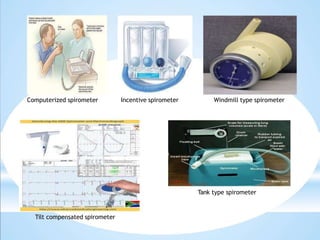
TYPES OF SPIROMETRY
-Computerized spirometer
-Incentive spirometer
-Tilt compensated spirometer
-Windmill type spirometer
-Tank type spirometer
Computerized spirometer Incentive spirometer Windmill type spirometer
Tank type spirometer
Tilt compensated spirometer
CONTRAINDICATIONS OF SPIROMETRY
It should not be indicated for persons with,
-Haemoptysis of unknown origin
-Pneumothorax
-Unstable angina pectoris
-Recent myocardial infarction
-Thoracic aneurysms, abdominal aneurysms, cerebral
aneurysms.
-Recent eye surgery ( intraocular pressure during forced
expiration)
-History of syncope associated with forced expiration
-Patient with active Tuberculosis should not be tested
PRECAUTIONS TO BE TAKEN FOR SPIROMETRY
-Persons with high blood pressure
-Semi-comatic patients
-Patients with age of 80yrs or more
-The subject should be healthy (free from asthma)
-No air leaks in the apparatus (or else will give inaccurate
readings)
-The mouth piece should be sterilized
-The water chamber should not be overfilled (or it may
enter air tubes)
PARAMETERS OF PFT
 Forced vital capacity (FVC)
 Forced expiratory volume (FEV)
 Respiratory minute volume (RMV)
 Maximal voluntary ventilation (MVV)
 Peak respiratory flow rate (PEFR)
*Forced vital capacity
Volume of air that can be exhaled forcefully and rapidly after deep inspiration.
 DYNAMIC LUNG FUNCTION TEST
It is based on time i.e. rate at which air flow into and out of the
lungs.
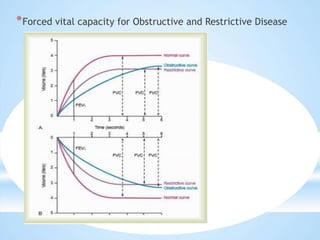
*Forced vital capacity for Obstructive and Restrictive Disease
* Forced expiratory volume
Volume of air which can be expired forcefully in a given unit of time (after
deep inspiration).
It is also known as timed vital capacity.
* Respiratory minute volume
Volume of air breathed in and out every minute.
 RMV= TV x RR
*Maximal voluntary ventilation
Maximum volume of air which can be breath in and out by forcefully
respiration in one minute.
It is also known as maximum breathing capacity.
 150-170 L/Min
* Peak respiratory flow rate
Maximum rate at which air can be expire after a deep inspiration.
 400 L/Min
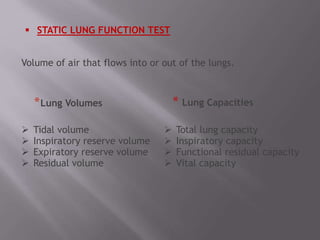
 STATIC LUNG FUNCTION TEST
Volume of air that flows into or out of the lungs.
*Lung Volumes * Lung Capacities
 Tidal volume
 Inspiratory reserve volume
 Expiratory reserve volume
 Residual volume
 Total lung capacity
 Inspiratory capacity
 Functional residual capacity
 Vital capacity
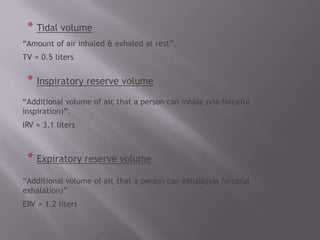
* Tidal volume
“Amount of air inhaled & exhaled at rest”.
TV = 0.5 liters
* Inspiratory reserve volume
“Additional volume of air
, that a person can inhale (via forceful
inspiration)”.
IRV = 3.1 liters
* Expiratory reserve volume
“Additional volume of air
, that a person can exhale(via forceful
exhalation)”
ERV = 1.2 liters
* Residual volume
“Volume of air remaining in the lung, even after forceful exhalation”
 RV = 1.2 liters
Lung Capacities
* Total lung capacity
T
otal volume of air a person can inspire after normal expiration”
 IC = (TV + IRV) = (0.5 + 3.1 ) liters = 3.6 liters.
* Inspiratory capacity
T
otal amount of air contained in the lungs after maximal inhalation”
 TLC = (RV + ERV + TV + IRV) = (1.2 + 1.2 + 0.5 + 3.1) liters = 6 liters.
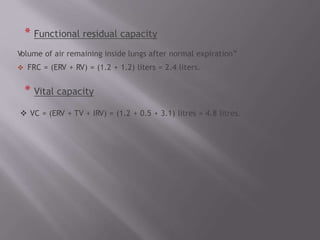
* Functional residual capacity
Volume of air remaining inside lungs after normal expiration”
 FRC = (ERV + RV) = (1.2 + 1.2) liters = 2.4 liters.
* Vital capacity
 VC = (ERV + TV + IRV) = (1.2 + 0.5 + 3.1) litres = 4.8 litres.
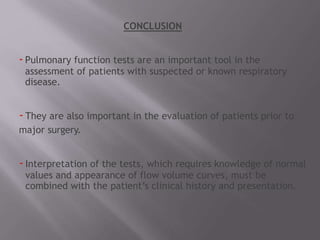
CONCLUSION
-Pulmonary function tests are an important tool in the
assessment of patients with suspected or known respiratory
disease.
-They are also important in the evaluation of patients prior to
major surgery.
-Interpretation of the tests, which requires knowledge of normal
values and appearance of flow volume curves, must be
combined with the patient’s clinical history and presentation.
THANK YOU!

Introduction to Pulmonary function test

  • 1.
    Presented by :Kaustubh Singh Pharm.D (PB) 1st Year School of Pharmaceutical Sciences SGRR University
  • 2.
    INTRODUCTION -It is agroup of procedures that measures the function of the lungs. -Pulmonary function tests can provide valuable information about the important individual processes that support gas exchange. CATEGORIES OF PFT There are 2 categories of PFT measuring i. Dynamic lung function test. ii. Static lung function test. .
  • 3.
    PURPOSE OF PFT -T o identify and quantify the changes in pulmonary function due to any disease. - Evaluate effectiveness of therapy. - Perform epidemiological surveillance for pulmonary disease. - Assess patients for risk of postoperative complications. - Determine pulmonary disability.
  • 4.
    PATHOPHYSIOLOGY *Pulmonary disease aredivided into two major categories: -Obstructive pulmonary disease. Eg. COPD -Restrictive pulmonary disease. Eg. Asthma -Some pulmonary disease can cause both obstructive and restrictive pulmonary disease. *Comparison of obstructive & restrictive pulmonary disease
  • 5.
    * Obstructive pulmonarydisease - The primary problem in obstructive pulmonary disease is an increased airway resistance. - In simple terms difficulty in expiration. Fig. Obstructive Pulmonary Disease
  • 6.
    * Restrictive pulmonarydisease - The primary problem in restrictive pulmonary disease is reduced lung compliance, lung volume or both. - In simple terms difficulty in inspiration. Fig. Restrictive Pulmonary Disease
  • 7.
    PULMONARY FUNCTION TESTEQUIPMENT • Two general types of measuring devices exist, those that: - Measure volume - Measure flow • Volume-measuring devices - spirometers • Flow-measuring devices - pneumotachometers • Every measuring device has capacity, accuracy, error, resolution, precision, linearity, & output
  • 8.
    SPIROMETRY *It is themeasurement of air entering and leaving lungs which includes measurement of several values of forced airflow and volume during inspiration and expiration. • Tests of pulmonary mechanics: -Forced vital capacity (FVC) -Forced expiratory volume in 1 second (FEV1) -Other forced expiratory flow measurements -Maximum voluntary ventilation • These measurements assess ability of lungs to move large volumes of air quickly through airways
  • 9.
    PURPOSE/IMPORTANCE OF SPIROMETRY •The purpose of spirometry is to assess the ability of the lungs to move large volumes of air quickly through the airways to identify airway obstruction. • Measuring flow rates is a surrogate for measuring airway resistance. • T o a lesser extent spirometry can also identify and quantify a restrictive type of pulmonary disease.
  • 10.
    TYPES OF SPIROMETRY -Computerizedspirometer -Incentive spirometer -Tilt compensated spirometer -Windmill type spirometer -Tank type spirometer
  • 11.
    Computerized spirometer Incentivespirometer Windmill type spirometer Tank type spirometer Tilt compensated spirometer
  • 12.
    CONTRAINDICATIONS OF SPIROMETRY Itshould not be indicated for persons with, -Haemoptysis of unknown origin -Pneumothorax -Unstable angina pectoris -Recent myocardial infarction -Thoracic aneurysms, abdominal aneurysms, cerebral aneurysms. -Recent eye surgery ( intraocular pressure during forced expiration) -History of syncope associated with forced expiration -Patient with active Tuberculosis should not be tested
  • 13.
    PRECAUTIONS TO BETAKEN FOR SPIROMETRY -Persons with high blood pressure -Semi-comatic patients -Patients with age of 80yrs or more -The subject should be healthy (free from asthma) -No air leaks in the apparatus (or else will give inaccurate readings) -The mouth piece should be sterilized -The water chamber should not be overfilled (or it may enter air tubes)
  • 14.
    PARAMETERS OF PFT Forced vital capacity (FVC)  Forced expiratory volume (FEV)  Respiratory minute volume (RMV)  Maximal voluntary ventilation (MVV)  Peak respiratory flow rate (PEFR) *Forced vital capacity Volume of air that can be exhaled forcefully and rapidly after deep inspiration.  DYNAMIC LUNG FUNCTION TEST It is based on time i.e. rate at which air flow into and out of the lungs.
  • 15.
    *Forced vital capacityfor Obstructive and Restrictive Disease
  • 16.
    * Forced expiratoryvolume Volume of air which can be expired forcefully in a given unit of time (after deep inspiration). It is also known as timed vital capacity. * Respiratory minute volume Volume of air breathed in and out every minute.  RMV= TV x RR
  • 17.
    *Maximal voluntary ventilation Maximumvolume of air which can be breath in and out by forcefully respiration in one minute. It is also known as maximum breathing capacity.  150-170 L/Min * Peak respiratory flow rate Maximum rate at which air can be expire after a deep inspiration.  400 L/Min
  • 18.
     STATIC LUNGFUNCTION TEST Volume of air that flows into or out of the lungs. *Lung Volumes * Lung Capacities  Tidal volume  Inspiratory reserve volume  Expiratory reserve volume  Residual volume  Total lung capacity  Inspiratory capacity  Functional residual capacity  Vital capacity
  • 19.
    * Tidal volume “Amountof air inhaled & exhaled at rest”. TV = 0.5 liters * Inspiratory reserve volume “Additional volume of air , that a person can inhale (via forceful inspiration)”. IRV = 3.1 liters * Expiratory reserve volume “Additional volume of air , that a person can exhale(via forceful exhalation)” ERV = 1.2 liters
  • 20.
    * Residual volume “Volumeof air remaining in the lung, even after forceful exhalation”  RV = 1.2 liters Lung Capacities * Total lung capacity T otal volume of air a person can inspire after normal expiration”  IC = (TV + IRV) = (0.5 + 3.1 ) liters = 3.6 liters. * Inspiratory capacity T otal amount of air contained in the lungs after maximal inhalation”  TLC = (RV + ERV + TV + IRV) = (1.2 + 1.2 + 0.5 + 3.1) liters = 6 liters.
  • 21.
    * Functional residualcapacity Volume of air remaining inside lungs after normal expiration”  FRC = (ERV + RV) = (1.2 + 1.2) liters = 2.4 liters. * Vital capacity  VC = (ERV + TV + IRV) = (1.2 + 0.5 + 3.1) litres = 4.8 litres.
  • 22.
    CONCLUSION -Pulmonary function testsare an important tool in the assessment of patients with suspected or known respiratory disease. -They are also important in the evaluation of patients prior to major surgery. -Interpretation of the tests, which requires knowledge of normal values and appearance of flow volume curves, must be combined with the patient’s clinical history and presentation.
  • 23.