STAGES of READING DEVELOPMENT The Major Qualitative Characteristics and How They Are Acquired
Stage 0:  “Pseudo Reading” Preschool (ages 6 months to 6 years)
Stage 0: Pre-reading Stage: Unsystematic accumulation of understandings about reading between pre-school and kindergarten. Stage 1:Initial Reading or Decoding Stage (grades 1-2;  Ages 6-7 ) Student's central task is learning arbitrary letters and associating them with corresponding parts of spoken words.  Learner acquires knowledge about reading.  Phonics.
Stage 2: Confirmation, Fluency, Ungluing from Print, Automaticity Stage (grades 2-3; Ages 7-8) Consolidation of what was learned in Stage 1.  Requires reading many easy and familiar books for developmental reading.  Gradual increase in functional and recreational reading.  Common use of the basal readers.  Functional reading is important - content area texts.  Range of possible recreational reading increas es.
Stage 3: Reading for Learning the New Stage: A First Step (Grades 4-8; ages 9-13) Readers need to bring prior knowledge to their reading. Children acquire facts. Stage 4: Multiple Viewpoints Stage: (High School; Ages 14-18) Should include instruction in reading/study skills and reading strategies for success. Stage 5:Construction & Reconstruction Stage: College; Ages 18 & beyond) Adult literacy should stress acquisition of skills useful to the participants and the ability to apply those skills.
Stage 0 Major Qualitative Characteristics and Masteries by End of Stage Pretend reading Retells story from pictures Names alphabet letters Prints own name Plays with books, pencils, paper
Stage 0 •  How it’s Acquired Being read to by someone who responds to child’s interest Being provided with books, paper, pencils, letters, time
Stage 0 • Relationship of Reading to Listening Most can understand children’s picture books and stories read to them Can understand thousands of the words they hear by age 6, but can read few if any of them
Stage 1: Initial reading and decoding Grade 1 and beginning Grade 2 (ages 6 and 7)
Stage 1 Major Qualitative Characteristics and Masteries by End of Stage Learns relation between letters and sounds and between printed and spoken words Able to read simple text containing high-frequency words and phonically regular words Sounds out new one-syllable words
Stage 1 • How it’s acquired Direct instruction and practice in letter-sound relationships Reading of simple stories using simple phonic patterns and high frequency words Being read to at a higher level to develop advanced language patterns, new words, and ideas
Stage 1 • Relationship of Reading to Listening Child’s reading level is much below the  language that is understood when heard At end of stage, most children understand 6,000 or more words but can read only about 600.
Stage 2:  Confirmation and Fluency Grades 2 and 3 (ages 7 and 8)
Stage 2 Major Qualitative Characteristics and Masteries by End of Stage Reads simple stories with increasing fluency Learns to consolidate decoding, sight vocabulary, & meaning context to read stories and selections
Stage 2 How it’s acquired Direct instruction in advanced decoding skills Wide reading w/ instructional and independent materials Being read to at levels above their own to develop language, vocabulary and concepts
Stage 2 Relationship of Reading to Listening About 3,000 words can be read 9,000 or more words in listening vocabulary Listening is still more effective than reading
Stage 3:  Reading for Learning the New Grades 4-8 (ages 9-13)
Stage 3: Phase A & B A. Intermediate, grades 4-6 B. Junior high school, grades 7-9
Stage 3 Major Qualitative Characteristics and Masteries by End of Stage For the first time, may be responsible for reading independently to -learn new ideas,  -gain new knowledge, -experience new feelings and attitudes Generally from one viewpoint
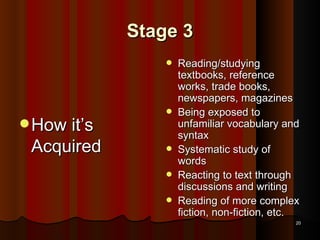
Stage 3 How it’s  Acquired Reading/studying textbooks, reference works, trade books, newspapers, magazines Being exposed to unfamiliar vocabulary and syntax  Systematic study of words  Reacting to text through discussions and writing Reading of more complex fiction, non-fiction, etc.
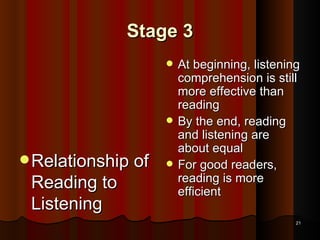
Stage 3 Relationship of Reading to Listening At beginning, listening comprehension is still more effective than reading By the end, reading and listening are about equal  For good readers, reading is more efficient
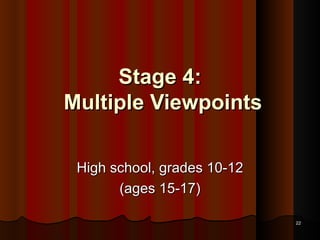
Stage 4:  Multiple Viewpoints High school, grades 10-12 (ages 15-17)
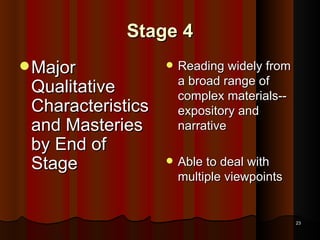
Stage 4 Major Qualitative Characteristics and Masteries by End of Stage Reading widely from a broad range of complex materials--expository and narrative Able to deal with multiple viewpoints
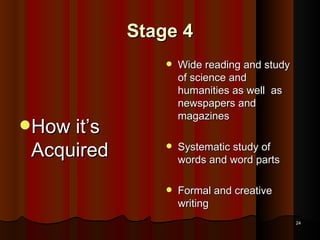
Stage 4 How it’s Acquired Wide reading and study of science and humanities as well  as newspapers and magazines Systematic study of words and word parts Formal and creative writing
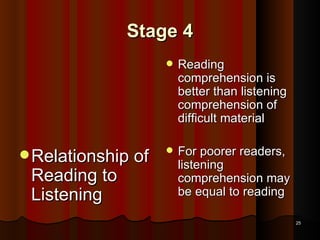
Stage 4 Relationship of Reading to Listening Reading comprehension is better than listening comprehension of difficult material For poorer readers, listening comprehension may be equal to reading
Stage 5:  Construction and Reconstruction College and beyond (age 18+)
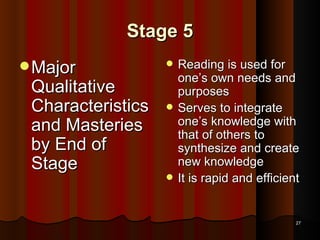
Stage 5 Major Qualitative Characteristics and Masteries by End of Stage Reading is used for one’s own needs and purposes Serves to integrate one’s knowledge with that of others to synthesize and create new knowledge It is rapid and efficient
Stage 5 How it’s Acquired Wide reading of ever more difficult materials Writing papers, tests, essays that call for integration of varied knowledge and points of view
Stage 5 Relationship of Reading to Listening Reading is more efficient than listening
Implications: Stage 3 is necessary for the industrial workplace Stage 4 is an absolute for the informational age Many readers never get beyond Stage 3 and most reading instruction ends before students are adept at Stage 3 skills Most remediation is done in Stage 1 and Stage 2 as well as Stage 3A However, Stage 3A depends so heavily on adequate Stage 1 & 2 skills that decoding and fluency may be more important for older students whose comprehension seems low

Stages of Reading Development

  • 1.
    STAGES of READINGDEVELOPMENT The Major Qualitative Characteristics and How They Are Acquired
  • 2.
    Stage 0: “Pseudo Reading” Preschool (ages 6 months to 6 years)
  • 3.
    Stage 0: Pre-readingStage: Unsystematic accumulation of understandings about reading between pre-school and kindergarten. Stage 1:Initial Reading or Decoding Stage (grades 1-2; Ages 6-7 ) Student's central task is learning arbitrary letters and associating them with corresponding parts of spoken words. Learner acquires knowledge about reading. Phonics.
  • 4.
    Stage 2: Confirmation,Fluency, Ungluing from Print, Automaticity Stage (grades 2-3; Ages 7-8) Consolidation of what was learned in Stage 1. Requires reading many easy and familiar books for developmental reading. Gradual increase in functional and recreational reading. Common use of the basal readers. Functional reading is important - content area texts. Range of possible recreational reading increas es.
  • 5.
    Stage 3: Readingfor Learning the New Stage: A First Step (Grades 4-8; ages 9-13) Readers need to bring prior knowledge to their reading. Children acquire facts. Stage 4: Multiple Viewpoints Stage: (High School; Ages 14-18) Should include instruction in reading/study skills and reading strategies for success. Stage 5:Construction & Reconstruction Stage: College; Ages 18 & beyond) Adult literacy should stress acquisition of skills useful to the participants and the ability to apply those skills.
  • 6.
    Stage 0 MajorQualitative Characteristics and Masteries by End of Stage Pretend reading Retells story from pictures Names alphabet letters Prints own name Plays with books, pencils, paper
  • 7.
    Stage 0 • How it’s Acquired Being read to by someone who responds to child’s interest Being provided with books, paper, pencils, letters, time
  • 8.
    Stage 0 •Relationship of Reading to Listening Most can understand children’s picture books and stories read to them Can understand thousands of the words they hear by age 6, but can read few if any of them
  • 9.
    Stage 1: Initialreading and decoding Grade 1 and beginning Grade 2 (ages 6 and 7)
  • 10.
    Stage 1 MajorQualitative Characteristics and Masteries by End of Stage Learns relation between letters and sounds and between printed and spoken words Able to read simple text containing high-frequency words and phonically regular words Sounds out new one-syllable words
  • 11.
    Stage 1 •How it’s acquired Direct instruction and practice in letter-sound relationships Reading of simple stories using simple phonic patterns and high frequency words Being read to at a higher level to develop advanced language patterns, new words, and ideas
  • 12.
    Stage 1 •Relationship of Reading to Listening Child’s reading level is much below the language that is understood when heard At end of stage, most children understand 6,000 or more words but can read only about 600.
  • 13.
    Stage 2: Confirmation and Fluency Grades 2 and 3 (ages 7 and 8)
  • 14.
    Stage 2 MajorQualitative Characteristics and Masteries by End of Stage Reads simple stories with increasing fluency Learns to consolidate decoding, sight vocabulary, & meaning context to read stories and selections
  • 15.
    Stage 2 Howit’s acquired Direct instruction in advanced decoding skills Wide reading w/ instructional and independent materials Being read to at levels above their own to develop language, vocabulary and concepts
  • 16.
    Stage 2 Relationshipof Reading to Listening About 3,000 words can be read 9,000 or more words in listening vocabulary Listening is still more effective than reading
  • 17.
    Stage 3: Reading for Learning the New Grades 4-8 (ages 9-13)
  • 18.
    Stage 3: PhaseA & B A. Intermediate, grades 4-6 B. Junior high school, grades 7-9
  • 19.
    Stage 3 MajorQualitative Characteristics and Masteries by End of Stage For the first time, may be responsible for reading independently to -learn new ideas, -gain new knowledge, -experience new feelings and attitudes Generally from one viewpoint
  • 20.
    Stage 3 Howit’s Acquired Reading/studying textbooks, reference works, trade books, newspapers, magazines Being exposed to unfamiliar vocabulary and syntax Systematic study of words Reacting to text through discussions and writing Reading of more complex fiction, non-fiction, etc.
  • 21.
    Stage 3 Relationshipof Reading to Listening At beginning, listening comprehension is still more effective than reading By the end, reading and listening are about equal For good readers, reading is more efficient
  • 22.
    Stage 4: Multiple Viewpoints High school, grades 10-12 (ages 15-17)
  • 23.
    Stage 4 MajorQualitative Characteristics and Masteries by End of Stage Reading widely from a broad range of complex materials--expository and narrative Able to deal with multiple viewpoints
  • 24.
    Stage 4 Howit’s Acquired Wide reading and study of science and humanities as well as newspapers and magazines Systematic study of words and word parts Formal and creative writing
  • 25.
    Stage 4 Relationshipof Reading to Listening Reading comprehension is better than listening comprehension of difficult material For poorer readers, listening comprehension may be equal to reading
  • 26.
    Stage 5: Construction and Reconstruction College and beyond (age 18+)
  • 27.
    Stage 5 MajorQualitative Characteristics and Masteries by End of Stage Reading is used for one’s own needs and purposes Serves to integrate one’s knowledge with that of others to synthesize and create new knowledge It is rapid and efficient
  • 28.
    Stage 5 Howit’s Acquired Wide reading of ever more difficult materials Writing papers, tests, essays that call for integration of varied knowledge and points of view
  • 29.
    Stage 5 Relationshipof Reading to Listening Reading is more efficient than listening
  • 30.
    Implications: Stage 3is necessary for the industrial workplace Stage 4 is an absolute for the informational age Many readers never get beyond Stage 3 and most reading instruction ends before students are adept at Stage 3 skills Most remediation is done in Stage 1 and Stage 2 as well as Stage 3A However, Stage 3A depends so heavily on adequate Stage 1 & 2 skills that decoding and fluency may be more important for older students whose comprehension seems low